Listen to the podcast of this post by clicking on the player below, and you can also subscribe on Apple, Spotify, or Audible.
Back in 2014, I was reading through the history of the divided kingdoms of Judah and Israel. The historical accounts of these kingdoms in both the Books of Kings and Chronicles go back-and-forth from kings in the north to kings in the south. I was having trouble keeping them all straight, so I began designing a side-by-side chart to help me.
I had no idea that this chart would be viewed and downloaded by other Bible students literally thousands and thousands of times each year.
You can find all of the download information for this chart by clicking here.
Listen to the podcast of this post by clicking on the player below, and you can also subscribe on Apple, Spotify, or Audible.
I don’t know if this ever happens to you, but I’ve lost count of the number of times that this happens to me. I open up my Bible and begin reading right where I left off the day before, and as I’m reading, my attention is riveted by words that seem to pop off the page!
I look at them again and see that this passage contains highlights or underlining or notations from when I read here before. Yet I’m left scratching my head saying, “How did I miss this when I read this passage earlier?!”
I know this is because I’m a different person now than I was the last time I was reading this passage. I’ve learned some things and hopefully I have grown in the process. Quite simply, the Holy Spirit knew I wasn’t ready earlier for the new concept that jumped off the page at me.
The other day I was reading in the Book of Romans and I noticed something that Paul wrote—
And, moreover, that the Gentiles might glorify God for His mercy. As it is written: “Therefore I will praise You among the Gentiles; I will sing the praises of Your name.” Again, it says, “Rejoice, you Gentiles, with His people.” And again, “Praise the Lord, all you Gentiles; let all the peoples extol Him.” And again, Isaiah says, “The Root of Jesse will spring up, One who will arise to rule over the nations; in Him the Gentiles will hope.” (Romans 15:9-12)
Look at that wording: “As it is written … again it says … and again … and again….” Paul is telling us that God tells us the same thing in different ways, at different times, and through different voices. It’s the same message, but it resonates a little differently in each place. As God’s Word speaks to us again and again and again, we see the richness and fullness of the message.
In v. 9, Paul quotes David in 2 Samuel 22:50 and Psalm 18:49.
In v. 10, the quotation is fromMoses in Deuteronomy 32:43.
In v. 11, an anonymous psalmist in Psalm 117:1 is quoted.
And in v. 12, Paul quotes the prophet Isaiah in Isaiah 11:10.
The Jews considered the Holy Scripture to be divided into three sections: The Law, the Prophets, and the Writings. Look again what Paul did:
He quotes Moses from the Law
He quotes Isaiah from the Prophets
He quotes David and the anonymous psalmist from the Writings
Jesus said, “Do not think that I came to destroy the Law or the Prophets. I did not come to destroy but to fulfill” (Matthew 5:17). And after His resurrection, as He walked and talked with a couple of disciples, He reminded them, “This is what I told you while I was still with you: Everything must be fulfilled that is written about me in the Law of Moses, the Prophets and the Psalms” (Luke 24:44).
One of the reasons that the consistent message of the Scripture is repeated again and again and again is so that everyone will have a chance to hear it and believe it.
There is such a beauty in this! I encourage you to take the time to look up the cross-references that many Study Bibles have put together. As you read the “it is written” statements in the Bible, I hope you will be encouraged as you see it throughout all the Bible again and again and again!
Check out the book reviews I’ve shared on these study Bibles:
Leaders are needed for tough times. “Doing difficult creates natural separation” for your leadership, says Eric Thomas. Check out this full conversation from The Craig and Greg Show.
“Busier than a businessman, more sought out than a celebrity, wanted as a mother of many toddlers, and bearing a task as big as the world, Jesus prayed.” Check out Scott Hubbard’s post Never Too Busy To Pray.
“This is certain, that a man that studieth revenge keeps his wounds green, which otherwise would heal and do well.” —Sir Francis Bacon
“Do not have your concert first, and then tune your instrument afterwards. Begin the day with the Word of God and prayer, and get first of all into harmony with Him.” —Hudson Taylor
There are almost 12,000 species of snakes and lizards, but evolutionists still do not know where they came from. Vertebrate paleontologist Michael Benton stated, “The early history of squamates [snakes, lizards] is patchy,” and the debate of snake origin “is far from resolved.” ICR offers the most straightforward solution to this supposed evolutionary dilemma: “snakes and lizards have been created with the genetic ability to undergo “remarkably varied jaw shapes” that have led to “their extraordinary ecological success” as they move in and fill various niches.”
Seth Porch, in talking about the joy of daily reading the Bible, notes, “By itself, neither habit, shame, nor duty will lead you to open God’s word daily with a heart posture of humble expectation and joy. Such an attitude toward the Bible comes only from the astonished realization that in these pages God actually speaks.” I hope you find the joy in reading God’s Word throughout this new year. I love my YouVersion reading plans that take me through the Bible. You may also like the companion book by Dick Brogden called Missionary God, Missionary Bible. And I shared some Bible studies that may interest you here and here.
Listen to the podcast of this post by clicking on the player below, and you can also subscribe on Apple, Spotify, or Audible.
I take some time at the end of each calendar year for a quick recap of everything we have learned during this year at Calvary Assembly of God. I do this because I want to make sure we are all on the same page with each other before we move into a new year. And I also think it’s very important that we are continually reminded and reassured of what God has done for us. In our series on gratitude we talked about the dangers of forgetting to remember and re-tell the blessings of God. We see in the letters from the apostles both a re-telling of their own words, and reusing and amplifying the words of Jesus and other apostles.
You can click on the sermon series title to find a list of all of the sermons in that series. Clicking on those individual sermons will give you a short written recap of that message, and it will also give you the link to watch the video of the full sermon.
Kingdom Praying. Jesus made it clear time and time again that He came to reveal the Kingdom of God to us. He described what the Kingdom was like and told us that He came to be the means by which we could enter God’s Kingdom. He also told us how God’s children could access the power and privileges of our Heavenly Father through the means of prayer. He assured us with words like, “Do not be afraid, little flock, for your Father has been pleased to give you the Kingdom” (Luke 12:32). Jesus said quite simply that we had access to our Father through prayer. And then to make sure we didn’t miss out on this awesome privilege, He instructed us, “This, then, is how you should pray” (Matthew 6:8).
Jots and Tittles. As we get closer to the death and resurrection of Jesus, there are an increasing number of prophecies that are fulfilled in these events. Jesus appears to have been very attentive to making sure that each and every one of these prophecies were fulfilled to the smallest detail. Near the beginning of His public ministry, Jesus noted that not one iota—or “one jot or tittle” in the Old English vocabulary—of any of God’s promises would be left unfulfilled (Matthew 5:18). It’s amazing that Jesus so carefully attended to all of these, but it’s also important to ask ourselves what these fulfilled prophecies mean to us today.
Takin’ Him to the Streets. Just before Jesus ascended to Heaven, He told His followers that they would have the joyful responsibility of taking the good news of forgiveness and eternal life to all the highways and byways of every nation. Later on, Paul would get more specific about all of the groups to which he was taking the message of Jesus (see Luke 24:46-47; 1 Corinthians 9:20-22). That commission is still in effect for Christians today: We are to share the gospel with everyone—from easy street to skid row, from Wall Street to Main Street, and every street in between. The streets on which you live and work are different from the streets where I travel. In fact, all of us live on different streets, but everyone we meet on every street needs to hear about Jesus. In this new series of messages, we are going to learn how the Holy Spirit can help us be ready to take Jesus to those on each street where God sends us.
Ascending. Every year, Jews from around the world made four pilgrimages up to Jerusalem for various feasts and sacrifices. These journeys reminded them of God’s goodness as they went to the Temple to worship, and they helped refocus on God’s ways as they returned to their regular routines. Jerusalem is over 2500 feet above sea level, so the pilgrimage there was a physical workout as well as a spiritual workout. These workouts were beneficial for God’s people, preparing them to minister in their cities in the following months. The Book of Psalms contains 15 songs that these pilgrims would sing to and with each other as they traveled up to Jerusalem. These Psalms of Ascent are still instructive for Christians today.
Living in your Gift Zone. God created each and every human being uniquely. We all come in different shapes and sizes, but we all share one thing in common: He created each of us with a unique personality and a unique gift package. By unique, I truly mean that we are all one-of-a-kind creations that have never existed in all of history! Here’s another thing we all have in common: We usually live in a comfort zone that is far smaller than our gift zone. Living this way keeps us from soaring through life in the way that God intended. He wants each of us to know our gifts, and to use our gifts in a way that benefits our world and brings Him glory. It starts with believing that we are indeed gifted by our Creator. Then we must have the courage to step out of our comfort zone into the much larger gift zone God has given us.
Is that in the Bible? A meme that makes me chuckle every time I see it is a “quote” attributed to Abraham Lincoln in which he says, “The problem with quotes found on the internet is that they are often not true.” (Not to spoil the joke for you, but unless Lincoln knew how to time travel to the future, I don’t think he knew about the modern internet!). I love this meme because it captures something that so many people fall into: a quick acceptance of a statement without verifying its source or thinking through the implications of the statement’s truthfulness. In this series I think you may be surprised to discover just how many phrases we call biblical aren’t, and how many phrases there are that we never realized are actually in the Bible.
Be Thankful. It’s so easy to spot the negative things. It’s so easy to gripe about the bad stuff with others. It’s so easy to complain about what’s wrong with the world. But the Bible repeatedly calls the saints of God to rise above this downward pull of negativity. In fact, for those who have a relationship with their Heavenly Father, who call Jesus their Savior, and who call the Holy Spirit their Counselor, there is really only one way to live: Grateful!
Christ’s Advents. The word Advent means the appearing—something that bursts onto the scene. At this time of year we are actually thinking about TWO Advents. We look backward in gratitude to celebrate the first Advent of Jesus when He was born in a manger in Bethlehem. And then we look forward in joyful expectation to the second Advent of Jesus when He will return to earth again as King of kings. As Christians live in this time between the two Advents, our celebration and expectation should bring four noticeable attributes from our lives: hope, peace, joy, and love.
This next year promises to be another amazing time of learning and growing. If you live in northern Kent County and don’t have a home church, I would love for you to visit us!
Shepherd leaders cannot allow past hurts to negatively impact their current situations. Don’t give in to the natural fight-or-flight response, but ask God to help you response with supernatural faithfulness. I unpack this idea in greater depth in my book When Sheep Bite.
I have lots of new content every week, which you can check out on my YouTube channel.
In responding to an evolutionary biologist’s claims that the material world is all that matters, John Stonestreet invokes the timely wisdom of G.K. Chesterton and C.S. Lewis. One of my favorite quotes from Lewis appears in this post: “A theory which explained everything else in the whole universe but which made it impossible to believe that our thinking was valid, would be utterly out of court… It would be an argument which proved that no argument was sound—a proof that there are no such things as proofs—which is nonsense.”
“Good leaders love leading the people they lead more than they love leading people.” —John Maxwell
Gerrit Scott Dawson writes about how the Bible helps us see ourselves more clearly. “The truth-telling mirror of Scripture exposes and composes us. Imagine a mirror that would make you as appealing as you could hope to be. Imagine a well of clear water that not only reflected but washed you clean of dirt and blemishes. When we read Scripture with open hearts and in reliance on the Spirit, that’s what happens.”
“Twice in the book of Hebrews we are urged to ‘consider Jesus.’ In Hebrews 3:1, the writer exhorts us to consider Jesus (κατανοήσατε) so that we will continue believing in and confessing Him throughout our lives. This word means to pay attention to something through direct observation, with the implication of also thinking about it, meditating on it, and returning to it often, just as one might carefully observe an object in creation or a work of art. … In Hebrews 12:3, the writer calls us again to consider Jesus, but this time as a work of rational analysis (ἀναλογίσασθε), a theological analysis, as opposed to an aesthetical contemplation. This suggests the need to study, read, think deeply, meditate, talk with others, and know Jesus in terms appropriate to His uniqueness and mission.” —T.M. Moore
“Be silent, if you choose; but when it is necessary, speak—and speak in such a way that people will remember it.” —Wolfgang Amadeus Mozart
Listen to the podcast of this post by clicking on the player below, and you can also subscribe on Apple, Spotify, or Audible.
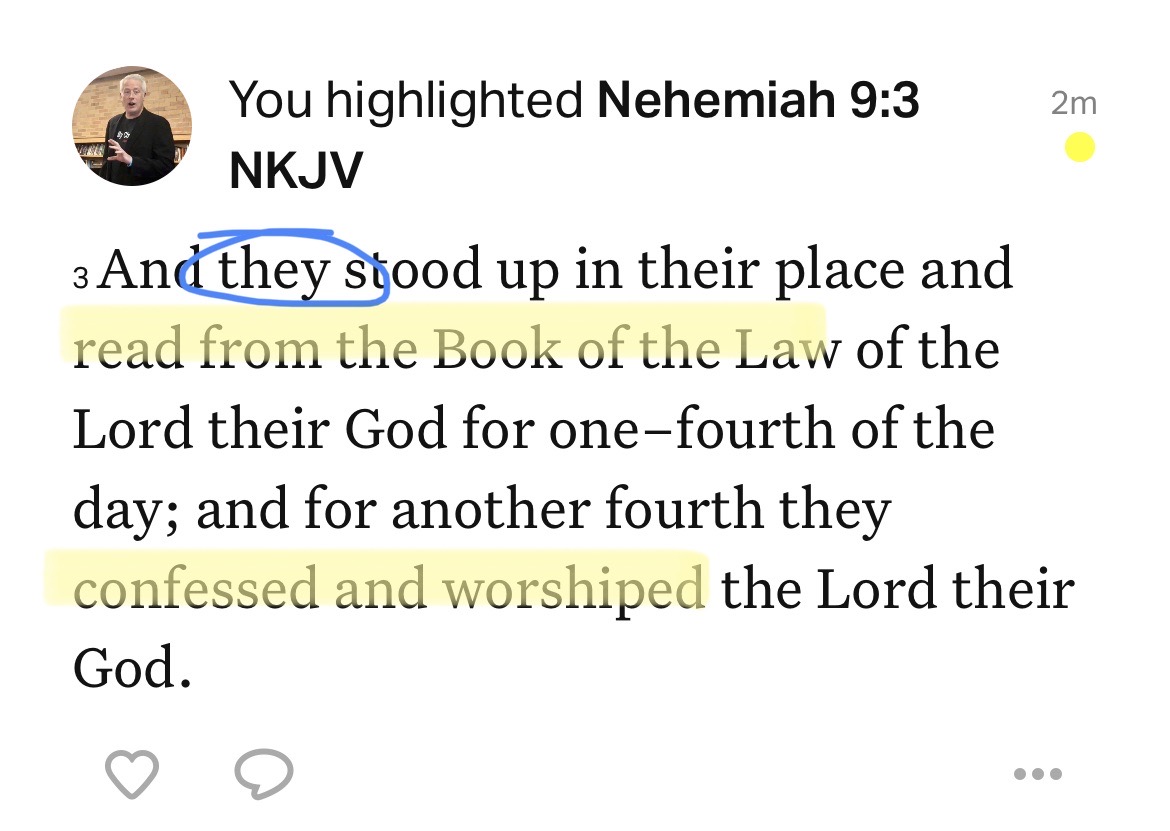
I want to give you some thoughts to take your Bible studies even deeper. Here are three strategies to make your Bible study time stickier—sticking in your heart and your mind.
And they stood up in their place and read from the Book of the Law of the Lord their God for one-fourth of the day; and for another fourth they confessed and worshiped the Lord their God. (Nehemiah 9:3)
I have three takeaways from this verse—
(1) When we read God’s Word, the Holy Spirit illuminates it to us. Confession and worship should be normal responses to the Word and the Spirit.
Listen to the podcast of this post by clicking on the player below, and you can also subscribe on Apple, Spotify, or Audible.
A meme that makes me chuckle every time I see it is a “quote” attributed to Abraham Lincoln in which he says, “The problem with quotes found on the internet is that they are often not true.”
(Not to spoil the joke for you, but unless Lincoln knew how to time travel to the future, I don’t think he knew about the modern internet! 😂)
I love this meme because it captures something that so many people fall into: a quick acceptance of a statement without verifying its source or thinking through the implications of the statement’s truthfulness.
Some insightful comments sound Shakespearean, but William never wrote them.
Some pieces of wisdom sound Socratic, but Socrates never taught them.
Some religious maxims sound godly, but the Bible never recorded them.
I would like to invite you to join me as we relaunch this series called Is That In The Bible? I think you may be surprised to discover just how many phrases we call biblical aren’t, and how many phrases there are that we never realized are actually in the Bible.
By the way, if you have a phrase that you would like to have us explore in this series, please leave it in a comment below. You may want to check out the questions we have already addressed:
Leaders should be able to use mistakes as growth opportunities. Check out these wise words from the book Spiritual Leadership.
I have lots of new content every week, which you can check out on my YouTube channel.
T.M. Moore encourages Christian to be ready to help their neighbors answer their burning questions: “Christians, Charles Taylor insists, must not be guilty of crushing human flourishing by a too-small vision of God and an unloving or unenergetic approach to our neighbors. Instead, we must study and prepare to ‘respond most profoundly and convincingly to what are ultimately commonly felt dilemmas.’ We must be ready to guide our neighbors out of the dark woods of wrong belief into the radiant meadows of the Sun of Righteousness, risen with healing in His wings. But to do this, we must be ready guides. We must anticipate the questions our groping neighbors will ask and prepare to answer them clearly and intelligently (1 Peter 3:15).”
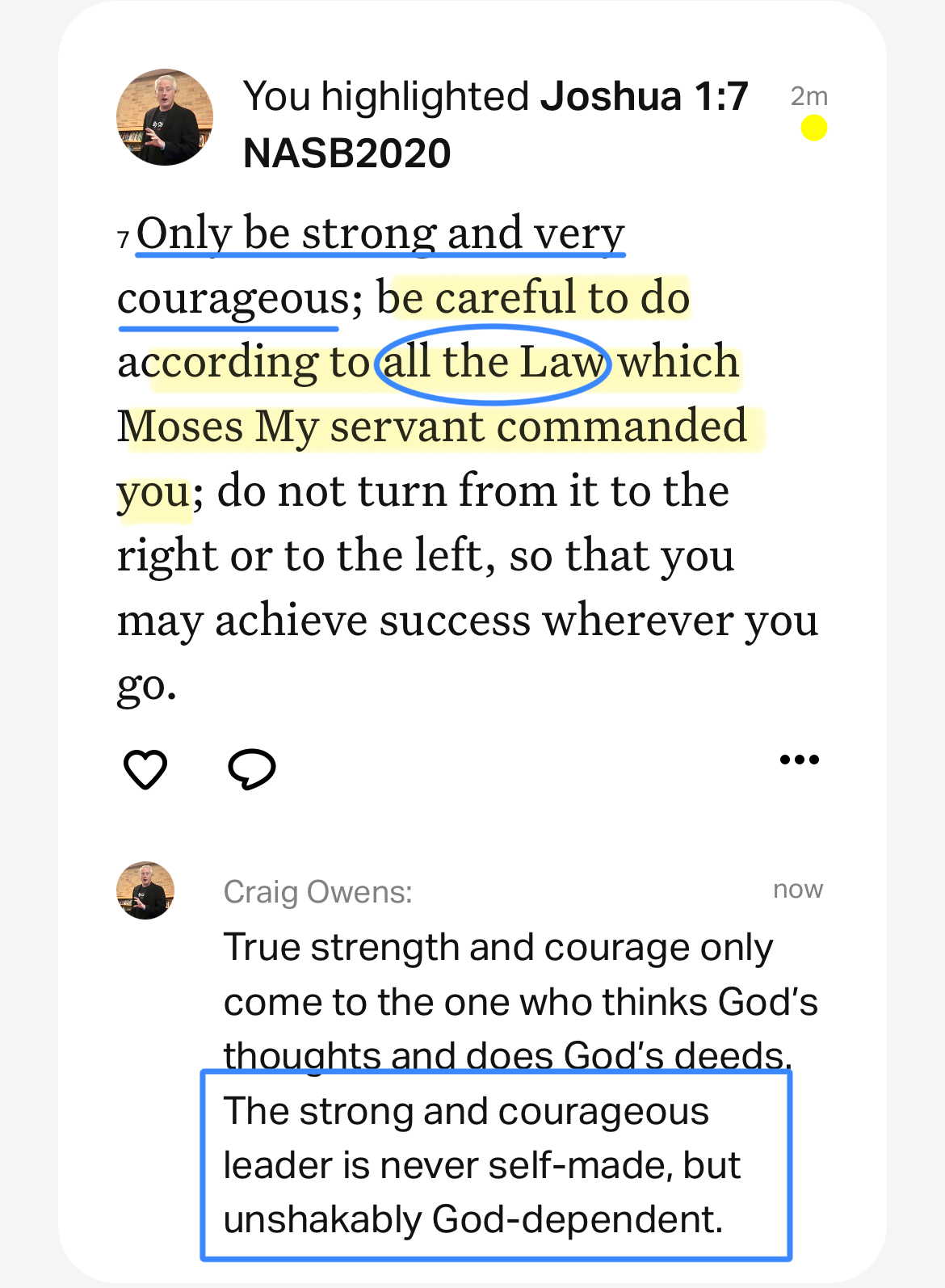
True strength and courage only come to the one who thinks God’s thoughts and does God’s deeds (see Joshua 1:7). The strong and courageous leader is never self-made, but unshakably God-dependent.
On the latest Craig and Greg Show podcast, this the quote from Andy Murray that I shared: “A great team begins to happen when you have the right people on the bus in the right seats and the bus breaks down…. They work through the crisis, they get back on the bus, they’re sweating and tired. All of the sudden something magical happens: They begin to talk to each other. Culture happens through crisis. Unfortunately, many team environments have structured the crisis out.”
Mabel Dean went to Egypt at 40 years old and stayed there for nearly 40 years without taking a single furlough! “All of Dean’s life, people did not expect her to amount to much. Despite what others said, Dean believed that she had a mandate from God for missions work in Africa. She later stated, ‘I was the only homely one in my family. Yet I was the one that He chose for His work.’”
One of the prayers in the Songs of Ascent calls us to mature (or ascend) in our prayers for those who have hurt us.
“There is always a better way of doing things, and either you or your competitor will find it.” —Brad Anderson
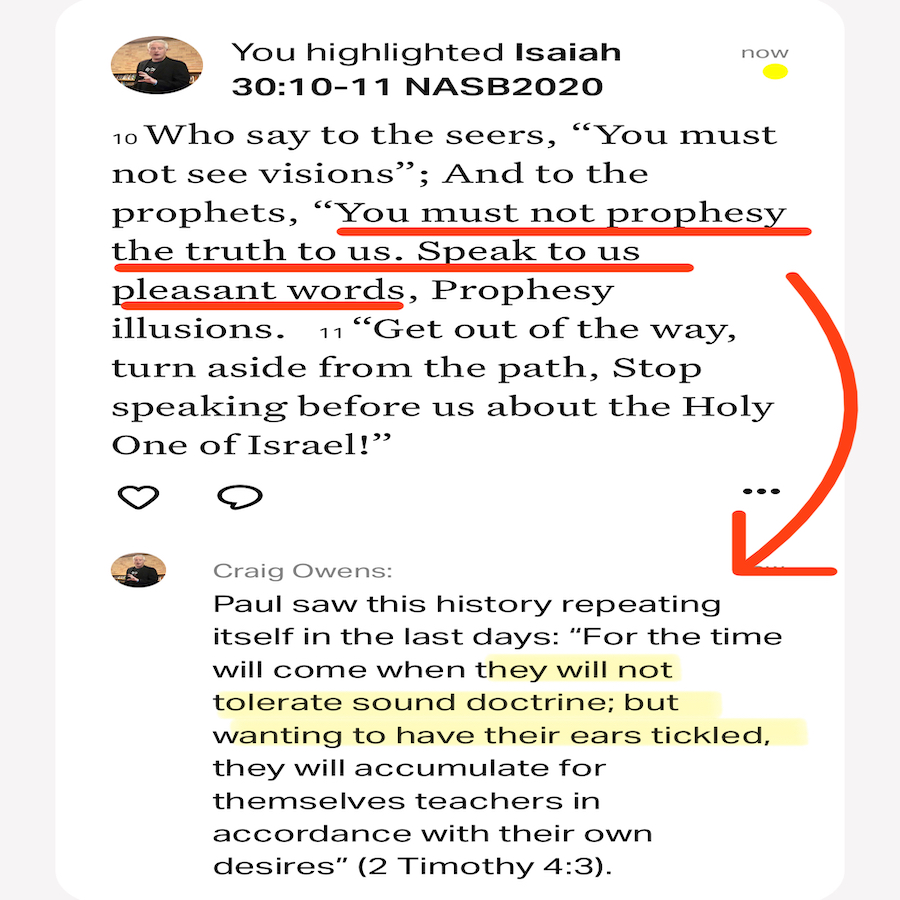
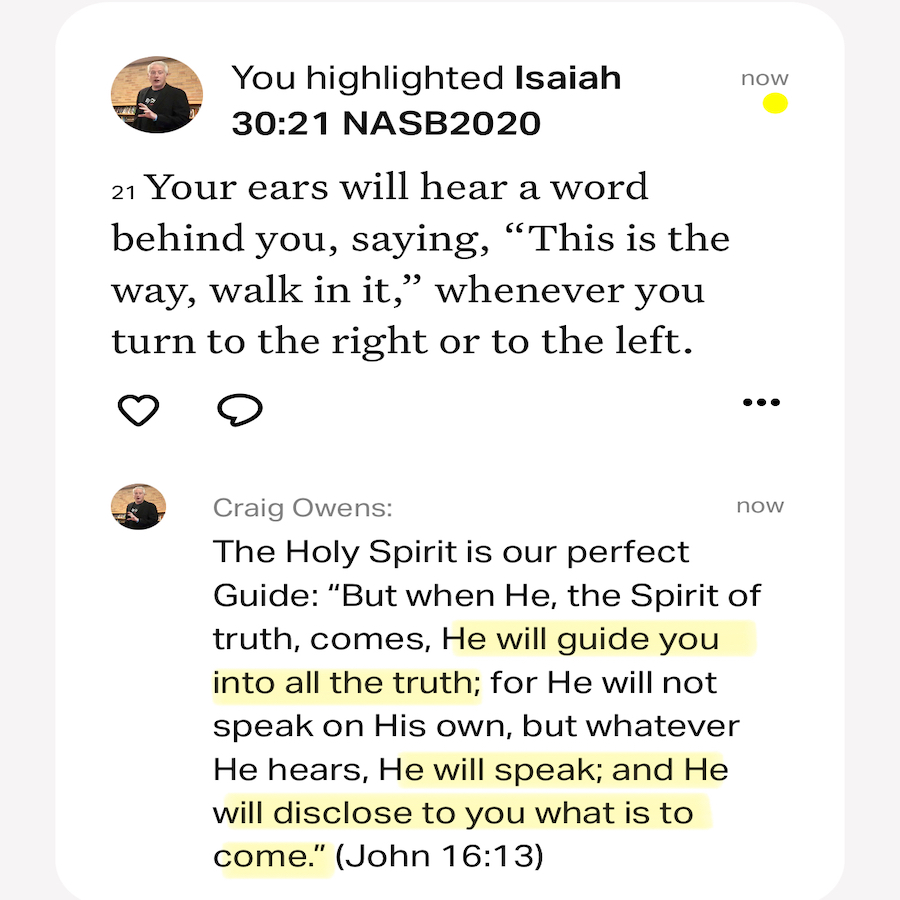
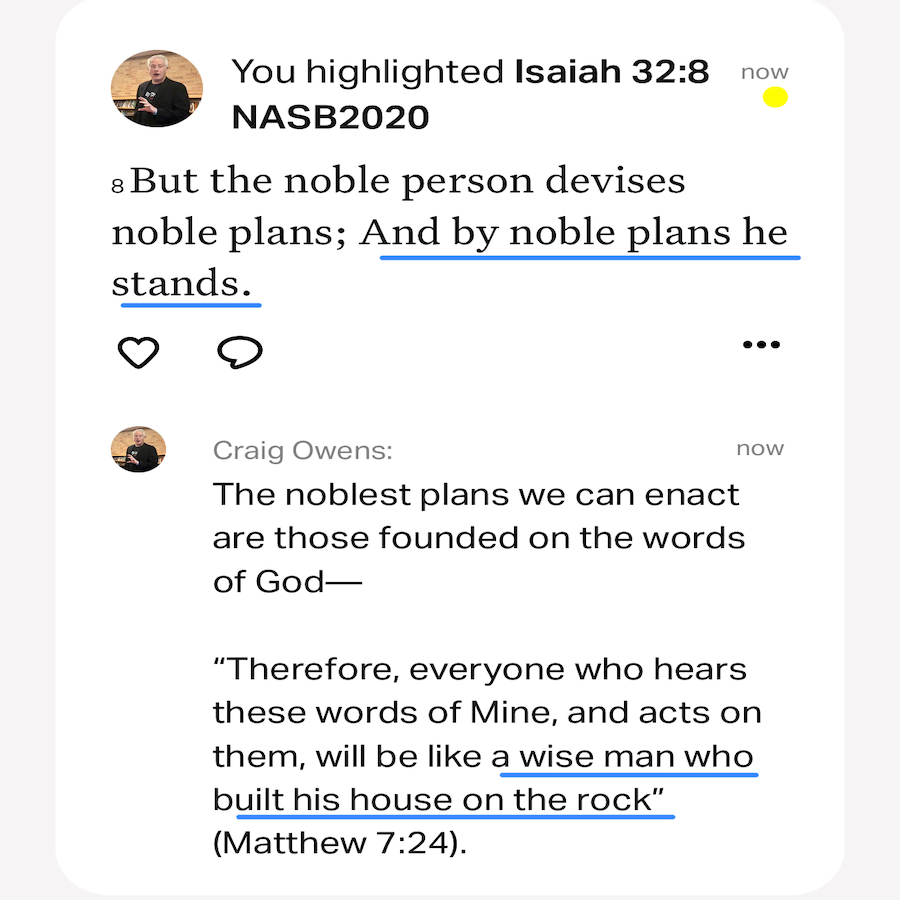
Something stood out to me quite clearly the other day as I highlighted several verses from Isaiah and was reminded of their complementary verses scattered throughout the New Testament. Always remember—









 Craig T. Owens