Set Up For Success (Or Failure)

Listen to the podcast of this post by clicking on the player below, and you can also subscribe on AppleSpotify, or Audible. 

Like it or not, your example as a leader is making an impact on all the people around you—including the next generation of leaders who will take their positions after you have passed away. 

So I have a simple question for you: Are you setting them up for success or failure? 

There is no middle ground. 

Consider three generation of kings of Judah—Hezekiah, Manasseh, and Amon. 

Hezekiah had been sick and God miraculously healed him. When Merodach-baladan, king of Babylon, heard about this, he sent envoys to see King Hezekiah. Instead of bragging on God, Hezekiah bragged about all of his riches. 

After the envoys left, the prophet Isaiah told Hezekiah the consequences of his pride

“Behold, the days are coming when everything that is in your house, and what your fathers have stored up to this day, will be carried to Babylon; nothing will be left,” says the Lord. “And some of your sons who will come from you, whom you will father, will be taken away, and they will become eunuchs in the palace of the king of Babylon.” (Isaiah 39:6-7) 

Sadly, Hezekiah responded, “At least it won’t impact me.” 

A mark of a godly leader is one who desires to set up future leaders for success. 

His son Manasseh became one of the most evil, godless kings that Judah had ever known. And as a result, he experienced the punishment that Isaiah had prophesied. 

Thankfully, Manasseh eventually humbled himself, repented of his sin, and got to experience God’s restoration to a small degree—

When he was in distress, he appeased the Lord his God and humbled himself greatly before the God of his fathers. When he prayed to Him, He was moved by him and heard his pleading, and brought him back to Jerusalem to his kingdom. Then Manasseh knew that the Lord alone is God. (2 Chronicles 33:12-13) 
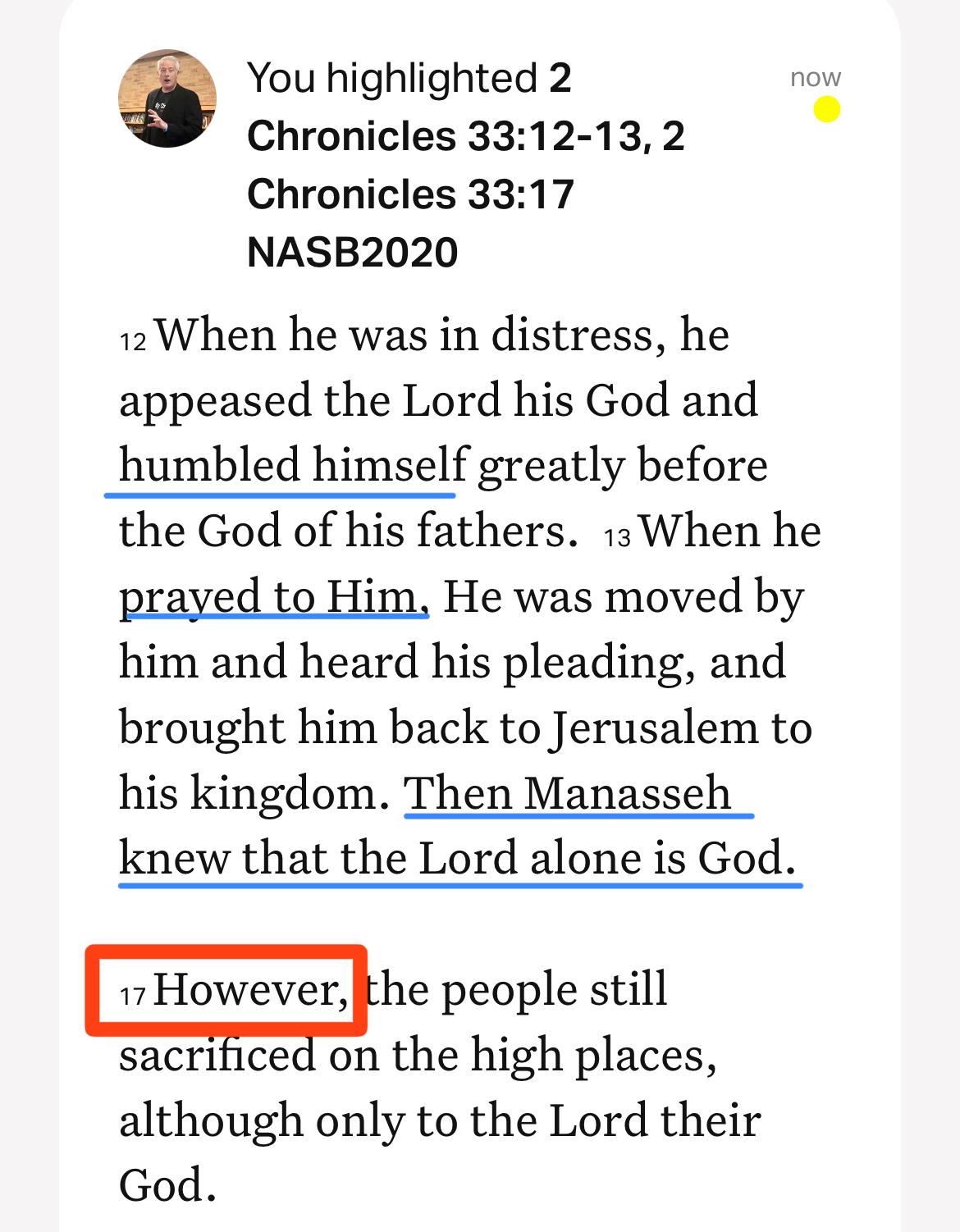
But there is a sad “however” for Manasseh’s son Amon: However, the people still sacrificed on the high places (2 Chronicles 33:17). This mixing of the worship of God with the worship of pagan idols always pulls people away from God. It certainly did that for Amon because “he did evil in the sight of the Lord, just as his father Manasseh had done. For he walked entirely in the way that his father had walked, and served the idols that his father had served, and worshiped them” (2 Kings 21:20-21). “Furthermore, he did not humble himself before the Lord as his father Manasseh had done, but Amon multiplied his guilt” (2 Chronicles 33:23). 

Godly leaders should be just as concerned about the people that come after them as they are about the people around them now. Godly leaders strive to set up future generations for success—so they can receive God’s continued and increased blessings.

This is part 78 in my series on godly leadership. You can check out all of my posts in this series by clicking here.

►► Would you please prayerfully consider supporting this ministry? My Patreon supporters get behind-the-scenes access to exclusive materials. ◀︎◀︎

Beware Of Pride!

Now [Uzziah] went out and fought against the Philistines, and broke down the wall of Gath, the wall of Jabneh, and the wall of Ashdod; and he built cities in the area of Ashdod and among the Philistines. God helped him against the Philistines.… Under their direction was an army of 307,500, who could wage war with great power, to help the king against the enemy. Moreover, Uzziah prepared for all the army shields, spears, helmets, body armor, bows, and slingstones. In Jerusalem he made machines of war invented by skillful workmen to be on the towers and the corners, for the purpose of shooting arrows and great stones. So his fame spread far, for he was marvelously helped until he was strong. But when he became strong, his heart was so proud that he acted corruptly, and he was untrue to the Lord his God, for he entered the temple of the Lord to burn incense on the altar of incense. (2 Chronicles 26:6-7, 13-16) 

King Uzziah became intoxicated by his success, forgetting that God had made him successful. In his pride, he tried to elevate himself into a position that was not intended for him. 

This sounds just like the actions of Lucifer, who was also corrupted by his pride and tried to make himself God. 

⚠️  BEWARE OF PRIDE! ⚠️

Check out some related posts: 

Links & Quotes

There’s no secret formula to fruitfulness as a Christian. We just stay connected to Jesus and the fruit will grow. This clip is from this sermon.

I have lots of new content every week, which you can check out on my YouTube channel.

The “Ten Commandments” are not explicitly listed or reiterated in the New Testament. Does that mean they are obsolete? No, says David Mathis, it means they are fulfilled. “Jesus Himself says He did not come to destroy the Law and Prophets, but to do something even more striking: fulfill them (Matthew 5:17). That is, fulfill like prophecy. Not simply keep the Ten in place, or remain under them, or leave them untouched, but fulfill them—first in His own person, and then by His Spirit in His church. He came not to cast off Moses, but to fulfill Jeremiah, and in doing so, He accomplished what is even more radical: establishing Himself as the supreme authority, putting God’s law within His people (rather than on tablets), writing it on their hearts (rather than stone), and making all His people to know Him (Jeremiah 31:31–34).” Check out my post The 10 Commandments in the New Testament.

More archeological evidence supporting to the historicity of the Bible. You can check out the full article, but this paragraph is a good summation: “One of the surprising findings was that, according to the results of their tests, the Broad Wall in Jerusalem, also known as Hezekiah’s Wall, was likely built during the reign of Uzziah, who Scripture says built fortifications in Jerusalem (2 Chronicles 26:9). Another finding was that Jerusalem was much more heavily populated and urbanized in the 12th through 10th centuries BC than some scholars previously thought. This would align with the biblical description of Jerusalem, particularly during the days of David and Solomon.”

“There is much of beauty, goodness, and truth to be discovered in the city of man, as Augustine pointed out toward the end of his great treatise, City of God. But all the culture and best intentions of men turn to corruption apart from the power of God to redeem and renew them. We who live also in the heavenly city now possess the mind of Christ (1 Corinthians 2:16); we are able to see the ways that culture can be ‘taken captive’ from the clutches of sin and unbelief and made to serve the purposes of Christ in all things. Thus, for the honor and glory of God, we commit ourselves daily to using all our time, activities, relationships, roles, responsibilities, and culture to furthering His rule on earth as it is in heaven.” —T.M. Moore

“Have movies and most conventional paleontologists got it all wrong? T. rex and other theropod dinosaurs (the meat-eaters) are often portrayed as intelligent predators that can outmuscle and outsmart their opponents. But is that really supported by science?” A very interesting compilation of research can be found here. The conclusion is exactly right: “God designed dinosaur brains that were perfectly suited for their lifestyles and body size when He created dinosaurs on Day 6 of the creation week (Genesis 1:25).” 

God’s Strong Support

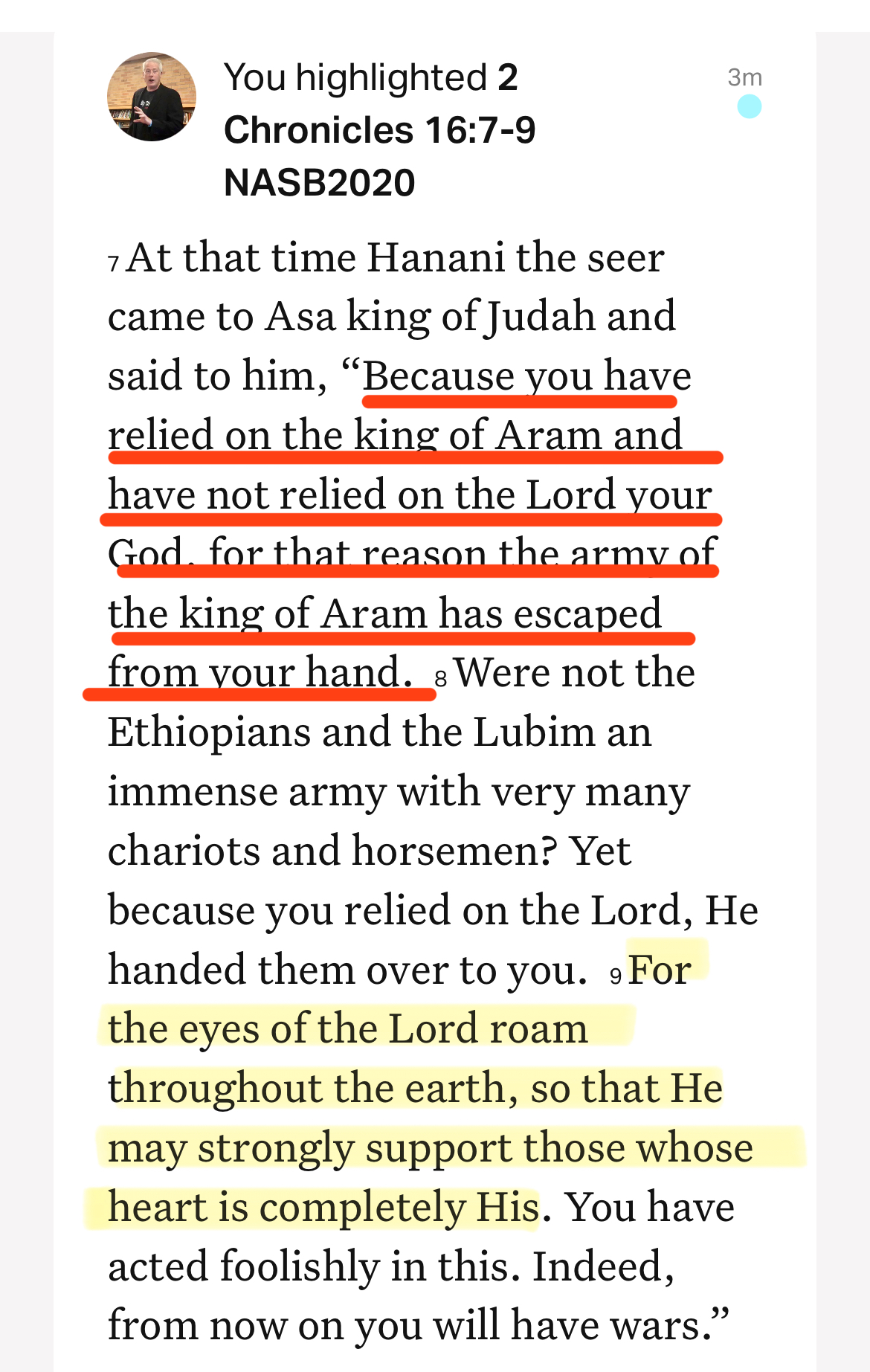
At that time Hanani the seer came to Asa king of Judah and said to him, “Because you have relied on the king of Aram and have not relied on the Lord your God, for that reason the army of the king of Aram has escaped from your hand. Were not the Ethiopians and the Lubim an immense army with very many chariots and horsemen? Yet because you relied on the Lord, He handed them over to you. For the eyes of the Lord roam throughout the earth, so that He may strongly support those whose heart is completely His. You have acted foolishly in this. Indeed, from now on you will have wars.” (2 Chronicles 16:7-9) 

Asa had trusted God to help him against a much more formidable army (see 2 Chronicles 14:9-15), but he now tries to deal with Baasha on his own. One of the lies the devil gets us to believe goes like this, “Don’t trouble God with the little stuff. After all, God helps those who help themselves.” 

The truth is, God helps those who admit that they cannot help themselves. 

God is called our ever-present help—He wants us to turn to Him as our first response in every situation. 

I talk more about King Asa in one of my godly leadership posts called Finishing Well is Better. And you may also be interested in a related post Does Self-Help Get God’s Help?

Gratitude Is A Sword

Listen to the podcast of this post by clicking on the player below, and you can also subscribe on AppleSpotify, or Audible. 

It would be nice if complainers were satisfied just complaining to themselves, but they’re not. Do you know the cliché misery loves company? It’s just as true for complainers: They really want others to join them in their bellyaching! 

I think a good word for what these negative people do is ambush. The dictionary says that means to lie in wait with hostile intent. Jesus told His followers that this ambushing behavior was going to happen. In Luke 6:22, He uses the word “when” not “if”—

Blessed are you when people hate you, when they exclude you and insult you and reject your name as evil, because of the Son of Man. 

We see this vividly portrayed in the life of Daniel. This man had done nothing but helpful things since the moment he arrived in Babylon. He faithfully served foreign kings, never wanted any recognition for himself, saved lives, interpreted dreams, and explained confusing things. He had a great work ethic and impeccable integrity. But the complainers still wanted to ambush him (see Daniel 6:1-5). 

One psalmist described these ambushers in terms of a hunting lion: His mouth is full of lies and threats; trouble and evil are under his tongue. He lies in wait near the villages; from ambush he murders the innocent. His eyes watch in secret for his victims (Psalm 10:7-8). 

Doesn’t this sound like what the devil does too? Be alert and of sober mind. Your enemy the devil prowls around like a roaring lion looking for someone to devour (1 Peter 5:8). 

I already shared with you that gratitude is our shield for defense, but the Bible tells us that gratitude is also our sword for offense! 

Jerusalem was surrounded by three armies that were lying in wait to ambush the Israelites. After God told the people of Jerusalem that He would deliver them, King Jehoshaphat sent out his army with the worshippers at the front of the ranks. Then listen to how worship not only thwarted the ambushers but boomeranged their evil plans back on themselves—

As they began to sing and praise, the Lord set ambushes against the men of Ammon and Moab and Mount Seir who were invading Judah, and they were defeated. The Ammonites and Moabites rose up against the men from Mount Seir to destroy and annihilate them. After they finished slaughtering the men from Seir, they helped to destroy one another. (2 Chronicles 20:22-23) 

When we worship God and sing our grateful praise to Him, we put the sword of God in our mouths. And there isn’t a more effective sword against the darkness than the (S)Word of God (Hebrews 4:12; Revelation 1:16; Ephesians 6:17)! 

Paul told the church at Colosse that singing our praise to God with other saints was an encouragement to all who heard those worshipful songs (Colossians 3:15-17). 

So when the ambushers are surrounding you, use your thankful songs as a shield, as a sword, and as an encouragement to others! 

If you’ve missed any of the other messages in our series The Great Attitude of Gratitude, you can find them all here.

►► Would you please prayerfully consider supporting this ministry? My Patreon supporters get behind-the-scenes access to exclusive materials. ◀︎◀︎

Don’t Fight Fire With Fire

Listen to the podcast of this post by clicking on the player below, and you can also subscribe on AppleSpotify, or Audible. 

The events in the Bible are rooted in history. These are actual events in which real people lived in a moment in recorded history. The songs of ascent were sung both pre-exile and post-exile. The post-exile pilgrims were returning to Jerusalem after the edict of King Cyrus (2 Chronicles 36:22-23). 

The first pilgrims to go up to Jerusalem after the exile were the rebuilders of both Jerusalem and the temple, and they faced heavy opposition (Ezra 4:1-5; Nehemiah 4:1-3, 7-8). In light of these events, I think the song of ascent in Psalm 125 is especially pertinent to this situation. 

The middle verse of Psalm 125 contains a warning to godly people. God’s followers may be tempted to grab earthly political power to try to make things right—to “fight fire with fire.” The phrase “the scepter of the wicked” symbolizes the royal authority of a foreign conqueror. In other words, we might justify using the scepter of the wicked because we think “the ends justify the means.” But notice the warning if we do: “the righteous might use their hands to do evil.” 

You can see this in a couple of other biblical translations. The Amplified Bible says, “lest the righteous (God’s people) stretch forth their hands to iniquity and apostasy,” and the New Living Translation says, “the godly might be tempted to do wrong.” 

Instead, we are called to look to God for our security. Psalm 125:1-2 sounds like an echo of Psalm 121, in which we are reminded that our God is unshakable, unrivaled, and eternal. Political parties come and go, even evil dictators and tyrannical regimes come and go, but the Sovereign God remains forever. All of History is His story! 

Chuck Colson used to frequently remind his audiences, “Salvation does not arrive on Air Force One!” 

The motto on our US currency is still accurate: In God we trust! Psalm 125:4 says the same thing: God does good to those who trust Him. 

Earlier I mentioned the opposition that Ezra and Nehemiah recorded. Let me also share with you how these God-fearing men instructed the Jewish people to respond. Ezra says that the prophets called them to remember “the name of the God of Israel, who was over them,” and three times Nehemiah records that their response was prayer to God (Ezra 5:1; Nehemiah 4:4, 9; 6:9). 

In God we trust, not in political power. On the flip side, Psalm 125:5 warns us that God treats as evildoers those who look to the worldly scepter to try to get ahead. 

So when opposition and even persecution come, we should pray to God and ask for Him to remove the scepter of the wicked. Let’s pray for God to put His favor in the hearts of even ungodly leaders. Ezra recognized this when he said—

Praise be to the Lord, the God of our ancestors, who has put it into the king’s heart to bring honor to the house of the Lord in Jerusalem in this way and who has extended His good favor to me before the king and his advisers and all the king’s powerful officials. Because the hand of the Lord my God was on me, I took courage and gathered leaders from Israel to go up with me. (Ezra 7:27-28)

The New Testament calls on Christians to pray for those in governmental leadership over us (1 Timothy 2:1-2). But perhpas you ask, “What exactly are we to pray for these leaders?” Solomon wrote, “The king’s heart is like channels of water in the hand of the Lord; He turns it wherever He wishes” (Proverbs 21:1). So perhaps a God-honoring prayer is to ask for our leaders’ hearts to be moved as King Cyrus’ heart was. 

Commenting on this verse from Proverbs 21, Dick Brogden wrote:

“God is King of kings and ultimately always wins, always gets His way. Even when it seems that earthly authorities continually rebel against the Lord and His Anointed, the reality is that even their most heinous acts are turned against them. It must be very frustrating to be the devil and to constantly see how God turns situations to gospel good and God’s unique glory. God is so wise that He turns the hearts of authorities without them knowing it. Smug on their decaying thrones, the power brokers of this world revel in their supposed autonomy and imagined resistance, never realizing how foolish they look to the angel hosts who are privy to God’s unmatched strategic dominance.”

Let’s never try to fight fire with fire, but let’s turn repeatedly to God in prayer whenever opposition arises against God-fearing people anywhere. 

If you’ve missed any of the messages in our Ascending series, you can find all of the previous messages here. 

►► Would you please prayerfully consider supporting this ministry? My Patreon supporters get behind-the-scenes access to exclusive materials. ◀︎◀︎

Worth The Effort

Listen to the podcast of this post by clicking on the player below, and you can also subscribe on AppleSpotify, or Audible. 

The Bible is not only the inspired Word of God but it is rooted in history too. Every prayer was prayed by a real person in distress, and every song of praise was lifted up by someone who personally experienced God’s deliverance. 

The reason why this is so important is that it makes God’s Word relatable and applicable to us. If the Bible merely contained moral stories set in some make-believe world, we may have a hard time seeing how to apply the principles to our daily lives. But, thankfully, this isn’t the case. We can read the real-life experiences of real historical people and then we can allow the Holy Spirit to help us apply this inspired Word to our lives. 

There is a collection of 15 songs in the Book of Psalms called “The Songs of Ascent.” Even these songs have an important historical background. 

The books of Kings and Chronicles tell the sad history of Israel and Judah sliding farther and farther away from God until finally, God must punish them. He punishes Judah by bringing King Nebuchadnezzar against them, who destroyed the temple at Jerusalem and carried the people into exile in Babylon. But even as they are being taken away, God speaks a prophetic word through Jeremiah that in 70 years He will raise up another leader, Cyrus king of the Persians, who will allow the exiles to return home. You can read all of these historical accounts in 2 Chronicles 36:15-23; Jeremiah 29:10-14; and Isaiah 44:28-45:6. 

Second Chronicles ends with this proclamation from King Cyrus: “The Lord, the God of heaven, has given me all the kingdoms of the earth and He has appointed me to build a temple for Him at Jerusalem in Judah. Anyone of His people among you—may the Lord his God be with him, and let him go up” (2 Chronicles 26:23). 

The phrase “let him go up” is both literal (since Jerusalem is 2500 feet above sea level) and spiritual. Listen to these words from King Solomon, “The way of life winds upward for the wise, that he may turn away from hell below” (Proverbs 15:24 NKJV). 

The Songs of Ascent were a rallying cry—an encouragement to all pilgrims to keep climbing up. 

In Hebrew literature, the main point is usually found in the middle of the poem or story, unlike our Western literature which puts the payoff at the end. In the first Song of Ascent, the middle is verse 4. But the second half of Psalm 120 seems out of place for people ascending up to Jerusalem to worship God. Verse 5 begins with the words, “Woe to me.” 

The psalmist is expressing his pain in living among the people of Meshech and Kedar. The people of Meshech were vicious people who traded human lives for money and who conducted themselves as terrorists (Ezekiel 27:13; 32:26). Their name literally means “drawing away.” The people of Kedar were nomadic sons of Ishmael. Being nomadic means they were never at rest. Their name literally means “dark place.” Very noteworthy is that there is no mention of God in verses 5-7.  

The middle verse of this song (v. 4) turns the people of Meshech and Kedar over to God. It is a reminder that we are not the ones to dispense justice. If God knew how to overthrow the powerful kingdoms of Judah, Babylon, and the Medes, if He knew to call Cyrus by name at just the right moment, He also knows how to deal with these sinners. 

This Song of Ascent shows the stark contrast between keeping our eyes on the dark culture around us versus keeping our eyes on the God who is never weighed down by the darkness. As we go higher up, we focus more on God; as His saints focus on Him, His light shines on them; as His light shines on them, they point sinners living in dark valleys to the God of light and love. 

Staying down is easy. Getting up requires intentional effort. Going up requires us to overcome the pull of sin and the frustration of watching for judgment to fall on sinners. 

Continually going up glorifies God, has eternal rewards for saints, and creates a compelling testimony for sinners.

Going up is a lot of effort, but the rewards are so worth it! As the apostle Paul reminded his friends in Rome, “I consider that our present sufferings are not worth comparing with the glory that will be revealed in us” (Romans 8:18). Let’s keep climbing up and let’s keep lifting our eyes to the only One who has the eternal light. 

If you’ve missed any of the messages in our look at the Songs of Ascent, you can find them all here. 

►► Would you please prayerfully consider supporting this ministry? My Patreon supporters get behind-the-scenes access to exclusive materials. ◀︎◀︎
Created To Crave God

Listen to the podcast of this post by clicking on the player below, and you can also subscribe on AppleSpotify, or Audible. 

I was playing golf with a pastor and a missionary when the starter asked if a single player could join us to make a foursome. We happily agreed. About 4-5 holes into our game, our guest asked what we did. My pastor friend started out, “I’m a pastor, and this guy is a missionary, and—” 

Our guest interrupted and blurted out, “You guys are Christians?! I’ve never had so much fun! I always heard Christians were boring.” 

When did it come about that people thought of Christians as boring—or even worse, as sourpusses and killjoys? Sadly, too many Christians have helped cement this idea in people’s minds. I think this is largely because those Christians are misinformed and frustrated. This frustration, I believe, comes from the mistaken idea that Christians are supposed to squelch any urges or cravings that we have.  

But check out this Q&A from the Westminster Catechism—

Q: What is the chief end of man? 

A: To glorify God and to enjoy Him forever. 

Glorifying God is supposed to result in enjoyment—enjoying both God’s presence and the life He has given us. We are created to crave the fuel of His Spirit that satisfies and energizes us. 

Just as your car would at best under-perform if you attempted to run it with anything else but gasoline, so our lives will under-perform and feel like drudgery if we are trying to fuel our cravings with anything other than God. 

The dictionary defines “craving” as a great or eager desire, or a yearning. But I believe the Bible defines God-honoring craving as the longing for an intimate relationship with God that is implanted by God Himself. 

The people of Judah had gone astray from God and were trying to satisfy their urges with foreign gods and pagan idolatry. When King Asa called these backsliders back to God, here’s how he did it—

[Asa] commanded Judah to seek the Lord, the God of their fathers—to inquire of and for Him and crave Him as a vital necessity—and to obey the law and the commandment. (2 Chronicles 14:4 AMP) 

Contrast this with the temporary cravings of earth—

But those who crave to be rich fall into temptation and a snare and into many foolish, useless, godless, and hurtful desires… (1 Timothy 6:9 AMP) 

This world is fading away, along with everything that people crave. But anyone who does what pleases God will live forever (1 John 2:17 NLT). 

Nowhere are godly cravings and earthly cravings better contrasted than in James 4:1-6. 

In this passage, the Greek word for desires (v. 1) and pleasures (v. 3) is hedone. This is where we get our English word “hedonism.” There is nothing wrong with pleasure—for God Himself takes pleasure—but it’s what pleasures we are craving that can make them ungodly. James rightly points out that the wrong hedonism is a craving to fulfill “your desires,” “your pleasures,” and to desire “friendship with the world” (v. 1, 3, 4)

Jesus talked about worldly cravings—using the same word hedone—when He said, “The seed that fell among thorns stands for those who hear, but as they go on their way they are choked by life’s worries, riches and pleasures [hedone], and they do not mature” (Luke 8:14). 

Notice the same thing in Isaiah 58:2 where God declares that people “seem eager” to delight in God, but it’s only a show for them to satisfy fleshly cravings. John Piper noted, “God means they are delighting in their business and not in the beauty of their God. He does not rebuke their hedonism. He rebukes the weakness of it. They have settled for secular interests and thus honor them above the Lord.” 

Instead, notice the fulfilled cravings when we seek God: “If you keep your feet from breaking the Sabbath and from doing as you please on My holy day, if you call the Sabbath a delight and the Lord’s holy day honorable, and if you honor it by not going your own way and not doing as you please or speaking idle words, then you will find your joy in the Lord, and I will cause you to ride in triumph on the heights of the land and to feast on the inheritance of your father Jacob. For the mouth of the Lord has spoken” (Isaiah 58:13-14). 

I like that reminder that “the mouth of the Lord has spoken.” The origin of the word craving is the Old Norse word krefja, which means to lay claim on something because of a promise. God has promised, and so we can claim it. 

James assures us that the spirit God implanted in us envies intensely (James 4:5). We were made to crave God’s presence, we were made to find ultimate satisfaction in His presence, we were made to find eternal delight in knowing Him more intimately! 

The proud person says, “God, I know what I want. Give it to me.” The humble person says, “God, I know Your presence is the only thing that will satisfy me. Give it to me.” 

The craving in our spirit can be redirected from earthly yearnings to God-honoring yearnings by yielding to the Holy Spirit. I would humbly suggest that our prayer should be something like this—

“Father, grant that my cravings are for Your name to be hallowed, Your kingdom to be made visible, and Your will to be done. Let the enjoyment I have in Your presence shine out of me in a way that invites others to be dissatisfied with their earthly cravings and find their ultimate satisfaction in a personal relationship with You through Jesus Christ. Holy Spirit, continue to refine and redirect all of my cravings away from earthly things to eternal pleasures. In Jesus’ name I pray, Amen.” 

If you would like to follow along with all of the messages in this series called Craving, you can find all of the sermons by clicking here. 

►► Would you please prayerfully consider supporting this ministry? My Patreon supporters get behind-the-scenes access to exclusive materials. ◀︎◀︎
Thursdays With Spurgeon—God Our Healer

This is a weekly series with things I’m reading and pondering from Charles Spurgeon. You can read the original seed thought here, or type “Thursdays With Spurgeon” in the search box to read more entries.

Listen to the podcast of this post by clicking on the player below, and you can also subscribe on AppleSpotify, or Audible. 

God Our Healer

O Lord my God, I cried out to You, and You healed me. O Lord, You brought my soul up from the grave; You have kept me alive, that I should not go down to the pit. (Psalm 30:2-3) 

     God is the best Physician, even for our bodily infirmities. We do very wickedly and foolishly when we forget God. It was a sin in Asa that he trusted physicians and not God (2 Chronicles 16:12). If we must have a physician, let it be so, but still let us go to our God first of all. And above all remember that there can be no power to heal in medicine of itself; the healing energy must flow from the divine hand. …

     If our watch is out of order, we take it to the watchmaker; if our bodies or souls are in an evil plight, let us resort to Him who created them, who has unfailing skill to put them in right condition. As for our spiritual diseases, nothing can heal these evils but the touch of the Lord Christ: if we do but touch the hem of His garment, we shall be made whole….

From Spurgeon And The Psalms

God has created us as a soul with a body. I believe that physical ailments can be attended to by a medical doctor, emotional distress should be addressed by a counselor, and spiritual issues should have the wisdom of a pastor. 

But let’s always remember that since God created our body, soul, and spirit, He is the Ultimate Source of wisdom for any areas that are out of alignment. So as Spurgeon says, seek out a doctor, counselor, or pastor, but go to God first. 

God may bring divine healing that requires no other intervention, or He may heal through medicine or counseling, but ultimately He is THE Healer.

►► Would you please prayerfully consider supporting this ministry? My Patreon supporters get behind-the-scenes access to exclusive materials. ◀︎◀︎

Halfway Leaders Become Evil Leaders

Listen to the podcast of this post by clicking on the player below, and you can also subscribe on Apple or Spotify.

Amaziah did what was right in the eyes of the Lord, but not wholeheartedly (2 Chronicles 25:2).

Notice the contradictions in Amaziah’s life and leadership: 

obeyed God’s law (v. 4)
🚫disobeyed God’s law (v. 14)

trusted that God would give success to the army of Judah (v. 5)
🚫supplemented his army with mercenaries from Israel (v. 6)

listened to the prophet God sent to him (vv. 7-10)
🚫ignored the prophet God sent to him (vv. 15-16)

trusted God (vv. 9-10)
🚫turned to idols (v. 14)

Sadly, the “not wholeheartedly” leader usually ends up just like other leaders that God calls “evil” (vv. 22-24, 27). 

Bottom line: there is no such thing as a halfway leader in God’s eyes. There is only following God or rebelling against God—all leaders must choose one or the other.

A mark of a godly leader is one who consistently chooses to follow God wholeheartedly.

This is part 55 in my series on godly leadership. You can check out all of my posts in this series by clicking here.

►► Would you please prayerfully consider supporting this ministry? ◀︎◀︎