Listen to the audio-only version of this podcast by clicking on the player below, or scroll down to watch the video.
Automatic habits are an integral part of our everyday lives. From driving a car to the way we tie our shoes, these habits help us all the time with very little thought. Of course, habits aren’t limited to these mundane tasks, we also form them in other areas, like our leadership. As a leader, it’s important to be self-reflective of our habits and make sure they are taking us in the direction we want to go. In this episode, Greg and I discuss how cultivating the right habits will help you flourish as a leader.
[0:19] Aristotle said excellence is a matter of our habits.
[1:27] Our habits are mostly automatic—both the good and the bad habits.
[3:10] How do we keep our habits healthy during chaotic times?
[5:54] What about coping habits—should a leader use them or avoid them?
[7:15] My most beneficial leadership habit.
[9:13] Time-wasters are habits too.
[10:37] When we make changes in our habits, they should be incremental changes.
[12:17] We need to know why we want to make the change in a habit. The “why” determines the “what” and the “how.”
[15:24] How do leaders sustain their healthy habits?
[16:33] How can leaders regain their list momentum of good habits?
[19:27] Leaders need to be aware of the pull of their unintentional habits.
[22:23] How do we get our habits to serve us?
[23:30] I share two vital habits all high-performing leaders need.
[24:56] Leaders need to develop “muscle memory” to keep their healthy habits serving them.
[26:27] Greg shares some important quotes about a leader’s habits.
Check out this episode and subscribe on YouTube so you can watch all of the upcoming episodes. You can also listen to our podcast on Spotify and Apple.
Listen to the podcast of this post by clicking on the player below, and you can also subscribe on Apple, Spotify, or Audible.
I know you want to lash out against those evil people who come at you—just to say something that will “put them in their place.”
I get it. I feel like that at times too.
But pause.
Think about the last rain storm that came your way. The rain beat down on your roof and the wind blew against the walls of your house. You knew that there was no reason to yell at the rain because you were safe in your house. You also knew that yelling at the wind and the rain wouldn’t do a thing to it.
Therefore everyone who hears these words of Mine and acts on them, may be compared to a wise man who built his house on the rock. And the rain fell, and the floods came, and the winds blew and slammed against that house; and yet it did not fall, for it had been founded on the rock. (Matthew 7:24-25)
When you abide in Jesus—when His words are the foundation of your life—you are safe and secure. There is no reason to fret about the breath of the ruthless, there is no reason to lash out at them. In fact, there might not be any reason to speak to them at all.
Let the evildoers rage, but you can save your breath. Instead of using your breath to respond to their howling words, use your breath to praise the One who holds you securely forever!
Listen to the podcast of this post by clicking on the player below, and you can also subscribe on Apple, Spotify, or Audible.
Last week I challenged you to free up some time in your schedule so that you could begin to apply these six spiritual disciplines we are going to discuss.
Let’s keep in mind why we are learning and working on these disciplines. The key phrase is “so that”: I’m going to get stronger so that I have something to give to others, so that they will have something to give to others (and to me), and on and on it goes. Each of us needs all of us, and all of us need each of us!
I love to read. In fact, I’m usually reading several books at the same time. Without a close second, my favorite book is my Bible. I say “my Bible” because I’ve made it mine—it’s underlined, circled, notated, and marked. It’s the Book I’m in every day, and it’s the Book that helps me glean the best knowledge from all the other books I read.
G.K. Chesterton, the famous British writer, was once invited to a meeting of the leading intellectuals in England. They were discussing what one book they would want to have with them if they were shipwrecked on an island. Everybody expected Chesterton to say, “My Bible.” But when it came to his turn to speak, Chesterton said, “If I were shipwrecked on a desert island, I’d like to have Thomas’s Guide to Practical Shipbuilding.”
Chesterton wasn’t saying the Bible wouldn’t have been of benefit to him on that island, but he was saying that those who study the Bible have the most practical insights! The Bible doesn’t just have lofty ideas, but it gives us heavenly wisdom that is highly practical to our everyday lives.
The first spiritual discipline we are considering in our series Saints Together is: Studying our Bible. Notice I didn’t say just to read the Bible, but to really study the Book of books.
The apostle Paul wrote, “So then faith comes by hearing, and hearing by the Word of God” (Romans 10:17). How do we know our faith is growing? It must be tested. Look at what James had to say about growing our faith—“the testing of your faith produces perseverance” (James 1:3).
Testing really comes down to this: Does what I believe work in my everyday life? Can I truly put what the Bible teaches me into action? James went a little deeper with this in James 2:17-19.
Allow me to share four indispensable components of our Bible study time. You will notice that for all of these components, I am giving you verses from the 119th chapter of the Psalms. This single chapter mentions God’s Word in every single one of its 176 verses. As an added bonus, this chapter is divided into twenty-two 8-verse sections. Scientists tell us that if you do anything for twenty-one days in a row, you will have gone a long way toward making it a permanent habit. So reading one section of Psalm 119 every day is a great place to start on this spiritual discipline of studying your Bible.
Here are the four components:
(1) Read the Word. You cannot study something you haven’t read. I would suggest you pray before reading (Psalm 119:18, 33). I’d also suggest you leverage the power of your brain using a well-worn path by setting aside the same time, same place, and same method of study every day.
(4) Live out the Word. Apply it by allowing it to make a change in your life. Notice the action words in Psalm 119:1-4: walk … keep … walk … fully obey…. Or as God said to Joshua—
“Keep this Book of the Law always on your lips; meditate on it day and night, so that you may be careful to do everything written in it. Then you will be prosperous and successful.” (Joshua 1:8)
This is how Jesus lived His life and it’s also how He said the Holy Spirit would help us live our lives in a God-glorifying way (John 12:49-50, 14:26).
Every day we should be living out the living Word of God!
The Holy Spirit knows the best place to use us, the best time to use us, and the best way to use us. We must trust Him! I have lots of new content every week, which you can check out on my YouTube channel.
“In our rush to be thanked or appreciated, or even in our shortsighted compassion, we can undermine the good God is patiently working. In that sense our good is actually evil, for it resists the wisdom, love, and transformative lessons of God.” —Dick Brogden, in Proverbs: Amplified and Applied
I love this quote in J.R.R. Tolkien’s Fellowship of the Ring when Merry Brandybuck tells Frodo about the stick-to-it-iveness of his friends: “You can trust us to stick to you through thick and thin to the bitter end. And you can trust us to keep any secret of yours closer than you keep it yourself. But you cannot trust us to let you face trouble alone. … We are your friends, Frodo.”
I love this devotional from John Piper about God-given foes and God-given faith. “The logic of fearlessness in the face of adversity is this double truth: Both your adversity and your faith in the face of adversity are gifts of God.”
Listen to the podcast of this post by clicking on the player below, and you can also subscribe on Apple, Spotify, or Audible.
When Jesus was discussing end times events with His disciples, He described days that looked pretty bleak. Do any of these descriptions sound familiar today?
In times like these, Jesus said many people will be deceived. This is why Jesus twice tells His followers to “be on your guard” (vv. 9, 23).
What exactly does “on guard” look like?
Maybe you’ve heard a similar phrase before a fencing match, reminding the combatants to raise their swords. That’s a good picture for Christians. Paul tells us that we can use the “sword of the Spirit, which is the Word of God” to defend ourselves during spiritual warfare (Ephesians 6:17).
While Jesus is instructing His disciples, He tells them the sword-like power of His words. He said, “My words will never pass away” (Mark 13:31). In other words, His sword is invincible!
Another modern-day phrase that fills out the definition of being on guard is when someone says, “Heads up!” This means to watch out for things that may be headed your way. Jesus reminded us, “I have told you everything ahead of time” (v. 23) so we can be aware of what’s coming.
We are aware of the approaching dark days of the end times, but we are not afraid of them. Three times, Jesus tells us to “keep watch” (vv. 34, 35, 37). This Greek word means to be aroused from sleep so that we can give active and strict attention to the task before us.
“Be on guard! Be alert!” Jesus said (v. 33), so that you don’t become apathetic. The devil prowls around, seeking to use the times of turmoil to confuse, deceive, and then mislead people.
But we are not unaware of his schemes.
Christian, we must stay on guard. We must be ready but unafraid of the opposition. We must keep in mind the never-failing Word of God, and we must use that sword to cut down the deceiving ideas. The Holy Spirit will give you the right words to wield at the right moment—
“…Don’t worry in advance about what to say. Just say what God tells you at that time, for it is not you who will be speaking, but the Holy Spirit.” (Mark 13:11)
Listen to the podcast of this post by clicking on the player below, and you can also subscribe on Apple, Spotify, or Audible.
In my book Shepherd Leadership I talk about some strong, godly men who gave into temptation at a moment of weakness—David who behaved so poorly toward Bathsheba and Uriah, Elijah who got depressed and suicidal, and Peter who denied knowing Jesus.
One common factor for all of these guys is that their moment of giving in came when they were alone. They were isolated from others who may have been able to help them overcome the temptations that tripped them up.
Have you ever heard of the law of the weakest link?
If I have a chain with links that can handle 400, 300, 250, 175, and 500 pounds, how much weight can the chain hold? You don’t really need a calculator for this one because the answer is the capacity of the weakest link: 175 pounds. This is why it’s to my advantage to not only strengthen myself, but to help others grow their strength as well.
In Galatians 6:2-5, the apostle Paul talks about the strength we need for ourselves and our fellow Christian brothers and sisters. First, he says that each of us should test our own actions. I can only know my breaking point if I’m tested, and the Holy Spirit knows how to do this perfectly. After this testing, Paul says then I can take pride in myself without saying, “Well, at least I’m better than him!”
Quite simply, Paul tells each of us that we must be able to carry our own loads. Why? Because only a strong Christian can help someone else with their load. We each have to get stronger individually so that we have strength for others!
This is just like what we’ve been learning in our look at the Songs of Ascent: the goal is for all of the pilgrims to get to Zion together!
In this series, we are going to learn about six spiritual disciplines. Much like a physical workout, the Holy Spirit will start with us where we are. Not everyone will be at the same level nor will everyone progress at the same rate. But all of us will need these four things.
(1) Discipline. This is saying no to the easy thing or the thing that brings only fleeting happiness so that I can say yes to the things that bring eternal joy.
(2) Stick-to-it-iveness. I have to be committed to this process for a lifetime.
(3) Grace for yourself. There are going to be moments of struggles, plateaus, and even stumbles. Those are all a part of the journey, so we must extend grace to ourselves to learn, repent, and move forward.
(4) Patience for others. As I just mentioned, we are all on our own journey and we all progress at different rates. Let’s be patient with each other.
All of these spiritual disciplines are to strengthen us individually so that we have something to share with other saints (2 Corinthians 1:3-6).
These spiritual disciplines shouldn’t become legalistic. Don’t make the way you do it the way everyone has to do it. After all, a 175-pound link will be different than a 250-pound link.
What I am calling spiritual disciplines, C.S. Lewis called religious practices. In a letter to a friend, he wrote about the safety and beauty that result from these pursuits—
“I think about the practices what a wise old priest said to me about a ‘rule of life’ in general—‘It is not a stair but a bannister’…i.e. it is, not the thing you ascend by but it is a protective against falling off and a help-up. I think thus we ascend. The stair is God’s grace. One’s climb from step to step is obedience. Many different kinds of bannisters exist, all legitimate. It is possible to get up without any bannisters, if need be: but no one would willingly build a staircase without them because it would be less safe, more laborious, and a little lacking in beauty.” (C.S. Lewis)
Don’t give in to F.E.A.R. When the devil’s lies make us afraid, remember that F.E.A.R. stands for false evidence appearing real. The Holy Spirit can help you find the true evidence in God’s Word that will confront and dismantle the false evidence.Check out this full message here. I have lots of new content every week, which you can check out on my YouTube channel.
“Meanwhile it is also necessary for the ruler [pastor] to keep wary watch, lest the lust of pleasing men assail him; lest, when he studiously penetrates the things that are within, and providently supplies the things that are without, he seek to be beloved of those that are under him more than truth…” (Gregory the Great). Check out how T.M. Moore unpacks this quote.
The Culture Translator” newsletter from Axis has this sobering reminder of the dangers of pornography.
What it is: An eye-opening essay in The Free Press describes the impact of pornography on a teen’s developing brain.
What it tells us: The author of this piece, Isabel Hogben, is a homeschooled high schooler living in Redford City, California. In one of several devastating lines, Hogben details how she stumbled upon PornHub when she was only ten years old, even as her very present mother was “making sure I was eating nine differently colored fruits and vegetables on the daily.” Hogben goes on to explain that today’s pornography depicts a synthetically augmented and physically brutal type of sex that makes Playboy magazine look “like an American Girl Doll catalog.” She notes that teens who have never had a physical sexual encounter can’t know the difference between what fake sex and real sex is supposed to be like, skewing their expectations, and that her peers think selling nudes online is normal. As she examines the way porn causes scientifically-measurable changes in the brain, Hogden concludes that porn is not “content” as much as it is a dangerously addictive substance not unlike street drugs.
“Do nothing that you would not like God to see. Say nothing you would not like God to hear. Go no place where you would not like God to find you. Never spend your time in such a way that you would not like God to say, ‘What are you doing?’” —J.C. Ryle
“Learning to say no is not just about courage, but also learning how to prioritize your life and become more productive.” —John Maxwell



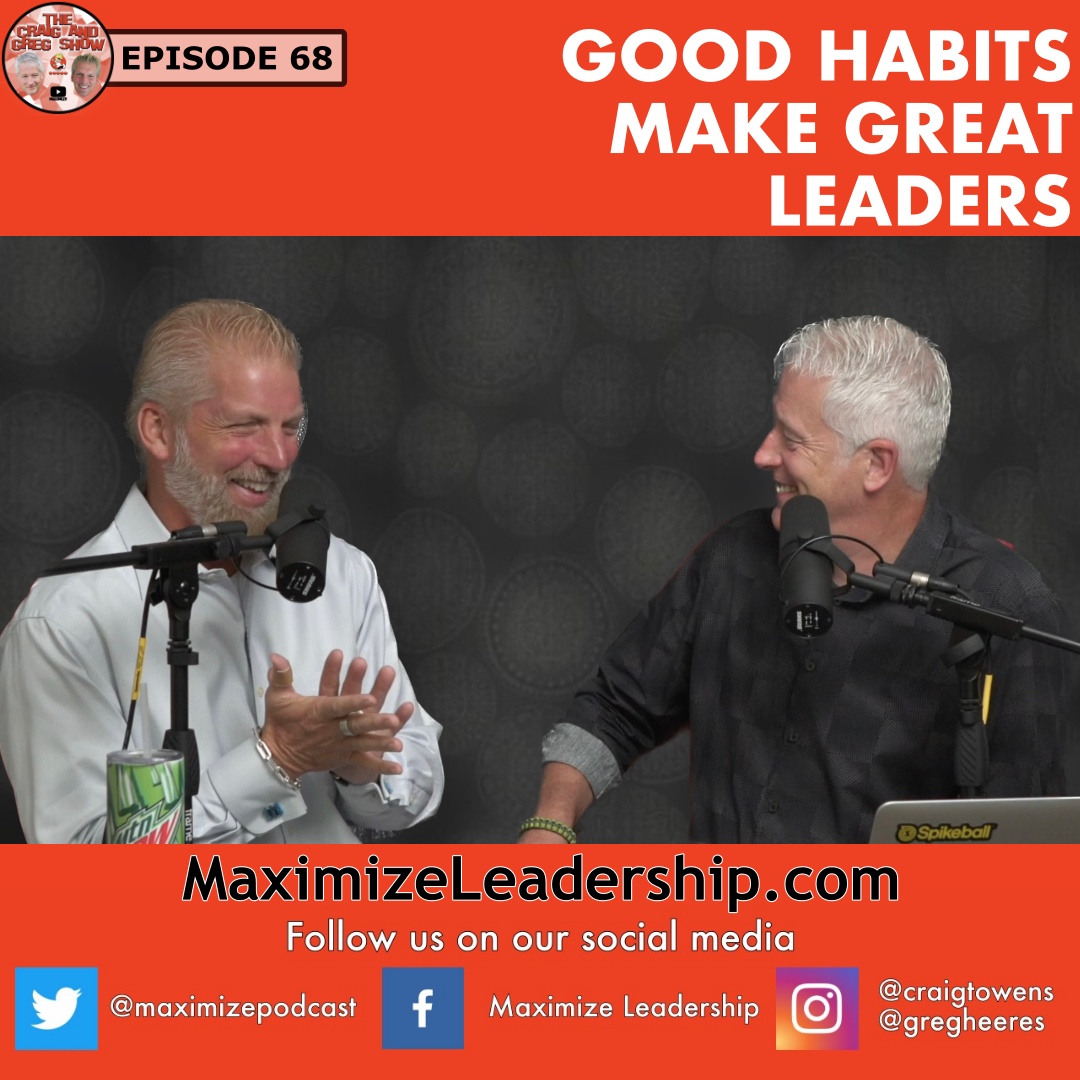 Automatic habits are an integral part of our everyday lives. From driving a car to the way we tie our shoes, these habits help us all the time with very little thought. Of course, habits aren’t limited to these mundane tasks, we also form them in other areas, like our leadership. As a leader, it’s important to be self-reflective of our habits and make sure they are taking us in the direction we want to go. In this episode, Greg and I discuss how cultivating the right habits will help you flourish as a leader.




 Craig T. Owens