Listen to the podcast of this post by clicking on the player below, and you can also subscribe on Apple, Spotify, or Audible.
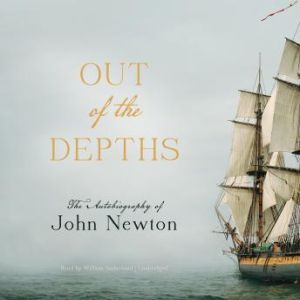
I’ve heard it reported (and I quite believe it) that “Amazing Grace” is the best-known song in the world. This song of God’s unfathomable grace was written by a pastor who was once a slave trader. Out Of The Depths is the autobiography of slave-trader-turned-pastor John Newton.
This story is told largely through the re-printing of letters that John Newton wrote to a friend over a lengthy correspondence. The original letters were not preserved, so as Mr. Newton wrote them again, he said that he added details that he hadn’t included in the first writing. Then the book closes with some remembrances of a dear friend, and a compilation of some short maxims that Pastor Newton used in his sermons and in conversations with friends.
One of the real benefits of Newton writing these letters so long after the actual events is his ability to look back at the lessons he learned through his various trials. Granted, many of his trials were brought on by his own stubbornness, but still the beginning of the message of grace from his memorable hymn is heard in the recounting of these stories.
Another key aspect of his story is his relationship with his wife. She and her family were much more committed Christians than Newton was at the time he began to show an interest in his bride-to-be, but neither she nor her family allowed the courtship to proceed until Newton had entirely surrendered his life to Jesus Christ. Their marriage was a source of great strength and encouragement to Pastor Newton.
I highly recommend this book to those who enjoy learning about the key figures of church history.
Listen to the podcast of this post by clicking on the player below, and you can also subscribe on Apple, Spotify, or Audible.
I think we all know the cliche, “Beauty is in the eye of the beholder.” But isn’t that too shallow? Are we really saying that beauty is only what we can see on the surface? Instead, I think we should say, “True beauty is in the heart of the beholder.”
Where does beauty begin? What is its source?
Jesus told us, “Love your neighbor as yourself.” I can only love others to the level that I love myself, and that also means that I can only see beauty in others as I see it in myself. But if I try to achieve this by just loving myself or telling myself how beautiful I am, my pride comes in and crumbles the whole foundation.
So the first thing Jesus told us was to go to the Source—to Love Himself: “Love the Lord your God with all your heart and with all your soul and with all your mind and with all your strength” (Mark 12:30-31). When we come to our Heavenly Father through our beautiful Savior we discover how beautiful we are in Him. We are clothed in the righteous robes of Jesus, which makes us as beautiful as He is. Then our Father sings His love to us (see Song of Songs 2:10, 4:7).
The dictionary defines beauty this way: “The quality present in a thing or person that gives intense pleasure or deep satisfaction to the mind.” But the word beauty originated from a Latin word that meant good or virtuous. Sadly, our vain world has made beauty something that is only skin deep, and very rarely is someone’s goodness or virtue described as beautiful.
Let me say it again: “True beauty is in the heart of the beholder.” Peter and Jesus both make this same point, reminding us that something beautiful on the outside can actually be covering up something quite ugly on the inside, or to say it another way: true beauty is far deeper than merely what we see with our eyes (1 Peter 3:3-4; Matthew 23:27).
On the other hand, Isaiah prophesied about Jesus that, “there was nothing beautiful or majestic about His appearance, nothing to attract us to Him” (Isaiah 53:2 NLT). Outwardly, especially at His crucifixion, Jesus was grotesque, but this ugliness was our ugliness—our sin, and our disease, and our pride that Jesus took on Himself. He willingly took on our ugliness to allow us to exchange ashes for beauty, mourning for rejoicing, and sin for righteousness (Isaiah 53:2-5; 61:1-2, 9-10).
So in prayer, we go to the One who isn’t beautiful in the eyes of a vain world. Jesus made Himself nothing, taking on the very nature of a servant, He came not to be served but to serve, He washed dirty feet, He hung out with sinners, He didn’t stay at the Ritz (He didn’t even have a home of His own), and He had only one set of clothes to wear. But He willingly took on all of our pain and sin so that He could take away our ugly robes and clothe us in His beautifully perfect robe of righteousness.
It’s only when I know how beautiful and loved I am in God’s sight that I can begin to love others and see the beauty in them.
Looking at True Beauty is the only way I can see myself correctly. Looking at True Beauty I can see the intrinsic worth and beauty in others.
Prayer takes me to the beautiful Savior. Prayer reveals Christ’s beauty in me. Prayer brings His beauty to a vain world.
“Without prayer the Christian life, robbed of its sweetness and its beauty, becomes cold and formal and dead; but rooted in the secret place where God meets and walks and talks with His own, it grows into such a testimony of divine power that all men will feel its influence and be touched by the warmth of its love.” —E.M. Bounds
I pray that we will know this truth—that true beauty is in the heart of the beholder—and that we will truly know that Real Beauty is only found when we gaze at our beautiful Savior.
We are blessed to have such an excellent pregnancy resource center in Cedar Springs. Alpha Family Center is a loving place to help families through some of the challenges of raising and caring for a family.
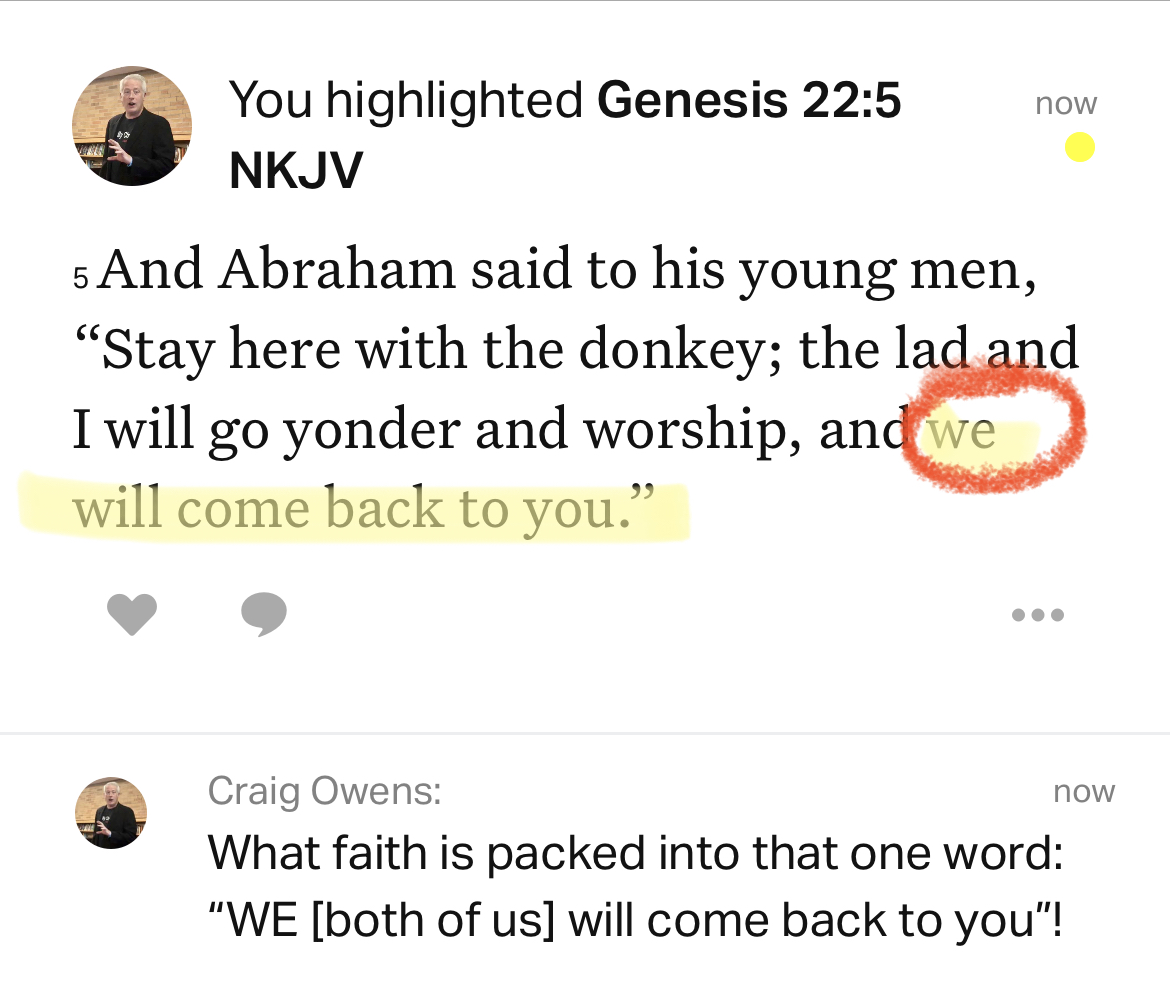
Abraham is commanded by God to sacrifice his son Isaac. Look at Abraham’s faith in just one word: “WEwill come back to you.”
Follow me on YouVersion so we can share more thoughts on God’s Word with each other.
Wil Robinson shares a fable from Leo Tolstoy with the three most important questions everyone should ask themselves. The three questions are: How can I learn to do the right thing at the right time? Who are the people I most need, and to whom should I, therefore, pay more attention than to the rest? And, what affairs are the most important and need my first attention?
“Faithfulness is displayed in both word and deed—seen best by combining the Great Commission’s instruction to ‘make disciples’ with the second greatest commandment to ‘love thy neighbor.’ The beauty of the Gospel is found in both proclamation and demonstration. Neither comes first; neither comes second. Like the perfect marriage, it’s the duty of the Christians to take on each, giving 100 percent effort to both.” —Gabe Lyons, The Next Christians
“Oh, that the eyes of sinners may be speedily opened—that they may see the difference of things, the beauty which is in holiness, and the astonishing madness that is in sin!” —Thomas Watson
John Piper observes, “The number-one reason why people in such seemingly hopeless situations purchase scratch-offs is because things already look so hopeless for improvement that the so-called ‘stupidity’ of wasting this dollar won’t really make anything worse.” This post elaborates on how the lottery preys on the poor.
This is a weekly series with things I’m reading and pondering from Charles Spurgeon. You can read the original seed thought here, or type “Thursdays With Spurgeon” in the search box to read more entries.
Listen to the podcast of this post by clicking on the player below, and you can also subscribe on Apple, Spotify, or Audible.
Do Your Own Growing
Having a form of godliness but denying its power. Have nothing to do with such people. (2 Timothy 3:5)
But now, as these people had not got the power of godliness, how did they come to hold the form of it? This needs several answers. Some come by the form of godliness in a hereditary way. Their ancestors were always godly people, and they almost naturally take up with the profession of their fathers. …
Not generation but regeneration makes the Christian. You are not Christians because you can trace the line of fleshly descent throughout twenty generations of children of God. … Grace does not run in the blood. If you have no better foundation for your religion than your earthly parentage, you are in a wretched case. …
I have seen the form of godliness taken up on account of friendships. Many a time courtship and marriage have led to a formal religiousness but a lacking heart. … Godliness should never be put on in order that we may put a wedding ring upon the finger. This is a sad abuse of religious profession. …
I put these things to you that there may be a great searching of hearts among us all and that we may candidly consider how we have come by our form of godliness. …
Let me remind you of the questionable value of that which springs out of fallen human nature. Assuredly, it brings no one into the spiritual kingdom, for ‘that which is born of the flesh is flesh.’ Only ‘that which is born of the Spirit is spirit’ (John 3:6). ‘You must be born again’ (3:7). Beware of everything that springs up in the field without the sowing of the Husbandman, for it will turn out to be a weed.
From The Form Of Godliness Without The Power
There’s an old Irish proverb that says, “You’ve got to do your own growing, no matter how tall your grandfather is.” This is equally true for Christians!
I’m a fourth-generation Pentecostal Christian, which means I was practically raised in a church building. But still I had to come to a point in my life where I had to decide: Do I believe that Jesus is my Savior just because my parents and grandparents believed this, or because I truly believed it for myself. All of us, regardless of our parentage, have to make this choice.
Listen to the podcast of this post by clicking on the player below, and you can also subscribe on Apple, Spotify, or Audible.
…I will hide My face from this city because of all its wickedness. Nevertheless, I will bring health and healing to it… (Jeremiah 33:5-6)
God’s anger at Judah’s sin is blazing hot! And rightly so: Dr. Henry Halley points out, “Most of the 20 Davidic kings who reigned over Judah during the 400 years between David and the Babylonian exile were very bad. Only a few were worthy of the name of David.” So it is understandable that God would need to punish that sinful nation.
Then comes that word “nevertheless.” In spite of the rampant sin, God’s promise of restoration is even greater than the pain of His punishment.
God promises healing, restoration, complete cleansing from sin, and more descendants of David and Levi than can be counted. And He promises this to the exact same people that He promised to punish.
I don’t know about you, but to me this almost seems like a contradiction. Does God want to punish them or does He want to bless them?
The apparent contradiction is hard for our finite brains to comprehend. That’s why God makes an important statement to Jeremiah before He begins describing the punishment and the blessings: “Call to Me and I will answer you and tell you great and unsearchable things you do not know” (v. 3).
Aha! When we call on God to help us with unsearchable things, we find there are no contradictions in God nor in the Bible itself.
C.S. Lewis wrote, “Heaven will solve our problems, but not, I think, by showing us subtle reconciliations between all our apparently contradictory notions. The notions will all be knocked from under our feet. We shall see that there never was any problem”—or any contradiction at all.
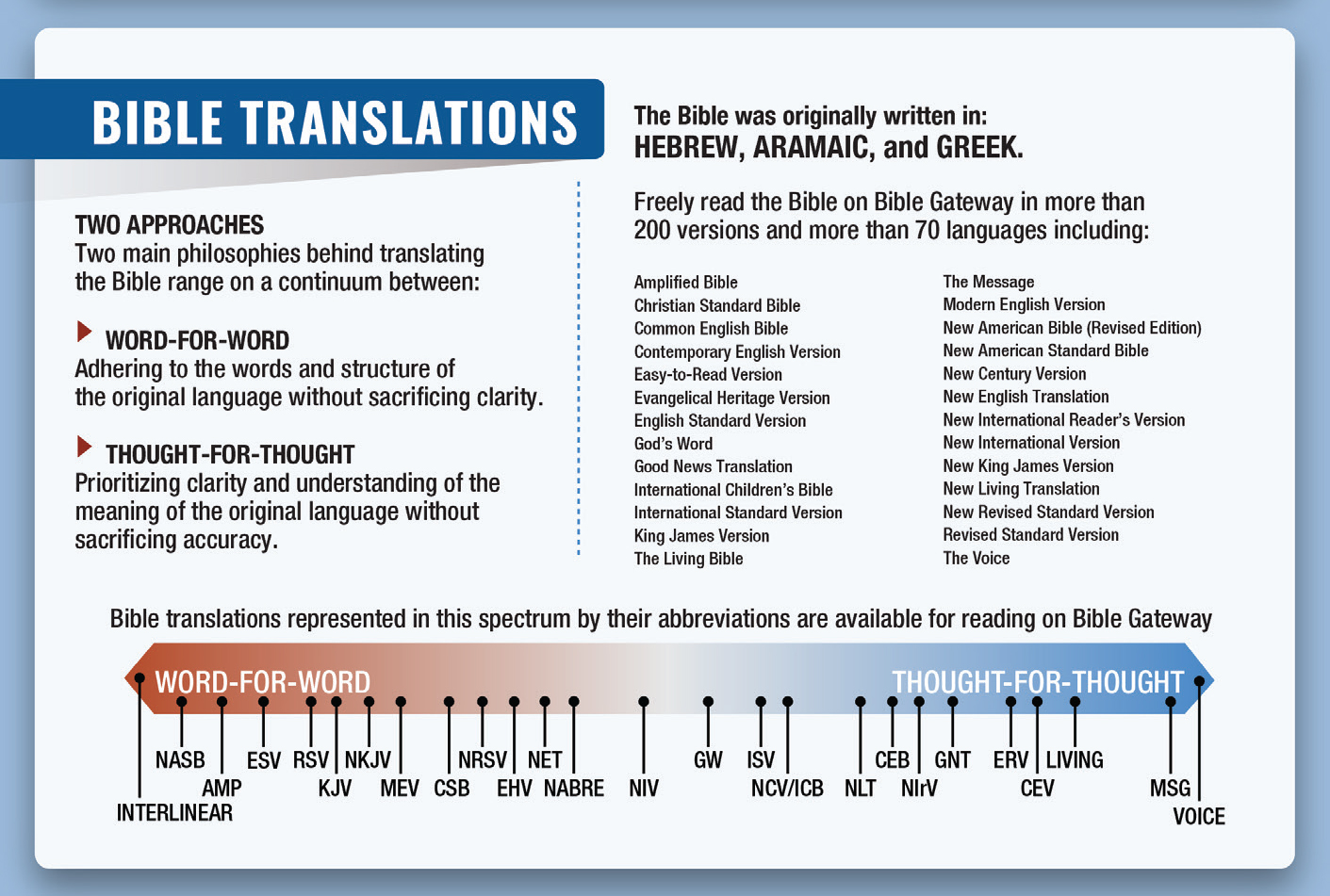
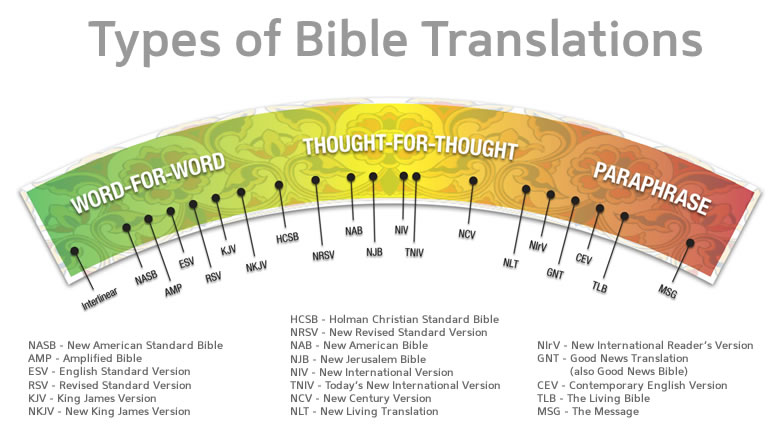
There are so many quality translations of the Bible to help us read God’s Word profitably, but many people ask me about the origin of each of these translations. I have shared three views of biblical translations below—two serious and one comical way of looking at them.
They only caution I would point out is a translation or paraphrase that is from a single person’s point of view. The Bible itself talks about success that comes from the combined wisdom of counselors, so a single-person paraphrase does open itself up more to the author’s whims than to true scholarship.
Listen to the podcast of this post by clicking on the player below, and you can also subscribe on Apple, Spotify, or Audible.
And they were not able to resist the wisdom and the Spirit by which [Stephen] spoke. (Acts 6:10)
Luke the historian doesn’t give us very many details about Stephen, but one common thread is the obvious help the Holy Spirit gave him:
Stephen, full of faith and power, did great wonders and signs among the people
they were not able to resist the wisdom and the Spirit by which he spoke
all who sat in the council…saw his face as the face of an angel
when they heard these things they were cut to the heart
being full of the Holy Spirit, [Stephen] gazed into heaven and saw the glory of God, and Jesus standing at the right hand of God
Jesus lived this way too. Near the end of His public ministry He said,
“I have never spoken on My own authority or of My own accord or as self-appointed, but the Father Who sent Me has Himself given Me orders concerning what to say and what to tell. And I know that His commandment means eternal life. So whatever I speak, I am saying exactly what My Father has told Me to say and in accordance with His instructions.” (John 12:49-50 AMP)
Jesus said this same Holy Spirit who directed His vocabulary, and Who gave Stephen his irresistible words, would do the same thing for us too. The apostle Paul asked for the Ephesian Christians to pray for him like this, “Pray also for me, that whenever I speak, words may be given me so that I will fearlessly make known the mystery of the gospel” (Ephesians 6:19).
When we are yielded to the Holy Spirit we can say with assurance…
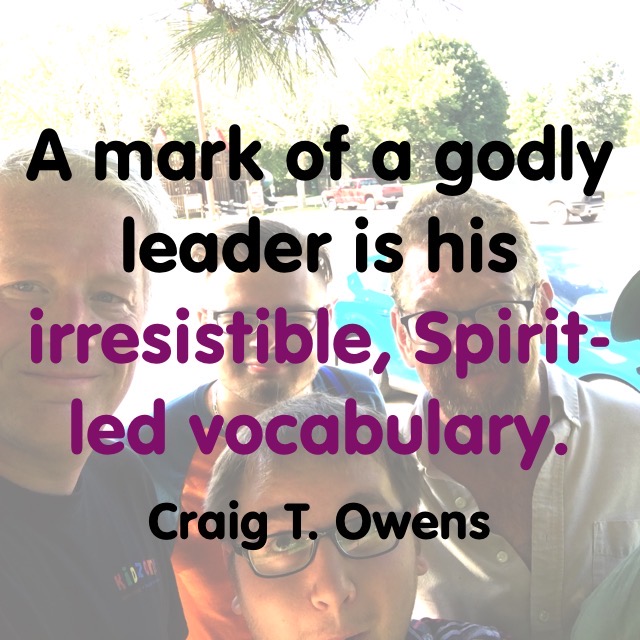
A mark of a godly leader is his irresistible, Spirit-led vocabulary.
This is part 60 in my series on godly leadership. You can check out all of my posts in this series by clicking here.
It’s one thing to read things, hear things, and even believe things, but it’s something completely different when you experience those things for yourself.
The one with an experience…
…is never at the mercy of the one with an argument
…gains the ear of others
…inspires others to desire a similar experience for themselves
In the case of prayer, I feel bad for those who have heard that God no longer answers prayer, or no longer does the miraculous for His children. I have personally experienced God’s healing power as a direct result of someone praying for me. In fact, I’m alive today because of the prayers of my two grandmothers!
When God answers prayer, it is awesome!
The dictionary defines awesome with three main words: reverence, admiration, and fear. I think we can be a bit more specific with these definitions—
for saints: reverence
for seekers: admiration
for sinners: fear
It is so important for Christians to personally experience the awesome deeds our God has done because we have prayed in the awesome name of Jesus!
A.W. Tozer wrote, “There’s an awesomeness about God which is missing in our day altogether; there’s little sense of admiring awe in the Church of Christ these days.”
I think this is because our prayers are too tame.
The writer of Hebrews tells us about the powerful personal relationship we can have to Almighty God through Jesus Christ. His conclusion is, “Therefore, since we are receiving a kingdom that cannot be shaken, let us be thankful, and so worship God acceptably with reverence and awe, for our ‘God is a consuming fire’” (Hebrews 12:28-29).
When Christians pray in the awesome name of Jesus, and God does awesome things in response, the saints stand in reverent worship of Him. God told Moses, “The people you live among will see how awesome is the work that I, the Lord, will do for you,” and David exclaimed, “You answer us with awesome and righteous deeds” (Exodus 34:10; Psalm 65:5).
These awesome answers that we personally experience gain the attention and admiration of seekers. Again, David said, “Come and see what God has done, His awesome deeds for mankind!” (Psalm 66:5).
But God showing up in His awesome strength will also create fear in sinners. The prophet Joel said, “The day of the Lord is an awesome, terrible thing” (Joel 2:11). The righteous judgment of God is awesome, but so is the love of God: “Lord, the God of heaven, the great and awesome God, who keeps His covenant of love with those who love Him and keep His commandments” (Nehemiah 1:5). We need to use the awesomeness of God as a means to tell both sinners and seekers how they can know the awesome love of God.
Remember that Tozer said “there’s little sense of admiring awe in the Church of Christ these days.” So I think we need to pray this, “God, forgive us for expectations of You that are too low.”
I challenge you:
Let’s pray bolder prayers this year to our awesome God.
Let’s worship in reverence of His awesome deeds.
Let’s create a sense of admiration in seekers which will lead them to reverence as saints.
Let’s address the fear of sinners, and lead them to admiration as seekers, and to reverence as saints.



 I’ve heard it reported (and I quite believe it) that “Amazing Grace” is the best-known song in the world. This song of God’s unfathomable grace was written by a pastor who was once a slave trader. Out Of The Depths is the autobiography of slave-trader-turned-pastor John Newton.










 Craig T. Owens