“Love of the Word appears preeminently in our Lord and Savior Jesus Christ. He read it publicly. He quoted it continually. He expounded it frequently. He advised the Jews to search it. He used it as His weapon to resist the devil. He repeatedly said, ‘The Scripture must be fulfilled.’ Almost the last thing He did was to ‘open their minds so they could understand the Scriptures’ (Luke 24:45). I am afraid that man cannot be a true servant of Christ, who has not something of his Master’s mind and feeling towards the Bible.” —J.C. Ryle, Bible Reading
“The character of our praying will determine the character of our preaching. Light praying will make light preaching. …The preacher must be preeminently a man of prayer. His heart must graduate in the school of prayer. In the school of prayer only can the heart learn to preach.” —E.M. Bounds, Power Through Prayer
“Some pastors and preachers are lazy and no good. They do not pray; they do not read; they do not search the Scripture. … The call is: watch, study, attend to reading. In truth you cannot read too much in Scripture; and what you read you cannot read too carefully, and what you read carefully you cannot understand too well, and what you understand well you cannot teach too well, and what you teach well you cannot live too well. … The devil … the world … and our flesh are raging and raving against us. Therefore, dear sirs and brothers, pastors and preachers, pray, read, study, be diligent.” —Martin Luther
Listen to the podcast of this post by clicking on the player below, and you can also subscribe on Apple, Spotify, or Audible.
God needed to use Philip to steer a God-seeking government official to Jesus Christ. After this brief one-on-one encounter, God removed Philip from the scene and almost entirely from the pages of history.
Philip had just been leading a huge revival in Samaria, but he didn’t count success by the nickels-and-noses metrics of the world. He obeyed God even to the point of “taking a step backwards” in the world’s eyes, but in God’s eyes it was the most successful of moves.
Don’t try to grow your ministry. First, because it’s not yours, it’s His; and second, because your measure of success is probably more slanted toward quantitative measurements than qualitative. Jesus wasn’t concerned about bigger numbers: “What do you think?” He asked, “If a man has a hundred sheep, and one of them goes astray, does he not leave the ninety-nine and go to the mountains to seek the one that is straying?” (Matthew 18:12). …
What’s the value of one government official’s life? God says that his value is incalculable. Apparently, God knew that Philip was the perfect shepherd to lead this Ethiopian to the pasture where he would accept Jesus as his Savior. Philip was obedient, a sheep was saved, and God was pleased. …
The Chief Shepherd made this commitment to His sheep: “And I will give you shepherds according to My heart, who will feed you with knowledge and understanding” (Jeremiah 3:15). My prayer is that we would much rather feed a few sheep where God has directed us and given us His heart than for us to try to manufacture success that is measured by how many nickels and noses we can count.
I’ll be sharing more clips from this book signing event soon, so please stay tuned. Shepherd Leadership: The Metrics That Really Matter is available in print or ebook, and in audiobook through either Audible or Apple.
This is a weekly series with things I’m reading and pondering from Charles Spurgeon. You can read the original seed thought here, or type “Thursdays With Spurgeon” in the search box to read more entries.
Listen to the podcast of this post by clicking on the player below, and you can also subscribe on Apple, Spotify, or Audible.
No Fear Of Inspection
Having a form of godliness but denying its power. Have nothing to do with such people. (2 Timothy 3:5)
Paul warns us of certain characters that will appear in the last times. It is a terrible list. The like have appeared in other days, but we are led by his warning to apprehend that they will appear in greater numbers in the last days than in any previous age. ‘People will be lovers of themselves, lovers of money, boastful, proud, abusive, disobedient to their parents, ungrateful, unholy, without love, unforgiving, slanderous, without self-control, brutal, not lovers of the good, treacherous, rash, conceited, lovers of pleasure rather than lovers of God’ (2 Timothy 3:2-4). …
The raw material of a devil was an angel bereft of holiness. You cannot make a Judas except out of an apostle. The eminently good in outward form, when without inward life, decays into the foulest thing under heaven. You cannot wonder that these are called perilous times, in which such characters abound. …
Those who constantly associate in worship, unite in church fellowship, and work together for sacred purposes have a form of godliness, and a very useful and proper form it is. Alas, it is of no value without the power of the Holy Spirit.
Some go farther than public worship. They use a great deal of religious talk. They freely speak of the things of God in Christian company. They can defend the doctrines of Scripture, they can plead for its precepts, and they can narrate the experience of a believer. …
That religion that comes from the lips outward but does not well up from the deep fountains of the heart is not that living water that will spring up to eternal life. Tongue godliness is an abomination if the heart is destitute of divine grace.
When we have done all the work our position requires of us, we may only have displayed the form of godliness. Unless we harken to our Lord and from His presence derive power, we will be as a sounding brass and a tinkling cymbal. Brethren, I speak to myself and to each one of you in solemn earnestness. If much speaking, generous giving, and constant occupation could win heaven, we might easily make sure of it. But more than these are needed. …
O my active and energetic brother, remember the word, ‘Therefore let him who thinks he stands take heed lest he fall’ (1 Corinthians 10:12). If any of you dislikes this searching sermon, your dislike proves how much you need it. He that is not willing to search himself should stand self-incriminated by that unwillingness to look at his affairs. If you are right, you will not object to being weighed in the balances. If you are indeed pure gold, you may still feel anxiety at the sight of the furnace, but you will not be driven to anger at the prospect of the fire. Your prayer will always be, ‘Search me, God, and know my heart; test me and know my anxious thoughts.See if there is any offensive way in me, and lead me in the way everlasting’ (Psalm 139:23-24).
From The Form Of Godliness Without The Power
Those who are in right standing with God—in other words, those who are not merely godly in outward appearance only—should have no fear of their lives being inspected. Accountability among fellow Christians is a liberating thing because it keeps us in a place of safety. But even better is when we pray, “Search me, Lord” and then we quickly, and without offering any excuses, correct whatever the Holy Spirit reveals to our hearts.
In these last days, let us be even more attentive to this!
On a recent episode of our leadership podcast, Greg Heeres and I were discussing how easy it is for people to slip into a complaining attitude. One of the things I point out is that if we ask for compliments instead of complaints, we can begin to change the culture of our organization.
Listen to the podcast of this post by clicking on the player below, and you can also subscribe on Apple, Spotify, or Audible.
Go down to the potter’s house, and there I will give you My message (God speaking to Jeremiah).
Jesus was masterful in using visual illustrations—common, everyday things—to illustrate the biblical truth He wanted to teach. God does the same thing with Jeremiah.
God instructs Jeremiah to simply go to the potter’s house and watch. Jeremiah obeyed: “I went down to the potter’s house, and I saw him working” (v. 3). It was after taking in this scene that God could speak to Jeremiah a sermon illustration. Jeremiah says, “Then the word of the Lord came to me” (v. 5).
Not only did God help Jeremiah prepare his sermon with a visual illustration, but God also prepared Jeremiah for the follow up conversation. God knew how the people would respond to Jeremiah’s message, and He again gave him the words to speak ahead of time (vv. 12-17).
God knows His sheep better than we do. He knows what they need to hear, and how best to make His message stick. Jesus said,
“I have never spoken on My own authority or of My own accord or as self-appointed, but the Father Who sent Me has Himself given Me orders concerning what to say and what to tell. And I know that His commandment means eternal life. So whatever I speak, I am saying exactly what My Father has told Me to say and in accordance with His instructions.” (John 12:49-50 AMP)
We pastors and evangelists dare not try to prepare a message on our own!
Samuel Johnson prayed something that I pray every time I sit down to prepare a sermon: “Almighty God, my Heavenly Father, without Whose help labor is useless, without Whose light search is in vain, invigorate my studies.”
Seeking God’s help in our sermon preparation should be our very first action every single time.
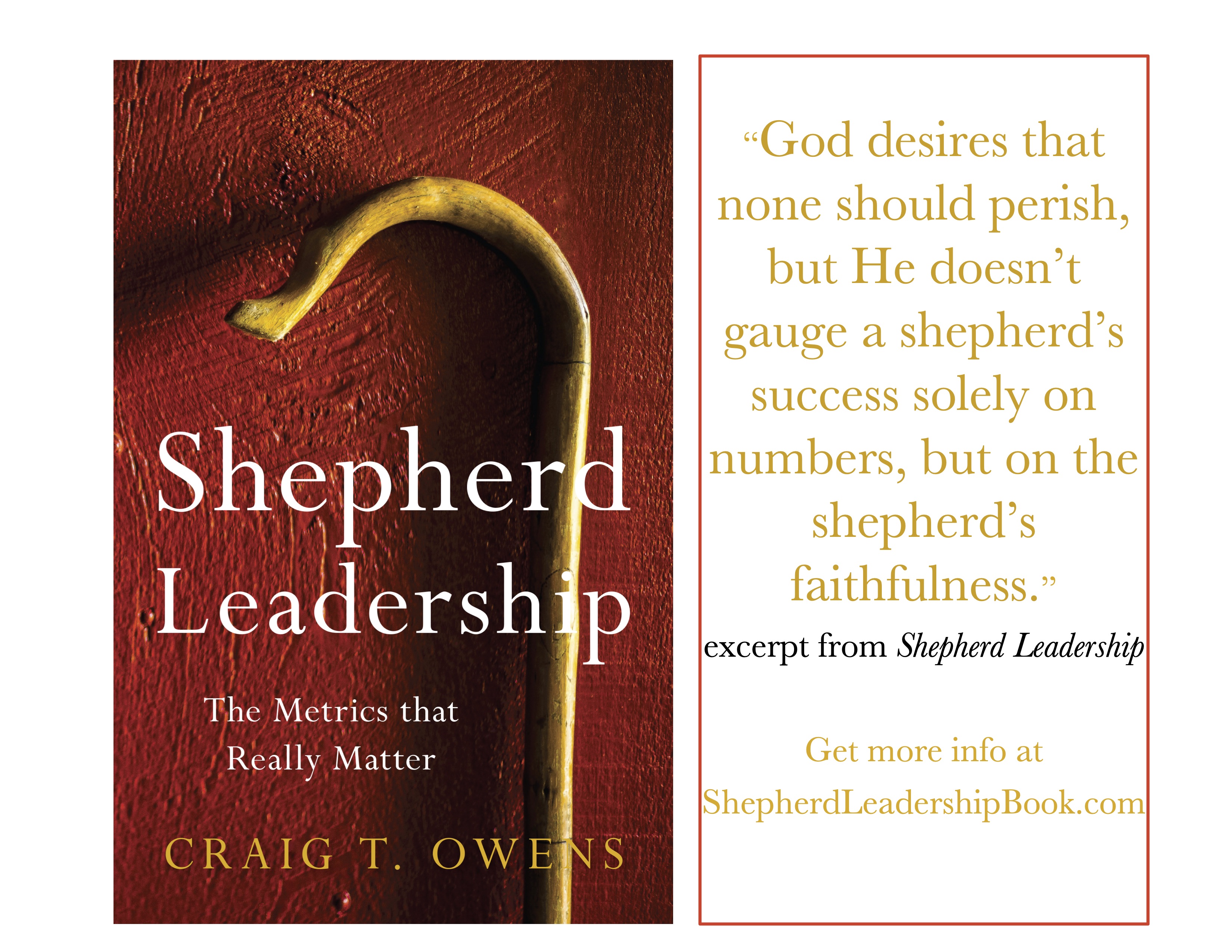
I wrote Shepherd Leadership: The Metrics That Really Matter to encourage pastors who are tired and struggling with feelings of failure. One of the most powerful sources of encouragement is more leaders surrounding a tired pastor.
I have a chapter dedicated to this called “Going Farther.” Here’s a short excerpt—
You will not only extend your leadership by having other servant-hearted shepherds around you, but you will also have a guard against the aloneness that led to such ugly warts on the biography of otherwise powerful leaders such as David, Elijah, and Peter.
Jesus told us to pray to the Lord of the Harvest to send out more workers into the field (Luke 10:2). In a similar attitude, I believe we can pray to the Chief Shepherd to send out more under-shepherds into the pastures; specifically, we can pray for those under-shepherds to be sent into the pasture where we labor. The early church showed us the example of prayer being the priority when new shepherds were needed (Acts 1:21-26, 6:3-6, 13:1-3; 2 Timothy 1:3-6). We would do well to make it a priority to pray for God to send us godly leaders that can serve alongside us.
If you are a pastor, please pick up a copy of this book, as I truly believe it will encourage you. If you love your pastor, please give him or her a copy as a gift. I promise you that this book will bring such a fresh perspective to their ministry.
And whether you are a pastor or a lay leader in your church, please continue to pray for God to send more laborers into your harvest field.
Listen to the podcast of this post by clicking on the player below, and you can also subscribe on Apple, Spotify, or Audible.
God uses humans—flawed, imperfect humans—to accomplish His sovereign plan. As we yield to His sovereignty we can discover an unparalleled joy. In The Legacy Of Sovereign Joy, John Piper shows us this principle in the lives of three notable men of church history: Augustine of Hippo, Martin Luther, and John Calvin.
Although separated by 1000 years, these men are inseparably linked to the beginning of the Reformation. Both Luther and Calvin relied heavily on the writings of Augustine as they called Christians away from the unbiblical teachings and traditions, and back to the pure, freeing truths of the Bible.
These men are also linked in another way that should be quite encouraging to us. Augustine struggled with his sexual passions, Luther struggled to control his razor-sharp tongue, and Calvin used some rather worldly means to fight for biblical truths. All of them were flawed men, and yet God sovereignly used them. And through all of their struggles, the Holy Spirit brought all three of them into a place where they savored the sovereign joy that only God can give. This should give us great encouragement that God can use us too.
By themselves, John Piper’s biographies of these men are worth your time to read, but the way Pastor John intertwines their stories to show us how sovereign joy can be our mainstay as well is absolutely brilliant.
Listen to the podcast of this post by clicking on the player below, and you can also subscribe on Apple, Spotify, or Audible.
Last week here in wintry Michigan we had a couple of snow days (for those of you in non-snow states, that means the roads were too dangerous even for us Michiganders, so the schools were closed). Students and teachers too “work” very hard for snow days. By that I mean they try a bunch of tactics that are supposed to increase the likelihood of school being called off—like flushing ice cubes down the toilet, wearing their PJs inside-out, or even sleeping with a spoon under their pillow.
But I’ve also noticed it’s not just praying for snow days where people employ some tactics they think will help things go their way. Like saying, “Pretty please with sugar on top” when trying to get special favor, or athletes not saying anything at all to a teammate who’s on the brink of something historic, or business people saying, “Wish me luck” before going into the big meeting. And even Christians who end their prayer with, “In Jesus’ name, Amen” to help make their prayer answerable.
In case you haven’t noticed, just saying that phrase is not some magical, abracadabra formula for success (for some very notable examples of this check out Matthew 7:21-23 and Acts 19:13-16).
But still, Jesus does specifically say, “And I will do whatever you ask in My name, so that the Father may be glorified in the Son. You may ask Me for anything in My name, and I will do it” (John 14:13-14).
This is where context is king. In John 13-16, Jesus is giving His final instructions to His disciples before His arrest and crucifixion. They are clearly anxious about His departure because chapter 14 opens with the words, “Do not let your hearts be troubled.”
In this passage of John 14, Jesus is giving the disciples the basis for their confident hope in Him. He tells them that He is THE way to the Father (they don’t have to look for another path), and He is THE revelation of the Father (He will make the Father’s will crystal clear to them).
Jesus tells them that He has been doing His Father’s work, which is verified by the evidence of the miracles—or we could say the answers to His prayers (v. 10-11). Jesus wants His followers to pray this same way, live this same way, and see even greater things done in His name (v. 12).
So we can infer from this that praying in the name of Jesus essentially means two things:
We pray in harmony with the character of Jesus. That means that we pray prayers that Jesus Himself would pray. If you cannot imagine Jesus asking for what you’re asking for, then it’s not in alignment with His character.
We pray in faith in the supreme authority of Jesus to do what we ask. Jesus is Supreme over everything else. To pray in His name means we look for answers from no other source.
I think the key to understanding this is found in the small preposition Jesus uses 12 times in this passage: IN.
Jesus is IN the Father, the Father is IN Jesus, and the Holy Spirit is IN us. This means that we are also IN the Father with Jesus!
Which means we don’t have to try to be like Jesus or to merely imitate Him, but we let the Holy Spirit sanctify us into the character of Jesus.
When I talk to my Dad I don’t have to remind myself that I am his son—I just am his son. I don’t have to carefully calculate how I’m going to make requests of him. I know his heart, and I know my inseparable relationship with him, so I just talk to him.
Have you ever noticed in the Gospels that when Jesus does a miracle, He doesn’t pray the way that we typically pray? When the man with leprosy came to Jesus, He merely said, “Be clean.” I think we might have bowed our heads, closed our eyes, placed our hands on him and said something like, “Dear heavenly Father, if it’s Your will bring Your healing touch to our dear brother. In Jesus’ name we pray, Amen.” But Jesus knew the Father’s heart was to heal this suffering man, so Jesus simply spoke the words. His statement was a prayer that resonated with the heart of His Father, and that prayer was immediately answered.
The Holy Spirit is sanctifying you to pray this same way:
He wants to mold your heart to be passionate for the things of the Father—John 5:17
He wants to transform your mind to think the Father’s thoughts—John 16:13-14
He wants to soften your will to be yielded to the will of the Father—Matthew 26:36-44
He wants to settle your emotions to be at peace in the Father—John 14:1
He wants to even change your vocabulary to the very words Jesus would use—John 12:49
When your heart, mind, will, and emotions are being sanctified, the supremacy of Jesus will naturally be at the forefront of everything you feel, think, do, and say. Then you will be naturally praying in the name and character of Jesus for God’s glory to be seen.
Praying in the name of the Supreme Jesus means that we pray IN God’s will FOR God’s glory.
To see all of the messages in our series called Awesome: Learning to pray in the awesome name of Jesus, please click here.



 E’en for the dead, I will not bind










 Craig T. Owens