Listen to the podcast of this post by clicking on the player below, and you can also subscribe on Apple, Spotify, or Audible.
When C.S. Lewis esteems another author’s work, that is a pretty good indication to me that I should take notice. Lewis wrote, “I was brought back…by the strong influence of two writers, the Presbyterian, George MacDonald, and the Roman Catholic, G.K. Chesterton.” In A Year with G.K. Chesterton, we get a small glimpse of what Lewis found so appealing.
Much like the multitude of genres in which Lewis wrote, Chesterton, too, shows an incredible skill to produce quality works in wide-ranging genres: prose, poetry, fantasy, theology, and political and cultural commentary, to name just a few.
Chesterton was well known for his quick wit and—at times—biting sarcasm. And yet, he could also speak so tenderly of a pastoral scene as he described how this scene showed us hints of heaven. It would be utterly impossible to pigeonhole him into just one genre of literature.
In A Year with G.K. Chesterton, editor Kevin Belmonte takes us across the full scope of this prolific author’s work. Because Chesterton was a devout Catholic, each day’s reading begins with a portion of Scripture, followed by an excerpt or two from Chesterton’s works, which illuminate the day’s Bible verses. Then we get an “On this day” portion, which may include an entry from Chesterton’s personal correspondence or insight into a momentous event on that particular day in Chesterton’s life. As you read through this overview, you may find yourself gravitating to a particular book or genre. I would encourage you then to track that book down and dive in.
After spending a few minutes with this insightful author for a full year, you will not only know more about him but you will have a new lens with which to read the Bible and to observe God’s creation all around you.
Listen to the podcast of this post by clicking on the player below, and you can also subscribe on Apple, Spotify, or Audible. Check out the video content in this post by clicking here.
Think about this: How do your favorite books end? How about the ending of your favorite movies?
I love listening to old-time radio shows, and I can quote the endings because they are all identical.
In the Bible, how do the epistles end? Most end with the author passing along his greetings, speaking a doxology like, “The Lord be with you,” or even a simple “Amen.”
Now listen to the last two verses of the Book of James: My brothers and sisters, if one of you should wander from the truth and someone should bring that person back,remember this: Whoever turns a sinner from the error of their way will save them from death and cover over a multitude of sins (5:19-20).
James is a general epistle—not written to a particular congregation—so it was intended to be read to saints everywhere. The same is true for the Gospels:
Matthew: Jesus commissions His followers to go into all the world and preach the Gospel and then He promises, “I am with you always, to the very end of the age” (Matthew 28:19-20).
Mark: “Then the disciples went out and preached everywhere” (Mark 16:20).
Luke-Acts: “And they stayed continually at the temple, praising God” (Luke 24:53); they were baptized in the Holy Spirit and more saints went out preaching (Acts 2); Paul “proclaimed the kingdom of God and taught about the Lord Jesus Christ—with all boldness and without hindrance!” (Acts 28:31).
John: “Jesus did many other things as well. If every one of them were written down, I suppose that even the whole world would not have room for the books that would be written” (John 21:25). The implication, I believe, is that we are to do this as well—“Very truly I tell you, whoever believes in Me will do the works I have been doing and they will do even greater things than these because I am going to the Father” (John 14:12).
So James writes instructions to the saints in this same posture of an ongoing work. He writes his epistle as a cycle—
He ends with”brothers and sisters” (Greek: adelphos in 5:19-20), and starts with adelphos (1:2),
He ends with a call to prayer (5:13-15), and opens with a call to prayer (1:5-7).
He ends with a call to patience in trouble (5:7-11), and he begins teaching saints about trials (1:2-4).
He ends with encouragement of how maturing saints can triumph over difficult situations (5:16), and he opens with the word of encouragement that our difficult situations serve to mature us (1:12).
In between these bookends is fabulous counsel for daily living: Dealing with temptation, learning from the Word, watching our words, letting our day deeds reflect our faith, growing in wisdom, and seizing each day for God’s glory.
There is no finish line for me while God still has me on earth. If I’m still here, He’s still working on me so that He can work through me. We start our Christian journey justified—a one-time event where we’ve been made just as if we had never sinned. We end out journey when we are glorified—a one-time event when we arrive in Heaven. But along the journey we are being sanctified—an going process (that I like to call saint-ification) the whole time we’re on earth.
Throughout this sanctification process, we are continually growing. See Psalm 92:12-14—
The righteous will flourish like a palm tree, they will grow like a cedar of Lebanon, planted in the house of the LORD, they will flourish in the courts of our God.They will still bear fruit in old age, they will stay fresh and green.
If you’re still breathing, you should still be…
…maturing through trials
…bearing increasingly more fruit
…useful for the Kingdom
…invaluable to the Body of Christ
So take a deep breath.
If you’re still breathing, God still has a plan for you. Don’t worry about the finish line (God will take care of that), but keep learning, growing, and serving all the way to the end.
Greg and I both have confessions to make about areas we fell short in our earlier careers. But we have learned that those stumbling points can be launching points for greater growth.
“Without God, there could be no American form of Government, nor an American way of life. Recognition of the Supreme Being is the first—the most basic—expression of Americanism.” —Dwight D. Eisenhower
Greg Morse calls out the way pornography addictions are hamstringing the church. “My intention is simply to kindle the abhorrence that every saint should have for this sin. I hate pornography. I hate what it does to young men; I hate what it does to marriages; I hate what it does to older men and even older ministers who trip while crossing the finish line. I hate its accessibility; I hate its covertness; I hate how it is designed by satan to disable the men and women who were made for so much more.”
“But the question is not what we intended ourselves to be, but what [God] intended us to be when He made us. He is the inventor, we are only the machine. He is the painter, we are only the picture. How should we know what He means us to be like? … We may be content to remain what we call ‘ordinary people’: but He is determined to carry out a quite different plan. To shrink back from that plan is not humility: it is laziness and cowardice. To submit to it is not conceit or megalomania; it is obedience.” —C.S. Lewis, in Mere Christianity
“Leadership development is synonymous with personal development. As leaders grow personally, they increase their ability to lead. As they increase their capability to lead, they enlarge the capacity of their organization to grow. Therefore, the most crucial objective for any leader is personal growth. … The most important thing spiritual leaders do is cultivate their relationship with God (John 15:5; Jeremiah 7:13).” —Richard and Henry Blackaby, in Spiritual Leadership
Listen to the podcast of this post by clicking on the player below, and you can also subscribe on Apple, Spotify, or Audible. Check out the video content in this post by clicking here.
Is it really true that practice makes perfect? And if so, what exactly does perfection look like?
“On the one hand, God’s demand for perfection need not discourage you in the least in your present attempts to be good, or even in your present failures. Each time you fall He will pick you up again. And He knows perfectly well that your own efforts are never going to bring you anywhere near perfection. On the other hand, you must realise from the outset that the goal towards which He is beginning to guide you is absolute perfection; and no power in the whole universe, except you yourself, can prevent Him from taking you to that goal.”
You may also want to check out a couple of related blog posts:
Listen to the podcast of this post by clicking on the player below, and you can also subscribe on Apple, Spotify, or Audible.
Now faith is confidence in what we hope for and assurance about what we do not see. (Hebrews 11:1)
All of the examples of faith-filled living in this 11th chapter of Hebrews are people who believed what God told them about their unseen future. And yet, they lived as though they could see it and hear it!
Abel offered “a better sacrifice” because he knew a greater reward was in his future.
Enoch walked with God like a friend.
Noah prepared for rain and for a flood.
Abraham saw his descendants living in their own land.
Sarah prepared to have a baby when she “was past childbearing age” and her husband was “as good as dead.”
Isaac blessed Jacob and Esau, and Jacob blessed Manasseh and Ephraim’s future descendants, as they saw them perpetuating Abraham’s family line.
Joseph planned for the exodus.
Moses’ parents saw him as a national leader.
Moses saw a kingdom greater than Egypt.
The Israelites saw dry ground where there was a vast ocean and a rushing river, and collapsed walls where there was there was an impassable city.
Rahab believed in the true God.
“There were others who were tortured”; “the world was not worthy of them”—“they were too good for this world” (v. 38 in the NLT).
But they were more “commended for their faith” than anyone who may have received accolades while on this earth.
Their commendation was, “Well done, good and faithful servant! Enter into your Master’s happiness forever!” (see Matthew 25:21, 23, 34).
“Some faced jeers” but then heard the cheers of the “great cloud of witnesses” (12:1) and the applause from nail-scarred Hands!
Reading these faith-filled biographies prompts me to search my motivations—
What do I see? Am I too focused on the here and now?
What do I hear? Am I motivated by earthly cheers and discouraged by earthly jeers?
May my eyes see and my ears hear what God has promised. May my faith be confident in hope of what God has promised and assured about what I do not see or hear with my natural eyes and ears. Instead, may I see promises fulfilled and hear the joyful shout of, “Well done!”
“‘Sanctify them through Thy truth: Thy word is truth’ [John 17:17]. The great objective of God’s Word is to make us holy. No diligence or success in Bible study will really profit us unless it makes us more humble and holy. In our use of Holy Scripture, this must be our main objective. The reason there is often so much Bible reading with so little real result in a Christlike character is that ‘…salvation through sanctification of the Spirit and belief of the truth’ (2 Thessalonians 2:13) is not truly desired. …
“It is God Himself who alone can make us holy by His Word. The Word, separate from God and His direct operation, cannot accomplish anything in us. The Word is an instrument: God Himself must use it. God is the only holy One. He alone can make holy. The unspeakable value of God’s Word is that it is God’s means of holiness.
“The terrible mistake of many people is that they forget that God alone can use it and make it effective. It is not enough that I have access to the office of a physician. I need for him to prescribe a cure. Without him, my use of his medicines could be fatal. This was true of the scribes and Pharisees of Jesus’ day. They made their boast in God’s law. They delighted in their study of Scripture and yet remained unsanctified. The Word did not sanctify them, because they did not seek for this in the Word and did not yield to God to do it for them [John 5:39-40]. …
“‘There is none holy as the Lord…’ (1 Samuel 2:2). All holiness is His, and He makes things holy by His holy presence. The tabernacle and temple were not holy in virtue of cleansing, separation, or an indwelling God. His taking possession made them holy. God makes us holy through His Word, bringing Christ and the Holy Spirit into us. The Father can only do this as we wait before Him and in deep dependence and full surrender give ourselves up to Him. When we pray by faith, ‘Sanctify [me] through Thy truth; Thy word is truth,’ our knowledge of God’s Word will truly make us holy.” —Andrew Murray
Listen to the podcast of this post by clicking on the player below, and you can also subscribe on Apple, Spotify, or Audible. Check out the video content in this post by clicking here.
Throughout history, no one is ever seen approaching a king like it’s no big deal. Even those who are confident in themselves, still are seen reassuring themselves before they venture into the king’s throne room.
Last week we talked about the King’s royal robes that allow us to enter into His presence. We see that in civic government too (Esther 4:1-2). Mordecai urges Queen Esther to approach King Xerxes to intercede for the Jewish people. She is clothed appropriately (2:12, 15-17) but even she knows that’s not enough (4:11).
We who are clothed in the royal robes of Jesus can approach God’s throne confidently—Let us then approach God’s throne of grace with confidence, so that we may receive mercy and find grace to help us in our time of need (Hebrews 4:16).
Our next Royal Psalm is Psalm 95. This psalm is both an invitation and a warning.
Invitation: Come (3x)…
…with joyful shouts because He is “the Rock of our salvation” (v. 1; c.f. Hebrews 10:22).
…with thanksgiving because of His greatness (vv. 2-5; c.f. Hebrews 12:28)
…with worship because He is our God (vv. 6-7a; Matthew 2:2, 11)
Remember this psalm is both an invitation and a warning. The warning is the danger of refusing to approach the King. We see a hint of this warning in Hebrews 12:28-29.
Have you noticed that I have been referencing the Book of Hebrews quite frequently? That’s because the writer of Hebrews links back to this Royal Psalm in a way no other biblical author does. Check out how this psalm ends (Psalm 95:7-11).
The writer of Hebrews quotes this royal psalm (Hebrews 3:7-11), and then shares a Spirit-inspired commentary or application in verses 12-19.
Note the words unbelieving and unbelief (vv. 12, 19). These are the same Greek word which means faithlessness. This faithless attitude blocks miracles (Matthew 13:58), which can result in a hardening of our heart (Mark 16:14). Finally, this hardness of heart can keep us from resting in our King (vv. 12, 19); the word disobeyed in v. 18 means refusing to let yourself be persuaded.
Now notice the Therefore…be careful in Hebrews 4:1-7.The unbelief now moves to disobedience (vv. 6, 11), which is really better defined as obstinacy. In verses 8-11, the word Sabbath-rest is unique in all of Scripture. It’s the place of perfect contentment, undiluted and uninterrupted for all of eternity! But in order to enter this Sabbath-rest, we have to cease from our own way of doing things (see Matthew 11:28-30).
Look at how Hebrews 4 concludes: Let us then approach the throne of grace with confidence, so that we may receive mercy and find grace to help us in our time of need (v. 16).
Verses 1-8 quote the Scripture of God’s promised rest, culminating in the Sabbath-rest in v. 9.
Verses 10-11 tell us to learn from the Scriptures the “example of disobedience” so that we don’t repeat it. Verse 12 tells us God’s Word exposes all our faithlessness, disobedience, and obstinacy that may even be hidden from our sight, but know that everything is uncovered and laid bear before our King of kings (v. 13).
Notice the therefore (v. 14) and the then (v. 16). My flesh would have me run and hide when my sin is revealed, but here we see that the conviction of the Spirit through the exposing Word should prompt us to run to the throne of grace with confidence (vv. 14-16).
Confident of what? Receiving mercy and finding grace.
Where is the source of this confidence? Our great High Priest Jesus—our conquering King—has opened the way for us to come to a throne of grace instead of a throne of wrath!
We come joyfully, thankfully, and worshipfully. We come not because of our deeds, but yoked to our King.
In Esther 5:1-2 we see Esther adorned to enter the king’s presence, unsure if she would be accepted. But we don’t have to adorn ourselves. Instead, we are clothed in the righteous, royal robe of Jesus which makes God pleased so that He extends His scepter of Sabbath-rest (Hebrews 4:16)!
May we all desire to enter into this place of Sabbath-rest!
Here’s a quote from John Piper that got me thinking: “God loves His people. He loves for them to get good food, rich food. He knows how to put His shepherds in the vice of affliction and squeeze out of us authentic, prayer-soaked, desperation-flavored insight—the unsearchable riches of Christ for the joy of His people.” Pastor, God wants to use you to shepherd the flock He’s placed under your care. So trust Him to give you what you need. And check out my book When Sheep Bite to help you along through this journey.
“Do more than go to church; be the church. Find a place to serve in the promises of your pastor and fight for that vision like it was your own. Do more than give what’s left; give what’s right. Do more than show up as a consumer; show up as a partner, knowing the day will come when you will need partnership to see your dream come to pass. If your promise is concerning business, then be the best employee of the people for whom you work. If your promise will need generous people involved to make it happen, then be generous in the promises of others. If your promise is about your family, be a blessing to the families of those who are around you. Make their dreams come to pass and you will plant the seeds that will, in time, become the fruit of your God-given why.” —Jim Wiegand, in Why is Greater Than What
“You have noticed, I expect, that Christ Himself sometimes describes the Christian way as very hard, sometimes as very easy. He says, ‘Take up your Cross’—in other words, it is like going to be beaten to death in a concentration camp. Next minute he says, ‘My yoke is easy and my burden light.’ He means both.” —C.S. Lewis, in Mere Christianity
T.M. Moore is beginning a new series of posts on the importance of the spiritual life for the Christian. He writes, “We may thus define the spiritual life in terms of Christ exalted as our focus, Christ indwelling as our sustaining power, Christ at work in and through us as the outcome of our discipleship, and Christ returning as the hope which sustains us through the tests we encounter every day. True spiritual life, in other words, is all about Jesus Christ.”
“The truths of eternity have an infinite power. They are often powerless because we do not give them time to reveal themselves. Taking time to be alone with God is the only remedy. … The Word that we get from the mouth of God brings the power to know it and to do it. Let us learn this lesson: personal fellowship with God alone in secret can make the Word alive and powerful.” —Andrew Murray
Dr. Thaddeus Williams unpacks what Charles Darwin meant when he wrote to a friend, “The horrid doubt always arises whether the convictions of man’s mind, which has been developed from the mind of the lower animals, are of any value or at all trustworthy.” Check out Dr. Williams’ post, which he opens with, “If our minds came from a capital “M” Mind—God—gifted to us as truth-knowing mechanisms, we have a reason to reason. But if our minds came from a non-mind, a literally dumb process of random mutations and natural selection, then our minds are not fundamentally truth-knowing mechanisms, but mere survival mechanisms.”
“Our first birth brought us into sin and sorrow, but our second birth brings us into purity and joy. We were born to die; now are we born never to die, ‘begotten again’ unto a life that shall remain in us for evermore, a life which shall even penetrate these mortal bodies, and make them immortal, ‘by the resurrection of Jesus Christ from the dead.’” —Charles Spurgeon, commenting on 1 Peter 1:3-4
Listen to the podcast of this post by clicking on the player below, and you can also subscribe on Apple, Spotify, or Audible. Check out the video content in this post by clicking here.
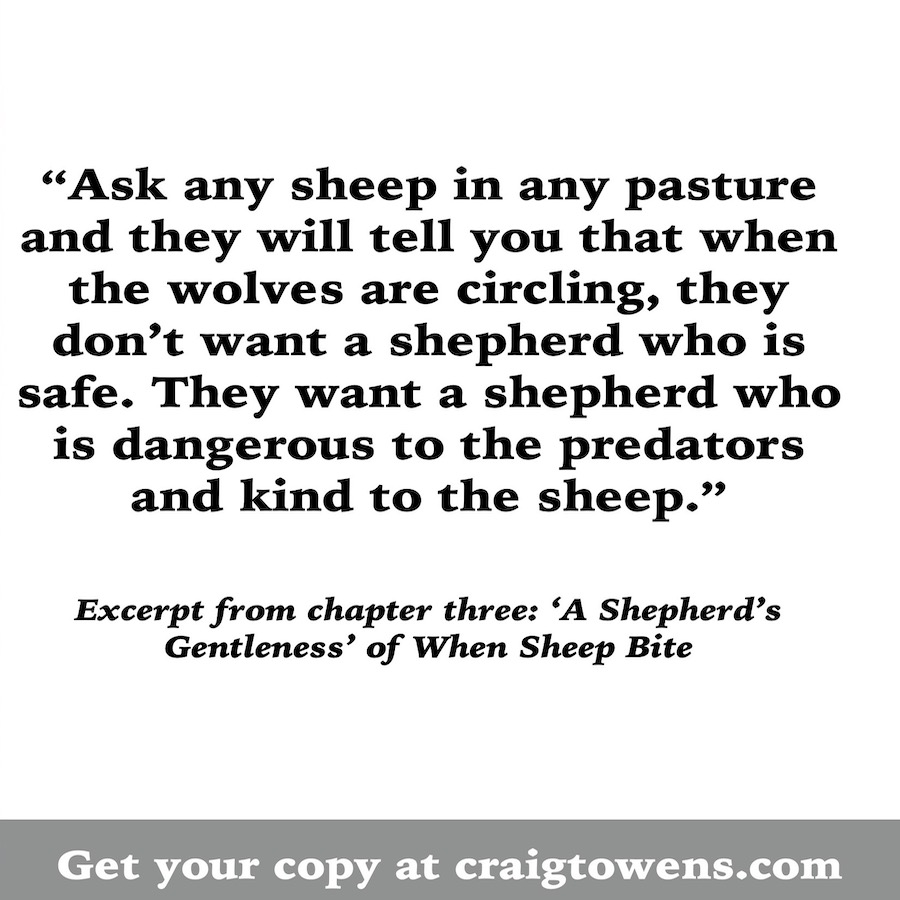
Gentleness is both a safe word and an unsafe word, which makes gentleness such an indispensable trait for shepherd leaders. Check out this clip from my time on the Leading from Alignment podcast.
Here is an excerpt from the chapter that Jim Wiegand was referencing—
I mention this fruit of gentleness specifically because I think it is one of the least understood and one of the most powerful virtues in a shepherd’s life. If you go to a modern dictionary for a definition of gentleness, you might read words like kind, moderate, calm, and tame. If you dig a little deeper into the synonyms, you will discover words like meek and mild.
The Greek philosophers thought and taught extensively about the virtues. For them a virtue was a healthy tension or a balanced response between two opposite extremes. Many philosophers referred to a virtue as a “golden mean” between those extremes. For instance, the virtue of generosity might be described as the golden mean between thriftiness and lavishness; courage could be the golden mean between rashness and timidity; and purity the golden mean between prudishness and immorality.
The gentleman or gentlewoman is not a pushover. They are strong. They know what they believe in and are passionate for the truth. They know when to fight and how to fight. So gentleness becomes the golden mean between a pacifist and a fighter. Gentleness is a lion with powerful muscles, razor-sharp claws, and a jaw strong enough to snap a bone who knows how to velvet its paws and use its nearly invincible strength as a means for good. —from Chapter 3: “A Shepherd’s Gentleness”
Listen to the podcast of this post by clicking on the player below, and you can also subscribe on Apple, Spotify, or Audible.
Brothers and sisters, do not slander one another. Anyone who speaks against a brother or sister or judges them speaks against the law and judges it. When you judge the law, you are not keeping it, but sitting in judgment on it. (James 4:11)
There are three Greek words that dominate this verse.
First, there is katalaleo. This word appears five times in the whole New Testament, with three of those used in this verse alone!
This verse in the NIV uses the words “slander” and “speaks against.” Other translations render these same words:
criticize (NLT)
accuse (AMPC)
malign (AMPC)
speak evil (NKJV)
bad mouth (MSG)
Literally translated katalaleo means “to talk down.” The word is only used in this verse and in 1 Peter 2:12 and 3:16, where worldlings are speaking against Christians. Paul uses the root word once in Romans 1:30, also to describe evil people as “backbiters.”
This word is never used in a complementary way, whether talking about those calling themselves Christians or not.
The second word is adelphos. This word is translated “brothers and sisters” three times in just this one verse. How sad that James has to put “slander” alongside “saints” when writing to the church!
The third word is krinos or krino. This word for judge or judgment is used four times in this single verse. It means to sit in an elevated or authoritative position to make rulings or determinations about others.
James says if we judge people, we are really judging the law; thereby, we judge the “only one Lawgiver and Judge, the One who is able to save and destroy” (v. 12).
His most convicting words are probably this: “When you judge the law, you are not keeping it.”
The Bible has much to say to those who talk about others, and none of it is good.
Talking about others…
(1) …Breaks the Mosaic law.You shall not give false testimony against your neighbor (Exodus 20:16).
(2) …Violates the Golden Rule.So in everything, do to others what you would have them do to you, for this sums up the Law and the Prophets (Matthew 7:12).
(3) …Doesn’t honor the Great Commandment.One of the teachers of the law came and heard them debating. Noticing that Jesus had given them a good answer, he asked Him, “Of all the commandments, which is the most important?” “The most important one,” answered Jesus, “is this: ‘Hear, O Israel: The Lord our God, the Lord is one. Love the Lord your God with all your heart and with all your soul and with all your mind and with all your strength.’ The second is this: ‘Love your neighbor as yourself.’ There is no commandment greater than these” (Mark 12:28-31).
(4) …Subjects me to judgment.Do not judge, or you too will be judged. For in the same way you judge others, you will be judged, and with the measure you use, it will be measured to you (Matthew 7:1-2).
(5) …Makes me a lawbreaker.If you really keep the royal law found in Scripture, “Love your neighbor as yourself,” you are doing right. But if you show favoritism, you sin and are convicted by the law as lawbreakers. For whoever keeps the whole law and yet stumbles at just one point is guilty of breaking all of it. For He who said, “You shall not commit adultery,” also said, “You shall not murder.” If you do not commit adultery but do commit murder, you have become a lawbreaker (James 2:8-11).
The bottom line:
🛑 STOP TALKING ABOUT OTHER PEOPLE!! 🛑
You may also want to check out a couple of related posts:



 When C.S. Lewis esteems another author’s work, that is a pretty good indication to me that I should take notice. Lewis wrote, “I was brought back…by the strong influence of two writers, the Presbyterian, George MacDonald, and the Roman Catholic, G.K. Chesterton.” In A Year with G.K. Chesterton, we get a small glimpse of what Lewis found so appealing.