Everyday Evidence

Last week we learned that speaking in tongues was one of the most noticeable and consistent characteristics of those who were baptized in the Holy Spirit. 

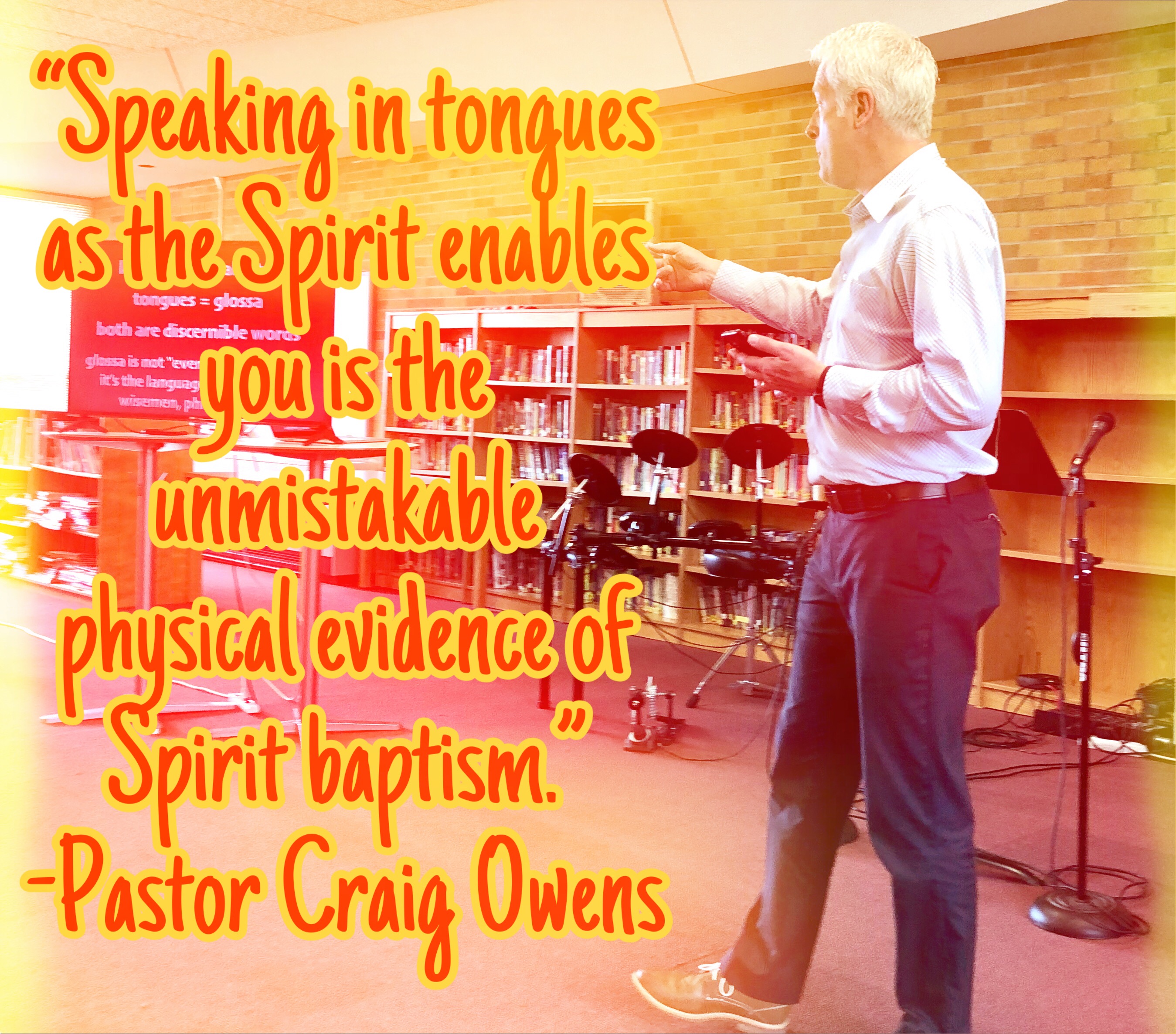
Speaking in tongues as the Spirit enables you is the unmistakable, objective, outward, initial physical evidence. The Bible makes clear that continuing to pray in tongues has huge benefits for both our personal prayer lives and for the corporate church body. But don’t stop there! 

The initial, outward evidence is primarily for the individual Christian—it’s a way of knowing that you know that you have indeed been baptized in the Spirit. But there also needs to be some everyday evidence for others that testifies to them that something is different about your life. 

Consider the disciples of Jesus before and after being baptized in the Holy Spirit…

Their vocabulary

Before being baptized in the Spirit they said stupid things because they didn’t know what to say (Mark 9:5-6) But after being baptized in the Spirit there was no more foot-in-mouth disease. Just as the Holy Spirit enabled them to praise God in an unlearned tongue, He also empowered their natural dialect. The same Greek word is used in Acts 2:4 (enabled by the Holy Spirit), 2:14 (Peter addressed the crowd), and 26:25 (what I am saying is true and reasonable). 

Their spiritual power

Before it was limited, and often thwarted, but afterward, it was limitless and effortless (Mark 9:17-18; Acts 3:1-8; 5:15; 6:8).

Their understanding of servanthood

Before they argued about who was the greatest. Afterward, they gladly gave all that they had to others (Mark 9:33-34; Acts 2:44-45). 

Their boldness in the face of adversity

Before they abandoned Jesus, ran away, and hid in locked rooms. Afterward, there was no intimidating or silencing them (Acts 4:8, 13, 18-20). 

Their understanding of Scripture

Before they had virtually no understanding of Scripture’s application. Afterward, they understood how to apply God’s Word in almost every situation (Acts 2:16, 33-35; 4:24-26). 

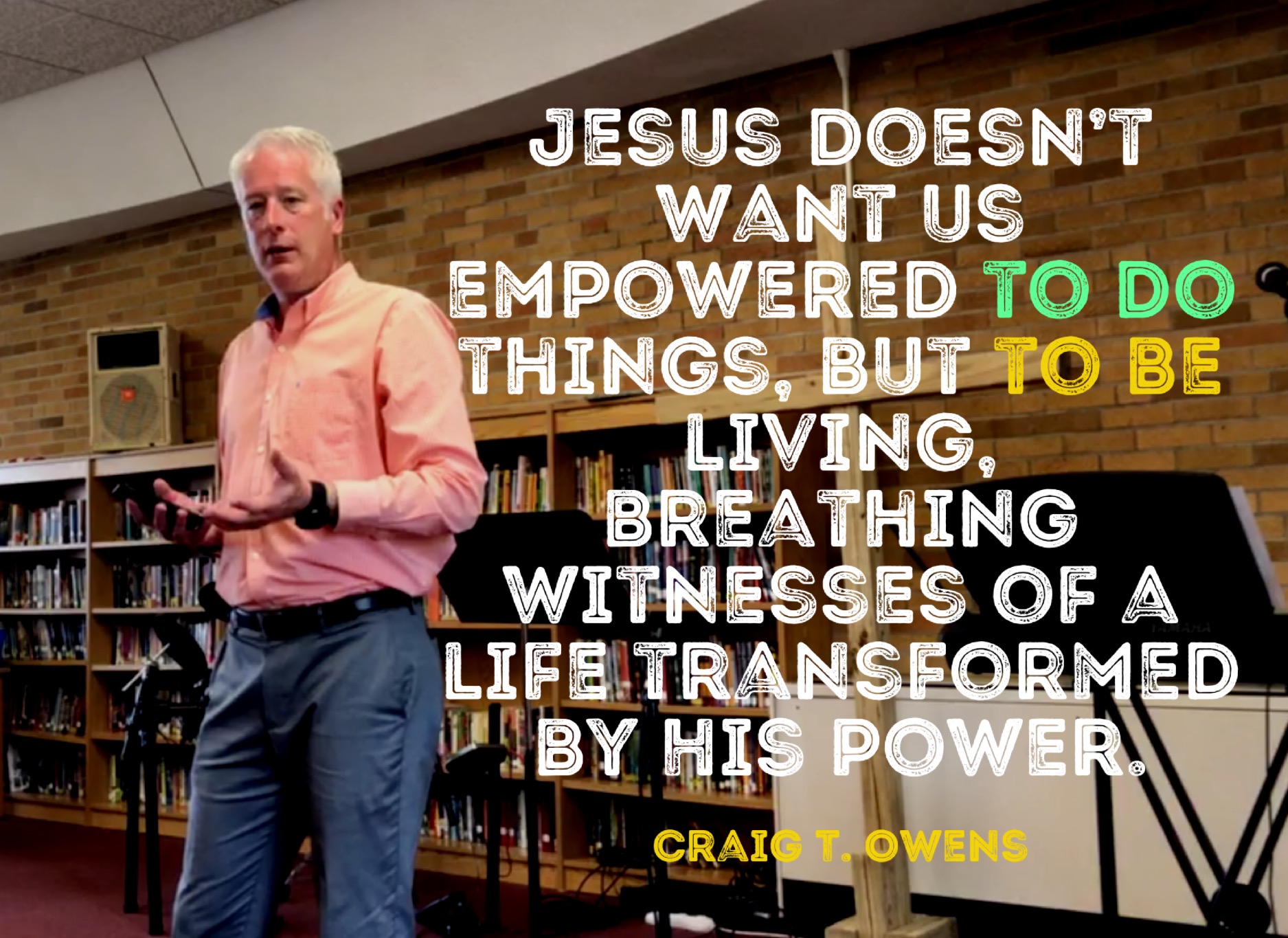
Jesus promised that the baptism in the Holy Spirit would empower us TO BE His witnesses (Acts 1:8). Not just to do things for Him. There’s nothing wrong about doing Jesus-glorifying things, but in themselves, they are too short-sighted. Jesus doesn’t want us empowered to do things, but TO BE a living, breathing, walking, talking witness of a life transformed by His power. That’s the reason why I say to you again and again: Don’t stop at salvation. Press on and press in to be baptized in the Holy Spirit so that you can BE an empowered, transformed and transforming witness for Jesus!

If you missed any of the messages in this series, you can access the full list of messages by clicking here

Poetry Saturday—The Course Of Prayer

Even so, the course of prayer who knows?
   It springs in silence where it will,
      Springs out of sight, and flows
         At first a lonely rill
But streams shall meet it by and by
   From thousand sympathetic hearts,
      Together swelling high
         Their chant of many parts. 
Unheard by all but angel ears
   The good Cornelius knelt alone,
      Nor dream’d his prayers and tears
         Would help a world undone. 
The while upon his terrac’d roof
   The lov’d Apostle to his Lord
      In silent thought aloof
         For Heavenly vision soar’d. 
Far o’er the glowing western main
   His wistful brow was upward rais’d,
      Where, like an angel’s train,
         The burnish’d water blaz’d. 
The saint beside the ocean pray’d,
   The soldier in his chosen bower
,
      Where all his eye survey’d
         Seem’d sacred in that hour. 
To each unknown his brother’s prayer,
   Yet brethren true in dearest love
      Were they—and now they share
         Fraternal joys above. —John Keble

On Full Display

In the same way, let your good deeds shine out for all to see, so that everyone will praise your heavenly Father. (Matthew 5:16)

Jesus wants Christians to be leaders, to be pacesetting examples. That means that Christian leaders must be comfortable with others carefully watching their lives. 

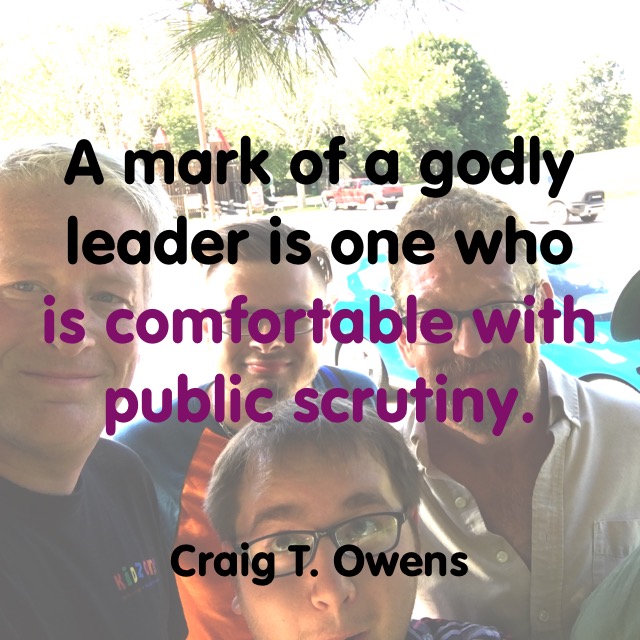
A mark of a godly leader is one who is comfortable with public scrutiny.

“It is bad enough to be blind ourselves. It is a thousand times worse to be a blind guide.” —J.C. Ryle 

“Live an exemplary life among the natives so that your actions will refute their prejudices. Then they’ll be won over to God’s side and be there to join in the celebration when he arrives.” —1 Peter 2:12 MSG 

Sermons must be practiced as well as preached…. If a man teach uprightly and walk crookedly, more will fall down in the night of his life than he built in the day of his doctrine.” —John Owen 

Be a walking, talking, living example of what you preach, in every silent moment of your life, known and unknown; bear the scrutiny of God, until you can prove that you are indeed an example of what He can do.” —Oswald Chambers 

“Behave yourselves wisely—living prudently and with discretion—in your relations with those of the outside world (the non-Christians)…” —Colossians 4:5 AMP

“We hear that some people in your group refuse to work [or are behaving irresponsibly; are living/walking in idleness/disorder]. They do nothing but busy themselves [meddle; interfere] in other people’s lives. We command those [such] people and beg [urge; encourage; exhort] them in the Lord Jesus Christ to work quietly [or settle down] and earn [eat] their own food.” —2 Thessalonians 3:11-12 EXB)

“We should make less excuses for the weaknesses of a Christian than for any other man. A Christian has God’s honor at stake. When a man is regenerated and bears the Name of Christ the Spirit of God will see to it that he is scrutinized by the world, and the more we are able to meet that scrutiny the healthier will we be as Christians.” —Oswald Chambers 

This is part 37 in my series on godly leadership. You can check out all of my posts in this series by clicking here.

Thursdays With Spurgeon—How satan Attacks

This is a weekly series with things I’m reading and pondering from Charles Spurgeon. You can read the original seed thought here, or type “Thursdays With Spurgeon” in the search box to read more entries.

How satan Attacks

     Our faith at times has to fight for its very existence. The old Adam within us rages mightily, and the new spirit within us, like a young lion, disdains to be vanquished; and so these two strong ones contend, till our spirit is full of agony. …

     Christ alone was tempted in all points as we are, though without sin. No one man is tempted in all points exactly like another man, and each one has certain trials in which he must stand alone amid the rage of war, with not even a book to help him, or a biography to assist him—no man ever having gone that way before except that one Man whose trail reveals a nail-pierced foot. He alone knows all of the devious paths of sorrow. Yet even in such byways, the Lord is with us, helping us, sustaining us, and giving us grace to conquer at the close. … 

     So satan, loath to leave a soul, pursues it hotfoot. He will have it back if he can; and often, soon after conversion, there comes a time of dreadful conflict, when the soul seems as if it could not live. … 

     Once, when the tempter had grievously assailed me, I went to see my dear old grandfather. I told him about my terrible experience, and then I wound up by saying, “Grandfather, I am sure I cannot be a child of God, or else I should never have such evil thoughts as these.”

     “Nonsense, Charles,” answered the good old man. “It is just because you are a Christian that you are thus tempted. These blasphemies are no children of yours; they are the devil’s brats, which he delights to lay at the door of a Christian. Don’t you own them as yours; give them neither house-room or heart-room.” 

From The Autobiography of Charles Spurgeon 

The spiritual attacks—especially on new Christians—can be intense. Even “veteran” Christians aren’t immune to such attacks. 

Although every Christian shares some commonality in the ways in which we are tempted, no one experiences an identical attack. The devil is a cunning schemer and he can tailor-make his attacks to each individual. Gratefully, there is One who knows every minute detail of our temptation. Jesus was tempted in every way that we are, and He overcame those temptations without sinning. Now our victorious Savior stands before God’s throne interceding on our behalf as we battle the tempter. 

Spurgeon’s grandfather was right—don’t own these satanic blasphemies as your own! Remind yourself that you are in a war. Then say with the apostle Paul, “Thanks be to God that Jesus Christ has rescued me from all these. There is now no condemnation for me because I am in Christ Jesus, and there is absolutely nothing that can separate me from that love!” (see Romans 7:25; 8:1, 31-39)

Worth The Risk

“‘And Jesus said unto them, strive to enter in at the straight gate: for many, I say unto you, will seek to enter in, and shall not be able’ (Luke 13:24). Christ said His disciples were measuring by a wrong rule. ‘If following after sermons and testimonies and excitement were enough to save, heaven would already be full,’ He was saying. But do not sift the pure from the impure by such a coarse sieve. ‘Strive to enter—fight and wrestle, risk life and limb rather than fall short of heaven.’ … Almost anyone is willing to walk through heaven’s door if he never has to risk his pride in public or hazard his everyday interests by any inconvenience or opposition of the world.” —William Gurnall, in The Christian In Complete Armor

My Conscience

…my conscience also bearing me witness in the Holy Spirit (Romans 9:1). 

Conscience is that God-implanted part of a human soul that can distinguish between…

  • …the morally good and the morally bad 
  • …the things that attract God’s presence and the things that repel God’s presence
  • …commending things and condemning things
  • …the things that please the Holy Spirit and the things that grieve the Holy Spirit

Sin corrupts a conscience. Sin tries to blur the lines between good and evil. Sin looks for loopholes. 

Paul said his conscience was aligned with the Holy Spirit—my conscience bearing me witness in the Holy Spirit. 

The word for witness is the Greek word martyreo. Martyreo helps me distinguish because of personal experience OR divine revelation. In the case of a Holy Spirit-baptized Christian, it isn’t OR, it’s AND. Jesus used the same word when He said the baptism in the Spirit would empower His followers to be martyreo (Acts 1:8). 

The Holy Spirit aligns my conscience with God’s righteousness. The Spirit grieves when I fall short, and He rejoices when I obey. 

Following the other uses of martyreo in the New Testament, we can see that a Spirit-aligned conscience…

Can you say with Paul, “My conscience is aligned with the Holy Spirit”? You can if you make it a daily habit to listen for the Spirit’s voice and then obey His promptings. 

Don’t let sin corrupt your conscience, but let the Holy Spirit align your conscience with God’s righteousness. 

The Unmistakable Evidence

That Pentecost Sunday immediately following Christ’s resurrection forever changed what Pentecost stood for. From this point forward, Christians who have encountered the Holy Spirit as those 120 followers of Jesus did now call themselves Pentecostal. (Check out Acts 2:1-12, 16, 22-24, 37-39.)

If you had been present on that day, there were three pieces of evidence you would have noticed:

  1. Wind—this is the Greek word pneuma, which is the same as the Hebrew word ruach. This is the impartation of the Spirit that brings a true life connection to the Trinity (Genesis 2:7). This power was foretold by Jesus when He promised, “you will receive power when the Holy Spirit comes on you…” (Acts 1:8a). 
  1. Fire—this was foretold by John (Luke 3:16). This fire was to light up our witness to a dark world (Matthew 5:14-16). Again Jesus promised, “you will receive power to be My witnesses…” (Acts 1:8b). 
  1. Tongues—this fulfilled the promise of Jesus, “to be My witnesses…to the ends of the earth” (Acts 1:8c). 

Some have tried to call this speaking in tongues an “ecstatic utterance,” or just nonsensical gibberish. But notice the descriptions Luke gives: each one heard them speaking in his own language (v. 6), each of us hears them in his own native language (v. 8), and declaring the wonders of God in our own tongues (v. 11). Luke lists visitors from over 15 different places around the world that heard their native tongue being spoken by these native Galileans. Luke pointed out that these Spirit-baptized Christians spoke like this as the Spirit enabled them (v. 4b). 

Two types of vocabulary are happening here—language (vv. 6, 8), which is the Greek word dialektos, and tongues (vv. 4, 11), which is the Greek word glossa. 

Dialektos is a learned language. Glossa can also be learned, but it’s not something that one just casually picks up. The Greeks said glossa is “not a word of everyday speech but one belonging to dignified and elevated discourse.” The Greeks called glossa the language of prophets, wisemen, and philosophers.

“But,” you might say, “speaking in tongues sounds weird!” Yes, it does. As N.T. Wright said:

“God acts completely unexpectedly—as He always said He would.” 

Remember this—God is God. He is uncontainable, indefinable. If we can define Him, He is not God, but we are. He always does things “out of the box”—at least out of our box, not His! Like sending His Son born of a virgin, and empowering Jesus to restore sight to one born blind, and enabling Jesus to cure someone who contracted leprosy, and even reversing the laws of biology to bring Jesus back to life! 

So it’s not unexpected that the baptism of the Holy Spirit is accompanied by someone praising God in a dialect they have never learned. Speaking in tongues as the Spirit enables you is the unmistakable, objective, outward, initial physical evidence of the baptism in the Holy Spirit. 

Jesus wants us to have rivers of living water flowing—bursting!—out of us. This living water can flow out of anyone who has the Spirit IN them! Don’t wait another day: be baptized in the Holy Spirit.

If you missed any of the messages in this series, you can access the full list of messages by clicking here.
Poetry Saturday—O My Soul What Means This Sadness

O my soul! what means this sadness?
Wherefore art thou thus cast down?
Let thy griefs be turned to gladness,
Bid thy restless fears be gone;
Look to Jesus, look to Jesus,
And rejoice in His dear name.

What though satan’s strong temptations
Vex and grieve thee day by day,
And thy sinful inclinations
Often fill thee with dismay;
Thou shalt conquer,
Through the Lamb’s redeeming blood.

Though ten thousand ills beset thee
From without and from within,
Jesus saith He’ll ne’er forget thee,
But will save from hell and sin.
He is faithful
To perform His gracious Word.

Though distresses now attend thee,
And thou tread’st the thorny road,
His right hand shall still defend thee;
Soon He’ll bring thee home to God.
Therefore praise Him,
Praise the great Redeemer’s name.

Oh that I could now adore Him
Like the heavenly host above,
Who forever bow before Him,
And unceasing sing His love.
Happy songsters!
When shall I your chorus join? —W.B. Bradbury

The Doom Hanging Over Our Nation

“Since Roe vs. Wade in 1973, more than 50,000,000 babies have been murdered.

“How many missionaries were murdered in their mother’s wombs?

“How many astute business people gifted in creating wealth to give to missionary work among the unreached were slain before they drew a breath or donated a dollar?

“How many billions of hours of intercessory prayer have been lost because men and women who would have stormed heaven on their knees for the sake of those who have never heard were never heard themselves?

“How much damage, loss, and injury has been done to the spread of the gospel because we killed millions of God’s missionary hearted children in utero? … 

The doom of any nation that rebels against God is sure. The fact that God allows any good to come out of a nation that has brutally murdered 50,000,000 children can only be explained by His unfathomable mercy and the fact that there is a remnant that still lives for the glory of God among the nations. Missionary activity—that is Jesus-centered and gospel-preaching—is scorned and ridiculed by secular America today. Ironically, that activity may be the only reason God has not destroyed this land.” —Dick Brogden, in Missionary God, Missionary Bible

Thursdays With Spurgeon—Blessed Assurance

This is a weekly series with things I’m reading and pondering from Charles Spurgeon. You can read the original seed thought here, or type “Thursdays With Spurgeon” in the search box to read more entries.

Blessed Assurance

     The Holy Spirit, who enabled me to believe, gave me peace through believing. I felt as sure that I was forgiven as before I felt sure of condemnation. I had been certain of my condemnation because the Word of God declared it, and my conscience bore witness to it; but when the Lord Jesus justified me, the same witnesses made me equally certain. The Word of the Lord in the Scripture says, “He who believes in Him is not condemned” (John 3:18), and my conscience bore witness that I believed, and that God in pardoning me was just. Thus I had the witness of the Holy Spirit and also of my own conscience, and these two agreed in one. …  

     I find the apostle Paul speaking by the Holy Spirit and saying, “Having been justified by faith, we have peace with God” (Romans 5:1). If I know that my trust is fixed on Jesus only, and that I have faith in Him, were it not ten thousand times more absurd for me not to be at peace than for me to be filled with joy unspeakable? It is but taking God at His Word, when the soul knows as a necessary consequence of its faith that it is saved. …  

     Has Jesus saved me? I dare not speak with any hesitation here; I know He has. His word is true; therefore I am saved. My evidence that I am saved does not lie in the fact that I preach, or that I do this or that. All my hope lies in this, that Jesus Christ came to save sinners. I am a sinner, I trust Him, then He came to save me, and I am saved. I live habitually in the enjoyment of this blessed fact, and it is long since I have doubted the truth of it, for I have His own Word to sustain my faith.

From The Autobiography Of Charles Spurgeon

The joy that Spurgeon recounts in his conversion is the same joy that is available to all who call on Jesus in faith. As Spurgeon was prone to quoting passages of hymns in his sermons and books, these words of his remind me of a favorite hymn as well—

Blessed assurance, Jesus is mine;
Oh, what a foretaste of glory divine! 
Heir of salvation, purchase of God,
Born of His Spirit, washed in His blood. 
This is my story, this is my song,
Praising my Savior all the day long!