Thursdays With Spurgeon—Mercy Finds The Loophole

This is a weekly series with things I’m reading and pondering from Charles Spurgeon. You can read the original seed thought here, or type “Thursdays With Spurgeon” in the search box to read more entries.

Listen to the podcast of this post by clicking on the player below, and you can also subscribe on iTunes or Spotify.

Mercy Finds The Loophole

And the Lord smelled a soothing aroma. Then the Lord said in His heart, “I will never again curse the ground for man’s sake, although the imagination of man’s heart is evil from his youth; nor will I again destroy every living thing as I have done.” (Genesis 8:21) 

     To begin, then, with the text, we have here a most painful fact that man’s nature is incurable. ‘The imagination of man’s heart is evil from his youth.’ You will remember, before the flood, in the fifth verse of the sixth chapter, it is written, ‘Then the Lord saw that the wickedness of man was great in the earth, and that every intent of the thoughts of his heart was only evil continually’ (Genesis 6:5). After the flood it was just the same. … 

     You might have hoped that after so terrible a judgment, when only a picked and peculiar few, that is, eight, were saved by water, that man began anew with better stock.… It is not one wit so. The same God who, after looking at men, declared that his imagination was evil before the flood, pronounces the very same verdict upon them afterward. …

     I believe that God might justly have condemned the whole race of Adam on account of Adam’s sin and their own guilt. But I do think that this was a blessed loophole through which His mercy could, as it were, come fairly to the sons of men. ‘No,’ He says, ‘I made them not distinct individuals but a race. They fell as a race; they will rise as an elect race. “For as in Adam all die, even so in Christ all shall be made alive” (1 Corinthians 15:22). And ‘For as by one man’s disobedience many were made sinners, so also by one Man’s obedience many will be made righteous” (Romans 5:19).’ … 

     I must have more than nature can give me. More than my mother gave me, more than my father gave me, and more than flesh and blood can produce under the most favorable circumstances. I must have the Spirit of God from heaven.

From Human Depravity And Divine Mercy

When Adam and Eve sinned, God wasn’t scrambling to come up with a Plan B. Jesus is described as the Lamb slain from the foundation of the world (Revelation 13:8), meaning that God had His merciful plan of redemption ready before He even created humans! 

The atoning sacrifice Jesus made on the Cross was the “loophole” that God’s mercy used to pardon our sins. We can never earn our salvation because we are still people with evil hearts. But we can put our faith in the One who took our punishment upon Himself so that His righteousness can be our righteousness. 

O what a Savior! O what mercy God has shown! O how great is His love for us! How shall we escape appropriate retribution if we neglect and refuse to pay attention to such a great salvation…? (Hebrews 2:3)

►► Would you please prayerfully consider supporting this ministry? ◀︎◀︎
 

A Persistent Mother

I love this mother! She exemplifies persistence and insistence in prayer.

Leaving that place, Jesus withdrew to the region of Tyre and Sidon. A Canaanite woman from that vicinity came to Him, crying out, “Lord, Son of David, have mercy on me! My daughter is suffering terribly from demon-possession.”

Jesus did not answer a word. So His disciples came to Him and urged Him, “Send her away, for she keeps crying out after us.”

He answered, “I was sent only to the lost sheep of Israel.”

The woman came and knelt before Him. “Lord, help me!” she said.

He replied, “It is not right to take the children’s bread and toss it to their dogs.”

“Yes, Lord,” she said, “but even the dogs eat the crumbs that fall from their masters’ table.”

Then Jesus answered, “Woman, you have great faith! Your request is granted.” And her daughter was healed from that hour. (Matthew 15:21-28; Mark 7:24-30)

10 Quotes From The Ten Booms

Listen to the podcast of this post by clicking on the player below, and you can also subscribe on Apple or Spotify.

I recently shared my book review on the heroic story of the ten Boom family during the Nazi occupation of Holland, as told in the story The Hiding Place. This story is a must-read! Please check out my full book review by clicking here. 

These are some quotes from these godly sisters. 

“Worry does not empty tomorrow of its sorrow. It empties today of its strength.” —Corrie ten Boom 

“Any concern too small to be turned into prayer is too small to be made into a burden.” —Corrie ten Boom 

“When Jesus Christ tells us to forgive our enemies, He gives us the power He demands of us.” —Corrie ten Boom 

“We must tell people how good God is. After the war, we must go around telling people. No one will be able to say that they have suffered worse than us. We can tell them how wonderful God is, and how His love will fill our lives, if only we will give up our hatred and bitterness.” —Betsie ten Boom 

“At that moment when I was able to forgive, my hatred disappeared. … Forgiveness is the key which unlocks the door of resentment and the handcuffs of hatred. It is a power that breaks the chains of bitterness and the shackles of selfishness. What a liberation it is when you can forgive.” —Corrie ten Boom 

“Never be afraid to trust an unknown future to a known God.” —Corrie ten Boom 

“When a train goes through a tunnel and it gets dark, you don’t throw away the ticket and jump off. You sit still and trust the engineer.” —Corrie ten Boom 

“If they can be taught to hate, they can be taught to love.” —Betsie ten Boom, speaking to Corrie about the Nazi prison guards 

“We never know how God will answer our prayers, but we can expect that He will get us involved in His plan for the answer. If we are true intercessors, we must be ready to take part in God’s work on behalf of the people for whom we pray.” —Corrie ten Boom 

“Holiness is the Holy Spirit, a holy God in my heart, which makes me similar to Jesus.” —Betsie ten Boom 

►► Would you please prayerfully consider supporting this ministry? ◀︎◀︎

By the way, another great book of recollections from Corrie is I Stand At The Door And Knock. 

The Craig And Greg Show: What’s New, Leadercat?

On this episode of “The Craig And Greg Show” we talk about: 

  • the challenge for leaders when things are changing
  • too many leaders get comfortable with the status quo 
  • leaders need to adopt a growth mindset
  • what if we changed “what’s the worst that could happen?” to “what’s the best that could happen?”
  • I reference John Maxwell’s helpful book Sometimes You Win—Sometimes You Learn  
  • Greg cautions that either we address change or we avoid change, but if we avoid changing, our group may move on without us
  • just because we are changing doesn’t mean we are growing
  • Greg offers counsel on what leaders need to evaluate when considering changes
  • “unhealthy leaders change things to gain more control; healthy leaders change things to help the whole team get better,” Greg says
  • we don’t grow in areas of comfort: we learn most of our lessons moving forward, but we learn very few lessons sitting still
  • good leaders reassure other leaders to make thoughtful changes
  • the right way for leaders to partner with their team to effect positive changes

Check out this episode and subscribe on YouTube so you can watch all of the upcoming episodes. You can also listen to our podcast on Spotify and Apple.

How To Bring Men To Christ (book review)

Listen to the podcast of this post by clicking on the player below, and you can also subscribe on Apple or Spotify.

Among the last words Jesus spoke to His disciples was His commission that after they were empowered by the baptism in the Holy Spirit they should go into all the world, preaching the gospel, and making more disciples of Jesus. R.A. Torrey spent his life fulfilling this commission, and he shares the lessons he learned in his book How To Bring Men To Christ. 

This book is a highly practical guide that is set up almost like an encyclopedia. After a brief introduction, the second chapter is simply entitled “How to begin,” and it outlines the broad, big-picture strokes. Then the next nine chapters are all entitled “Dealing with….” Torrey gives us a detailed listing of passages of Scripture, including how and when to use them, for various types of people, such as: the indifferent, those anxious about their eternal fate, those with false hopes, those who lack assurance of salvation, skeptics, complainers, and the hardheaded. Torrey gives the Christian soul-winner all of the biblical help they will need, plus some personal examples of how he employed these scriptures himself. 

The final two chapters of this book focus on the role of the Holy Spirit in helping Christians progress in their own sanctification and grow in their maturity as soul winners. 

How To Bring Men To Christ can probably be read through quite quickly, but it is a book that many Christians will want to put in a place of reference where they can return to it again and again. All Christians who want to live out the Great Commission that was given to us by Jesus Himself will want to read this highly practical book.

►► Would you please prayerfully consider supporting this ministry? ◀︎◀︎

“Father, Forgive Them”

Listen to the podcast of this post by clicking on the player below, and you can also subscribe on Apple or Spotify.

In our system of law, special attention is given to someone’s dying declaration. If our legal system gives such weight to the last words of an imperfect man, it seems to me that we should take special note of the dying declarations of the only truly innocent Man who ever walked this earth: Jesus Christ. 

After being nailed to the Cross, the first dying declaration from Jesus was: Father, forgive them, for they do not know what they are doing (Luke 23:34). 

Let’s say that Billy is dying on a hospital bed after being fatally shot, and all he can muster the strength to do is point at Johnny and whisper, “He… shot… me….” We would know who the “he” was in that situation, but who exactly is the “them” in this declaration of Jesus? 

Who offended Jesus? Who mortally wounded Him? Who caused Him such anguish? Maybe it was…

  • His disciples who couldn’t stay awake to pray with Him 
  • Judas who betrayed Him with a kiss 
  • the nine disciples who ran away 
  • Peter who denied three times that he knew Jesus 
  • the false witnesses in Caiaphas’ house
  • the members of the Sanhedrin who hit Him and spit on Him 
  • the members of the Sanhedrin who were silent 
  • the temple guards who mocked Him 
  • those who spewed lies when Jesus stood before Pilate
  • those who lied about Jesus when He stood before Herod 
  • Herod and his soldiers who mocked Him 
  • the Roman soldiers who abused Him 
  • the Roman soldiers who stripped Him naked and crucified Him 

To all of the above, Jesus said, “Father, forgive them”!  

Listen to how Peter described the response of Jesus to all of this: When they hurled their insults at Him, He did not retaliate; when He suffered, He made no threats… (1 Peter 2:23). That word for insults means to heap abuse on Him or to pile on. This was a fulfillment of a 700-year-old prophecy: He was oppressed and afflicted… (Isaiah 53:7). Isaiah uses similar words, where oppressed means tyrannized, and afflicted means a humiliating, painful loss of dignity. 

Christ’s own disciples afflicted Him, and so did the temple guards, and Pilate, and King Herod, and the Roman soldiers… and you and me. All of this mistreatment and humiliation and tyrannizing was handed out by us too (see Isaiah 53:6; 1 Peter 2:24-25). That’s why His arms were spread so wide when He said, “Father, forgive them,” because there were so many that needed forgiveness! 

When Jesus said forgive, He was asking His Father to take away our guilt that kept us out of God’s presence. Think of a courtroom scene where God the Father is the Judge, satan is the prosecutor, Jesus is the victim, and I am the defendant. The evidence is overwhelming and incontrovertible, and I am pronounced guilty. My punishment is a death sentence. When Jesus says, “Father, forgive him,” He is taking the death penalty in my place! 

In another beautiful fulfillment of an Old Testament practice, Jesus became both our sin offering and our scapegoat, making atonement for us at the mercyseat in the Most Holy Place, and allowing us to be welcomed into God’s holy presence (Leviticus 16:15-16, 20-22; Hebrews 9:12-14). 

When Jesus said, “Father, forgive them,” He was saying, “Father, bring them into Your presence!” 

You and I need to accept by faith the atoning work done on the Cross, the forgiveness of sins that was purchased for us. Jesus didn’t come to condemn us, but to lovingly restore us, and for that we are eternally and humbly grateful. 

Please don’t miss out on any of these dying declarations from Jesus. You can find my thoughts on all of the confessions of this dying Man by clicking here.

►► Would you please prayerfully consider supporting this ministry? ◀︎◀︎

Poetry Saturday—My Blessing, My Proof

Listen to the podcast of this post by clicking on the player below, and you can also subscribe on Apple or Spotify.

I will not be dissuaded from my view
that we shall see revival not long hence;
there’s just too much persuasive evidence
to make me think God’s promise is not true.
The many and abundant blessings, new
each day, with which we are surrounded—dense
with love divine, portending heaven, whence
they come to us, and which they witness to—
betoken greater, worldwide blessings, due
when God is pleased that they their sweet descents
should make. Our daily bounty thus presents
fresh hope that soon revival will ensue.
   My daily blessings coalesce in you,
   my Proof and foretaste of what God will do. —T.M. Moore (based on Psalm 67:6-7)

This poem is from T.M. Moore’s enjoyable book of poetry Bricks and Rungs.

►► Would you please prayerfully consider supporting this ministry? ◀︎◀︎

Thursdays With Spurgeon—Our Daily Doctrine Of Experience

This is a weekly series with things I’m reading and pondering from Charles Spurgeon. You can read the original seed thought here, or type “Thursdays With Spurgeon” in the search box to read more entries.

Listen to the podcast of this post by clicking on the player below, and you can also subscribe on iTunes or Spotify.

Our Daily Doctrine Of Experience 

[God] alone is my rock and my salvation (Psalm 62:2).

     Doctrine is nothing unless it is proved in our experience. Most of God’s doctrines are only to be learned by practice—by taking them out into the world and letting them bear the wear and tear of life. …  

     Think how many enemies you have. How many rivers you have to cross, how many mountains to climb, how many dragons to fight, how many lions’ teeth to escape, how many fires to pass through, how many floods to wade. … Can your salvation be of anything except God? … 

     I beseech you, remember this. I hope you know it by experience in the past, but try to remember it in the future—wherever you go, ‘Salvation is of the Lord.’ Do not get to looking at your heart; do not get to examining to see whether you have anything to recommend you; just remember, salvation is of the Lord. ‘He alone is my rock and my salvation.’ … 

     I say, Christian, your highest and noblest experience is not to be groaning about your corruption, is not to be crying about your wanderings, but is to say, ‘With all my sin and care and woe, His Spirit will not let me go.’ ‘Lord, I believe; help my unbelief!’ (Mark 9:24). …  

     Now we must have the great duty. The great duty is this: If God only is our rock and we know it, are we not bound to put all our trust in God, to give all our love to God, to set all our hope upon God, to spend all our life for God, and to devote our whole being to God? … Trace your mercies to God and say perpetually, ‘He alone is my rock and my salvation.’

From God Alone The Salvation Of His People

If you will look through the pages of the Bible, you will see that people struggled when they forgot what God had done for them and therefore they began to take matters into their own hands. In the Old Testament, the prophets called this idolatry and adultery; in the New Testament, Jesus called this a lack of faith. 

An old hymn reminds us:

Oh, to grace how great a debtor
Daily I’m constrained to be!
Let Thy goodness, like a fetter
Bind my wandering heart to Thee
Prone to wander, Lord, I feel it
Prone to leave the God I love
Here’s my heart, Oh, take and seal it
Seal it for Thy courts above (Robert Robinson, Come Thou Fount)

I think this is the reason why Jesus taught us to pray, “Give us today our daily bread.” We need to be perpetually reliant on God’s grace—a perpetual debtor. This posture reminds us, “He alone is my rock and my salvation,” and guards us against the spirit of self-reliance that would lead us astray. 

Let our doctrine be proven in our daily experience of coming to God as our one and only Source again and again and again.

►► Would you please prayerfully consider supporting this ministry? ◀︎◀︎

 

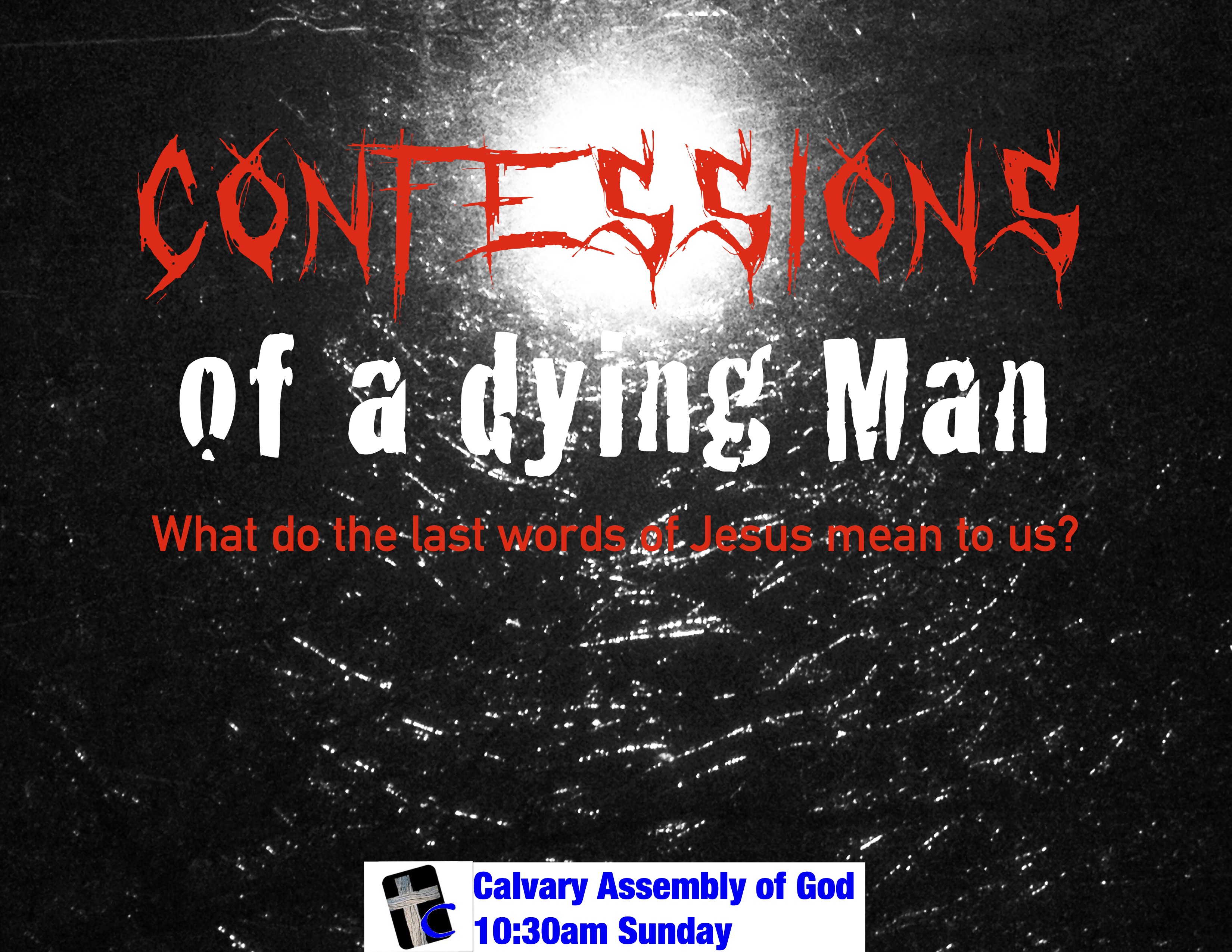
Confessions Of A Dying Man

In our justice system, rarely will a judge allow hearsay testimony to be introduced in court. But there is one notable exception: a dying declaration. 

A dying declaration is the statement of a mortally injured person who is aware he or she is about to die. This statement is admissible testimony in court on the theory that a dying person has no reason not to tell the truth. 

Jesus was nailed to a Cross. Mortally injured, unable to escape, He had no reason to lie. In His dying moments, struggling to get enough air in His lungs to be able to speak, Jesus choked out seven statements that still have a profound impact on us today. 

Here are the confessions of Jesus we have discussed:

Prideful Prayer

Listen to the podcast of this post by clicking on the player below, and you can also subscribe on Apple or Spotify.

To some who were confident of their own righteousness and looked down on everybody else, Jesus told this parable: “Two men went up to the temple to pray, one a Pharisee and the other a tax collector. The Pharisee stood up and prayed about himself: ‘God, I thank You that I am not like other men—robbers, evildoers, adulterers—or even like this tax collector. I fast twice a week and give a tenth of all I get.’

“But the tax collector stood at a distance. He would not even look up to heaven, but beat his breast and said, ‘God, have mercy on me, a sinner.’

“I tell you that this man, rather than the other, went home justified before God. For everyone who exalts himself will be humbled, and he who humbles himself will be exalted.” (Luke 18:9-14) 

I think the NIV footnote on verse 11 is the most accurate rendering of “the Pharisee stood up and prayed about himself.” The footnote says, “He prayed TO himself.” He made himself God, which, if you will recall, is exactly how satan tempted Adam and Eve—you will be like God (Genesis 3:5). 

In a portion of William Cowper’s poem Truth, he addresses the pride of the Pharisee, and warns us that this could be our pride too if we aren’t carefully guarding our hearts. 

Who judged the Pharisee? What odious cause
Exposed him to the vengeance of the laws?
Had he seduced a virgin, wrong’d a friend,
Or stabb’d a man to serve some private end?
Was blasphemy his sin? Or did he stray
From the strict duties of the sacred day?
Sit long and late at the carousing board?
(Such were the sins with which he charged his Lord.)
No—the man’s morals were exact. What then?
‘Twas his ambition to be seen of men;
His virtues were his pride; and that one vice
Made all his virtues gewgaws [gyoo-gaws] of no price;
He wore them as fine trappings for a show,
A praying, synagogue-frequenting beau.
The self-applauding bird, the peacock, see—
Mark what a sumptuous Pharisee is he!
Meridian sunbeams tempt him to unfold
His radiant glories, azure, green, and gold:
He treads as if, some solemn music near,
His measured step were govern’d by his ear;
And seems to say—“Ye meaner fowl give place;
I am all splendour, dignity, and grace!”
Not so the pheasant on his charms presumes,
Though he, too, has a glory in his plumes.
He, Christian-like, retreats with modest mien
To the close copse or far sequester’d green,
And shines without desiring to be seen.
The plea of works, as arrogant and vain,
Heaven turns from with abhorrence and disdain;
Not more affronted by avow’d neglect,
Than by the mere dissembler’s feign’d respect.
What is all righteousness that men devise?
What—but a sordid bargain for the skies!
But Christ as soon would abdicate His own,
As stoop from heaven to sell the proud a throne.

When the writer of Hebrews says that we can approach the throne of grace boldly, it is clear that it is not because of our righteous deeds, even if they are as exacting and as perfect as a Pharisee. We can only come boldly into God’s presence because we come in the name and the righteousness of Jesus. “I tell you that this man, rather than the other, went home justified before God.” 

Adding “in Jesus name” to the end of our prayers isn’t a password that opens the storeroom of Heaven, but it is a reminder that we have nothing in ourselves to commend us to God. We come boldly only in Jesus.

►► Would you please prayerfully consider supporting this ministry? ◀︎◀︎