[6:30] Efficiency and effectiveness don’t have to compete with each other
[7:11] Quality is never an accident
[7:50] Greg shares a helpful list of three items, but to stay on track you can only pick 2-of-the-3
[8:45] What distracts us from pursuing quality?
[10:00] Both quality and quantity have their places, but the leader needs to determine which one takes the priority
[10:47] Greg shares a comical conclusion he made after overhearing a break room conversation
[12:27] Why do leaders find security in “more”?
[13:55] There is one key place where quantity should probably come first
[14:48] Numbers are easy to use to measure quantity, but quality is much harder to measure
[16:38] An important lesson for leaders
[18:14] A leader’s words need to be more qualitative than quantitative
[19:15] Our coaching huddle clients get both quantity and quality
Check out this episode and subscribe on YouTube so you can watch all of the upcoming episodes. You can also listen to our podcast on Spotify and Apple.
This is a weekly series with things I’m reading and pondering from Charles Spurgeon. You can read the original seed thought here, or type “Thursdays With Spurgeon” in the search box to read more entries.
Listen to the podcast of this post by clicking on the player below, and you can also subscribe on Apple, Spotify, or Audible.
The Whole Counsel Of God’s Word
The words of the Lord are flawless, like silver purified in a crucible, like goldrefined seven times. (Psalm 12:6)
Beloved friends, consider the quality of the words of God. ‘The words of the Lord are pure words.’ From this statement I gather, first, the uniformity of their character. No exception is made to any of the words of God, but they are all described as pure words. They are not all of the same character. Some are for teaching, others are for comfort, and others for rebuke. But they are so far of a uniform character that they are all pure words. I conceive it to be an evil habit to make preferences in Holy Scripture. We must preserve this volume as a whole. …
Above all, do not drop into the semi-blasphemy of some, who think the New Testament vastly superior to the Old. … They are of equal authority, and they cast such light upon each other that we could not spare either of them. … In the whole Book, from Genesis to Revelation, the words of Jehovah are found, and they are always pure words. …
Whether the Holy Spirit speaks by Isaiah, or Jeremiah, or John, or James, or Paul, the authority is still the same. Even concerning Jesus Christ our Lord this is true. For He says of Himself, ‘The word which you hear is not Mine, but the Father’s who sent Me’ (John 14:24). In this matter He puts Himself upon the level of others who were as the mouth of God.
From The Bible Tried And Proved
Because my parents were such amazing hosts, we had a steady stream of evangelists and missionaries that dined in our home. As a young man, I was so blessed to sit at the dining room table and listen to some of the wisest and godly preachers of their time.
One such evangelist was C.M. Ward, who hosted the “Revivaltime” radio broadcast for a quarter of a century. I remember listening intently to a conversation in our home when he turned and looked right at me. “Young man,” he said, “The Word of God is pure. You can devour it and feed on all of it. But anything else you read is like eating chicken: There’s some meat that’s good, but you have to watch out for the bones that can choke you.”
Those words have stuck with me for nearly 50 years. I delight in reading my Bible as my daily Bread—both Old Testament and New Testament, the words of the prophets, the words of Jesus, and the words of the apostles. It’s all so beneficial!
I encourage you not to pick and choose the biblical passages that you like best, but to read, study, and meditate on the whole Book. Find a study Bible to use, get into a Bible-preaching church, and make God’s Word your daily Source of wisdom.
ALL Scripture is for ALL servants of God. ALL Scripture is applicable to ALL the circumstances we will ever face in life.
Listen to the podcast of this post by clicking on the player below, and you can also subscribe on Apple, Spotify, or Audible.
My book Shepherd Leadership: The Metrics That Really Matter opens with a chapter ‘The Wrong Ladder.’ This chapter is a reminder that we don’t have to figure out which ladder to climb in order to be successful. The last chapter of my book is entitled ‘Applause,’ which begins with the words, “Self-promotion is an anti-God attitude.”
Often we see God taking obscure people and vaulting them to a position of prominence. Sometimes they will remain in that position until the day they die, and sometimes God will remove them after a rather short period of time.
God prepares people, God promotes people, and God removes people as He sees best.
This is never more true than in the story of Daniel. “So Daniel prospered during the reign of Darius and the reign of Cyrus the Persian” (Daniel 6:28). In fact, for most of Daniel’s life, he is in a prominent leadership position. Daniel prospered, but he did so because God promoted him. Daniel never sought a position, and even if he was removed from a position, he didn’t try to retain it nor regain it.
Daniel knew God was in control, and he trusted His timing.
I’ve been sharing a series of leadership lessons from the life of Daniel with my Patreon supporters. Check out this brief clip from a lesson I entitled “No Self-Promotion.”
If you are a Christian leader, I challenge you to stop polishing up your résumé. Whether you have a résumé that looks great or not, God will still place you where He needs you, when He needs you to be there. Remember: “Self-promotion is an anti-God attitude.”
Listen to the podcast of this post by clicking on the player below, and you can also subscribe on Apple, Spotify, or Audible.
Last week I said, “You are God’s gift to the world IF you are revealing God’s Gift to the world in everything you say and do.”
That “IF” is a big one.
I’ll be the first one to admit that I struggle with consistency in this! But before we all get frustrated, throw up our hands and say, “This is so hard! Why even try?” I’ve got a word of encouragement for you: God’s Gift in us is both perfect and being perfected.
In order to explain this, I need to go back in time. In fact, I need to go all the way back to when Time began. The opening words of the Bible are, “In the beginning God created the heavens and the earth” (Genesis 1:1). God the Father, the Nicene Creed says, is “the Maker of heaven and earth.”
But God the Son is involved in Creation, as is God the Holy Spirit (John 1:1-3; Genesis 1:2). Again, the Nicene Creed quotes John 1 about Jesus, “Through Him all things were made,” and the Creed also says the Holy Spirit is “the Giver of life.”
So the Father created everything through His Word and by His Spirit.
All of the Godhead is also involved in our salvation too. The Father loved us and gave us His Son. Jesus paid the price for our atonement and justified us with the Father. And the Holy Spirit draws us to the Father through the Son as He sanctifies us.
The reason I said the Gift in us is both perfect and being perfected is because when Jesus said, “It is finished,” nothing was left to be done: it is a perfect Gift, fully paid for. “The law is only a shadow of the good things that are coming—not the realities themselves. For this reason it can never, by the same sacrifices repeated endlessly year after year, make perfect those who draw near to worship. … [But] by one sacrifice He [Jesus] has made perfect forever those who are being made holy” (Hebrews 10:1, 14).
Do you see those verb tenses? Jesus made our atonement perfect, but we are now being made holy by the Holy Spirit.
When I serve as a coach or a consultant, I tell people up front, “There is going to be a time that you won’t like me very much because I’m going to keep uncovering things that you’ve overlooked. It’s going to get uncomfortable before we see improvement. But if you will stick with me, I promise you that there will be a noticeable improvement on the other side of this uncomfortableness.”
God disciplines those He loves. He wants His Son’s Gift to be seen by the world, so the Spirit must keep saint-ifying us. He will continue to hover over us, never letting us get complacent, vivifying us so that more and more of Jesus is increasingly seen in our lives.
It’s going to get uncomfortable before we see improvement!
Instead, listen to this prayer from the apostle Paul and make it your own prayer—
For this reason we…have not ceased to pray and make special request for you, asking that you may be filled with the full, deep, and clear knowledge of His will in all spiritual wisdom—in comprehensive insight into the ways and purposes of God, and in understanding and discernment of spiritual things.
That you may walk, live, and conduct yourselves in a manner worthy of the Lord, fully pleasing to Him and desiring to please Him in all things, bearing fruit in every good work and steadily growing and increasing in and by the knowledge of God with fuller, deeper, and clearer insight, acquaintance, and recognition.
We pray that you may be invigorated and strengthened with all power according to the might of His glory, to exercise every kind of endurance and patience, perseverance, and forbearance with joy, giving thanks to the Father, Who has qualified and made us fit to share the portion which is the inheritance of the saints—God’s holy people—in the Light. (Colossians 1:9-12 AMP)
You are God’s gift to the world IF you are revealing God’s gift to the world in everything you say and do. The Gift in you has already been made perfect, and now the Holy Spirit is going to help you demonstrate this Gift more perfectly. Your fruitfulness is being made holy through His loving work in you.
Listen to the podcast of this post by clicking on the player below, and you can also subscribe on Apple, Spotify, or Audible.
I had a great time on the Ailbe Podcast with Rusty Rabon.
Rusty wanted to dig a little deeper into the five chapters I wrote about a shepherd’s health. Quite simply, we cannot give to others what we do not possess ourselves, so if the shepherd isn’t mentally, physically, spiritually, and emotionally healthy, he cannot give health to the sheep under his care.
Rusty and I specifically chatted about what Jesus did to remain at optimal physical health, because as I point out, without physical health it’s hard to be healthy in any of the other areas.
I’ll be sharing more clips from this interview soon, so please stay tuned. If you would like to check out the other clips I have already shared, they are located here, here, here, and here. Shepherd Leadership: The Metrics That Really Matter is available in print or ebook, and in audiobook through either Audible or Apple.
Check out this episode and subscribe on YouTube so you can watch all of the upcoming episodes. You can also listen to our podcast on Spotify and Apple.
Listen to the podcast of this post by clicking on the player below, and you can also subscribe on Apple, Spotify, or Audible.
Ever since Resurrection Day, we can continually celebrate the greatest Gift ever—the death and resurrection of Jesus!
After making His bodily resurrection abundantly clear, Jesus ascended back to heaven. And now we await His second advent. But here’s an important question: If Jesus ascended back into heaven, where is our Gift now? Quite simply: If you have invited Jesus into your heart, YOU are the gift!
But there is one more step, an ongoing process called sanctification or as I like to say it, “saint-ification.”
Even as we are in this process, Jesus commissioned all of His disciples to Go…preach (Mark 16:15; Matthew 28:18-20). That means “as you are going” or “wherever you go” tell everyone the good news of the greatest Gift ever.
Jesus also told us that the Holy Spirit would empower us to be effective at this preaching (Acts 1:4-5, 8). Notice that in Acts 1:8 Jesus said, “You will BE My witnesses,” not you will do witnessing. The Holy Spirit empowers us to BE God’s gift to the world, and to use Christ’s authority properly.
The apostle Paul echos this. He tells us how everyone can receive the Gift of Jesus. Paul then notes that people hear about this Gift because those who have received the Gift are preaching to them (Romans 10:8-15).
We are all preachers or proclaimers of the Greatest Gift. Don’t confuse preaching with being a pastor. Preaching is a lifestyle for all Christians, whereas pastoring is an office that only some Christians are called to. Francis of Assisi said, “Preach always; if necessary, use words.”
Here are three things that I think preach unmistakably.
(1) Loving, practical service to those in need (John 13:34-35; Matthew 25:34-40)
Jesus said it pretty simply: If someone is hungry, give them something to eat. This practical love is an unmistakable sermon.
(2) Loving, practical service to those you dislike—or who dislike you (Luke 6:27-36)
Anyone can do loving things for people they like, but when you bless people who are mean to you, another unmistakable sermon is being preached.
Paul contrasts the fruit of those who haven’t invited Jesus into their hearts with those who have. Our fruits of kindness in an unkind world, or self-control in a hedonistic world also preach an unmistakable sermon.
Listen to the podcast of this post by clicking on the player below, and you can also subscribe on Apple, Spotify, or Audible.
On Resurrection Sunday we celebrate the greatest Gift ever—Jesus our Savior conquered sin and death!
I don’t know about you, but many times when I’m given a gift, I feel like I need to give a gift back to the giver. I want this gift to seem appropriate for the gift I was given so that the other person knows that I really appreciated their thoughtfulness. But there is a danger if we try to do this with God’s Gift to us.
One of the psalmists wondered how to repay God. After praising God for the salvation He worked, the psalmist asks, “How can I repay the Lord for all His goodness to me?” (Psalm 116:1-6, 12).
As I said, not only is there a danger in trying to give God a gift that somehow reciprocates what He’s given to us, but how do you give a gift to the One who needs nothing (see Acts 17:25; Psalm 50:9-12)?
Let me try to explain it this way. What if a rich friend gave me a house, all its furnishings, and all its food? He said, “I want to provide this place for you to live and not concern yourself with your housing or food needs. The house has no mortgage, I will pay for the utilities, and I will keep your kitchen stocked with food.”
I would, of course, exclaim, “Wow! Thank you!” But what if I then began to make monthly mortgage payments, or started leaving money in the cupboard to pay for the groceries? Wouldn’t I really be saying to my friend, “I’m not sure you can afford this.” Or maybe even, “Let me give you something so you won’t think me ungrateful and then end up taking back your gift.”
In my attempt to give back to my generous friend, I’m really questioning his resources that will allow this gift to continue or his motivation for blessing me.
The psalmist in Psalm 116 gives us two ways we can express our gratitude to God for His Gift of Jesus (Psalm 116:13-14).
I will lift up my cup of salvation. This isn’t lifting up a cup to say, “Cheers,” but lifting it up for a continual refilling because He is the only Source that can refill it.
I will fulfill my vows to the Lord. One picture of our relationship with Jesus is a marriage, where Jesus is the Bridegroom and we are the bride. At almost any wedding you may attend, the bride and groom make vows to each other that essentially say, “I only have eyes for you. My heart is only longing for you. I’m devoted to you forever, no matter what!”
In my Good Friday message, I said that Jesus IS the perfect Gift. When He said, “It is finished,” He left nothing undone.
For me to then say, “Thank you for that Gift. Now I must do _____,” is to really say, “I don’t think the Gift was perfect. There are still some things needed to complete it.”
Or it might be fear speaking that says, “If I don’t give something back, You may withdraw Your Gift from me!”
I think these stem from two misconceptions:
Misconception #1: “God does loving things.” Truth #1: Yes He does, but more than that God IS love.
God is love. He could never love you more than He already does, so stop trying to earn His love. And He could never love you less than He already does, so stop worrying.
Misconception #2: “God supplies my needs.” Truth #2: Yes He does, but more than that God IS provision.
God is provision. He never runs low. He is never dependent on someone else. He is never short-changed. He knows exactly what you need, and He can perfectly provide for you each and every moment.
Don’t try to repay God for sending His Son Jesus, but celebrate God’s Perfect Gift by continuing to let Him fill your cup of salvation, honoring your vows to Him, and living securely and joyfully in His love and provision.
Check out this episode and subscribe on YouTube so you can watch all of the upcoming episodes. You can also listen to our podcast on Spotify and Apple.
Listen to the podcast of this post by clicking on the player below, and you can also subscribe on Apple, Spotify, or Audible.
Have you ever seen kids tearing into a Christmas present and then being disappointed that what they got wasn’t what they wanted? They may say something like, “This isn’t what I put on my wish list!”
From the response of the religious leaders in the Gospels, it appears that the gift of Jesus on that original “Christmas morning” was very similar. It’s almost like they were saying, “This isn’t the type of Messiah we wanted!” They wanted someone to give them freedom from the Romans, but their Heavenly Father wanted them to have something far bigger and greater: Eternal freedom from the penalty of sin.
The first humans had the joy of being innocent in God’s presence, where they had everything they needed. But satan got Adam and Eve to focus on something they wanted, and thatsin of disobedience brought an immediate separation. They now feared the nearness of God.
There were immediate and painful consequences for their sin, but God wanted the heaviest of penalties to fall on Himself. To foreshadow this, God sacrificed an innocent animal to cover their nakedness, showing us what the gift of Jesus would do for us (Genesis 3:1-21).
In The Holy War, John Bunyan tells the story of the town of Mansoul enslaved to Diabolus. The crafty serpent plays on their fears by reminding them how terrible it would be if they allowed Holy God to come near them while they were in their sinful state:
“‘Gentlemen,’ quoth he, ‘and my faithful subjects, if it is true that this summoner hath said concerning the greatness of their King, by His terror you will always be kept in bondage, and so be made to sneak. Yea, how can you now, though He is at a distance, endure to think of such a Mighty One? And if not to think of Him while at a distance, how can you endure to be in His presence?’”
Diabolus even tried to make their slavery to sin look like freedom: “I, your prince, am familiar with you, and you may play with me as you would with a grasshopper. Consider, therefore, what is for your profit, and remember the immunities that I have granted you.’”
As John Piper reminds us, “Christmas is for freedom.” Indeed, that’s just what we see on the first “Christmas morning” in words like salvation, no fear, and great joy (Matthew 1:21; Luke 2:10-11).
Turning again to The Holy War, here’s what the Father said to His Son: “Wherefore the King called to Him Emmanuel, His Son, who said, ‘Here am I, My Father.’ Then said the King, ‘Thou knowest, as I do Myself, the condition of the town of Mansoul, and what We have purposed, and what Thou hast done to redeem it. Come now, therefore, My Son, and prepare Thyself.’”
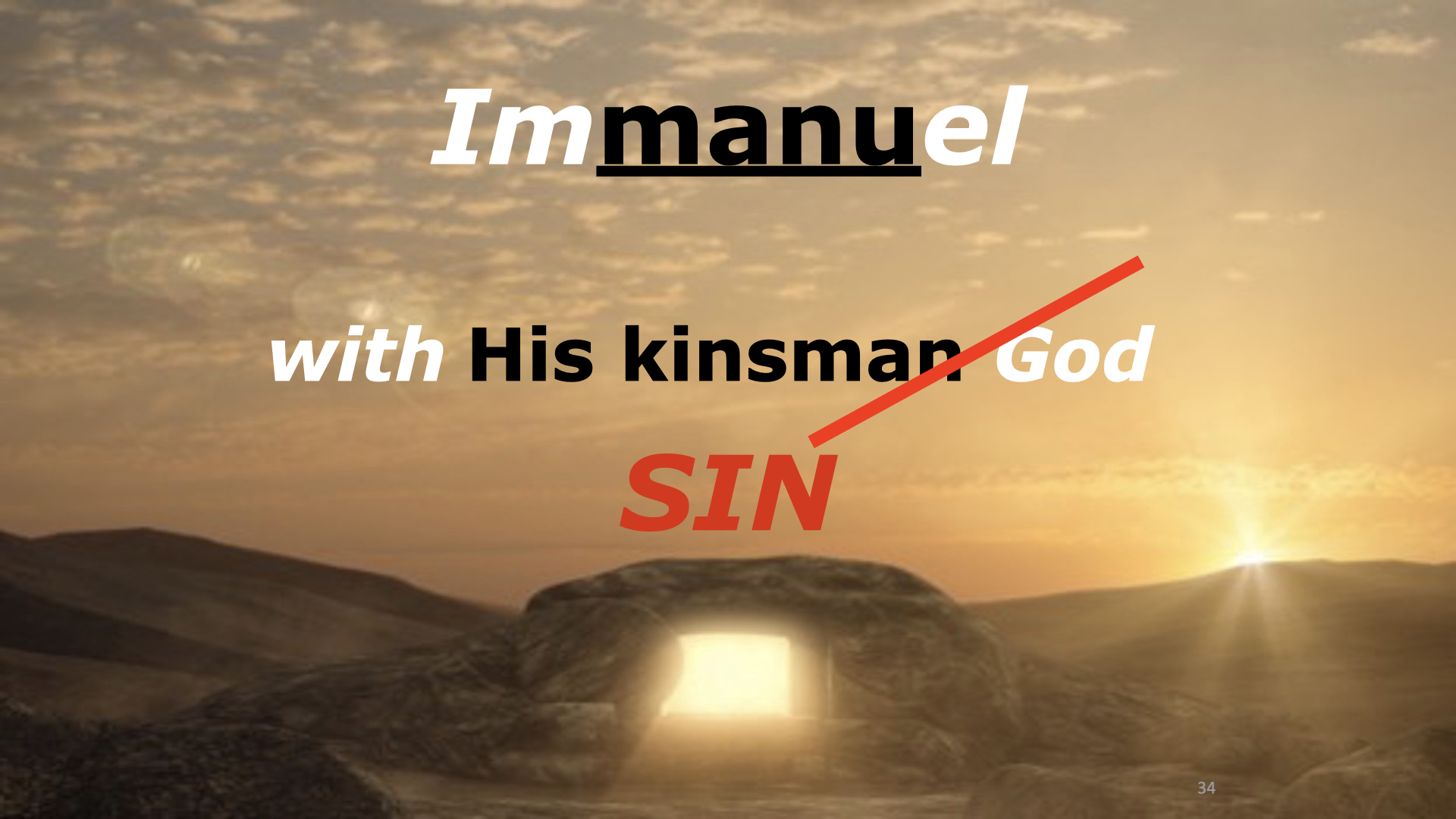
Immanuel (or the Romanized spelling Emmanuel) is the One who removes the separation caused by our sin, and rejoins us to God. That prefix “im” means with, and the suffix “El” means God. The root word means God’s kinsmen. Immanuel comes to repair what was severed by taking sin’s penalty on Himself, and allowing us to once again enjoy the closeness of kinship with our Heavenly Father (Matthew 1:22-23; Galatians 4:4-7).
When the people saw this Gift on Christmas morning, they said, “This isn’t what we wanted! We wanted a rich, powerful, conquering King. One who would send the Romans running in fear!” As a result, very few unwrapped this Heavenly Gift. But God reminded them, “That may be what you wanted, but I have given what you need. I want you to have not just temporary freedom from the Romans, but eternal freedom from your sin so that you can be forever in My presence!”
This is what Jesus rejoiced to do for us with the Gift of His life, death, and resurrection. One more passage from The Holy War tells us, “Then said the King’s Son, ‘Thy law is within My heart: I delight to do Thy will. This is the day that I have longed for, and the work that I have waited for all this while. … I will go and will deliver from Diabolus, and from his power, Thy perishing town of Mansoul. My heart has been often pained within Me for the miserable town of Mansoul; but now it is rejoiced, but now it is glad.’” (The timing for the Incarnation of Jesus and even these words of Immanuel Himself are found in Hebrews 2:14-15; 10:5-7).
God’s love is too great to be limited to just meeting our wants because in our immaturity and sinfulness we don’t know what we really need—but He does. So His love sent Immanuel to us.
The Gift was given to us at Christmas, but in our immaturity and shortsightedness, we didn’t realize the full impact of this Gift until Jesus rose victoriously from the grave! Now by placing our faith in His completed work, we can be rejoined to God and live in unshakable hope of an eternity with Him!



 On this episode of “The Craig And Greg Show” we talk about:








 Craig T. Owens