Listen to the podcast of this post by clicking on the player below, and you can also subscribe on Apple, Spotify, or Audible.
I had a great time on the Ailbe Podcast with Rusty Rabon.
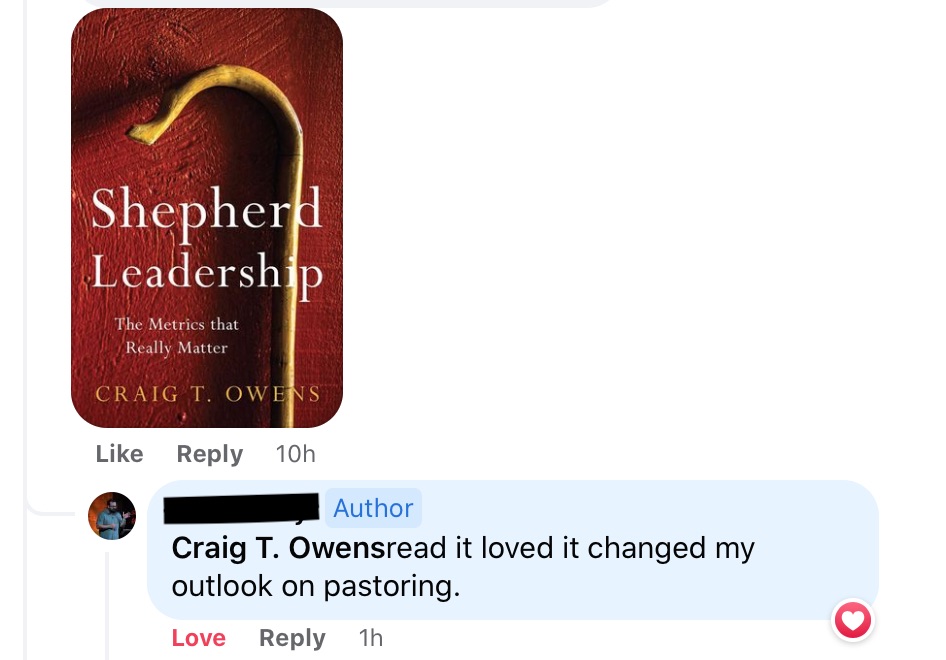
Rusty referred to the opening chapter of my book Shepherd Leadership: The Metrics That Really Matter where I talk about how many of our churches and church leaders are attempting to climb the wrong ladder of success. Rusty noted how many people become frustrated because they are not seeing the success the way that so many people define it.
Before addressing frustrated pastors, I first spoke to the board members that are supporting that pastor.
In Shepherd Leadership I wrote,
“Businesses think in terms of quantitative gains—things they can count—but churches and nonprofits should be thinking in terms of qualitative gains—a quality improvement that isn’t as easily counted. I think we all know this, and yet we still persist in wanting to define success in a church or a nonprofit by those quantitative standards such as attendance growth, donations, and the like. When we think qualitative over quantitative, suddenly what seemed “small” is so significant and so valuable that it cannot be calculated!”
I’ll be sharing more clips from this interview soon, so please stay tuned. If you would like to check out the other clips I have already shared from this podcast, please check them out here. Shepherd Leadership: The Metrics That Really Matter is available in print or ebook, and in audiobook through either Audible or Apple.
You are a one-of-a-kind creation. God is infinitely creative so He never has to duplicate any of His creative works. He saw your life and implanted in you what you need to glorify Him (Psalm 139:13-18). But we need to think about this uniqueness the right way.
Lucifer, an archangel, became satan, the Christian’s archenemy, because of his oversized pride. Pride is what turned Lucifer into satan, and it’s a tactic he still uses today on God’s creations. His other tactic is slander: attempting to get us to think we are insignificant and have no real purpose in the world.
In Romans 12, Paul talks about our lives being used as a living, breathing, God-honoring sacrifice. But Romans 12:1 begins with the word “therefore,” so we need to back up a few verses. The final four verses of chapter 11 are a beautiful doxology that is praising God for His wisdom and sovereignty. Paul then offers this conclusion: Therefore we need to think correctly about our place in the world, allowing the Holy Spirit to transform our thoughts.
Paul uses the word “think” twice in this passage. The root word is the same in each place (phroneo in Greek), but the prefix is what sets them apart from each other.The first has the prefix hyper-. That means it’s overly-analyzed thinking, overly self-concerned thinking, or self-focused.
The second time the prefix is soph- (which means “wise”). This is sound thinking, big-picture thinking, or others-focused. The Holy Spirit wants to give us sophroneo thinking to reveal our God-implanted gifts and talents that are to be used to benefit others—in fact, to benefit the whole Body of Christ.
In Romans 12, Paul uses the phrase “one body” twice as he talks about our spiritual gifts. He uses the same “one body” praise three times in 1 Corinthians 12 as he again talks about spiritual gifts (1 Corinthians 12:12-13, 20).
The Holy Spirit gives gifts to individuals so that individuals can edify the whole Body of Christ. It’s not competing with one another but completing one another.
Remember: Saints is always plural in the New Testament! I need you to bring out the saintly qualities in my life, as much as you need me to bring out the saintly qualities in your life.
God doesn’t give a vision to a leader so that a leader can have a better life, but so that the leader can help the people get to a better place. Vision is always through the leader to the people.
Daniel exhibits this in his life.
This video is a short clip from a longer video that is exclusive content for my Patreon supporters.
This is a weekly series with things I’m reading and pondering from Charles Spurgeon. You can read the original seed thought here, or type “Thursdays With Spurgeon” in the search box to read more entries.
Listen to the podcast of this post by clicking on the player below, and you can also subscribe on Apple, Spotify, or Audible.
Encouragement For Preachers
…For the mouth of the Lord has spoken (Isaiah 1:20).
We preach because ‘the mouth of the Lord has spoken.’ It would not be worth our while to speak what Isaiah had spoken if in it there was nothing more than Isaiah’s thought—neither should we care to meditate hour after hour upon the writings of Paul, if there was nothing more than Paul in them. … The true preacher, the man whom God has commissioned, delivers his message with awe and trembling because ‘the mouth of the Lord has spoken.’ …
Woe unto us if we dare to speak the Word of the Lord with less than our whole heart and soul and strength! Woe unto us if we handle the Word as if it were an occasion for display! If it were our own word, we might be studious of the graces of oratory. But if it is God’s Word, we cannot afford to think of ourselves. … Because the mouth of the Lord has spoken the truth of God, we therefore endeavor to preach it with absolute fidelity. …
Believing that ‘the mouth of the Lord has spoken,’ it is my duty to repeat God’s Word to you as correctly as I can after having heard it and felt it in my own soul. It is not mine to amend or adapt the gospel. …Again, dear friends, as ‘the mouth of the Lord has spoken,’ we speak the divine truth with courage and full assurance. Modesty is a virtue, but hesitancy when we are speaking for the Lord is a great fault. …
We preach not the gospel by your leave. We do not ask tolerance nor court applause. We preach Christ crucified, and we preach boldly as we ought to speak because it is God’s Word not our own. … We cannot use ‘ifs’ and ‘buts,’ for we are dealing with God’s ‘shalls’ and ‘wills.’ If He says it is so, it is so. And there is the end of it. Controversy ceases when Jehovah speaks [Jeremiah 1:17-19].
From The Infallibility Of Scripture
Preaching God’s Word is not for the faint of heart. It takes one who is confidently humbled—confident that God has spoken and humbled that He would choose someone like me to speak His Word to His people.
Check this out: “Now Moses was a very humble man, more humble than anyone else on the face of the earth” (Numbers 12:3). Who wrote the book of Numbers? If you answered “Moses,” you are correct. Doesn’t that sound a bit brash to declare that you are more humble than anyone else on the earth? Yet, God allowed Moses to pen those words, making that a Holy Spirit-inspired statement of fact. Humility is a double-edged sword: it can serve a leader well when it is balanced with appropriate confidence, but it is a detriment to an organization’s health if it is self-de-basing humility that undercuts a leader’s credibility.
The God-honoring preacher gets his message from the mouth of the Lord, and then confidently endeavors “to preach it with absolute fidelity.” Whether others praise of criticize, the humble leader says, “I am only God’s servant speaking God’s Word.”
Preachers, let’s make sure that everything we confidently and humbly share from our pulpits is the whole counsel of what has been spoken by the mouth of the Lord.
[0:15] I adapt a verse from the Bible to talk about generosity and Greg agrees with me.
[1:00] Generosity is so much more than donating money.
[2:15] Generous leaders are proactive, and have appropriate boundaries.
[2:48] Leaders cannot fake generosity.
[3:42] Generosity isn’t in the big things, but the everyday things.
[4:25] Time, talent, treasure are all important components in generosity.
[6:00] Greg shares a telling statistic about how Americans give to charities.
[6:45] Greg says giving your network can be one of the most generous things a leader does.
[7:37] Generosity requires an abundance mindset.
[8:52] What holds us back from being generous?
[10:00] Comparisons kill generosity.
[10:27] Being generous expands our influence, but stinginess strangles it.
[12:55] Our teammates are looking for places to be generous.
[13:53] Generosity opens doors for new opportunities.
[14:51] Greg shares an insightful quote from Anne Frank
[15:17] I make a connection to the change in Ebenezer Scrooge’s life.
[16:11] How we define a generous leader.
[17:38] Our leadership challenge: how can you view generosity differently?
Check out this episode and subscribe on YouTube so you can watch all of the upcoming episodes. You can also listen to our podcast on Spotify and Apple.
Listen to the podcast of this post by clicking on the player below, and you can also subscribe on Apple, Spotify, or Audible.
Last week we saw the in-ness of the Holy Spirit guiding us, teaching us, and empowering us to overcome evil. For what purpose? Why does the Holy Spirit lead us this way? Because the Spirit desires to draw everyone into this in-ness. His work in and through our lives is always unmistakable and irrefutable.
A good word to describe the unmistakable and irrefutable work of the Spirit is: Miracles.
Miraculous signs characterized the earthly ministry of Jesus, and they also should to the hallmark of Spirit-baptized Christians today who are sharing the Gospel with others (Acts 10:38; 2:43; Mark 16:20).
Some may ask, “Why don’t we see as many miracles today?” And some skeptics even point to a decrease in miracles as proof of their cessationist paradigm. But consider this: Has God’s power been diminished? Have all needs been met? Are there no more sickness or unsolvable problems of human suffering? Is everyone free of the power of the devil?
No, of course not!
So that would mean if there is any diminishment in miracles, the diminishment would seem to be in us! Particularly I think it is that we no longer expect miracles to happen.
Not only should we expect miracles, but we should also expect to be the vessel through which the Holy Spirit demonstrates the miracle.
Here are 8 miracles that we should be expecting:
Minds opened that were blinded to the Gospel message—2 Corinthians 4:4-6
Jeff and I talked about some of the changes pastors and churches were forced to confront during the COVID shutdowns. For me, this was a time for my leadership team to examine why we “do church” the way we do. These shutdowns helped us identify the things that were biblical and non-biblical.
My larger concern is that churches, parachurch organizations, and nonprofit ministries that are largely founded to fulfill a biblical mandate are straying from the simple, freeing truths found in the Bible. Or maybe I should say that they are adding things to their ministries that aren’t in the pages of Scripture. Whichever way you want to say it, the result is the same: We are using the wrong metrics to define “success” for our ministries. I fear that in our focus on unbiblical practices, we are missing the joy of really doing ministry.
Our ministry should be joyful to us as leaders and joy-giving to those to whom we are ministering. If it’s draining instead of fulfilling, that may be an indication that we are trying to gauge success by monitoring non-biblical metrics.
If you want to dig into this a bit more, check out two previous posts I wrote:
I’ll be sharing more clips from this 200churches interview soon, so please stay tuned. Shepherd Leadership: The Metrics That Really Matter is available in print or ebook, and in audiobook through either Audible or Apple.
Max Lucado addresses the sickening news of sexual abuse coverups in the church. He wrote, “[Jesus] defended the weak, stood up for the forgotten. The idea that His church would be unsafe for His sons and daughters disturbs Him deeply. And you can bet your Bible that He’ll turn a few tables. If history teaches us anything it is this: Jesus will not sit idle while His church drifts from His cause. ‘I will rescue My flock from their mouths,” He declared through a prophet. ‘It will no longer be food for them’ (Ezekiel 34:10).
“Repentance is necessary; heartfelt, tear-stained, face-on-the floor repentance. By all of us in positions of leadership. Will we see it? I pray so. Regardless, I pray that you will pursue the difficult path of seeking Christ in spite of Christians who have let you down. His pastors have failed to pastor. But when they don’t, He still does. Let Him pastor you.”
Darren Carlson wrote, “Healthy pastors experience the fullness and complexity of their emotions, and then hold them up against the sinlessness of Christ. How might Jesus respond to the pain and loss and victory and neediness in front of me? We grow emotionally as leaders by studying the heart of Jesus as he walks among sinners and sufferers.” His post ‘Healthy Pastors Have Emotions: How to Test and Cultivate Your Feelings’ is an excellent read. I explore the emotional health of shepherd pastors in my book.
Listen to the podcast of this post by clicking on the player below, and you can also subscribe on Apple, Spotify, or Audible.
I’ve been presenting a series of exclusive leadership lessons to my Patreon supporters, but I wanted to make this particular lesson available to everyone because of its overlap with my book Shepherd Leadership: The Metrics That Really Matter.
Listen to the podcast of this post by clicking on the player below, and you can also subscribe on Apple, Spotify, or Audible.
We said that when it comes to the Holy Spirit’s involvement in a Christian’s life: In > On. For instance, in our learning we don’t have to go to a tutor or attend classes only at set times, but we have The Tutor IN us. Or when need wisdom for decisions we don’t have to seek out the right advisors and try to coordinate their schedule with ours, but we have The Counselor IN us.
Let me point out the in-ness that permeates this 25th Psalm and then show you its fulfillment when the Holy Spirit comes to baptize believers in the New Testament.
(1) “IN You I trust” (v. 2). Not in human abilities or personal pedigree or earthly riches, but IN the in-ness of the Holy Spirit. Jesus said, “He who believes IN Me—who cleaves to and trusts IN and relies on Me—as the Scripture has said, ‘From his INNERmost being shall flow continuously springs and rivers of living water.’ But He was speaking here of the Spirit, Whom those who believed (trusted, had faith) IN Him were afterward to receive…” (John 7:38-39 AMP).
(2) “my hope is IN You” (vv. 3, 5, 21). A natural fruit of trusting IN the Holy Spirit’s empowerment is the hope that only that relationship brings. Paul talks abut this twice in his letter to the Romans. First, even in the midst of trials, Paul says we have this hope: “And hope does not put us to shame, because God’s love has been poured out INto our hearts through the Holy Spirit, who has been given to us” (Romans 5:5). And then Paul prays for his friends to experience this same in-ness of hope: “May the God of hope fill you with all joy and peace as you trust IN Him, so that you may overflow with hope by the power of the Holy Spirit” (Romans 15:13).
(3) “guide me IN Your truth … guide me IN what is right” (v. 5, 9). Jesus identified the Holy Spirit as the Spirit of Truth Who guides us INto truth (John 14:17, 16:13). This is how Jesus lived (Matthew 4:1) and it’s how we can live too: “But I say, walk and live habitually IN the Holy Spirit—responsive to and controlled and guided by the Spirit—then you will certainly not gratify the cravings and desires of the flesh…” (Galatians 5:16 AMP).
(4) “He instructs sinners IN His ways” (v. 8, 12). The Hebrew word David uses for “teach” in vv. 4, 5, 9 is “lamad.” It means being taught in a way that equips us to teach others. Jesus “gave instructions through the Spirit” to His disciples, and then He commanded them to teach others the same way (Acts 1:2; Matthew 28:20). The Spirit of Truth that inspired the Word of God can illuminate it to our hearts as He instructs us (see 2 Timothy 3:16-17).
(5) “the Lord confides IN those who fear Him” (v. 14). The KJV says, “The secret of the Lord is with those who fear Him.” Isaiah said, “Whether you turn to the right or to the left, your ears will hear a voice behind you, saying, ‘This is the way; walk in it’” (Isaiah 30:21). And Jesus said that every word He spoke was directed by the Holy Spirit IN Him (John 12:49).
(6) “I take refuge IN You”(v. 20). We can take refuge IN the One whom we trust and hope, the One who leads us INto truth and instructs us, the One who confides IN us. This in-ness helps us thwart the enemy’s attacks against us. As John wrote, “But you belong to God, my dear children. You have already won a victory over those people, because the Spirit who lives IN you is greater than the spirit who lives in the world” (1 John 4:4 NLT).
Don’t stop at salvation, but allow the Holy Spirit to baptize you and fill you. Don’t be satisfied with merely experiencing God’s presence ON you, but let His Spirit come IN you.
This in-ness keeps us trustful of God, victorious over the devil, hopeful of our future, righteous in a wicked world, informed of God’s ways, peaceful in trials, and fully protected from the enemy of our souls.



 I had a great time on the Ailbe Podcast with Rusty Rabon.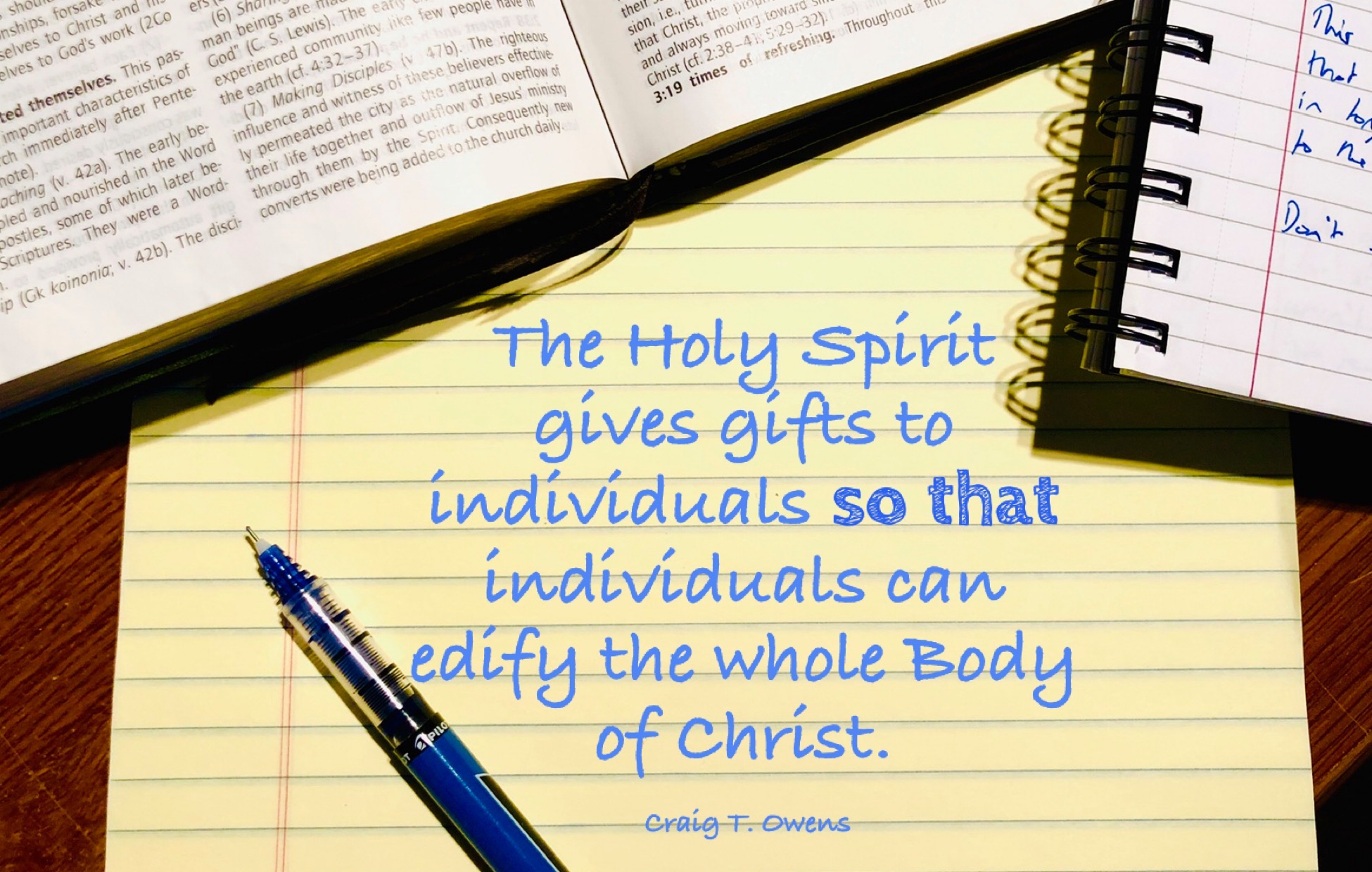











 Craig T. Owens