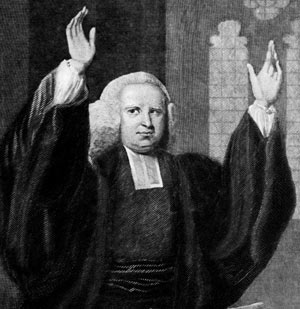
“The fruit of the Spirit (Galatians 5:22-23) do not automatically become evident in our lives. If we are not discerning enough to recognize their availability to us, to desire them, and then to nourish them in our thoughts, they will never become embedded in our nature or behavior. Every further step of spiritual growth in God’s grace must be preceded by acknowledging our lack of a godly attribute and then by exhibiting a prayerful determination to obtain it. …
“Today many people are attempting to use their mental capacity and logical thinking to obtain sanctification, yet this is nothing but a religious fabrication. They believe that if they just mentally put themselves on the altar and believe the altar provides the gift of sanctification, they can then logically conclude they are fully sanctified. Then they go happily on their way, expressing their flippant, theological babble about the ‘deep’ things of God.
“Yet the heartstrings of their old nature have not been broken, and their unyielding character, which they inherited from Adam, has not been ground to powder. Their soul has not throbbed with the lonely, gushing groans of Gethsemane. Having no scars from their death on Calvary, they will exhibit nothing of the soft, sweet, gentle, restful, victorious, overflowing, and triumphant life that flows like a spring morning from an empty tomb.” —George Whitefield
Listen to the podcast of this post by clicking on the player below, and you can also subscribe on Apple, Spotify, or Audible.
Valley times come to all people. Even Christians.
The Songs Of Ascent in the Psalms imply this, since the pilgrims are ascending from a valley to the place of worship in Jerusalem. But this idea of going through a valley is especially seen in Psalm 121.
The psalmist starts by saying I lift my eyes up to the hills. He then sings that he found his help in God. This idea of help is not what we think of in today’s world. It’s not like dialing 911, reporting our need, and waiting for help to arrive. It’s not even like driving to a hospital, checking into the emergency room, and waiting for a doctor to see us.
The idea of help in the Bible is a picture of surrounding. It’s not something we have to wait to arrive, but something—or should I say Someone—Who is already right there!
In verses 4-8, the phrase watch over is used five times. This too gives us the idea of the closeness of our help. The Hebrew word translated watch over has four powerful word pictures:
A Gardener carefully watching over his precious garden.
A Soldier dutifully guarding a valuable treasure.
A Watchman diligently scanning the horizon for any approaching enemies.
A Shepherd lovingly attending to his flock.
I especially like the picture of a shepherd because of another valley reference. The opening words to Psalm 23 are, “The Lord is my Shepherd.” Then we read of 10 blessings the Good Shepherd gives His sheep while they pass through the Valley of the Shadow of Death. Our Shepherd…
Gives us His confidence so we will fear no evil
Reveals His close, intimate presence
Protects us with His rod
Guides us with His staff
Brings comfort to our hurts
Provides us with food
Anoints us with His blessings
Pours out His overflowing blessings
Allows His goodness and love to always follow us
Gives us the assurance of eternal life
Then adding a couple of more blessings from Psalm 121, we see He…
11. Never lets our foot slip (121:3)
12. Never sleeps or slumbers, so that we can rest securely (121:3-4)
Remember these songs of ascent are sung by those coming out of the valley. They are sung to remind us of God’s deliverance, they are also sung as encouragement to those still in the Valley.
Jesus went through the darkest Valley anyone has ever gone through. It wasn’t just the valley of the shadow of death, He went through death, hell, and the grave. He overcame for you and me! He now walks with us in our valleys. He says to us, “I’ve been there, done that, and have the scars to prove it. I will never leave you or forsake you. I know this valley. I know how to get you out of this valley. Trust Me!”
We, too, who have been through the valleys and are now singing the song of ascent, need to sing loudly for those who are still in the valleys. We need to sing songs of assurance to them: “I have been in that same valley. I know how dark it is. But I know God watched over me and brought me safely through. Now I have a much better vantage point. And I say to you, trust Him! He is watching over you too. He will not let your foot slip. He will not sleep or slumber. He will protect you, and anoint you, and feed you, and give you His own dear presence. Don’t stop walking!”
I remember visiting Denver, Colorado. The scenery was so breathtaking, so I decided to go for an early morning hike. Quickly I discovered that my hike became breathtaking in more than one way! Even though I was in good shape, I had a hard time getting my breath because of the mile-high atmosphere.
I learned later that this is why many top athletes train in high elevation: it increases their lung capacity and endurance so that they now have an advantage when they compete against others.
In the first song of ascent, I noticed something unusual in the very first verse. Some Bibles translate the verbs in the present tense (I call on the Lord and He answers me), but some translations use the past tense (I called on the Lord and He answered me). Which is correct? Actually both of them are correct!
The verbs are written in the perfect tense—something done at a specific point in the past, but still relevant and powerful in the present. In other words, we can say it like this, “I called on the Lord in the past and He most definitely answered me. That gives me confidence to call on the Lord today, knowing that He will answer me again.”
Past answers lead to present power and future hope.
But—oh wow!!—check out how God answers us! The word literally means that God answers us in song. God so loves it when you trust Him enough to bring all your cares to Him, that He sings His answer to you. For the Lord your God is living among you. He is a mighty Savior. He will take delight in you with gladness. With His love, He will calm all your fears. He will rejoice over you with joyful songs (Zephaniah 3:17).
If we don’t continue to recall how God has answered us in the past, we’re missing out on the blessing of hearing Him sing His answers over us again today. As a result, we begin to live in the world’s valley-level turmoil and anxiety.
Peace is longed for in verses 6 and 7. The Christian wants to live in peace, but the world loves turmoil. Want proof? Just look at what makes the headlines today! The solution is to keep going back to God again and again and again—
Do not be anxious about anything, but in everything, by prayer and petition, with thanksgiving, present your requests to God.And the peace of God, which transcends understanding, will guard your hearts and minds in Christ Jesus.(Philippians 4:6-7)
Check out the full message to find the peace you are longing for!
If you don’t have a home church, please join us this Sunday as we continue our look at the psalms of ascent, or you can tune in to our live Periscope broadcast from wherever you are.
We have to remember that relationship is the goal. We’re not trying to make converts to Christianity and rack up some sort of high score. We’re building relationships with people because we love people; and that love for them should motivate us to:
Want what’s best for them
Be willing to serve them
The Bible says this: And we urge you, brothers, warn those who are idle, encourage the timid, help the weak, be patient with everyone.
Everyone?! There’s that word again!
This word patient has five parts to its definition. I’m struck by how these aspects of patience also echo the definition of love in 1 Corinthians 13…
Patience doesn’t lose heart—Love is patient (1 Corinthians 13:4a)
Patience endures misfortune—Love is not self-seeking (13:5a)
Patience is slow to anger—Love is not easily angered (13:5b)
Patience bears with the offenses of others—Love keeps no record of wrongs (13:5c)
Patience perseveres bravely—Love always protects, always trusts, always hopes, always perseveres. Love never fails (13:7-8)
How are you doing in your relationships? Are you losing heart? becoming angry? about ready to throw in the towel on a difficult relationship? Ask God to renew your love, and your patience level will increase as well.
Let’s all strive to love others—even the difficult “others”—the way God loves us!
Jesus told His followers that their ministry assignment was to take His message of salvation throughout the entire world. One requirement to do this, is to be able to communicate with lots of people. Actually to be able to communicate with everyone.
Be careful to do what is right in the eyes of everybody. If it is possible, as far as it depends on you, live at peace with everyone. (Romans 12:17-18)
Really? Everybody and everyone?!
Yes!
Jesus said our Helper would be the Holy Spirit. He would come to empower us to be witnesses to everyone, everybody, everywhere (Acts 1:8).
So if you are a Doer, and you’re trying to share the Good News about Jesus with a Planner, you can probably see a potential problem. The Doer is speaking in bullet points, but the Planner is wanting a lot more facts and figures.
This is where the Holy Spirit can help us. He has the insight that we don’t, and He can direct our words, just as He directed Christ’s words (see John 12:49-50).
Here’s how to talk their talk when you’re sharing the Good News:
(1) Doer—
Keep it brief
Share more facts than stories
Stress now/today
Rely on the Gospel of Mark (action oriented)
(2) Planner—
Tell them the who, what, where, when, why, and how
Be ready for lots of questions
Give them time to process your information
Rely on the Gospel of Matthew (lots of background, lots of Old Testament references to answer the who, what, where, when, why and how)
(3) People—
Develop a friendship first
Share more stories than facts
Don’t tell them, show them your personal life
Rely on the Gospel of Luke (lots of personal stories about changed lives)
(4) Vision—
Share both the facts and the stories
Encourage them to “Imagine what would happen …”
Give them time to ask questions
Rely on the Gospel of John (very poetic and image-rich)
You can connect with everyone, everybody, everywhere and share the Gospel with them in an effective way. Allow the Holy Spirit to give you the insight you need.
Check out how I describe this in more detail here…
But here’s an important thing: If you don’t get along well with others now, don’t try to change your behavior!
Stephen Covey wrote, “To try to change outward behaviors does very little good in the long run if I fail to examine the basic paradigms from which those attitudes and behaviors flow.”
You see, behavior is the fruit. If we want to change the fruit, we need to back up a few steps.
The Apostle Paul used the life of Jesus as an example for Christians on how we can get along with others. But notice this: most of what Paul discusses is the “inside stuff.”
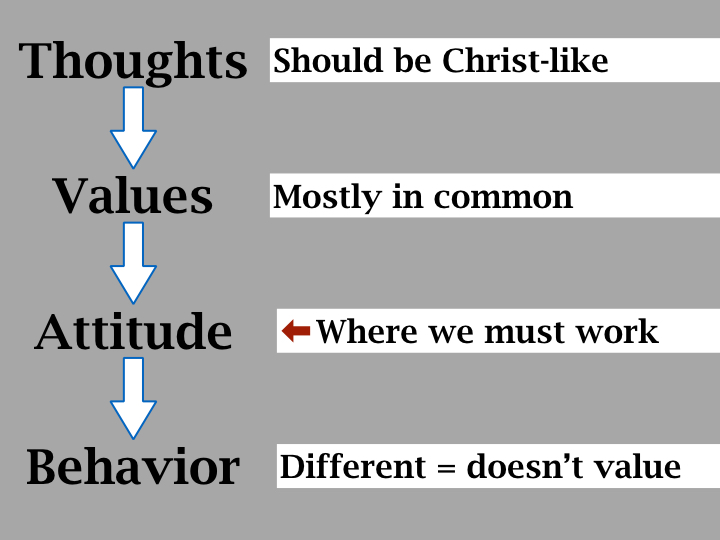
(1) Thoughts—These need to be humble thoughts about God’s love toward us (v. 1).
(2) Values—Paul tells us to be “one in spirit and purpose” with others (v. 2). The definition of the Greek words here mean valuing the well-being of everyone. Paul then explains how our humility can lead to these win-win relationships (vv. 3, 4).
(3) Attitudes—“Your attitude should be the same as Christ Jesus” (v. 5). Jesus showed us what it was to have an attitude related toward obedience to God’s will.
(4) Behavior—If our thoughts, values and attitudes are rightly aligned to God, then our behavior will naturally be Christ-like as well. We see the example of Jesus in verses 6-8, and God’s reward for that behavior in verses 9-11. Then Paul calls on Christians to follow that pattern in our own lives (vv. 12, 13).
Most decent, reasonably-thinking human beings share the same values. Harry Truman said, “When we understand the other fellow’s viewpoint—understand what he is trying to do—nine times out of ten he is trying to do right.”
The problem is this: When the other person behaves differently from me, my natural tendency is to assumehe doesn’t value what I value. In other words, I’m judging his value system on the way I normally behave.
The break-down is in my attitude. That’s the area I need to address. That’s the attribute of Jesus that Paul told us to copy.
So if I want to get along better with others, I shouldn’t try to change my behavior, but my attitude. My prayer should be: “I want this same attitude to be in me which was also in Christ Jesus. He served God and others, so I too want to follow His example of obedience, and I want to demonstrate my appreciation for all that Jesus has done for me by working hard to better get along with others. Help me change my attitude!”
Check out this video of the full message…
I hope you can join us next Sunday as we continue learning how to get along with others. Please join us in person or on Periscope.
The Place Of Help is one of the longest of Oswald Chambers’ books, compromised almost entirely of sermons he delivered in various settings. Half of these sermons are from the YMCA Hut in Zeitoun, Egypt, where Chambers ministered to British, Australian and New Zealand troops during “The War” (what we now call World War I).
The title of the first chapter is also the title of this book. Oswald’s wife, Biddy, describes how the title came about—
I recall vividly the place of the ‘birth’ of this article; my husband dictated it to me during our stay in America in 1910, when we spent a little while in the exceedingly grand and beautiful Catskill mountains, amidst scenery which left us with the sense of worship expressed by Isaiah ‘The whole earth is full of His glory.’ May every thought of the one, who so continually lifted our eyes from the ‘hills’ to God Himself, be a mighty inspiration to us all to so ‘dwell in the shadow of the Almighty’ that our lives may be a sacrament whereby God can be revealed as our ‘refuge and strength and very present Help.’
Indeed these sermons are a challenging read. Chambers is delivering these messages in the build-up to The Great War, and even near the front lines of the War itself. These are not messages to those cloistered in safety, but those feeling the weight of the battle bear down upon them. Much like Christians today, who stand on the front lines of a very real cultural and spiritual battlefront, some of whom even face a very real physical danger because of their faith in Jesus Christ.
This collection of real, inspiring, soul-stretching messages are timely for any Christian today. A true faith expander!
Last week I spoke and wrote about some tools you might use to study your Bible. Now I’d like to share some Bible study projects you might try with those new tools. As always, I recommend that beginning Bible studies go verse by verse through the Bible. I believe you will lay a strong foundation for your faith when you systematically put God’s Word into your heart.
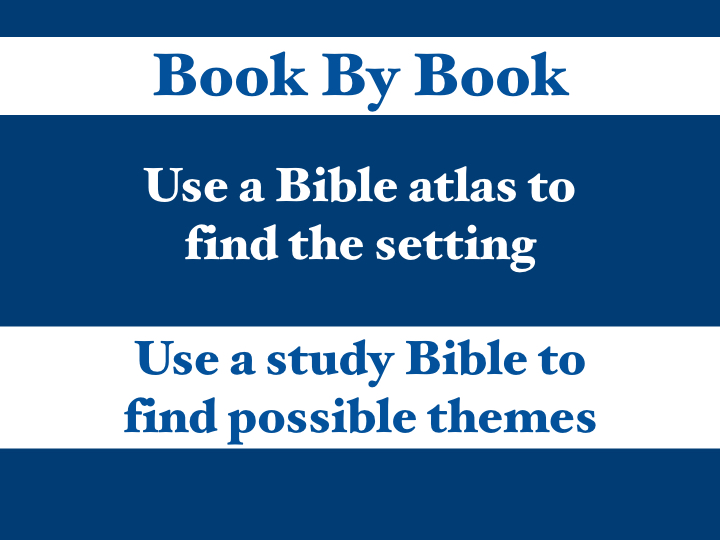
Book By Book
I’ll use the book of Ephesians as an example. Using my Bible atlas I find that the city of Ephesus is located along an important trade route, and it is the Roman capital of the province of Asia. My Full Life Study Bible tells me that because so much trade passed through this city, this letter was probably intended to be a circular letter for all of the communities near Ephesus. As a result, Paul is not addressing any specific problems in this church, but writes theological ideas for a broad spectrum of people.
As I begin reading, I paused in the first verse when I came to the phrase “the faithful in Christ.” I asked myself, “What does it mean to be faithful IN Christ? Can I be faithful outside of Him?” By the time I got to verse 3, I saw a similar phrase: “every spiritual blessing in Christ.” Now I went back and used a blue highlighter (there’s nothing special about blue, it just happened to be the first highlighter I grabbed), and marked those two “in Christ” phrases. I see two more in verse 4: “He chose us in Him” and “holy and blameless in His sight.” Going through the whole book I discovered 36 times the phrases “in Christ” or “in Him.” This is helpful to me to know the kind of security I have in Jesus.
Another thing that stood out to me were Paul’s prayers for the church. I see His very moving prayers in passages like 1:15-19 and in 3:14-21. I also see in 6:18 that he tells us to pray all kinds of prayers for ourselves and for others. And I see in 6:19 that Paul asked the church to pray for him too.
And always look for “therefore” phrases. For example in 4:24-25 or 4:32-5:1. The “therefore” phrases tell us how to live or think in light of the ideas that were just shared.
Chapter By Chapter
A good place to do this is in the Psalms or Proverbs. These are usually stand-alone chapters. When reading the chapters in these two books, I love reading them in parallel with other translations. For example, check out this from Psalm 1.
In Psalm 59, notice the superscript (or introduction). This gives us some background information to the psalm. Using my concordance, I found that this psalm was written this time in David’s life.
There is usually a theme to each chapter of the Proverbs, so try to discover that. In Proverbs 2, I noticed the “if … then” statements. In the first four verses I see things like “IF you will seek wisdom like this,” and then in verses 5-22 I see a whole bunch of blessings that follow the “then” that starts verse 5.
Word By Word
Sometimes I like to go really deep in a passage, so I slow down and look at it word by word. Here you need to use a Strong’s Concordance of the Bible. I like the one available on Blue Letter Bible. For example, next to 2 Peter 1:5, you can hover over the word “Tools” and select “Interlinear.” Clicking on “Interlinear” you will see all of the Greek words that make up this verse. By clicking on the Strong’s number, you can see the definition of that Greek word. Scrolling down a bit, you can see all of the other verses where that Greek word is used in the New Testament.
In this video I go into more detail on how I undertake all of these Bible studies. And be sure to join us next week as we take another look at different types of Bible studies.
It’s been said that if the only tool a man has in his toolbox is a hammer, he tends to see every problem as a nail. In other words, we try to force every project to be handled in the exactly same way.
Sadly, for many Christians, the same is true with our knowledge of the Bible. If we have limited tools, we try to make every situation look like something we can fix with that smaller toolbox. It’s not enough for us to know only a couple of verses or a few biblical principles, and then try to use those tools to handle all of life’s situations. So let me share some basic tools that will help you expand your biblical toolbox.
Time and culture—Think about how much your culture has changed just in the 70-80 years since your grandparents were born. Think about how wardrobes have changed, and technology, and manners and customs. The earliest book of the Bible was written about 1400 BC, and the most recent book was written about 100 AD. To better understand the things I read in the Bible, here are some tools I like to use:
A Bible dictionary to help you know the people and various terms of their culture. I have three of them on my bookshelf, but I also like this collection from BibleGateway.
Language—Even the English language has changed a lot since William Shakespeare penned his famous plays. But consider that the Bible was written in languages that are even older (not to mention they’re languages other than English!). To really get the full meaning of a passage, here are some tools I use:
Strong’s Concordance is the gold standard for digging into the Old Testament Hebrew and New Testament Greek definitions. It’s the book on my shelf I go to most often when I am studying, but Blue Letter Bible also has an excellent online resource.
Chain of pearls—The Bible is not a collection of isolated, independent stories or concepts, but it is a beautiful string of pearls. Every part connects to the rest of the Scripture. So some resources I use to help me discover how the pearls are strung together include:
What did I miss? What are your favorite Bible study tools? In the comments, please share books, commentaries, or online resources that you use to maximize your study of God’s Word.
There are two Greek words in the New Testament that have to do with trying to figure things out. One of them leads to less knowledge, and one opens the way for greater learning. Not surprisingly, Jesus never used the first way, but He confronts people who try to.
The first Greek word is defined as learning through self-calculation. In other words, I try to get at the right answer by either teaching myself, or by talking with people who don’t know any more than I do. This way leaves me in the dark.
For example, notice the phrase “discussed among themselves” in Matthew 16:7 and Mark 11:31. These are people who wanted to try to get answers without going to someone who could teach them. So that leads to four terrible ways to study your Bible—
Approach your Bible with a know-it-all attitude.
Try to figure out what the Bible is saying all on your own.
Try to be your own Bible teacher.
Grade your own tests as to your answers being right or wrong.
These are not only terrible ways to learn, but they are the exact opposite of what God desires. God says things like, “Come, let us reason together” (Isaiah 1:18), and “Call to Me and I will tell youthings you do not know” (Jeremiah 33:3).
There is another Greek word which means to learn by having a conversation with someone more knowledgable than myself. So that means four great ways to study your Bible are—
Ask the Holy Spirit to illuminate Scripture to you (John 16:13).
Study the Bible in a daily systematic way (Acts 19:9).
Don’t take anyone else’s word for what the Word says (Acts 17:11).
If you’re confused, ask God to make it clear to you (Jeremiah 33:3).
Luke records an important story for us that took place on the day Jesus was raised from the dead. Two men were walking along “discussing these things with each other,” but not consulting the Scriptures. The result: they were sad and confused. Jesus join them on their journey (although they didn’t recognize Him at first), and took them to the Scriptures that showed them the answers for which they were yearning. They even said, “When He talked to us from the Scriptures, that’s when our hearts burned within us!” (see Luke 24:13-32).
You can try to figure life out on your own, and you will probably end up stymied like the religious leaders in Mark 11, or downcast like the disciples in Luke 24. Or you can ask the Holy Spirit to show you truths from the Scriptures, and have your eyes opened, like the two disciples after Jesus met with them. I think the choice is obvious!



 “The fruit of the Spirit (Galatians 5:22-23) do not automatically become evident in our lives. If we are not discerning enough to recognize their availability to us, to desire them, and then to nourish them in our thoughts, they will never become embedded in our nature or behavior. Every further step of spiritual growth in God’s grace must be preceded by acknowledging our lack of a godly attribute and then by exhibiting a prayerful determination to obtain it. …








 Craig T. Owens