Thursdays With Oswald—Is It Human Or Divine?

Oswald ChambersThis is a weekly series with things I’m reading and pondering from Oswald Chambers. You can read the original seed thought here, or type “Thursdays With Oswald” in the search box to read more entries.

Is It Human Or Divine? 

     It is easy to say that human love and Divine love are one and the same thing; actually they are very far from being the same. It is also easy to say that human virtues and God’s nature are one and the same thing; but this, too, is actually far from the truth. We must square our thinking with facts. Sin has come in and made a hiatus between human and Divine love, between human virtues and God’s nature, and what we see now in human nature is only the remnant and refraction of the Divine. Human virtues according to the Bible are not promises of what human nature is going to be, but remnants of what human nature once was. … 

     As Christians we must learn to trace things to their right source. God makes very distinct the difference between the qualities that are Divine and those that are human. John 15:13 has reference to human love, which lays down its life for its friends. Romans 5:8 has reference to the Divine love, which lays down its life for its enemies, a thing human nature can never do.

From The Psychology Of Redemption

We must be very careful about looking at our life, and then trying to match it up with something we see in Scripture. It should always be the other way around—look at Scripture first, and then see if my life squares with what I see in God’s Word.

Even harder: see if my life squares with what I see in the life of Jesus as presented to me in God’s Word.

In Psalm 139 David began His prayer by saying, “God, You have searched me thoroughly, and You know me completely.” Then he ended his prayer by inviting God to search him yet again. This should be the ongoing posture and attitude of a Christian: asking the Holy Spirit to constantly show us where our lives fall short of the Christian lifestyle presented in the Bible.

T.M. Moore On Using Time

T.M. Moore“We measure time, from the human perspective, in various ways—seconds, minutes, days, weeks, months, years, and so forth. But these are not true quantitative measurements of some material quantity—like a half gallon jug measures a certain amount of milk. Our measures of time are more on the order of estimates (as we think of the future), experiences (with respect to the present), and records (as we think about the time that is gone by).

“All time comes from the Word of God (John 1:1-3), is sustained by the Word of God (Hebrews 1:3), and returns—like the talents in Jesus’ parable—to its Creator and true Owner (Romans 11:34-36). There is as yet no future time, and the time we’ve used up is gone forever; we cannot return to it. Every moment of your time comes fresh from the Word of God, and returns immediately to Him for His review.

“The only time we ever have is the present moment, and each of those is supplied for us, as an act of free grace, by the eternal God and His Word.” —T.M. Moore

Thursdays With Oswald—Working Out God’s Will

Oswald ChambersThis is a weekly series with things I’m reading and pondering from Oswald Chambers. You can read the original seed thought here, or type “Thursdays With Oswald” in the search box to read more entries.

Working Out God’s Will

     We do not enter into the life of God by imitation, or by vows, or by ceremonies, or by Church membership; we enter into it by its entering into us at Regeneration. The Cross of Jesus Christ is the gateway into His life. … 

     The world is that system of things which organizes its life without any thought of Jesus Christ. … 

     Nothing blinds in the mind to the claims of Jesus Christ more effectually than a good, clean-living, upright life based on self-realization. For a thing to be satanic does not mean that it is abominable and immoral. The satanically managed man is moral, upright, proud, and individual; he is absolutely self-governed and has no need of God. … 

     When by the Cross of Christ we have entered into the experience of identification with our Lord, then there comes the practical working out of Matthew 11:29, “Take My yoke upon you, and learn of Me; for I am meek and lowly in heart.” … 

     God will bring across our path people who embody the characteristics that we have shown to Him—stubbornness, pride, conceit, opinionatedness, sensuality, a hundred little meannesses. “Now,” He says, “love them as I have loved you.” 

From The Psychology Of Redemption

So God’s will is not something we learn by going to church, or imitating someone we think to be a godly person. God’s will is living like Jesus:

  • Totally abandoned to God’s will
  • Staying linked to Jesus
  • Loving the people that God brings across our path like God loves us

How are you doing?

7 Quotes From “Hope … The Best Of All Things”

HopeJoni Eareckson Tada knows what it is to battle darkness and depression. And she also know the power of hope in those dark places. Hope … The Best Of All Things is an encouraging book for anyone going through a difficult place (please check out my book review here).

Here are some of the quotes from Hope which especially stood out to me.

“People are angry; cynicism and despair are on the rise, and the nightly news reminds us we are only one terrorist plot away from another national nightmare. Oh, how we need to grasp the soul-settling hope found in the pages of God’s Word—not only grasp it, but allow the hope of God to fill and overflow our hearts, transforming us into people who are confident and at peace with themselves, their God, and their circumstances.”

“For me, suffering is still that jackhammer breaking apart my rocks of resistance every day. It’s still the chisel that God is using to chip away at my self-sufficiency and my self-motivation and my self-consumption. Suffering is still that sheepdog snapping and barking at my heels, driving me down the road to Calvary where otherwise I do not want to go. My human nature, my flesh, does not want to endure hardship like a good soldier (2 Timothy 2:3) or follow Christ’s example (1 Peter 2:21) or welcome a trial as friend. No, my flesh does not want to rejoice in suffering (Romans 5:3) or be holy as He is holy (1 Peter 1:15). But it is at Calvary, at the Cross, where I meet suffering on God’s terms.”

“Do you know who the truly handicapped people are? They are the ones—and many of them are Christians—who hear the alarm clock go off at seven-thirty in the morning, throw back the covers, jump out of bed, take a quick shower, choke down breakfast, and zoom out the front door. They do all this on automatic pilot without stopping once to acknowledge their Creator, their great God Who gives them life and strength each day. Christian, if you live that way, do you know that James 4:6 says God opposes you? ‘God opposes the proud, but gives grace to the humble.’”

“Take up your cross daily and follow the Lord Jesus (Luke 9:23). I must qualify that statement. Please know that when I take up my cross every day I am not talking about my wheelchair. My wheelchair is not my cross to bear. Neither is your cane or walker your cross. Neither is your dead-end job or your irksome in-laws. Your cross to bear is not your migraine headaches, not your sinus infection, not your stiff joints. That is not your cross to bear. My cross is not my wheelchair; it is my attitude. Your cross is your attitude about your dead-end job and your in-laws. It is your attitude about your aches and pains. Any complaints, any grumblings, any disputings or murmurings, any anxieties, any worries, any resentments or anything that hints of a raging torrent of bitterness—these are the things God calls me to die to daily.”

“You see, we are to God the fragrance of Christ. The world can’t see Jesus endure suffering with grace because He’s not here on earth, but you and I are. And we can fill up in our flesh what is lacking in His afflictions (Colossians 1:24), and in so doing become that sweet fragrance, that perfume, that aroma of Christ to God.”

“God mandates that we go out into the streets and the alleys and the highways and the byways. He mandates that we find the poor, the blind, the disabled, and the lame, and help them get busy living, because misery might love company, but joy craves a crowd. And the Father and the Son and the Holy Spirit crave a crowd of joy, joy spilling over and splashing and filling the hearts of thirsty people in this world who are absolutely dehydrated from a lack of hope.”

“The hope we wait for is our only hope, the blessed hope, the glorious appearing of our great God and Savior, Jesus Christ (Titus 2:13). It is Jesus for Whom we have prevailed through all of this suffering, and, oh, for the sweetness of melding one heart into His in that intimacy that is so precious. … Our hope is for the Desire of the nations. Our hope is the Healer of broken hearts, the Friend of sinners, the God of all encouragement, the Father of all comfort, the Lord of all hope. And it is my prayer that the eyes of your heart might be enlightened so that you might know this hope to which He has called you.”

4 Ways To Share The Good News With Everyone

Everybody EveryoneJesus told His followers that their ministry assignment was to take His message of salvation throughout the entire world. One requirement to do this, is to be able to communicate with lots of people. Actually to be able to communicate with everyone.

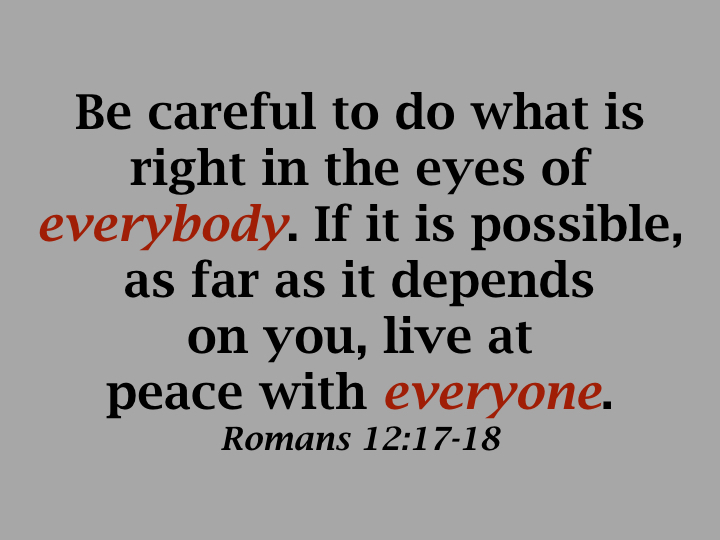
Be careful to do what is right in the eyes of everybody. If it is possible, as far as it depends on you, live at peace with everyone. (Romans 12:17-18)

Really? Everybody and everyone?!

Yes!

Jesus said our Helper would be the Holy Spirit. He would come to empower us to be witnesses to everyone, everybody, everywhere (Acts 1:8).

We have been learning how to communicate with others better, but noticing their communication style “accent.” Check out this post to get some more insight into this. In a nutshell…

  • Doers are action-oriented
  • Planners like to work out all the details
  • People want to make sure everyone is connected
  • Visions are imagining a better future

So if you are a Doer, and you’re trying to share the Good News about Jesus with a Planner, you can probably see a potential problem. The Doer is speaking in bullet points, but the Planner is wanting a lot more facts and figures.

This is where the Holy Spirit can help us. He has the insight that we don’t, and He can direct our words, just as He directed Christ’s words (see John 12:49-50).

Here’s how to talk their talk when you’re sharing the Good News:

(1) Doer

  • Keep it brief
  • Share more facts than stories
  • Stress now/today
  • Rely on the Gospel of Mark (action oriented)

(2) Planner

  • Tell them the who, what, where, when, why, and how
  • Be ready for lots of questions
  • Give them time to process your information
  • Rely on the Gospel of Matthew (lots of background, lots of Old Testament references to answer the who, what, where, when, why and how)

(3) People

  • Develop a friendship first
  • Share more stories than facts
  • Don’t tell them, show them your personal life
  • Rely on the Gospel of Luke (lots of personal stories about changed lives)

(4) Vision

  • Share both the facts and the stories
  • Encourage them to “Imagine what would happen …”
  • Give them time to ask questions
  • Rely on the Gospel of John (very poetic and image-rich)

You can connect with everyone, everybody, everywhere and share the Gospel with them in an effective way. Allow the Holy Spirit to give you the insight you need.

Check out how I describe this in more detail here…

The Rewards For Getting Along With Difficult People

How To Get Along With OthersHere’s a shocking statement—Difficult people are difficult to get along with. I know, I probably just blew your mind with that one, but sometimes it’s important to state the obvious.

Christians should be the best at getting along with others. First of all, because they have the Holy Spirit to help them, and, second, because the world is watching to see if having a relationship with Jesus really does make a difference.

We’ve already learned that in order to change our behavior toward difficult people, we can’t change our behavior (check out my post on that topic here). Instead, we need to change our thoughts first. One thought to change is about ourselves, and another thought to change is the fact that Jesus promised rewards for those who loved difficult people—

If you love those who love you, what credit is that to you? Even sinners love those who love them. And if you do good to those who are good to you, what credit is that to you? Even sinners do that. And if you lend to those from whom you expect repayment, what credit is that to you? Even sinners lend to sinners, expecting to be repaid in full. But love your enemies, do good to them, and lend to them without expecting to get anything back. Then your reward will be great, and you will be children of the Most High, because he is kind to the ungrateful and wicked. (Luke 6:32-35)

One way to love others is by learning to “speak their language.” Most of us communicate with four different accents: Doer, People, Planner, Vision.

You can watch the video where I explain these styles in more detail, but you can learn their accent by listening for…

(1) How they handle stressful situations:

  • Doer—get hyper-focused
  • Planner—withdraw to plan
  • People—call a meeting
  • Vision—take time to daydream

(2) How they listen to others:

  • Doer—take short bullet points and then quick action
  • Planner—take detailed notes, and ask lots of detailed questions
  • People—make good eye contact, take very little notes, and then reiterate what was said
  • Vision—doodle, and express “ping pong ball” thoughts

(3) How they speak about folks with other “accents”:

  • Doer—this is taking too long; nothing ever gets done; they’re daydreamers
  • Planner—they jump the gun; they’re swayed by emotions; they’re unpredictable
  • People—why don’t they want to meet; they’re too aggressive; they’re too robotic
  • Vision—they don’t see the big picture; they’re too rigid; they’re too emotional

You CAN get along better with everyone. Romans 12:18 tells us that peaceful living with others depends on you and me. Let’s do this well so that Jesus is glorified!

Abundantly Able

Yet Abraham did not waver through unbelief regarding the promise of God, but was strengthened in his faith and gave glory to God, being fully persuaded that God had power to do what He had promised. (Romans 4:20-21)

A.B. Simpson“The literal translation of this passage from the Greek expresses the thought in this way: God is not merely able but abundantly able, bountifully and generously able, with an infinite surplus of resources, and eternally able ‘to do what He had promised.’ He is the God of limitless resources—the only limit comes from us. Our requests, our thoughts, and our prayers are too small, and our expectations are too low. God is trying to raise our vision to a higher level, call us to have greater expectations, and thereby bring us to greater appropriation. Shall we continue living in a way that mocks His will and denies His Word?” —A.B. Simpson

How To Make New Communications Habits

Making new habitsPreviously I wrote about NOT trying to change our bad behaviors. That’s because our behavior is a natural outcome of several other factors (read more about that by clicking here). The important progression goes like this: Thoughts → Values → Attitudes → Behaviors.

The two areas we can address are our thoughts and attitudes. When it comes to interacting with other people, notice carefully the words Jesus said: “Love your neighbor as yourself” (Mark 12:31).

Jesus says that our thoughts about ourselves can limit our thoughts about others. If your thoughts are limited, your value on people and healthy relationships will slide. If those values drop, your attitude about others will begin to sour. And with those thoughts, values and attitude dropping, isn’t it natural to expect that you will struggle getting along with others?

So you must get this clear—

  • God had a plan for you from before the beginning of time (Ephesians 2:10)
  • God knit you together in your mother’s womb (Psalm 139:13-18)
  • God put just the right gifts and talents in you to change the world (Romans 12:3-6; 1 Corinthians 12:4-7).
  • God made you unique (you-nique!).
  • You are a one-of-a-kind masterpiece!

Because you are you-nique, you hear and see the world uniquely, and you respond uniquely. You and I respond mostly by habit.

Habits are good when they are healthy. But unhealthy habits create assumptions and blind spots that can hinder our relationships.

To make new relationship habits requires three things:

  1. Knowledge (what do I need to do)
  2. Skill (how do I need to do it)
  3. Desire (I really want to make this change)

If you want to make some new communication habits, get knowledge from people who love you and from reading the Bible. Then read some books or attend some seminars that will give you new skills. Then combine those with your sincere desire to want to improve your relationship habits, and watch for great things to happen!

I am leading our church through a training on our communication styles. Please join us on Sunday as we learn how to better get along with others. I’d love for you to join us either in person or on our Periscope broadcast.

You Are An Empowered Peacemaker

My new attitude“The whole world—with one minor exception—is made up of others,” says John Maxwell. The ‘one minor exception’ is that person who’s looking back at you from the mirror every morning, so if you want to be successful in life, you better learn to get along with ‘the others.’

I believe this is especially important for those who call themselves Christians. Here are three reasons why—

  1. Our interaction with other Christians is a testimony to outsiders—John 13:34-35.
  2. Our positive interaction with outsiders can draw others to Christ—Colossians 4:5.
  3. Our negative interaction with outsiders can repel others from Christ—1 Peter 2:12.

So although it can be very (sometimes very, very!) challenging, we are called to find ways to get along with others. The Apostle Paul said:

Be careful to do what is right in the eyes of everybody. If it is possible, as far as it depends on you, live at peace with everyone (Romans 12:17-18, emphasis added).

When you see the phrase “if it is possible” you may think that Paul has given us an “out.” We could say, “I tried really hard to get along with that guy, but it just hasn’t worked, so I’m off the hook!”

But consider how another translation of the Bible states this phrase: Do all that you can to live in peace with everyone.

Jesus was asked to do something that had never been done before: heal two men born blind. Jesus asked these men, “Do you believe I am able to do this?” (Matthew 9:28). The men answered an emphatic, “Yes!” On another occasion a father asked Jesus to heal his son by saying, “If You can, please help us.” Jesus said, “‘If I can? All things are possible to those who believe.” The father immediately replied, “I do believe; please help my unbelief” (Mark 9:22-24).

If you are Christian, the Spirit of Jesus lives in you. So the question Jesus asks us about our difficult relationships is, “Do you believe I am able to help you?” Or perhaps more accurately He asks us, “Will you let Me help you?”

So the part of the verse which says, “if it is possible, as far at it depends on you” is really saying, “If you really believe Jesus is stronger than this strained relationship, will you let Him do something in you to bring about peace?”

We aren’t asking Jesus to change the other person; we’re asking Him to change us. We aren’t asking someone else to get on our page, or to see the world from our perspective; we’re asking the Holy Spirit to help us get on their page, to help us see the world they way they see it.

We need to have a new attitude. And I believe that attitude comes from a prayer like this—

I have been empowered by the Spirit of Christ in me. 
It is now possible for me to live at peace with everyone. 
I can let the Holy Spirit use to me make a beautiful harmony. 
I will keep on living like this every day.

Next Sunday we will be looking at some practical techniques and more biblical insights to help us excel in getting along with all ‘the others’ that make up the world. Please join us in person or on Periscope.

6 More Quotes From “Light & Truth—Acts and the Larger Epistles”

Light & Truth [Acts]Horatius Bonar’s wisdom and insight in the Scriptures is still clear and relevant for us today. Here are some additional quotes I highlighted in his commentary. The reference in brackets is the passage in the Bible on which Bonar is commenting.

“We are described as feeble men, bearing on our shoulders a burden too heavy to be borne; the Holy Spirit comes up to us; not exactly to take away the burden; nor to strengthen us under it; but to put His own Almighty shoulder under it, in the room of, and along with ours; thus lightening the load, though not changing it; and bearing the heavier part of it with His own Almightiness. Thus it is that He ‘helps’ our infirmities; making us to feel both the burden and the infirmity all the while that He helps; nay, giving us such a kind and mode of help, as will keep us constantly sensible of both.” [Romans 8:26

“How real, how true, how fast must that love have been. Here is its sincerity demonstrated. Here are its dimensions measured. What is its height? The answer is, ‘He spared not His Son.’ What is its depth? ‘He spared not His Son.’ What is its length? ‘He spared not His Son.’ What is its breadth? ‘He spared not His Son.’ Nay, He delivered Him up. Nay, He laid our sins upon Him; He made Him a curse for us. The more that we meditate on this one gift, the more does its greatness display itself. It passeth all measurement and all understanding.” [Romans 8:32]

“Prayer takes for granted that God is full, and we are empty; that He is infinitely full, and we unspeakably empty. … Prayer takes for granted that there is a connection between His fullness and our emptiness. The fullness is not inaccessible. It is not too high for us to reach, or for it to stoop. It is not too great for us, nor too distant, so as to be incommunicable. There is a connection, and it has been established by God Himself; it is a divine medium of communication: ‘Ask, and you shall receive.’ Prayer takes for granted that we are entitled to use this channel.” [Romans 12:12

“If you are Christians then, be consistent. Be Christians out and out; Christians every hour, in every part, and in every matter. Beware of half-hearted discipleship, of compromise with evil, of conformity to the world, of trying to serve two masters. … Half-hearted Christianity will only dishonor God, while it makes you miserable. There is abundance of Christianity, so-called, in our day. Who does not call himself a Christian? But who cultivates the holiness, the blamelessness, the devotedness, the calm consistency of a follower of Christ? Who hates sin as it ought to be hated? Who separates from the world as he ought? Who follows Christ as He ought to be followed? Who walks in the footsteps of the holy Son of God?” [1 Corinthians 1:8]

“Let us walk worthy [of the blessings in Christ Jesus]; as men who really believe it; happy, holy, unworldly, zealous, generous, loving. Let us carry the consciousness of our calling into everything—great or small; into business, daily life, recreations, reading, education, everything; maintaining our true position before men; manifesting our proper character; letting the world know our prospects, and doing nothing inconsistent with what we profess to be now, and with what we shall be when the Lord comes.” [1 Corinthians 1:9]

“Thus, then, is our whole earthly life, in all its parts, to be regulated by the magnitude of the eternal. Things present must be subordinated to those which are to come, the seen to the unseen, the earthly to the heavenly. It is by the light of the coming glory that we must walk while here. It is from the clock of eternity that our time is to be always taken. Arrange your business, your recreations, your duties with reference to the invisible and unending future. Live, speak, work, move, as those who believe that the things which are seen are temporal, but the things which are not seen are eternal.” [1 Corinthians 7:29-31]

The first set of quotes I shared from this book can be read here. And my review of this book is posted here.