C.S. Lewis might be one of the best known Christian apologists of the twentieth century, but he started out as an avowed atheist scholar. I’ve read biographies about Lewis’ conversion, but in Yours, Jack you can read in his own words the transformation in his thinking.
Paul F. Ford served as the editor for this book and has compiled a marvelous collection of personal correspondence from C.S. Lewis (or Jack, as most called him) to inquirers from all over the world. The letters cover samples of his letters from 1916 to 1963, and have been selected to give us insights into Lewis’ spiritual maturing, as well as to read some of the “seed thoughts” that would show up as fully-formed ideas in later books.
Ford wrote, “The purpose of this collection of letters are (1) to draw attention to how, indirectly and directly, C.S. Lewis experienced spiritual direction, wrote about it, and practiced it, and (2) to allow the reader to benefit from having Lewis as a director.”
But I got so much more out of these correspondences. I could see relationships deepening, spiritual thoughts being forged and sharpened, and feel the tenderness that comes out of Lewis’ pen to each and every person to whom he wrote. And for those who have read any of the other books C.S. Lewis authored, you will smile as you see the fledgling thoughts being tested out on his friends before they appear in his classic and well-loved books.
This book is a must-read for all fans of C.S. Lewis.
Normally on Tuesdays, I post book reviews here, but I’ve been reading a couple of YouVersion reading plans with my wife this summer that I felt I must share with you. Both of them are by Jimmy Evans—One: A Marriage Devotional and Strengths-Based Marriage.
If you are unfamiliar with YouVersion Bible, there is both a web-based site and a mobile app that you really should check out. I spend a lot of quality time in the Scripture using the app on my iPhone each day. One of the cool features YouVersion has recently introduced is the ability to read devotional plans with friends. This offers:
accountability with your reading partners
a set schedule of reading assignments
access to all the biblical texts that correspond with the day’s devotional reading
a place to share your thoughts just with your reading partners, and inaccessible to anyone else on YouVersion
Strengths-Based Marriage focuses on exactly what the title leads you to expect—the strengths in you and your spouse. Instead of trying to “fix” something in your spouse, Jimmy Evans turns your attention toward the God-implanted strengths in your spouse, and then gives you some practical counsel for calling out those strengths.
For example, in one of the devotions he wrote, “Each of us is remarkably unique, and to minimize that irreplaceable uniqueness is to rob the world of a contribution that cannot come any other way.” And in another devotional he says, “You cannot separate your treasures from your passions. In other words, you will always be most passionate about the people, pursuits, and places where you are investing the best of your life. Your passions will always follow the investments of your time, energy, and strengths.”
One: A Marriage Devotional is a much more daily nuts-and-bolts approach to our marriages. In this devotional he shares relationships principles, and then gives us a “Talk It Out” and a “Walk It Out” assignment to put into practice.
In one of these devotionals he writes, “God created marriage to operate as the most important human relationship in our lives, and it only succeeds on that level. … Priority must be proven daily in real terms and not just in words. Good intentions mean very little in marriage. The only thing that matters is what you do and continue to do consistently. For your marriage to work, you must establish it as the first priority and be willing to protect it against good or bad things that try to distract you.”
Whether your marriage is in need of urgent attention, it could use some minor improvements, or it’s already pretty great, both of these devotionals will give you practical tips, time with your spouse in God’s Word, great conversation-starting questions, and some highly practical tips you can use right now.
In each chapter of The Wisdom Of God, A.W. Tozer prayers for us that we would see Wisdom as a Person to be known. Here are a few more of those prayers.
“Let me not stay my heart till I have discovered Thee in all Thy fullness.”
“Manifest Thy grace and wisdom in my life today as a witness to those around me.”
“O Lord God, Thy wisdom has been poured into my heart, creating such a longing for Thee that nothing in this world can satisfy.”
“Heavenly Father, open my eyes to recognize Thy hand in my life. … May I be aware of my surroundings in light of what Thou art doing.”
“Let me penetrate the cloud of unknowing and see Thy face and allow it to transform every aspect of my being.”
“I praise Thee for Thy faithfulness in pursuing me and going to the ultimate end to rescue me from myself.”
“My heart, O God, needs Thy most sacred protection. Keep me from the infiltration of sin into my life so that I may glorify Thee in everything I do.”
“I praise Thee, O God, for the restlessness of my spirit has driven me forward to discover my rest completely in Thee.”
“Dear heavenly Father, may I sent before me only that which will glorify Thee in all the beauty of Thy purity and holiness. I pray Thy wisdom will guide me throughout my life in making the choices that will bless me and honor Thee.”
You can check out some of the other prayers from The Wisdom Of God that I shared here. You can also read my review of this collection of sermons by clicking here.
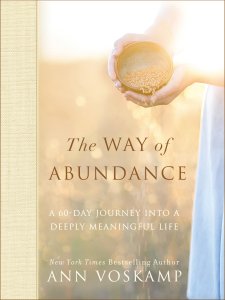
Ann Voskamp speaks lovingly to the hurting and broken. She never condemns them for their brokenness, nor does she encourage them to stay in their difficult place. Instead, Ann brings a new perspective to the path of healing; a path that allows our brokenness to become our givenness to other broken and hurting people. This is The Way Of Abundance. Be sure to check out my full book review by clicking here.
“Go fall in love with grace and mercy and the only One who has ever loved you to death—and back to the realest, abundant life. Because the world is begging us all to get out of bed and live given, get out of bed and sacrifice for someone hurting, for someone different, for someone forgotten or marginalized, to hold the hand of someone who doesn’t look like a us, to lean in and listen to someone angry and grieving and doubting the likes of us, to give a bit of ourselves to those who feel like they aren’t given much real space at the table.”
“The real Jesus turns our questions of why—why this brokenness, why this darkness?—and says, ‘You’re asking the wrong question. You’re looking for someone to blame. There is no such cause-effect here.’ ‘This happened so the power of God could be seen in him’ [John 9:3]. There’s brokenness that’s not about blame. There’s brokenness that makes a canvas for God’s light to be lavishly splashed across the darkness. There’s brokenness that carves windows straight into our souls. Brokenness cracks open a soul so the power of God can crack the darkness in the world.”
“When you aren’t afraid of being afraid, you transform fear into friend. … Feelings can accompany you, but they don’t get to control you. Feelings get to inform you, but they don’t get to form you. Feelings get to keep you company, but they don’t get to keep you in bondage. Only God keeps you.”
“We are always lost until our heart makes its home inside of someone else. Our lives are unfulfilling if we only let our hearts fill us instead of filling other people’s broken places. The art of living is believing there is enough love in you, that you are loved enough by Him, to be made into love to give. Fulfilling lives happen when we give our hearts to fill other people’s empty spaces.”
“There are really only two choices when begging temptation looks you square in your twitching eye: there is either the pain of self-denial, or the pain of self-destruction. … They’ll tell you there’s no such thing called temptation anymore, only repressed self-limitation. They’ll tell you temptation isn’t an issue for the sophisticated. And all I want to say: just don’t say you’re a follower of Christ if you’re actually following your own heart.”
“Shame dies when stories are told in safe places. … Shame gets unspeakable power only if it’s unspeakable.”
“The only way to live a truly remarkable life is not to get everyone to notice you, but to leave noticeable marks of His love everywhere you go.”
“When you feel basically respectable, you want religion. And when you know you feel the brokenness of rejection, you want the gospel. In religion, it’s the ‘respectable’ who search for a God to impress. But in the Gospel, it’s God who searches for the brokenhearted rejected to save.”
“Never fear the moments you imagine will freeze you: unexpected blasts of cold can be what draws you nearer to the flame of His love.”
“The body of Christ must recapture its vision as the only collective in the world that exists for its nonmembers. … We are a community that will not dish out condemnation but courage, that will lean in and listen long and love large.”
“You love as much as you are willing to be inconvenienced. … The brokenness of people is never truly an intrusion. Loving the broken people when it is inconvenient is the way to have fuller inclusion in the life of Christ.”
The Wisdom Of God is a collection of never-before-published sermons from A.W. Tozer, in which he makes the case that true Wisdom is a Person to be known not a quality to be gained.
“Wisdom and power cannot be separated from the Cross. If we do not obey, we blind ourselves, and we become dependent upon our own intellect, which will be in no way sufficient to teach others.”
“Today, Christians need to learn how to worship, and instead of having all this religious claptrap and modern entertainment to hold people together, have the fire of God and the presence of the Holy Spirit, which, by the way, will be enough.”
“The one thing God has to offer us and the only thing we absolutely need is His wisdom. Flowing from that wisdom is the solution to all the problems that we could ever face. To know the wisdom of God in its fullness is to experience life as God intended it to be.”
“Our relationship with God must be based upon God’s ways and not our ways.”
“To fear God, out of which flows wisdom, is to submit myself to God unconditionally and without any personal agenda. When I come to God as He invites me to come, I will have what God intends for me to have.”
“This effusion of superior wisdom is a gift imparted by God in addition to the gift of wisdom that He gives the birds so they know to fly south and that which He gives man to invent a spaceship or an electric light. This effusion of superior wisdom is something you either have or you don’t. It does not come gradually to anyone. So a man is either born or he is not. He is either born-again or he has not been born again; he cannot come into that gradually. The doctrine of gradualness is from the devil to keep the church of Christ from going forward.”
“For wisdom dwells with God and He pours her out upon all His works in the degree they are able to absorb it, and the wisest man is the one who turns to the Lord in repentance and faith.”
“Christ is that ancient, most excellent wisdom incarnated in our nature and making atonement for all our moral infamy. Any emphasis that makes sin less infamous than that is not biblical. Any interpretation of grace and mercy that allows sin to appear even reasonably excusable in the eyes of God is not a proper interpretation. Any doctrine, any view of sin that allows it to be excused in anyway is not biblical. It is not God’s way of looking at it, for God looks at sin as alienation. … God sent His only Son to make atonement for our infamy and saves those that turn to the wisdom of the just through repentance.”
“We Christians are a strange crowd. We make a more of the invisible than the visible. We talk constantly to Someone we cannot see. We act as if thing were real that people do not believe are real and waive aside things that some people attach great value to. We sing about a Man who was rejected and crucified, and we say, ‘We find the yoke easy.’”
You can read my review of The Wisdom Of God by clicking here. And be sure to check out some other quotes from this book here.
Those in pastoral ministry are ministers; they are not professional, career-minded, corporate ladder-climbers. John Piper has written a book that I believe every pastor should read: Brothers, We Are Not Professionals. Here are a few more quotes from this excellent book.
“Is not our most painful failure in the pastorate the inability to weep over the unbelievers in our neighborhoods and the carnal members of our churches? …
“I must feel the truth of hell—that it exists and is terrible and horrible beyond imaginings forever and ever. ‘These will go away into eternal punishment’ (Matthew 25:46). Even if I try to make the ‘lake of fire’ (Revelation 20:15) or the ‘fiery furnace’ (Matthew 13:42) a symbol, I am confronted with the terrifying thought that symbols are not overstatements but understatements of reality. …
“I say to you, on the authority of Scripture, remember, remember, remember the horrid condition of being separated from Christ, without hope and without God, on the brink of hell. ‘Remember that you were at that time separated from Christ, alienated from the commonwealth of Israel and strangers to the covenants of promise, having no hope and without God in the world’ (Ephesians 2:12). …
“When the heart no longer feels the truth of hell, the gospel passes from good news to simply news.”
“Warning has value in stirring us up to take the glories of holiness and heaven seriously so that we come to see them for what they are and delight in them. But it is the delight in them that causes the true grief when we fall short.”
“Pastors, you will know your people’s souls best by knowing your own. So try to be ruthlessly honest with yourself.”
“If the heart is without passion, it will produce lifeless, jargon-laden spontaneity. And if the heart is aflame, no form will quench it.”
“We ought to experience the deepest emotions about the deepest things. And we ought to speak often, and publicly, about what means most to us, in a way that shows its value.”
“Eating, exercising, and sleeping are more spiritually relevant in the ministry than we may think. … The point is that we be intentional about how our eating affects the ability of our body to be a helpful partner in seeing the glory of God.”
“When we say that what we do on Sunday morning is to ‘go hard after God,’ what we mean is that we are going hard after satisfaction in God, and going hard after God as our prize, and going hard after God as our treasure, our soul-food, our heart-delight, our spirit’s pleasure. Or to put Christ in His rightful place—it means that we are going hard after all that God is for us in Jesus Christ, crucified and risen.”
“It will transform your pastoral leadership in worship if you teach your people that the basic attitude of worship on Sunday morning is not to come with your hands full to give to God but with your hands empty to receive from God.”
“Brothers, we are leaders, and the burden of change lies most heavily on us.”
You can read my full book review of Brothers, We Are Not Professionals by clicking here, and you can check out some other quotes from this book here.
“If you are going to live the life that God created you to live, if you are going to live to your full potential, if you are going to live the kind of life that never settles, you have to come to a place where you decide to stop running and instead choose to take a stand. …
“You have to eventually stop trying to be what everyone else wants you to be, and you have to stop choosing to become only what comes easy to you. You have to decide what will define you. What will mark you as a person? How will you be known by others? Your decisions are the direct result of truly knowing yourself. …
“When we run in fear, we are only postponing the inevitable. We will eventually have to face those fears. We will eventually have to fight those battles. Running only makes us weaker and makes our opposition stronger. …
“There comes a time and a place you have to decide, This is worth fighting for. This is where I stand. This is who I am. This is the life I have chosen. I will not run. I will not allow fear to move me from where I should be to where it wants me to live. I would rather die facing the challenge than exist running from it.” —Erwin McManus, in The Last Arrow (emphasis added)
Check out my review of The Last Arrowhere, and check out some quotes from this book here, here, and here.
Cold-Case Christianity by J. Warner Wallace is educational in a number of ways. Not only will you learn more about police investigations and courtroom deliberations, but Christians and skeptics alike will learn about the reliability of the biblical account concerning Jesus. You can check out my full book review by clicking here.
“The Christian tradition is actually intellectually robust and satisfying, even if we believers are occasionally unable to respond to your challenges. The answers are available; you don’t have to turn off your brain to be a believer. Yes, it is possible to become a Christian because of the evidence rather than in spite of the evidence.”
“Faith is actually the opposite of unbelief, not reason. … The biblical definition of faith is a well-placed and reasonable inference based on evidence.”
“What about cases that have no direct evidence connecting the suspect to the crime scene? Can the truth be proved beyond a reasonable doubt when all the evidence we have is circumstantial? Absolutely.
“Jurors are instructed to make no qualitative distinction between direct and circumstantial evidence in a case. Judges tell jurors, ‘Both direct and circumstantial evidence are acceptable types of evidence to prove or disprove the elements of a charge, including intent and mental state and acts necessary to a conviction, and neither is necessarily more reliable than the other. Neither is entitled to any greater weight than the other.’”
“William Dembski (the well-known mathematician, statistician, theologian, and intelligent-design advocate) has argued that specified complexity (and, therefore, the intervention of an intelligent agent) can be identified by using an ‘explanatory filter.’ If an object or event (1) cannot be explained by some natural law that necessitates its appearance, (2) exists in spite of the high improbability that it could occur as the result of chance, and (3) conforms to an independently existing and recognizable pattern, the most reasonable inference is that it is the product of an intelligent designer.”
“The early church fathers and leaders recognized that the Gospels were the eyewitness testimony of the apostles, and they set the Gospels apart for this reason. The ancient Christian author Tertullian wrote in AD 212: ‘The same authority of the apostolic churches will afford evidence to the other Gospels also, which we possess equally through their means, and according to their usage—I mean the Gospels of John and Matthew—whilst that which Mark published may be affirmed to be Peter’s whose interpreter Mark was’ (Against Marcion).”
“Skeptics cannot reject the reasonable inferences from the evidence we do have, simply because there may possibly be some evidence we don’t have; skeptics also need to defend their doubt evidentially.”
“The reasonable inference from the circumstantial evidence is that the Gospels were written very early in history, at a time when the original eyewitnesses and gospel writers were still alive and could testify to what they had seen.”
“Some have argued that the Gospels are late because none of the authors specifically identifies himself in the accounts. … BUT … The Gospels are not the only ancient documents that fail to identify the author within the text of the manuscripts. Tacitus (the Roman senator and historian who lived from AD 56 to AD 117) wrote a history of the Roman Empire from the reign of Augustus Caesar to Nero entitled Annals. Tacitus was, in fact, present during much of this period of time, but failed to include himself in any of his descriptions or identify himself as the author.”
“While it is possible that the Gospels were not written by the traditional first-century authors and were given these attributions only much later in history, it is not evidentially reasonable. If skeptics were willing to give the Gospels the same ‘benefit of the doubt’ they are willing to give other ancient documents, the Gospels would easily pass the test of authorship.”
“The most reasonable inference is that the gospel writers were present, corroborated, accurate, and unbiased. If this is the case, we can conclude with confidence that their testimony is reliable.”
You are a gift. You are God’s grace gift to the world.
Max Lucado said it this way: “You are you-nique.”
God made you on purpose and for a purpose.
God implanted unique abilities in you from conception (see Psalm 139:13). And check out what God said to Jeremiah, “Before I formed you in the womb I knew and approved of you…” (Jeremiah 1:5). Before you were even conceived, God already knew all about you AND He approved of you!
Why did God implant these unique abilities in you? Because He knew of the unique opportunities you would face during your lifetime (see Psalm 139:16). Because God is for you, He gave you all that you would need to successfully face every opportunity that came your way.
Every one of us has been given these grace gifts of unique talents and opportunities. The Bible says, “to each one of us grace has been given as Christ apportioned it” (Ephesians 4:7). If God is for you, and God is for me, then that means that you have been gifted to be a blessing to me and I have been gifted to be a blessing to you (Romans 12:3-6; 1 Corinthians 12:4-7).
Let me state it again: every one of us has been entrusted by God with unique talents in order to successfully face the unique opportunities that He knew we would face. Jon Bloom reminds us, “Some are given more, some are given less, but all are given much.”
So what do we do with what we’ve been entrusted? There are two possibilities: (1) We can invest our talents and abilities in a way that glorifies God, or (2) We can squander the talents God has given us.
How do you squander the grace gift of your life?
Not discovering it—I have a gift?
Devaluing it—I’m nothing special.
Overvaluing it—I’m super-important. I don’t need anyone else.
Laziness—I don’t want to mess it up, so there’s no need for me to invest my gift.
Short-sightedness—My gift is just for me, so it doesn’t matter what I do with it.
I hope we can all say what Erma Bombeck wrote: “When I stand before God at the end of my life, I would hope that I would not have a single bit of talent left but could say, ‘I used everything You gave me.’”
How do you honor God with your you-niqueness? I can tell you in just three simple words—You be you!
If you will just be who God made you—not downplaying your talents, not wishing you had someone else’s talents—that’s when you will feel fulfilled, and God will be glorified, and the rest of the world will be blessed! So…