How To Make New Communications Habits

Making new habitsPreviously I wrote about NOT trying to change our bad behaviors. That’s because our behavior is a natural outcome of several other factors (read more about that by clicking here). The important progression goes like this: Thoughts → Values → Attitudes → Behaviors.

The two areas we can address are our thoughts and attitudes. When it comes to interacting with other people, notice carefully the words Jesus said: “Love your neighbor as yourself” (Mark 12:31).

Jesus says that our thoughts about ourselves can limit our thoughts about others. If your thoughts are limited, your value on people and healthy relationships will slide. If those values drop, your attitude about others will begin to sour. And with those thoughts, values and attitude dropping, isn’t it natural to expect that you will struggle getting along with others?

So you must get this clear—

  • God had a plan for you from before the beginning of time (Ephesians 2:10)
  • God knit you together in your mother’s womb (Psalm 139:13-18)
  • God put just the right gifts and talents in you to change the world (Romans 12:3-6; 1 Corinthians 12:4-7).
  • God made you unique (you-nique!).
  • You are a one-of-a-kind masterpiece!

Because you are you-nique, you hear and see the world uniquely, and you respond uniquely. You and I respond mostly by habit.

Habits are good when they are healthy. But unhealthy habits create assumptions and blind spots that can hinder our relationships.

To make new relationship habits requires three things:

  1. Knowledge (what do I need to do)
  2. Skill (how do I need to do it)
  3. Desire (I really want to make this change)

If you want to make some new communication habits, get knowledge from people who love you and from reading the Bible. Then read some books or attend some seminars that will give you new skills. Then combine those with your sincere desire to want to improve your relationship habits, and watch for great things to happen!

I am leading our church through a training on our communication styles. Please join us on Sunday as we learn how to better get along with others. I’d love for you to join us either in person or on our Periscope broadcast.
3 Bible Studies For You To Try

Book by book studyLast week I spoke and wrote about some tools you might use to study your Bible. Now I’d like to share some Bible study projects you might try with those new tools. As always, I recommend that beginning Bible studies go verse by verse through the Bible. I believe you will lay a strong foundation for your faith when you systematically put God’s Word into your heart.

Book By Book

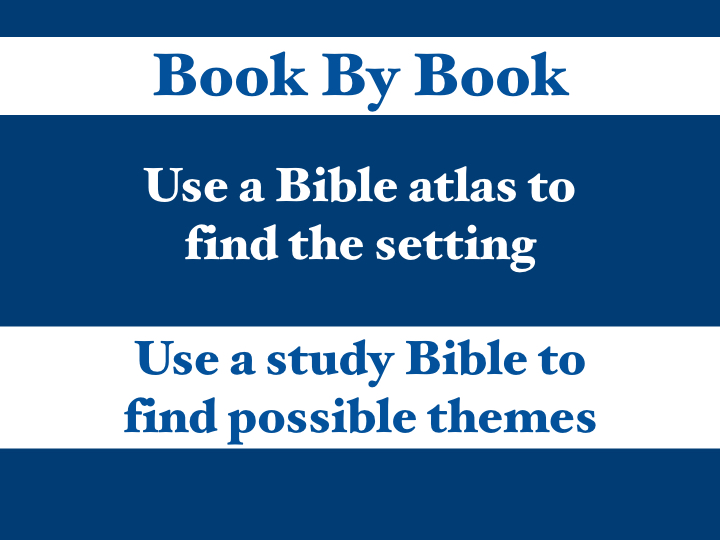
I’ll use the book of Ephesians as an example. Using my Bible atlas I find that the city of Ephesus is located along an important trade route, and it is the Roman capital of the province of Asia. My Full Life Study Bible tells me that because so much trade passed through this city, this letter was probably intended to be a circular letter for all of the communities near Ephesus. As a result, Paul is not addressing any specific problems in this church, but writes theological ideas for a broad spectrum of people.

As I begin reading, I paused in the first verse when I came to the phrase “the faithful in Christ.” I asked myself, “What does it mean to be faithful IN Christ? Can I be faithful outside of Him?” By the time I got to verse 3, I saw a similar phrase: “every spiritual blessing in Christ.” Now I went back and used a blue highlighter (there’s nothing special about blue, it just happened to be the first highlighter I grabbed), and marked those two “in Christ” phrases. I see two more in verse 4: “He chose us in Him” and “holy and blameless in His sight.” Going through the whole book I discovered 36 times the phrases “in Christ” or “in Him.” This is helpful to me to know the kind of security I have in Jesus.

Another thing that stood out to me were Paul’s prayers for the church. I see His very moving prayers in passages like 1:15-19 and in 3:14-21. I also see in 6:18 that he tells us to pray all kinds of prayers for ourselves and for others. And I see in 6:19 that Paul asked the church to pray for him too.

And always look for “therefore” phrases. For example in 4:24-25 or 4:32-5:1. The “therefore” phrases tell us how to live or think in light of the ideas that were just shared.

Chapter By Chapter

A good place to do this is in the Psalms or Proverbs. These are usually stand-alone chapters. When reading the chapters in these two books, I love reading them in parallel with other translations. For example, check out this from Psalm 1.

In Psalm 59, notice the superscript (or introduction). This gives us some background information to the psalm. Using my concordance, I found that this psalm was written this time in David’s life.

There is usually a theme to each chapter of the Proverbs, so try to discover that. In Proverbs 2, I noticed the “if … then” statements. In the first four verses I see things like “IF you will seek wisdom like this,” and then in verses 5-22 I see a whole bunch of blessings that follow the “then” that starts verse 5.

Word By Word

Sometimes I like to go really deep in a passage, so I slow down and look at it word by word. Here you need to use a Strong’s Concordance of the Bible. I like the one available on Blue Letter Bible. For example, next to 2 Peter 1:5, you can hover over the word “Tools” and select “Interlinear.” Clicking on “Interlinear” you will see all of the Greek words that make up this verse. By clicking on the Strong’s number, you can see the definition of that Greek word. Scrolling down a bit, you can see all of the other verses where that Greek word is used in the New Testament.

None of these tools are meant to take the place of the Holy Spirit. He is called the Spirit of Truth, and since He is the One who inspired all of the Scripture, ask His help before you begin any Bible study.

Here are two more Bible studies for you to try.

In this video I go into more detail on how I undertake all of these Bible studies. And be sure to join us next week as we take another look at different types of Bible studies.

4 Reasons To Study Your Bible

Commitment to readYou probably hear Christians say quite frequently, “You should read your Bible.” But one thing you may not hear as often is why you should read your Bible. There are probably many more reasons, but here are four reasons why I believe reading your Bible should be a daily part of your life.

(1) To help spot errors.

When the devil tempted Jesus, it is noteworthy that Jesus didn’t try to use logic, or persuasion, or even willpower. Every temptation was blocked by Jesus saying, “It is written” as He quoted Scripture.

In the second temptation, the devil tried the same tactic. He, too, quoted a couple of verses from the Psalms, but he took them out of their context. So notice Christ’s reply, “It is also written” (Matthew 4:7). The best way to spot error is to know the full counsel of God’s Word. This tactic the devil tried with Jesus wasn’t something new, but it was something he used on the very first humans: “Did God really say…” (Genesis 3:1), and he will try it again on you!

(2) To clarify your emotions.

Most of us allow our emotions to control our actions. Or sometimes we wrestle with, “My heart says one thing, but my head says something else!” In this tug-of-war, we allow our emotions to determine our beliefs, and then our beliefs determine our actions. This is not only dangerous, but it is contrary to what the Bible teaches.

The healthy way to respond is by fully knowing what we believe, and then acting according to our beliefs. Our proper emotional response will then follow those actions.

Look at the example of Jesus in John 2:13-16. He was ticked off at how people were misusing His Father’s house, and He did some serious house cleaning! Just reading those four verses, you may get the idea that Christ’s emotions carried Him away. But check out verse 17, in which we see He was acting in accordance to His beliefs, which were fully grounded in Scripture.

(3) To know prophesy.

All of the Scriptures point to Jesus, so all of the Scriptures are illuminated by Christ (Luke 24:27, 45). If you want to know what is happening in our world, turn to the pages of Scripture and see how Jesus is revealed. This will help you put even current events into perspective.

(4) To give sound answers.

When people need help, I want to be able to give them real answers. Not my opinion, but truth that they can apply. The Apostle Peter told us to always be prepared to give people an answer that is based on our knowledge of Jesus (1 Peter 3:15).

“Beware of saying, ‘I haven’t time to read the Bible, or to pray’; say rather, ‘I haven’t disciplined myself to do these things.’” —Oswald Chambers

Can I challenge you to do something I challenged my whole church to do … Make a commitment to read the Bible every day for the next seven days. See what happens as God meets with you, and reveals Himself and His wisdom to you, every day.

We’ll be learning some Bible study strategies next Sunday, and I invite you to join us.

The Power Of Confession

God restoresGod wants to meet with us. He loves hearing our voice and talking to us. We can come into His presence at anytime, with anything and everything that’s on our heart, and know for sure that He is waiting to hear from us.

But there is one thing that can short-circuit this intimate relationship. And if we don’t deal with this one thing quickly, it could lead to disastrous results.

This one thing is unconfessed sin.

Adam and Eve sinned, and started a downward slide that we continue in today. First, they tried to cover up their sin (Genesis 3:7). Think about this for a moment. They made clothes out of fig leaves. What happens to leaves when are detached from their vine? Yep, they die and shrivel up!

Next, they tried to hide from God (Genesis 3:8-10). Really? You can hide from God?! That’s sort of like a toddler covering her eyes and thinking since she can’t see daddy, he can’t see her either.

Then they made excuses for their sin (Genesis 3:11-13). Of course, they said, we would have never sinned on our own. She made me do it! The devil made me do it!

None of this worked. Instead it kept them in fear of God’s presence!! 

A beautiful prayer of confession of his sin is David’s prayer in Psalm 51. Notice this:

  • He was assured of God’s unfailing love and His great compassion (v. 1).
  • He confessed his sin without excuse. Five times in verses 1-3 he says my transgression, my sin, my iniquity.
  • He let God restore him (vv. 7-12)

It works so much better when God does the restoring! Instead of the fig leaves which were dying, God Himself made clothes for Adam and Eve (Genesis 3:21). This was a foreshadowing of the of way God will clothe all men and women who confess their sin, and place their faith in Christ’s work on Calvary (Ephesians 5:26-27).

Don’t let unconfessed sin keep you from God’s presence! Quickly confess your sin, and let God clothe you in the righteousness of Jesus.

We’ll be continuing our look at Practical Prayer this Sunday, and I hope you can join me. If you cannot join us in person, check out our live broadcast on Periscope.

Expectation Or Superstition?

Safe placeWhat good is it to pray if we don’t expect to receive anything from God? Isn’t that just making “prayer” a superstition? Instead, the Bible tells us that we can have “a remarkable degree of confidence” that when we take something to God in prayer, we can expect something great (1 John 5:14-15)!

Our prayer closet should be the safest place for us to express ourselves. You might have a close friend with whom you can “be yourself.” You can pour everything out to your friend, knowing that they will still love you. And yet, even with that really close, true-blue friend there are still times you hold back.

God doesn’t want that from us.

Check out David’s prayer closet. He had no problems telling God how he felt about the bad guys who were after him (Psalm 56:5-7; 57:3; 58:6-8; 59:13). Here’s the important thing to note: David poured out these words only in God’s presence. We don’t read anywhere in the Bible where David yelled these words at his enemies, or even shared these thoughts with his close friends.

Instead David said, “Trust in Him at all times, O people; pour out your hearts to Him, for God is our refuge” (Psalm 62:8). Pouring out your heart to anyone else can sound like gossiping, picking a fight, or whining!

When David got it all out in God’s presence, he experienced two really cool things:

  1. His swirling, angry thoughts were quietedfor God alone my soul waits in silence.
  2. He came away with an expectation of God’s helpmy soul, wait thou only upon God; for my expectation is from Him.

What about you? Are you being honest in prayer? Are you pouring out all of your hurts and doubts and frustrations to your Heavenly Father? Do you expect Him to answer you?

Here’s how you can tell if you aren’t praying with total honesty … you will walk out of your prayer closet still in turmoil. When you truly unload your heart in God’s presence, He will give you a peace that is so beyond anything you could have worked up yourself (Philippians 4:6-7).

Check this out…

Join me next Sunday as we continue our look at Practical Prayer.

Week Of Prayer—Thursday

WOP_2016_Slide_ThuOur week of prayer continues today with this prayer focus for Thursday—

Pray that with absolute trust in God you will say yes in obedience to His direction in your life.

We have been praying the Scriptures all week. For today’s prayer focus, perhaps you could pray something like this:

God, I trust You. Completely. Although at times I have questions, I still trust You. How long, Lord? Will You forget me forever? How long will You hide Your face from me? How long must I wrestle with my thoughts and day after day have sorrow in my heart? How long will my enemies triumph over me? Look on me and answer, O Lord my God. Give light to my eyes, or I will sleep in death, and my enemy will say, “I have overcome him,” and my foes will rejoice when I fall. But I trust in Your unfailing love; my heart rejoices in Your salvation. So I will sing Your praise, for You have been good to me [Psalm 13]. 

But I will extol You at all times; Your praise will always be on my lips. I will glory in You; let anyone around me who is afflicted hear and rejoice. I call out to them, “Glorify the Lord with me; let us exalt His name together.” Because when I cry out to You, You answer me; You deliver me from all my fears. When I keep my eyes on You, my face is radiant. When I call to You, You hear me, and You save me out of all my troubles. Your angels encamp around me, and You deliver me. I have tasted and now I know for myself that You are good. I am blessed when I take refuge in You. Listen to what I have learned: Fear the Lord, you His holy people, for those who fear Him lack nothing [Psalm 34:1-9]. In Jesus’ name, Amen.

Peace On Earth! Really?

Craig T. OwensFor some people, “peace on earth” is just a wish. Perhaps all of this talk of peace and goodwill during the buildup to Christmas is doing just the opposite, and you’re feeling a bit stressed out.

How do you think Joseph felt on the night of his first son’s birth? Do you think he was peaceful, or do you think things weren’t going as he had planned, and his stress level was through the roof? We can learn a very valuable lesson from his life.

Please gather your family and friends around to watch this short 10-minute video before you begin your Christmas celebration. This encouraging word may be just what you need to have a peaceful and joyous Christmas.

(If you have any trouble with the above video, here’s another link to try.)

I encourage you to read the Scriptures I mention in this video. They are:

And the quote from Max Lucado I shared:

“You’ve stood where Joseph stood. Caught between what God says and what makes sense. You’ve done what He told you to do only to wonder if it was Him speaking in the first place. You stared into a sky blackened with doubt. And you’ve asked what Joseph asked. You’ve asked if you’re still on the right road. You’ve asked if you were supposed to turn left when you turned right. And you’ve asked if there is a plan behind the scheme. Things haven’t turned out like you thought they would. Each of us knows what it’s like to search the night for light. Not outside a stable, but perhaps outside an emergency room. On the gravel of a roadside. On the manicured grass of the cemetery. We’ve asked our questions. We’ve questioned God’s plan. And we’ve wondered why God does what He does. The Bethlehem sky is not the first to hear the pleading of a confused pilgrim. If you are asking what Joseph asked, let me urge you to do what Joseph did. Obey.”

Merry Christmas!

8 Quotes Worth Studying From “Proverbs”

ProverbsIn my review of Proverbs by Charles Bridges (which you can read by clicking here), I noted how he weaved the principles in the biblical book of Proverbs into the teaching that occurs throughout the Scripture. In others words, he showed that the wisdom in Proverbs wasn’t just a “stand-alone” wisdom, but integrated into the whole.
In the quotes I’m sharing today, I trust you will get a glimpse of what I mean. The reference in brackets before the quote indicate the Proverb to which Bridges is commenting. I have also linked all of the Scripture references to my friends at Bible Gateway, so you can look them up easily (and I encourage you to do so!).

[Proverbs 1:10-16] “If the temptation prevail, charge it not on God; no—nor on the devil. As the worst he can do, he can only tempt, he cannot force us, to sin. When he has plied us with his utmost power, and most subtle artifice, it is at the choice of our own will, whether we yield or no (see James 1:13-15). The habitual resistance of the will clears us of responsibility (cp. Romans 7:14-17, 19-20, 23). The consent, even if it be not carried out into the act, lays the responsibility at our own door.”

[Proverbs 2:10-11] “The forsaken sin only makes way for some more plausible, but not less deadly passion. The heart, cast into the mold of the Gospel, is the only cover from those snares within and without (Romans 6:17, 18; 2 Corinthians 3:18), which so imperceptibly, yet so fatally, estrange us from God. Never, till the vital principle is implanted, is their mischief discerned. Never, till then, does the heart find its proper object, its true resting-place.”

[Proverbs 3:5-6] “Take one step at a time, every step under Divine warrant and direction (cp. Ezekiel 18:21-23; Nehemiah 1:11). Ever plan for yourself in simple dependence on God. It is nothing less than self-idolatry to conceive that we can carry on even the ordinary matters of the day without His counsel. He loves to be consulted. Therefore, take all thy difficulties to be resolved by Him. Be in the habit of going to Him in the first place—before self-will, self-pleasing, self-wisdom, human friends, convenience, expediency. Before any of these have been consulted, go to God at once. Consider no circumstances too clear to need His direction. In all thy ways, small as well as great; in all thy concerns, personal or relative, temporal or eternal, let Him be supreme.”

[Proverbs 3:11-12] “Faith understands the reasons of the discipline (1 Peter 1:6, 7); acknowledges it as a part of His gracious providence (Deuteronomy 8:2, 15, 16), and the provision of His everlasting covenant (Psalm 89:30-32); waits to see the end of the Lord (James 5:11); and meanwhile draws its main support from the seal of adoption.”

[Proverbs 4:14-17] “To pray not to be led into temptation; yet not to watch, that we enter not into it (Matthew 6:13; 26:41)—is practically to contradict our prayers; to mock our God, by asking for what we do not heartily wish.”

[Proverbs 11:18-19] “Righteousness is the seed; happiness is the harvest. The reward indeed is not from cause, but of consequence; not of debt, but of grace depending upon a free promise; mercifully yet surely linked with Christian perseverance (Ecclesiastes 11:6; Hosea 10:12; 1 Corinthians 15:58; Galatians 6:7, 8).”

[Proverbs 17:22] “If then, Christian, you believe the Gospel to be ‘glad tidings’ (Luke 1:19; 8:1), show that you believe it, by lighting up your face with a smile.”

[Proverbs 28:13] “The love of sin struggles with the power of conscience. The door of access to God is barred (Psalm 66:18). Christian confidence is clouded (Psalm 32:3, 4); and, unless Sovereign mercy interpose, it must end in the sting of ‘the never-dying worm’ (Isaiah 66:24; Mark 9:44-48). The covering of the disease precludes the possibility of the cure. Only the penitent confessor can be the pardoned sinner.”

“The best work on the Proverbs. While explaining the passage in hand, he sets other portions of the Word in new lights.” —C.H. Spurgeon, commenting on this book

11 More Quotes From “Our Portrait In Genesis”

The Complete Works Of Oswald ChambersOswald Chambers’ book Our Portrait In Genesis is an excellent companion book when you read the book of Genesis from the Bible. I’ve already shared a few quotes from this book here, and here. Below are a few more I found highlighter-worthy.

“Degeneration and backsliding are by no means one and the same. Degeneration begins in almost imperceptible ways; backsliding in the Scriptural use of the term is a distinct forsaking of what I know of God and a deliberate substitution of something other (cf. Jeremiah 2:13). … If I maintain my right to my natural self I will begin to degenerate and get out of God’s purpose. … If I refuse to sacrifice the natural, the God-life in me is killed.”

“To experience conviction of sin is not a cause for misgiving, but an occasion for understanding the impossible things God has done in the Redemption.”

“All through, a personal crisis ought to serve as an occasion for revealing the fact that God reigns, as well as compelling us to know our own character.”

“We have the notion that it is only when we are pure and holy that God will appear to us; that God’s blessing is a sign that we are right with Him. Neither notion is true. Our Lord took care to say that God makes His sun to rise on the evil and on the good, and sends His rain on the just and on the unjust. God’s blessings are not to be taken as an indication of the integrity of the character blessed, yet on the other hand the discernment of God’s character is determined entirely by the individual character of the person estimating God. ‘With the merciful You will show Yourself merciful’ (Psalm 18:25). The way I discern God’s character is determined by my own character. God remains true to His character, and as I grow in integrity I discern Him. Jacob’s undeservedness, and the fact that God continually blesses him, are brought out very clearly all through his life.”

“‘I can’t understand why I have no confidence in God’; the reason may be a matter of digestion, not enough fresh air, or sleep, too much tea—something slight. It is the shallow things that put us wrong much more quickly than the big things. The great object of the enemy of our souls is to make us fling away our confidence in God; to do this is nothing less than spiritual suicide. When we experience misgiving because we have sinned there is never any ambiguity as to its clause, the Holy Spirit brings conviction home like a lightning flash.”

“Prayer in distress dredges the soul (cf. Psalm 107). It is a good thing to keep note of the things you prayed about when you were in distress. We remain ignorant of ourselves because we do not keep a spiritual autobiography.”

“That is always the test of the reality of sanctification, not so much that I have received something, but that I have ceased to be my old self.”

“The warrior of God is not the man of muscle and a strong jaw, but the man of un-utterable weakness, the man who knows he has not any power; Jacob is no longer strong in himself, he is strong only in God, his life is no longer marked by striving, but by reliance on God. You cannot imitate reliance on God.”

“Authority never comes from you, but from God through you, therefore let God introduce or withhold as He chooses.”

“Beware of saying, ‘Oh well, it doesn’t matter much what I think about in secret’; it does, for the opportunity will come when what you think about in secret will find expression and spurt out in an act. The Bible always speaks of sin as it appears in its final analysis. Jesus does not say, ‘You must not covet because it will lead to stealing’; He says, ‘You must not covet because it is stealing.’ He does not say, ‘You must not be angry with your brother because it will lead to murder’; He says, ‘You must not be angry with your brother because it is murder.’”

“Four times over in this chapter [Genesis 39] is this statement made, ‘the Lord was with Joseph.’ It is the presence of God that is the secret of victory always. The fear of the Lord creates an atmosphere in which impure thoughts and unholy desires die a natural death.”

You can also read my review of this book by clicking here.

Try Reverse Thinking

Listen to the podcast of this post by clicking on the player below, and you can also subscribe on Apple or Spotify.

Today was the absolute worst day ever
And don’t try to convince me that
There’s something good in every day
Because, when you take a closer look,
This world is a pretty evil place.
Even if
Some goodness does shine through once in a while
Satisfaction and happiness don’t last.
And it’s not true that
It’s all in the mind and heart
Because
True happiness can be obtained
Only if one’s surroundings are good
It’s not true that good exists
I’m sure you can agree that
The reality
Creates
My attitude
It’s all beyond my control
And you’ll never in a million years hear me say that
Today was a good day
(now read from the bottom to the top)

Psychologists call it metacognition when we think about what we’re thinking about. The Bible calls it capturing every thought (2 Corinthians 10:5).

Sometimes it takes reversing our thinking.

The devil has a singular agenda: He wants to steal joy from your life, he wants to kill any hope you have for the future, and he wants your end to be utter destruction.

Jesus has a singular agenda for you too: I have come that you might have abundant life.

Try reversing your thinking. Try thinking about your thinking a different way.

The devil says, “Life has no purpose.” God says, “I created you on purpose.”

The devil says, “You’re nothing special.” God says, “You’re one-of-a-kind.”

The devil says, “God remembers you blew it.” God says, “I’ve forgotten everything I’ve forgiven.”

The devil says, “This life is all there is.” God says, “You can’t even imagine what’s coming next!”

The devil says, “You’ll never find true love.” God says, “I love you so much that I died for you.”

Reverse your thinking to listen to what God says. Then you will be able to reverse today was the absolute worst day ever to today was a good day!

►► Would you please prayerfully consider supporting this ministry? My Patreon supporters get behind-the-scenes access to exclusive materials. ◀︎◀︎