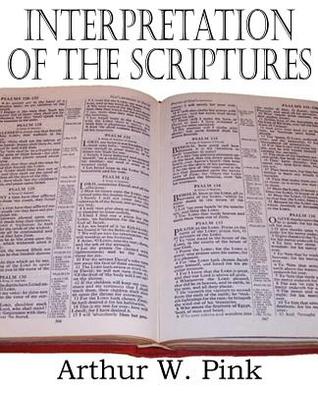
11 Quotes From “Interpretation Of The Scriptures”

In my review of A.W. Pink’s book Interpretation Of The Scriptures, I noted that any student of the Bible will benefit from reading this exceptional book. The quotes I want to share today are for that universal audience, but I will also be sharing some additional quotes soon that are specifically aimed at those who are Bible teachers or pastors.

“God does not ask for blind credence from us, but an intelligent faith, and for that three things are indispensable: that His Word should be read (or heard), understood, and personally appropriated.”

“Moreover, the obscurity is not in them [the Scripture], but in the depravity of our nature which resists the holy requirements of God, and the pride of our hearts which disdains seeking enlightenment from Him.”

“It has pleased God to furnish His people with gifted instructors, and instead of haughtily ignoring them we ought (while testing their teaching—Acts 17:11) to accept thankfully whatever help they can afford us.”

“Methods of Bible study are only of relative importance; but the spirit in which it is studied is all-important. It calls for no argument to prove that a spiritual book calls for a spiritually minded reader. … Only where there is honesty of soul and spirituality of heart will there be clearness of vision to perceive the Truth; only then will the mind be capable of discerning the full import of what is read. … None but the Spirit of Truth can write God’s Law on my heart. Here, then, is the first and most essential qualification for understanding and interpreting the Scriptures, namely a mind illumined by the Holy Spirit.”

“That which conflicts with what is taught, plainly and uniformly, in the Scriptures as a whole, and which whole is set before us as the alone rule of our faith and obedience. This requires from the expositor not only a knowledge of the general sense of the Bible, but also that he takes the trouble to collect and compare all the passages which treat of or have a definite bearing upon the immediate point before him, so that he may obtain the full mind of the Spirit thereon. Having done that, any passage which is still obscure or doubtful to him must be interpreted by those which are clear. No doctrine is to be founded on a single passage.”

“By divorcing a verse from its setting or singling out a single clause, one may ‘prove’ not only absurdities but real falsities by the very words of Scripture.”

“The word for ‘search the Scriptures’ (John 5:39) signifies diligently to track out, as the hunter does the spoor of animals. The interpreter’s job is to bring out the sense and not merely the sound of the Word.”

“To a very large extent, and far more so than any uninspired book, the Bible is a self-explaining volume: not only because it records the performance of its promises and the fulfillment of its prophecies, not only because its types and antitypes mutually unfold each other, but because all its fundamental truths may be discovered by means of its own contents, without reference to anything extra or outside itself.”

“Assuredly God has not subordinated His Word to our reason for us to accept only what commends itself to our judgment. Nevertheless, He has furnished His people with this faculty, and though insufficient of itself it is a valuable aid in the understanding of Truth. While reason is not to be made the measurer of our belief, yet it is to be used as the handmaid of faith, by comparing passage with passage, deducing inferences and drawing consequences according to the legitimate laws of logic.”

“The concordance will stand [the Bible reader] in far better stead than the best dictionary.”

“There is a middle ground between hastily condemning or accepting, namely to weigh carefully and prayerfully what is presented, testing it by other passages and by our own experience.”

A Leader’s Confidence

Give ear to my words, O Lord, consider my meditation. Give heed to the voice of my cry, my King and my God, for to You I will pray (Psalm 5:1-2).

When David prays, he prays with confidence—he is confident that God will hear him.

Where does his confidence come from? From these two truths about the nature of God:

  1. You are a God who takes no pleasure in wickedness (v. 4), so David must confess his sin quickly.
  2. In fear of You I worship (v. 7), so David doesn’t have to cower before God wondering if God will forgive his sin.

David didn’t take the condition of his soul for granted (v. 5), but he came quickly into God’s presence because he knew of God’s mercy to forgive.

Not only was David confident that God would hear his prayer, but he also eagerly anticipated receiving…

  • …God’s answer to his prayer
  • …God’s joy
  • …God’s blessing
  • …God’s protection

A mark of a godly leader is one who prays confidently and then eagerly expects God to answer.

If you want confidence in your earthly leadership, do what David modeled: Enter God’s presence quickly and confidently, and then eagerly anticipate what God is going to do!

This is Part 16 in my series on godly leadership. You can check out all of my posts on this topic by clicking here.

A Surprising Way To Relieve Stress

Paul writes some pretty straightforward words to the Christians at Philippi about how to overcome anxiety.

Just to be clear, we’re not talking about a problem-free nor a stress-free life. That’s simply not possible. Our bodies were created to deal with stress in a healthy way. But stress that is unhealthy, or unnecessarily prolonged, or not flushed properly from the body becomes anxiety. Anxiety is the culprit responsible for a whole list of bad things!

When we face a stressor, our bodies release a hormone called cortisol. The main function of this hormone is to prepare us to fight or flight. Sometimes this looks like over-engaging in problem-solving, and sometimes it looks like a complete withdrawal from life. Sometimes cortisol leads to sleeplessness and a diminished appetite, and sometimes it makes people sleepy and craving comfort food.

But the bottom line is the fight-or-flight response is very me-focused!

The strategies Paul lists for us take the focus off me and put it on God. He especially counsels us to pray to God and to praise God. Between these two healthy responses is something unexpected. He writes, “Let your gentleness be evident to all. The Lord is near.”

What in the world does gentleness have to do with relieving stress?!

First, let’s consider the motivation: The Lord is near. I think this could mean:

  1. The Lord’s name is near, as in we are called “Christians” and so we should act in a way that glorifies God.
  2. The Lord is near to help us.
  3. The Lord’s return is closing in where we will have to give an account of how we have lived our lives.

Then there is this word gentleness. This word means:

  • moderation
  • considerate of others
  • patience toward our situation and toward others
  • or as The Message says: Make it as clear as you can to all you meet that you’re on their side, working with them and not against them.

Cortisol is naturally removed from our physical bodies through rest and exercise. Anxiety is naturally removed from our emotional lives the same way—resting in God’s presence (honk!) and gently and considerately exercising a blessing for someone else.

THE BEST WAY TO DE-STRESS IS TO BLESS! 

When anxiety builds:

  1. Honk
  2. Bless
  3. Repeat

Don’t let stress win by making you self-centered. Defeat stress and anxiety by praising God and blessings others. And then make that a daily habit!

Praying Against Spiritual Strongholds

“This week we pray that God will demolish the Antichrist’s strongholds

“We are surrounded by systems and strongholds that oppose Christ the Lord and King. There are social, political, economic, and legal structures and schemes that try to disparage God.

“We are not for or against a particular political system. We are Bible-believers, Christ-worshippers; and we come from all walks of life and backgrounds. We seek the glory of God and His alone. We align ourselves with His Word.

“We should not harbor enmity or hatred toward anyone. Even if they oppose us, deride our faith, doubt our God, and insult our Savior and King, they are not our enemies. The real enemy is satan who manipulates them. Our war is against satan and his strongholds.

“Such people are poor humans who need love and compassion from us, and mercy and forgiveness from God. We do not depend on human methods or material weapons, because this is spiritual warfare against satanic powers. Rather, our method is prayer, and that is all.

“Our prayer—O Lord our God, may You be praised for ever and ever! Why do the nations rage? Why do the peoples plot in vain? The kings of the earth set themselves, and the rulers take counsel together, against You and against Your Anointed One (Psalm 2:1-2).

“Help us arm ourselves with the weapons You gave us in Your Word: the belt of truth, the breastplate of righteousness, the readiness of the gospel of peace, the shield of faith, the helmet of salvation, and the sword of the Spirit (Ephesians 6:14-17).

He who sits in the heavens laughs; the Lord derides them … at the name of Jesus every knee will bow, in heaven and on earth and under the earth, and every tongue confess that Jesus Christ is Lord, to the glory of God the Father (Psalm 2:4; Philippians 2:10-11). I pray in the mighty name of Jesus. Amen.” —a prayer from Praying For Muslims

8 Quotes From “Live Dead Journey”

Live Dead Journey are notes from missionaries on the front lines. You can check out my book review by clicking here. One of the things that stood out to me was the focus of these “tour guides” on their time abiding with Jesus. Here are some quotes that share their heart on this.

“Abiding time is extravagant daily time with Jesus.” –Dick Brogden

“Jesus spent close to 90 percent of His life in a village of twelve families, and even His three years of ministry were characterized by time alone with the Father. Moses spent forty years in Midian and had multiple trips to the mountain with God. Paul spent thirteen years in preparation, some of it in the Arabian Desert, and prayed constantly. Adam, Joseph, David, Elijah, Daniel, Mary, John, and others all gave God extravagant time. When we examine the lives of any heroes of the faith, we can see that they lingered daily with Jesus.” –Dick Brogden

“Jesus has become my safe place. When stability is not present in life here, I can lean on Him. When friends are not constant, Jesus is. He knows what I need and provides everything. Jesus is enough for me.” –Joy Hawthorne

“I’ve learned that not spending time with Jesus today is one step in not spending time with Him tomorrow.” –Miriam Davis

“One thing I have discovered is that I can’t survive throughout the day on just one block of time with Jesus. So at some other point in my day, I spend time basking in His presence. … Abiding is a lifestyle.” –Eva Bridges

“To help draw out the lessons from a passage, I now look for the following. Is there:

  • A command for me to obey?
  • A promise for me to claim?
  • A sin for me to avoid or repent of?
  • An example for me to follow (good) or avoid (bad)?
  • A truth to believe?
  • A prayer to pray?” –Jeff Griffin

“I’ve realized that what I desire I become–Jesus is my desire, and I want to be like Him.” –Cathy Stone

“How extravagant are you toward Jesus with your time? Do you lavish time on Jesus? Do you give Jesus the most energetic and focused times of your day? Or do you tend to give Jesus the crumbs of your schedule?” –Dick Brogden

Saturday In The Psalms—In Over My Head!

Save me, O God! For the waters have come up to my neck! (Psalm 69)

Not just up to David’s neck, but he felt like he was in over his head! Ever been there? You feel like…

  • …there’s no solid ground to stand on
  • …you’re stuck in deep muck
  • …the floodwaters are rising fast

David cried himself dry and hoarse because of the troubles ganging up on him!

One of David’s motivations in asking God for help was not just to alleviate his own suffering, but to not be a burden to other God-followers—“Let not those who wait for You, O Lord God of hosts, be ashamed because of me; let not those who seek You be confounded because of me, O God of Israel.”

So David made his prayer to God, believing that God would completely vindicate and rescue him. And as he prayed, he praised—“Let Your salvation, O God, set me up on high. I will praise the name of God with a song, and I will magnify Him with thanksgiving.”

When you’re in over your head, there’s nowhere else to look but up! 

Our prayer: Holy Spirit, when I feel like I’m in over my head, may You remind me to lift up my prayer and my praise to my Savior. Don’t let other God-followers be ashamed because of me, but let my deliverance be the reason they continue to look expectantly to You!

10 Quotes From “As Kingfishers Catch Fire”

As Kingfishers Catch Fire is a collection of 49 sermons from Eugene Peterson. Check out my full book review by clicking here. Below are a few quotes that caught my attention.

“The Christian life is the lifelong practice of attending to the details of congruence—congruence between ends and means, congruence between what we do and the way we do it, congruence between what is written in Scripture and our living out what is written, congruence between a ship and its prow, congruence between preaching and living, congruence between the sermon and what is lived in both preacher and congregation, the congruence of the Word made flesh in Jesus with what is lived in our flesh.”

“Science and religion are opposites, the way your thumb and forefinger are opposites: if you are going to get a grip on things, you need them both.”

“Friendship is not a way of accomplishing something but a way of being with another in which we become more authentically ourselves.”

“Naming an event a miracle doesn’t mean we can’t understand it. It means we can’t anticipate it. It means we can’t reproduce it. We cannot control it. There is more going on then we can comprehend.”

“There are people today who mistakenly look at those [Ten] Commandments as restrictive, not realizing that for those who first heard them—and for those who hear them still, in faith—they provide for and preserve the values of the free life. The reality and truth of God is protected from commercialization and manipulation. Human life is honored. The dignity of work is protected. Close personal relationships are preserved. Truth is respected. Each of the commands articulates a reality and a value that protects a free life.”

“Aaron made a god, a golden calf. At that moment Aaron quit being their pastor and became their accomplice. There are some people who are always looking for a religion that makes no demands and offers only rewards, a religion that dazzles and entertains, a religion in which there is no waiting and no emptiness. And they can usually find someone like Aaron who will help them make it up, some sort of golden calf religion.”

“Acts of love cannot be canned and then used off the shelf. Every act of love requires creative and personal giving, responding, and serving appropriate to—context specific to—both the person doing the loving and the person being loved.”

“Our habit is to talk about God, not to Him. We love discussing God. The psalms resist these discussions. They are not provided to teach us about God but to train us in responding to Him.”

“The Christian life is not, in the first place, something we do. It consists of the healthy and mature formation of our lives by the Spirit, the Holy Spirit. Christian living goes off the rails badly when it is conceived as a program or routine that we engage in or skills that we master.”

“In prayer we do not act. God does. In prayer we do not develop a technology that sets the gears and pulleys of miracle in motion. We participate in God’s action. ‘Not my will but Yours.’”

Fear God, Honor The King

Give to Caesar what belongs to Caesar, and give to God what belongs to God (Matthew 22:21).

The Bible has much to say to God-followers about how to interact with earthly governments:

  • Wise King Solomon told us to “fear the Lord and the king” and not go along with rebels against the government (Proverbs 24:21)
  • Daniel said several times that “the Most High is sovereign over all kingdoms on earth and gives them to anyone He wishes” (Daniel 4 & 5)
  • The Apostle Paul declared he was no rebel to either the civil or religious governors: “I have done nothing wrong against the Jewish law or against the temple or against Caesar” (Acts 25:8)
  • Later on, Paul reminded the church that government officials are God’s servants, and that we need to give them the respect that is owed to them (see Romans 13:1-7)
  • Peter counseled Christians: “Submit yourselves for the Lord’s sake to every human authority: whether to the emperor, as the supreme authority, or to governors … Show proper respect to everyone, love the family of believers, fear God, honor the emperor” (1 Peter 2:13-17)

But a man that exemplifies this balance between fearing God and honoring the king best is Mordecai. Mordecai was a Jew who served the Babylonian king faithfully—

  • He protected the king from would-be assassins
  • But disobeyed the king when the law of the land conflicted with God’s law
  • Then Mordecai helped the king get out of a bad law written by an evil man

A mark of a godly leader is one who knows the difference between fearing God and honoring earthly kings.

How can today’s leaders live out this principle? This is something that should lead us to prayerfully search the Scriptures, and then boldly live out what the Holy Spirit reveals to us.

This is Part 13 in my series on godly leadership. You can check out all of my posts by clicking here.

13 Introspective Questions From “Longing For A Changed World”

As Ralph Lehman made his case for Christian to (re)establish a prayer focus for revival in his book Longing For A Changed World, he asked several penetrating questions. Here are a few of them for you to consider.

“[Josiah’s revival] was one revival that began with the leaders of government. Are we praying for our leaders?”

“Our government has entered many areas that were once considered to be the Church’s sphere of ministry. How can we lead our churches back into these areas?”

“Have you considered that you are grieving the Spirit when you deprive Him of conversing with God by choosing not to pray?”

“As men of prayer, should we not strive to be like the great prayer warriors of the Bible?”

“Tertullian, a church father who lived in the Roman Empire around 200 A.D., stated that the Roman emperor and his armies benefited greatly from the prayers of the Christians who interceded on their behalf. Can we present the same argument to our political leaders today?”

“What would we be willing to leave or to set aside for the sake of more time in prayer, seeking the Kingdom and righteousness of God?”

“Do we seek the Lord of revival, or merely desire His blessings?”

“If we do not enjoy God’s presence, through His Word and prayer, we are missing the true blessing God intends for us—the blessing of Himself. If we will not seek the presence of God day by day, how can we expect Him to go with us in our daily lives?”

“If God was willing to take the Israelites into the Promised Land without His presence [Exodus 33:3-4], what does this say to the proponents of the ‘health and wealth’ gospel?”

“Even though we have been blessed immeasurably by living here in the United States, do our hearts long for God’s rule to be acknowledged in our land? Do we yearn to abide in His presence? Or are we idle in our contentment with the milk and honey?”

“Sometimes, our areas of giftedness become spheres where we fail to ask God for strength. Have you considered your strengths may be the very areas that satan exploits?”

“Are we praying for revival, are we also praying that we would conduct ourselves in such a way that the world would take notice, even if this meant for us to suffer?”

“Is the God of today’s church big enough to surprise us?”

You can check out some other quotes from Longing For A Changed World by clicking here, and my full book review is available here.

Correctly Handling Your Strong Emotions

And it grieved me bitterly… (Nehemiah 13:8).

Leaders believe so strongly in what they have been called by God to do, that opposition to God’s plan arouses very strong emotions in a leader!

When Nehemiah was angered at those who either deliberately or unintentionally sinned, his anger brought swift and decisive action—

  • He threw away people’s stuff
  • He issued explicit commands
  • He confronted other leaders
  • He issued strong threats
  • He beat people up (really!)
  • He excommunicated

Yet in all these actions he did not sin. He prayed in between many of these episodes, “God, remember what I have done. Show me mercy. Reward me for this good I have done.” And nowhere after these prayers do we see God rebuking Nehemiah for mishandling his emotional responses.

A mark of a godly leader is one who handles his strong emotions in a God-honoring way.

A leader’s prayer: Father, in my anger keep me from sin. May even my strongest of emotional responses bring glory to You.

This is Part 12 in my series on godly leadership. You can check out all of my posts by clicking here.