Links & Quotes

link quote

“With such prayer it is an absolute certainty that I must succeed with God in prayer. If my prayer were my own prayer, I might not be so sure of it, but if the prayer which I utter be God’s own prayer written on my soul, God is always one with Himself, and what He writes on the heart is only written there because it is written in His purposes.” —Charles Spurgeon, commenting on Jude 20

“I do not believe one can settle how much we ought to give. I am afraid the only safe rule is to give more than we can spare. In other words, if our expenditure on comforts, luxuries, amusements, etc., is up to the standard common among those with the same income as our own, we are probably giving away too little. If our charities do not at all pinch or hamper us, I should say they are too small. There ought to be things we should like to do and cannot do because our charities expenditure excludes them.” —C.S. Lewis

Dr. James Dobson has 8 reminders for stressed parents.

“We must stand on every promise and pray in faith, effectually, fervently, without doubt, and then wait and rest, trusting the Lord to do what is right, in His time and His way. Few Christians today wait with patience for God to work in His time. The more it is delayed, the angrier some get. Some finally give up, thinking God doesn’t answer.” —David Wilkerson

A university scientist is fired for publishing a peer-reviewed paper in a respected scientific journal that dares (gasp!) to mention that the biblical Flood might account for a specific finding he had made. The scientific community is becoming more and more touchy about anything that disproves their tenuous beliefs in an Earth that is anything less than billions of years old.

Continue to pray for Asia Bibi, who is appealing her death sentence in Pakistan. Her crime? She is a Christian. Also please consider supporting the American Center for Law & Justice who is helping Asia, and many others like her.

[INFOGRAPHIC] Have I mentioned that I am a huge fan of The Overview Bible Project? I love this infographic and insight into the biblical authors.


Don’t Misuse God’s Name

Representing God's nameYou’ve heard the old nursery rhyme: Sticks and stones may break my bones but words will never hurt me. We all know this isn’t true: words do hurt, and names that people call us may leave lasting wounds.

Words and names are important to God. God used His word to create the universe (God said, “Let there by light”); Jesus was called The Word (see John 1:1); God has named people and even renamed them to reflect their character or destiny.

The most important name of all is God’s own name, so the Third Commandment says, “You shall not misuse the name of the LORD your God…” (Exodus 20:7). How can we misuse God’s name? There are five ways—

(1) As emptiness or nothingness

  • Are our words empty? Do we use filler phrases like “Oh my God!” that neither talk to Jehovah or about Jehovah? We shouldn’t use God’s name unless we’re talking to Him or about Him in a respectful way.

(2) In vanity

  • In reality this means calling ourselves a Christian, but speaking in an un-Christlike way.
  • “Giving God a ‘bad name’ might diminish or demolish people’s belief, respect, and awe for God, a tragedy for a world that needs holiness. … It is a major responsibility to represent God; one which should not be taken lightly.” —Dr. Laura Schlessinger

(3) Being insincere

  • Are our promises empty, or is our word our bond? If we have to use phrases like “I swear to God that I will…” then that means we cannot be trusted on our own merits. When we claim to be Christians but cannot be trusted, we undermine the trustworthiness of God in the minds of other people.
  • “The godly man, therefore, will make promises cautiously but keep them conscientiously once they are made, knowing that irresponsibility and unreliability here are great and grievous sins.” —J.I. Packer

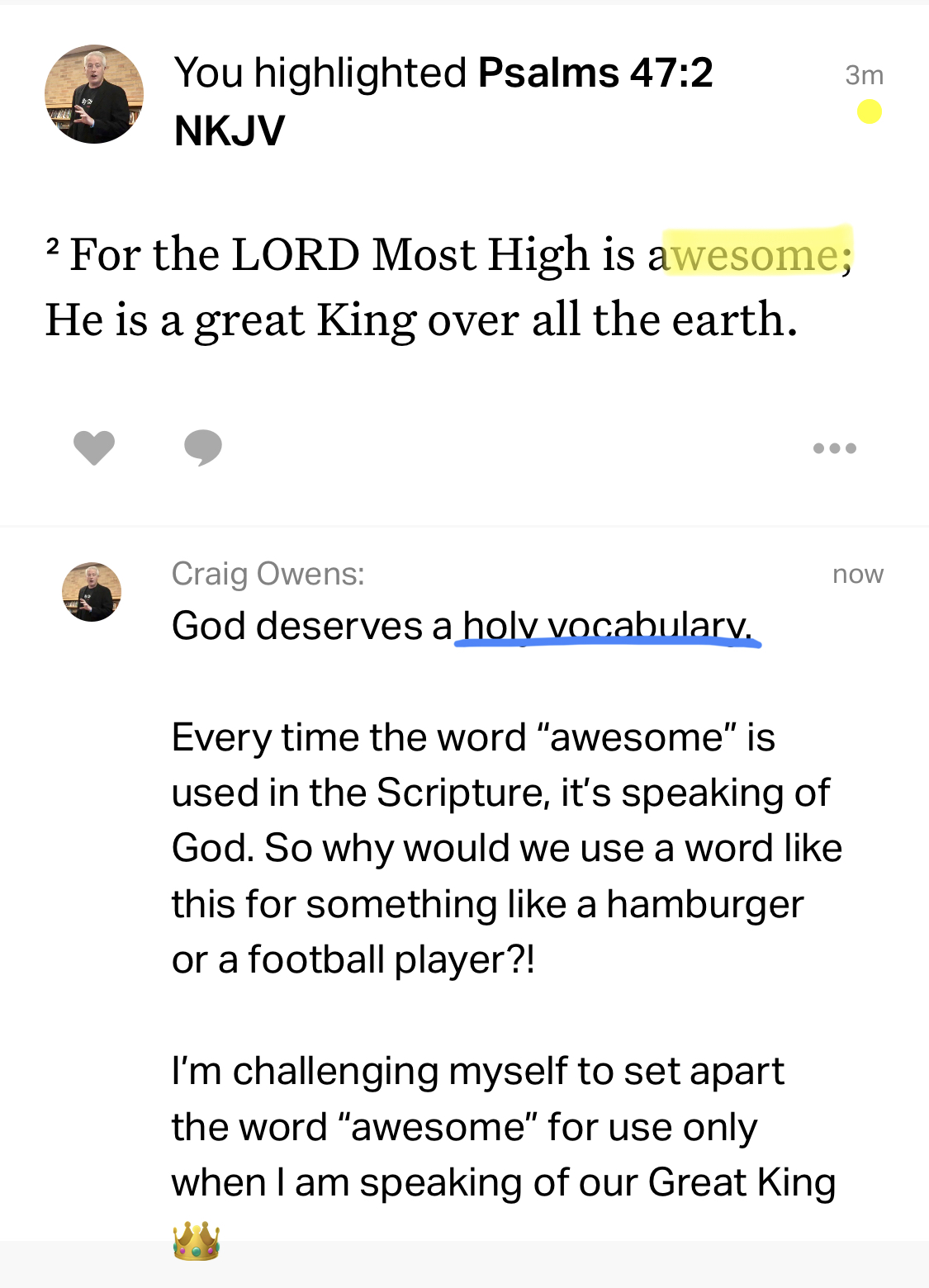
(4) Having an unholy vocabulary

  • Holy means something set apart for a special use. Perhaps there are words we use to describe God that we are also using for lesser things. It might be good to listen to how the Holy Spirit would challenge us to have a unique vocabulary to talk to or about our unique God.

(5) Worthlessness of conduct

  • As the cliche goes, “What you do speaks so loudly that I cannot hear what you are saying.” So we need to make sure that we both talk like Jesus talked and live like Jesus lived.

Anything less than these standards just may be misusing God’s holy name and character by misrepresenting Him or giving Him a “bad name.” What do you think?

If you have missed any of the messages in our series The Love In The Law, you can find them all by clicking here.

Links & Quotes

link quote

Some good reading from this weekend…

“I do not agree with a big way of doing things. What matters is the individual. If we wait till we get numbers, then we will be lost in the numbers and we will never be able to show that love and respect for the person.” —Mother Teresa

For anyone struggling with an addiction to pornography, this sounds like a helpful book: 10 Lies Men Believe About Pornography.

According to Cosmopolitan magazine, if you are pro-life political candidate you are automatically disqualified from getting support from any “enlightened” woman.

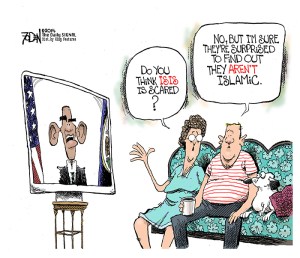
Obama & ISIS[INFOGRAPHIC] This is scary … do you know how much money ISIS makes every day from selling the oil they have captured?

“It is right to pour out our whole soul before Him that careth for us. But it is good, likewise, to unbosom ourselves to a friend, in whom we can confide.” —John Wesley

“That is always the way with a truly healthy Christian; God’s grace is externally manifested. There is the inner life within, it is active, and by and by when it is in a right state, it saturates everything. You talk with the gracious man, he cannot help talking about Christ; you go into his house, you will soon see that a Christian lives there; you notice his actions and you will soon see he has been with Jesus. He is so full of sap [Psalm 104:16] that the sap must come out. He has so much of the divine life within, that the holy oil and divine balsam must flow from him.” —Charles Spurgeon

“O God, of Thy goodness give me Thyself, for Thou art enough for me, and I may ask nothing that is less and find any full honors to Thee. God give me Thyself!” —Lady Julian

“Yes—at first one is sort of concussed and ‘life has no taste and no direction.’ One soon discovers, however, that grief is not a state but a process—like a walk in a winding valley with a new prospect at every bend.” —C.S. Lewis

A great post from Dave Barringer for married couples: Faking Your Death.

“Christianity is the only world religion whose primary source documents are in a language other than the founder of the religion. In other words, the New Testament texts are not in Aramaic, but in Koine Greek. … This makes a vitally important theological statement which so dramatically contrasts, for example, with Muslims who maintain that the Qur’an is untranslatable and that the Word of Allah can be conveyed truly and fully only in Arabic. For, at the very outset of the Christian message, the translatability of the gospel is enshrined in our primary source documents.” —Dr. Timothy C. Tennent, President of Asbury Theological Seminary, The Translatability Of The Gospel

Links & Quotes

link quote

Some good reading from today…

“Moses’ aim in knowing God’s ways is so that he may know God Himself. ‘Let me know Your ways that I may know You’ [Exodus 33:13]. … This is the great passion of our lives: to know God Himself by grace, and to make Him known by grace.” —John Piper

“However deep the mystery, however many the paradoxes involved, it is still true that men become saints not at their own whim but by sovereign calling.” —A.W. Tozer

“A thousand years of remorse over a wrong act would not please God as much as a change of conduct and a reformed life.” —A.W. Tozer

“To think that before the hills were formed, or the channels of the sea were scooped out, God loved me; that from everlasting to everlasting His mercy is upon His people. Is not that a consolation?” —Charles Spurgeon

As our kids get ready to go back to school, Kevin Belmonte has a great reminder why teachers deserve our thanks.

God is willing to let His name be mocked just to wake up the church and give one last trump to the world.” Read more in David Wilkerson’s post: Please Say It Isn’t So.

“It’s easy to forget who is the servant and who is to be served. The tool of distortion is one of satan’s slyest. When the focus is on yourself, you worry that your co-workers won’t appreciate you or your leaders will overwork you. With time, your agenda becomes more important than God’s. You’re more concerned with presenting self than pleasing Him. You may even find yourself doubting God’s judgment. … Guard your attitude. If you concern yourself with your neighbor’s talents, you’ll neglect your own. But if you concern yourself with yours, you could inspire both!” —Max Lucado

Watch out! It won’t be long until this is true in America: British Christians forced to hide beliefs.

Jonah Goldberg asks: If “evil” doesn’t apply to ISIS, then what does?

A Leader’s Nudge And Covering

Nudge & coverLeadership carries a heavy responsibility. I often paraphrase what the Apostle James wrote, “Not many of you should presume to be leaders because you know leaders will be judged more strictly” (see James 3:1).

Consider what was said to Jeroboam, the king of Israel: “And God will give Israel up because of the sins Jeroboam has committed and has caused Israel to commit” (1 Kings 14:16, emphasis added).

A leader’s action has consequences not only for himself, but for all the people under his care. Sure, some Israelites were going to sin regardless of how Jeroboam lived, but his sinful lifestyle gave a nudge to those who took their cues from him. In other words, Jeroboam’s sin made it that much easier for others to sin.

I’m sure there were some Israelites who didn’t follow Jeroboam into sin, yet they were now exposed to God’s “jealous anger” (1 Kings 14:22) because Jeroboam’s sin removed the covering of God’s blessing on those northern tribes.

These principles still hold true today for me as a dad, a husband, a pastor, a citizen of Cedar Springs. And they hold true for you in your role as a spouse, a parent, an employer or employee, a Christian. Your sin may be the nudge to others that causes them to sin; your sin will remove God’s covering and expose people to His judgment.

Leaders best serve by staying wholly committed to God. 

It’s only as I am wholly—and holy—His that I can nudge people toward righteousness and preserve the covering of God’s blessing.

May our lives never arouse God’s righteous anger, but may we be a blessing by wholly serving Him all the days of our lives.

Money & Hammers

Money checklistHammers are very similar to money. Don’t believe me? Just take a look at some of the things they have in common. They both…

  1. …are tools.
  2. …can be used to build up or destroy.
  3. …are amoral.
  4. …don’t have any power until they’re in a person’s hand.

I realize in church circles it can make people uncomfortable to talk about money, but it shouldn’t be that way. The Bible is very clear in saying wealth comes from God, as well as how to use that wealth, so why should that be uncomfortable? Here are some of the things the Bible says about wealth:

  • If we honor God, He blesses our work (Proverbs 3:9-10).
  • If we take the glory for our success, God calls us “foolish” (Luke 12:16-21).
  • Money can be used to build God’s kingdom (Acts 4:34-37) or to build our own reputations (Acts 5:1-11).
  • Making the pursuit of money our priority becomes an idol (Luke 16:10-13).
  • The anxiety over money can choke our spiritual life (Matthew 13:22).
  • God gives us the ability to work, to make money, and to enjoy both the work and the rewards of work (Ecclesiastes 5:19).
  • God alone judges our attitude toward money (Luke 16:15).

It’s not money that is immoral, but our pursuit of Money (with a capital “M” or what the Bible calls Mammon) that is immoral.

It’s not money that will ruin us, but our trust in money that will ruin us.

It’s not money that gives us a secure future, but God Who richly provides us with everything for our enjoyment (1 Timothy 6:17).

Don’t envy people with more money than you. Don’t look down on people with less money than you. Don’t—as Jesus said to the Pharisees—justify your opinions and attitudes about money.

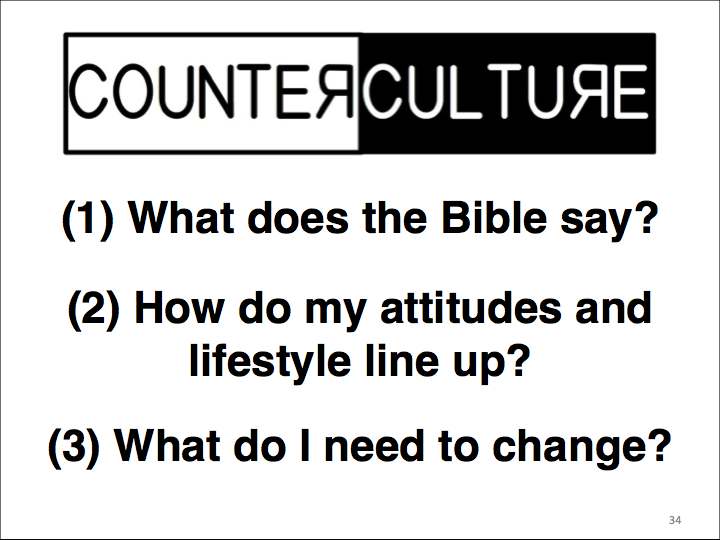
Only an honest listening to the Holy Spirit about your attitude and lifestyle concerning money is what can keep us from letting money rob us of God’s blessing.


7 Quotes From “Discipleship In Crisis”

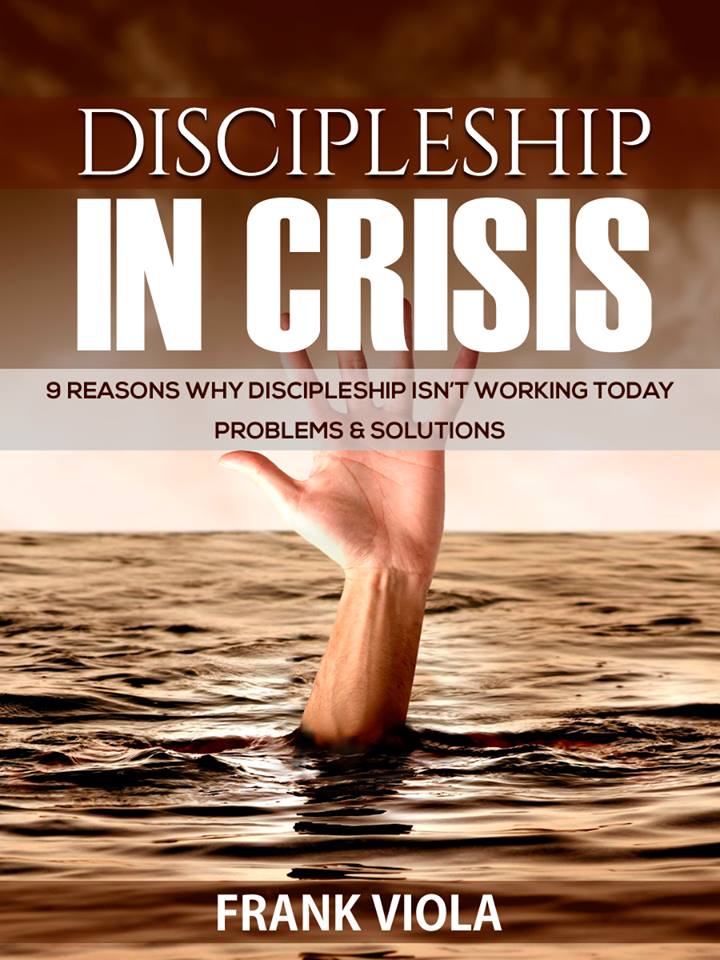
Discipleship In CrisisCheck out my review of Discipleship In Crisis by Frank Viola by clicking here. Below are a few quotes which I found especially highlighter worthy.

“The presupposition that sits underneath virtually every sermon heralded today and most of the Christian books that fill bookstores is that we can live the Christian life if we just try hard enough. If we study our Bible more, pray more, witness more, tithe more, hear more sermons… then we can be like Jesus. But that’s not the gospel. The gospel teaches that just as Jesus couldn’t do anything of Himself, we can’t do anything of ourselves. Listen to the Lord again: ‘Without Me you can do nothing.’ The Christian life is impossible. It’s only Him-possible.” 

“The goal of the gospel is not to get you out of hell and into Heaven, but to get God out of Heaven and into you.”

“A person who is living by the tree of life doesn’t sit back and say, ‘Let me try to do good and avoid evil.’ Instead, he allows the life of God to flow with in and through him. He yields to the instincts, promptings, and energy of that God-life. … You see, ‘good’ is a form of life. And only God is good. Here are the two choices before you today: (1) The choice to intellectually know good from evil and to try to do good = the tree of the knowledge of good and evil; (2) Living by the life of God, which is goodness itself = the tree of life.”

“The only way you and I can truly imitate Jesus’ external lifestyle is to imitate His internal relationship with His Father.”

“What history teaches us is that men have never learned anything from it.” —G.W.F. Hegel

“In a word, you cannot raise the bar on discipleship without raising the bar on the ekklesia—the living experience of the body of Christ—the native habitat in which true disciple-making and transformation take place.”

“The New Testament talks about spiritual seeing, spiritual touching, spiritual tasting, spiritual handling, and spiritual healing. These are the faculties of your Spirit-regenerated human spirit. Jesus was very much in touch with His spiritual instincts, and hence, He ‘perceived’ things ‘in His spirit’ that were outside natural means. He did this as a man anointed by the Holy Spirit, not because He was God.”

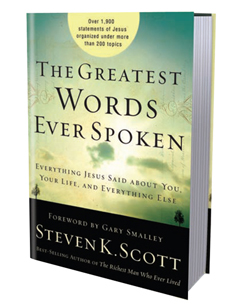
7 Quotes From “The Greatest Words Ever Spoken”

The Grestest Words Ever SpokenObviously the best quotes from The Greatest Words Ever Spoken are from Jesus Himself. But Steven K. Scott, who complied the words of Christ into this unique format (you may read my book review by clicking here) had some good things to say too.

“No occurrence in history or physical science has been verified with a higher degree of statistical certainty than the fact that Jesus is exactly who He claimed to be—the Messiah, the Son of the living God.” 

“We cannot worship the Father in spirit or in truth unless we see Him for who He really is and understand His relationship with the Son.”

“Agnostics hold the position that they simply do not know if God exists. Atheists, on the other hand, claim intellectual superiority over all others, saying they know there is no God.”

“If you want to know what God thinks and feels, how He acts and works, what grieves Him and what pleases Him, all you have to do is read the words and observe the behavior of Jesus Christ.”

“Several years ago a string of four letters took the Christian community by storm. It seemed like WWJD, which stands for ‘What would Jesus do?’ was everywhere—and why not? When a choice has to be made, is any other question more important to ask? The answer is ‘Yes, one question is more important. One question Christians should ask before choosing any course of action, making any spiritual decision, or adopting any value or belief.’ That question is ‘WDJS: what did Jesus say?’ This is the question Christians need to ask because in many situations we simply can’t know for sure what Jesus would do, so we are left to figure it out for ourselves. And figuring it out may require more wisdom, revelation, insight, and spiritual maturity than we possess at the time. … Jesus made more statements about how His followers should live and what they should believe than about any other group of topics.”

“By nature, we evaluate nearly every situation according to its immediate impact on our desires, and we make our choices accordingly. Consequently, we often sacrifice that which would bring infinite eternal benefit in exchange for temporary gratification.”

“Jesus shows us that blaming others for our failures is not only offensive to God; it is detrimental to our relationships. While we all want healthier relationships, most of us have a hard time breaking free from our natural inclinations. The words of Christ… can bring about extraordinary change in every relationship in your life, for the rest of your life. … We can have better relationships with anyone who crosses our path, but it doesn’t happen naturally. Jesus provides both the revelation and the power that frees us from our human nature.”

Boomerang

BoomerangI was very hesitant to enter the pastorate. As I look back now, I see God had been preparing me for this all my life, but I was reluctant to take on such a heavy spiritual responsibility.

When I finally submitted, I made a covenant with God: “I never want to preach a sermon where my finger is pointed at the congregation, where I am saying, ‘You people better listen to this!’ But I only want to share what You have been challenging me to do and become. I want the congregation to hear an overflow of the work being done in me.”

I recently read a paragraph from Oswald Chambers that validates that covenant I made—

“It is an easy business to preach, an appallingly easy thing to tell other people what to do; it is another thing to have God’s message turned into a boomerang—‘You have been teaching these people that they should be full of peace and of joy, but what about yourself? Are you full of peace and joy?’ The truthful witness is the one who lets his light shine in works which exhibit the disposition of Jesus; one who lives the truth as well as preaches it.

My pastor friend, don’t preach it if you’re not living it! Or another way: live it first, then preach it.

Be The Sermon

Gregory The GreatIt’s not enough to just preach a sermon, my pastor friend, we must be the sermon, too.

Heed these challenging words from Gregory The Great (ca. 540-604)—

“There are some who investigate spiritual precepts with cunning care, but what they penetrate with their understanding they trample on in their lives: all at once they teaching the things which not by practice but by study they have learnt; and what in words they preach by their manners they impugn. …

“The ruler should always be chief in action, that by his living he may point out the way to those that are put under him, and that the flock, which follows the voice and manners of the shepherd, may learn how to walk better through example than through words. For he who is required by the necessity of his position to speak the highest things is required by the same necessity to exhibit the highest things. …

Every preacher should give forth a sound more by his deeds than by his words, and rather by good living imprint footsteps for men to follow than by speaking show them the way to walk in.”