You Are An Empowered Peacemaker

My new attitude“The whole world—with one minor exception—is made up of others,” says John Maxwell. The ‘one minor exception’ is that person who’s looking back at you from the mirror every morning, so if you want to be successful in life, you better learn to get along with ‘the others.’

I believe this is especially important for those who call themselves Christians. Here are three reasons why—

  1. Our interaction with other Christians is a testimony to outsiders—John 13:34-35.
  2. Our positive interaction with outsiders can draw others to Christ—Colossians 4:5.
  3. Our negative interaction with outsiders can repel others from Christ—1 Peter 2:12.

So although it can be very (sometimes very, very!) challenging, we are called to find ways to get along with others. The Apostle Paul said:

Be careful to do what is right in the eyes of everybody. If it is possible, as far as it depends on you, live at peace with everyone (Romans 12:17-18, emphasis added).

When you see the phrase “if it is possible” you may think that Paul has given us an “out.” We could say, “I tried really hard to get along with that guy, but it just hasn’t worked, so I’m off the hook!”

But consider how another translation of the Bible states this phrase: Do all that you can to live in peace with everyone.

Jesus was asked to do something that had never been done before: heal two men born blind. Jesus asked these men, “Do you believe I am able to do this?” (Matthew 9:28). The men answered an emphatic, “Yes!” On another occasion a father asked Jesus to heal his son by saying, “If You can, please help us.” Jesus said, “‘If I can? All things are possible to those who believe.” The father immediately replied, “I do believe; please help my unbelief” (Mark 9:22-24).

If you are Christian, the Spirit of Jesus lives in you. So the question Jesus asks us about our difficult relationships is, “Do you believe I am able to help you?” Or perhaps more accurately He asks us, “Will you let Me help you?”

So the part of the verse which says, “if it is possible, as far at it depends on you” is really saying, “If you really believe Jesus is stronger than this strained relationship, will you let Him do something in you to bring about peace?”

We aren’t asking Jesus to change the other person; we’re asking Him to change us. We aren’t asking someone else to get on our page, or to see the world from our perspective; we’re asking the Holy Spirit to help us get on their page, to help us see the world they way they see it.

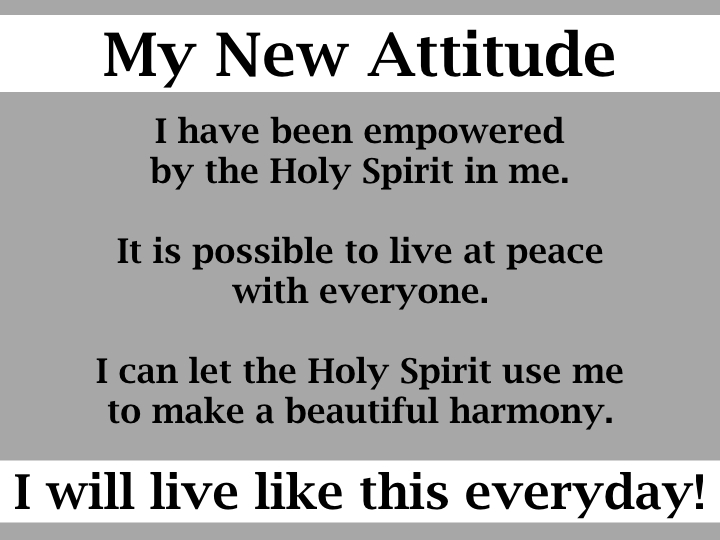
We need to have a new attitude. And I believe that attitude comes from a prayer like this—

I have been empowered by the Spirit of Christ in me. 
It is now possible for me to live at peace with everyone. 
I can let the Holy Spirit use to me make a beautiful harmony. 
I will keep on living like this every day.

Next Sunday we will be looking at some practical techniques and more biblical insights to help us excel in getting along with all ‘the others’ that make up the world. Please join us in person or on Periscope.

3 Bible Studies For You To Try

Book by book studyLast week I spoke and wrote about some tools you might use to study your Bible. Now I’d like to share some Bible study projects you might try with those new tools. As always, I recommend that beginning Bible studies go verse by verse through the Bible. I believe you will lay a strong foundation for your faith when you systematically put God’s Word into your heart.

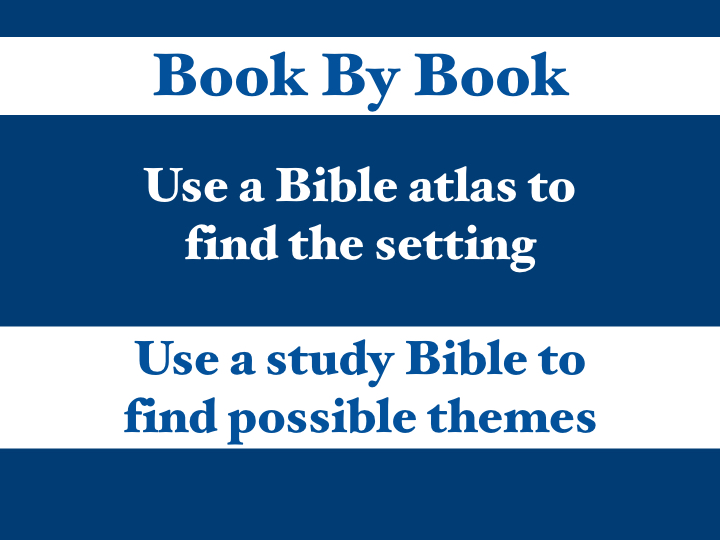
Book By Book

I’ll use the book of Ephesians as an example. Using my Bible atlas I find that the city of Ephesus is located along an important trade route, and it is the Roman capital of the province of Asia. My Full Life Study Bible tells me that because so much trade passed through this city, this letter was probably intended to be a circular letter for all of the communities near Ephesus. As a result, Paul is not addressing any specific problems in this church, but writes theological ideas for a broad spectrum of people.

As I begin reading, I paused in the first verse when I came to the phrase “the faithful in Christ.” I asked myself, “What does it mean to be faithful IN Christ? Can I be faithful outside of Him?” By the time I got to verse 3, I saw a similar phrase: “every spiritual blessing in Christ.” Now I went back and used a blue highlighter (there’s nothing special about blue, it just happened to be the first highlighter I grabbed), and marked those two “in Christ” phrases. I see two more in verse 4: “He chose us in Him” and “holy and blameless in His sight.” Going through the whole book I discovered 36 times the phrases “in Christ” or “in Him.” This is helpful to me to know the kind of security I have in Jesus.

Another thing that stood out to me were Paul’s prayers for the church. I see His very moving prayers in passages like 1:15-19 and in 3:14-21. I also see in 6:18 that he tells us to pray all kinds of prayers for ourselves and for others. And I see in 6:19 that Paul asked the church to pray for him too.

And always look for “therefore” phrases. For example in 4:24-25 or 4:32-5:1. The “therefore” phrases tell us how to live or think in light of the ideas that were just shared.

Chapter By Chapter

A good place to do this is in the Psalms or Proverbs. These are usually stand-alone chapters. When reading the chapters in these two books, I love reading them in parallel with other translations. For example, check out this from Psalm 1.

In Psalm 59, notice the superscript (or introduction). This gives us some background information to the psalm. Using my concordance, I found that this psalm was written this time in David’s life.

There is usually a theme to each chapter of the Proverbs, so try to discover that. In Proverbs 2, I noticed the “if … then” statements. In the first four verses I see things like “IF you will seek wisdom like this,” and then in verses 5-22 I see a whole bunch of blessings that follow the “then” that starts verse 5.

Word By Word

Sometimes I like to go really deep in a passage, so I slow down and look at it word by word. Here you need to use a Strong’s Concordance of the Bible. I like the one available on Blue Letter Bible. For example, next to 2 Peter 1:5, you can hover over the word “Tools” and select “Interlinear.” Clicking on “Interlinear” you will see all of the Greek words that make up this verse. By clicking on the Strong’s number, you can see the definition of that Greek word. Scrolling down a bit, you can see all of the other verses where that Greek word is used in the New Testament.

None of these tools are meant to take the place of the Holy Spirit. He is called the Spirit of Truth, and since He is the One who inspired all of the Scripture, ask His help before you begin any Bible study.

Here are two more Bible studies for you to try.

In this video I go into more detail on how I undertake all of these Bible studies. And be sure to join us next week as we take another look at different types of Bible studies.

Go Deep

J. Gresham Machen“‘Put out into deep water’ (Luke 5:4). The Lord did not say how deep. The depth of the water into which we sail depends upon how completely we have cut our ties to the shore, the greatness of our need, and our anxieties about the future. …

Our needs are to be met in the deep things of God. We are to sail into the deep of God’s Word, which the Holy Spirit will open to us with profound yet crystal-clear meaning. And the words we knew in the past will have an ocean of new meaning, which will render their original message very shallow. …

The Holy Spirit desires that our self become completely submerged—not merely ankle-deep, knee-deep, waist-deep, but self-deep. He wants us hidden and bathed under this life-giving stream. Let loose the lines holding you to the shore and sail into the deep. And never forget, the Man who does the measuring is with us today.” —J. Gresham Machen

3 Quotes About Bible Studies

New Bible study toolsYesterday I shared 7 must-have Bible study tools. Here are three powerful quotes on how and why we should make studying our Bibles an ongoing, lifelong pursuit.

“Search the Scriptures. Do not merely read them—search them; look up the parallel passages; collate them; try to get the meaning of the Spirit upon any one truth by looking to all the texts which refer to it. Read the Bible consecutively: do not merely read a verse here and there—that is not fair.” —Charles Spurgeon

“One cannot simply read the Bible, like other books. One must be prepared really to enquire of it. Only thus will it reveal itself. Only if we expect from it the ultimate answer, shall we receive it.” —Dietrich Bonhoeffer

“Let us resolve to read the Bible more and more every year we live. Let us try to get it rooted in our memories, and engraved into our hearts. … Let us resolve to be more watchful over our Bible reading every year that we live. Let us be jealously careful about the time we give to it, and the manner that time is spent. Let us be aware of omitting our daily reading without sufficient cause. Let us not be gaping, and yawning and dozing over our book, while we read. … Let us be very careful that we never exalt any minister, or sermon, or book, or tract, or friend above the Word. Cursed be that book, or tract, or human counsel, which creeps in between us and the Bible, and hides the Bible from our eyes! … Let us resolve to talk more to believers about the Bible when we meet them. Sorry to say, the conversation of Christians, when they do meet, is often sadly unprofitable! How many frivolous, and trifling, and uncharitable things are said! Let us bring out the Bible more, and it will help to drive the devil away, and keep our hearts in tune.” —J.C. Ryle

6 More Quotes From “Light & Truth—Acts and the Larger Epistles”

Light & Truth [Acts]Horatius Bonar’s wisdom and insight in the Scriptures is still clear and relevant for us today. Here are some additional quotes I highlighted in his commentary. The reference in brackets is the passage in the Bible on which Bonar is commenting.

“We are described as feeble men, bearing on our shoulders a burden too heavy to be borne; the Holy Spirit comes up to us; not exactly to take away the burden; nor to strengthen us under it; but to put His own Almighty shoulder under it, in the room of, and along with ours; thus lightening the load, though not changing it; and bearing the heavier part of it with His own Almightiness. Thus it is that He ‘helps’ our infirmities; making us to feel both the burden and the infirmity all the while that He helps; nay, giving us such a kind and mode of help, as will keep us constantly sensible of both.” [Romans 8:26

“How real, how true, how fast must that love have been. Here is its sincerity demonstrated. Here are its dimensions measured. What is its height? The answer is, ‘He spared not His Son.’ What is its depth? ‘He spared not His Son.’ What is its length? ‘He spared not His Son.’ What is its breadth? ‘He spared not His Son.’ Nay, He delivered Him up. Nay, He laid our sins upon Him; He made Him a curse for us. The more that we meditate on this one gift, the more does its greatness display itself. It passeth all measurement and all understanding.” [Romans 8:32]

“Prayer takes for granted that God is full, and we are empty; that He is infinitely full, and we unspeakably empty. … Prayer takes for granted that there is a connection between His fullness and our emptiness. The fullness is not inaccessible. It is not too high for us to reach, or for it to stoop. It is not too great for us, nor too distant, so as to be incommunicable. There is a connection, and it has been established by God Himself; it is a divine medium of communication: ‘Ask, and you shall receive.’ Prayer takes for granted that we are entitled to use this channel.” [Romans 12:12

“If you are Christians then, be consistent. Be Christians out and out; Christians every hour, in every part, and in every matter. Beware of half-hearted discipleship, of compromise with evil, of conformity to the world, of trying to serve two masters. … Half-hearted Christianity will only dishonor God, while it makes you miserable. There is abundance of Christianity, so-called, in our day. Who does not call himself a Christian? But who cultivates the holiness, the blamelessness, the devotedness, the calm consistency of a follower of Christ? Who hates sin as it ought to be hated? Who separates from the world as he ought? Who follows Christ as He ought to be followed? Who walks in the footsteps of the holy Son of God?” [1 Corinthians 1:8]

“Let us walk worthy [of the blessings in Christ Jesus]; as men who really believe it; happy, holy, unworldly, zealous, generous, loving. Let us carry the consciousness of our calling into everything—great or small; into business, daily life, recreations, reading, education, everything; maintaining our true position before men; manifesting our proper character; letting the world know our prospects, and doing nothing inconsistent with what we profess to be now, and with what we shall be when the Lord comes.” [1 Corinthians 1:9]

“Thus, then, is our whole earthly life, in all its parts, to be regulated by the magnitude of the eternal. Things present must be subordinated to those which are to come, the seen to the unseen, the earthly to the heavenly. It is by the light of the coming glory that we must walk while here. It is from the clock of eternity that our time is to be always taken. Arrange your business, your recreations, your duties with reference to the invisible and unending future. Live, speak, work, move, as those who believe that the things which are seen are temporal, but the things which are not seen are eternal.” [1 Corinthians 7:29-31]

The first set of quotes I shared from this book can be read here. And my review of this book is posted here.

Thursdays With Oswald—The Honor Of A Saint

Oswald ChambersThis is a weekly series with things I’m reading and pondering from Oswald Chambers. You can read the original seed thought here, or type “Thursdays With Oswald” in the search box to read more entries.

The Honor Of A Saint 

     It is up to us to live the life of a saint in order to show our gratitude to God for His amazing salvation, a salvation which cost us nothing but which cost God everything. In this passage [Galatians 2:20] Paul describes how this point of honor was reached in his life—“I have been crucified with Christ…and that life which I now live in the flesh….” The word “now” is very annoying, if only Paul had said “hereafter”—“This is the kind of life I am going to live after I am dead and in heaven; down here I am compassed about with infirmities and am a miserable sinner.” But he did not, he said “now,” “that life which I now live in the flesh…” i.e., the life men could see, “… I live in faith, the faith which is in the Son of God.” … 

     When the Spirit of God is in us He gives us intuitive discernment, we know exactly what He wants; then the point is, are we going through identification with our Lord in order that that intuitive light may become the discipline of our lives? It is this practical aspect that has been ignored. We have not sufficiently emphasized the fact that we have to live as saints, and that in our lives the honor at stake is not our personal honor, but the honor of Jesus Christ.

From Our Place Of Help

One question comes to my mind when I read this: Is Jesus Christ being honored by the way I live now?

8 Quotes From “Light & Truth—Acts and the Larger Epistles”

Light & Truth [Acts]Horatius Bonar had great insight into the application of Scriptures. Check out my review of this commentary from Dr. Bonar by clicking here. Below are a few quotes that caught my attention. The reference in brackets after the quote is the biblical passage on which Bonar is commenting.

“Our Bible is of God; yet it is also of man. It is both divine and human. It comes to us from God’s Spirit; it comes also from man’s spirit. It is written in the language of the earth, yet its words are the words of him ‘Who speaketh it from heaven.’ Natural, yet supernatural; simple, yet profound; undogmatical, yet authoritative; very like a common book, yet very unlike also; dealing often with seeming incredibilities and contradictions, yet never assuming any need for apology, or explanation, or retraction; a book for humanity at large, yet minutely special in its fitnesses for every case of every soul; throughout its pages, from first to last, one unchanging estimate of sin as an infinite evil, get always bringing out God’s gracious mind toward the sinner, even in his condemnation of the guilt; such is the great Book with which man has to do, which man has to study, out of which man has to gather wisdom for eternity.” [Acts 1:1

“One of the great characteristics of the whole interval between Christ’s first and second coming is the world’s rage, secret and open, against the Father and the Son. … It is very useless anger. It accomplishes nothing. It is like an angry child striking a huge rock with its fist. It is the mere display of impotent hatred, or the temporary gratification of their dislike of God, and their rejection of His purpose regarding His Son. … It calls light darkness, and darkness light; good evil, and evil good; but the light and the darkness, the good and evil, still remain as they were. All the enlightenment of the age, all the appliances of modern progress, are impotent against God and His Christ, against His truth, and His church, and His Word.” [Acts 4:25]

“This is one of the many repetitions of the Pentecostal scene which occurred in early days. Most unscriptural is the statement of some that the giving of the Spirit at Pentecost was a thing done once for all, not to be repeated, and that we are not to pray for or expect such things again. The whole of the ‘Acts of the Apostles’ is a direct refutation of this piece of human fancy. Wherever the apostles went there was a repetition of Pentecost, whether at Jerusalem, or Samaria, or Antioch, or Corinth. Every conversion is the repetition of Pentecost; it is doing the same thing for an individual soul as was done for three thousand then, by a similar process, and by the same power—the power of the Holy Spirit. The Holy Ghost is the heritage of the church. The Old Testament saints possessed Him; and still more the New. This is our heritage, the heritage of every believing man.” [Acts 11:15

“Beware of seeking anything less than the baptism of the Holy Ghost. Our whole life is to be a reception of the Spirit. He is to be continually coming down on us, and filling us. Let us open our mouth wide that He may fill it. Let us beware of anything that would present itself as a substitute for the living Spirit. Many such things may we expect in these last days from satan as an angel of light.” [Acts 11:15]

“We are tempted in our day to be ashamed of the gospel. It is thought to be bare, unintellectual, almost childish by many. Hence, they would overlay it with argument and eloquence, to make it more respectable and more attractive. Every such attempt to add to it is being ashamed of it.” [Romans 1:16

“We must have a righteousness, else we cannot stand before God; we cannot have merely a religion.” [Romans 4:6-8]

“The prodigal did not work for the ‘best robe,’ but got it all ready-made from his father’s hands; Joseph did not work for his coat of many colors, but received it as the gift of his father’s love; Adam did not work for the skins with which the Lord God clothed him: so it is with the sinner in his approach to God, and in God’s approaches to him. ‘Righteousness without works’ is given him; nay, put upon him as a raiment, a divine raiment, to fit him for drawing near to God.” [Romans 4:6-8

“When the night is darkest, and the stars are hidden, and the clouds are black, then we think most of the clear fair day, and long for its dawn. When the storm is roughest, with the waves and wind roaring around the laboring vessel, then we are troubled, and look eagerly out for the glad and sunny calm. When winter binds the earth in its chain of frost, and wraps it in snow and ice, then we begin to ask for spring, with its flowers, and songs, and verdure. So with the saint, as represented by the apostle here. This is night, and storm, and winter to him; he is ever thinking of the day, and the calm, and the spring.” [Romans 8:19-23]

More quotes are here.

Week Of Prayer—Tuesday

WOP_2016_Slide_TueOur week of prayer continues today with this prayer focus for Tuesday—

Seek God for strength to keep moving forward even in the midst of discouragement or suffering, knowing that faith to persevere strengthens character and kindles hope.

I love to pray God’s Word. Perhaps today you could pray something like this:

Heavenly Father, this time of life I’m in right now is tough. But I trust You. In fact, I also glory in my suffering, because I know that suffering produces perseverance; perseverance produces character; and character produces hope. And hope does not put me to shame, because Your love has been poured out into my heart through Your Holy Spirit [Romans 5:3-5]

So I trust in You entirely, the everlasting God, the Creator of the ends of the earth. You will never grow tired or weary, and Your understanding is higher than mine. You give strength to me when I’m weary and You increase my power when I’m weak. Even youths grow tired and weary, and young people stumble and fall; but when my hope is in You, You will renew my strength. In You, I will soar on wings like eagles; I will run and not grow weary, I will walk and not be faint [Isaiah 40:28-31]

While I’m in this difficult time, Father, I place my trust and my hope in You. In Jesus’ name, Amen.

Links & Quotes

link quote

“Ah, what a thing is prayer! The simplest form of speech—such as even a child could utter—yet the highest and divinest of all utterances; such as the Holy Spirit alone can enable us to give fourth.” —Horatius Bonar

“When God feels distant, remember the Christmas story. When you feel alone, unloved, or unlovable, remember that God loves you. And He travelled a great distance to be close to you. Why? Because He loves to be with the ones He loves!” —Max Lucado

“Do you ever take a moment to pray but feel like you stumble out of the gate? Do you have trouble finding the words when it comes time to bow your head? Remember, the One who hears your prayers is your Daddy. You don’t need to wow him with eloquence. Jesus downplayed the importance of words in prayers. We tend to do the opposite. The more words the better. The better words the better. … Just as a happy child cannot mis-hug, the sincere heart cannot mis-pray.” —Max Lucado

J.Warner Wallace answers a good question: Why doesn’t the birth record of Jesus appear in every Gospel?

Dan Reiland has some good words for those in leadership positions in ministry.

Far too many school administrators and teachers think they are limited by the so-called “separation of church and state.” Here’s a post from Eric Buehrer you should share with any of your friends who work in the public school system.

John Stonestreet says, “Remember when people laughed about ‘death panels’?” Check out Who decides to end a life?

Frank Turek asks, “How do we fix a world filled with murder, rape, betrayal, adultery, fraud, theft, sexual exploitation, pornography, bullying, abortion, terrorism, cheating, lying, child abuse, racism, assault, drugs, robbery, and countless other evils?” He says we may not like the answer.

Links & Quotes

link quote

“Foretastes are good. Unless they become substitutes. O, don’t let all the sweet things of this season become substitutes of the final great, all-satisfying Sweetness. Let every loss and every delight send your hearts a-homing after heaven.” —John Piper

“Are you in a season of winter?  A lost job… A doctor’s report… A broken marriage? Maybe you feel stuck in winter, like Christmas may never come. As scripture says, God rewards those who diligently seek Him. So just like the wise men of the Christmas story…search for the Lord. Look for Him in the midst of your darkest nights and coldest winters. Hope may seem as distant as a star, but if the Christmas story tells us anything…God is still present. God is still working. And in this very moment, God is near.” —Max Lucado

“If there had been no prophet like Nathan—no piercing, prophetic word—David could have ended up like Saul: spiritually dead, with no Holy Ghost guidance, having lost all intimacy with God. … If you are being probed by God’s Word—if His Spirit isn’t letting you sit comfortably in your sin—then you are being shown mercy. It is the deep love of God at work, wooing you out of death and into life.” —David Wilkerson

“If regrets about yesterday’s decisions and actions help you do better work today, then they’ve served a useful purpose. … Most of the time, though, we use regrets to keep us from moving forward. They paralyze us in the face of possibility. We don’t want to do something if it reminds us of that black hole we have in our past. It’s useful if you can forgive yourself, because the regrets you’re carrying around are keeping you from holding onto the possibility that you can contribute even more tomorrow.” —Seth Godin

Live Action shares an important post: Abortion and the church—what can we do?

Nature shares some science myths that won’t die.

Ty Cobb is my all-time favorite Detroit Tiger. Here is a cool timeline of his life.

[VIDEO] Excellent word from Bobby Conway: How should a Christian vote?—