Links & Quotes

The armor of God is not for us to fight in but to shield us while we pray. Prayer is the weapon!

I have a lot of new video content on my YouTube channel every week. Please check it out and subscribe so you don’t miss anything.

“Psychologists, since the beginning of the discipline, have argued about the essence of what it means to be human. Some, like [Sigmund] Freud, insist that we are motivated by physical pleasure, while others, like Victor Frankl or Abraham Maslow, believe that some higher purpose…. Human beings, made in the image and likeness of God, only realize their full potential and pleasure as they participate in the very being of God and know and experience the pleasure He takes in Himself and His glory.” —T.M. Moore 

“If you are persevering in faith today, you owe it to the blood of Jesus. The Holy Spirit, who is working in you to preserve your faith, is honoring the purchase of Jesus. God the Spirit works in us what God the Son obtained for us. The Father planned it. Jesus bought it. The Spirit applies it—all of them infallibly.” —John Piper

“The Hebrew word Davar (דבר, pronounced ‘daw-var’) reveals something profound about God’s Word—it’s not merely information, but transformation. … Throughout Scripture, God’s Word consistently proves both living and active. It has the power to create worlds (Genesis 1), transform lives (Psalm 119:105), and accomplish God’s purposes (Isaiah 55:11).” —Dave Adamson 

More fascinating archeology that supports the Bible’s historicity. This is a look at the library of letters found at Tell el-Amarna in Egypt. “The most obvious connection between the Amarna Letters and biblical history is that some of the letters appear to be describing, in real-time, the attacks of the Israelites during the period of the conquest. Remember, the initial conquest battles took a period of some 5–6 years, but the attempts by various tribes to conquer their allotted territories lasted into the period of the Judges. The letters from the rulers of some of the very cities named in the biblical conquest calling for help from the attacking ʿapîru/ḫa-bi-ru, provide a poignant backdrop to this period of biblical history.”

“Because I am your constant Companion, there should be a lightness to your step that is observable to others. Do not be weighed down with problems and unresolved issues, for I am your burden-bearer.” —Jesus in Sarah Young’s Jesus Calling, based on Psalm 31:19–20; John 16:33
Links & Quotes

When there is a misunderstanding between the leader and a team member, insecure leaders want the other person to change. Secure leaders, however, take ownership and ask, “What do I need to do differently?” Check out more from The Craig and Greg Show.

I have a lot of new video content on my YouTube channel every week. Please check it out and subscribe so you don’t miss anything.

In elaborating on the words of Jesus in Matthew 5:13 about Christians being the salt of the earth, T.M. Moore wrote, “In Jesus’ day, salt had three primary functions. Most people would have understood two of these, but only those raised in an Old Testament framework would have known about the third.” Read more about what churches should be considering about how they season the community around them.

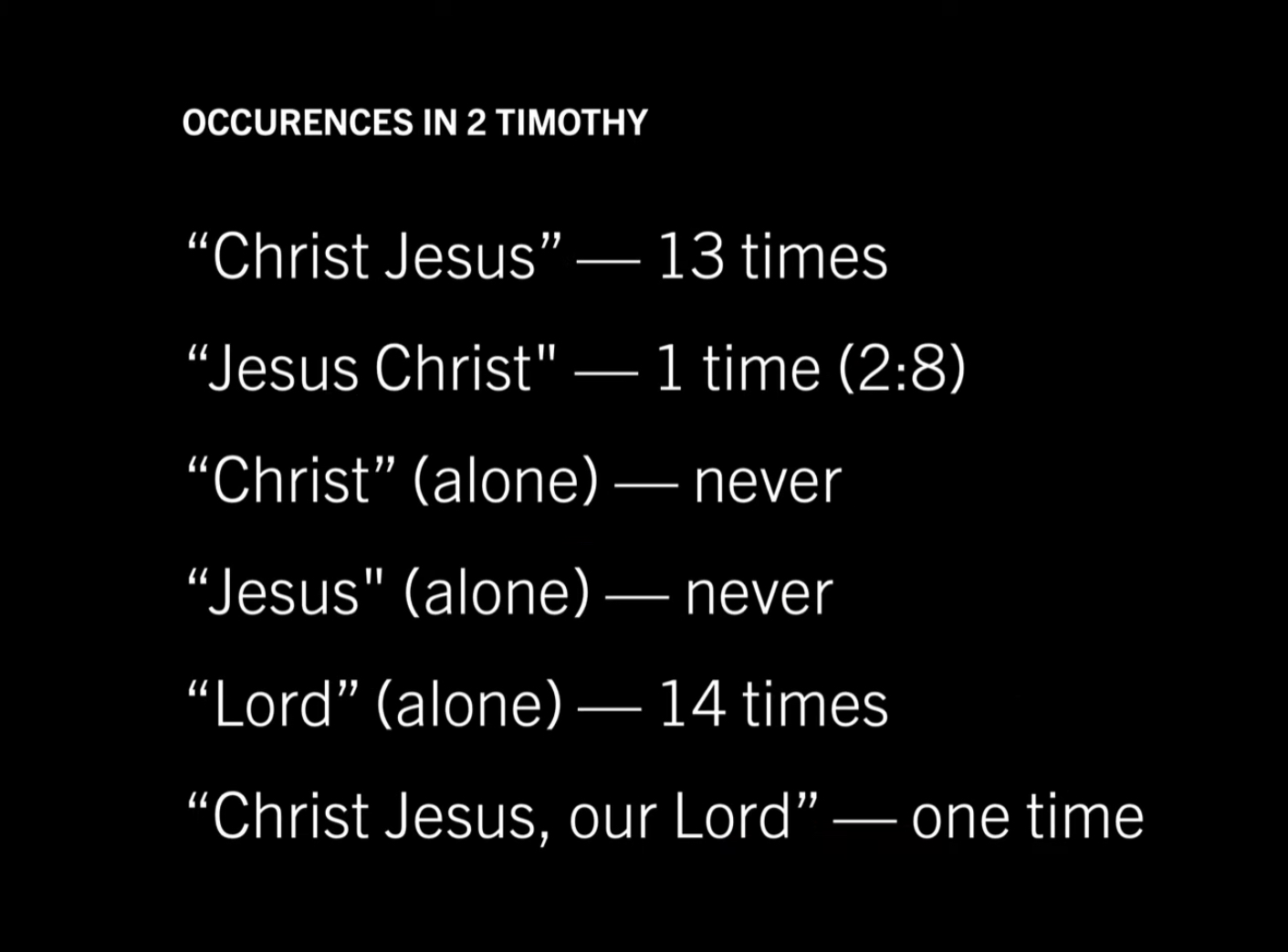
In his “Look at the Book” series, John Piper expounds on the many ways Paul refers to Jesus in his second letter to Timothy. There are several ways, but Paul’s preferred way is “Christ Jesus.” Pastor John unpacks the Hebrew and Greek origins of these words and titles, and why he thinks Paul especially gravitated toward this title.

Aerosols from penguin excrement may help trigger cloud formation, reducing solar heating and helping stabilize local areas of the Antarctic climate, study finds.” Hmmm, it’s almost like God designed His creation to take care of itself—because He did!

And an article in Science says, “According to secular models of Solar System formation, Earth, as an inner Solar System planet, should have little to no water.” And yet more than 70% of Earth is covered with water!

Aelred of Rievaulx wrote, “In friendship there is nothing more outstanding than faithfulness, which seems to be both the nurse and guardian of friendship. In all of life’s turns, in adversity and prosperity, in joy and sadness, in delightful and bitter circumstances, it reveals itself to be comparable to friendship, holding in the same regard both the humble and the exalted, the poor and the rich, the strong and the weak, the well and the infirm.”

Commenting on Aelred’s words, T.M. Moore observed, “Don’t we all want friends like that, who not only will provoke and prod us to grow in the Lord, but will stand by us in good times and bad, when we’re up and when we’re down? But if we would have such friends, we must be good stewards of their trust. This, again, is why spiritual friendships must be grounded in the Lord and focused on Jesus if they are going to bear the fruit of His indwelling Spirit.”

Evolutionary scientists claim to have made some steps forward in their understanding of the origins of life by using “the last universal common ancestor (LUCA).” But creationists like those at ICR observe that, “This mysterious LUCA is an unknown entity that existed from an unknown time ago at an unknown place by an unknown chain of unknown processes.” Clearly, the hypothesis that is the most straightforward and explainable is that God created the life in our universe just as the Bible states.

Along the same lines, Glenn Schrivener asks, “What do you think was there ‘in the beginning’—before peoples, planets, and protons? If you could hit rewind on the history of the universe and go back as far as possible, what would you find?” Then he gives us four possible things we may consider.

Walking Boldly In Dark Places

Listen to the podcast of this post by clicking on the player below, and you can also subscribe on AppleSpotify, or Audible. 

I was reading the results of a survey which said one of the top traits for exemplary leaders was: They keep their word. 

But don’t we really mean, “They keep their word most of the time”? After all, we do allow those who have a track record of integrity an “out” for unusual or unexpected circumstances. And we would still say that leader had honesty and integrity. 

God always keeps His word. He never needs an “out” because nothing is ever unexpected for Him! He is always the Promise Maker and the Promise Fulfiller (Isaiah 42:9, 46:10, 55:10-11; Jeremiah 1:12). 

I like the way Jesus sums up these statement from His Father: For assuredly, I say to you, till heaven and earth pass away, one jot or one tittle will by no means pass from the law till all is fulfilled (Matthew 5:18 NKJV). 

A  jot is the smallest Hebrew letter (yodh). In Greek the word is iota. This tells us that God is concerned about the smallest of details. 

A tittle is the precise difference between Hebrew letters like cheth and he, between daleth and resh, and between beth and kaph.  

All of these are fulfilled—brought to their perfect completion (Luke 1:37, 22:37)! 

When we see any of God’s promises made and kept, we need to ask ourselves three questions:

  1. What did it mean then? 
  2. What does it mean now? 
  3. What does it mean for me today? 

For example, look at the promise that was made about people living in a very dark place seeing the Light of God. The prophecy is first made in Isaiah 8:19-9:7 that the people of Zebulun and Naphtali would get to see and experience the light of the Messiah. 

Matthew 4:11-17 tells us that after Jesus endured the temptation of the devil for 40 days, He went to Capernaum—the region of Zebulun and Naphtali. But before He arrived there, He was first rejected by the folks in His hometown of Nazareth (see Luke 4:14-31). 

Our God who knows the end from the beginning never makes a mistake; nothing is ever random or inconsequential. We should develop the habit of praying, “Now that this is happened, what would You have me do?” As Jesus was rejected by the people who should have been so excited to see His ministry flourish, He wasn’t dismayed or discouraged, but He directed His steps toward Capernaum. 

In my heart, I may plan a course for my life, but I must trust God to direct my steps. My life has a purpose. Just as the Holy Spirit directed the movements of Jesus, He is directing my steps. 

Even when God seems to have directed my steps into a dark place, He has sent me there as His light. I am sent on purpose. I walk a path Jesus has already walked, and a path that He is still walking with me—He guides me in paths of righteousness for His name’s sake. Even though I walk through the valley of the shadow of death, I will fear no evil, for You are with me (Psalm 23:3-4). 

I don’t walk into the darkness in my own strength or as a way to fulfill my own plans but instead I trust that “the zeal of the Lord Almighty will accomplish this” (Isaiah 9:7)! 

Because Jesus is fulfilling every jot and every tittle, I can live confidently in Him! 

If you would like to follow along with all of the messages in this series called Jots and Tittles, you can find them all here. 

►► Would you please prayerfully consider supporting this ministry? My Patreon supporters get behind-the-scenes access to exclusive materials. ◀︎◀︎

Links & Quotes

Every Monday I share a 1-minute thought to get your week started. It’s my weekly Monday Motivation series of videos. Check out this week’s video that I posted the day after Christmas, and please subscribe on YouTube.

T.M. Moore wrote one of the endorsements for my book Shepherd Leadership. In an interview I then did on his Fellowship of Ailbe podcast, I shared my dismay over unbiblical ideas and practices that have crept into the church. Both T.M. and I share a passion to see our church leadership return to our secure biblical foundation. 

In a recent blog post, T.M wrote, “From the days of the apostles onward, a tendency has existed among church leaders to drift from the plain teaching of the Word of God into forms of Christian life and ministry that derive from sources other than Scripture. Or that stretch the meaning of Scripture to fit the shape of certain cultural forms.” Please check out T.M.’s post “Do not go beyond.”

In a fascinating post from Rabbi Benjamin Blech, I read these thoughts about the power of a name: “The Hebrew word for soul is neshamah. Central to that word, the middle two letters, shin and mem, make the word shem, Hebrew for ‘name.’ Your name is the key to your soul. … When the Torah says, ‘God created,’ it doesn’t suggest that He worked with what He fashioned by labor, but merely that He spoke—and the very words describing the object came into being. God said, ‘Let there be light and there was light.’ The Almighty merely gave it a name, and the very letters defined its atomic structure.” Check out the full post here.

And once again archeologists discover evidence that corroborates the biblical accounts. In this case, more evidence is found from King Hezekiah. As I have said numerous times, the historicity of the Bible is amply verified.

“Success” doesn’t always mean bigger numbers. King David got into trouble with God when he wanted to measure his success by how many fighting men he had under his command. Consistently throughout the Bible God’s measure of success is our trust in Him. This thought was a key part of the sub-title of my book Shepherd Leadership: The Metrics That Really Matter.

Cold-case detective J. Warner Wallace tackles an important topic: Does objective truth exist, and how can it be defined? This is a quite lengthy post but it is well worth your time.

“Pain nourishes courage. You can’t be brave if you’ve only had wonderful things happen to you.” —Mary Tyler Moore

The Holy War (book review)

Listen to the podcast of this post by clicking on the player below, and you can also subscribe on AppleSpotify, or Audible. 

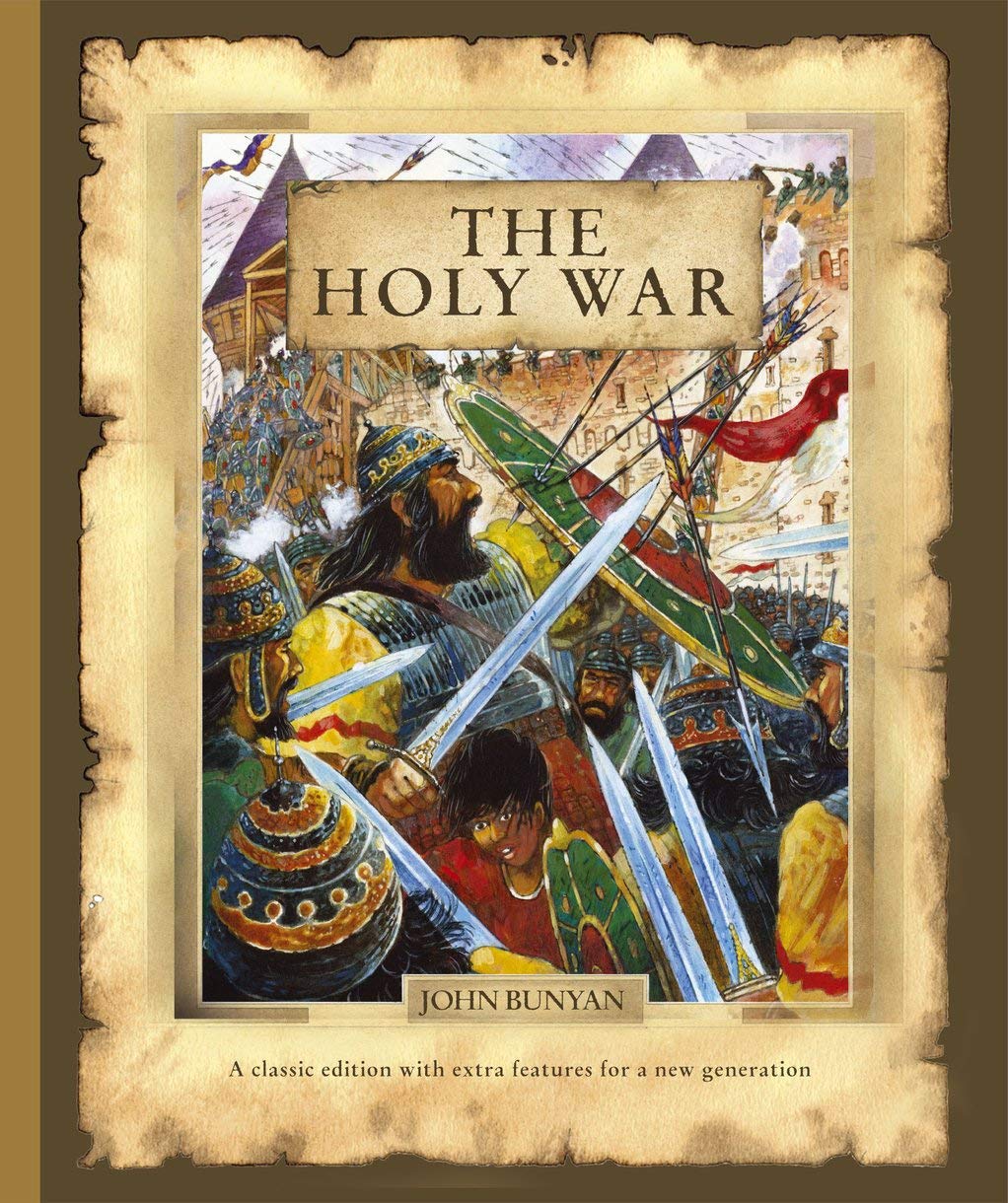
Many of the principles taught in the Bible are conveyed to us through graphic stories. Think about some of the imagery the prophets of the Old Testament used or even the parables Jesus used in the New Testament. In fact, even the Hebrew language of the Old Testament and the Greek language of the New Testament are very picturesque languages. John Bunyan takes full advantage of this in his book The Holy War. 

If you have ever read a John Bunyan book or sermon, it is quite obvious that the Bible is his Source Book. In fact, Charles Spurgeon said of him, “Why, this man is a living Bible! Prick him anywhere—his blood is Bibline, the very essence of the Bible flows from him. He cannot speak without quoting a text, for his very soul is full of the Word of God.” Much like The Pilgrim’s Progress, The Holy War is steeped in biblical imagery that makes the story so engaging. 

The title and subtitle of the book alone tell you the essence of the story: The holy war made by Shaddai upon Diabolus for the regaining of the metropolis of the world, or the losing and taking again of the town of Mansoul. With the assault taking place on Ear-gate and Eye-gate of Mansoul by such combatants as Lord Incredulity or Mr. Forget-Good, and the servants of King Shaddai such as Captain Conviction, Mr. Justice, and Mr. True-Man drawing up battle lines against the town, you can quickly see how picturesque the language truly is. 

Much in the vein of C.S. Lewis’ The Screwtape Letters, Bunyan also lets us hear the correspondence and war counsels of Lucifer and his minions, as well as the conversation between King Shaddai and His Son Emmanuel. 

As with anything I’ve ever read from John Bunyan, The Holy War is entertaining and insightful. If you have read and enjoyed The Pilgrim’s Progress, I think you will thoroughly enjoy this book as well. 

►► Would you please prayerfully consider supporting this ministry? My Patreon supporters get behind-the-scenes access to exclusive materials. ◀︎◀︎

Parallelism

As regular readers of this blog probably know, on Saturdays I like to share poems that I have read during the week. One place I encounter poetry on a regular basis is in my daily Bible reading. But if you have read the Bible, no doubt you have discovered what I have discovered: ancient Hebrew poetry is very different from the poetry we usually read!

I found this helpful chart explaining the parallelism of Hebrew poetry in my Faithlife Illustrated Study Bible, and I thought you might benefit from it too.

If you would like to download this chart, I have shared it as a PDF here → Parallelism

“My God, My God”

Listen to the podcast of this post by clicking on the player below, and you can also subscribe on Apple or Spotify.

Jesus has been hanging on the Cross silently for three hours. And now He gathers His strength for four final statements that all come in pretty close proximity. His first three dying declarations have been declarations of love:

But now comes a word of sheer, unparalleled agony. A word from a heart that is experiencing the depths of betrayal and pain that has never been known—or even approached—in all of human history: Eloi, Eloi, lama sabachthani! (Matthew 27:45-46; Mark 15:33-34)

Does this sound like a good Friday message: My God, My God, why have You forsaken Me? 

This is the only one of the seven dying declarations of Jesus that Matthew and Mark record, and they do it nearly identically: 

  • It’s spoken in the everyday language of the people: Aramaic 
  • It’s translated into the worldwide language of business and literature: Greek 
  • It’s a direct quotation of Hebrew Scripture 

This is a word for everyone: Jews and Greek, nobles and commoners, religious people and pagans. 

This dying declaration comes from words taken directly from Psalm 22. David wrote this psalm 1000 years before the crucifixion of Jesus, but note the amazing accuracy in the despicable treatment of Jesus, gambling for Christ’s clothes, even the crucifixion itself (which was unknown in David’s time), and then there’s the heart-wrenching cry My God, My God, why have You forsaken Me?  

Matthew and Mark say Jesus “cried out.” This can mean a cry of joy or a cry of pain. They also record that He cried out with “a loud voice.” The Greek words here will sound very familiar even to English ears—“loud” is the word megas, and “voice” is the word phoné. Literally: Jesus raised a megaphone voice to make sure everyone heard His cry! 

Remember that cried out can either be a cry of joy or of pain? Which one was it? You could make the case that it is both of these meanings. But there is a third way of using this word: a cry for help. 

Jesus is about to take a plunge. He is about to descend deeper than anyone else ever has. He is about to voluntarily go into Hell itself. This megaphone cry is His battlecry before storming the gates of Hell! 

Christ’s megaphone battlecry was heard in Hell and in Heaven as Jesus descended to decisively defeat hell, death, and the grave! Make no mistake, Jesus undoubtedly won that battle! That same descriptive word megas is also used for… 

  • …the stone in front of His grave is a megas stone 
  • …the earthquake that rolled away that stone on Resurrection morning was a megas earthquake 
  • …the joy of Christ’s friends at seeing the tomb empty was a megas joy 
  • …the trumpet sound at Christ’s Second Coming when He returns to earth as the Conquering King will be a megas blast, and His shout a megaphone cry (Matthew 24:31; 1 Thessalonians 4:16)! 

Jesus went to the deepest depths to take us to the highest heights! 

His megaphone declaration from the Cross on Good Friday was a cry of pain over our sin, a battlecry as He stormed the gates of Hell, and a cry of joy over His coming victory! 

So now we can say, “Where, O Death, is your victory? Oh yeah, you don’t have one because my Savior has totally defeated you!” 

If you’ve missed any of the other dying declarations of Jesus from the Cross, you may access the full list by clicking here.

►► Would you please prayerfully consider supporting this ministry? ◀︎◀︎

Two Joys

…joy… (Nehemiah 8) 

Although the word in English is “joy,” there are two different Hebrew words used here. Think of them this way—one is the root and the other is the flower. 

In verse 10, the Hebrew word chedvah is only used twice in all of the Old Testament (it’s also used in 1 Chronicles 16:27). This word describes the source of joy—or the root—which is found exclusively in God’s presence. 

In verses 12 and 17 the word for “joy” is simchah. This word essentially becomes the outward expression—or the flower—because it is nourished by the chedvah root. 

Here’s how it plays out in the book of Nehemiah. Because the people had heard and been given understanding of God’s Word, they joyfully celebrated. And because God helped them complete the wall around Jerusalem and reestablish worship at the temple, they also happily celebrated. God was the chedvah root of their joy, and their outward celebration was the simchah flower. 

God alone is the Root—the Source—of chedvah. My simchah celebration both glorifies Him as the Source and points others to Him. My simchah flower will make others desirous for the chedvah root that has brought about this outward joyful expression from me. 

To be a joyless Christian is a contradiction of terms. To not express simchah means either I am not abiding deeply in the root of chedvah, or that I don’t believe it is worthwhile enough to share with others. But of course, if I have truly been to the Source, I will want others to enjoy this relationship with God as well.

Two questions for me to ask myself: (1) Is my heart abiding deeply in God as my Source of joy? And (2) Is my outward joy a making others desirous to know this Source of joy for themselves? 

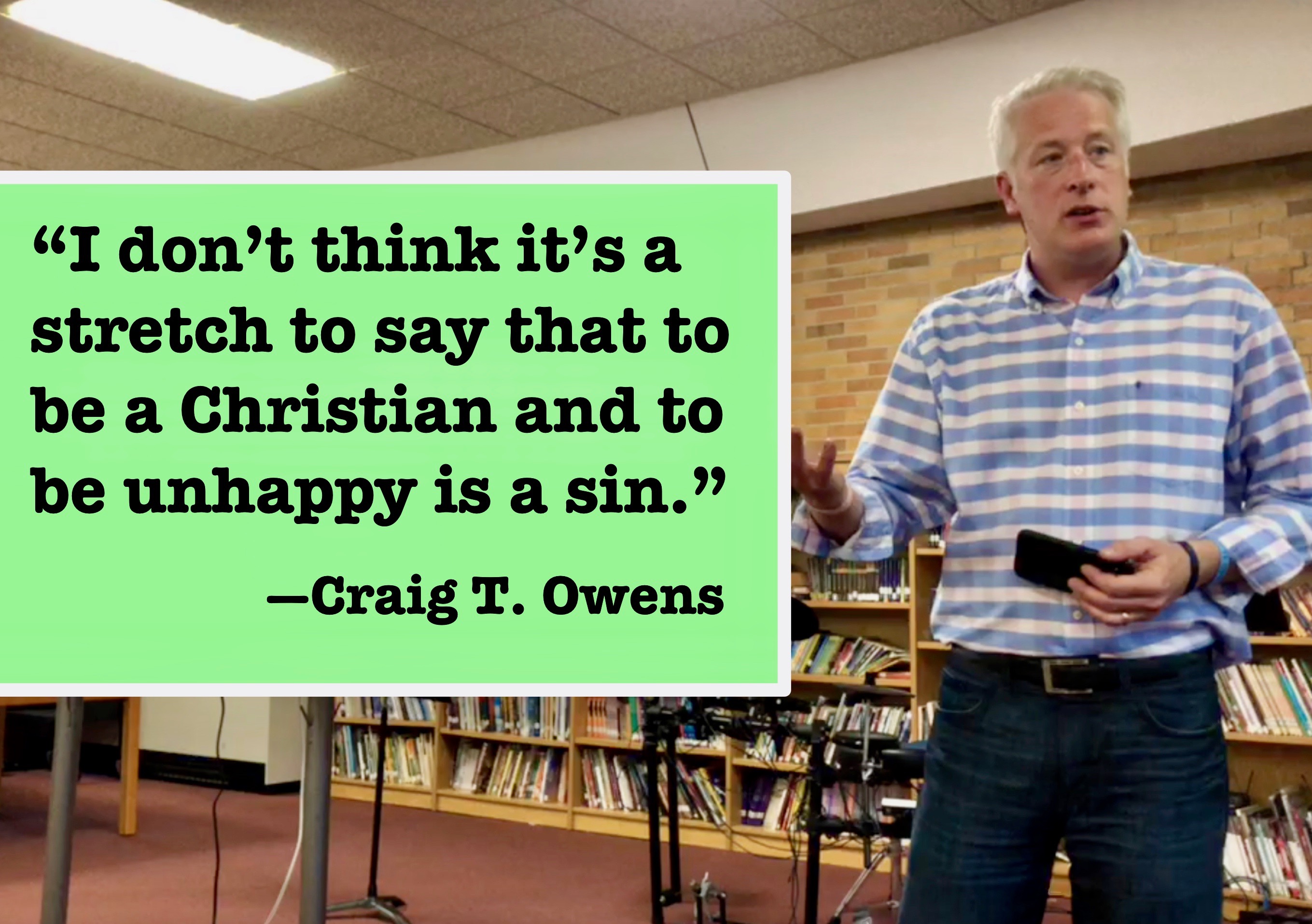
I don’t think it’s a stretch to say that to be a Christian and to be unhappy is a sin. A joyless, unhappy Christian gives God no praise, robs Him of glory, and paints God in a bad light. A happy Christian knows the Lord is his strength, his comfort, his supply. The joy-filled, happy Christian lifts God high and invites others to know this All-Good, All-Happy God too! 

“Alas!” To “Aha!”

Listen to the podcast of this post by clicking on the player below, and you can also subscribe on AppleSpotify, or Audible.

…oh no… (2 Kings 6:5, 15). 

The words “Oh no!” are actually a single word in the Hebrew language (Hebrew: ‘ahahh) that has been transliterated into English as “Aha!” 

But I think the old English translation is better in this context: ALAS! 

ALAS is usually a painful realization of the situation, not a cry of enlightened discovery. Here are the other times that this Hebrew/English word for ALAS! is used: 

  • Joshua said it after his army was defeated at Ai 
  • Gideon said it after realizing he had been face-to-face with God 
  • Jephtha cried it out after he knew that his daughter would have to be sacrificed
  • King Joram uttered this when he realized his troops and animals had no water in the desert 
  • Jeremiah said this to God after he was called to be a prophet, and after he was asked by God to speak countercultural words (he actually said ALAS! four times!) 
  • Ezekiel also cried out ALAS! four times when God asked him to do or to watch difficult things 
  • Joel cried it out when he saw the Day of the Lord quickly approaching 

(check out the above references by clicking here) 

In all of these ALAS! painful moments, these men were at their wits’ end, at the end of their own abilities—they couldn’t do anything to help themselves. 

In all of these ALAS! moments, they came to just one important realization: Only Yahweh can help me. That realization is truly the AHA! of an enlightened discovery! 

Calling on God turns a painful ALAS! moment into a God-glorifying AHA! moment. God alone can provide where no one else can.

Don’t despair in the ALAS! times, but cry it out loud to the only One who can help you, and then watch to see how He alone will turn your situation into a defining, God-glorifying AHA! testimony. 

►► Would you please prayerfully consider supporting this ministry? ◀︎◀︎

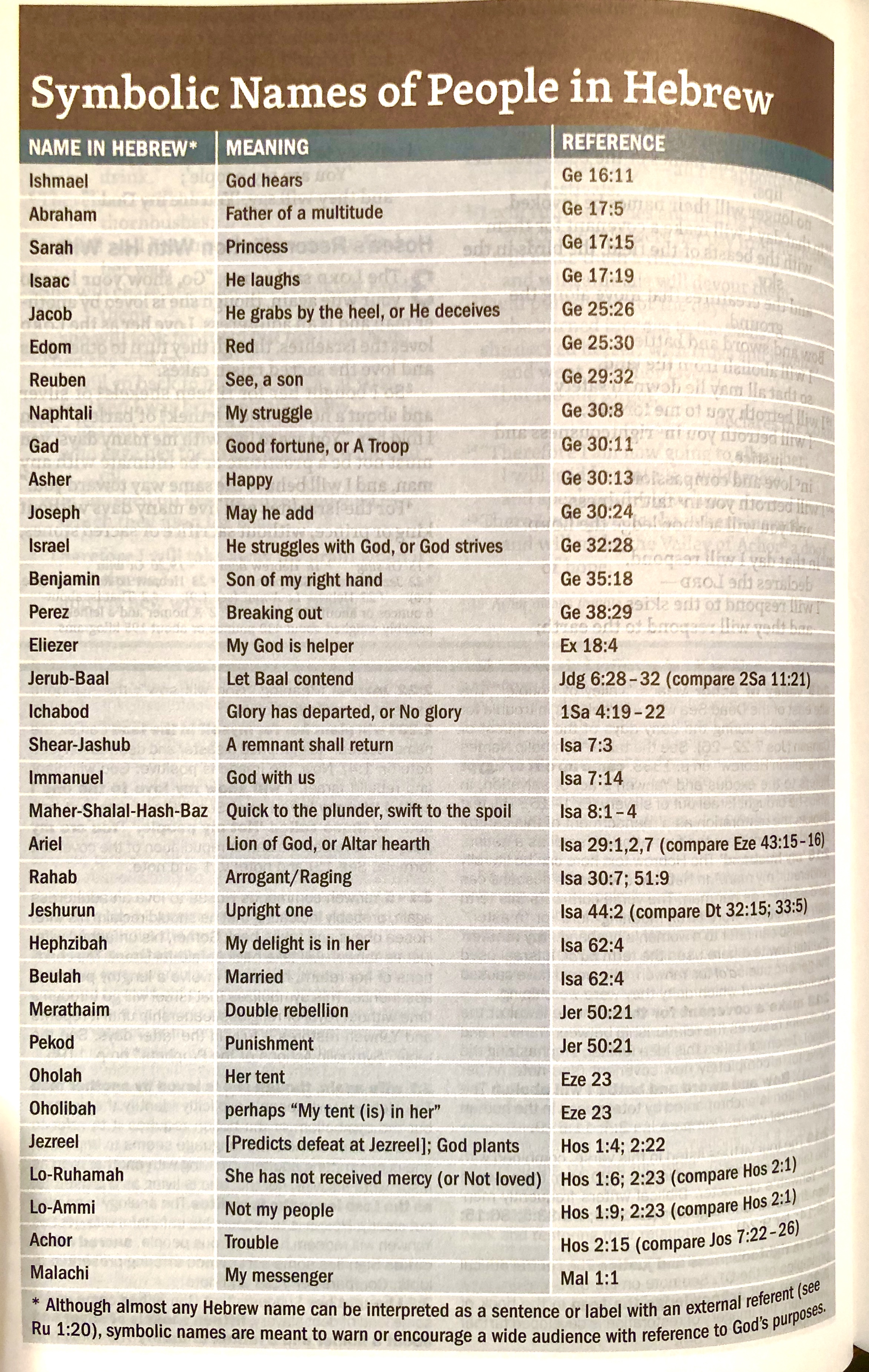
Symbolic Hebrew Names In The Old Testament

In studying for our ongoing series Major Lessons From Minor Prophets, I came across this chart in my Faithlife Illustrated Study Bible. This isn’t an exhaustive list by any means, but it is a good list to get you started on your own Bible study. 

I always find it fascinating when God names something, or instructs parents to name their children, or especially when a name gets changed. Many study Bibles contain a footnote by these names to give you the Hebrew or Greek definition, so don’t breeze by those too quickly! 

You can also find this list from the Faithlife Bible by clicking here. 

Happy studying! 

P.S. I also invite you to check out this name change which all of us can relate to!