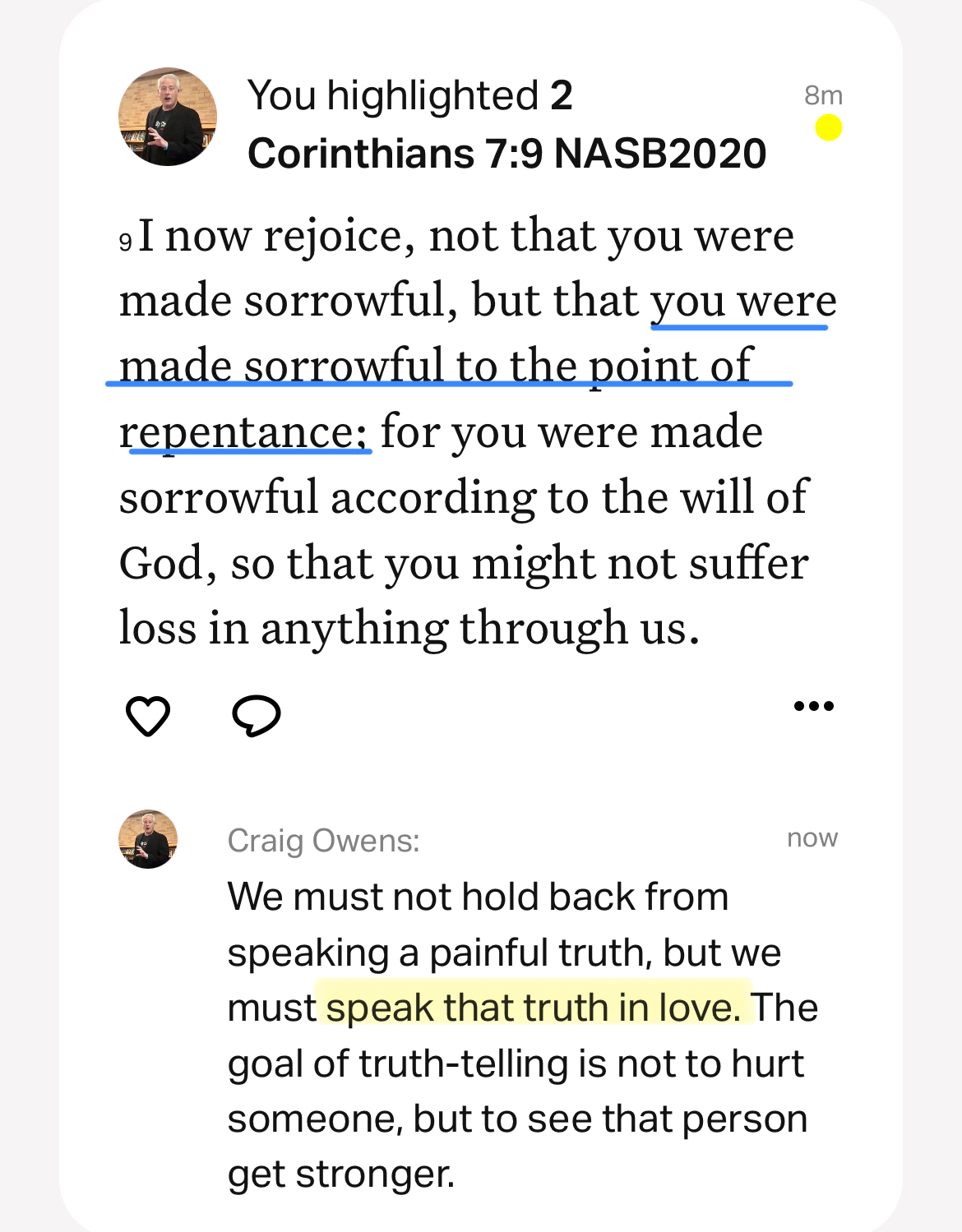
For though I caused you sorrow by my letter, I do not regret it; though I did regret it—for I see that that letter caused you sorrow, though only for a while—I now rejoice, not that you were made sorrowful, but that you were made sorrowful to the point of repentance; for you were made sorrowful according to the will of God, so that you might not suffer loss in anything through us. For the sorrow that is according to the will of God produces a repentance without regret, leading to salvation, but the sorrow of the world produces death. (2 Corinthians 7:8-10 NASB)
Is it okay for you to hurt your friend’s feelings?
I think it is acceptable if those painful words save your friend from a world of hurt.
We must not hold back from speaking a painful truth, but if we do have to share that word, we must ensure that we are speaking that truth in love (Ephesians 4:15). Remember that people don’t care what you know until they know that you care. The goal of truth-telling is not to hurt a friend’s feelings, but to spare that friend a greater pain or to see that friend get stronger.
If you have to speak these words, be sure to water your lovingly truthful words in tears before you share them. As Jesus said, “Remove the plank in your own eye first” (Matthew 7:5).
If you are on the receiving end of painful words, ask yourself, “Is this a friend who loves me and wants the best for me? If so, is there truth in these words?” Even if the words were delivered clumsily, see the love behind the words and find the truth that can help you make a change for the better (Proverbs 27:6, 17).
To dive a little deeper into this topic, check out my video on The Podcast called Speak the truth in love.
Listen to the podcast of this post by clicking on the player below, and you can also subscribe on Apple, Spotify, or Audible.
It is so much easier to complain than to compliment. We can slide into the negative conversations almost without thinking about it.
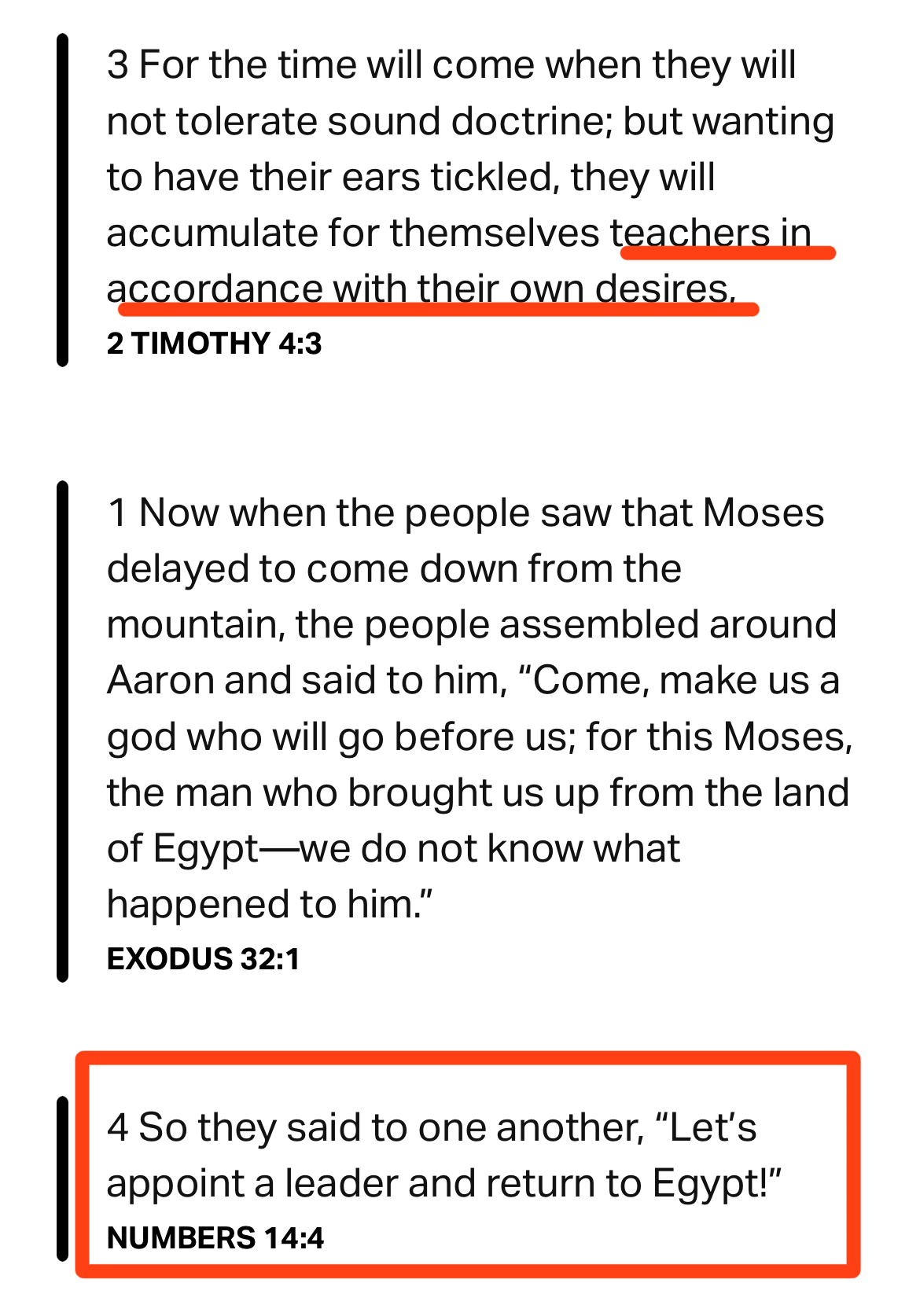
In one of the last things that Paul wrote to Timothy—as he’s in prison, quite possibly awaiting execution—he warns his friend against the darkness of the last days (2 Timothy 3:1-5). We need to engage our minds, our wills, and our emotions to not go with the flow of culture’s negativity.
Remember the wise words from George Santayana: “Those who do not learn from history are doomed to repeat it.” The apostle Paul said this before Mr. Santayana (1 Corinthians 10:1-6). We need to learn the lessons of the dangers of forgetfulness that leads us to ingratitude.
Even before Paul, the Old Testament is filled with repeated reminders to remember God’s blessings and gratefully look to Him to supply every need. Let’s unpack some lessons on the importance of gratitude from Israel’s history in Psalm 106.
In Psalm 106:7, the Israelites forget what God has done for them in Egypt. Now that they appear to be pinned between the Red Sea and the onrushing Egyptian army, their forgetfulness becomes grumbling against God (Exodus 14:10-12).
In Psalm 106:13-14, instead of being grateful for the miraculous supply of manna, the Israelites are grumbling about the meat they don’t have (Numbers 11:4-6).
Here’s the lesson for us to learn: God wants to teach us to be thankful for His daily provisions for us (Joshua 5:12; Matthew 6:11).
In Psalm 106:21, 28-29, the next generation of Israelites didn’t remember to be thankful because they had seldom heard their parents express gratitude (Judges 2:10-11).
Here’s the lesson for us to learn: Our daily thankfulness fortifies future generations (Psalm 37).
Here is the repeated pattern we see—
Thankfulness → Forgetfulness → Fearful / Selfish attitudes → Susceptible to the temptation to grumble against God
Thankfulness → Remembering → Joyful / Secure attitudes → Fortified against the temptation to grumble against God
Jim Cymbala said, “Ingratitude to God is the first step toward backsliding and departure from God. So, it is to our benefit to have a thankful heart toward God.”
Let’s put into practice this lesson from King David: “Praise the Lord, O my soul, and forget bot all His benefits” (Psalm 103:2).
Listen to the podcast of this post by clicking on the player below, and you can also subscribe on Apple, Spotify, or Audible.
And Jesus cried out again with a loud voice, and gave up His spirit. And behold, the veil of the temple was torn in two from top to bottom; and the earth shook and the rocks were split. Also the tombs were opened, and many bodies of the saints who had fallen asleep were raised; and coming out of the tombs after His resurrection, they entered the holy city and appeared to many. (Matthew 27:50-53)
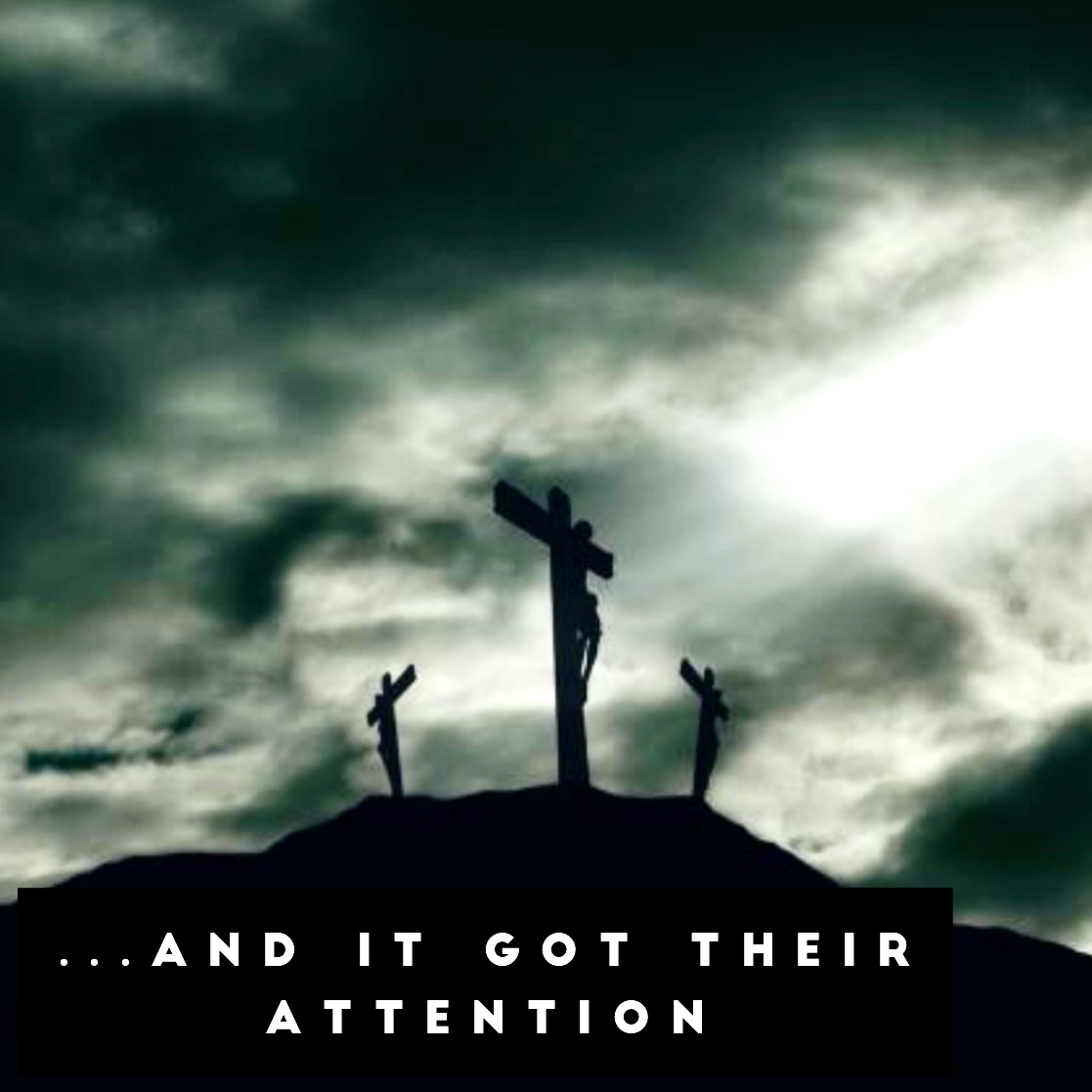
The centurion and his soldiers saw a Man die like no other crucifixion victim ever had. And it got their attention!
People in Jerusalem had dead friends and family members return to life. And it got their attention!
The religious leaders felt the earthquake and saw the curtain that shielded the Holy of Holies ripped in half. And it got their attention!
Now all of them had a choice: Would they acknowledge that Jesus was who He said He was or not. The Bible gives us only one man’s response: the centurion at the Cross. And Jesus, crying out with a loud voice, said, “Father, into Your hands I entrust My spirit.” And having said this, He died. Now when the centurion saw what had happened, he began praising God, saying, “This Man was in fact innocent” (Luke 23:46-47).
I wonder if there were others?
More importantly, with all of God’s miracles around me every single day, does it get my attention?
Listen to the podcast of this post by clicking on the player below, and you can also subscribe on Apple, Spotify, or Audible.
Do you remember this song: “If you’re happy and you know it clap your hands”? It goes on to say, “If you’re happy and you know, then your life will surely show it….” Frankly, I’m concerned about Christians that are unhappy.
Charles Spurgeon was talking to his students and he said, “I commend cheerfulness to all who would win souls; not levity and frothiness, but a genial, happy spirit. There are more flies caught with honey than with vinegar, and there will be more souls led to heaven by a man who wears heaven in his face than by one who bears Tartarus in his looks.” Tartarus, in Greek mythology, is a sunless abyss, below Hades, in which Zeus imprisoned the Titans, which is the exact opposite of the Paradise described in the Bible.
Unhappiness generally comes from ingratitude. An unhappy Christian gives God no praise, robs Him of glory, and paints God in a bad light. A happy Christian lifts God high and invites others to know this All-Good, All-Happy God too!
Christians need to fight against the downward pull of negativity in which our culture seems to so easily gravitate. In his letter to the Philippians, the apostle Paul says that a Christian who doesn’t engage in the complaining that the world is known for will shine brightly. Quite simply, thankfulness is the antidote to complaining (Philippians 2:14-18).
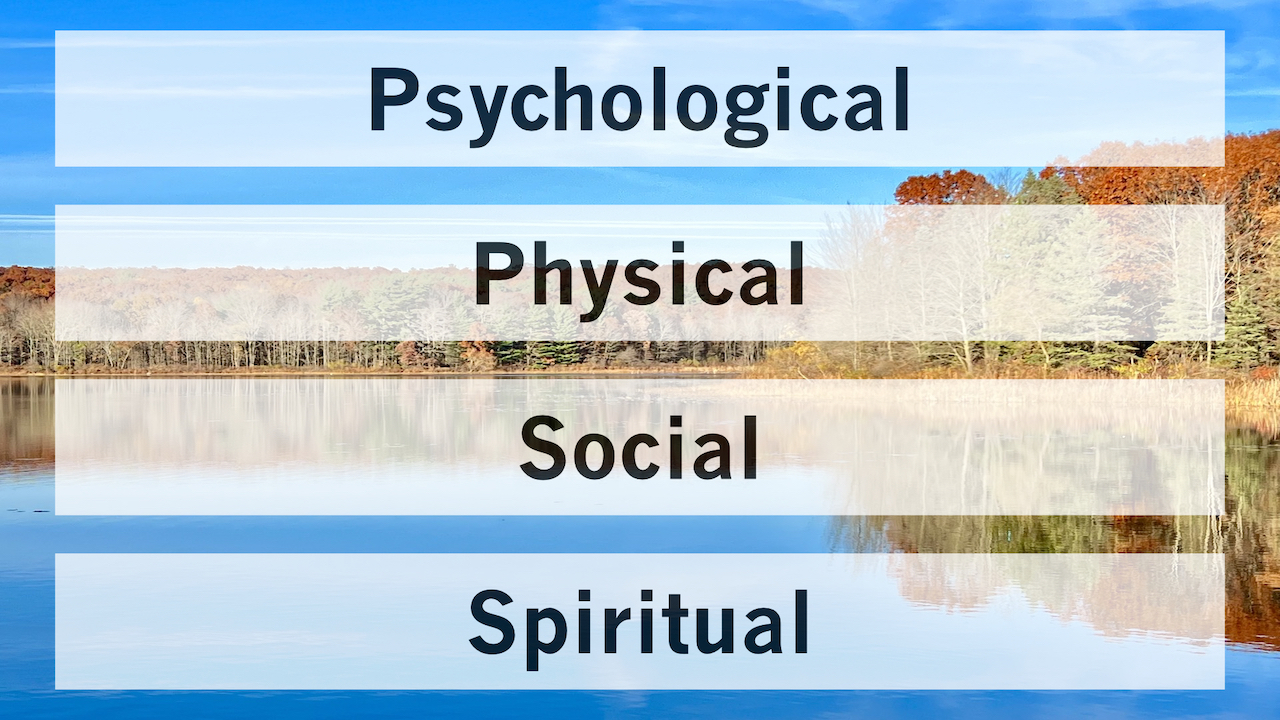
Even those who may not recognize the the authority of Scripture have extolled the benefits of gratitude. Psychologists and medical professionals have identified three benefits from a thankful heart:
Physical benefits—stronger immune system, less body aches and pains, regulated blood pressure, a better sleep-wake cycle
Social benefits—better communication with others, increased empathy, increased likability
And Christians can add one more benefit to this list:
Spiritual benefits—more dynamic corporate worship, enchanted Christian testimony, perseverance through trials, fortification against giving in to temptation
The well-known Cleveland Clinic reported that an attitude of gratitude leads to overall wellness. When you are grateful for what you have, it improves your outlook mentally, physically, spiritually, and relationally.
Here are five things you can start doing today that will increase your gratitude levels, enhance your Christian testimony, and generally improve your life:
Switch your perspective. Worry is focusing on what you don’t have. Make the switch to gratitude by giving thanks for what you do have (Matthew 6:25-34).
Strengthen your relationships. It’s fine to weep with those who weep, but let’s encourage others and be encouraged by others so that we can rejoice with those who rejoice (1 Thessalonians 3:6-10),
Foster healthy habits. Dr. Luke gives us the pyramid of health that Jesus demonstrated in Luke 2:52. The pinnacle is strong relationships, and grateful people are more empathetic and likable.
Keep a gratitude journal so that you don’t forget what God has done for you (Psalm 106:7).
Talk about your gratitude. This instills thankfulness in other saints (Isaiah 63:7) and in future generations of your family (Isaiah 46:4), and it becomes a testimony for seekers (1 Peter 3:15).
Let me close with this observation from Blaise Pascal: “There are three kinds of people in the world; those who have sought God and found Him and now serve Him, those who are seeking Him, but have not yet found Him, and those who neither seek Him nor find Him. The first are reasonable and happy, the second reasonable and unhappy, and the third unreasonable and unhappy.”
Reasonable, happy saints are the ones who lift God high and invite others to know this All-Good, All-Happy God too! Not just at the Thanksgiving season, but starting now and then going all year long!
Follow along with all of the messages in this series called Be Thankful by clicking here.
Listen to the podcast of this post by clicking on the player below, and you can also subscribe on Apple, Spotify, or Audible.
Ministry was booming in Samaria, and Philip was at the center of the activity. People were getting saved, healed, and set free from demonic possession.
And then an angel tells Philip it is time to move on. We don’t see Philip debating or negotiating, but we just see his immediate obedience. As Philip is traveling the route the angel gave him, he sees a chariot approaching. The Holy Spirit then speaks to Philip and says, “Get close to that chariot and stay near it.” It was then that Philip hears the man in the chariot reading aloud from the Book of Isaiah, so he asks him if he understands what he is reading. This high-ranking official from Ethiopia then invites Philip into his chariot to explain the meaning to him.
Philip had to leave Samaria in time to cross paths with the Ethiopian official who was heading home from Jerusalem—they met in the middle of a desert. An angel got Philip started. The Holy Spirit refined where Philip needed to be. And then Philip took it from there.
If Philip had been trying to “grow” a successful ministry, he may have downplayed or even ignore the messages he received. But Philip wasn’t concerned about bigger numbers, just quicker obedience.
Philip’s quick obedience placed him precisely where God needed him to be, precisely when he needed to be there! (See Acts 8:4-40.)
In my book Shepherd Leadership, I have a chapter entitled “Don’t Try to Grow Your Ministry.” A portion of what I wrote comes from Philip’s quick obedience—
Don’t try to grow your ministry. First, because it’s not yours, it’s His; and second, because your measure of success is probably more slanted toward quantitative measurements than qualitative. Jesus wasn’t concerned about bigger numbers: “What do you think?” He asked, “If a man has a hundred sheep, and one of them goes astray, does he not leave the ninety-nine and go to the mountains to seek the one that is straying?” (Matthew 18:12).
Philip went to Samaria to tell people about Jesus. He didn’t go there because it fit his plan, but because Jesus said, “You will be My witnesses in Jerusalem, and in all Judea and Samaria, and to the ends of the earth” (Acts 1:8). Philip’s obedience brought God’s success: hundreds turned to Jesus as their Savior, demon-possessed people were delivered, the sick were healed, and the new Christians were baptized in the Holy Spirit. Yet God called Philip to leave these “ninety-nine” and go to the desert to cross paths with just one confused and wondering sheep (Acts 8). After that, Philip virtually disappears from Luke’s historical record.
What’s the value of one government official’s life? God says that his value is incalculable. Apparently, God knew that Philip was the perfect shepherd to lead this Ethiopian to the pasture where he would accept Jesus as his Savior. Philip was obedient, a sheep was saved, and God was pleased. But I wonder how many people today might think Philip’s ministry was unsuccessful because he left a bigger ministry in Samaria to go to a smaller ministry in the desert? Bishop William C. Abney said, “I’m still waiting for a leader to say, ‘God called me to a smaller ministry.’ We usually only say, ‘God called me’ when it’s something bigger. God’s math doesn’t work our way.”
The Chief Shepherd made this commitment to His sheep: “And I will give you shepherds according to My heart, who will feed you with knowledge and understanding” (Jeremiah 3:15). My prayer is that we would much rather feed a few sheep where God has directed us and given us His heart than for us to try to manufacture success that is measured by how many nickels and noses we can count.
Philip demonstrates for us that it’s not about bigger numbers, it’s about obedience to God’s voice in the moment, and then hearing our Chief Shepherd’s voice at the end of our life saying, “Well done, good and faithful servant.”
Listen to the podcast of this post by clicking on the player below, and you can also subscribe on Apple, Spotify, or Audible.
We have been learning about how God gifts us so that He can use us to build His kingdom. Discovering these gifts and then living in this gift zone is going to require us to stretch out of our comfort zone. So far, we’ve looked at two factors:
As you look back, the things that thrill you and kill you have probably remained consistent through your life. You may recall moments where implementing your gifts went very well and times when it didn’t go so well. The former makes us ready to try again and maybe expand a little further, but the latter tempts us to shrink back into our comfort zone. The key is to find out how we can be more consistent in using our gifts productively.
It looks like this: God’s gifts + Our stewardship = Productive strengths.
God gives the gifts as only He knows best (Psalm 139:16; Romans 12:6; 1 Corinthians 12:11) and then we steward these gifts into productive strengths.
The dictionary defines it as the responsible overseeing and protection of something considered worth caring for and preserving.
The Bible always portrays a steward as the one in charge of the precious things in a household—in our case, the Church.
Jesus makes the role of a steward very clear in his parable found in Matthew 25:14-27. Notice three important things:
The master gave gifts to everyone of his servants, but he gave “each according to his ability” (vv. 14-15).
The wise servants stewarded the master’s gift by that way they “put his money to work” (vv. 16-18)
The master demanded accountability of all of his servants. Two servants acknowledged “you entrusted me” with these gifts (vv. 19-23), while one said, “I was afraid” (vv. 24-27).
God created each of us on purpose and for a purpose. He gave us the gifts we need to accomplish that purpose. We will only find our fulfillment in life in stewarding those God-given gifts and opportunities in ways that glorify Him. Not only fulfillment here, but then eternal satisfaction when we hear our Savior say, “Well done, good and faithful servant! Enter into your Master’s happiness!”
The only servants that heard the “well done” from their master were those who realized it was “your money…entrusted” to me. I like how Eugene Peterson brings this out in his paraphrase:
Make a careful exploration of who you are and the work you have been given, and then sink yourself into that. Don’t be impressed with yourself. Don’t compare yourself with others. Each of you must take responsibility for doing the creative best you can with your own life. (Galatians 6:4-5 MSG)
So let’s add one more circle to the passion and pain circles, and that is the circle of proficiency. This is what fulfills us because we can do it so well; it feels so natural for us to be doing this. Proficiency is what really brings together the passion and the pain, and it helps us find the sweet spot.
Let me give you a couple of examples—one from the Old Testament and one from the New Testament.
Nehemiah was killed that Jerusalem was in shambles and the people were disgraced (Nehemiah 1:3-4)—that’s what killed him. Nehemiah didn’t go to wall-building school, but he effortlessly strategized, cast vision, organized, planned, procured, and adapted—that’s his proficiency. The wall was built in 52 days, Israel’s enemies were disgraced, and the people had a place to worship again (Nehemiah 6:15-16, 9:1-3)—that’s what thrilled him.
The apostles and the first deacons in the New Testament church saw that some of the widows were being overlooked in the food distribution (Acts 6:1)—this is what killed them. These new leaders didn’t go to food-distribution school, but they effectively strategized, cast vision, organized, planned, procured, and adapted (v. 3)—this is their proficiency. The widows were cared for, the Word of God spread, and more people became Christians (v. 7)—that’s what thrilled them.
God gives gifts—we feel that in what thrills us and what kills us. We steward those gifts into productive strengths—we stick with what we fulfilled in doing. Our productive strengths then glorify God as we strengthen and grow the Body of Christ.
Let me give you four things to consider about your area of proficiency:
What comes easily to me?
Where do I see both the steps and the completion before others do?
Where do I experience the greatest ROI of my time and efforts?
What do I do that thrills me because I ran to because it was killing me, and now it fulfills me to keep doing it?
With all three of these circles, please take some time to ponder what your sweet spot is. And if you’ve missed any of the messages in this series, you can find them all here.
Listen to the podcast of this post by clicking on the player below, and you can also subscribe on Apple, Spotify, or Audible.
John Stonestreet used an interesting term (pre-political) that got me thinking about how many government programs would be unnecessary if the Church was doing what Jesus called the Church to do.
Here’s the full quote from John Stonestreet: “Christian political engagement should hit its fever pitch notduring elections. The only way to relieve the political pressures of our day is to build up the pre-political aspects of our life together, especially the family and the Church. When we care well for our children, our neighbors, and our communities, the state doesn’t have to.”
Listen to the podcast of this post by clicking on the player below, and you can also subscribe on Apple, Spotify, or Audible.
Jesus had just healed the sick people that were brought to Him, and then we read:
So the crowd was astonished as they saw those who were unable to speak talking, those with impaired limbs restored, those who were limping walking around, and those who were blind seeing; and they glorified the God of Israel. (Matthew 15:31)
Before Jesus ascended back into Heaven, He told His followers that they would do the same things He had done, including preaching the Gospel and healing the sick. The focal point is still to be the same as it was while Jesus was on earth: “They glorified God.”
We would laugh if an ax boasted about the tree he had cut down. We all know that the power came from the lumberjack.
It was the lumberjack who chose the ax, sharpened the ax, and skillfully used the ax to chop down the large tree. The felled tree is a testament to the lumberjack’s strength.
In the same way, God may use one of us as His instrument to display His power. If the blind receive their sight, the lame can walk, and the lost find Jesus as their Savior, we would laugh if the one who prayed or preached boasted about his ability that brought about these miracles.
These changed lives are a testament to the power and wisdom that flows from God. The one who prays or preaches is merely the instrument that was used by Him. God may pick up that person again and again, or He may lean him against the wall after one use. God determines the best instrument to use for His glory.
In fact, God Himself says, “Does the ax raise itself above the person who swings it, or the saw boast against the one who uses it?” (Isaiah 10:15). And, “Let not the wise boast of their wisdom or the strong boast of their strength or the rich boast of their riches, but let the one who boasts boast about this: that they have the understanding to know Me” (Jeremiah 9:23-24).
Be careful if you find yourself thinking, “Look what I have done,” and let your heart quickly change that to, “Look what my merciful God has been please to do through Me!”
It’s not about our glory, is all about God’s glory!
Listen to the podcast of this post by clicking on the player below, and you can also subscribe on Apple, Spotify, or Audible.
The Christians could have used the “great persecution” that broke out against them (Acts 8:1) as a great excuse to hide or to remain quiet. After all, Saul and his hoard were specifically targeting those who were known to be Christians, so keeping quiet or out of sight might have saved their lives.
Instead, these fearless Christians used this great persecution as a messenger from God to keep them on-mission in fulfilling the Great Commission (Matthew 28:18-20; Acts 1:8), taking the Gospel to even the despised Samaritans (Acts 8:4)!
Would they have taken this message to these folks without this “nudge” of persecution? Maybe, but then again, maybe they would have stayed in Jerusalem and delayed too long in sharing with those who lived in the capital city. It’s a really good bet that without this persecution they wouldn’t have come up with the idea of going to Samaria on their own!
I think we can learn some good lessons from this incident. When unexpected difficulties crash into our lives, let’s re-frame our thinking. Instead of using this hardship as an excuse to do less, let’s ask:
Do I need to re-evaluate what I have (or haven’t) been doing? Do I need to repent of anything?
Am I on-mission as a Christian witness? Am I consistently using my God-given gifts in God-glorifying ways to point others to Jesus?
How can I live out and proclaim the Word of God even in this unexpected place?
Let’s be like those Christians who didn’t grumble, who didn’t hide, who didn’t make excuses. But they said, “This is just another opportunity for us to invite people to meet Jesus as their Lord and Savior,” and then they joyfully moved forward.
Listen to the podcast of this post by clicking on the player below, and you can also subscribe on Apple, Spotify, or Audible.
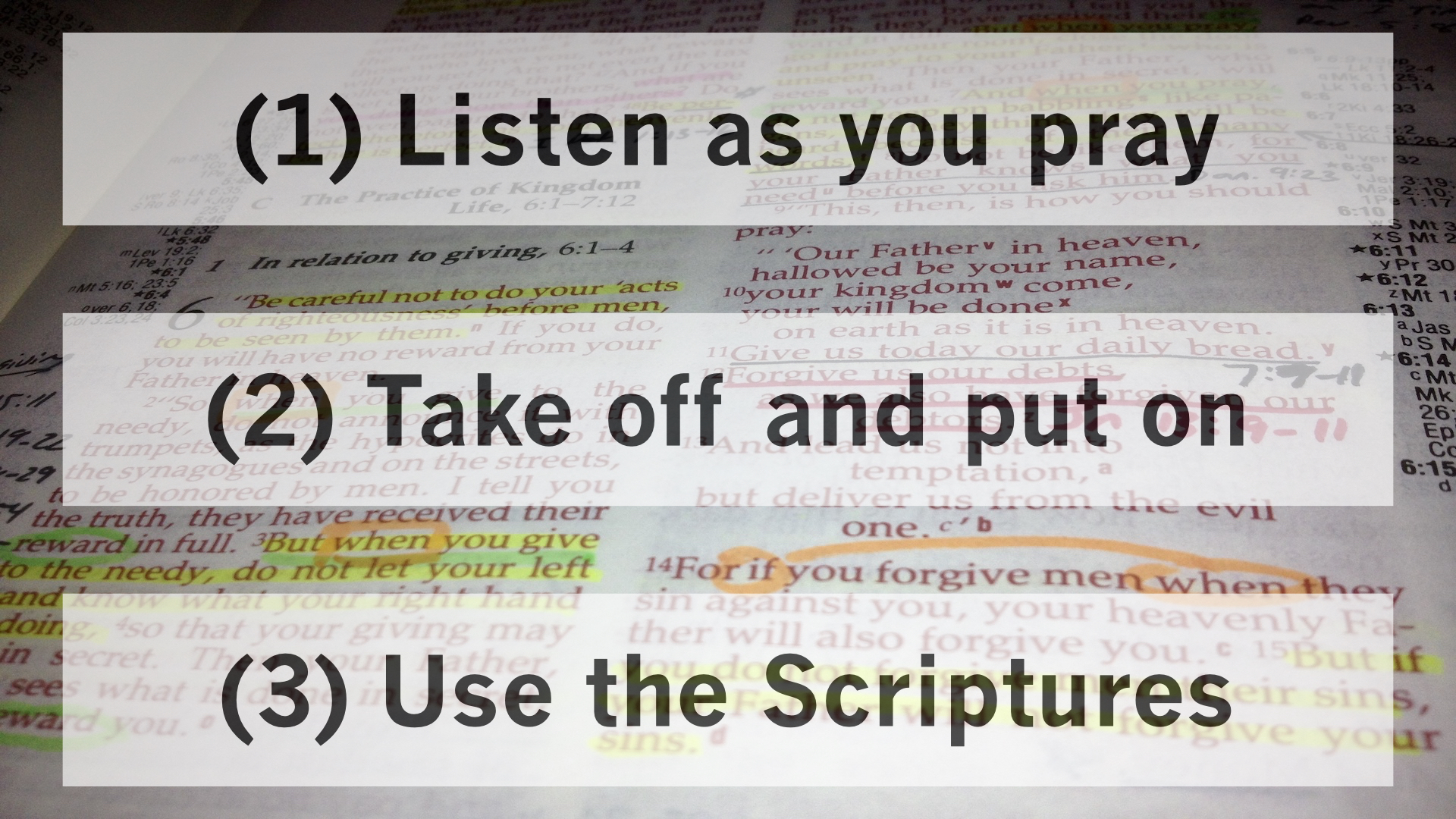
I want to give you some thoughts to take your Bible studies even deeper. Here are three strategies to make your Bible study time stickier—sticking in your heart and your mind.