“…the heavens, even the highest heavens, cannot contain You. How much less this temple I have built! Yet, Lord by God, give attention to Your servant’s prayer…” (2 Chronicles 6:18, 19).
It’s amazing to think that the Limitless God of the Universe condescends to listen to frail human prayers!
The key is my humility to approach God. Not as one afraid to approach, but as one who is humbly confident that He wants me to come to Him (see Matthew 6:8).
This is a weekly series with things I’m reading and pondering from Charles Spurgeon. You can read the original seed thought here, or type “Thursdays With Spurgeon” in the search box to read more entries.
Our Prayer Helper
Likewise the Spirit also helps in our weaknesses. For we do not know what we should pray for as we ought, but the Spirit Himself makes intercession for us with groanings which cannot be uttered. (Romans 8:26)
A man’s heart is moved when he groans. A groan is a matter about which there is no hypocrisy. A groan comes not from the lips, but from the heart. A groan, then, is a part of prayer that we owe to the Holy Spirit, and the same is true of all the prayer that wells up from the deep fountains of our inner life. [see also Jeremiah 4:19; Isaiah 38:14; Psalm 77:4, 38:8-9] …
That which is thrown up from the depths of the soul, when it is stirred with a terrible tempest, is more precious than pearl or coral, for it is the intercession of the Holy Spirit! …
Beloved, what a different view of prayer God has from that which men think to be the correct one! You may have seen very beautiful prayers in print and you may have heard very charming compositions from the pulpit, but I trust you have not fallen in love with them. Judge these things rightly. I pray you never think well of fine prayers, for before the thrice-holy God it ill becomes a sinful supplicant to play the orator! … The tail feathers of pride should be pulled out of our prayers, for they need only the wing feathers of faith. The peacock feathers of poetical expression are out of place before the throne of God. … God looks at the heart. To Him fine language is as sounding brass or a tinkling cymbal, while a groan has music in it!
From The Holy Spirit’s Intercession
God is not looking for well-polished prayers; He’s looking for real prayers. Let’s be honest: Not even the most educated person in the world has a vocabulary sufficient enough to accurately communicate with The Almighty God!
Our Heavenly Father wants us to come to Him in simple, childlike anticipation. Notice I didn’t say childish anticipation—there is a huge difference. What Paul is telling us in Romans 8 is that the Holy Spirit can make the most eloquent, childlike, sincere prayer out of our deepest longings in our hearts.
Jesus reminded us, “Your Father knows the things you have need of before you ask Him” (Matthew 6:8). Our Father wants to answer our prayers, and He has given us His Holy Spirit to help us pray in a way that He can answer.
Don’t try to spruce up your vocabulary before you come to God in prayer. Just come to God in prayer, trusting that the Holy Spirit will make a beautiful prayer even out of your childlike groanings! The Holy Spirit turns our groans into prayerful poetry in our Heavenly Father’s ears!
How did Nahum respond to this word of judgment God spoke through him? His opening words say, “The burden against Nineveh. The book of the vision of Nahum the Elkoshite” (NKJV). The Hebrew word for “burden” is almost always associated with a word God has spoken. It’s a realization of God’s weighty glory; it’s never, ever something we should trivialize!
Prophets don’t just prophesy future events, they also announce in the present tense where people have departed from a lifestyle that robs God of His glory and how they can be forgiven of sins.
“The prophets foretell (speak to what will happen in the future) and forth-tell (speak to what we should be doing in the present), both in the light of God’s heart for His own glory among all peoples of the world.” —Dick Brogden
God never makes idle threats nor empty promises. Truly His Word is His bond. Through Nahum, God foretold that Assyria would be utterly destroyed, twice saying, “I am against you” (Nahum 2:13-3:7).
The world may rejoice at God’s justice on evil (3:19), but how does God feel about carrying out His judgment? Ezekiel records God saying, “Do I take any pleasure in the death of the wicked,” declares the Sovereign Lord. “Rather, am I not pleased when they turn from their ways and live?” (Ezekiel 18:23)
And Jesus declared, “For God so loved the world that He gave His one and only Son, that whoever believes in Him shall not perish but have eternal life. For God did not send His Son into the world to condemn the world, but to save the world through Him.” (John 3:16-17)
The Bible shows that when I sin, God’s first response is not anger toward me but broken-hearted grief. This is the message that must be both foretold and forth-told by Christians.
“But what can I do,” you might ask. “I’m just one person. I’m not a big-time evangelist.” That sounds a lot like Nahum. He was just a guy from Elkosh—no special family lineage, no large city to claim as his home.
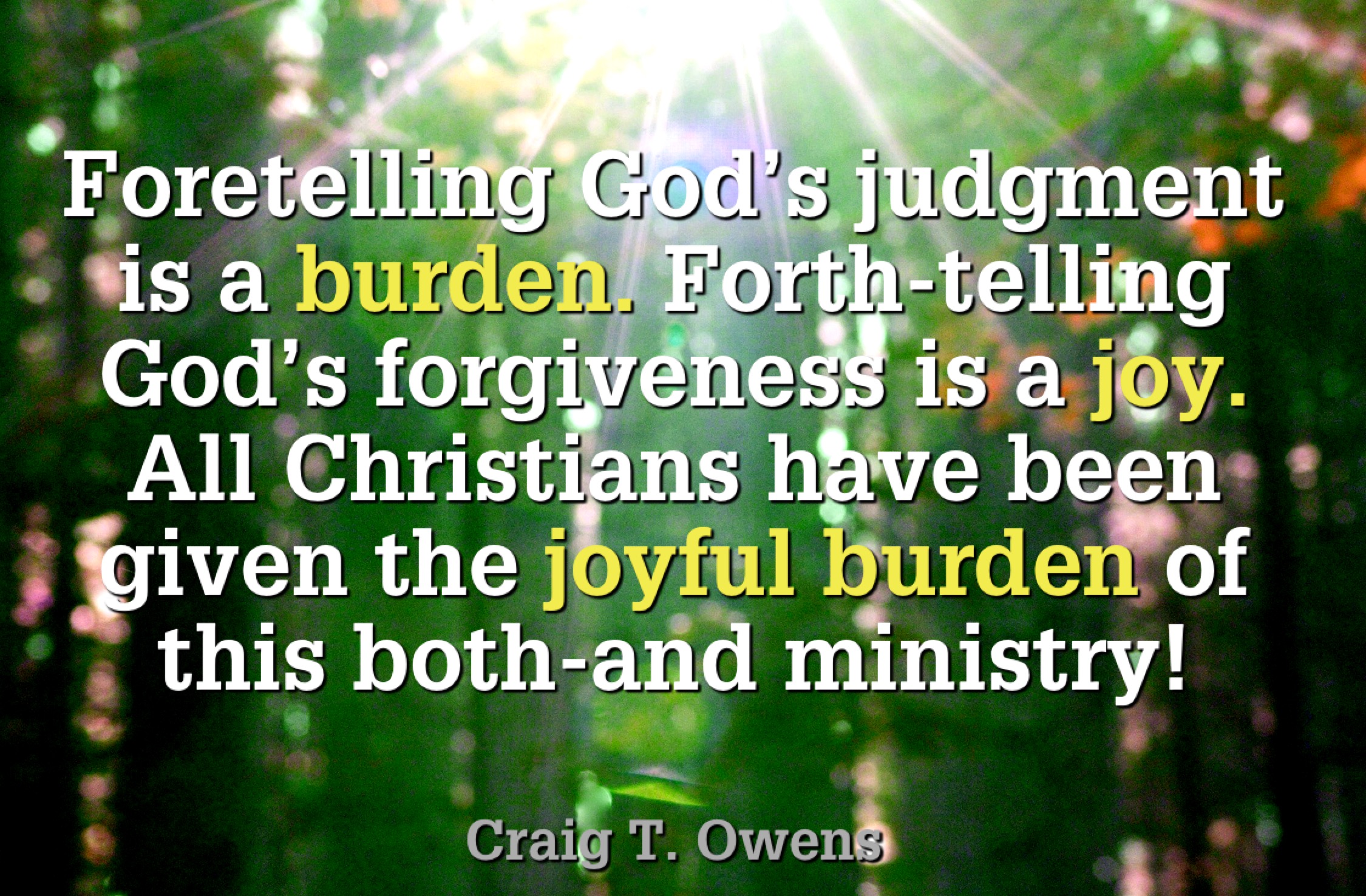
Foretelling God’s judgment is a burden. Forth-telling God’s forgiveness is a joy. All Christians have been given the joyful burden of this both-and ministry!
…with Your mouth You have promised and with Your hand You have fulfilled it… (2 Chronicles 6:15).
I rest solely on what God says—He says it and He fulfills it.
I can live on “every Word” He speaks (Deuteronomy 8:3).
“Every Word” of God is flawless and is a protection for me (Proverbs 30:5).
None of God’s Word ever fail (Isaiah 55:11).
God gives us His Word to speak (Jeremiah 26:12; John 12:49; Luke 21:15).
We defeat our enemies by God’s Word in our mouth (Matthew 4:4, 7, 10; Revelation 12:11).
Every Word of God gives life because of the Holy Spirit’s anointing on it (John 6:63).
Every Word of God is a sword (Hebrews 4:12; Revelation 1:16; 2:12, 16; 19:15). Or as my friend Sasha reminds me God’s Word is our S(word)!
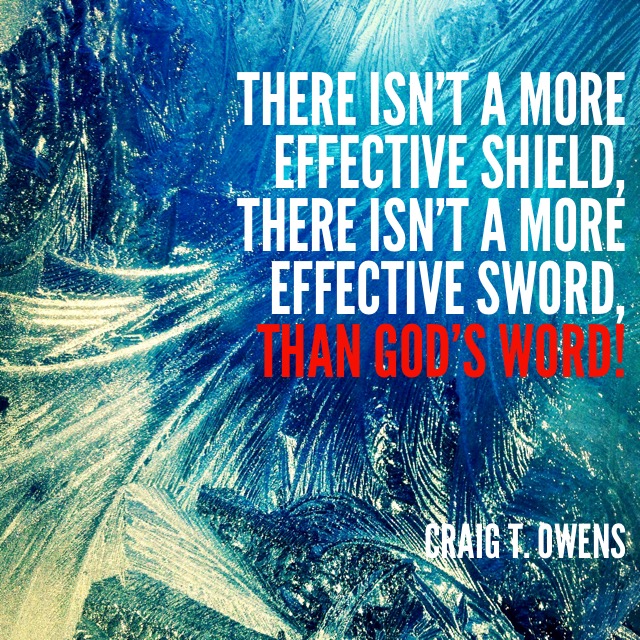
There isn’t a more effective shield against enemies, there isn’t a more deadly weapon against temptation, there isn’t a more sure foundation in storms than the Word spoken and fulfilled by God!
This is a weekly series with things I’m reading and pondering from Charles Spurgeon. You can read the original seed thought here, or type “Thursdays With Spurgeon” in the search box to read more entries.
God’s Part, Our Part
The lesson is clear to all: The wind turns mills that men make. It fills sails that human hands have spread. And the Spirit blesses human effort, crowns with success our labors, establishes the work of our hands upon us, and teaches us all through that ‘the hand of the diligent makes rich’ (Proverbs 10:4). And ‘if anybody will not work, neither shall he eat’ (2 Thessalonians 3:10). …
Let us do our part faithfully, spread every sail, make all as perfect as human skill and wisdom can direct, and then in patient continuance in well-doing await the Spirit’s propitious gales, neither murmuring because He tarries nor being taken unawares when He comes upon us in His sovereign pleasure to do that which seems good in His sight.
From The Holy Spirit Compared To The Wind
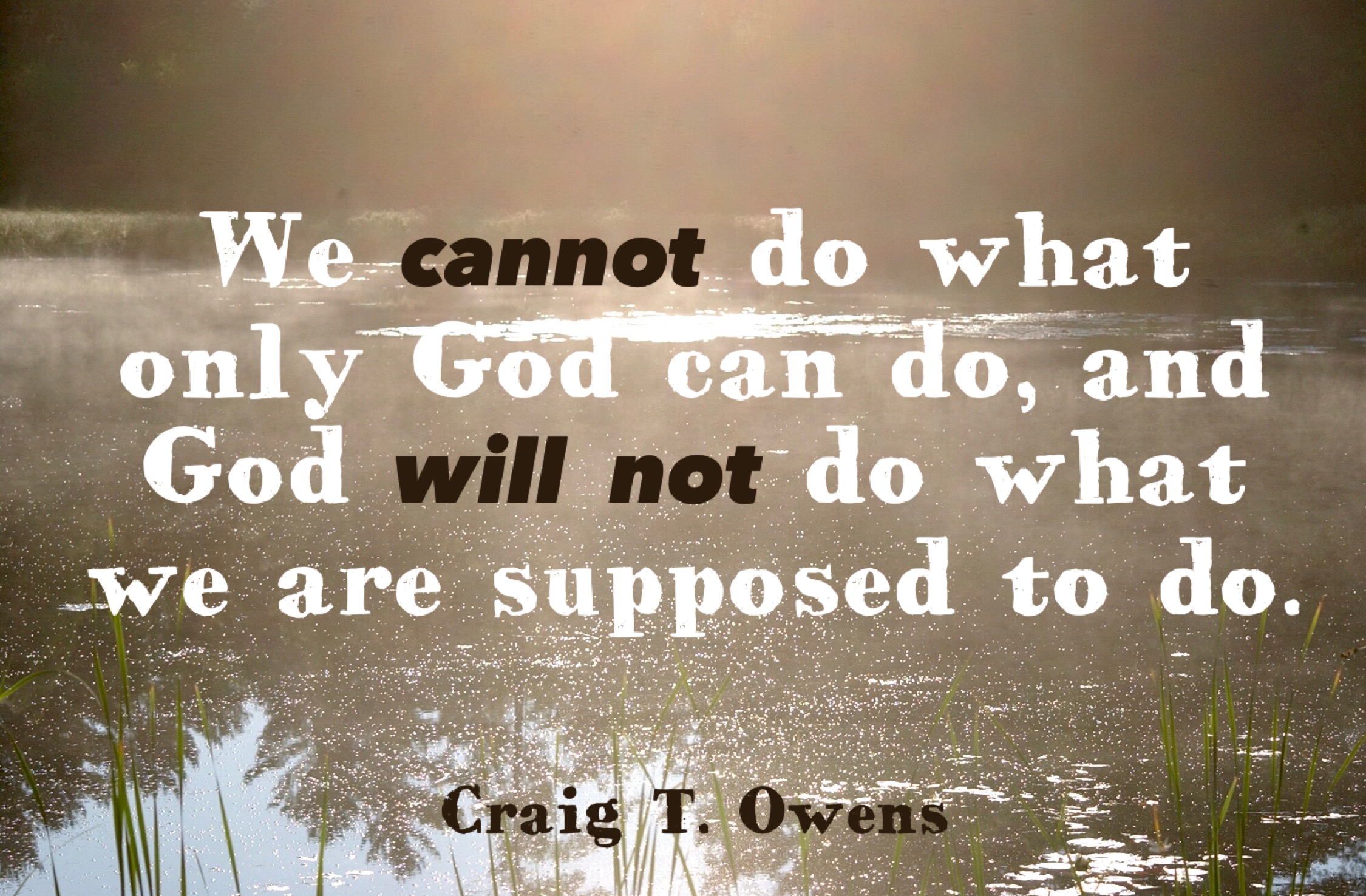
We cannot do what only God can do, and God will not do what we are supposed to do. It is the Holy Spirit who can help us keep those two thoughts clear.
It’s wrong to say, “God only helps those who help themselves.” But it’s equally as wrong to say, “I don’t need to do anything except wait for God.” In example after example in the Bible we see people doing their part while at the same time believing for God to do something miraculous:
Micah may be classified as a minor prophet, but the prophecies in his book are fulfilled in a major way in as little as 20 years and as far out as 2700+ years!
Here’s a question for us to consider: What exactly is the role of prophecy in the life of a Christian?
Check out some of Micah’s most notable prophecies:
Judgment is coming to Samaria/Israel (1:6-7). This was fulfilled about 20 years later when the Assyrians defeated Samaria and took the Israelites into exile.
Judgment is coming on southern Judah (1:9-16). This was fulfilled about 30 years laterwhen Sennacherib attacked Philistia and southern Judah, coming “even to the gate of Jerusalem” (v. 12). At the gate of Jerusalem was the miraculous deliverance God gave during Hezekiah’s reign (see 2 Kings 18-19; Isaiah 37).
Judgment is coming on Jerusalem (3:12). Micah even prophesied the Babylonians would defeat them (4:10). This is noteworthy because Assyria was the dominant world power at this time; it would be another 100 years before Babylon would even begin to rise to power. This prophecy was fulfilled about 160 years later, and this prophecy actually saved Jeremiah’s life around that same time (Jeremiah 26:7-19).
The Messiah will be born in Bethlehem (5:2). This prophecy was fulfilled about 700 years later when Jesus was born (Matthew 2:5-6).
How people will respond to the Messiah’s Advent (7:4-6). This prophecy was partially fulfilled 700 years later in a direct quotation from Jesus (Matthew 10:34-36).
The coming of the final Kingdom of God (4:1-3). This prophecy will be fulfilled at Christ’s second Advent.
First of all, fulfilled prophecy reminds us that God is sovereignly in control of everything (Isaiah 46:10). But right on the heels of that, fulfilled prophecy reminds us that there is still more prophecy left to be fulfilled (2 Peter 1:20-2:3).
The Bible tells me that when I sin, God’s first response is not anger toward me but broken-hearted grief. In a similar fashion, the prophecies of coming judgment on sinners are intended to show us the incredible mercy of God in the forgiveness of sin that He made available (Micah 7:18-20).
Prophecy is never, never to be used as a club to beat people into submission to God. When Micah prophesied the destruction of Israel and Judah, he wept (Micah 1:8).
We live in an age today—as Micah experienced and as the apostle Peter said would be coming—where people won’t want to hear the news that unforgiven sin brings God’s judgment. Our response to this should be brokenhearted grief, tears, and a steadfast commitment to speak the truth in love that Jesus has provided the only means to be rescued from that judgment.
Jonah is the only narrative in the minor prophets. He was a prophet during the reign of Jeroboam II when Israel was temporarily growing in strength. He is the first of Israel’s prophets to be sent to a non-Jewish population.
Critics have raised questions about this book. Questions like: Did Jonah write this book himself or is it just a story about him? Is this book historical or allegorical?
The five biggest objections that are raised to Jonah’s historicity are:
The hyper-nationalistic feel is more like when Ezra and Nehemiah led people back to Jerusalem after their captivity in Babylon, and not during the time of Jeroboam II.
Parts of Jonah appear copied from the prophet Joel.
There are no (or incorrect) details about the major city of Nineveh that Jonah visited.
There are no extra-biblical historical records of a revival in Nineveh.
Jonah was swallowed by a fish?!
I think there are very good reasons to believe that Jonah was both autobiographical and historically accurate.
First, there was a revival of sorts (although not religiously) in Israel during the time of Jeroboam II. This was a time that Israel felt like it could flex its muscles again, so Jonah would not be acting out of character to be so pro-Israel.
Second, Jonah 3:9 and Joel 2:14 sound similar, but scholars cannot tell which was written first. Couldn’t God amplify a message? Consider how many parts of the Gospel of Mark are used in the Gospels of Matthew and Luke. And it’s a regular practice for authors even today to directly quote other sources.
Third, regarding the lack of details about Nineveh, the biblical writers give very few details of any places outside of Israel or Judah. The only “incorrect” detail skeptics point to is Jonah 3:3 stating that the city was so big that it would take three days to walk around it. Nineveh was a city of about 120,000 inhabitants, so it could easily take three days of walking and preaching in order to get the message to everyone.
Fourth, the revival in Nineveh was clearly short-lived. Jonah was probably in Nineveh around 760 BC. Assyria was rising politically and militarily during that time and defeated Israel just 40 years after Jonah’s preaching. Assyria itself was then defeated in 605 BC.
Finally, Jonah was swallowed by a fish?! The root word for fish in Hebrew means something that has grown to such an enormous size that it overshadows everything else. But notice that what caused the sailors to be in awe of God was not the whale/fish swallowing Jonah, but the immediate calming of the ocean when Jonah was thrown overboard (Jonah 1:15-16). Miracles appear throughout this book. And throughout the entire Bible!
Why should the appearance of miracles surprise us? Some people have a bias against the supernatural, where they wrongly believe that we can know everything through naturalistic means. C.S. Lewis pointed out, “I use the word Miracle to mean an interference with Nature by supernatural power. … Nature as a whole is herself one huge result of the Supernatural: God created her.”
I don’t think this story is a parable or an allegory because nowhere else in the Bible are such details given in the form of a parable.
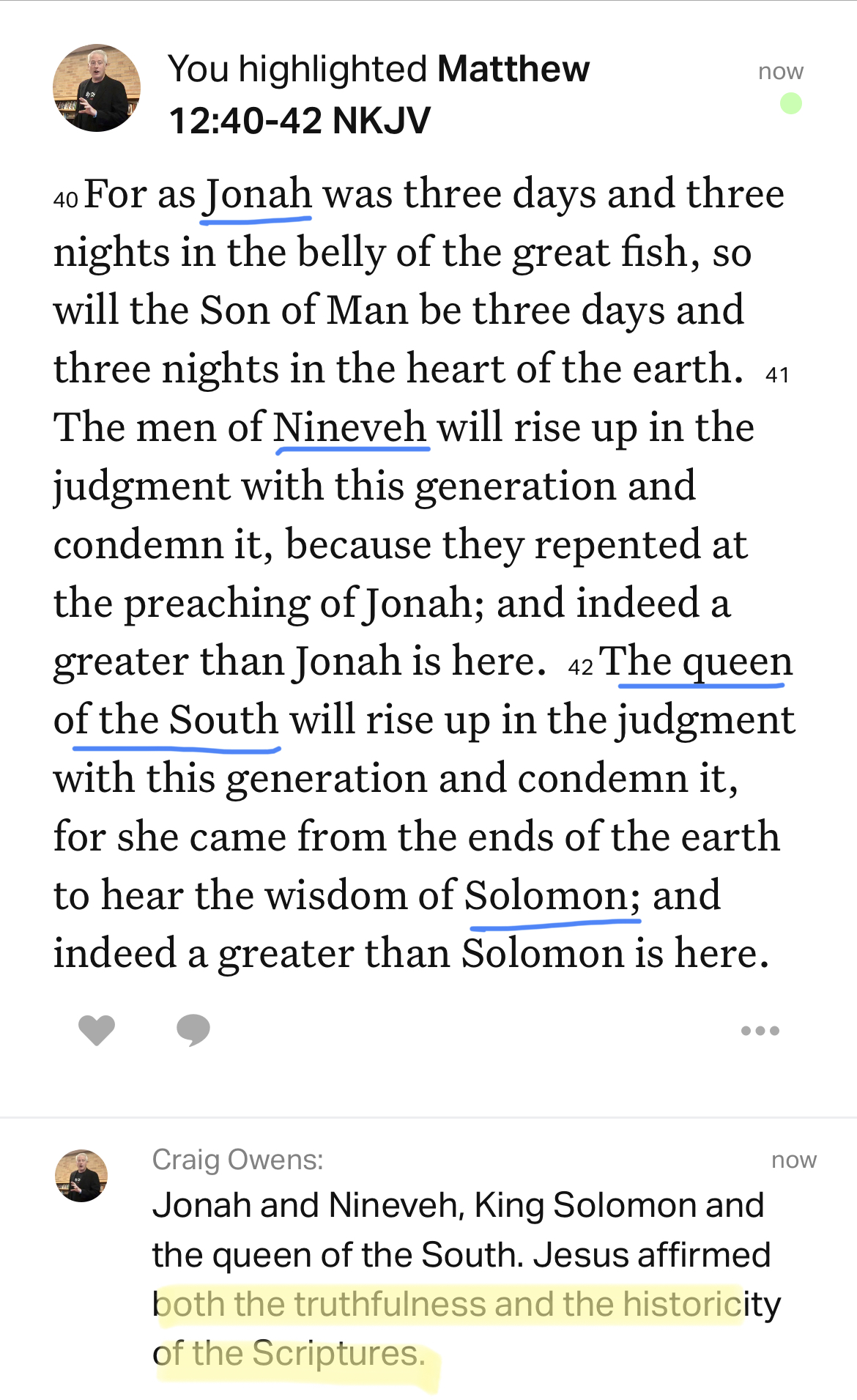
I believe this story is historical because Jesus talked about the historicity of Jonah in the same breath as He talked about other historical people: the Queen of the South and Solomon (Matthew 12:38-42). Jesus clearly viewed Jonah as historically reliable and accurate. To call Jonah into question is to call into question the truthfulness of Jesus Himself!
History matters because all of History is God’s story!
Our belief in the message of the Bible is not based upon “once upon a time” or “a long time ago in a galaxy far, far away.” It’s based upon real people in real places, especially the historicity of Jesus (notice all of the historical details Luke lists in the birth account of Jesus).
Jonah was clearly one of those historical people, in an historic place, and at a precise moment in world history that tells the story of Jesus and our redemption which He purchased!
If you want to check out all of the messages in our series on the major lessons from the minor prophets, you can find that list by clicking here.
Here’s the seed thought for this episode of Think On This…
Do to others what you would like them to do to you. (Matthew 7:12)
Think on this: Do I apply the Golden Rule negatively (just trying to avoid offending)? Or do I apply it positively (creatively trying to find ways to help others)?
This is a weekly series with things I’m reading and pondering from Charles Spurgeon. You can read the original seed thought here, or type “Thursdays With Spurgeon” in the search box to read more entries.
Be A Reflector
For it is the God who commanded light to shine out of darkness, who has shone in our hearts to give the light of the knowledge of the glory of God in the face of Jesus Christ. (2 Corinthians 4:6)
It is by the heart that we know God and Christ, and as our affections are purified, we become sensible of God’s presence in Christ. … Our beholding Him has purified the eyes that have gazed upon His purity. His brightness has helped our eyesight so that we see much already and will yet see more. …
Why did not everybody see the glory of God in Jesus Christ when He was here? It was conspicuous enough. Answer: It matters not how brightly the sun shines among blind men. … What, then, has happened to us? To eternal grace be endless praise! God Himself has shined into our hearts. That same God who said, ‘Light be,’ and light was, has shined into our hearts! … If you can delight in God in Christ Jesus, then remember, no man can say that Jesus is the Christ but by the Holy Spirit, and you have said it [Matthew 16:13-17]! …
You must not hoard up the light within yourself—it will not be light to you if you do. Only think of a person when his room is full of sunlight saying to his servant, ‘Quick, now! Close the shutters and let us keep this precious light to ourselves.’ Your room will be in the dark, my friend! …
A man of God, when he receives the light of Christ, can become so perfect a reflector that to common eyes, at any rate, he is brightness itself! … Scatter your light in all unselfishness. Wish to shine, not that others may say, ‘How great he is,’ but that they, getting the light, may rejoice in the Source from which it came to you and to them.
From The Glory Of God In The Face Of Jesus Christ
As the old hymn reminds us, “’Twas grace that taught my heart to fear, and grace my fears relieved; how precious did that grace appear the hour I first believed.” It is by God’s grace alone that we have been given light to see Jesus and to place our faith in Him!



 “…the heavens, even the highest heavens, cannot contain You. How much less this temple I have built! Yet, Lord by God, give attention to Your servant’s prayer…” (2 Chronicles 6:18, 19).





 Craig T. Owens
Think On This…
September 4, 2020 — Craig T. OwensDo to others what you would like them to do to you. (Matthew 7:12)
Think on this: Do I apply the Golden Rule negatively (just trying to avoid offending)? Or do I apply it positively (creatively trying to find ways to help others)?
Share this: