A Proactive Pause

Listen to the podcast of this post by clicking on the player below, and you can also subscribe on AppleSpotify, or Audible. 

Let’s keep in mind why we are learning and working on these spiritual disciplines. The key phrase is “so that”—I get stronger so that we can get stronger.

Today we are looking at spiritual discipline #2—Solitude. We will need discipline to abide with Jesus in our time of solitude—removing all distractions—so that we can respond better to our circumstances, and help other saints respond better too. 

Part of the dictionary definition of solitude is “a place absent of human activity.” Note that important word human activity. Solitude is a time for stepping back from all our human striving to get a heavenly perspective. Solitude is a proactive pause in difficult times so that we can respond with a God-honoring reaction. 

Let me give you five ideal situations to discipline ourselves to find solitude. 

(1) After ministry exertion. I’m sure there have been times when an interaction with another person or a group of people has exhausted you. It’s at these times we should find a place of solitude to be refreshed, just as Jesus did (Luke 5:16). 

(2) In stormy times. When everything around us seems to be unstable, proactively pausing in a time of solitude is saying with the psalmist, “God is our refuge and strength, an ever-present help in trouble,” and then hearing God say to our anxious hearts, “Be still, and know that I am God” (Psalm 46:1, 10). These are the same words Jesus said to both the stormy seas and the disquieted hearts of His disciples (see Mark 4:35-39). 

(3) When we’re between a rock and a hard place. This is when we feel like neither option before us is a pleasant one. Like when the Israelites were caught between the onrushing Egyptian army and the uncrossable Red Sea. Listen to how similar the words of Moses sound, “The Lord will fight for you; you need only to be still” (see Exodus 14:1-14). 

(4) When we have a big decision ahead. We may gather all of the information and do our our research and still feel inadequate to make a good decision. Jesus had hundreds of disciples, but He needed to choose just twelve to serve as His apostles. Before making this decision, Jesus spent the night in solitude with His Father (Luke 6:12-13). 

(5) When we get angry. There are other strong emotions that sometimes seem to overwhelm us, but I’ve noticed that anger causes more people to fly off the handle than most of the other emotions. When Jesus saw the shameful way the temple was being used, He got so angry that His disciples recalled the Psalm that said zeal was burning Him up (Psalm 69:9; John 2:17). Instead of reacting in the heat of the moment, Jesus spent all night in solitude with His Father (Mark 11:11, 19).  

Our solitude time could include Bible reading, but it’s probably more of a time for quieting ourselves—taking a break from human activity—so we can hear the Holy Spirit reminding us of what we’ve already studied (John 14:26).  

Then keep in mind that solitude is not retreating and staying away from others, but solitude is so that I can effectively respond to pressing situations. Christian solitude is not me-time, it’s us-time (where the “us” is me + Jesus) so that I’m ready for we-time (where the “we” is me + others). 

This is such an important discipline for Christians so that we don’t respond inappropriately in an intense situation, but we respond in a Christ-like way that brings glory to God. Pay attention to your strong emotions, listen to the Holy Spirit, and proactively find a place of solitude. 

If you have missed any of the other messages in this series called Saints Together, you can find them all by clicking here.

►► Would you please prayerfully consider supporting this ministry? My Patreon supporters get behind-the-scenes access to exclusive materials, like a 10-minute video I just shared on study tips for the poetic books of the Bible. ◀︎◀︎

On Guard!

Listen to the podcast of this post by clicking on the player below, and you can also subscribe on AppleSpotify, or Audible. 

When Jesus was discussing end times events with His disciples, He described days that looked pretty bleak. Do any of these descriptions sound familiar today?

  • Wars 
  • Turmoil
  • Persecution
  • Betrayal 
  • Family strife 
  • Christians hated by the world (see Mark 13:5-12)

In times like these, Jesus said many people will be deceived. This is why Jesus twice tells His followers to “be on your guard” (vv. 9, 23). 

What exactly does “on guard” look like? 

Maybe you’ve heard a similar phrase before a fencing match, reminding the combatants to raise their swords. That’s a good picture for Christians. Paul tells us that we can use the “sword of the Spirit, which is the Word of God” to defend ourselves during spiritual warfare (Ephesians 6:17). 

While Jesus is instructing His disciples, He tells them the sword-like power of His words. He said, “My words will never pass away” (Mark 13:31). In other words, His sword is invincible! 

Another modern-day phrase that fills out the definition of being on guard is when someone says, “Heads up!” This means to watch out for things that may be headed your way. Jesus reminded us, “I have told you everything ahead of time” (v. 23) so we can be aware of what’s coming. 

We are aware of the approaching dark days of the end times, but we are not afraid of them. Three times, Jesus tells us to “keep watch” (vv. 34, 35, 37). This Greek word means to be aroused from sleep so that we can give active and strict attention to the task before us. 

“Be on guard! Be alert!” Jesus said (v. 33), so that you don’t become apathetic. The devil prowls around, seeking to use the times of turmoil to confuse, deceive, and then mislead people. 

But we are not unaware of his schemes. 

Christian, we must stay on guard. We must be ready but unafraid of the opposition. We must keep in mind the never-failing Word of God, and we must use that sword to cut down the deceiving ideas. The Holy Spirit will give you the right words to wield at the right moment—

“…Don’t worry in advance about what to say. Just say what God tells you at that time, for it is not you who will be speaking, but the Holy Spirit.” (Mark 13:11) 

►► Would you please prayerfully consider supporting this ministry? My Patreon supporters get behind-the-scenes access to exclusive materials. ◀︎◀︎
Last Place

Listen to the podcast of this post by clicking on the player below, and you can also subscribe on AppleSpotify, or Audible. 

I was sitting with a couple of ladies in our school district who were trying to figure out the logistics for a food distribution program. I was offering them a couple of suggestions when one of them asked me, “Have you ever had any experience with something like this?” 

I told her that I had, and then she responded, “But this is going to be pretty big. Probably about 40 families.” 

I smiled and told her that the food distribution program I helped coordinate fed nearly 5000 people. 

She said, “Well, I guess we don’t have to worry anymore!” And from then on, whenever any logistical concerns came up, these ladies confidently handed off the situation to me. Once they knew that I had some relevant experience, they didn’t have any more moments of questioning. 

Unlike Jesus, I didn’t create all of the food from a few loaves and fish. I simply organized the distribution of the food others had donated. I am glad these ladies had confidence in me, but at the same time, I had to guard my heart against the pride that can so easily puff up my ego.

Can you imagine if you were one of the disciples of Jesus, and had seen all of the miraculous things He had done and heard all of the profound things that He had said, and then still had the audacity to ask, “Who is the greatest”?! 

And yet that is exactly what they did (Mark 9:33-35). 

How in the world could they argue about something like this when Jesus was right there with them? Maybe this thought finally sunk in a little because later on they pivoted a bit in their argument to ask who was the greatest after Jesus (Matthew 20:20-28). 

Jesus minced no words and left nothing vague in His answer: “Anyone wants to be first must be the very last, and the servant of all” (Mark 9:34). 

This is exactly what Jesus embodied. He literally lived and died to prove that the highest greatness is measured by the lowest of servanthood. 

…Christ Jesus: Who, being in very nature God, did not consider equality with God something to be used to His own advantage; rather, He made Himself nothing by taking the very nature of a servant, being made in human likeness. And being found in appearance as a man, He humbled Himself by becoming obedient to death—even death on a Cross! (Philippians 2:5-8)

The very last. Jesus made Himself nothing.

Not above some and beneath some, but the servant of all. 

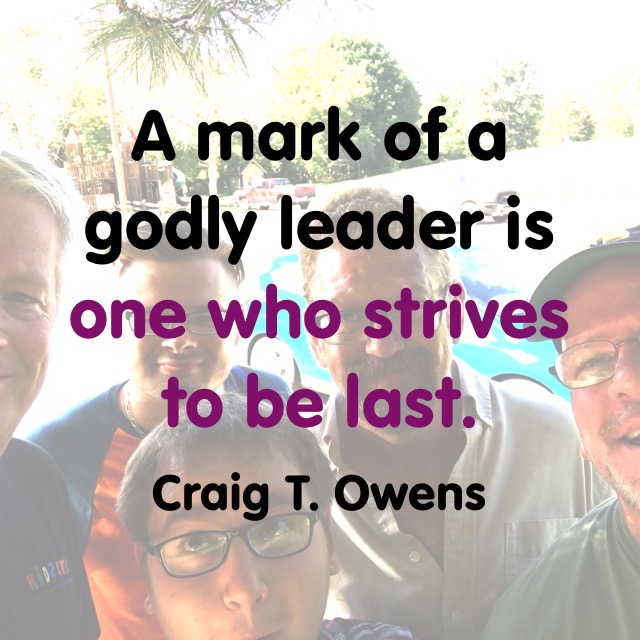
A mark of a godly leader is one who strives to be last.

Not: “I am second.” But: “I am last.” 

This is not just a declaration, but it is a declaration followed by a lifetime of submitting and serving. Not trying to lead others, but trying to out-serve all. 

This is part 74 in my series on godly leadership. You can check out all of my posts in this series by clicking here.

►► Would you please prayerfully consider supporting this ministry? My Patreon supporters get behind-the-scenes access to exclusive materials, like this recent Bible study tip from the Book of Ecclesiastes. ◀︎◀︎

Ready To Love

Listen to the podcast of this post by clicking on the player below, and you can also subscribe on AppleSpotify, or Audible. 

Every day you will be around people who are in need of love. Are you ready to love them? Two examples from the life of Jesus show us how to be ready.

Check out this episode of The Podcast.

Resources to go along with this podcast:

►► Would you please prayerfully consider supporting this ministry? My Patreon supporters get behind-the-scenes access to exclusive materials, like this recent post about building trust. ◀︎◀︎

Sin Is Never Manageable

Listen to the podcast of this post by clicking on the player below, and you can also subscribe on AppleSpotify, or Audible. 

King Herod Antipas was the son of King Herod the Great. Herod the Great is the one who tried to kill Jesus shortly after He was born, and in the process murdered numerous infant boys in and around Bethlehem (Matthew 2:16). 

Herod Antipas seduced his sister-in-law Herodias (who was married to his brother Philip), who then divorced her husband to marry Antipas, who had also divorced his own wife (Matthew 14:3). This is also the Herod who so desperately wanted to see Jesus perform a miracle (Luke 9:7-9, 23:6-10). 

Antipas was no choir boy! And yet he had a strange fascination with spiritual matters. Not only did he want to see Jesus, but he liked hearing John the Baptist preach. At the same time, he hated John’s message that said he was living in sin (Mark 6:17-18; Leviticus 20:21). Herod wanted John dead, but he also feared the backlash from the people who thought John was God’s prophet. Later on, he tried to protect John from death, but in trying to save face with his guests, he had to have John killed (Mark 6:26; Matthew 14:5). 

Herod Antipas continually flirted with sin—never killing it, never running away from it. And this eventually caught up with him.

The Gospel of Mark records, “Finally the opportunity came” (Mark 6:21). Herodias’ daughter performed a seductive dance for Herod on his birthday, which cause him to say in front of everyone, “I’ll give you whatever you want.” Prompted by her mother, this young lady seized the opportunity and said, “I want the head of John the Baptist on a platter!” Following in his father’s footsteps, Herod Antipas became a murderer. 

If sin is left close, it will kill you. The Bible tells us sin is crouching nearby, always looking for an opportunity, always a part of the devil’s scheming plan to destroy us (Genesis 4:7; Luke 4:13; Ephesians 6:11; 1 Peter 5:8). 

Sin is never manageable. The little compromises eventually strengthen and blossom, and we are undone by our sin. No matter how “little” we may think our sin is, “little sins” are anything but harmless indiscretions. That’s why as soon as any sin comes to light, it must be killed instantly!

Let us not make the same fatal mistake that Herod Antipas made by flirting with our sin instead of killing it. Paul wrote, “So put to death the sinful, earthly things lurking within you. Have nothing to do with sexual immorality, impurity, lust, and evil desires. … [N]ow is the time to get rid of anger, rage, malicious behavior, slander, and dirty language” (Colossians 3:5, 8).

Or, as John Owen put it, “Be killing sin, or it will be killing you.” 

►► Would you please prayerfully consider supporting this ministry? My Patreon supporters get behind-the-scenes access to exclusive materials, like this recent post about building trust. ◀︎◀︎

Power-Packed Sermons

Listen to the podcast of this post by clicking on the player below, and you can also subscribe on AppleSpotify, or Audible. 

Jesus began to speak to them in parables… (Mark 12:1). 

What Jesus relates here in the 12th chapter of Mark’s Gospel is only the fourth parable that Mark records, and as the final parable that Jesus shares, it brings His public ministry to a close. 

Jesus concludes this parable by quoting from Psalm 118. This Psalm is the last of the “Hallel Psalms” that were sung at the conclusion of the Passover celebration. This song specifically looks eagerly forward to the arrival of the Messiah. It contains the words that the crowd used on Palm Sunday: “Lord, save us! Lord, grant us success! Blessed is He who comes in the name of the Lord” (Psalm 118:25-26). By quoting from the same Psalm—that was perhaps hundreds of years old, but had just been sung and shouted by the crowd—Jesus was claiming to be the Messiah longed for in that Hallel Psalm. 

As you may recall, these shouts from the crowd and the activities of Jesus as He cleansed the temple got the religious leaders riled up! They, in essence, asked Jesus, “Who do You think You are?!” His answer is contained in this parable of Mark 12. 

At the conclusion of this parable, the religious leaders “knew He had spoken this parable against them” (Mark 12:12).

Mark’s observation about the response of the religious leaders is, in a nutshell, the essence of a Holy Spirit-anointed sermon. The connection of Scripture to current events is powerful! The Holy Spirit is also the One who brings the application of Scripture to bear on the hearts of the audience.

Pastors, if you want to deliver soul-shaking, life-transforming, eye-opening, heart-melting sermons, you must follow this example of Jesus: Stick with the Scripture! 

We don’t need to try to be clever or witty or even memorable. We just need to speak the Word of God that is inspired by the Holy Spirit, and then allow the Holy Spirit to illuminate that inspired Word to each person’s needs. As Randy Pope noted, “Preaching is not talking to people about the Bible; it is talking to people about themselves from the Bible.” 

I don’t want to try to make my voice impress people, but I am desperate for God’s voice to impact people. Nearly every week as I prepare a sermon, I’ll pray this prayer from Oswald Chambers: “In my preaching, cause Thy glorious voice to be heard, Thy lovely face to be seen, Thy pervasive Spirit felt.” My dear pastor, I would encourage you to make this your prayer as well. 

►► Would you please prayerfully consider supporting this ministry? My Patreon supporters get behind-the-scenes access to exclusive materials. ◀︎◀︎
A Preservative To Moral Decay

Listen to the podcast of this post by clicking on the player below, and you can also subscribe on AppleSpotify, or Audible. 

Have you ever wondered why the Roman soldiers treated Jesus so cruelly? After all, these are professional soldiers so why are they acting in such an unsoldierly way (see Mark 15:16-20)? 

Perhaps they thought that Jesus was just another criminal that was in cahoots with Barabbas—a murderer and insurrectionist. But where would they get that idea? It must have come from the lies and slander that the Sanhedrin were spewing. 

Perhaps the soldiers had a low value of all human life. Where would this come from? First from their leadership: particularly the way history tells us that Pontius Pilate treated the Jews. But we can go a little broader because we also know from history the disregard the Romans had for the weak, the young, the sick, and the aged. 

The bottom line is this: Anytime there is a departure in even the slightest degree from the Great Commandment—love God, love yourself, and love your neighbor—the resulting society is dark and ugly, with people mistreating others in the most inhumane of ways. 

This is where Christians are called to be salt and light. 

We stand as a check against the decay in societal values. Our high view of God’s power and love, our proper understanding of each person’s worth in God’s sight, and the way we express genuine love for others—especially the weak and marginalized—is a preservative to the moral decay. 

It’s so easy to get caught up with the loud voices around us. Pontius Pilate did, the Roman soldiers did, the Sanhedrin did, and the crowds that listened to these leaders did too. 

If you are concerned about the moral decay you see in your neighborhood, the movies and music that are released, or the behavior of our elected officials, we must adhere all the more closely to the Great Commandment: Love God with all your being, maintain a healthy self-image in light of God’s love for you, and then love your neighbor—all of your neighbors—in the same way God loves you. 

This is the only way His Spirit can equip and empower us to be effective salt and light in these last days! 

►► Would you please prayerfully consider supporting this ministry? My Patreon supporters get behind-the-scenes access to exclusive materials. ◀︎◀︎

I Only Have Eyes For You

Listen to the podcast of this post by clicking on the player below, and you can also subscribe on AppleSpotify, or Audible. 

Love should be blind. That is, we should be so enamored with the one we love that we are blind to all others. There are some sweet lyrics to a 1932 song called “I only have eyes for you”—

My love must be a kind of blind love
I can’t see anyone but you
and, dear, I wonder if you’ll find
love an optical illusion too

Are the stars out tonight?
I don’t know if it’s cloudy or bright
‘cause I only have eyes for you, dear
The moon may be high
But I can’t see a thing in the sky
‘cause I only have eyes for you

I don’t know if we’re in a garden
or on a crowded avenue
you are here and so am I
maybe millions of people go by
but they all disappear from view
‘cause I only have eyes for you

Instead of having dedicated eyes, what would you think of someone who was constantly “checking out” those other than their sweetheart? That’s what the song of ascent in Psalm 123 calls on us to contemplate. 

Notice the use of the word “eyes” four times in just the opening two verses. The psalmist is asking us, “Do you only have eyes for God, or are you glancing elsewhere?” 

The call throughout the Bible, from beginning to end, has always been for a steadfast, loving eye for our loving God. From Moses to Jesus, the call is to love God above all else—to only have eyes for Him (Deuteronomy 6:5; Mark 12:30). I think this is why Jesus taught us to pray for a daily look to our Father’s hand for each moment’s provision (Matthew 6:11). 

This is not a begrudging “have to look” but an “I cannot help but continually look.” David said it this way, “Blessed be the Lord, Who daily loads us with benefits” (Psalm 68:19)!  

When we continually keep our eyes on our loving Heavenly Father, we see more and more of His graceful favor toward us. It’s the proud and arrogant (in verses 3-4) that think they have to take care of themselves, or that they have to keep their eyes open to other possibilities. 

God loves to shower His favor on those who only have eyes for Him: “Out of His fullness we have all received grace in place of grace already given” (John 1:16). This reminds me of the waves on the shore, where one wave of grace continually follows the previous wave of grace, which is quickly followed by yet another wave of grace. In fact, this idea is beautifully captured in the Amplified Bible’s rendering of this verse—

For out of His fullness (abundance) we have all received—all had a share and we were all supplied with—one grace after another and spiritual blessing upon spiritual blessing and even favor upon favor and gift heaped upon gift. 

God’s grace is unearned by our efforts, undeserved despite our sins, and unending for all of eternity!  

This song of ascent assures us that the humble servant who only has eyes for God is:

  • grateful for past blessings 
  • unashamed of his total dependence on God’s provision 
  • confidant in God’s favorable reply for every single request (Matthew 6:8; Luke 12:32)

So the questions we need to ask ourselves are simply, “Where are my eyes? Do I only have eyes for my God, or do I keep my options open? Do I humbly and confidently bring my petitions to God, or do I take matters into my own hands?” 

Since this is a song of ascent, let’s make sure that our song to God is always, “I only have eyes for You!” 

If you’ve missed any of the other messages in our series looking at these Psalms of Ascent, you can find them all by clicking here. 

►► Would you please prayerfully consider supporting this ministry? My Patreon supporters get behind-the-scenes access to exclusive materials. ◀︎◀︎

Unafraid Of End Times Events

Listen to the podcast of this post by clicking on the player below, and you can also subscribe on AppleSpotify, or Audible.

When people ask me about end times events, it is usually from a posture of hand-wringing worry. But when Jesus told His followers about what is to come, He repeatedly told them not to be afraid.

Some resources from this video:

►► Would you please prayerfully consider supporting this ministry? My Patreon supporters get behind-the-scenes access to exclusive materials. ◀︎◀︎
The Courage Of A Spiritual Father

Listen to the podcast of this post by clicking on the player below, and you can also subscribe on AppleSpotify, or Audible. 

Father’s Day can bring up a lot of different emotions for folks. Growing up, you might not have had a very good experience with your father or perhaps you didn’t have a father involved with you at all. Maybe you look back on your own history as a Dad and have some regrets. Perhaps you’re an empty-nester now or maybe you’ve never had kids of your own. 

Regardless of your experience with your father or with your own circumstances, I think there are some things that we all naturally expect from our Dads. These are things that we should honor and things we as Dads should strive to demonstrate in our lives.  

Luke introduces us to a man in the Book of Acts named Joseph. We don’t know if he is a biological father or not, but he is presented to us as a spiritual father that we would do well to emulate. In fact, we only know his name is Joseph from our first introduction to him. This man was such an inspiration to so many people that he was given the nickname Barnabas—the name that is used everywhere else in the New Testament. 

When we think of our list of attributes of an ideal father, I think we all look to our fathers for these five things.

(1) Be there when we are getting started. Barnabas was there when Saul (later named Paul) first became a Christian and when the first Gentiles became Christians (Acts 9:26-28; 11:19-23). 

(2) Provide for us financially. Barnabas is the first person mentioned by name that gave a significant and much-needed financial donation to the Church (Acts 4:34-37).  

(3) Help us learn to leave our nest and fly on our own. Barnabas gave Paul his first leadership role in the Church (Acts 11:25-26). 

(4) Step back as we learn to soar on our own. Barnabas took the lead in the first commissioned missionary journey, but then we see him stepping aside for Paul to take the lead (Acts 13:1-2, 13). 

(5) Continue to “be there” for us even after we’ve left the nest. Barnabas also picked John Mark to accompany him and Paul on that first missionary endeavor, but when Barnabas stepped aside for Paul, Mark headed home instead of continuing on their trip. Later on, Barnabas wanted to give Mark another shot, but Paul was strongly against that. As a result, Paul and Barnabas parted company, with Barnabas taking Mark with him. From this point on, Luke doesn’t tell us anything else about Barnabas, but we know that Mark became the first one to write his Gospel account of the life of Jesus and that he became reconciled to both Paul and Peter, becoming an invaluable help to both of them. Although we don’t read what happened, I think it’s a good bet that all of this came about through the encouragement of Barnabas (Acts 13:13, 15:36-40; 2 Timothy 4:11; 1 Peter 5:13). 

(Check out all of the above Scriptures by clicking here.)

The name Joseph means “exalted.” Joseph was born into the tribe of Levi, placing him at the heart of the Jewish faith, yet he risked it all to not only acknowledge Jesus as the Messiah but to be so invested in the Christian Church that they called him Barnabas. Luke tells that his name means Son of Encouragement. 

The word “encourage” literally comes from in + courage—to put courage into someone, to inspire others with the courage or confidence they need to do something great. 

The word “encouragement” in Acts 4:26 in Greek is paraklesis: the same word used for the Holy Spirit. 

Fathers can only put in others what is already in themselves.

Acts 11:24 tells us that Barnabas was “a good man, full of the Holy Spirit and faith.” Because He was full of the Spirit of God, he could put that courage and security in others around him. 

Guys, it’s the same for us today. We have to be filled with the security, the joy, and the courage that springs eternally from the Holy Spirit. Only when we are filled with the Spirit can we put something truly impactful into the lives of our kids—both our biological and spiritual children. 

We don’t know how old Barnabas was. We don’t know if he had children of his own or not. All we know is that he was a good man that was full of the Holy Spirit, and that gave him the courage to put into others. 

What a great example for all of us to follow! 

If you’ve missed any of the other messages in our series We Are: Pentecostal, where we’ve been learning about the blessings that come to those who are baptized in the Holy Spirit, you can find all of those messages here. 

►► Would you please prayerfully consider supporting this ministry? My Patreon supporters get behind-the-scenes access to exclusive materials. ◀︎◀︎