Paul and Timothy, bondservants of Jesus Christ, to all the saints in Christ Jesus who are in Philippi, with the bishops and deacons (Philippians 1:1).
In just his opening line, Paul lists three types of servant-leaders: bondservants, bishops, deacons.
The servant-leaders are all called to put the needs of the saints ahead of their own needs. They all serve so the saints can shine! And as the saints shine, they attract others to Jesus Christ.
Jesus is our example of the Ultimate Servant (Philippians 2:5-8), and we are called to follow His example (John 13:12-17).
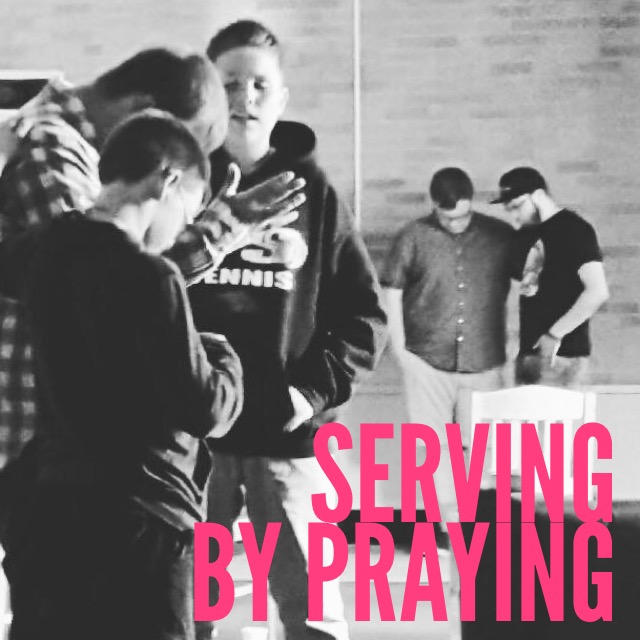
One thing that clearly kept Paul, Timothy, and the other servant-leaders in Philippi in this servant’s posture was prayer. Even the physical posture of kneeling in prayer is a posture of a servant who is actively serving.
Paul prayed for the Philippians frequently—In all my prayers for all of you, I always pray with joy (1:4).
He prayed for them to grow in love and knowledge—I pray that your love will overflow more and more, and that you will keep on growing in knowledge and understanding (1:9).
Paul was grateful for the prayers of the saints—I know that as you pray for me and the Spirit of Jesus Christ helps me, this will lead to my deliverance (1:19).
And he closed his letter with a call for them to continue to pray about everything—Don’t worry about anything; instead, pray about everything. Tell God what you need, and thank Him for all he has done (4:6).
Here are four powerful lessons for all Christians to live out…
(1) Leaders need to pray for the saints, and leaders need the saints to pray for them.
(2) Leaders need to be prayerful to keep their posture right as servants.
(3) Saints need to be prayerful for their leaders so that their leaders can continue to serve them in God-honoring ways.
(4) We all serve best when we are diligent to keep our prayer life vibrant and healthy.
Jesus never rushed. He was never late. He was never early. Nor did He ever remain silent when He should have spoken. Nor did He ever misspeak.
His timing and His wording were always spot on.
This wasn’t just a “Jesus thing,” as He told His followers that we could flow in God’s timing just as He was doing.
We don’t have to try to figure out our timing or our wording by external standards (v. 24). But when we are so immersed in the same Holy Spirit that directed Jesus, we simply flow in His living water to where we need to be, when we need to be there. Whether it’s time to speak or time for silence, the Holy Spirit can again flow our thoughts and words perfectly.
Others won’t understand.
They have their own agenda, and they will want me to be a part of their plans (vv. 3-5, 18, 32-36, 42, 52). I must listen to the unmistakable voice of the Spirit and squelch the voices of the crowd.
A mark of a godly leader is one who flows with the Spirit of God.
Don’t go with the flow of culture or others’ agendas. Don’t try to figure out where you need to be or what you need to say. Simply flow in the Spirit. Then your timing and your wording will be just as spot-on as Jesus showed us.
This is part 38 in my series on godly leadership. You can check out all of my posts in this series by clicking here.
We’ve all been there: an unexpected calamity has rocked our faith, making us question what we previously believed to be true. What do we do with these times of doubt? Dominic Done has given us a helpful resource in his book When Faith Fails. Please check out my full book review by clicking here.
“An anonymous fourteenth-century mystic once said that we find ourselves ‘in a cloud of unknowing.’ That is why we doubt. We don’t always see the sky. However, what we have to be reminded of here is that all of this was part of God’s design. He purposefully made it like this. He built limits into the system. It wasn’t an accident. He knew we would have to live with so many unknowns. And yet He chose for the human story to look this way. … When God decided to create, He could have said yes to a thousand other possibilities. But He didn’t. He chose this world. He chose you. He chose me. Limits and all. And still, He called it ‘good.’ All of this means that doubts are normal. They’re a natural consequence of living in this world.”
“If all we care about is certainty, we lose the beauty of mystery. If all we value is explanation, we lose the joy of exploration.”
“We need to stop vilifying those who live in the tension of conflicted faith. Doubt isn’t a malevolent demon that we need to exorcise out of our brothers and sisters with sanctimonious words. It’s part of their story. It’s part of my story. Jude 22 says, ‘Be merciful to those who doubt.’”
“What if God made the world like this to push us to deeper faith? … Doubts aren’t just an obstacle; they’re an opportunity. Uncertainty can lead us into the beautiful mystery we call God.”
“What’s vital to note here is that when the Bible uses the word doubt it’s different from the word unbelief (Matthew 14:31 and Hebrews 3:19). This is important because some Christians assume that doubt and unbelief are synonymous. They’re not. Doubt can lead to unbelief, just as doubt can lead to faith. But the two are not the same. Doubt says, ‘I am unsure of what is right.’ Unbelief says, ‘I don’t care about what is right.’ Doubt is searching for the light. Unbelief is choosing to gouge out your eyes. Doubt is pursuing truth, wherever it may lead. Unbelief is content with a lie. Doubt exists somewhere between belief and unbelief. Doubt is the moment of tension, which in and of itself isn’t good or bad. It’s somewhere in between. … Doubt isn’t the end of the story; it’s the suspense within it.”
“Doubt’s greatest strength is secrecy.… But if we name our doubts and drag them into the light, we may find resolution, or we may discover the tension of authentically living in a doubt-filled faith.”
“Abraham and Sarah doubted God’s promise (Genesis 17:17-22; 18:10-15). Gideon doubted his calling (Judges 6:36). Job doubted God’s character (Job 7:20-21). John the Baptist, whom Jesus called ‘the greatest of all the prophets,’ doubted if Jesus was the Messiah (Matthew 11:1-6). Peter doubted his faith (Mark 14:66-72). Thomas doubted the resurrection (John 20:24-29). The list goes on. Scripture doesn’t edit out the stories of those who struggled to believe. It weaves their heart-rending struggles into the narrative.”
“If your faith is being shaken by the suffering you see, don’t be content with cheesy Christian truisms or Facebook clichés. … Lean into the chaos. Cry out to God. Talk to people who have gone through pain and have come out on the other side awash with hope. Immerse yourself in Scripture’s lament and redemption. Dare to say, ‘I will not let You go until You bless me.’”
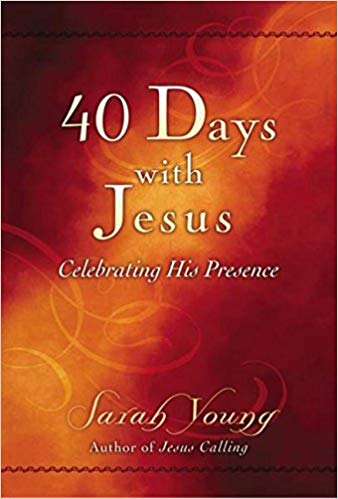
Martin Luther said, “The Bible is alive, it speaks to me.” Truly, the Bible is God’s Word speaking to us every time we peer into its pages, so I love how Sarah Young strings passages of Scripture together to allow us to hear Jesus speaking to us in a first-person voice.
40 Days With Jesus was designed as a series of readings during the Lenten season, as we walk with Jesus to the Cross and His resurrection from the dead. But any time is a good time when we can walk with Jesus and hear His unmistakable voice reassuring our hearts.
Are you walking through a dark time in your life? Know that Jesus is walking with you.
Do you want to live a life of purpose and lasting value? Listen to Jesus counsel you.
Are you standing at a crossroads trying to make the right decision? Let Jesus point the way.
Each time I read a Sarah Young book, it reignites my heart to read the Bible as though Jesus is personally speaking to me. Because He is!
40 Days With Jesus is a great starting point for you to learn to hear Jesus speaking to you every time you open your Bible. The Holy Spirit will then use those words read in your quiet time to continue to bring you direction and reassurance all throughout your day (John 14:26).
According to Paul, there are only two ways people can live: in the flesh or in the Spirit. That is—(1) operating separate from God, or (2) with a soul/body that is operating with God’s full involvement.
The trouble is: we’re always—as long as we’re alive—still in the flesh because we need these bodies to carry around our soul and spirit. But changes begin to occur first at salvation (when the connection of our spirit to God’s Spirit is reestablished), and even more so after being baptized in the Holy Spirit (when we are not trying to work out things on our own).
As a result, we have the same brain, but a mind that is being renewed; the same eyes, but insight that is being expanded; the same ears, but learning new ways to hear what the Holy Spirit is saying.
Remember that Jesus promised that the baptism in the Holy Spirit would empower us TO BE His witnesses (Acts 1:8). Not just to do things differently, but to have our spirit so enlivened by the Holy Spirit that we are living, breathing, walking, talking witnesses of a life transformed.
Have you noticed that there wasn’t a steep “learning curve” for the disciples of Jesus following Pentecost? Part of that is due to four key habits that the Holy Spirit helped form in their lives.
Correct biblical application—We immediately see people going from “They didn’t understand from the Scriptures” to quickly applying biblical texts to their current situations. This is exactly what Jesus promised would happen (John 20:6-9; Acts 2:16, 25, 34; John 14:26).
Intercessory prayer—To intercede is to take someone else’s needs to God on their behalf. The Holy Spirit can help us apply Scripture to our prayers, and can even help us without words at all (Acts 4:24-26; Romans 8:26-27).
Healthy conflict resolution—We’re all different, so not seeing eye-to-eye is bound to happen, but Spirit-empowered Christians will be able to resolve conflicts faster and with better results (Acts 6:1-8; Acts 15:1-31).
“Your life as a Christian should make unbelievers question their disbelief in God.” —Dietrich Bonhoeffer
Amen! Your life as a Christian that is living out daily habits that have been empowered by the Spirit should make everyone around you want to go deeper and deeper into all that the Holy Spirit has in store for them too.
This is a weekly series with things I’m reading and pondering from Charles Spurgeon. You can read the original seed thought here, or type “Thursdays With Spurgeon” in the search box to read more entries.
Our Fight For Faith
Our faith at times has to fight for its very existence. The old Adam within us rages mightily, and the new spirit within us, like a young lion, disdains to be vanquished; and so these two strong ones contend, till our spirit is full of agony. …
Christ alone was tempted in all points as we are, though without sin. No one man is tempted in all points exactly like another man, and each one has certain trials in which he must stand alone amid the rage of war, with not even a book to help him, or a biography to assist him—no man ever having gone that way before except that one Man whose trail reveals a nail-pierced foot. He alone knows all of the devious paths of sorrow. Yet even in such byways, the Lord is with us, helping us, sustaining us, and giving us grace to conquer at the close. …
So satan, loath to leave a soul, pursues it hotfoot. He will have it back if he can; and often, soon after conversion, there comes a time of dreadful conflict, when the soul seems as if it could not live. …
Once, when the tempter had grievously assailed me, I went to see my dear old grandfather. I told him about my terrible experience, and then I wound up by saying, “Grandfather, I am sure I cannot be a child of God, or else I should never have such evil thoughts as these.”
“Nonsense, Charles,” answered the good old man. “It is just because you are a Christian that you are thus tempted. These blasphemies are no children of yours; they are the devil’s brats, which he delights to lay at the door of a Christian. Don’t you own them as yours; give them neither house-room or heart-room.”
From The Autobiography Of Charles Spurgeon
The apostle Peter says our adversary the devil continually prowls around looking for a follower of Jesus that he can devour. This shouldn’t be surprising to us since Jesus said that the devil’s agenda was to steal, kill, and destroy. (See 1 Peter 5:8-9; John 10:10.)
But the apostle Paul also tells us that we aren’t supposed to be unaware of the devil’s schemes. Instead, we are to capture every thought and make them obedient to Jesus (2 Corinthians 10:5). That means, as Spurgeon’s grandfather counseled him, we recognize those evil thoughts as the devil’s brats and don’t allow them to take up room in our house nor our heart.
Stand firm—those who are in Christ are more than conquerors!
This is a weekly series with things I’m reading and pondering from Charles Spurgeon. You can read the original seed thought here, or type “Thursdays With Spurgeon” in the search box to read more entries.
Blessed Assurance
The Holy Spirit, who enabled me to believe, gave me peace through believing. I felt as sure that I was forgiven as before I felt sure of condemnation. I had been certain of my condemnation because the Word of God declared it, and my conscience bore witness to it; but when the Lord Jesus justified me, the same witnesses made me equally certain. The Word of the Lord in the Scripture says, “He who believes in Him is not condemned” (John 3:18), and my conscience bore witness that I believed, and that God in pardoning me was just. Thus I had the witness of the Holy Spirit and also of my own conscience, and these two agreed in one. …
I find the apostle Paul speaking by the Holy Spirit and saying, “Having been justified by faith, we have peace with God” (Romans 5:1). If I know that my trust is fixed on Jesus only, and that I have faith in Him, were it not ten thousand times more absurd for me not to be at peace than for me to be filled with joy unspeakable? It is but taking God at His Word, when the soul knows as a necessary consequence of its faith that it is saved. …
Has Jesus saved me? I dare not speak with any hesitation here; I know He has. His word is true; therefore I am saved. My evidence that I am saved does not lie in the fact that I preach, or that I do this or that. All my hope lies in this, that Jesus Christ came to save sinners. I am a sinner, I trust Him, then He came to save me, and I am saved. I live habitually in the enjoyment of this blessed fact, and it is long since I have doubted the truth of it, for I have His own Word to sustain my faith.
From The Autobiography Of Charles Spurgeon
The joy that Spurgeon recounts in his conversion is the same joy that is available to all who call on Jesus in faith. As Spurgeon was prone to quoting passages of hymns in his sermons and books, these words of his remind me of a favorite hymn as well—
The Holy Spirit is vital in everything concerning a Christian’s life.Dr. Donald Stamps emphatically said it this way:
“It is essential that believers recognize the importance of the Holy Spirit in God’s redemptive purpose. Many Christians have no idea what difference it would make if there were no Holy Spirit in this world. Without the Holy Spirit there would be no creation, no universe, no human race (Genesis 1:2; Job 33:4). Without the Holy Spirit there would be no Bible (2 Peter 1:21), no New Testament (John 14:26; 15:26-27; 1 Corinthians 2:10-14), no power to proclaim the gospel (Acts 1:8). Without the Holy Spirit there would be no faith, no new birth, no holiness, no Christians at all in the world.”
Sometimes I think we have in our mind that the “old” in Old Testament somehow means outdated or no longer applicable to our lives, and the “new” in New Testament should be our sole focus. But Jesus affirmed again and again that all of the Scriptures—what we now refer to as the Old Testament—all point to Him.
The outpouring of the Holy Spirit on that Pentecost Sunday was not something new to the New Testament Christians. He was always a part of a believer’s life. Even 1000 years before Christ’s public ministry, David knew the importance of the Holy Spirit in both salvation, and in living a consistently holy lifestyle (Psalm 51:10-12, 143:10).
If Jesus needed the baptism in the Spirit to empower Him, direct Him, and give Him success, how much more do we need this?! That’s why Jesus imparted the Holy Spirit to His followers at their moment of salvation, but then admonished them to eagerly expect the baptism in the Holy Spirit as well (John 20:22; Luke 24:49; Acts 1:8).
Quite simply Jesus is saying—DON’T STOP AT SALVATION
Jesus didn’t, the apostles didn’t, Paul didn’t, Apollos didn’t, the Ephesian Christians didn’t, I didn’t, and you shouldn’t either!
The foundational claim of Christianity is Jesus died AND rose to life again. The Apostle Paul says that if the resurrection didn’t happen, anyone who claims to be a Christian is in a world of hurt (1 Corinthians 15:3-4, 14, 17-20).
“But resurrected from the dead?! Really? I believe in facts. I believe in the laws of science.” Me too! But I also believe that the supernatural is not the opposite of belief in the natural. Just like Paul said, “Why should any of you consider it incredible that God raises the dead?” (Acts 26:8).
Noted astronomer Allan Rex Sandage said, “It is my science that drove me to the conclusion that the world is much more complicated than can be explained by science. It was only through the supernatural that I can understand the mystery of existence.”
And C.S. Lewis added, “How can anything be seen to be an exception till the rules are known? … Nothing can seem extraordinary until you have discovered what is ordinary. Belief in miracles, far from depending on an ignorance of the laws of nature, is only possible in so far as those laws are known.”
Let me give you a simple example. Suppose I divide $5 evenly between two of my buddies. The laws of mathematics dictate that both of them will have $2.50. But what if one of my friends, through some sleight of hand, steals some of my other friend’s money? The fact that one of them now has more than half doesn’t change that mathematical law that $5 divided evenly is two sets of $2.50.
The mathematician as a mathematician doesn’t know how likely one friend is to steal some of the other friend’s money. For that answer, he has to ask someone else. The changing of the outcome does not negate the laws. In fact, the more certain we are of the laws of mathematics the more clearly we know that something outside of them “interfered.”
Concerning Jesus, there are three undeniable facts—
It appears the laws of biology have been interfered with, that a supernatural miracle has occurred. The supernatural fact that Jesus was resurrected does not change the biological fact that death is irreversible. We just didn’t expect the outside influence. Just like we didn’t expect one friend to steal money from another friend.
What does this mean for you and me? It means that you can trust God’s word. All of it! Jesus told us that He would die by crucifixion and that He would be resurrected three days later (John 10:18; Matthew 20:19).
If that word came true, we can also trust this word: We can have our sins forgiven and receive God’s gift of eternal life—just as Christ was raised from the dead through the glory of the Father, we too may live a new life (Romans 6:4).
The law of sin says: All of us have sinned and fallen short of God’s standard. The unbreakable law of sin is that the penalty for unforgiven sin is eternal death. That law cannot be broken, unless there is a Supernatural interference—a miracle!
Jesus interfered. He took our sins upon Himself. He supernaturally switched places with us and let the death penalty fall on Himself. And if we believe in that, we can have our sins forgiven and receive what we didn’t expect—eternal life with God!
What a God we have! And how fortunate we are to have Him, this Father of our Master Jesus! Because Jesus was raised from the dead, we’ve been given a brand-new life and have everything to live for, including a future in heaven—an inheritance that is kept in heaven for you, pure and undefiled, beyond the reach of change and decay (1 Peter 1:3-4 MSG & NLT)
The appearances of Jesus after His resurrection aren’t just limited to the four Gospels (Matthew, Mark, Luke, and John), but also in the books of Acts and 1 Corinthians. Check out this infographic from The Infographic Bible by Karen Sawrey.
(click the image to zoom in)
Jesus appeared at…
A—an empty tomb in the Garden at Golgotha in Jerusalem (Matthew 28:1-10; Mark 16:9-11; John 20:1-18)
B—on the road to Emmaus (Mark 16:12-13; Luke 24:13-32)