Kept To Keep

Listen to the podcast of this post by clicking on the player below, and you can also subscribe on AppleSpotify, or Audible. 

Last week I reminded you that the main point in Hebrew literature is usually found in the middle. In Psalm 121 that would be the first phrase of verse 5: The Lord watches over you. 

But I notice something that seems contradictory in the New Testament. Whereas the message here is, “God watches over you,” the message in some New Testament verses seems to be, “You watch over yourself” (see for example Matthew 26:41; 1 Thessalonians 5:6; 1 Timothy 4:16). Paul even said to the Christians at Corinth, “I worked harder than all of them” (1 Corinthians 15:10). 

So which is it: Is God watching over us or are we to watch over ourselves? It’s actually both, but something important has to come first. We cannot watch over ourselves unless we are assured that the Lord is watching over us to sustain us. 

Okay, I was being a bit sarcastic when I said those verses seemed contradictory, as I clearly quoted them out of their context. For instance, in that statement from Paul in 1 Corinthians, check out the full verse, “But by the grace of God I am what I am, and His grace to me was not without effect. No, I worked harder than all of them—yet not I, but the grace of God that was with me.” Paul is clearly saying that he could only work hard because he was empowered by God’s grace. Notice that it is decidedly not the other way around: Paul doesn’t say, “I worked hard to earn the grace of God.” 

Remember that these psalms of ascent remind us of our upward look and our upward journey. We need to keep our eyes on the prize, which is God Himself (Psalm 121:1-2). Using the apostle Paul’s life as an example again, he said something very similar—

Not that I have already obtained all this, or have already arrived at my goal, but I press on to take hold of that for which Christ Jesus took hold of me. Brothers and sisters, I do not consider myself yet to have taken hold of it. But one thing I do: Forgetting what is behind and straining toward what is ahead, I press on toward the goal to win the prize for which God has called me heavenward in Christ Jesus. (Philippians 3:12-14) 

The middle verse of Psalm 121 foretells what appears six times in just eight verses: the Hebrew word samar. Depending on the translation of the Bible, this word is either “watch over” or “kept.” In either case, the meaning is a concentrated focus, not turning aside to the left or the right, not distracted, eyes on the ultimate prize. And all six of these instances are God’s unwavering, loving focus on us. In this song, we are told: 

  • God never slumbers or is even momentarily distracted (vv. 3-4) as opposed to other deities that were thought to sometimes be unavailable to their worshippers (see 1 Kings 18:27). Instead, our God watches us so closely that He notices if even a single hair falls from our head (Matthew 10:30-31). 
  • God stands beside us to protect our places of vulnerability (vv. 5-6). The Amplified Bible says, “The Lord is your shade on your right hand—the side not carrying a shield.”
  • God keeps us from the entrapment of evil (v. 7). Jesus told us that He was praying this way for us so we can have confidence to pray this for ourselves (Luke 22:32; Matthew 6:13).  
  • God protects us as His most precious treasure. David uses this same word samar in Psalm 17:8, “Keep me as the apple of Your eye; hide me in the shadow of Your wings.” 
  • God is our eternal Protector. The last phrase of this psalm says He watches over us “both now and forevermore” (v. 8).  

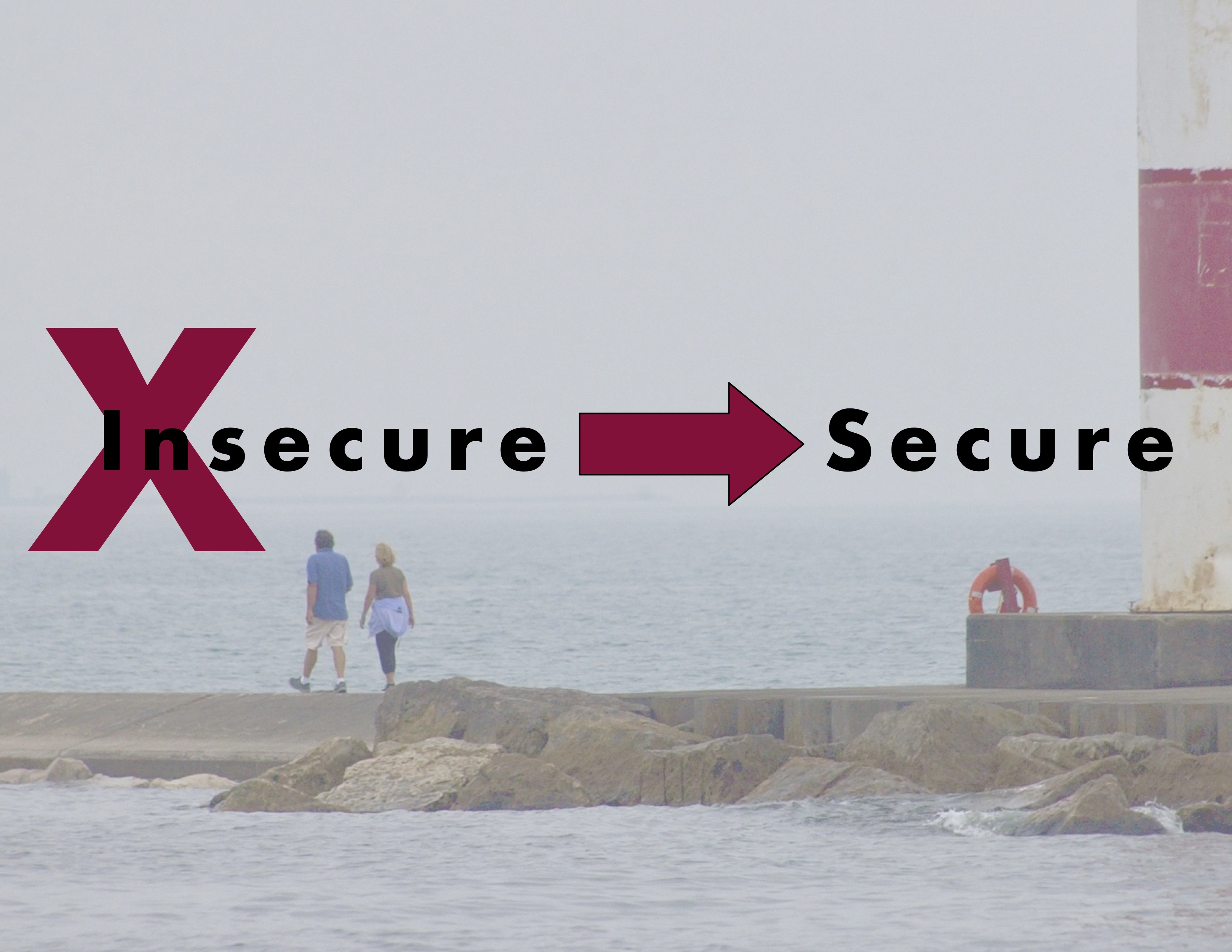
The other places the word samar is used in the Bible is a call for us to keep God’s commands. But just as we saw with Paul that he was committed to running his race well because he was assured of the prize Jesus had secured for him, so for us, we can only keep God’s commands because we are kept secure by God. 

Because we are kept by God we can keep His commands. In Deuteronomy 4, Moses applies the word samar to God’s people. We are to..

  • keep the commands of the Lord (v. 4) 
  • watch ourselves closely so we don’t forget what God has done for us (v. 9) 
  • be careful not to forget the covenant God paid for us (v. 23)
  • keep God’s decrees and commands as way a way to pass on God’s blessing to future generations (v. 40)

If God is not the One keeping and preserving me, it will be impossible for me to keep His commands on my own. The promise of His watchful keeping and preserving should fuel our prayer to watch over ourselves with all diligence. Read His promises, pray His promises, be assured of His ever-present help so that you can use His help to look out for yourself. 

If you’ve missed any of the others messages in our look at the Psalms of Ascent, you can find them all here.

►► Would you please prayerfully consider supporting this ministry? My Patreon supporters get behind-the-scenes access to exclusive materials. ◀︎◀︎
Poetry Saturday—Undying Love

Listen to the podcast of this post by clicking on the player below, and you can also subscribe on AppleSpotify, or Audible.

God hath not promised skies always blue,
   Flower-strewn pathways all our lives through;
God hath not promised sun without rain,
   Joy without sorrow, peace without pain.
God hath not promised we shall not know
   Toil and temptation, trouble and woe;
He hath not told us we shall not bear
   Man a burden, many a care.
But God hath promised strength for the day,
   Rest for the laborer, light for the way,
Grace for the trials, help from above,
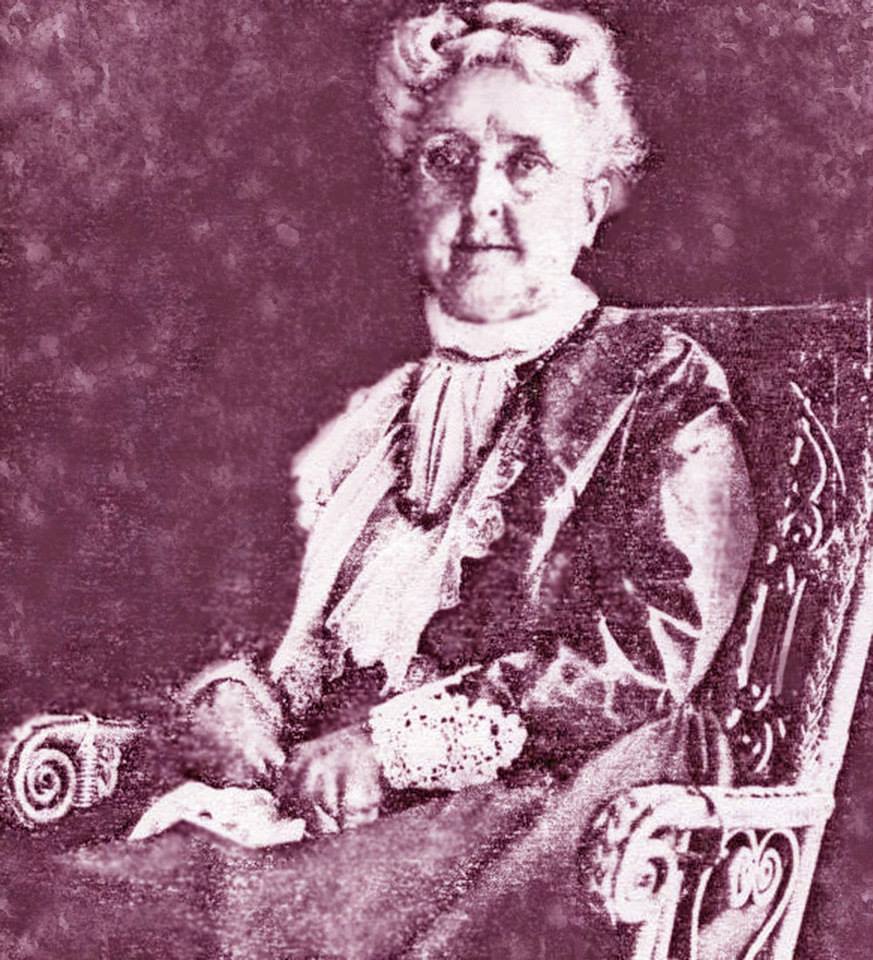
   Unfailing sympathy, undying love. —Annie Johnson Flint

►► Would you please prayerfully consider supporting this ministry? My Patreon supporters get behind-the-scenes access to exclusive materials. ◀︎◀︎

Parents, Don’t Fret

Listen to the podcast of this post by clicking on the player below, and you can also subscribe on AppleSpotify, or Audible. 

Near the beginning of my interview on the Leading From Alignment podcast with Jim Wiegand and John Opalewski, I was asked to share a bit of my personal background. 

I have been incredibly blessed to have grown up in a solid Christian home and in a fantastic Bible-believing church. And yet I still had to come to a point where I had to decide for myself whether I was going to put my faith in the claims of the Bible. Check this out…

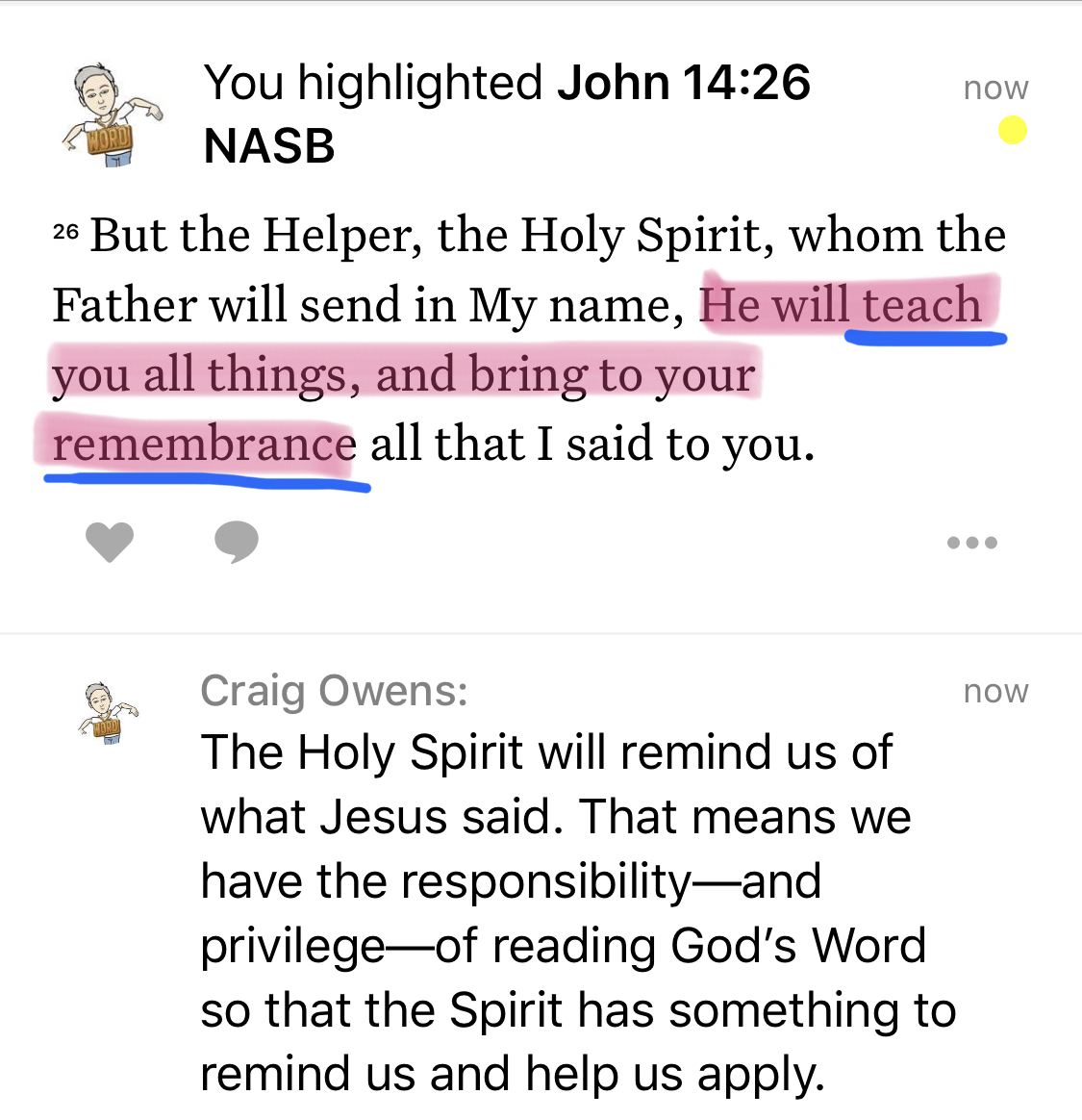
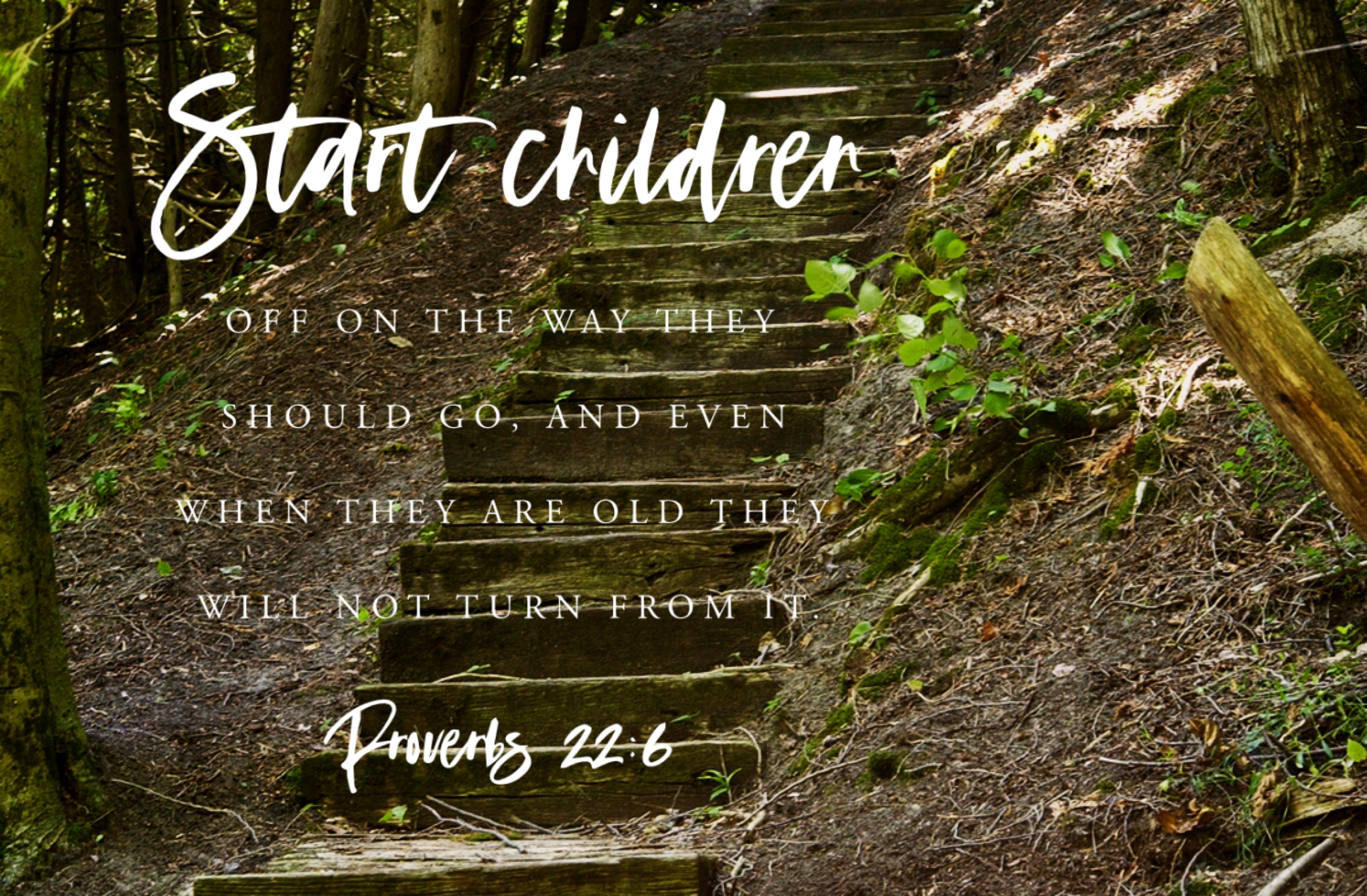
Parents, God is faithful to His Word. If we as parents will teach the Scriptural truths to our children, the Holy Spirit will bring that back to their remembrance as our kids get older. We don’t have to fret about their spiritual standing, but we can stand on God’s promises. 

This doesn’t remove responsibility from us. I love the story of a woman named Monica who prayed for years and years for the salvation of her son. Even when it appeared he was running as hard as he could away from God, Monica continued to pray. Eventually, her son did put his faith in Jesus and went on to have an immeasurable impact on world and church history. Monica’s son is Augustine of Hippo. 

So Mom and Dad, make sure your kids hear God’s Word. Then make sure God hears your prayers for that Word to not return void. You don’t have to fret over your children when you remember that God loves them even more than you do! 

►► Would you please prayerfully consider supporting this ministry? My Patreon supporters get behind-the-scenes access to exclusive materials. ◀︎◀︎
Faith Over Fear

Listen to the podcast of this post by clicking on the player below, and you can also subscribe on AppleSpotify, or Audible. 

I am always interested when I see contrasts in the Bible. Things like:

  • Live this way, not that way
  • These people are blessed, these people have trouble 
  • If you do this, you won’t have this 

So an interesting contrast caught my eye in the story where Jesus calms the storm (Matthew 8:23–27). Jesus is sleeping peacefully in the middle of a storm that is described as “furious [where] the waves swept over the boat.” The disciples were anything but peaceful—they thought they were going to drown—so they yelled for Jesus to wake up. 

Before Jesus calmed the storm, He says, “You of little faith, why are you so afraid?” 

That’s the phrase that caught my attention. Notice the contrast between “little faith” and “so afraid.” In other words, small faith means big fear! 

Strong’s Greek dictionary defines “little faith” as “dread (by implication) faithless.” So it appears there is an inverse proportion between faith and fear. 

The word that Jesus used for “afraid” is only used here and in the same story in Mark 4:40, and in Revelation 21:8 which lists people who will be excluded from entrance into heaven.

The phrase “so afraid” (or “O ye of little faith” in the King James Version) is just one word in Greek: olgiopistos. The root word pistos is faith, but I find the prefix oligos very descriptive. It means: 

  • small in quantity 
  • short in time 
  • slight in intensity 

In other words, it is faith that is immature, or hasn’t been used much, or hasn’t been applied to a particular circumstance. This word olgiopistos is used five times in the New Testament, and only used by Jesus. 

In addition to this story, it is used in Matthew 6:30 and Luke 12:28 when Jesus tells us not to worry about the things that God will provide for us—things like food, clothing, and shelter. Jesus uses this word for Peter when he began to sink in the water after walking a few steps toward Jesus. And Jesus uses it in Matthew 16:8 when He warns His disciples about the “yeast” of the Pharisees and Sadducees that can creep into their hearts and spoil their faith. (Check out all of these verses here.)

In mathematical circles, this relationship between faith and fear is one that would be called inversely proportional. When our faith is high, our fear is low; when our fear is high, our faith is low. I also think it is very eye-opening that the mathematical symbol for inverse proportionality (∝) is the same symbol called ichthus that the early church used to represent Jesus.

Faith and fear cannot coexist in the same heart. Sometimes our faith is small in quantity because we haven’t fed our faith with God’s promises. Sometimes our faith is short in time because we want things done on our time schedule. And sometimes our faith is slight in intensity because we are unsure if God can “come through” in this particular situation. 

Whatever the case, when we feel any fear, we need to ask for faith. We need to return to God’s Word and be assured that His promises are applicable regardless of the situation we are in. As our faith grows, our fear has to diminish! 

►► Would you please prayerfully consider supporting this ministry? My Patreon supporters get behind-the-scenes access to exclusive materials. ◀︎◀︎

Poetry Saturday—I Have Made Thy Word My Choice

Listen to the podcast of this post by clicking on the player below, and you can also subscribe on AppleSpotify, or Audible.

Lord, I have made Thy Word my choice,
My lasting heritage;
There shall my noblest pow’rs rejoice,
My warmest thoughts engage.

I’ll read the histories of Thy love,
And keep Thy laws in sight;
While through Thy promises I rove,
With ever fresh delight.

’Tis a broad land of wealth unknown,
Where springs of life arise,
Seeds of immortal bliss are sown,
And hidden glory lies.

My faith and love and every grace
Fall far below Thy Word, 
For perfect truth and righteousness
Dwell only with the Lord. —Isaac Watts

►► Would you please prayerfully consider supporting this ministry? My Patreon supporters get behind-the-scenes access to exclusive materials. ◀︎◀︎

Who Can Claim God’s Promises?

Listen to the podcast of this post by clicking on the player below, and you can also subscribe on AppleSpotify, or Audible. 

It’s a bit scary to me to realize how many people have a scarcity mindset. As a result, far too many people are trying to figure out how to get their piece of the pie, but they don’t really want others to have their piece too. This should never be the mindset of a Christian! Our God has an unlimited supply, so we should be the most generous and abundance-minded people. 

Sadly, sometimes I still encounter Christians who think that only some people can claim some of God’s promises. 

This is part 5 in our series “Is that in the Bible?” 

Statement #5—Old Testament promises are for the Jews, New Testament promises are for the Christians. Is that in the Bible? No! 

First of all, this assumes a dichotomy between the Old Testament and the New Testament. Second, it reveals a lack of understanding of what Jesus has done for everyone who places their faith in Him. 

Jesus Himself said, “Do not think that I have come to do away with or undo the Law or the Prophets; I have come not to do away with or undo but to complete and fulfill them” (Matthew 5:17 AMP). 

Plato told a story about people chained in a cave in such a way that they could only see the shadows on the wall. He said that if the chains were unlocked, some would turn toward the opening of the cave, see the solid figures that had been creating the shadows, and move out of the cave. Plato also said that some would see the reality and choose to stay trapped in the cave—they would prefer shadows over reality. 

Both John and the writer of Hebrews describe how Jesus came as the incarnate Reality of God. Jesus reveals that He is the Substance behind all of the shadows of worship in the First Testament (Hebrews 1:1-2; John 1:1-14). 

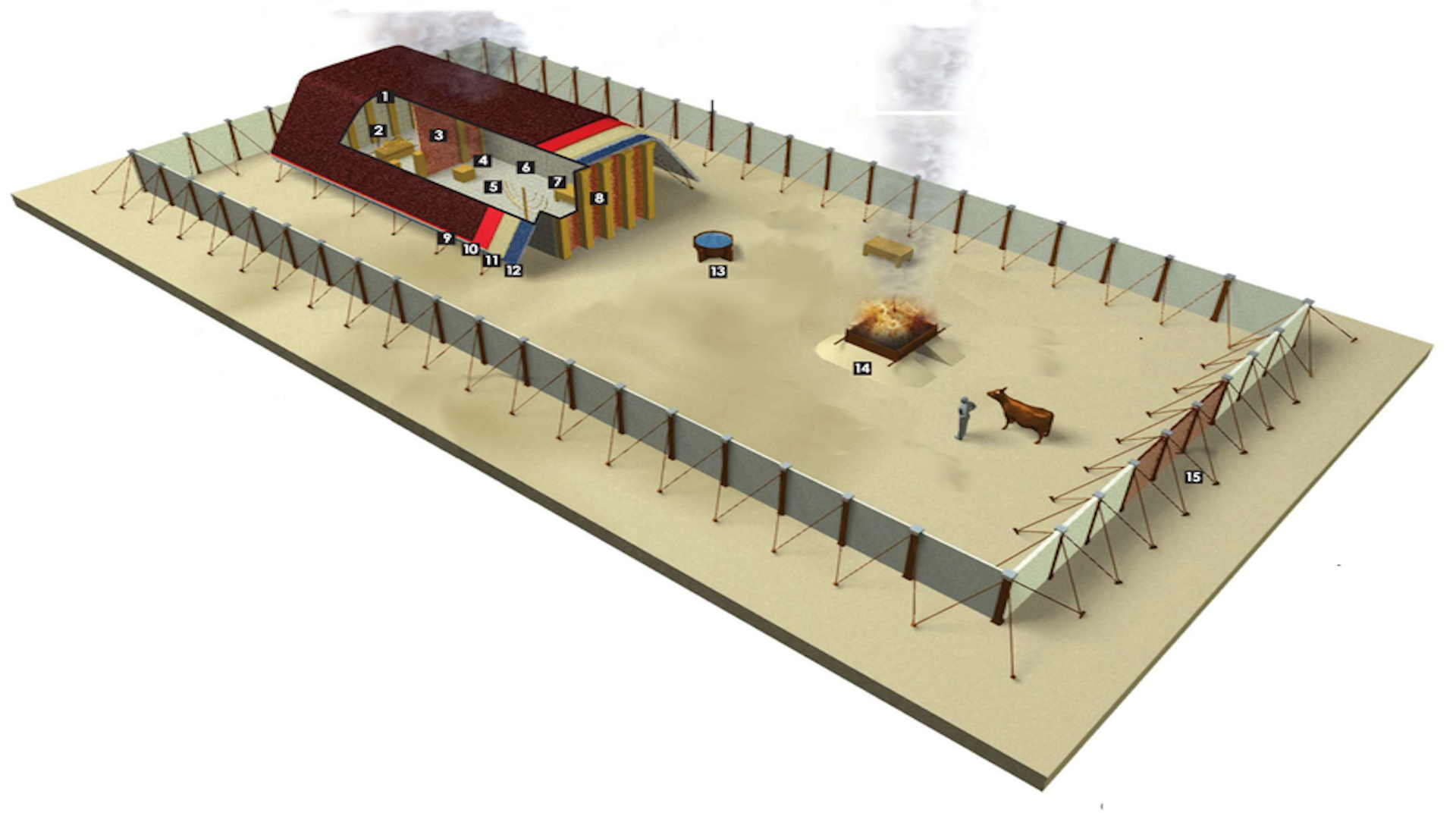
Look at the worship practices of the tabernacle, specifically the practices on the Day of Atonement. Two goats or lambs were brought into the outer court on that day—one had all of the sins of the people transferred to it and was sent into the wilderness as the scapegoat, and the other was sacrificed so its blood could make atonement for the sins of the people. The high priest would take this blood past the curtain separating the Holy Place from the Holy of Holies, and would sprinkle it on the atonement cover (also called the mercyseat) of the ark of the covenant of the Lord. 

John said that Jesus came to make His dwelling among humans. The word John uses for “dwelling” is the same word for “tabernacle.” Jesus Himself became not only our High Priest, but every single item the earthly high priest used on the Day of Atonement. Jesus is the…

  • scapegoat—Leviticus 16:20-22; John 1:29 
  • sacrificial lamb—Leviticus 16:15; 1 Peter 1:18-19
  • curtain in front of the Holy of Holies—Hebrews 10:22 
  • mercyseat—Exodus 24:8; Leviticus 4:6, 5:9; Hebrews 4:16

(Check out all of the above references by clicking here.)

By His life, death, and resurrection the shadows became Substance through Jesus. Hebrews 10:1-14 describes this, but especially note verse 12: “But when this High Priest [Jesus] offered for all time one sacrifice for sins, He sat down at the right hand of God.” 

Look again at the picture of the tabernacle and note that there are no chairs. That was because the earthly priest’s work was never done. But our fully human, fully divine High Priest completed everything that needed to be done, so He could sit down. 

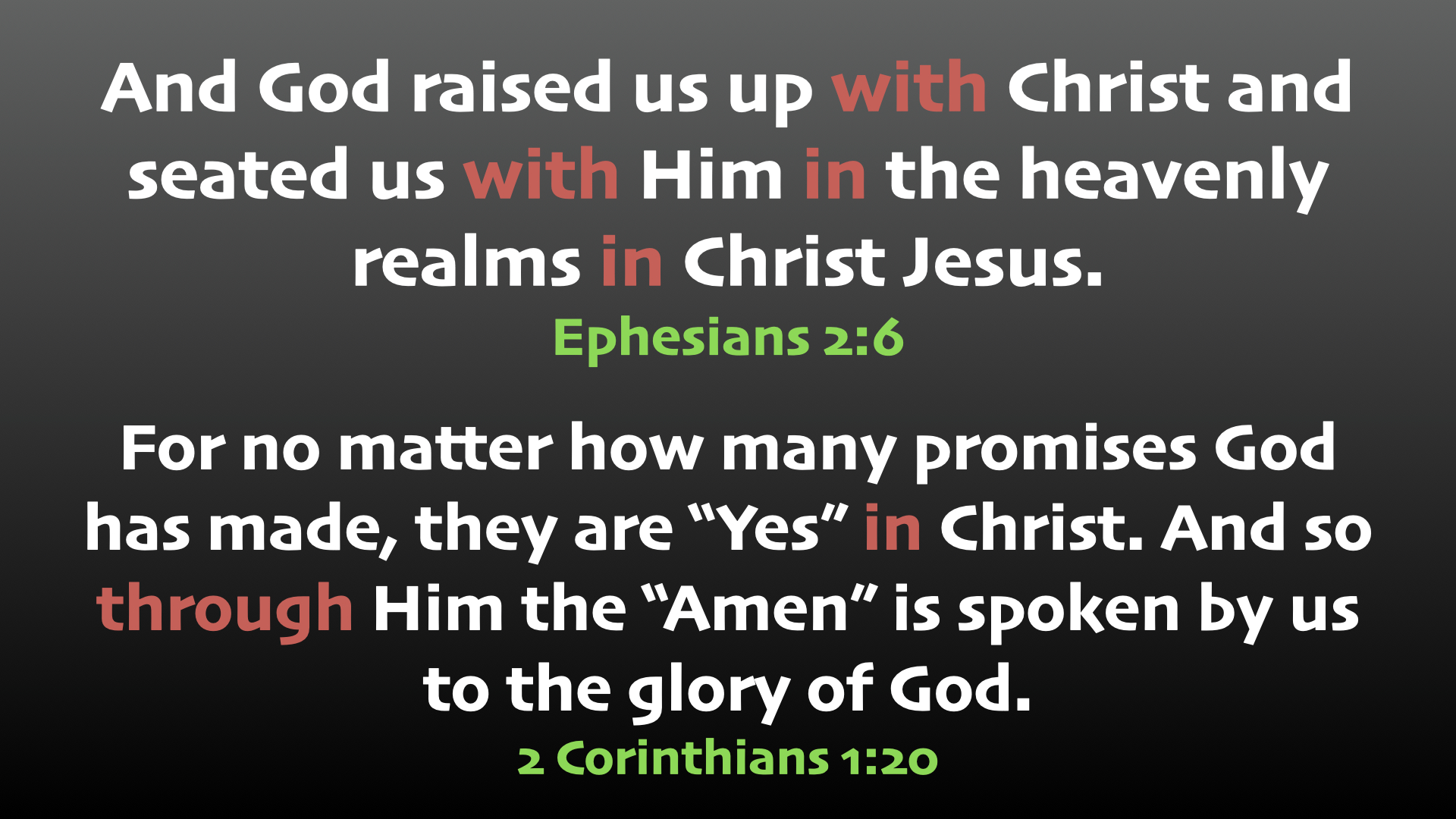
This High Priest not only sits down in God’s presence, but He takes us with Him into the Holy of Holies: “God raised us up with Christ and seated us with Him in the heavenly realms in Christ Jesus” (Ephesians 2:6)! 

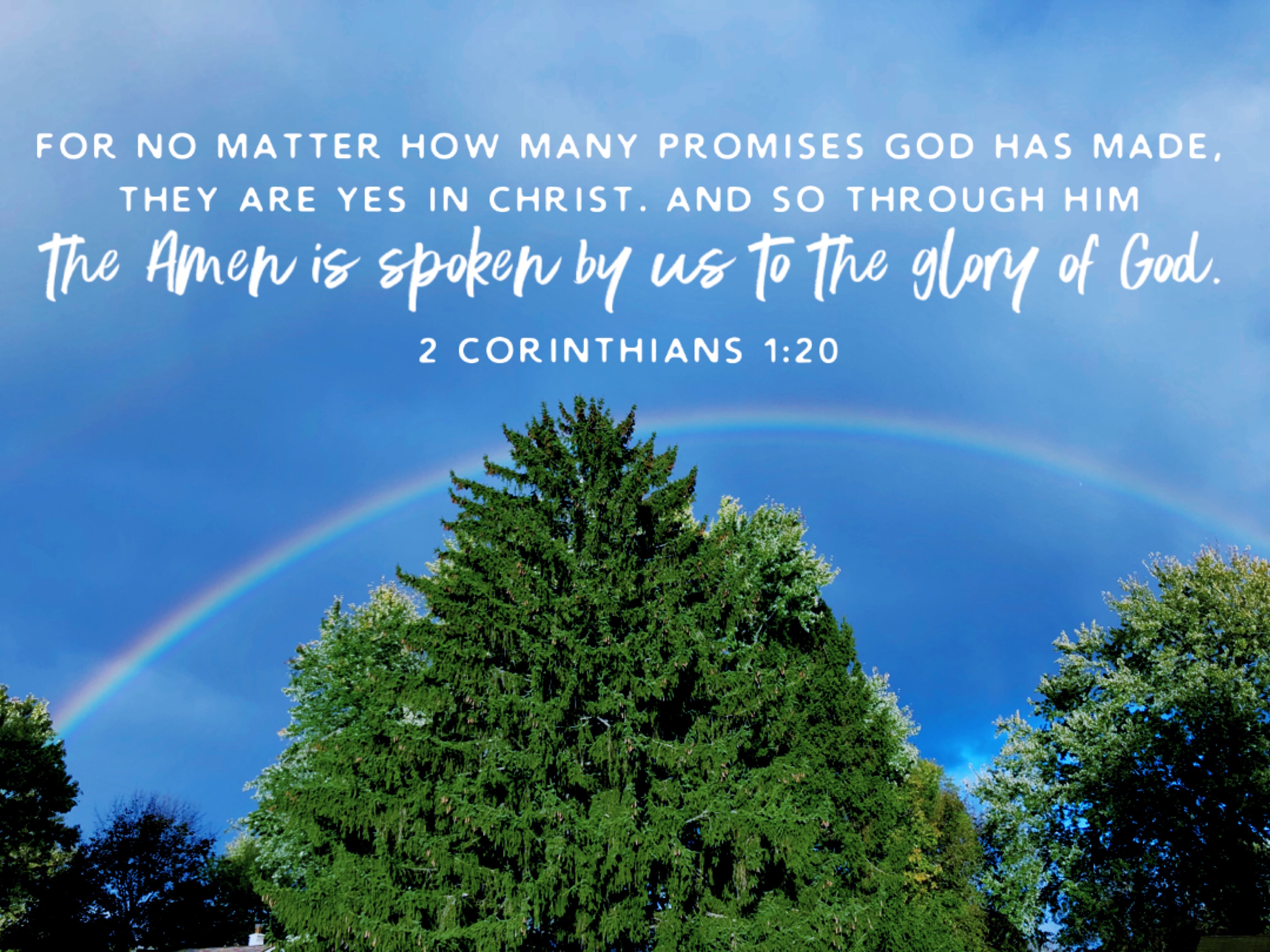
So now ALL God’s promises are for ALL who are in Jesus! “For no matter how many promises God has made, they are ‘Yes’ in Christ. And so through Him the ‘Amen’ is spoken by us to the glory of God” (2 Corinthians 1:20). 

I like how the Personalize Promise Bible turns that verse into this prayer: “My heavenly Father is faithful to His every Word. No matter how many promises He has made, in Jesus, He makes good on every one. I have God’s Word; therefore, I have God’s will. Every time that I pray in line with His Word, the answer is guaranteed.” 

My friend, if you have placed your faith in the completed work of Jesus, then EVERY promise in the Bible is a promise you can claim for your life. Hallelujah! What an amazing thing God has done for us through His Son Jesus Christ! 

If you’ve missed any of the topics we have covered in this series, you can find the full list by clicking here. 

►► Would you please prayerfully consider supporting this ministry? My Patreon supporters get behind-the-scenes access to exclusive materials. ◀︎◀︎
Links & Quotes

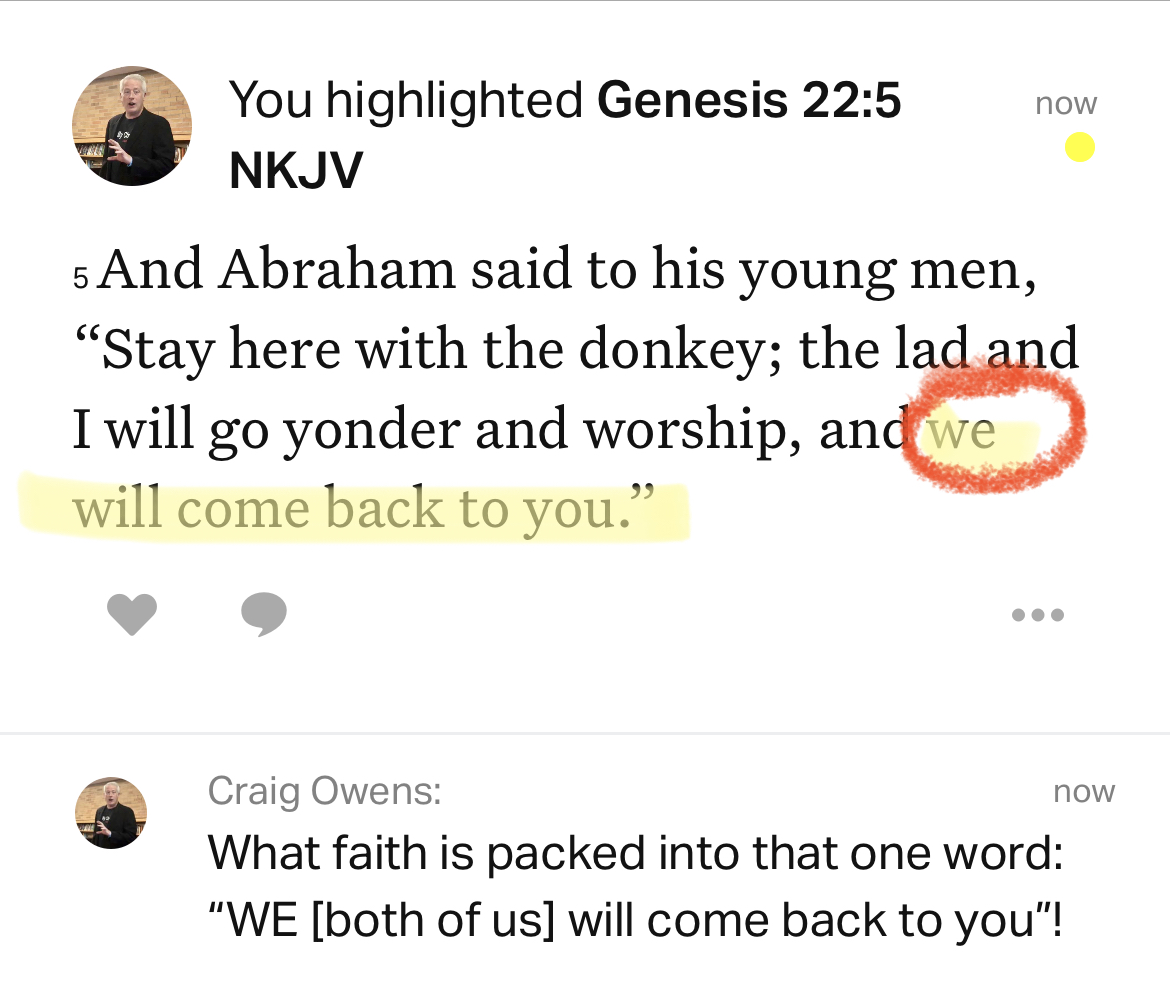
Abraham is commanded by God to sacrifice his son Isaac. Look at Abraham’s faith in just one word: “WE will come back to you.”

Follow me on YouVersion so we can share more thoughts on God’s Word with each other.

Wil Robinson shares a fable from Leo Tolstoy with the three most important questions everyone should ask themselves. The three questions are: How can I learn to do the right thing at the right time? Who are the people I most need, and to whom should I, therefore, pay more attention than to the rest? And, what affairs are the most important and need my first attention?

T.M. Moore reminds us how the promises of God can build courage in us. Check out all of the posts in his series called Brave Heart.

“Faithfulness is displayed in both word and deed—seen best by combining the Great Commission’s instruction to ‘make disciples’ with the second greatest commandment to ‘love thy neighbor.’ The beauty of the Gospel is found in both proclamation and demonstration. Neither comes first; neither comes second. Like the perfect marriage, it’s the duty of the Christians to take on each, giving 100 percent effort to both.” —Gabe Lyons, The Next Christians 

Fight The New Drug shared the results of a study of over 11,000 releationships, the five things the happiest couples have in common, and how pornography can undermine those relationships.

“Oh, that the eyes of sinners may be speedily opened—that they may see the difference of things, the beauty which is in holiness, and the astonishing madness that is in sin!” —Thomas Watson

Science is an important component in seeking truth. The Institute for Creation Research has an excellent perspective on the role of science for a Christian: “While the pursuit of science is certainly noble, it should be situated in its proper context and tackle matters within its empirically defined framework.”

John Piper observes, “The number-one reason why people in such seemingly hopeless situations purchase scratch-offs is because things already look so hopeless for improvement that the so-called ‘stupidity’ of wasting this dollar won’t really make anything worse.” This post elaborates on how the lottery preys on the poor.

Thursdays With Spurgeon—When God Seems Distant

This is a weekly series with things I’m reading and pondering from Charles Spurgeon. You can read the original seed thought here, or type “Thursdays With Spurgeon” in the search box to read more entries.

Listen to the podcast of this post by clicking on the player below, and you can also subscribe on AppleSpotify, or Audible. 

When God Seems Distant 

     You may possibly be in such a condition that every promise scowls at you as though it were transformed into a threat. When you turn over the pages of the Book once so full of comfort to you, it seems withered into a howling wilderness. … 

     Even those promises that you have been accustomed to offer to others in their time of need appear to shut their doors against you. ‘No admittance here,’ says one promise. Unbelief puts its burning finger right across another. Past sin accuses you and cries, ‘You cannot claim this word, for your transgression has forfeited it.’ So you may look through the whole Bible and find nothing upon which your souls may rest. … The fault is not in the promise but in us. …  

     Why does our gracious God permit this? Perhaps it is because you have been living without Him, and now He is going to take away everything upon which you have been in the habit of depending. Another reason may be that He wishes to drive you to Himself. … The prodigal was never safer than when he was driven to his father’s bosom, because he could find sustenance nowhere else. And, brothers and sisters, I think our Lord favors us with a famine in the land that it may make us seek after the Savior more. …

     When everything goes well with us, we frequently run a long way from God, but as soon as we are overtaken by trouble or see a lion in the way, we fly to our heavenly Father. I bless God for the mire and for my sinking in it, when it makes me cry out, ‘Deliver me, O my God, out of the deep mire, and let me not sink.’

From The Believer Sinking In The Mire

David said, “I keep my eyes always on the Lord. With Him at my right hand, I will not be shaken” (Psalm 16:8). And in another psalm he elaborated on this by saying, 

Yes, my soul, find rest in God; my hope comes from Him. Truly He is my rock and my salvation; He is my fortress, I will not be shaken. My salvation and my honor depend on God; He is my mighty rock, my refuge. Trust in Him at all times, you people; pour out your hearts to Him, for God is our refuge. (Psalm 62:6-8) 

God allows shaking so that we will recognize that He is the only sure foundation. The only things that shake and prove themselves to be untrustworthy are those things not standing on God. So if God seems distant, ask the Holy Spirit to show you if there are any idols in your heart. If there are, repent from trusting those and return to God alone. 

After this, the next step is to silence the voice of the enemy. Jesus said satan’s native language is lies and slander. As Spurgeon said, the enemy of your soul would love to tell you that God’s promises aren’t for you—that somehow you are disqualified from claiming them. 

We need to take every thought captive, and if those thoughts don’t line up with God’s Word we tear them down with the truth in Scripture. Once again, the Holy Spirit is our Counselor to remind us of the truth and assure our hearts that the promises are still for all of God’s children. 

As the words of the old hymn remind us:

Standing on the promises that cannot fail
When the howling storms of doubts and fear assail
By the living Word of God I shall prevail
Standing on the promises of God

►► Would you please prayerfully consider supporting this ministry? ◀︎◀︎

Faith To Stand

Listen to the podcast of this post by clicking on the player below, and you can also subscribe on AppleSpotify, or Audible. 

“…If you do not stand firm in your faith, you will not stand at all” (Isaiah 7:9). 

These words were spoken to King Ahaz and his people when they heard that enemies had allied themselves to attack. Their immediate response was, “And his people were shaken, as the trees of the forest are shaken by the wind” (v. 2). These are the people to whom God says, “If you do not stand firm in your faith, you will not stand at all.” 

In Hebrew this phrase is really just the same Hebrew word repeated twice: aman aman. It amounts to this: if you don’t stand, you won’t stand. 

Stand on what? Your faith. 

Faith in what? Isaiah tells us, “This is what the Sovereign Lord says” (v. 7). Jehovah Adonai is the final word. He calls the two conspiring enemies “smoldering stubs of firewood,” and He states definitively of their plans, “It will not take place, it will not happen” (vv. 4, 7). Fittingly, several English translations of this verse say, “Their plans will not stand.” 

When God speaks his final and decisive word, my faith-filled response should be exactly what He commanded the Israelites: “Be careful, keep calm, and don’t be afraid. Do not lose heart” (v. 4). 

I must deliberately and repeatedly silence the saber rattling of the enemy by standing in faith on God’s decisive word. My faith comes from hearing God’s word (Romans 10:17). 

This is why I am a huge proponent of not only reading God’s word, but turning His decisive word into prayer. Reminding myself—and repeatedly re-reminding myself—of what Jehovah Adonai has said is the only way to stand firm in faith. If I don’t stand firm in faith on His word, I will not be able to stand at all. 

I recently shared some faith-filled decisive promises from God’s word in another post. If I can help you find a word of God on which you can stand in faith, please reach out to me. 

►► Would you please prayerfully consider supporting this ministry? ◀︎◀︎

Clinging To Jesus

Listen to the podcast of this post by clicking on the player below, and you can also subscribe on AppleSpotify, or Audible. 

Previously I shared with you that according to the Anxiety & Depression Association of America, nearly 1-of-5 adults in the United States age 18 and older battle some form of anxiety disorder. That means there’s a good chance that either you or someone close to you will be in this battle sometime during their life. 

We also learned from David that being anxious or afraid is not a sin. He said, “When [not ‘if’] I am afraid, I put my trust in You” (Psalm 56:3). But we can grieve God’s heart if we don’t train ourselves to turn to Him as our trustworthy First Source of help. 

We also saw in Mark 4:35-39 how the disciples of Jesus were caught in a raging storm, trying everything in their own power to rescue themselves, and yet Jesus was right there with them. He arose and said, “Quiet. Be still,” and “THEN the wind died down and it was completely calm.” From this we learned that only His peace can X-out the noise of the storm and bring us to a place of quiet rest. 

We see another aspect of anxiety here: “Anxiety weighs down the heart” (Proverbs 12:25). That word for “anxiety” means carefulness, but not in the idea of being cautious. It literally means someone who is full of cares. This state leads to a heaviness of heart, as the KJV of that same verse says, “Heaviness in the heart of a man maketh it stoop.”  

I don’t think anyone wakes up one day and says, “I’m going to take all of the cares of the world on my shoulders today.” Instead, we pick up just one thing. “This is just a small thing,” we tell ourselves. Then we wake up the next morning with just that one little thing, and we pick up one more little thing. And then we do it again the next day, and the next day, and the next day. Until before we know it we are bowed down because we are full of cares. This heaviness makes us stoop, makes us unsteady on our feet, and magnifies even the smallest of concerns into a huge crisis. 

We are clinging to our load of cares—our care-fullness—but our loving Heavenly Father desires us to cling to something else. He wants us to cling to Him!

  • Moses told the Israelites: Serve only the Lord your God and fear Him alone. Obey His commands, listen to His voice, and cling to Him. (Deuteronomy 13:4 NLT) 
  • David declared: I cling to You; Your right hand upholds me. (Psalm 63:8) 

We see a beautiful example of Paul clinging to the promises of God during his multiple trials in and around Jerusalem and then during his journey to Rome to stand trial yet again. While he was still in prison in Jerusalem, Jesus appeared to him and said, “Take courage! As you have testified about Me in Jerusalem, so you must also testify in Rome” (Acts 23:11). 

Paul knew he was going to arrive in Rome. But during the horrendous storm at sea on his way there, Paul received an added assurance. He told his shipmates—

“But now I urge you to keep up your courage, because not one of you will be lost; only the ship will be destroyed. Last night an angel of the God to whom I belong and whom I serve stood beside me and said, ‘Do not be afraid, Paul. You must stand trial before Caesar; and God has graciously given you the lives of all who sail with you.’ So keep up your courage, men, for I have faith in God that it will happen just as He told me.” (Acts 27:22-25) 

Jesus tells all of us to cling to Him and His secure promises (Matthew 11:28-30). When we cling to Him, we no longer cling to the cares of this world. We move from from full-of-cares to care-less. We go from insecurity over our future to the security that only Jesus can give us! 

Paul clung to those promises of Jesus: I will rescue you … You must testify about Me in Rome … I have given you all who sail with you. Likewise, we need to arm ourselves with the promises of God and tenaciously cling to them. I’ve shared just a few promises in the comments below, but feel free to reach out to me if I can help you find a promise in the Bible that you can cling to through your stormy times. 

If you’ve missed any message in our series about X-ing our anxieties, please click here to find the full list. 

►► Would you please prayerfully consider supporting this ministry? ◀︎◀︎