Links & Quotes

If you want your heart to be able to perform better, you are going to have to stress it a bit—that’s called exercise. The same thing is true for the heart of leadership—we have to exercise our leadership so that it can rise to the challenge later.

I have a lot of new video content on my YouTube channel every week. Please check it out and subscribe so you don’t miss anything.

J. Warner Wallace wrote, “Everyone, whether they realize it or not, is engaged in worship. We all adore something, elevating it above the rest, sometimes so much that we overlook its flaws.” Check out this post about being careful about what we worship.

“Nothing teaches us about the preciousness of the Creator as much as when we learn the emptiness of everything else.” —Charles Spurgeon 

“We should avoid end-time hysteria and ‘not grow weary in doing good’ (2 Thessalonians 3:13). There will be good work to do (vocationally and socially and personally) right up to the Lord’s coming. Our normal earthly duties will not end until the Lord appears. The rule then, until he comes, is, ‘Whatever you do, work heartily, as for the Lord and not for men’ (Colossians 3:23).” —John Piper 

Greg Morse has a fascinating post connecting the fable of Chicken Little with the historical account of Noah and the imminent return of Jesus. “I hope an acorn falls afresh on our heads as we observe an Old Testament saint who was the Chicken Little of his day. A man who remained awake and faithful with his back against the end of the world: a man named Noah.”

The King’s Bride

Listen to the podcast of this post by clicking on the player below, and you can also subscribe on AppleSpotify, or Audible. 

How many of you have taken time to watch a royal wedding? It captivates the attention of so many people when actress Grace Kelly becomes Princess Grace of Monaco, or when a Kate Middleton becomes the Princess Catherine of Wales. There is something that enthralls us when someone who isn’t born to royalty is elevated to such a special place in a fairy tale-like romance and wedding. 

Remember that these Royal Psalms are pointing through the earthly representative to the heavenly Reality. Psalm 45 is a wedding song, quite probably a wedding march for King David’s bride. 

(Check out all of the Scriptures in this post by clicking here.)

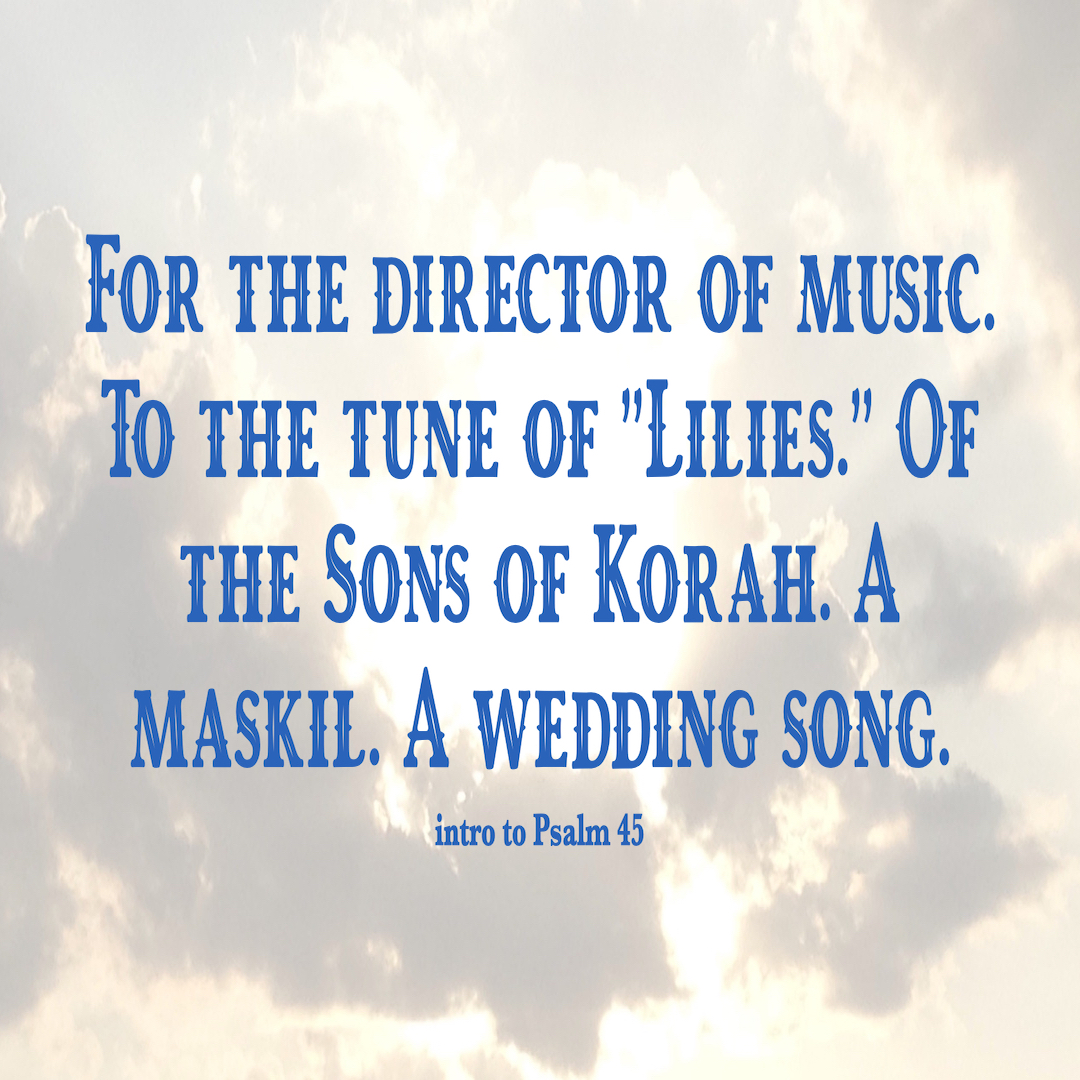
I’m intrigued by the preamble to this Psalm, as it is longer and more descriptive than most. 

  • For the director of music—appears 55x in the Psalter. 
  • To the tune of “Lilies”—appears only here and Psalms 69 and 80. 
  • Of the Sons of Korah—these are the skilled worship leaders. There are 11 songs written by them or for them. 
  • A maskil—this means it is to be a reflective song and is used 13 times. 
  • A wedding song—sometimes called a “song of love” in some translations. This Hebrew word is used 9 times in the Old Testament, always in poetic form, but Psalm 45 is the only instance it is said to be a wedding song. 

When we combine the beauty of lilies, the reflection of a maskil, and the skill of the Sons of Korah, we have a unique arrangement for a fairy tale-like romance that is culminating in a royal wedding. 

So I ask you to imagine this royal wedding ceremony where this song is sung from the perspective of the bride who is about to become royalty. As we see King David standing at the front awaiting his bride, let’s watch the scene expand to find King Jesus standing and awaiting His Church. 

  • Psalm 45:1-2 … Hear the bride, “How handsome You are, my Beloved! Oh, how charming!” (Song of Songs 1:16), and hear the wedding guests Revelation 19:6-7. 
  • vv. 3-7 … see the King standing with all the trophies of victories He has won. Verse 7 is quoted by the writer of Hebrews, specifically stating, “But about the Son [God] says…” (Hebrews 1:8-9). Also see Revelation 19:11-16. 
  • v. 8 … the aroma of victory is on the King and imputed to the Bride (Song 1:3; 2 Corinthians 2:14-15; Song 1:12). 
  • vv. 9-15 … the King is enthralled with the beauty of His Bride (Revelation 19:7-8; Song 1:15; Ephesians 5:25-27). 
  • vv. 16-17 … a blessing is pronounced on the couple (Ephesians 5:32). 

When we are enthralled with our King—when we only have eyes and hands and heart for Him—we are a pure virgin in His sight (2 Corinthians 11:2). But we are also a testimony to those who watch us watching our King.  

Just as royal weddings on earth captivate people who are watching the fairy tale-like wedding celebration, so will our devotion to the King intrigue and captivate a watching world. Notice again verse 17, “the nations will praise You for ever and ever.” When we love our King with all our heart, soul, mind, and strength, and then love others with that same love, we will draw the nations to our King (Revelation 22:17). 

If you have missed any of the other messages in our series looking at the Royal Palms, you can find them all here. 

►► Would you please prayerfully consider supporting this ministry? My Patreon supporters get behind-the-scenes access to exclusive materials. ◀︎◀︎

Links & Quotes

For personal growth and team growth, consider how you can set both small, bite-size goals that can be done daily and also bigger, stretching goals that energize the competitive drive. Check out more leadership content from The Craig and Greg Show.

I have a lot of new video content on my YouTube channel every week. Please check it out and subscribe so you don’t miss anything.

“This chapter contains the premier teaching of Christianity. It is an undying expression of Jesus’ doctrine of heavenly love. This chapter is more potent for the building of the church than any, or all, of the various manifestations of God’s power. Love is the church’s most effective weapon. Love is the essence of God’s nature. Love is the perfection of human character. Love is the most powerful, ultimate force in the universe. Without love, al various gifts of the Spirit are of no avail. … What a call to self-examination!” —Dr. Henry Halley, commenting on 1 Corinthians 13

“The transition from the good man to the saint is a sort of revolution; by which one for whom all things illustrate and illuminate God becomes one for whom God illustrates and illuminates all things.” —G.K. Chesterton 

T.M. Moore launched a new series of articles about the coming of God’s Kingdom in these last days. In the first article, T.M. wrote, “In his Pentecost sermon Peter announced that, with the resurrection of Jesus Christ and the pouring out of God’s Spirit, the ‘last days’ had begun (Acts 2:14-17), the new economy has been put into effect. Paul says Jesus came in ‘the fullness of the times’ to inaugurate His great work of redemption in these last days (Galatians 4:4). The ‘fullness of the times’ in which the divine economy is unfolding, is now. We are living in the last days, the fullness of the times, when the Lord of heaven and earth is establishing and expanding His divine economy.”

Once again, a new fossil discovery doesn’t fit into evolutionary models, but instead bolsters the facts recorded in the Bible about Creation and the Flood.

“For years, Michael Pratt operated in the shadows of the internet, profiting from coercion, deception, and exploitation under the guise of adult entertainment.” Pratt has now pled guilty to sexual trafficking charges. Fight The New Drug wrote, “The story is more than a courtroom headline. It’s a stark reminder of how the porn industry can weaponize vulnerability, disguise abuse and trafficking, and sell it as fantasy.”

A really penetrating question from John Piper: Why do so many PhDs in theology commit adultery?

“The Days of Noah”

Listen to the podcast of this post by clicking on the player below, and you can also subscribe on AppleSpotify, or Audible.

Jesus said His Second Coming would occur at a time in history that was just like the behaviors during “the days of Noah” (Matthew 24:36-39; Luke 17:26-27). 

What exactly did those days look like? 

   The earth was depraved and putrid in God’s sight, and the land was filled with violence (desecration, infringement, outrage, assault, and lust for power). And God looked upon the world and saw how degenerate, debased, and vicious it was, for all humanity had corrupted their way upon the earth and lost their true direction. (Genesis 6:11-12 AMPC) 

Paul describes this same environment to his friend Timothy—

   For people will be lovers of self and [utterly] self-centered, lovers of money and aroused by an inordinate [greedy] desire for wealth, proud and arrogant and contemptuous boasters. They will be abusive (blasphemous, scoffing), disobedient to parents, ungrateful, unholy and profane. [They will be] without natural [human] affection (callous and inhuman), relentless (admitting of no truce or appeasement); [they will be] slanderers (false accusers, troublemakers), intemperate and loose in morals and conduct, uncontrolled and fierce, haters of good. [They will be] treacherous [betrayers], rash, [and] inflated with self-conceit. [They will be] lovers of sensual pleasures and vain amusements more than and rather than lovers of God. (2 Timothy 3:2-4 AMPC) 

It seems to me that we are now living in “the days of Noah” and “the last days.” For Christians, I think this means two things:

(1) Be diligent to keep yourself devoted to living for God. Noah stood out in stark contrast to everyone else because of his righteousness and blamelessness “in his evil generation” (Genesis 6:9). Peter wrote, 

   So, beloved, since you are expecting these things, be eager to be found by Him [at His coming] without spot or blemish and at peace [in serene confidence, free from fears and agitating passions and moral conflicts]. (2 Peter 3:14 AMPC) 

(2) Be active in telling people about the Second Coming of Jesus and that the only door to salvation from God’s judgment is Jesus Christ. Jude wrote this—

   Guard and keep yourselves in the love of God; expect and patiently wait for the mercy of our Lord Jesus Christ (the Messiah)–[which will bring you] unto life eternal. And refute [so as to] convict some who dispute with you, and on some have mercy who waver and doubt. [Strive to] save others, snatching [them] out of [the] fire; on others take pity [but] with fear, loathing even the garment spotted by the flesh and polluted by their sensuality. (Jude 1:21-23 AMPC) 

The time is short. Let’s stay righteous and let’s stay active in proclaiming the Good News that Jesus is coming as the All-Righteous Judge, but He has already paid for our forgiveness so that we can “stand in the presence of His glory, blameless and with great joy” (Jude 1:24).

►► Would you please prayerfully consider supporting this ministry? My Patreon supporters get behind-the-scenes access to exclusive materials. ◀︎◀︎
On Guard!

Listen to the podcast of this post by clicking on the player below, and you can also subscribe on AppleSpotify, or Audible. 

When Jesus was discussing end times events with His disciples, He described days that looked pretty bleak. Do any of these descriptions sound familiar today?

  • Wars 
  • Turmoil
  • Persecution
  • Betrayal 
  • Family strife 
  • Christians hated by the world (see Mark 13:5-12)

In times like these, Jesus said many people will be deceived. This is why Jesus twice tells His followers to “be on your guard” (vv. 9, 23). 

What exactly does “on guard” look like? 

Maybe you’ve heard a similar phrase before a fencing match, reminding the combatants to raise their swords. That’s a good picture for Christians. Paul tells us that we can use the “sword of the Spirit, which is the Word of God” to defend ourselves during spiritual warfare (Ephesians 6:17). 

While Jesus is instructing His disciples, He tells them the sword-like power of His words. He said, “My words will never pass away” (Mark 13:31). In other words, His sword is invincible! 

Another modern-day phrase that fills out the definition of being on guard is when someone says, “Heads up!” This means to watch out for things that may be headed your way. Jesus reminded us, “I have told you everything ahead of time” (v. 23) so we can be aware of what’s coming. 

We are aware of the approaching dark days of the end times, but we are not afraid of them. Three times, Jesus tells us to “keep watch” (vv. 34, 35, 37). This Greek word means to be aroused from sleep so that we can give active and strict attention to the task before us. 

“Be on guard! Be alert!” Jesus said (v. 33), so that you don’t become apathetic. The devil prowls around, seeking to use the times of turmoil to confuse, deceive, and then mislead people. 

But we are not unaware of his schemes. 

Christian, we must stay on guard. We must be ready but unafraid of the opposition. We must keep in mind the never-failing Word of God, and we must use that sword to cut down the deceiving ideas. The Holy Spirit will give you the right words to wield at the right moment—

“…Don’t worry in advance about what to say. Just say what God tells you at that time, for it is not you who will be speaking, but the Holy Spirit.” (Mark 13:11) 

►► Would you please prayerfully consider supporting this ministry? My Patreon supporters get behind-the-scenes access to exclusive materials. ◀︎◀︎
Unafraid Of End Times Events

Listen to the podcast of this post by clicking on the player below, and you can also subscribe on AppleSpotify, or Audible.

When people ask me about end times events, it is usually from a posture of hand-wringing worry. But when Jesus told His followers about what is to come, He repeatedly told them not to be afraid.

Some resources from this video:

►► Would you please prayerfully consider supporting this ministry? My Patreon supporters get behind-the-scenes access to exclusive materials. ◀︎◀︎

Links & Quotes

God made you uniquely YOU on purpose. So you can ask Him to show you why He put you together as He did—with all of the gifts that make you YOU. Please subscribe to my YouTube channel.

In my Halley’s Study Bible, I read this commentary on Matthew 24-25—

“It is best not to be too dogmatic about the events surrounding [Christ’s] second coming. But if language is a vehicle of thought at all, it certainly takes a good deal of explaining and interpreting to make anything else out of Jesus’ words than that He Himself looked forward to His coming again as a definite historical event in which He will personally and literally appear to gather to Himself and to eternal glory those who have been redeemed by His blood.

“And it is best not to cloud the hope of His coming with too detailed a theory as to what is going to happen when He comes. Some people may be disappointed if Jesus does not follow the schedule they have mapped out for Him.”

“The future doesn’t belong to the fainthearted; it belongs to the brave.” —Ronald Reagan

“We are not called to punish the people for whom Jesus was already punished.” —Kevin Berry

Daniel B. Wallace, a New Testament professor at Dallas Theological Seminary, wrote, “If you could stack up all handwritten manuscripts of the New Testament—Greek, Syriac, Latin, Coptic, all languages—how tall would the stack be? … I have said in many lectures that it would be the equivalent of c. 4 & 1/2 Empire State Buildings stacked on top of each other. How did I come up with that number?” Check out his post to read how he calculated this astounding number. This is just another link in the chain of evidence for the historicity of the Bible.

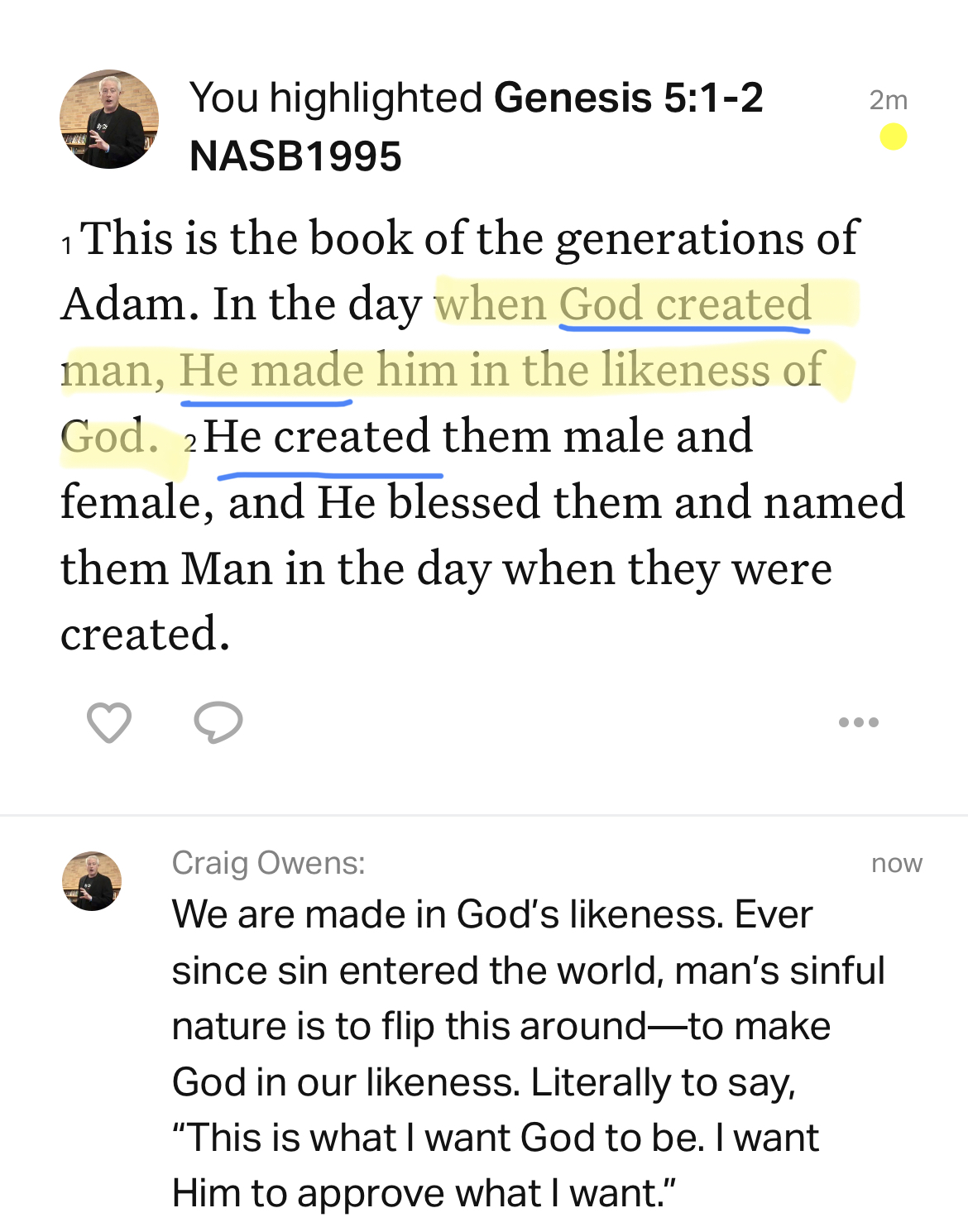
I shared this commentary on YouVersion this week: We are made in God’s likeness. Ever since sin entered the world, man’s sinful nature is to flip this around—to make God in our likeness. Literally to say, “This is what I want God to be. I want Him to approve what I want.”

“Pure humor is the most difficult of all of comedy. Late night humor is funny because it is mean. It is relatively easy to be crude, cynical, and sarcastic. It comes naturally to our fallen natures to criticize, tease, mock, and scoff. It’s much harder to make people laugh by lifting others up.” —Dick Brogden, in his book Proverbs: Amplified and Applied, commenting on Proverbs 1:22

Triumphant King

Listen to the podcast of this post by clicking on the player below, and you can also subscribe on AppleSpotify, or Audible. 

Have you ever noticed how many of our Christmas carols celebrate the dark night giving way to the bright light? For instance, the hymn O Holy Night contains the line, “long lay the world in sin and error pining until He appeared.” 

English historian and theologian Thomas Fuller was the first to put into print what has now become a cliché that so many people use: “It is always darkest just before the Day dawneth.” Indeed, Micah paints a very dark scene just before the Messiah makes His First Advent (Micah 5:1). 

The Light of Jesus that burst onto planet Earth in a Bethlehem stable revealed Him as our Great Shepherd, our Prince of Peace, and our Mighty Deliverer. And there is also one more title that Micah foretells: our Triumphant King! 

What does our Triumphant King do? He confronts and defeats the darkest foes. Check out the words in Micah 5:9-15: destroy (5x), demolish (2x), tear down, uproot, take vengeance. 

Christ’s birth in Bethlehem is our proof that God’s plan prevails. God always gets the final word, the decisive word, and the best word! 

Most of the Old Testament prophets foresaw both the first and second advents of Jesus simultaneously. The mountains of prophecy look like they are on top of each other, so it’s very common for the prophets to see events of both advents happening simultaneously. So Micah sees both the coming of Jesus in Bethlehem and His coming at the end of time as King.

There is a spiritual battle that has been raging since before Time began (Ephesians 6:12). It started when Lucifer became satan by his rebellion against God, and then he began his agenda of the destruction of God’s people (Ezekiel 28:12-17; Revelation 12:7-9, 13, 17). 

Into this dark battle, Jesus enters the scene. The reason the Son of God was made manifest (visible) was to undo—destroy, loosen, and dissolve—the works the devil has done (1 John 3:8 AMP). 

I already talked about how the death of Jesus on the Cross meant the death of Death, and Jesus became our Mighty Deliverer! The resurrection of Jesus means satan’s time is nearing an end. It may be dark now, but the darkness has to give way to the Light of the King of kings (check out these verses in Revelation). 

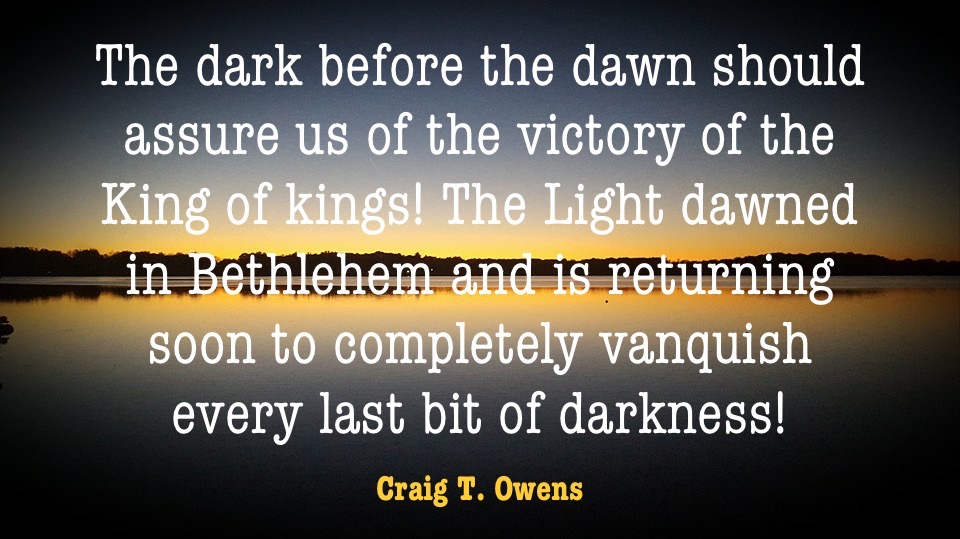
“It is always darkest just before the Day dawneth” should assure us of the victory of the King of kings! Jesus assured us that darkness is only afforded an hour, and then the Light will completely overwhelm it. The Light dawned in Bethlehem and is returning soon to completely vanquish every last bit of darkness!

If you missed any of the messages in our Advent series, you can find a list of all of those messages by clicking here. 

►► Would you please prayerfully consider supporting this ministry? My Patreon supporters get behind-the-scenes access to exclusive materials. ◀︎◀︎

God Bless America?

Listen to the podcast of this post by clicking on the player below, and you can also subscribe on AppleSpotify, or Audible. 

On this 4th of July weekend, is it right for us to pray for God’s blessing on America? I have blogged before about being careful with our terms that are biblical, unbiblical, or non-biblical. Clearly, the phrase “God bless America” is non-biblical—that is, this phrase doesn’t explicitly appear in the Scripture. But are there principles in the Bible that can make that phrase biblical? 

Yes, I believe so IF we recognize why we have been blessed by God. 

In God’s perfect timing, the next psalm in our series looking at the Selahs in the Psalms is one that addresses this topic. 

Notice the very first word in Psalm 87 is the personal pronoun “He.” There is an assumption the sons of Korah make that their readers will know that “He” is The Creator and Sustainer of the Universe. In fact, they see God as the Prime Mover in this psalm, putting His words at the very middle of the psalm (v. 4). 

Just before these quotation marks, we are invited to Selah—pause and carefully listen to God. He announces heavenly citizenship for age-old enemies of Israel: Rehab, Babylon, Philistia, Tyre, Cush. Peoples from all of these nations are identified as: “those who acknowledge Me” and three times He says they are “born in Zion” (vv. 4-6). 

God desires that none should perish. He wants people from every nation, tribe, and language to enjoy His presence forever in the eternal Zion. 

The sons of Korah remind us of just how blessed Zion truly is (vv. 1-3) and how God establishes all who have Zion citizenship (v. 5). God does this so that all people will see God’s blessing on those people who acknowledge Him as their Lord and King. 

So let’s return to my earlier question: Is it right and biblical for Christians to pray for God to bless America? 

Let me ask it another way: Has God blessed America? I believe He has and we should be eternally grateful. I believe this nation was founded on biblical principles, and recognized as a place where people could have the freedom to worship God.

Will God continue to bless America? Psalm 87 says the blessing will last only as long as we Americans acknowledge, “All my fountains are in You” (v. 7). This is a call for us to continually recognize God as our Foundation and Source. We also have to remember that the blessing is only to us so that it can flow through us to all peoples, languages, and tribes. 

The blessing stops when we dig our own wells, or we try to hoard the blessing. 

There are two phrases in this psalm that stand out to me as prophetic. 

  1. Selah (listen to this) and then “I will record” (vv. 3-4) 
  2. The Lord will write in the register” (stop to celebrate) Selah (v. 6)

God keeps perfect records of those who are citizens of Zion because they have acknowledged Jesus as the One who paid the price for their sins to be forgiven. So when John gives us a glimpse of the eternal Zion, he tells us about the rejoicing over those who are there “from every tribe and language and people and nation” (Revelation 5:9-10, 7:9-10, 21:22-27). 

Just as Revelation records spontaneous praise to God, the sons of Korah build in those Selah pauses to worship too:

  • Glorious things are said of God—praise Him! 
  • He has blessed us by His presence in our midst—praise Him! 
  • People from all tribes are entering Zion—praise Him! 

May God continue to bless America so that we can use those blessings to tell the world about His love as we invite them into a personal relationship with Jesus! 

If you’ve missed any of the messages in our Selah series, you can find the full list by clicking here.

►► Would you please prayerfully consider supporting this ministry? My Patreon supporters get behind-the-scenes access to exclusive materials. ◀︎◀︎

Links & Quotes

The seed your weakened hand is sowing
May ripen to a harvest broad,
Which yet may help, without your knowing,
To fill the granaries of God! —Margaret J. Prescott

My friend and podcast partner Greg Heeres talked about growing and learning through change. You can check out the rest of this episode of The Craig And Greg Show here.

Sometimes the prophetic language in the Bible can be a bit confusing. Like the phrase: “A time, times, and half a time.” Here is how Dr. Henry Halley unpacks this—

“It denotes the duration of the other horn of the fourth beast (Daniel 7:25). It denotes the period from Daniel to the time of the end (Daniel 12:6–7). It is used in Revelation 12:14 as identical to 42 months and to 1260 days (Revelation 11:2–3; 12:6, 14; 13:5), the period of time the Holy City was trampled, the two witnesses prophesied, the woman was in the wilderness, and the revived beast was on the throne. 

“The word ‘time,’ in the phrase ‘a time, times, and half a time’ is generally taken to mean year; the phrase thus means three and a half years, which is 42 months, or 1260 days. 

“By some, this is taken to refer to a literal three and a half years. Others, on the year-day interpretation (Numbers 14:34; Ezra 4:6), take it to be a period of 1260 years. Still others look upon the figures, not as defining time limits or periods, but as being symbolic: 7 Is the symbol of completeness, while three and a half, which is half of 7, represents incompleteness—that is, the reign of evil will be only temporary.” —Halley’s Study Bible (check out all of the biblical references in this quote by clicking here)

“Ambivalence toward the Law of God is troubling. Theologians discard the Law, and pastors either reject or neglect it. Jesus said that keeping and teaching the Law of God was a mark of Kingdom greatness (Matthew 5:17-19). Apparently that’s not a goal many of us aspire to. He also said that when the Law of God is neglected, love grows cold (Matthew 12:24). The ubiquitous lack of love in our world today is undoubtedly related to our failure to teach and live according to the Law of God. … 

“Pastors have three main resources for the work and business of ministry: The Word of God, prayer, and their personal example (Acts 6:4; 1 Peter 5:1-3). If any of these fails, their ministry will as well. Especially must pastors be seen to be men zealous for the Law of God, to obey all the counsel of the Lord in His Word and to resist the devil and overcome every temptation. Jesus did. Paul did. John said this is the way love flourishes (1 John 5:1-3). Throughout this generation, failures of obedience on the part of highly visible pastors have contributed to the Church’s becoming an object of scorn by many unbelievers, while believers have been largely silent about their failings. We must be diligent in obeying Christ if we would teach others to do so and thus fulfill our calling to the Kingdom and glory of God.” —T.M. Moore

New wide-angle X-ray scattering (WAXS) analysis dates the Shroud of Turin to the first century.

Not all viruses need to be eliminated. A study has discovered 5500 new RNA viruses on the ocean, finding “an entire phylum, the Taraviricota . . . found all over the oceans, which suggests they’re ecologically important.” The Creator knew what He was doing!