Wholly Healthy

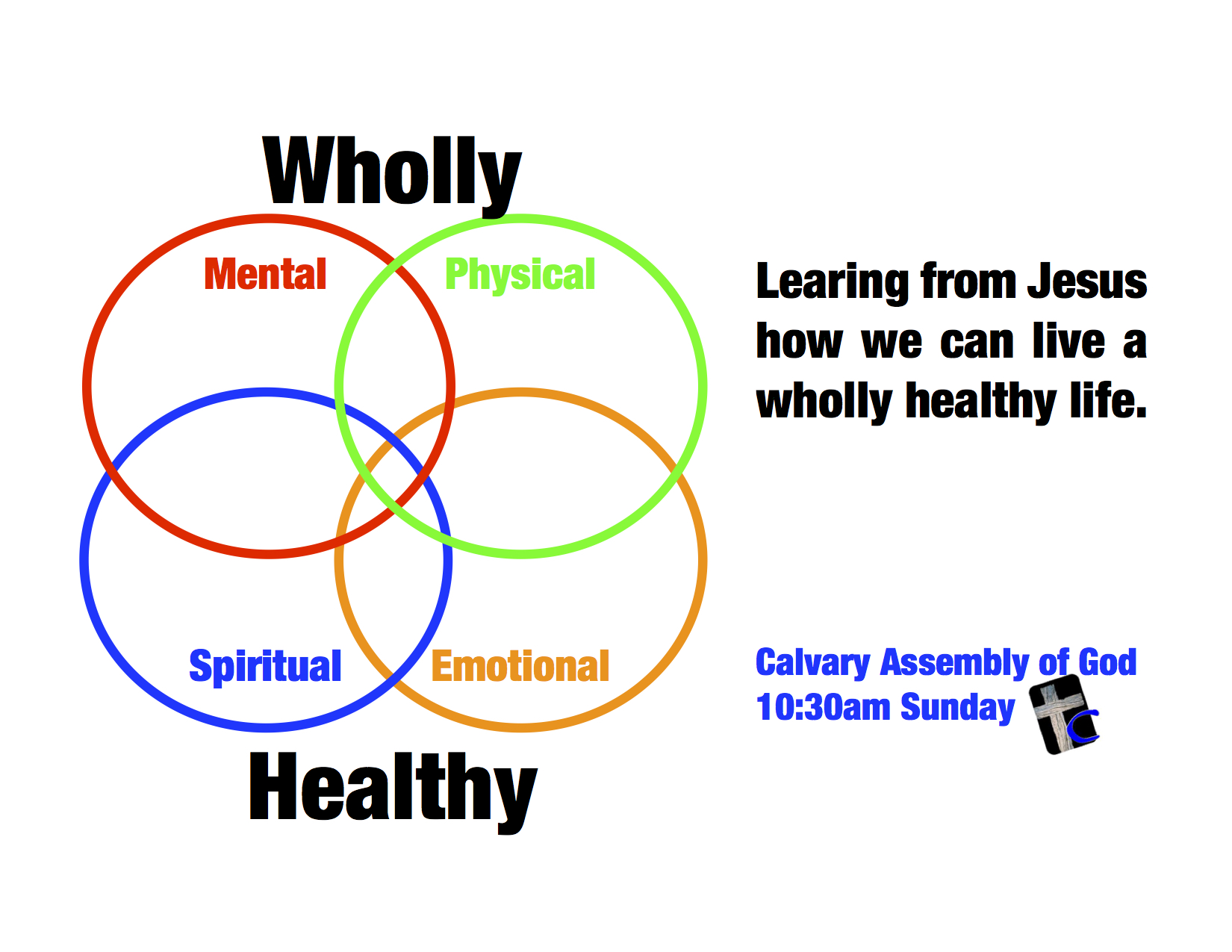
wholly-healthyHave you ever been tiptoeing through your house in the dark and stubbed your pinky toe? When that happens, is it only your pinky toe that hurts? No! It seems like your whole body gets into the action!

This is a simple way to understand that what affects one part of our life affects all parts of our life. We can’t simply quarantine one part that is having difficulty because that one part will eventually spread its pain everywhere else.

Humans were created as beings with several integrated parts. We have a physical body, we have a mind, we have emotions, and we have a God-breathed soul. If one of these parts becomes diseased, eventually all of the other parts will be affected, unless something is done to bring healing.

If we are dis-eased in any area, our health will be compromised in all areas.

Fortunately for us, Doctor Luke noted something about the health of Jesus during His earthly life. What Luke shows is how God intends for all of us to live—wholly healthy.

Modern medical science and psychology show us what the Bible pointed out long ago: We are integrated beings, and every part needs to be functioning optimally so that our whole being can function optimally.

Join us this Sunday as we begin a new series called Wholly Healthy. You will not only learn the importance of being aware of your health in four key areas, but you will also learn some practical thoughts for maintaining your optimal health.

If you missed any of the messages in this series, check them out here:

#MOWT

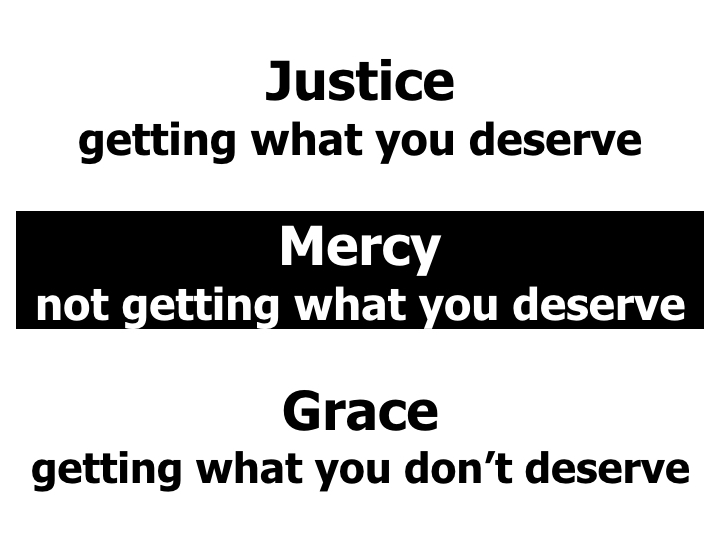
justice-mercy-graceLast week I blogged about justice, mercy, and grace. Justice is getting the penalty we deserve, mercy is not getting the penalty we deserve, and grace is getting blessings we don’t deserve.

If we are truly grace-full people, then we should be thank-full people as well. As we approach Thanksgiving Day, people are naturally thinking about things for which they can give thanks during this past year. But Christians should be the most full-of-thanks people on the planet, because we have been showered with so much grace! 

I’d like us to think about a word that I believe will increase our level of thankfulness: Appreciation. Appreciation goes beyond merely being thankful for blessings, as it sees the high value in those blessings, and then continually looks for ways to express even more gratitude for them. In other words, appreciation can begin a cycle of gratitude that grows and grows and GROWS!

Check out three parts to the definition of appreciation

[1] Gratitude; thankful recognition. Did you know that being grateful is actually good for you? Research has shown that increasing your gratitude levels increases your:

  • Physical health. “A state of gratitude, according to research by the Institute of HeartMath, also improves the heart’s rhythmic functioning, which helps us to reduce stress, think more clearly under pressure and heal physically. It’s actually physiologically impossible to be stressed and thankful at the same time” —Jon Gordon
  • Emotional health. Dr. Robert Emmons says gratitude decreases envy, resentment, and feelings of retaliation; and increases empathy, emotional resilience, and self-esteem.
  • Spiritual health. Notice how ingratitude is included in the list of a whole lot of ugliness (2 Timothy 3:1-4), but spiritual health is restored simply by being thankful (Ephesians 5:3-4).

[2] Estimating qualities and giving them their proper value. In order to determine value, we must have a standard of comparison. What’s your standard? Is it what your neighbor has? Is it what you don’t have? Or is it thankfulness for what God has given you? 

Max Lucado said, “To reflect on your blessings is to rehearse God’s accomplishments. To rehearse His accomplishments is to discover His heart. Gratitude always leaves us looking at God and away from dread.”

[3] Assessing the true worth of our blessings. Assessing leads to appreciation, and appreciation begins to give us a return on investment. I like how Jeff Anderson says it: “If you want to grow your faith, grow your gratitude. To grow your gratitude, take time to count your blessings.”

Remember: gratitude isn’t gratitude if it isn’t expressed. David made his gratitude known, and other afflicted people around him began to join with him in thanking God for His blessings (see Psalm 34:1-3). In other words, David’s thanksgiving went viral!

mowtHere’s how we can make our gratitude go viral: #MOWT. Let’s count our blessings every day, and let’s appreciate what God has done for us. Then let’s share our gratitude not only with God, but with others as well. Post it on Facebook or Twitter or Instagram with #MOWT: my one word thanks. Maybe include a photo and “family” #MOWT, or “protection” #MOWT, or even “paycheck” #MOWT.

Let’s give God so much glory for His grace gifts, that we tell the world about our appreciation!

Thursdays With Oswald—The Harmony Of Health

Oswald ChambersThis is a weekly series with things I’m reading and pondering from Oswald Chambers. You can read the original seed thought here, or type “Thursdays With Oswald” in the search box to read more entries.

The Harmony Of Health

     Health, or physical harmony, is a perfect balance between our organism and the outer world. … The great error of the healthy-minded cult is that it ignores a man’s moral and spiritual life. … The attitude to sickness in the Bible is totally different from the attitude of people who believe in faith-healing. The Bible attitude is not that God sends sickness or that sickness is of the devil, but that sickness is a fact usable by both God and the devil. 

   Happiness or moral harmony is a perfect balance between our inclination and our environment. … The Bible reveals that a man can have physical health at the cost of his moral welfare, and happiness at the cost of spiritual welfare. 

   Holiness, or spiritual harmony, is a perfect balance between our disposition and the law of God. … 

   The devil tries to make us think that when we have entered into the sanctified life, all is done; it is only begun. We have entered into Jesus Christ’s finished work, but remember, says Paul, you have attained to nothing yet; everything is perfectly adjusted, now began to attain and to “grow up into him in all things. These three things develop slowly together: first, the basis of spiritual holiness; second, the building of moral happiness; and third, the decoration of physical health. A full-grown man in Christ Jesus is one who has become exactly like Christ Jesus. “Till we all come…unto the measure of the stature of the fullness of Christ” (Ephesians 4:13). 

From The Philosophy Of Sin

Quite simply Oswald Chambers identifies health as a perfect balance:

  • Physical health balances outside germs against inside defenses.
  • Emotional health balances outside circumstances with inside coping mechanisms.
  • Spiritual health balances God’s law (outside) with our obedience to that law (inside).

Furthermore, Chambers says that Jesus Christ is our measuring stick. We must study God’s Word, and watch Jesus closely to see how He lived out the perfect balance of the Scriptural principles so that we can attain “unto the measure of the stature of the fullness of Christ.”

7 Tips For A Better Night’s Sleep

Psalm 4.8It’s no secret that being tired can lead to a lot of not-so-nice consequences. Everything from automobile crashes, to poor work performance, to foot-in-mouth statements, to giving in to temptations, to health issues are all traced back to not getting enough peaceful sleep.

But did you know that sweet sleep is something God wants to give you?

Psalm 127 says, “God grants sleep to those He loves.” Guess what? God loves you, and wants you to have a peaceful night’s sleep!

Here are some benefits to getting solid sack time:

  1. Muscles are repaired—the body “turns off” muscles during sleep so they can repair themselves.
  2. The hormone leptin, that regulates your appetite, is adjusted.
  3. Your blood pressure is lowered.
  4. Your heart rate is lowered.
  5. The energy-producing cells we all need are restocked.
  6. Your immune system is re-energized.
  7. Memories are consolidated from short-term memory banks to long-term memories.
  8. The hormones that allow you to concentrate are replenished.
  9. Your “database” of decision-making options is re-calibrated.
  10. Bottom line—you get healthier physically, mentally, emotionally, relationally, and spiritually.

All of this God wants to give to those He loves. “God loves me, so I’m going to sleep peacefully tonight!”

The problem is we often sabotage God’s blessing of sweet sleep by our own poor decisions during the day. So here are seven things you can do to cooperate with God’s blessing of sleep:

  1. Reduce stress. Stress causes your body to release cortisol, which prepares your body for fight-or-flight. This means when you’re trying to quiet down for the night, your body is still screaming, “Go, go go!” Stress is mainly triggered by worrying over things outside of our control, so check out what Jesus said to us about not worrying—Matthew 6:25-34.
  2. Reduce late-day caffeine. Caffeine has a half-life of six hours, so if you are pouring it into your body late in the date, you might fall into bed exhausted but the caffeine is keeping your brain buzzing. As a result, you don’t have the normal deep sleep patterns.
  3. Eliminate emotional caffeine. Arguments with other people release cortisol and adrenaline in your bloodstream. If these disagreements are happening later in the day, your body is fighting against God’s plan for your tranquil sleep. So take care of any disagreements quickly (Ephesians 4:26).
  4. Exercise. Getting some movement into your daily routine flushes cortisol and adrenaline from your bloodstream.
  5. Go to bed and get up at the same time. There’s a reason God made the sun to rise and set at predictable times. Your body also functions best on a predictable schedule.
  6. Reduce “blue lights” close to bed time. The blue light waves of dawn tell our bodies to stop releasing melatonin, the sleepy hormone. The red light waves of dusk tell our bodies to increase melatonin so we can go to sleep. But when we’re staring into the blue light of our phones and tablets, our body is being sent a conflicting signal.
  7. Pray. Two great passages you can pray before bedtime are Psalm 4:8 and Proverbs 3:24. Claim those promises of sweet sleep!

God loves you. He wants to give you the blessing of peaceful sleep. If you’re going to sleep peacefully tonight, make sure you are not sabotaging what God wants to give you.

If you’ve missed any of the messages in this series, you can access the complete list by clicking here

Break Free From Porn—5 Quotes That Will Help You

The Porn CircuitThe Porn Circuit is a great book to make you aware of the dangers of pornography. You can read my full book review of this free downloadable book here, and check out the first set of quotes I shared by clicking here.

Here are some additional quotes specifically to help you break free from the hold pornography has on your life.

Your #1 strategy … LEARN TO HATE PORN!

Hate what it does to you, to your relationships, and to those involved in sex trafficking because of the porn industry.

#2 … Create some positive activities you can do when you’re tempted to look at porn.

“The prefrontal cortex is the decision-making logical part of the brain, and each time that a person resists temptation and each time a positive habit is reinforced, the prefrontal cortex gets stronger. That means a person’s willpower grows and the cues and cravings for porn use grow weaker.”

“This approach (of introducing positive habits) makes plastic sense because it grows a new brain circuit that gives pleasure and triggers dopamine release which, as we have seen, rewards the new activity and consolidates and grows new neural connections. This new circuit can eventually compete with the older one, and according to use it or lose it, the pathological networks will weaken. With this treatment we don’t so much ‘break’ bad habits as replace bad behaviors with better ones.” —Dr. Norman Doidge

“Whatever rewarding activity is pursued, it needs to be an activity that is reoccurring. Building new rewarding neural pathways requires time and ongoing repetition:

  1. Neurons that fire together wire together. Repeating a pleasurable activity instead of the compulsive activity, such as porn use, forms a new circuit that is gradually reinforced instead of the compulsion.
  2. Neurons that fire apart wire apart. When a person refuses to act on a compulsion, like porn and masturbation, it weakens the link between the activity and the idea that it will provide relief.”

#3 … Start using the 3-second rule.

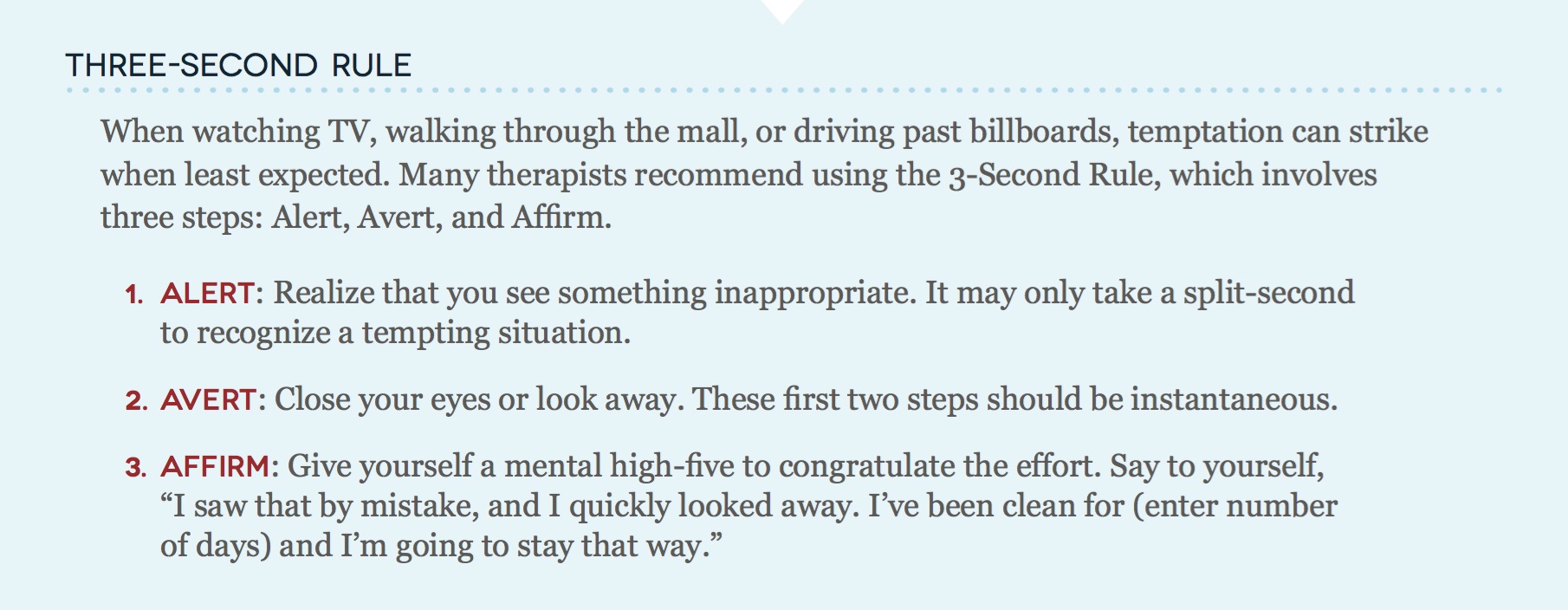
“When watching TV, walking through the mall, or driving past billboards, temptation can strike when least expected. Many therapists recommend using the 3-Second Rule, which involves three steps:

  1. Alert: Realize that you see something inappropriate. It may only take a split-second to recognize a tempting situation.
  2. Avert: Close your eyes or look away. These first two steps should be instantaneous.
  3. Affirm: Give yourself a mental high-five to congratulate the effort. Say to yourself, ‘I saw that by mistake, and I quickly looked away. I’ve been clean for (xx number of days) and I’m going to stay that way.’”

3-Second Rule

#4 … Don’t forget to watch out for H.A.L.T. times.

“Physical care is vital to vigilance. HALT is the acronym often used by therapists to remind people of when they can be most vulnerable it stands for: hungry, angry, lonely, tired. Simply going to bed on a regular schedule to get a good night’s rest can help one’s brain be more focused on positive habits and more alert to fight temptations. Not only eating but also eating well can improve mood and feelings of well-being. Regular exercise keeps the mind more focused, the body feeling great, and improve sleep.”

Links & Quotes

link quote

“Paul says ‘whatever you do’—even down to such everyday things as taking a meal—do it in order to glorify God [1 Corinthians 10:31]. Apparently there are ways of using culture—our table manners, language, style of dress, way of working, how we drive our car and care for our homes, the use we make of TV and films, the emails we write, the phone calls in which we become involved, and all the rest of our culture—there are ways of using such everyday things that will allow us to signal to the world around us that we are aware of an obligation in such cultural activities that extends beyond our own puny selfish interests. We seek the glory of God in our use of culture.” —T.M. Moore

“To be fully free, we must have the desire, the ability, and the opportunity to do what will make us happy forever. No regrets. And only Jesus, the Son of God Who died and rose for us, can make that possible. If the Son shall set you free, you shall be free indeed [John 8:31-32].” —John Piper

Here is what is sad to me, many people buy into what George Lord Byron wrote, speaking of Socrates: “Well didst thou speak, Athena’s wisest son, ‘All we know is nothing can be known.’” We can know through our relationship with Jesus Christ.

“Heaven will solve our problems, but not, I think, by showing us subtle reconciliations between all our apparently contradictory notions. The notions will all be knocked from under our feet. We shall see that there never was any problem.” —C.S. Lewis

“Pleasure is not a quick fix, it can be a thief, it will undermine happiness. Eventually, pleasure loses its pleasure and becomes a prison.” —Andy Stanley

If you have ever been hurt by your church, first of all: my heart breaks with yours … that should never have happened. But if it did, this post may help you in overcoming your hurt.

We must be in prayer! Every five minutes, a Christian is martyred for their faith somewhere in the world.

[VIDEO] J. Warner Wallace, a cold case detective, talks about how he uses his investigative skills to explain the origin of life from non-life—


8 More Powerful Relationship Quotes

Keep Your Love OnI have shared a couple of sets of quotes from Danny Silk’s book Keep Your Love On! (which you can read here and here). I have also posted a review on this book here.

This book is a must-read for pastors or counselors who do marriage or family counseling. This is also an excellent book to read if you have a relationship in your life that you would like to see healed or strengthened. Check out a few more quotes below.

“If you cannot communicate your needs to another person clearly, it is obviously going to be very difficult for that person to meet them. That’s why one of the primary tasks of reaching maturity is learning how to express thoughts, feelings, and needs. Those who never learn this skill, however, expect relationships to function without it. They say things like, ‘Well, if you love me, then you will just know what I need. Didn’t you notice that that bothered me? Haven’t you been paying attention? I can’t believe you don’t know that about me.’ Where does this desire or expectation that loved ones have a telepathic ability to know our feelings and needs come from? It comes from powerlessness and fear. It comes from dreaming that everything will turn out magically without actually having to communicate. Powerless people want to win the lottery, get their dream girl/guy with minimal effort, lose weight without exercise, and get their needs met without ever having to say a word.”

“The reason we can’t get our needs met without expressing them is that we were designed to have our needs met through a relational exchange. God made us this way. … Think about it. God, the one Person in the universe Who knows all things, and knows us incomparably better than we know ourselves, never says, ‘Well, obviously I know your needs, so you don’t need to tell Me about them.’ Instead, He repeatedly tells us to ask Him for what we need, and gives us some of the most profound, beautiful, and honest language for doing so—like the Lord’s Prayer, and most of the Psalms. He won’t meet our needs outside of a connection where we have to show up and crack our hearts open to Him, because that very connection is what we need to have our needs met in the first place.”

“If you want to protect your connection and build trust by always communicating respectfully, then your guiding rule must be, ‘It’s my job to tell you about me, and your job to tell me about you.’ The best tool for telling another person about you is an ‘I message.’ The basic structure of the ‘I message’ is: ‘I feel [emotion] when [described experience] and I need to feel [emotion].’” 

“As you construct an ‘I message,’ make sure that you are really expressing a feeling, not an opinion. … If you start to say, ‘I feel like…’ you should stop and check yourself—because what is most likely going to follow is not a feeling, but a judgment. And a judgment statement is actually an expression of mistrust, not trust.”

“Intimacy—‘into-me-see’—is created between two people who can say, ‘We can be ourselves together because you can see into me and I can see into you.’ The experience of intimacy—of being completely known and accepted, and completely knowing and accepting in return—is the most satisfying experience we can have as humans. Intimacy in a safe place brings euphoria. Remember the Garden of Eden? Paradise was the place where a man and a woman were unafraid to be vulnerable and intimate with each other in every way. The problem is that most of us are scared to death to be vulnerable in relationships. The reason is simple: In being vulnerable, we reach for our greatest need while risking our greatest pain.”

“Fear of rejection and shame sets us up to fall for the enemy’s counterfeits. Ever since sin entered the world and humanity became disconnected from God, we have been looking for ways to get our needs met outside of relationship or any scenario where we are required to be vulnerable and risk our hearts. We have always desperately sought the benefits of intimacy without wanting to pay the price. And the enemy continues to offer us the euphoric experiences we think we can control—things like alcohol, drugs, sex, Internet pornography, shopping, carbohydrates, adrenaline, or cash. We use these things to give ourselves a euphoric release and take care of our needs. But the counterfeits always have ugly repercussions, like drunk drivers killing innocent people, young kids destroying their brains, men ignoring the beautiful real women beside them in favor of the images, serious debt, morbid obesity and the host of diseases that accompany it, thrill seekers slowly becoming numb to reality, and selfish jerks not caring who they step on to get what they want. Counterfeits never come through.”

“Every respectful conversation needs one speaker and one listener at all times. … The listening role is the true servant role in a respectful conversation. The listener affirms, ‘Right now, this conversation is about you and your needs. I am here to help you figure them out and find a way to help you get them met.’ But in the end, the listener is really the winner. If I listen well, I will have two vital pieces of information—what you need and what I need to do. With these two pieces of information, I start to identify and take ownership of the problem and create an effective solution.”

“A skilled listener with a servant’s heart is the deadliest weapon against the fear-bombs that threaten connection.”

10 Quotes On Emotional Health From “Brain Savvy-Leaders”

Brain-Savvy LeadersOur emotions start in our brain. Charles Stone wrote a very helpful book called Brain-Savvy Leaders, in which he covers a lot of ground inside our heads. One aspect is our emotional health. I encourage you to read my review of this book by clicking here. Below are some quotes Charles shared on our emotional health.

“Gratefulness is actually good for brain and body health.” 

“When the emotionality of leaders takes over, they compromise their ability to lead well in these ways:

  • impulse can overwhelm intention
  • imagination gets pushed aside by instinct
  • defensiveness stifles healthy positions
  • automatic behavior shuts down reflective thought
  • emotionality gets in the way of intentionality.”

“Fear, conscious and unconscious, is prompted by the amygdala. The brain naturally focuses on problems and the negative. It overestimates threats and underestimates opportunities. In fact, two-thirds of the brain cells in our amygdala are primed for negativity and fear. Negative networks in our brain outweigh positive ones by five to one. And negative emotions are more easily consolidated (made more permanent) into our long-term memory than positive emotions.”

“Fear can even be subconscious, especially if we’re surrounded by bad news, critical people, or if our self-talk is constantly negative.”

“Neuroscientists have found that stuffing, denying, or a ignoring our emotions reinforces them, affects short-term memory, increases blood pressure, and robs our brain’s prefrontal cortex of the mental energy it needs.”

“Although it may seem counterintuitive, tagging your emotions, through labeling and naming them by putting feelings into words, actually recruits our impulse break and dampens activity in our panic alarm.”

“Anger is the wind that blows out the lamp of the mind.” —Chinese Proverb

“Since our brains process and remember bad events more thoroughly than good ones…it’s vital that we develop the discipline of being aware of our thoughts. … Thinking about our thinking is called ‘metacognition.’”

“Emotions play a significant role in decision-making and influence how well your team will embrace change. Just presenting facts without engaging positive and hopeful emotions will seldom move your team forward. The brain can only handle so much change at once. Trying to create too much change too quickly can engage the brain’s fear center and cause an away response, thus hindering change.”

“In one research study in Israel, Dr. Tal Shafir looked at the impact of movement on the brain of twenty-two young male and female participants. They looked at video clips of actors performing various emotions that corresponded to sad, fearful, happy, or neutral. Happy movements included raising their arms in the air, skipping, and jumping. Sad movements included closing their chests and slumping forward. The participants then either mimicked the movements or imagined themselves doing them. The emotions they reported mirrored the corresponding movements. So, if you need a mood boost, keep a good posture or throw your arms up and out into the air.”

Previously I shared some other quotes from this book on how we learn, and on how to keep our brain healthy. Please check these out too.

Links & Quotes

link quote

“Sing, O heavens! and rejoice, O earth! Man’s extremity is God’s opportunity.” —George Whitefield

“Health for sick humanity! Medicine for a diseased world! A Physician for a dying race! Such are the messages which we bring. All of them overflowing with God’s great love to sinners.” —Horatius Bonar

TAKE ACTION: House Democrats have introduced a bill to force American taxpayers to pay for the murder of children! Contact your House representative to encourage them to vote NO.

This is very clever: Gregg Farah summarized every chapter of the Bible in two words or less.

So excited for our local high school teacher Dave Stuart, who is a finalist for Teacher of the Year!

Patrick Morley has a great suggestion for making deposits in your spouse’s emotional bank account.

Links & Quotes

link quote

“While it’s true we need to shape up our practice of the faith, now is no time for shying away from engagement for the Gospel. Now is the favorable time for Christians to declare and defend the Christian worldview. Now is the day of salvation, and all believers must be diligent in proclaiming the Good News at every opportunity and by every means.” —T.M. Moore

“If you tell the world that Jesus is your Lord, your Savior and your Healer, a God Who can perform the impossible, they will watch to see how you react in impossible situations. Their eyes are glued to everyone who boasts of God’s goodness, power and glory. And the devil looks on, too, hoping our faith will fail.” —David Wilkerson

“There is a great God of grace Who magnifies His own infinite self-sufficiency by fulfilling promises to helpless people who trust Him. And there is a power that comes from prizing this God that leaves no nook and cranny of life untouched. It empowers us to love in the most practical ways.” —John Piper

“When your ethnicity is heaven, then all adversity offers the gift of intimacy, driving you into the home of His heart.” ―Ann Voskamp

Spiritual leaders need to be emotionally healthy. Peter Scazzero has written a couple of books on this topic, and I believe this interview will entice you to check out his books.

Ty Cobb is hands-down my favorite Detroit Tiger (maybe even my all-time favorite baseball player). He has gotten a bad rap from shoddy reporting. A Terrible Beauty is on my Amazon wish list (hint, hint!), and here is a cool interview with the book’s author Charles Leerhsen.

Jesus encouraged His followers to be childlike in their innocence and wonder. Here’s a great post to help us do that: How Not To Be A Boring Adult.

[VIDEO] Bobby Conway gives a good explanation of an important piece of church history: The Apostles Creed—