Links & Quotes

One of the things that contributes to “quiet quitting” is a lack of passion. But when the leader has conveyed a compelling vision for all that the organization is doing, that vision fuels the passion to work excellently. Vision can change a “have to” attitude into a “get to” attitude. Check out the full conversation Greg and I had about quiet quitting on the Craig And Greg Show. I have lots of new content every week, which you can check out on my YouTube channel.

“One important key to success is self-confidence. An important key to self-confidence is preparation.” —Arthur Ashe

“Strange as it may seem, the first rule of gracious speech is sincere listening: ‘So then, my beloved brethren, let every man be swift to hear, slow to speak, slow to wrath’ (James 1:19). Being an attentive and sincere listener is like cutting a swath through the jungle. It creates a path along which conversations can develop and people can journey together.” —T.M. Moore

J. Warner Wallace discusses how scientists who were Christians used their biblical worldview to drive their scientific pursuits. As a result, Christian scientists have been awarded more Nobel Prizes than any other group of scientific contributors!

“The devil will not stand by quietly and watch his realm decline and erode. He counterattacks with rage; his onslaught is fierce. One of the tricks he uses is to preoccupy Christian workers with issues that are detrimental to a healthy relationship with Christ. The scenario is all too familiar: a Christian worker gets busy in the ministry and work takes priority over relationship with God. He no longer has the time to sit at Jesus’ feet in quiet solitude and listen to God’s Word. Spiritual emptiness comes unnoticed and with it vulnerability to satan’s sifting (Luke 22:31-34); dishonest handling of monies or power or an illicit relationship is justified, and whoa! immorality has lured and sent such a Christian worker tumbling. He commits what he has preached against. Sin is dangerous. Sin is destructive. Its price is very costly—separation from God, irreversible stigma, damage to family relations, loss of ministry, loss of reputation, a black mark on God’s work, and the list goes on.” —Sobhi Malek

Our Creator gave us an amazing gift of the human brain! I love the fascinating new discoveries that scientists are continuing to make. Like this one: “To be spatially capable creatures, humans need their brains to tell them 1) where things are in relation to themselves and 2) where everything is in relation to everything else—the so-called allocentric map of space. To navigate an environment, the brain seems to generate a mental representation of its surroundings. This is often called a cognitive map.” Read more about our cognitive map here.

I hope you have had a chance to see the movie “Sound of Freedom.” Thankfully, this has gotten a lot of people talking about how to eliminate sex trafficking. Fight The New Drug has an excellent post on how you can spot and report human trafficking, and you should also check out Operation Underground Railroad, which was founded by Tim Ballard (whom Jim Caviezel portrays in the movie).

“It will be a comfort to me all my life to know that the scientist and the materialist have not the last word, that Darwin and Spencer, undermining ancestral beliefs, stand themselves on a foundation of sand.” —C.S. Lewis

Conquering Two Roadblocks To Sabbathing

Listen to the podcast of this post by clicking on the player below, and you can also subscribe on AppleSpotify, or Audible. 

I thought it was very appropriate that I got to be a guest on the Thriving In Ministry podcast with Kyle Willis while his podcast partner Dace Clifton was on sabbatical. It was appropriate because Kyle and I talked about the importance of pastors finding time to rest. 

Proper rest is absolutely vital for longevity and vitality. I hope you will listen to this short segment from this conversation. 

I shared with Kyle two main roadblocks to sabbathing. 

(1) Trying to be something you’re not. 

We are all wired differently. God wired us that way on purpose. So if you’re an early bird, guard those morning hours for your creative work and use the evenings for rest. If you’re a night owl, don’t try to copy the early birds, but rest early in the day and do your creative work when you are at your best. 

→ So the key concept to overcoming this roadblock is personalization. 

(2) Getting distracted by the non-essentials. 

Two things have really helped me with this one: Sticking to sustainable daily routines, while at the same time being sensitive to the Holy Spirit’s redirection (check out my post on the idea I call I.T.L.W.). 

→ The key concept here is flexible focus. 

I talk more about this concept of sabbathing and a leader’s overall healthiness in my book Shepherd Leadership. You can also check out some other posts about sabbathing by clicking here.

►► Would you please prayerfully consider supporting this ministry? My Patreon supporters get behind-the-scenes access to exclusive materials. ◀︎◀︎

Thursdays With Spurgeon—Prayer Preparation And Prayer Expectation

This is a weekly series with things I’m reading and pondering from Charles Spurgeon. You can read the original seed thought here, or type “Thursdays With Spurgeon” in the search box to read more entries.

Listen to the podcast of this post by clicking on the player below, and you can also subscribe on AppleSpotify, or Audible. 

Prayer Preparation And Prayer Expectation

In the morning, Lord, You hear my voice; in the morning I lay my requests before You and wait expectantly. (Psalm 5:3) 

     Do we not miss very much of the sweetness and efficacy of prayer by a want of careful meditation before it, and hopeful expectation after it? … We too often rush into the presence of God without forethought or humility. We are like people who present themselves before a king without a petition, and what wonder is it that we often miss the end of prayer? We should be careful to keep the stream of meditation always running, for this is the water to drive the mill of prayer. … Prayer without fervency is like hunting with a dead dog, and prayer without preparation is hawking with a blind falcon. Prayer is the work of the Holy Spirit, but He works by means. God made man, but He used the dust of the earth as a material. The Holy Ghost is the Author of prayer, but He employs the thoughts of a fervent soul as the gold with which to fashion the vessel. Let our prayers and praises be not the flashes of a hot and hasty brain but the steady burning of a well-kindled fire.

From Spurgeon And The Psalms

Sadly, I think we’ve become so accustomed to instant-everything in our society that it has seriously limited our prayer life. We walk into our prayer closet without an idea of what we’re going to pray, rattle off a few requests, say “Amen,” and walk out of our prayer closet exactly the same as we walked in. 

There is certainly help for us when we are so distressed—so at our wits’ end—that we don’t even know what to pray, but this is not what David is saying in Psalm 5. David is making it a regular practice to come into God’s presence with his requests at the ready, and he is walking away from his prayer time in eager expectation of God’s soon-to-be-realized answers. 

The Amplified Bible says, “I prepare a prayer…and watch and wait for You to speak to my heart.” 

I think it is a good idea for us to:

As Spurgeon said, “Let our prayers and praises be not the flashes of a hot and hasty brain but the steady burning of a well-kindled fire.”

►► Would you please prayerfully consider supporting this ministry? My Patreon supporters get behind-the-scenes access to exclusive materials. ◀︎◀︎

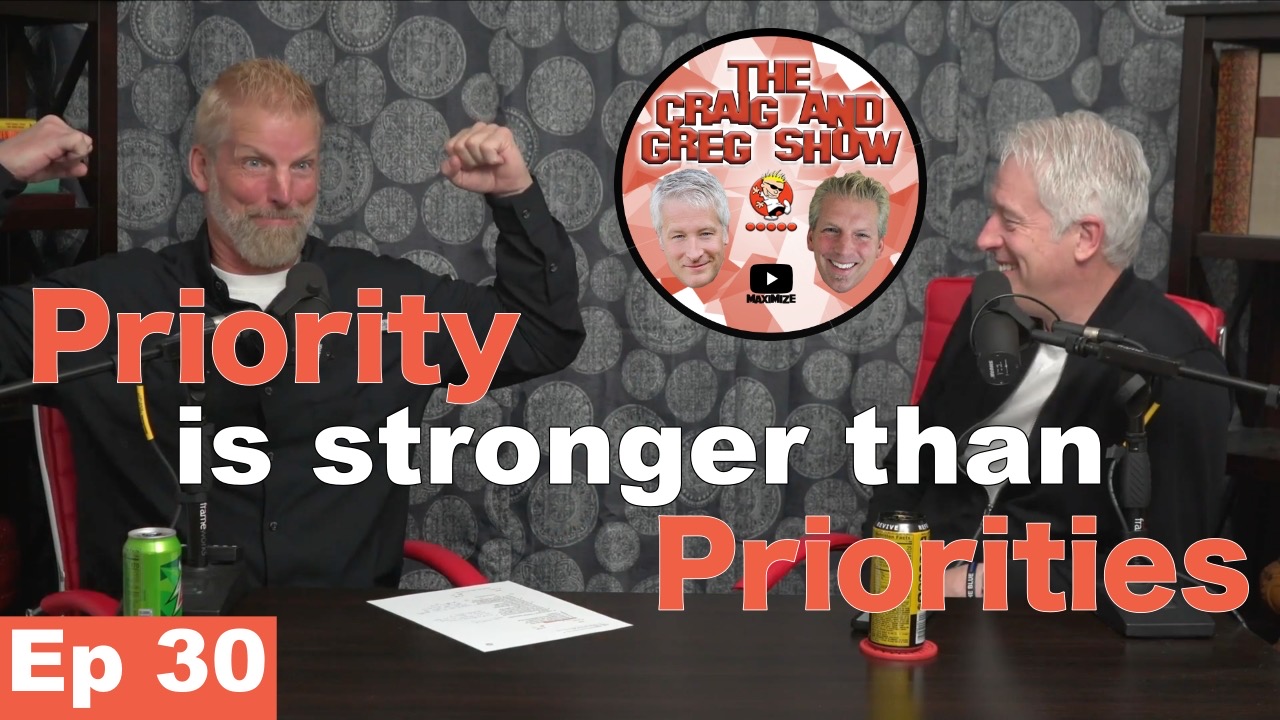
The Craig And Greg Show: A Leader’s Top Priority

Listen to the audio-only version of this podcast by clicking on the player below, or scroll down to watch the video.

On this episode of “The Craig And Greg Show” we talk about: 

  • [0:38] What are the origins of the word “priority” and why should priority be singular and not plural? 
  • [0:56] Is it true that multi-tasking increases efficiency? 
  • [2:52] Greg tells a story about shopping with his parents.
  • [3:55] Greg reminds us that the devil uses distraction as a tool.
  • [5:04] I talk about how leaders should set their first priority.
  • [6:32] Why is it so hard to invest in unavailable people?
  • [7:58] I explain how leaders can make time for their “have to” list.
  • [9:58] Greg loves “StrengthFinders” and how it helps leaders learn to work in their strength zone.
  • [10:52] We discuss the book No Is A Beautiful Word.
  • [12:42] How can leaders use the priority vs. priorities paradigm to create margin in their life?
  • [14:36] We throw out the “Not-To-Do List Challenge” for leaders.

Check out this episode and subscribe on YouTube so you can watch all of the upcoming episodes. You can also listen to our podcast on Spotify and Apple.

4 + 4 Strategies To Eliminate Distractions To Your Prayer Time

There’s a quote that has been the theme for this series on prayer: “Prayer pursues joy in fruitful fellowship with Jesus, knowing that God is glorified when we bear fruit in answer to prayer. Why do God’s children so often fail to have consistent habits of happy, fruitful prayer? Unless I’m badly mistaken, one of the reasons is not so much that we don’t want to, but that we don’t plan to.” —John Piper 

And unless I’m badly mistaken, the most obvious thing we need to plan to eliminate is distractions. 

Some people say they can juggle a lot of things at once. “I’m a really good multitasker,” they say. But science says differently. MIT neuroscientist Earl Miller concluded that our brains are “not wired to multitask well…. When people think they’re multitasking, they’re actually just switching from one task to another very rapidly. And every time they do, there’s a cognitive cost.” What is that cognitive cost? “Multitasking can drop IQ as much as 15 points, essentially turning you into the cognitive equivalent of an 8-year-old” (Inc. Magazine). 

If the devil can make you think you can multitask prayer with other things, he has seriously inhibited the effectiveness of your prayers. 

Jesus was not a multitasker—but He was singularly focused on His Father’s plan. And yet He accomplished more in His three years of public ministry than anyone else in history! 

Here are 4 strategies to help you get ready to pray:

  1. Try to have your prayer time in the same place and at the same time. Your brain likes routine and it will help you zero-in during your scheduled prayer times. 
  2. Silence your cell phone or other noisy distractions. 
  3. Keep a notepad handy for random thoughts that pop into your head. Writing them down will keep your brain from switching back-and-forth to them.
  4. Focus on listening, not on talking—Eugene Peterson said, “Prayer is first of all a means of listening. Prayer is an act of attention.” 

When we get right down to it, prayer is spiritual warfare (2 Corinthians 2:11; Ephesians 6:10-18). In the context of warfare, the word strategy means the maneuvering that takes place prior to the battle. The devil is a masterful tactician, and he will do everything he can to keep you distracted. 

That’s why three times Peter tells us to be clear-minded and singularly-focused in our thoughts SO THAT we can pray without the hindrances of distractions (1 Peter 1:13-14; 4:7; 5:8-9). And Paul tells us to take all our thoughts captive, so that no un-Christlike thoughts are inhibiting our prayer time (2 Corinthians 10:4-5). 

Here are 4 strategies to help you stay focused in prayer:

  1. A—adoration. Enter into God’s presence with a Psalm or worship music. 
  2. C—confession. Deal with unconfessed sin, unforgiveness, or relationship strife as quickly as possible (Psalm 66:18; Matthew 5:21-24). 
  3. T—thanksgiving. Paul counseled us, “Do not be anxious about anything, but in everything, by prayer and petition WITH thanksgiving, present your requests to God” (Philippians 4:6).  
  4. S—supplication. Intercede for your brothers and sisters in the battles they are facing (James 5:16; Job 42:10; Ephesians 6:18).  

Remember—

Prayer isn’t preparation for the battle; prayer IS the battle! Let’s not be distracted from that!

Poetry Saturday—Ready To Blaze

If we with earnest effort could succeed
   To make our life one long connected Prayer,
As lives of some perhaps have been and are:—
If—never leaving Thee—we had no need
Our wandering spirits back again to lead
   Into Thy presence, but continued there,
   Like angels standing on the highest stair
Of the sapphire throne―this were to pray indeed!
   But if distractions manifold prevail,
   And if in this we must confess we fail,
Grant us to keep at least a prompt desire,
   Continual readiness for Prayer and Praise—
An altar heaped and waiting to take fire
   With the least spark, and leap into a blaze! ―Richard Trench

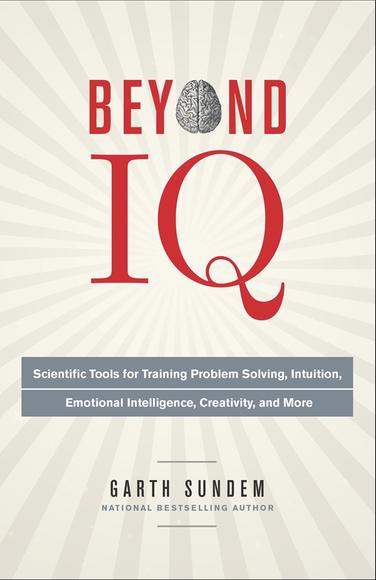
14 Quotes From “Beyond IQ”

Beyond IQI found Beyond IQ by Garth Sundem to be engaging because of both the research he presents, and the engaging exercises he incorporates to make the research applicable to us. You can read my full book review by clicking here. Here are some of the quotes I especially appreciated.

“First, here’s why insight can be difficult: it requires a paradoxical mix of experience with openness. Usually, experience leads to set-in-stone ways of doing things. Typically, openness is only present when you’re forced by inexperience to remain available in your search for solutions. Experience mixed with openness is a rare cocktail. … Rather than opening your mind to insight, [John] Kounios and [Mark] Jung-Beeman show that if you want insight, the best thing you can do is to close it. A closed mind shows up on an fMRI as activation of the anterior cingulate cortex, your brain’s home of inhibiting distraction. It’s as if your ACC is a pair of noise-canceling headphones, and with these headphones in place you’re more able to hear your brain’s quiet, insightful whispers.” 

“Science has known that during sleep the brain’s hippocampus—the structure responsible for encoding new memories—replays the day’s experiences from short-term storage and filters them into the neocortex, where experiences are integrated into… ‘pre-existing knowledge representations.’ Insight is the novel connection of knowledge, and sleep knocks knowledge into new configurations.”

“[Robert] Sternberg and his frequent collaborator, Richard Wagner, showed that situational judgment tests…designed to measure practical intelligence are a much better predictor then IQ of job performance in business managers, bank managers, and graduate students. IQ doesn’t lead to success. Practical intelligence does.” 

“The language of problem-solving is: initial state, constraints, operations, and goal state. … [Richard] Mayer says that the most striking feature of people who successfully solve real-world problems is the time they spend studying the initial state and the constraints—the extra time they spend clarifying the problem.”

“University of California-San Bernardino researcher James Kaufman knows the recipe for creativity. It’s equal parts intrinsic motivation, experience, and something he calls low personal inhibition. Intrinsic motivation is pretty self-explanatory, but beware of the danger of ‘replacing intrinsic motivation and a natural curiosity with external rewards,’ says Kaufman. If a parent wants a child to become a creative pianist, the parent should encourage interest in the piano but not incentivize this interest with ice cream. Creativity blooms in fields you’re drawn to, not in fields into which you’re pushed. … Kaufman’s research has shown that creative people are hard workers with background knowledge and expertise in their creative domains. ‘It’s the “learn the rules so you can break them” approach,’ he says.” 

“Dean Keith Simonton of UC Davis found that the nineteenth-century scientists who wrote the most-cited papers also wrote the least-cited papers. … The more scientific papers or sonatas or sonnets a person writes, the greater chance that one or more will be especially creative.”

“In any kind of cognitive activity you have two kinds of things going on. You have intelligence, but there’s also learning and skill and knowledge based on practice. The more the second develops, the less important the first becomes. … Even more importantly, we’ve shown that with enough practice and hard work, you can actually change the neurophysiology of the brain. For example, practice can encourage the brain to grow greater myelin coating on neurons. Thus our behaviors become literally hard-wired. Developing expertise literally makes certain thought patterns more efficient than others.” —Paul Feltovich 

“Florida State researcher K. Anders Ericcson shows that it’s not only experience that creates expertise but a step-by-step method of sculpting experience that he calls deliberate practice. To Ericsson, famous for his theory that 10,000 hours of practice creates expertise in any field, the four-step path to expertise includes performing your skill, monitoring your performance, evaluating your success, and figuring out how to do it better next time. Completing only the first step—performing the skill itself—leads to automated, low-level, rote performance in which you perform the skill the same way every time. Monitoring, evaluating, and adjusting your skill allows you to modify it after every pass, helping skill evolved toward expertise.”

“The more you use your brain, the longer you’ll be able to use it. … People with ‘cognitively protected’ brains were those who challenge themselves through a lifestyle that included reading, writing, attending lectures, and doing word puzzles—in other words, they followed a self-imposed regimen of cognitive involvement. … Cognitive involvement is only one tine of a three-pronged approach to brain health in later life. The second tine is a healthy body. … In fact, your cardiovascular health in middle age is even more important for your later brain health than the same risk factors in old age itself. … The third tine: social interaction. … Nothing forces the brain to work like interacting with other brains.” 

“Moral reasoning and wisdom are linked. Specifically (and this is kind of cool albeit technical), for those who possess strong moral reasoning, wisdom increases with age. If you have lower moral reasoning, you gain no wisdom as you get older. So if you want wisdom later, train your moral reasoning now.”

“Wisdom requires thought and action without yourself in mind, and sociologist Monika Ardelt of the University of Florida shows that selflessness is also the best predictor of successful aging. In fact, the wisdom born of selflessness beats out physical health, income, socioeconomic status, physical environment, and even social relationships in predicting life satisfaction in old age.”

“Pressure…sits like a lead weight in your working memory, claiming space that could otherwise hold useful information. And because working memory is a mainline to general intelligence, space claimed by pressure makes you measurably dumber. … Pressure flips a mental switch from implicit to explicit thought, making you apply a layer of analysis to things that should be automatic. … Chronic pressure can make you chronically prioritize the quick rewards of drugs and alcohol while discounting their long-term risk. … So beware. Stress plugs your working memory, analysis paralysis forces you to try to use it anyway, and your dopamine circuits cry for a quick, risky solution.”

“Students with high emotional intelligence (EI) have lower rates of drug use and teachers with high EI get more support from their principals. Employees with high EI have higher job performance, especially when their IQ is low (implying that emotional intelligence can help compensate for low general intelligence—and also that these skills are distinct). EI is even implicated in resilience—the more EI you have, the higher your chances of bouncing back after trauma or negative life events.” 

“If IQ is the strength of the bulb in your lighthouse, willpower is the lens that focuses it into a beam.”

Links & Quotes

link quote

Some great reading from today.

Why do we take a railway guide and arrange for a particular journey? … Well, one has confidence in the reliability of these official publications. As a rule we are not put to shame! Now, just as we use a railway guide we must use our Bible. We must depend on God’s Word just as we depend on man’s word, only remembering that though man may not be able to carry out his promise, God will always fulfill what He has said.” —Hudson Taylor

More archeological finds in Israel confirm the historicity of the Bible: Canaanite Fortress Discovered.

Explain to me again how this is legal (or humane!): Nurse tells grisly tale of partial-birth abortions.

The New York Post finds that tanning salons are inspected more than abortion clinics.

Medical science shows stress in the home adversely effects chromosomes in kids.

“Distractions must be conquered or they will conquer us. So let us cultivate simplicity; let us want fewer things; let us walk in the Spirit; let us fill our minds with the Word of God and our hearts with praise. In that way we can live in peace even in such a distraught world as this.” —A.W. Tozer

“If indeed the name of the eternal God is named upon us, we are secure; for, as of old, a Roman had but to say Romanus sum, I am a Roman, and he could claim the protection of all the legions of the vast empire; so everyone who is a man of God has omnipotence as his guardian, and God will sooner empty heaven of angels then leave a saint without defense. Be braver than lions for the right, for God is with you.” —Charles Spurgeon

“How one learns to be thankful for each day on which one can still do something.” —Karl Barth