Altar To Alter

Listen to the podcast of this post by clicking on the player below, and you can also subscribe on Apple, Spotify, or Audible.

The process of sanctification—or as I like remember the word: saint-ification—is the process whereby the Holy Spirit develops Christlike character in us. His process is immediate, personalized, and ongoing. In other words, the Spirit is intimately and immediately involved in every aspect of our lives.

Christlikeness in us is described in the Bible with phrases like…

  • Being made new in the attitude of your minds; and putting on the new self, created to be like God in true righteousness and holiness (Ephesians 4:23-24).
  • Conformed to the likeness of God’s Son (Romans 8:29).

The Holy Spirit is often portrayed as fire. In fact, the Bible says that Jesus will baptize you with the Holy Spirit and with fire (Matthew 3:11). This is because in order for Christlike character to be formed in us, that character will have to be forged in us. Forged in the Spirit’s fire.

Look at two examples:

  • Until the time came to fulfill his dreams, the Lord tested Joseph’s character (Psalm 105:19).
  • Even though Jesus was God’s Son, He learned obedience from the things He suffered (Hebrews 5:8).

Here’s what I’ve learned—

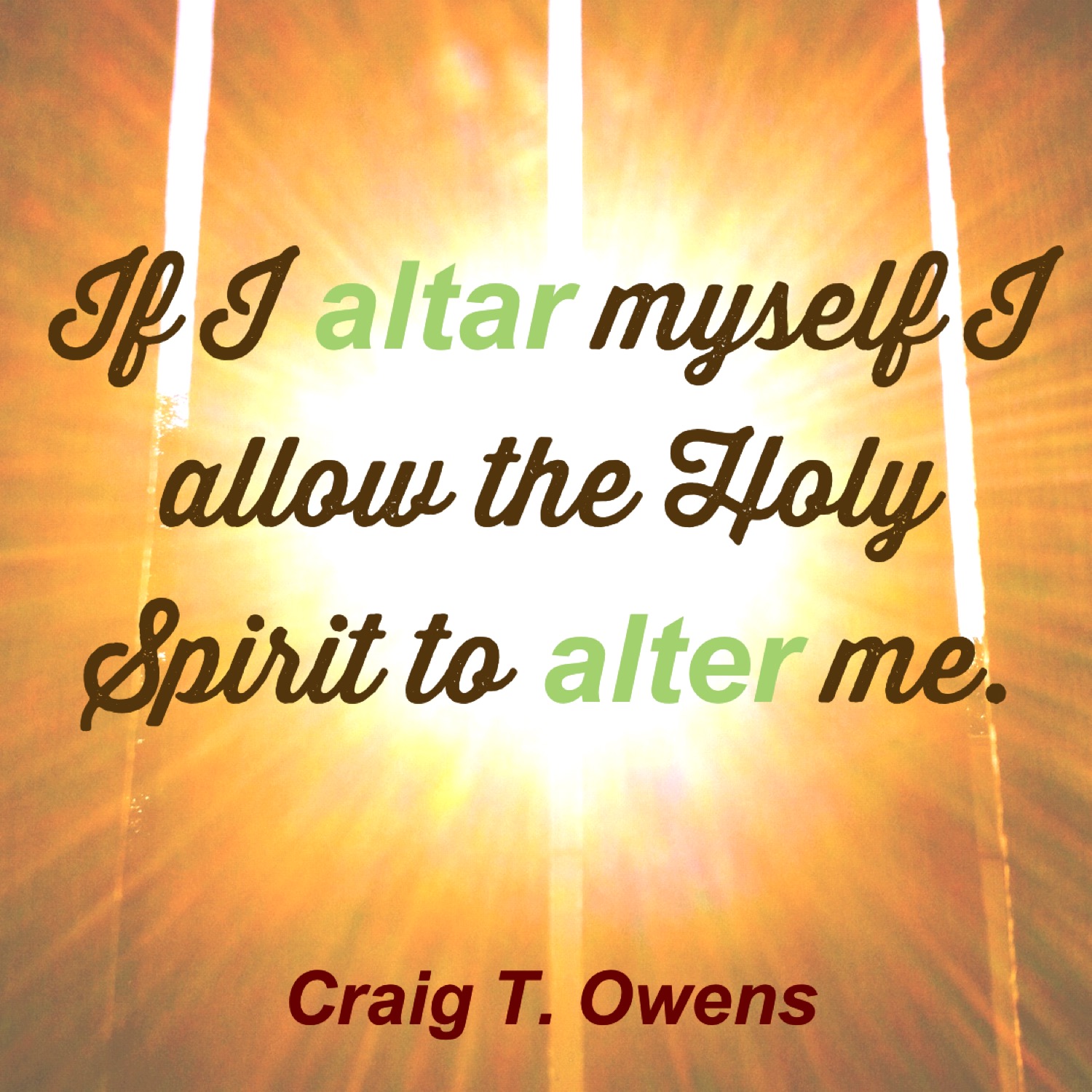
We must altar our lives so that the Holy Spirit can alter our lives.

Unless we yield to what the Holy Spirit wants to do with us, He cannot and will not bring about the changes that will lead to more Christlikeness being revealed in us.

It may be painful to altar our lives, but the apostle Paul says, “I consider that our present sufferings are not worth comparing with the glory that will be revealed in us” (Romans 8:18).

You altar, and then watch the Holy Spirit alter your life in a way that reveals God’s glory!

►► Would you please prayerfully consider supporting this ministry? ◀︎◀︎

Links & Quotes

link quote

Here are the links to some interesting reading I found this weekend.

“The dominant model of how speech works is that it is planned in advance—speakers begin with a conscious idea of exactly what they are going to say. But some researchers think that speech is not entirely planned, and that people know what they are saying in part through hearing themselves speak.” Check out more of this fascinating report You Don’t Always Know What You’re Saying.

A balanced approach is vital. “Beware any teacher or preacher who has little use for doctrine or church history.” —T.M. Moore

“Lastly, as the best advice I can give, seek more of the Spirit of God, for this is the way to become Christ-like. Vain are all your attempts to be like Him till you have sought His Spirit. Take the cold iron, and attempt to weld it if you can into a certain shape. How fruitless the effort! Lay it on the anvil, seize the blacksmith’s hammer with all your might; let blow after blow fall upon it, and you shall have done nothing. Twist it, turn it, use all your implements, but you shall not be able to fashion it as you would. But put it in the fire, let it be softened and made malleable, then lay it on the anvil, and each stroke shall have a mighty effect, so that you may fashion it into any form you may desire. So take your heart, not cold as it is, not stony, as it is by nature, but put it into the furnace; there let it be molten, and after that it can be turned like wax to the seal, and fashioned into the image of Jesus Christ.” —Charles Spurgeon

John Stonestreet has a timely reminder in his commentary Race And Redemption.

A great piece on euthanasia: What Happened To Switzerland?

Do You Smell Like Jesus?

Christ's aromaScientists tell us that the sense of smell contributes to more vivid and clear memory recall than any of the other human senses. Have you ever thought about the things Jesus smelled? Or about the memories others recalled about Jesus because of the way He smelled?

Less than a week before His crucifixion, Mary anointed Jesus with a highly-scented spice called spikenard (see John 12:1-8; Mark 14:3-9; and Matthew 26:6-13). Let me rephrase that: Mary didn’t just “anoint” Jesus as we think about that word today, she doused Him in a lifetime supply of this fragrance. Some people complained, but Jesus told those sour people that it was absolutely beautiful what she had done, as Jesus carried this aroma with Him to the Cross.

After He died on the Cross, Joseph and Nicodemus prepared Jesus for burial with 75 pounds of myrrh and aloes (see John 19:38-40). Think about that: seventy-five pounds! In doing so they actually fulfilled a prophesy from the Old Testament about King Jesus’ triumphal return to life—

Your throne, O God, will last for ever and ever; a scepter of justice will be the scepter of Your kingdom. You love righteousness and hate wickedness; therefore God, Your God, has set You above Your companions by anointing You with the oil of joy. All Your robes are fragrant with myrrh and aloes and cassia… (Psalm 45:6-8).

Jesus carried a powerful aroma with Him all the way to the Cross, into the tomb, and when He burst forth alive from the tomb! 

Without Christ, our lives carry the stench of death. We cannot come into our Heavenly Father’s presence because of that putrid smell clinging to us. But when God forgives us of our sins as we place our faith in Jesus, we are wrapped in the robes of Christ: we smell like Him and are welcomed into the Father’s presence.

Easter is a reminder of how a forgiven Christian should now live—

Live a life filled with love, following the example of Christ. He loved us and offered Himself as a sacrifice for us, a pleasing aroma to God (Ephesians 5:2).

…Now [God] uses us to spread the knowledge of Christ everywhere, like a sweet perfume. Our lives are a Christ-like fragrance rising up to God… (2 Corinthians 2:14-15).

How do you smell? Do you smell like Jesus? Are others attracted to the aroma of Christ because of what they smell in you? Smelling good honors the work Jesus did on the Cross and in overcoming the grave.

Links & Quotes

link quote

Some great reading I came across today.

I am so blessed to work at the En Gedi Youth Center every day. Here’s a great article on the youth center in Mlive.

[INFOGRAPHIC] Where Did Your Tax Money Go?

“Are you becoming more sweet-spirited, more like Jesus? Are you looking soberly in the mirror each day and praying, ‘Lord, I want to conform to Your image in every area of my life’? Or has your bitterness taken root, turning into rebellion and hardness of heart? Have you learned to shield yourself from the convicting voice of God’s Spirit?” —David Wilkerson

“Prayer at its holiest moment is the entering into God to a place of such blessed union as makes miracles seem tame and remarkable answers to prayer appear something very far short of wonderful by comparison.” —A.W. Tozer

“I find that when I think I am asking God to forgive me I am often in reality (unless I watch myself very carefully) asking Him to do something quite different. I am asking Him not to forgive me but to excuse me. But there is all the difference in the world between forgiving and excusing.” —C.S. Lewis

In Name Only

Brennan ManningPhiladelphia, as most people know is “The City of Brotherly Love.” The original Philadelphia in Asia Minor was founded in the second century BC by a man named Attalus who, quite the contrary to cultural norms, kept his brother in a position of power and influence alongside him.

Where many leaders were suspicious of anyone who could make a claim on the throne, Attalus loved (the Greek word is phileo) his brother (Greek adelphos meaning “from the same womb”), so the city took on this name and attitude as well. After the city was leveled by an earthquake in 17 AD, Emperor Tiberius sent the funds needed to rebuild. Out of gratitude to the emperor’s generosity there was a movement to rename the city Neocaesarea in his honor. But the people liked being known for their brotherly kindness, so the name Philadelphia stuck.

At least it stuck in name only. As the first century progressed, Philadelphians bowed more and more to Rome’s influence and this city once known for kindness to all began to persecute Christians.

This reminds me of the United States of America today. Our pledge of allegiance still includes “one nation under God,” and “in God we trust” is still on our currency, and we haven’t repealed the First Amendment which gives us freedom of religion. It appears that we are a “Christian nation,” but in name only.

Many cast the blame far and wide, but as Jesus addressed the people in the first city of Philadelphia (see Revelation 3:7-13), we see the blame is on those self-professing Christians who didn’t live Christ-like lives. They were Christians in name only.

For those who “have kept My Word and not denied My name” Jesus promises a list of rewards longer than the list for any of the other seven churches addressed in the book of Revelation! Those promises are still in effect for those who will not deny Christ. More specifically for those who by their words and their lifestyle hold true to Jesus Christ.

Brennan Manning was exactly right when he said, “The greatest single cause of atheism in the world today is Christians: who acknowledge Jesus with their lips, walk out the door, and deny Him by their lifestyle. That is what an unbelieving world simply finds unbelievable.”

My prayer is that Christians everywhere would be known not just by the name Christian, but by the way they hold true to Christ and His Word!

Please join me next Sunday as we look at the last of the churches in our series The 7-Star Church.

Come Holy Spirit

Come Holy Spirit [web]The Bible is so full of the amazing promises that come when we allow the Holy Spirit to move in our lives. Things like…

  • Anointing for service
  • Empowerment for telling other about Jesus
  • Answering those who criticize the gospel
  • Praying more intimately
  • Wisdom
  • Growing in Christlike character
  • Insight into difficult situations
  • Discernment
  • Creativity where there was stagnation
  • And on and on and on

With all of the blessings that come with the Holy Spirit’s move in our lives, why wouldn’t we pray more frequently, “Come Holy Spirit”?

Beginning this Sunday I will be talking about some of the roles the Holy Spirit plays in the lives of Christians. I hope you can join me each week at Calvary Assembly of God.

Thursdays With Oswald—Bitter, Dogmatic, Intolerant, And Utterly Un-Christlike

This is a weekly series with things I’m reading and pondering from Oswald Chambers. You can read the original seed thought here, or type “Thursdays With Oswald” in the search box to read more entries.

Oswald ChambersBitter, Dogmatic, Intolerant, And Utterly Un-Christlike

     Spiritual maturity is not reached by the passing of the years, but by obedience to the will of God. Some people mature into an understanding of God’s will more quickly than others because they obey more readily, they more readily sacrifice the life of nature to the will of God, they more easily swing clear of little determined opinions. 

     It is these little determined opinions, convictions of our own that won’t budge, that hinder growth in grace, and makes us bitter and dogmatic, intolerant, and utterly un-Christlike. 

From Bringing Sons Unto Glory 

Ouch! It’s so important that I read God’s Word with a heart ready to obey whatever the Holy Spirit shows me, even if it means sacrificing what I’ve always thought to be true. I must not cling to my own “little determined opinions” if I want to grow in spiritual maturity.

The contrast is crystal clear: Either I am maturing through complete obedience to God, or I am becoming bitter and dogmatic, intolerant, and utterly un-Christlike.


A Checklist For Growth

Listen to the podcast of this post by clicking on the player below, and you can also subscribe on Apple, Spotify, or Audible. 

Take just a moment to read these words from the apostle Peter—

So then, dear friends, since you are looking forward to this, make every effort to be found spotless, blameless and at peace with Him. … Therefore, dear friends, since you have been forewarned, be on your guard so that you may not be carried away by the error of the lawless and fall from your secure position. But grow in the grace and knowledge of our Lord and Savior Jesus Christ…. (2 Peter 3:14, 17-18)

How do I know I’m looking forward and growing? Here’s a checklist that needs to be reviewed regularly:

  • Am I spending more time preparing for my future than I am repairing my past?
  • Do I know that growth is both hard and rewarding work?
  • Do even the littlest of sins disturb me, rob me of peace, and send me quickly to confession and repentance?
  • Do I filter all my reading, studying, and learning through the standard of Scripture?
  • Is my faith stronger now than it was a year ago?
  • Am I exhibiting more Christ-like characteristics—grace, forgiveness, patience—now than I was last year?
  • Am I thrilled every time I get to learn more about Jesus?
  • Am I more reliant on the Holy Spirit now than I have been in the past, and do I converse with Him more frequently?
  • Would those closest to me say that I am becoming more like Jesus?

I hope we can all answer “Yes” to more and more of these items!

Growth is not automatic—this is especially true for spiritual growth. Growth must be intentional or it will not happen. I want to keep going forward in Christ!

May we add our “Amen” to Peter’s prayer: May God give you more and more grace and peace as you grow in your knowledge of God and Jesus our Lord (2 Peter 1:2).

►► Would you please prayerfully consider supporting this ministry? My Patreon supporters get behind-the-scenes access to exclusive materials. ◀︎◀︎

Thursdays With Oswald—The Realness Of The Holy Spirit

This is a weekly series with things I’m reading and pondering from Oswald Chambers. You can read the original seed thought here, or type “Thursdays With Oswald” in the search box to read more entries.

The Realness Of The Holy Spirit

     The Holy Spirit makes Jesus Christ both present and real. He is the most real Being on earth, ‘closer is He than breathing, and nearer than hands and feet.’ Simply receive the Holy Spirit, rely upon Him and obey Him and He will bring the realization of Christ….

     The Holy Spirit is seeking to awaken men out of lethargy; He is pleading, yearning, blessing, pouring benedictions on men, convicting and drawing them nearer, for one purpose only, that they may receive Him so that He may make them holy men and women exhibiting the life of Jesus Christ. How the devil does rob Christians who are not thinking on Pentecostal lines of the tremendous power of the Presence of Jesus made real by the Holy Spirit!

From Biblical Ethics

When Jesus said He would never leave us, He fulfilled this promise by sending the Holy Spirit. The Holy Spirit is our constant Guide, our wisest Counselor, our kindest Teacher, and the illuminating Spirit of Truth.

Think about this: The same Holy Spirit who inspired the writing of the Scriptures, is the same Holy Spirit Who will illuminate those Scriptures to you. How the devil does rob Christians who are not thinking on Pentecostal lines!

Holy Spirit, I willingly yield to Your illuminating and transforming presence in my life today!

Choice Four-Letter Words

Listen to the podcast of this post by clicking on the player below, and you can also subscribe on Apple, Spotify, or Audible.

Have you ever been “cursed out” by someone? I mean had a stream of four-letter obscenities hurled at you? What happens inside you? Isn’t your natural reaction to strike back? To begin to a counter-attack with a few choice four-letter words of your own?

It’s natural to feel this way; it’s a very human response.

On the other hand, have you ever been “blessed out” by someone? Had someone shower you with niceties and accolades and compliments? What happens inside you this time? Isn’t your natural reaction the complete opposite? Don’t you want to say, “Well, I think you’re pretty special, too”?

It’s natural to feel this way; it’s a very human response.

But Jesus commanded us to do something counter-cultural, something which requires a spiritual response: “Bless those who curse you” (Luke 6:28). Paul amplified this thought: “Bless those who persecute you; bless and do not curse” (Romans 12:14).

These words curse and bless are challenging for me. Curse means to hope for someone’s downfall; bless means to say good words to or about someone. Cursing can be done internally or verbally; blessing has to be done verbally. Eugene Peterson captures the essence of this in his paraphrase of Romans 12:14: “Bless your enemies; no cursing under your breath.”

If my natural response is to match curse for curse, obscenity for obscenity, then to respond in a Christ-like fashion is going to take a change of character. To respond with the right four-letter words, I have to do the opposite of my natural response.

In the Old Testament, the Hebrew word for bless carried the understanding that it all hinged on God—He is the focal point. All of the definitions of this word involve a close relationship with God: (a) bless God; (b) bless men in the name of God; (c) ask for divine favor for persons or things created by God; or (d) salute someone because we know God has saluted us.

In the New Testament, the Greek word for bless makes it clear that this has to be done verbally, out loud. It is impossible to bless under your breath. In the Greek, bless is the compound word eulogeo = eu- (good) + –logos (words): saying good words out loud.

Only God is good, so only a closer relationship with our good God will help us say good words to others. Especially to those who curse us.

The right four-letter words to use—the un-natural words to use—are: Good words.

I’m challenging myself today to bless others, especially those who curse me. I only want to say good to and about others today. I’m attempting to live out Ephesians 4:29—

  • Do not let any unwholesome talk come out of your mouths, but only what is helpful for building others up (New International Version)
  • Let no foul or polluting language, nor evil word nor unwholesome or worthless talk ever come out of your mouth, but only such speech as is good and beneficial to the spiritual progress of others (Amplified Bible)
  • Watch the way you talk. Let nothing foul or dirty come out of your mouth. Say only what helps, each word a gift (The Message)
  • When you talk, do not say harmful things, but say what people need—words that will help others become stronger (New Century Version).

So let me ask you: How will you say the right four-letter words to others today?

►► Would you please prayerfully consider supporting this ministry? My Patreon supporters get behind-the-scenes access to exclusive materials. ◀︎◀︎