Listen to the podcast of this post by clicking on the player below, and you can also subscribe on Apple, Spotify, or Audible.
Every monarch or president on the planet has certain protocols for anyone who interacts with them. There are requirements on how to walk into the room, titles that have to be used, the way you have to act, things you can or can’t say, and the list goes on and on.
So it’s natural to think that this is how we also have to approach the Sovereign King of the Universe. But this King so desires intimate conversation with His people that Jesus gave us this simple protocol: “Our Father” (Matthew 6:9-13).
Jesus told us that He wanted us to dispense with the world’s expected protocols. He said that when we approach God, those protocols are gone. In the preceding verses, He told us that we pray…
…NOT for show or else we are called hypocrites—putting on an act or performance to earn applause or approval.
…NOT with “alien” vocabulary or else we are pagans—adopting manners that aren’t our own as a means to be accepted.
The prayers of Jesus seldom sound like our modern idea of “prayer.” Instead, they sound more like an everyday conversation when He’s talking to His Father, and the sound like commands when He’s casting out demons or healing diseases (see examples in Matthew 8:3, 13, 26, 32; John 11:40-44).
Jesus also reminded us that we pray because…
He told us to
He wants us to seek God’s Kingdom
He wants us to receive God’s Kingdom
He wants us to live in the power of God’s Kingdom every single moment
Let me repeat: our protocol for prayer is nothing like the world’s protocols for interacting with rulers. Our protocol is simply coming to our Heavenly Father in simple, childlike love and anticipation.
Kingdom praying should be as natural as talking to the most loving Father you can imagine!
Check out the others messages in our series Kingdom Prayingby clicking here.
Jesus made it clear time and time again that He came to reveal the Kingdom of God to us. He described what the Kingdom was like and told us that He came to be the means by which we could enter God’s Kingdom.
He also told us how God’s children could access the power and privileges of our Heavenly Father through the means of prayer. He assured us with words like, “Do not be afraid, little flock, for your Father has been pleased to give you the Kingdom” (Luke 12:32).
Jesus said quite simply that we had access to our Father through prayer. And then to make sure we didn’t miss out on this awesome privilege, He instructed us, “This, then, is how you should pray” (Matthew 6:8).
Please join me this Sunday as we go point-by-point through this Kingdom-accessing model prayer. We will learn just how truly expansive and all-encompassing this short prayer is.
Listen to the podcast of this post by clicking on the player below, and you can also subscribe on Apple, Spotify, or Audible.
The apostle Peter said he wrote two letters to the church “as reminders to stimulate you to wholesome thinking” (2 Peter 3:1). And Paul reminded his young friend Timothy to “keep reminding [your congregation] of these things” (2 Timothy 2:14).
In the spirit of those great apostles, I have made it a practice to take time at the end of each year to look back on all that we have learned in the previous year, and then to look forward to where God may be leading Calvary Assembly of God in this upcoming year.
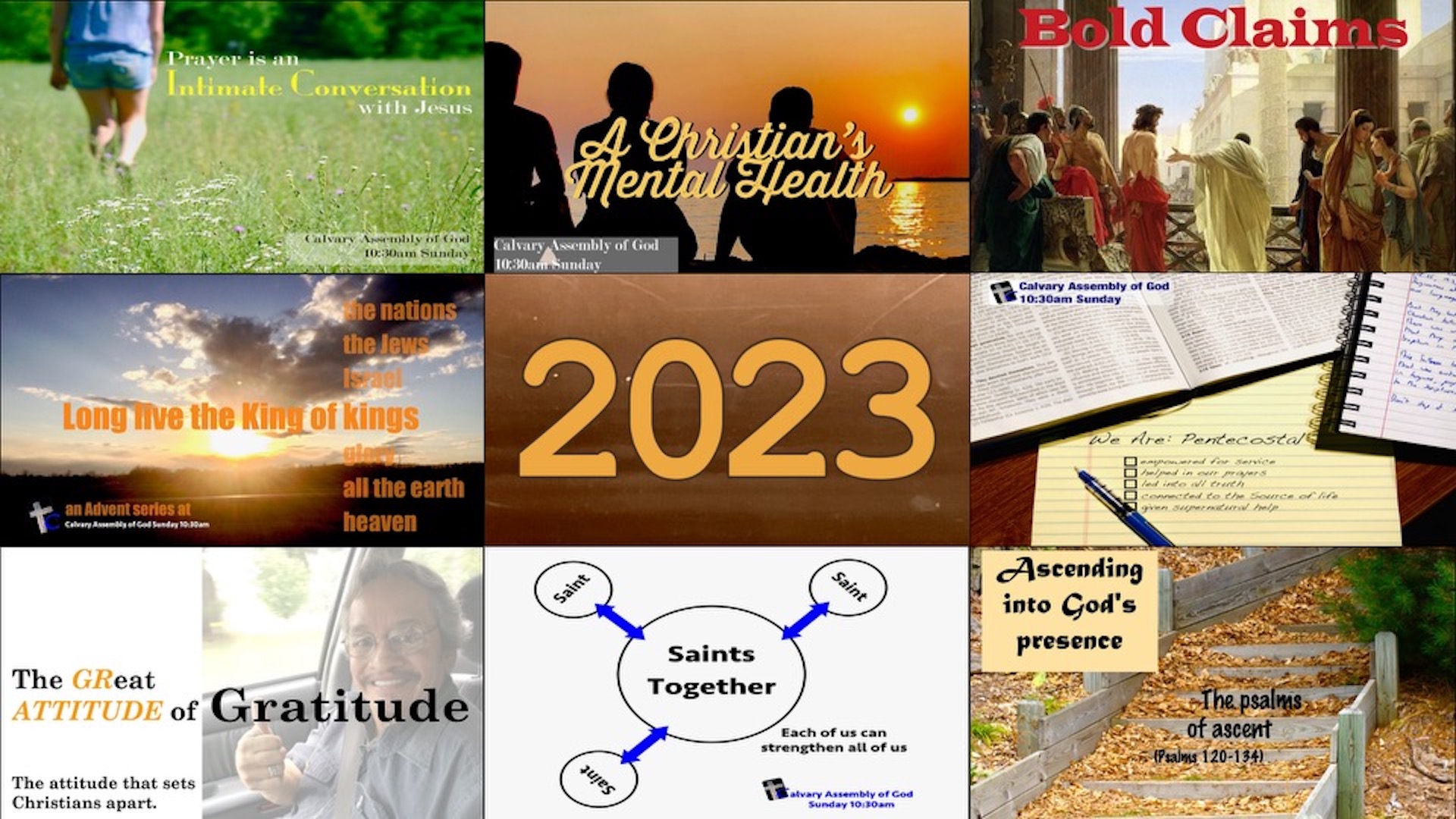
Clicking on each series title will take you to a list of all of the sermons in that series.
Intimate Conversation—The dictionary defines the word “intimate” with these phrases: associated in close personal relations, characterized by warm friendship, and closely personal. These words perfectly describe the relationship God wants to have with His children through prayer. Pete Briscoe said, “Prayer is an intimate conversation with the One who passionately loves you and lives in you.” The One who loves you so passionately desires to walk with you and share intimate knowledge with you. Prayer is not something formal, cold, or mechanical, but it is vibrant, warm, engaging, and life-changing.
A Christian’s Mental Health—I don’t think there is any arguing that Jesus was the healthiest individual who ever walked planet Earth. Some may want to push back with, “Of course He was because He didn’t have any problems to deal with!” But the writer of Hebrews tells us that Jesus experienced everything you and I will ever experience (Hebrews 2:17), so His deity didn’t exclude Him from the stressors that His humanity would have to face. And yet, He handled all of these things successfully. Luke the physician observed the growth of Jesus and tells us that it all began with Jesus having a robust mental health. From that foundation, everything else—physical, spiritual, relational—all could develop properly. We must learn from this example and pay careful attention to our own mental health.
Bold Claims—“That’s a pretty bold claim. Are you prepared to back that up?” I’ll bet you have heard something like that said to you, and maybe you have even said that yourself to someone else who made a big, audacious statement. After Jesus is arrested by the religious leaders—an arrest that will ultimately lead to Jesus being crucified on the Cross—there are some incredibly bold claims spoken by key people in this part of the Story. For the most part, these are claims that we don’t read earlier in any of the Gospels, but as this story is heading toward its most crucial moment, we have these audacious statements pronounced. But here’s the most important part: These bold claims weren’t just made, but they were backed up with proof as well.
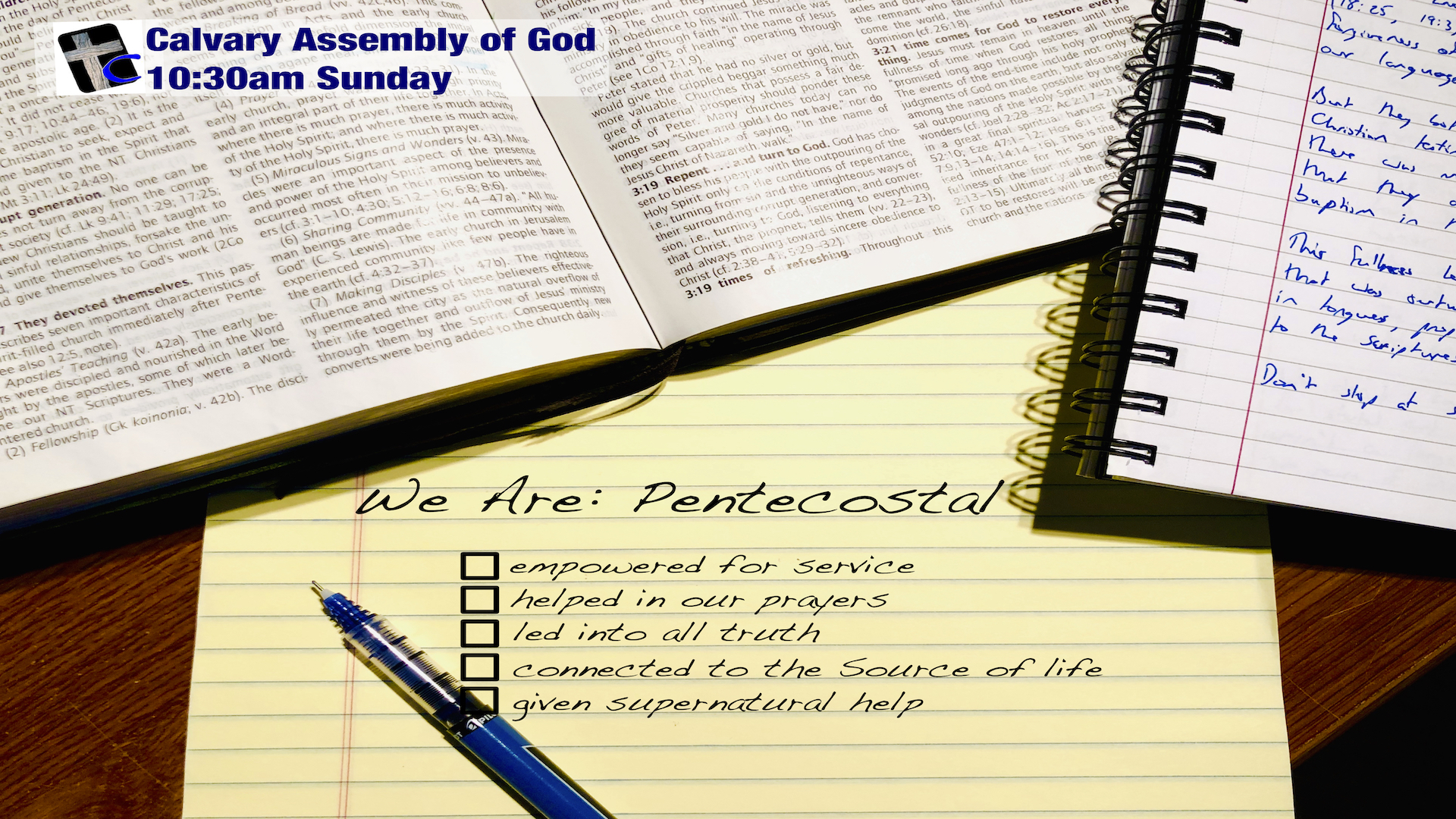
We Are: Pentecostal—Pentecost for over 1500 years was a celebration in Jerusalem that brought in Jews from all over the world. But on the Day of Pentecost that came just ten days after Jesus ascended back into heaven, the meaning of Pentecost was forever changed! Followers of Jesus—now empowered by an infilling of the Holy Spirit—began to take the good news of Jesus all over the world. These Spirit-filled Christians preached the Gospel and won converts to Christ even among hostile crowds, performed miracles and wonders, stood up to pagan priests and persecuting governmental leaders, and established a whole new way of living as Christ-followers. We, too, can be Pentecostal followers of Jesus Christ today.
Ascending—Every year, Jews from around the world made four pilgrimages up to Jerusalem for various feasts and sacrifices. These journeys reminded them of God’s goodness as they went to the Temple to worship, and they helped refocus on God’s ways as they returned to their regular routines. Jerusalem is over 2500 feet above sea level, so the pilgrimage there was a physical workout as well as a spiritual workout. These workouts were beneficial for God’s people, preparing them to minister in their cities in the following months. The Book of Psalms contains 15 songs that these pilgrims would sing to and with each other as they traveled up to Jerusalem. These Psalms of Ascent are still instructive for Christians today.
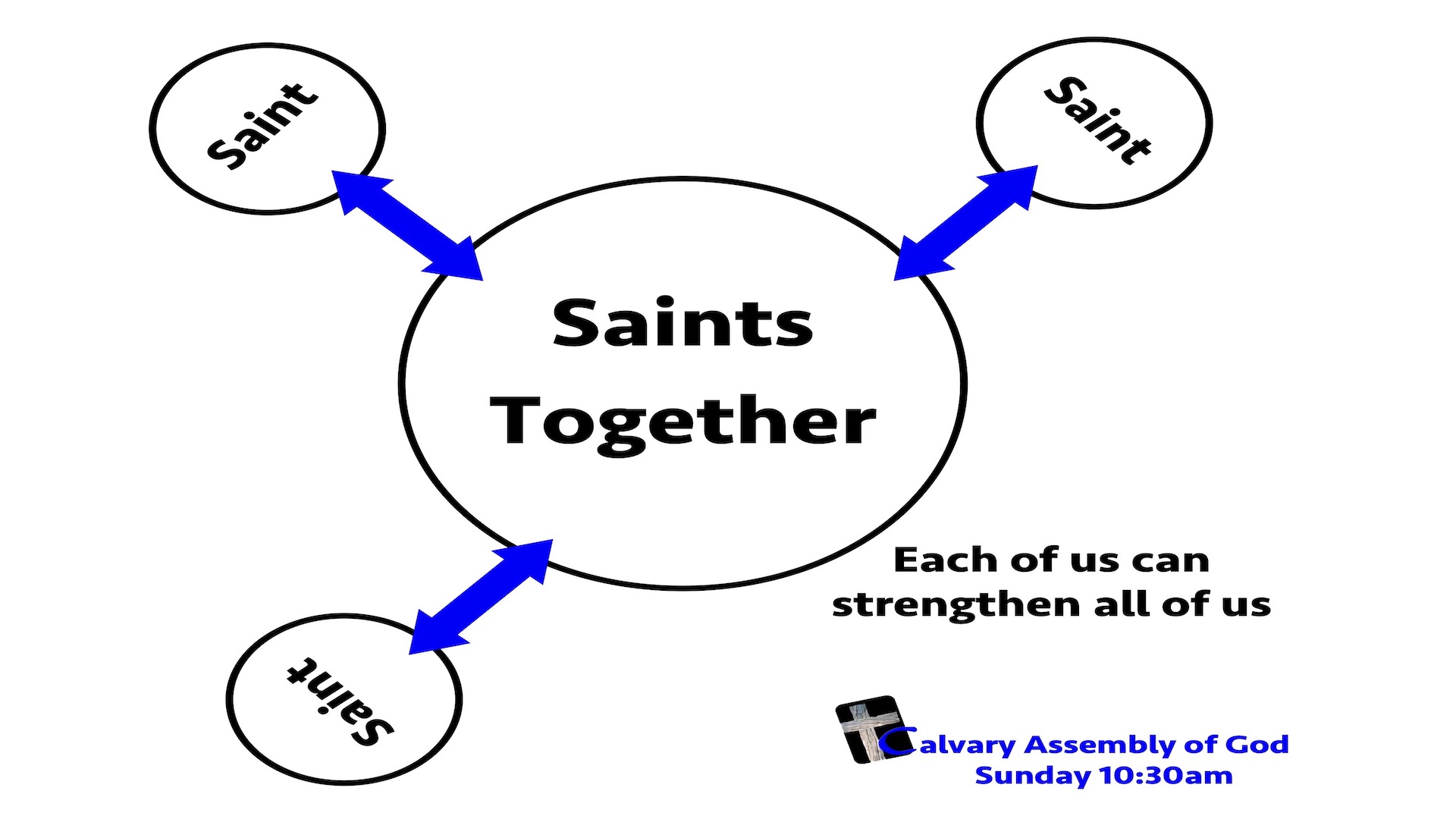
Saints Together—Throughout the New Testament the word “saints” is always in the plural form. This is a clear indication that none of us can develop into the full-fledged Christians we were meant to be on our own. We all need each other. More specifically, we all need the most mature version of each other. A key component of an individual saint’s development is the time spent alone being forged by the discipline of the Holy Spirit. Maturing saints then come together with each other to continue to strengthen and sharpen everyone in the church. Strong individual saints make a strong church, and a strong church makes strong individual saints! Let’s learn about six important spiritual disciplines that each individual saint must put into practice so that they can use their newly developed strengths to help other saints in their own development.
The Great Attitude Of Gratitude—There’s something about gratitude that distinguishes people. Think about it: would you rather hang around with grumblers or grateful people? The gratitude of Paul and Silas certainly made them stand out from the crowd when they were in Philippi. Wrongly accused, beaten, and thrown in prison, but instead of bellyaching, they were praising God. Later on, when Paul wrote his letter to the Christians in Philippi, the theme of gratefulness permeates his letter. The distinguishing mark is actually in the title: The GReat ATTITUDE spells out GRATITUDE!
Long Live The King Of Kings—Throughout human history, whenever a king died, the people would say something like, “The king is dead. Long live the king!” They would say this because the next king ascended to the throne immediately after his predecessor died. Except when a nation had been defeated, the cry, “The king is dead” was unanswered by, “Long live the king!” Israel must have felt like this. After being defeated by Nebuchadnezzar and spending 70 years in exile, it appeared to many that the line of kings was broken. Even after retuning to their homeland, Israel continued to live under the thumb of other powerful nations. And yet, some still clung to the glimmer of the promise God had made about an eternal King sitting on Jerusalem’s throne. The First Advent of Jesus revealed to us in the Gospels reassures us that the promise of an eternal King is true. Jesus came to earth to reveal His majesty to us. The First Advent is so important because it bolsters our faith for the imminent Second Advent when Jesus will return as the King of kings! Christmas is a great time to be reminded that even now we can confidently declare, “Long live the eternal King of kings!”
2024 promises to be an exciting year! If you don’t have a home church in the northern Kent County area, I would love to have you join us!
Listen to the podcast of this post by clicking on the player below, and you can also subscribe on Apple, Spotify, or Audible.
I once worked with a guy that was the epitome of “all talk and no action.” After a while people just stopped listening to him or believing anything he said. But something worse is someone who says he will do something but doesn’t have the power to finish what he started. In that case, you may have believed him and not taken any steps of your own, so when he finally admits defeat, you are totally unprepared to step in to help finish the task.
I think that comes close to the two attitudes people had prior to the First Advent of Jesus in Bethlehem. Some people thought all of God’s promises had just become “all talk and no action.”
But after Jesus began His public ministry, His skeptics may have originally thought He was also“all talk and no action,” but when they saw how the people responded to Him, they realized He at least had the power to sway a crowd. But they certainty didn’t think He could finish what He started.
The religious elite—the Sanhedrin—had their own plans in the works, and it appeared to them that Jesus was just going to get in the way. So they hatched a plan to have Pontius Pilate, the Roman governor, have Jesus crucified. As Jesus is hanging on the Cross, you can hear the skepticism and derision in the voices of these religious elite—
In the same way the chief priests, the teachers of the law and the elders mocked Him. “He saved others,” they said, “but He can’t save Himself! He’s the King of Israel! Let Him come down now from the Cross, and we will believe in Him. He trusts in God. Let God rescue Him now if He wants Him, for He said, ‘I am the Son of God.’” (Matthew 27:41-43)
After all, they had experienced “messiahs” before (Acts 5:35-37) so they thought this Jesus from Nazareth was just the next in a long line of pretenders. “King of Israel, indeed! Ha!”
But when someone tells you what they are going to do, and then they actually do it, skeptics are turned into believers. We see this happen in people like Nathaniel, a whole village of Samaritans, and one of the thieves that was crucified alongside Jesus (John 1:43-51; John 4:9-42; Luke 23:39-42)
Even though Jesus told His disciples exactly what was going to happen to Him in Jerusalem—and then it did!—they were still skeptical of the claims of His resurrection until they saw it for themselves (Matthew 20:18-19; John 20:3-8).
Skeptics need to see and hear for themselves that Jesus has the power to do what He says He will do. We are the ones that preach this Good News to them by the way we live.
We have to live as good citizens of the King of kings so that people will “come and see” what a good and loving King He is. For those who are skeptical of the claims of Jesus the King, we have to live in a way that makes it real. We have to help them see the King of kings!
Advent isn’t just a long-ago event that we fondly remember. The First Advent is proof that God has the power to keep His word. And just as wehave seen the First Advent, so we will see the Second Advent.
Listen to the podcast of this post by clicking on the player below, and you can also subscribe on Apple, Spotify, or Audible.
I did a series of Advent messages a few years ago called “The Carols of Christmas” with the premise that many of our old familiar carols had become too familiar and we had lost the true meaning in those beautiful songs.
I think the same is true with the sentiment of wanting to experience the glory of God. Sometimes you will hear people say, “We just want to see God’s glory!” but I’m not sure they really mean this or really want it.
Throughout the Bible, “glory” comes from the Hebrew word which means weightiness. When God appears—or even one of His angels glowing with His glorious presence—people collapse under the weight of His glory. Look at the examples of Moses, Isaiah, Daniel, and even John the beloved disciple of Jesus (Exodus 3:6; Isaiah 6:3-5; Daniel 8:15-17; Revelation 1:12-17).
In the light of Christ’s glory everything is exposed. We have no excuses for our sin. We are seen exactly as we are, and the fear of God’s judgment causes us to collapse under that weight.
But the First Advent story is filled with the phrase “Fear not.” Let me show you two examples. First, notice the strong emotions when the angels appear to the shepherds—
An angel of the Lord appeared to them, and the glory of the Lord shone around them, and they were terrified. But the angel said to them, “Do not be afraid. I bring you good news that will cause great joy for all the people.” (Luke 2:9-10)
What was this good news that would turn their fear into joy? Listen to the angelic message to Joseph—
Joseph son of David, do not be afraid to take Mary home as your wife, because what is conceived in her is from the Holy Spirit. She will give birth to a Son, and you are to give Him the name Jesus, because He will save His people from their sins. (Matthew 1:20-21)
Notice the phrase, “HE will save His people from their sins.” Part of what contributes to our fear of God’s glorious presence is knowing that we are helpless to remove our sins. The fact that Jesus would do this for us was foretold in prophecies like Isaiah 25:7-9 and 59:15-16.
How will Jesus do this? In 1 Corinthians 15:53, Paul says that in order to enter into God’s presence our perishable, mortal lives have to be exchanged for something imperishable and immortal. We are unable to do this, but in the Incarnation, the immortal God put on mortal flesh!
Paul goes on in 1 Corinthians 15 to say, “When the perishable has been clothed with the imperishable, and the mortal with immortality, then the saying that is written will come true: “Death has been swallowed up in victory.” Where, O death, is your victory? Where, O death, is your sting?” (1 Corinthians 15:54-55)!
If our sins were still clinging to us, spending eternity in the presence of the King of Glory would be torturous! Our fear of His weighty glory is only changed into joy when we accept that He has saved us from the penalty of our sins. Now our fear of His glory isn’t a crippling fear, but as we worship Him for His salvation our fear becomes reverential worship.
Or we could say it this way—When we fear the King of Glory we fear nothing else!
Charitie Lees Bancroft captures that idea in these stanzas of her poem:
When satan tempts me to despair
And tells me of the guilt within,
Upward I look and see Him there
Who made an end of all my sin.
Because the sinless Savior died,
My sinful soul is counted free;
For God the Just is satisfied
To look on Him and pardon me.
Behold Him there! The risen Lamb,
My perfect, spotless righteousness;
The great unchangeable “I AM,”
The King of glory and of grace!
One with Himself I cannot die,
My soul is purchased by His blood;
My life is hid with Christ on high,
With Christ, my Savior and my God.
With our sins forgiven by our faith in Jesus, we can now enjoy an eternity in the weighty, awesome presence of the King of Glory!
After this genealogy, we read that an angel says to Joseph, “Joseph son of David, do not be afraid to take Mary home as your wife, because what is conceived in her is from the Holy Spirit” (Matthew 1:20). And then notice this commentary from Matthew—
All this took place to fulfill what the Lord had said through the prophet: “The virgin will conceive and give birth to a Son, and they will call Him Immanuel”(which means “God with us”). (Matthew 1:22-23)
Matthew says, “all this took place to fulfill what the Lord had said.” All what? Everything that came before that statement: the genealogy with all its exceptional items, the 70-year exile of the Jewish people, the Immaculate Conception, the fulfillment of a 700-year-old prophecy.
I find this absolutely astounding! And so, apparently, did Joseph!
But remember that Jesus is not only “the son of David” but He is also called a “son of Abraham.” This means that Jesus came to be more than just the King of the Jews.
We have a cliché that says something like, “Don’t miss the forest for the trees.” By this, we mean that sometimes in the moment we only see one large tree or obstacle in front of us and we miss seeing the majesty of the whole forest. Or maybe we only see the obstacle and not the path that would take us where we need to go.
We are living between the Advents now so you would think that we have a good “forest” perspective, but even we sometimes get bogged down in the moment, wondering what God is doing. The story of Abraham should help us to see the whole forest of God’s plan a little better.
In Genesis 12:1-3 we read God’s promise to Abraham that all people on earth would be blessed by his obedience to God’s call. Listen to the opening words of Stephen’s sermon as he looked back on this—
The God of glory appeared to our father Abraham while he was still in Mesopotamia, before he lived in Harran. “Leave your country and your people,” God said, “and go to the land I will show you.” So he left the land of the Chaldeans and settled in Harran. After the death of his father, God sent him to this land where you are now living. (Acts 7:2-4)
Stephen reminds us that God spoke to Abraham while he was still living in Mesopotamia. Abraham must have shared this promise with his father because in Genesis 11:31 we read that Terah takes Abraham, Sarah, and Lot with him to make this journey, but they only traveled as far as Harran.
Why did they stop here? We’re not sure. Perhaps Terah was still grieving the death of his youngest son who had died before they left. Maybe Terah was concerned about his middle son Nahor who chose not to travel with them. Or maybe Terah was paralyzed by the magnitude of the journey still ahead of them. Whatever the reason, Terah allowed a “tree” to obscure his view of the whole “forest” of God’s plan.
Stephen then says that Abraham continued the journey to Canaan “after the death of his father.” But if we do the math, it appears that Terah was still biologically alive when Abraham left (see Genesis 11:26, 32; 16:3, 16).
Abraham had to trust God more than he respected his father, even to the point of considering his father as dead.
Later on, God gave Abraham a similar test with his own son. Abraham passed this test and God repeated His promise about blessing all people through Abraham(see Genesis 22:1-18).
In Romans 4, Paul explains that Abraham’s faith in God’s promise was rewarded, and that through our faith in Jesus we are connected to this same promise.
Just as there was an “all this took place to fulfill what the Lord had said” about Jesus—including the faith-filled obedience of Abraham and David—God has an “all this” for your life too.
God saw you before you were born. He had a plan for your life. He gave you gifts and talents to be used for His glory. There is not a single part—not a single experience—of your life that is accidental (Psalm 139:16; Ephesians 2:10; Romans 8:28).
Just as He used all this for Jesus, He is using all this for your life too. Will you trust Him?
Through David, God fulfilled the promise that Jesus would be King of the Jews. Through Abraham, God fulfilled the promise that Jesus would be King of all nations. Through Jesus, God fulfilled the promise that Jesus would be our Righteousness.
Abraham died without seeing the promise fulfilled. But we have seen the promise fulfilled, and that should fuel our faith to trust God to fulfill the promise He has for each of us. I pray that this assurance will be renewed in your heart as you celebrate Advent this year.
Listen to the podcast of this post by clicking on the player below, and you can also subscribe on Apple, Spotify, or Audible.
My podcast partner Greg and I just recorded an episode of our leadership podcast about Christmas traditions. I think there more traditions associated with this time of year than with any other event on our calendars. Traditions keep us connected to our roots, but they also help us feel like we can be in control of things.
There has been a tradition in countries with monarchies that whenever a king died, the people would say something like, “The king is dead. Long live the king!” They would say this because the next king ascended to the throne immediately after his predecessor died. Except when a nation had been defeated, the traditional cry of, “The king is dead” was unanswered by, “Long live the king!”
It appears at this moment that a new tradition has to be started—one where we take leadership over our own fates.
The apostle Peter noted that people awaiting the Second Coming of Jesus would question if that event was ever going to happen. And the prophet Malachi closed the Old Testament with people saying much the same thing: “There doesn’t seem to be any advantage to following God’s laws, so maybe we should just do things our own way” (2 Peter 3:3-4; Malachi 3:13-15).
But then we turn the page to the dawn of the New Testament, and Matthew writes his Gospel about the First Advent of Jesus. He wants to show us that although the line of earthly kings in Israel may have been broken, the promised King of kings had now come to earth.
I’m intrigued by the exceptions Matthew lists in his opening genealogy to illustrate this truth. First, as you might expect, the phrase “thefather of” appears 39 times. This tells us a biological fact of life. These men didn’t know if they had fathered a son or a daughter, what their child’s contribution to the world might be, or even if their child would live faithfully to God.
Matthew opens his genealogy by saying “the son of” twice. First, Matthew lists Jesus as the son of David—the king to whom God gave a very special promise of an eternal King coming from David’s family line. Then Matthew traces the genealogy back further to say “the son of Abraham”—the one through whom God said He would bless all nations (2 Samuel 7:11-16; Genesis 12:1-3).
And what about the exceptional women Matthew records in this male-dominated genealogy? We have Tamar, Judah’s daughter-in-law, who tricked him into fathering a child by her; Rahab, a Canaanite prostitute who put her faith in God; Ruth, a Moabitess who left her homeland because she trusted God; Bathsheba, an adulteress who became David’s wife; and then Mary, the mother of Jesus, who was called “highly favored” of God (Luke 1:28).
The phrase “son of” appears one more time when the angel calls Joseph by this title (Matthew 1:20). Jospeh is also called “thehusband of Mary” (Matthew 1:16).
Whereas Abraham and David were rewarded for their faithfulness to God and were told of future blessings, Joseph’s act was different. Joseph had a choice. He was told that the Child in Mary’s womb would be the Messiah. Now Jospeh had to decide: Would he choose to believe this? Would he choose to bear the shame and reproach to accept his role as father?
We have the a similar choice today: Will we choose to believe that God has announced His plan and that He is fulfilling His plan?
Here’s the simple truth. It appears as two statements, but it is really the same thought—
The Advent of Jesus has come. The Advent of Jesus will come.
The First Advent of Jesus should build our anticipation for the Second Advent. His First Advent should be proof that God keeps His promise.
Jesus told us that believing God’s promise would bring us into God’s family. Jesus said, “For My Father’s will is that everyone who looks to the Son and believes in Him shall have eternal life, and I will raise them up at the last day” (John 6:40).
The apostle Paul also assures us, “So in Christ Jesus you are all children of God through faith” (Galatians 3:26).
Let’s not blindly follow the traditions of previous generations, but let us chose for ourselves to believe in God’s promised Messiah, to trust that He alone can give us eternal life, and then let us live in both celebration of His First Advent and expectation of His Second Advent.
Listen to the podcast of this post by clicking on the player below, and you can also subscribe on Apple, Spotify, or Audible.
Throughout human history, whenever a king died, the people would say something like, “The king is dead. Long live the king!” They would say this because the next king ascended to the throne immediately after his predecessor died.
Except when a nation had been defeated, the cry, “The king is dead” was unanswered by, “Long live the king!”
Israel must have felt like this. After being defeated by Nebuchadnezzar and spending 70 years in exile, it appeared to many that the line of kings was broken. Even after retuning to their homeland, Israel continued to live under the thumb of other powerful nations.
And yet, some still clung to the glimmer of the promise God had made about an eternal King sitting on Jerusalem’s throne.
The First Advent of Jesus revealed to us in the Gospels reassures us that the promise of an eternal King is true. Jesus came to earth to reveal His majesty to us.
The First Advent is so important because it bolsters our faith for the imminent Second Advent when Jesus will return as the King of kings! Christmas is a great time to be reminded that even now we can confidently declare, “Long live the eternal King of kings!”
I would like to invite you to join us for this encouraging series of messages of faith, hope, and eternal encouragement every Sunday during December. Check out any messages you may have missed:
Listen to the podcast of this post by clicking on the player below, and you can also subscribe on Apple, Spotify, or Audible.
Gratitude is our shield against the negativity, and gratitude is also our sword against the ambushers. But using these pieces of our armor is exhausting, which means we also need a way to recover from the attacks of negativity.
Jesus began His public ministry with a sermon that prompted Luke to record that “everyone spoke well of Him.” But in less than 60 seconds, after Jesus outlined how His ministry would unfold, Jesus is being criticized to the point where those same praising people are now ready to throw Jesus off a cliff (Luke 4:18-29)!
Elbert Hubbard wrote, “If you have something others don’t, know something others don’t, or do something others aren’t doing, then, rest assured, you will be criticized. … To avoid criticism say nothing, do nothing, and be nothing.”
Even though Hubbard is probably right, Christians don’t have the option to “say nothing, do nothing, be nothing,” because Jesus has called us to go into all the world, preach the Good News, and be salt and light. That means we will be victims of criticism. We can use our shield and sword of gratitude, but we are also going to need some medicine to help us recover too.
“Sticks and stones may break my bones but words will never hurt me” is a lie. Words do hurt.
Jesus told us these stinging words would be thrown at us like sticks and stones in Luke 6:22. When we are criticized, we have to be careful not to get embittered. How does that happen? We are naturally self-protective, so criticized people become critical and cynical unless they can be healed and have joy restored.If we hold on to our hurts, bitterness can fester in our hearts (Hebrews 12:14-15).
Look at David in Psalm 69. He acknowledged the attacks from his enemies and how it made him feel, but then he applies the healing medicine of gratitude—
But as for me, afflicted and in pain—may Your salvation, God, protect me. I will praise God’s name in song and glorify Him with thanksgiving. (Psalm 69:29-30)
Our healing is in our thanking!
Medical research has shown that gratitude improves physical health—it reduces stress and resets the heart’s healthy rhythm. This is just as true spiritually: gratitude is our medicine.
You may be thinking, “How can I bless critical people? How can I be grateful when I’m surrounded by such hostility?”
David also wrote Psalm 23 for us. This is the psalm that begins, “The Lord is my Shepherd, I shall not be in want.” But notice especially the words of verse 5: “You prepare a table before me in the presence of my enemies. You anoint my head with oil; my cup overflows.”
It is precisely in the presence of enemies that God invites us to abide with Him and to receive His medicine of anointing. But I also see that our Good Shepherd doesn’t just give us adequate blessings, but overflowing blessings—enough for me and more to share with those around me.
In the New Testament Greek, one word for “bless” is eulogeo which literally means “good words.” Jesus, Paul, and Peter all tell us that when we are victims of the sticks and stones of negative words, we are to respond by saying good words both to God and to those who are hurling evil words at us (Matthew 5:43-44; 1 Corinthians 4:12; 1 Peter 3:9).
Peter shows us exactly how Jesus did this when He was hanging on the Cross and enduring the sneers, mocking words, and insults from those surrounding Him (1 Peter 2:21-23; Luke 23:35-39). Instead of throwing evil words back at them, Jesus blessed them by saying, “Father, forgive them for they do not know what they are doing” (Luke 23:34).
Listen to the podcast of this post by clicking on the player below, and you can also subscribe on Apple, Spotify, or Audible.
It would be nice if complainers were satisfied just complaining to themselves, but they’re not. Do you know the cliché misery loves company? It’s just as true for complainers: They really want others to join them in their bellyaching!
I think a good word for what these negative people do is ambush. The dictionary says that means to lie in wait with hostile intent. Jesus told His followers that this ambushing behavior was going to happen. In Luke 6:22, He uses the word “when” not “if”—
Blessed are you when people hate you, when they exclude you and insult you and reject your name as evil, because of the Son of Man.
We see this vividly portrayed in the life of Daniel. This man had done nothing but helpful things since the moment he arrived in Babylon. He faithfully served foreign kings, never wanted any recognition for himself, saved lives, interpreted dreams, and explained confusing things. He had a great work ethic and impeccable integrity. But the complainers still wanted to ambush him (see Daniel 6:1-5).
One psalmist described these ambushers in terms of a hunting lion: His mouth is full of lies and threats; trouble and evil are under his tongue. He lies in wait near the villages; from ambush he murders the innocent. His eyes watch in secret for his victims (Psalm 10:7-8).
Doesn’t this sound like what the devil does too? Be alert and of sober mind. Your enemy the devil prowls around like a roaring lion looking for someone to devour (1 Peter 5:8).
Jerusalem was surrounded by three armies that were lying in wait to ambush the Israelites. After God told the people of Jerusalem that He would deliver them, King Jehoshaphat sent out his army with the worshippers at the front of the ranks. Then listen to how worship not only thwarted the ambushers but boomeranged their evil plans back on themselves—
As they began to sing and praise, the Lord set ambushes against the men of Ammon and Moab and Mount Seir who were invading Judah, and they were defeated. The Ammonites and Moabites rose up against the men from Mount Seir to destroy and annihilate them. After they finished slaughtering the men from Seir, they helped to destroy one another. (2 Chronicles 20:22-23)
When we worship God and sing our grateful praise to Him, we put the sword of God in our mouths. And there isn’t a more effective sword against the darkness than the (S)Word of God (Hebrews 4:12; Revelation 1:16; Ephesians 6:17)!
Paul told the church at Colosse that singing our praise to God with other saints was an encouragement to all who heard those worshipful songs (Colossians 3:15-17).
So when the ambushers are surrounding you, use your thankful songs as a shield, as a sword, and as an encouragement to others!
If you’ve missed any of the other messages in our series The Great Attitude of Gratitude, you can find them all here.



 Every monarch or president on the planet has certain protocols for anyone who interacts with them. There are requirements on how to walk into the room, titles that have to be used, the way you have to act, things you can or can’t say, and the list goes on and on.











 Craig T. Owens