Comedian Brian Regan has a great bit about the “Me Monster.” Don’t be that person! John Maxwell wrote, “The problem is that interrupting translates to ‘What I want to say is more important than what you are saying.’” We probably can all do better at this.
“To bear the burdens of others we need to be careful to maintain an attitude of humility, coupled with a readiness to serve, according to the gifts and opportunities God gives us at any time (Romans 12:3-8). Even if it’s true that our fellow believers are acting like children, or like people who just need to ‘grow up’ in their faith, our responsibility is to humble ourselves and be ready to show them the love of Jesus however we may (Romans 14:1-18).” —T.M. Moore
“A cosmos one day being rebuked by a pessimist replied, ‘How can you who revile me consent to speak by my machinery? Permit me to reduce you to nothingness and then we will discuss the matter.’ Moral: You should not look a gift universe in the mouth.” —G.K. Chesterton [see Job 38:1-4]
“Moral principles do not depend on a majority vote. Wrong is wrong, even if everybody is wrong. Right is right, even if nobody is right.” —Fulton Sheen
A cold-case detective examines the universe as he would a crime scene. “The universe is an incredibly complex, finely tuned environment—so precise that carbon-based life like ours can exist at all. This point isn’t just made by those who believe in God; it’s widely recognized, even by critics and naturalists who try to account for the remarkable, razor-edge calibration of cosmological constants like the weak and strong nuclear forces, as well as electromagnetism. These are set within the narrowest tolerances. Just a slight deviation, and our universe would not be capable of sustaining life—yet, here we are.”
InThe Screwtape Letters, C.S. Lewis gives these words to Screwtape about politics: “About the general connection between Christianity and politics, our position is more delicate. Certainly we do not want men to allow their Christianity to flow over into their political life, for the establishment of anything like a really just society would be a major disaster. On the other hand we do want, and want very much, to make men treat Christianity as a means; preferably, of course, as a means to their own advancement, but, failing that, as a means to anything—even to social justice.”
A Christian brother or sister says or does something just a little “off.” How do you respond? “Now you’re pretty sure you should say something. But you’re also busy. Or you think someone else might be in a better position to bring it up. Or you hate uncomfortable conversations. (Or all of the above.) So you convince yourself to stay quiet.” Scott Hubbard shows us from Scripture why staying silent is not an option for Christians who love each other.
“According to Big Bang cosmology, we should be seeing these very distant galaxies, not as they are now, but as they were shortly after the Big Bang. Since star and galaxy formation should take many millions of years, theorists were not expecting to see many galaxies in the ‘early’ universe, and those that did exist were expected to be unevolved and immature. Yet data from the James Webb Space Telescope have been shattering these Big Bang expectations.” Check out this astronomical evidence that points to an all-wise Creator.
“Metabolomics is the study of chemical processes involving small molecules that were part of fats, proteins, amino acids, and nucleic acids.” This study has recently been applied to fossilized bones that have been excavated. The results: “Tiny chemical clues trapped inside ancient bones are revealing what animals ate, the diseases they carried, and the environments they lived in.”
“[God] unrolls before Job a long panorama of created things, the horse, the eagle, the raven, the wild ass, the peacock, the ostrich, the crocodile. He so describes each of them that it sounds like a monster walking in the sun. The whole is a sort of psalm or rhapsody of the sense of wonder. The Maker of all things is astonished at the things He has Himself made. This we may call the third point. Job puts forward a note of interrogation; God answers with a note of exclamation. Instead of proving to Job that it is an explicable world, He insists that it is a much stranger world than Job ever thought it was.” —G.K. Chesterton
Listen to the podcast of this post by clicking on the player below, and you can also subscribe on Apple, Spotify, or Audible.
I love the Fibber McGee and Molly radio broadcasts! One of the running gags on this show was Fibber’s closet: People who mistakenly opened the closet door got buried under a pile of stuff that Fibber had stashed away.
In one episode, Molly is determined to grow through all of the items that were strewn across the floor before they got shoved back into the closet. One by one Molly asked Fibber about all of the odd knick-knacks and he had a good explanation for every single one justifying why he couldn’t possibly part with it. One of my favorites was this—“What’s this bamboo pole,” Molly asked, and Fibber said, “Why, that pole is very important. If I was ever offered to be Joe Louis’ sparing partner, that’s the ten-foot pole I wouldn’t touch it with!”
I’m afraid that many of us have closets like this in our minds. We’ve accumulated a lot of just-in-case stuff for each and every scenario that may come upon us at some point in our lives.
All of our contingency plans implies that something is going to go wrong and that only the prepared and well-stocked will make it through.
Psalm 107 is the first psalm in Book 5 of the Psalter—the book that focuses mostly on praise. This author is recounting the history of Israel through the times of crisis:
lost and homeless (v. 4)
hungry and thirsty (vv. 5, 9)
trouble and distress (vv. 6, 13, 19, 28)
darkness and deepest gloom (vv. 10, 14)
prisoners in chains (v. 10)
knocking on death’s door (v. 18)
terrorized (v. 26)
at their wits’ end (v. 27)
We quickly go into crisis mode when we forget that God is in control!
In God’s Kingdom there is no emergency, no crisis, no Plan B. God is sovereignly in control—Isaiah 46:10.
God is in control of the macro—Genesis 1:1; Job 38:4-11
God is in control of the micro—Psalm 139:16; Jeremiah 29:11
God will use what we call a crisis to display His glory—Exodus 14:4 NLT
When you feel yourself spiraling into crisis mode—when you feel you’re at your wits’ end—you can get back into contentment mode.
“When a man is at his wits’ end it is not a cowardly thing to pray, it is the only way he can get in touch with Reality.” —Oswald Chambers
That’s what Job finally did—Job 42:1-2.
And that’s also what the psalmist did—Psalm 107:6-8, 13-15, 19-21, 28-31.
Prayer is a great rescue in trouble, and ongoing thankfulness is a great inoculation against going into crisis mentality. Notice that those four repeated phrases have both cried out to the LordANDLet them give thanks to the Lord for His unfailing love.
Let’s strive to remain aware of His unfailing love by cultivating consistent gratitude. I like v. 2 from the NLT: “Has the Lord redeemed you? Then speak out! Tell others He has redeemed you from your enemies”. When you are preoccupied with telling others and yourself how good God is, there isn’t room in your heart for the worry that leads toward crisis mode.
Remember: We can quickly go from contentment mode to crisis mode when we forget that God is in control, so remain full of thanks. “At all times and for everything giving thanks in the name of our Lord Jesus Christ to God the Father” (Ephesians 5:20 AMPC).
Listen to the podcast of this post by clicking on the player below, and you can also subscribe on Apple, Spotify, or Audible.
Have you ever heard this little saying: “To live above with saints we love, oh, that will be glory. But to live below with saints we know, well, that’s a different story”? I’ve found that it’s sometimes true!
We love Psalm 133:1-3 when the saints are all together. What a great “selling point” to invite someone to be a part of the Christian community! But Psalm 41:7-9 is kind of embarrassing as David talks about former friends who have hurt him deeply.
But being bitten by a fellow sheep is a reality we all have experienced, and, sadly, we will probably have to deal with again in the future. There is a natural way we tend to react when we’ve been bitten, but there is also a supernatural response that the Bible consistently calls us to. This is the God-glorifying way we all need to strive for.
In Acts 23, Paul is standing before the Sanhedrin. He opens his remarks by simply saying he has a clear conscience before God, and the high priest immediately orders that Paul be smacked on the mouth! That seems like a bit of an over-reaction on the part of the high priest, but maybe it was a bit of show of force to let Paul know who was really in charge. Paul responded with an immediate—and natural—reaction when he says, “God will slap you!”
Paul is an old man by this time. He’s been through shipwrecks, beatings, imprisonments, gone without food, traveled more miles than he can count, and preached more sermons than he can remember. His body was giving out on him, and his eyesight was especially weak. Clearly, Paul didn’t realize to whom we was addressing his remarks. But when he became aware, he immediately owned up to his mistake. Paul offered no excuses or justifications, just a quick, simple, sincere apology.
When you have been bitten (slapped) by another sheep, you should ask:
Could I have provoked them by something I said or did?
Could I have hurt them by something I didn’t say or do?
David prayed a great prayer in Psalm 139:23. But this prayer is only effective if we are willing to accept that we may have been the agitator that led to the bite. In the last words that Job speaks in the Book of Job, he is very introspective. Check out all of the “If I have” statements throughout Job 31.
In Psalm 26:2, David invites the Holy Spirit to check him three times!
test me = scrutinize me
try me = assay me
examine me = refine me in the fire
When we are bitten, we should be open to the possiblity that God is using this bite to get my attention—to make me aware of a fault in my life or something that’s been in a blind spot.
So we should consider the following:
Has this kind of bite happened more than once? From different sheep?
Has a spiritually wise person attempted to address this with me before?
Do I ever admit that I’m at fault, or is it always the other person’s fault?
Do I find myself making a list of why they should apologize to me?
When was the last time I apologized to someone else?
If the Holy Spirit reveals something in us, He will also empower us to make the change and make amends. The natural response is to place all the blame on others. The supernatural response to pray Psalm 26:2 before responding.
If we react only the natural way, it is a lose-lose for us and for the whole pasture. But if we learn to respond in a supernatural way, it becomes a win-win for everyone. Listen to the wise words of King Solomon—
He who heeds instruction and correction is not only himself in the way of life but also is a way of life for others. And he who neglects or refuses reproof not only himself goes astray but also causes to err and is a path toward ruin for others. (Proverbs 10:17 AMPC)
Let’s all strive for the supernatural response that is a win-win for the whole Kingdom of God!
Please follow along with all of the messages in this series by clicking here.
P.S. If you are a pastor, you may want to check out my book When Sheep Bite.
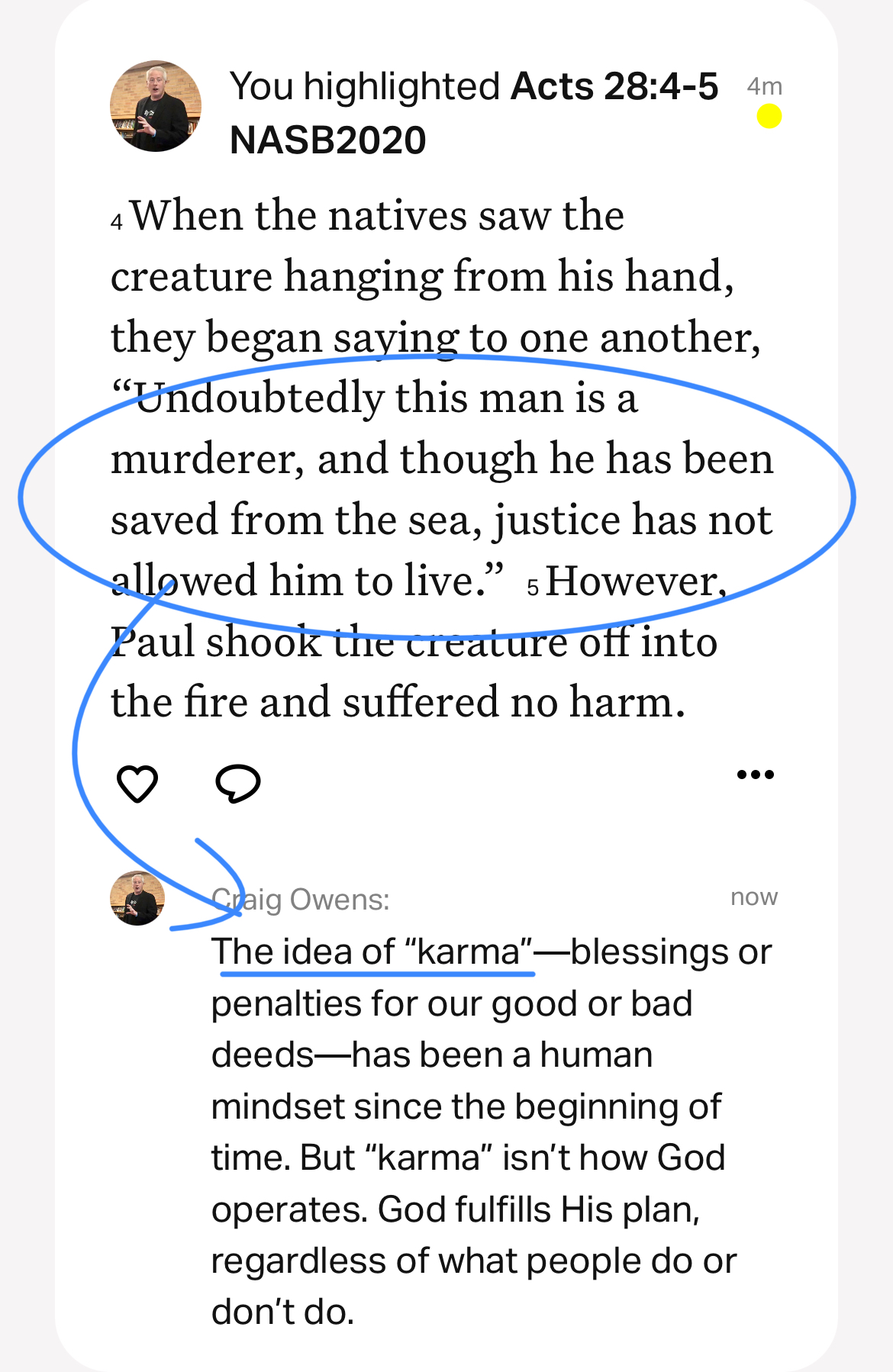
When the natives saw the creature hanging from his hand, they began saying to one another, “Undoubtedly this man is a murderer, and though he has been saved from the sea, justice has not allowed him to live.” However, Paul shook the creature off into the fire and suffered no harm. (Acts 28:4-5)
The residents of Malta thought the apostle Paul was experiencing karma.
The idea of “karma”—blessings or penalties for our good or bad deeds—has been a human mindset since the beginning of time.
This is really the mindset among Job’s three friends: Good things always happen to good people and bad things always happen to bad people. Except Job’s friends were wrong. We know this because we see behind the scenes in Heaven at the beginning of the story, and we hear God reprimand these men at the end of the story.
“Karma” isn’t how God operates. God fulfills His plan, regardless of what people do or don’t do.
In this story in Acts 28, God had promised Paul, “You must testify about Me in Rome,” so Paul was invincible until that promise from God was fulfilled.
To chalk things up to “karma” is to deny God’s sovereign plan. We have to guard our minds against this kind of thinking because it slips in so naturally. A part of renewing our minds (Romans 12:1-2) is not jumping to our conclusion, but trusting that God is sovereignly at work.
You may also want to check out these related blog posts:
Listen to the podcast of this post by clicking on the player below, and you can also subscribe on Apple, Spotify, or Audible.
The word Advent means the appearing—something that bursts onto the scene. At this time of year we are actually thinking about TWO Advents. We look backward in gratitude to celebrate the first Advent of Jesus when He was born in a manger in Bethlehem. And then we look forward in joyful expectation to the second Advent of Jesus when He will return to earth again as King of kings. As we will in this time between the Advents, there are four qualities that we should exemplify—the first is hope.
When the candle is lit, darkness disappears.
Darkness is not the opposite of light, it is the absence of light. In the same way, despair or hopelessness is the absence of hope.
Adam and Eve lived in perfection, but when they tried to do things their way—instead of obeying God’s way—their sin caused them despair. They tried to cover their nakedness, but with a hopeless covering of dying leaves. God came with a promise of full restoration, and illustrated it by covering them with the skin of a sacrificial animal (Genesis 3:7, 15, 21).
Job knew the hopelessness of self-covering and finality of earthly life, and even David—the man after God’s own heart knew this too (Job 6:11-13, 17:13-16; 1 Chronicles 29:15).
But Job and David both knew the hope they could have in their Redeemer (Job 19:25; Psalm 16).
Hope in both the Old and the New Testaments means a patient waiting, anticipating with pleasure, having a confident expectation. It’s a light shining in the darkness that cannot be extinguished—it’s hope that despair cannot darken (Isaiah 9:1-2, 6-7).
At His first Advent, Jesus appeared in our “clothing” so that He could become our sin and then clothe us in His righteousness (Hebrews 2:17; John 1:14; Romans 4:6-8; Hebrews 6:16-20). For this we look back in gratitude.
But we don’t live today merely in gratitude for Christ’s first Advent, but we also live in confident hope of Christ’s second Advent (Acts 1:11; John 14:1-3; 2 Corinthians 5:1-8; Revelation 22:7, 12, 20).
He came into this world of sin,
Made flesh and blood His dearest kin;
He died, that He might take us in,
And keep us till He comes again. —Scott Hubbard
How do we live out this confident hope—
May the God of HOPE fill you with all JOY and PEACE as you trust in Him, so that you may overflow with HOPE by the power of the Holy Spirit. (Romans 15:13)
Follow along with all four of the Advent attributes by clicking here.
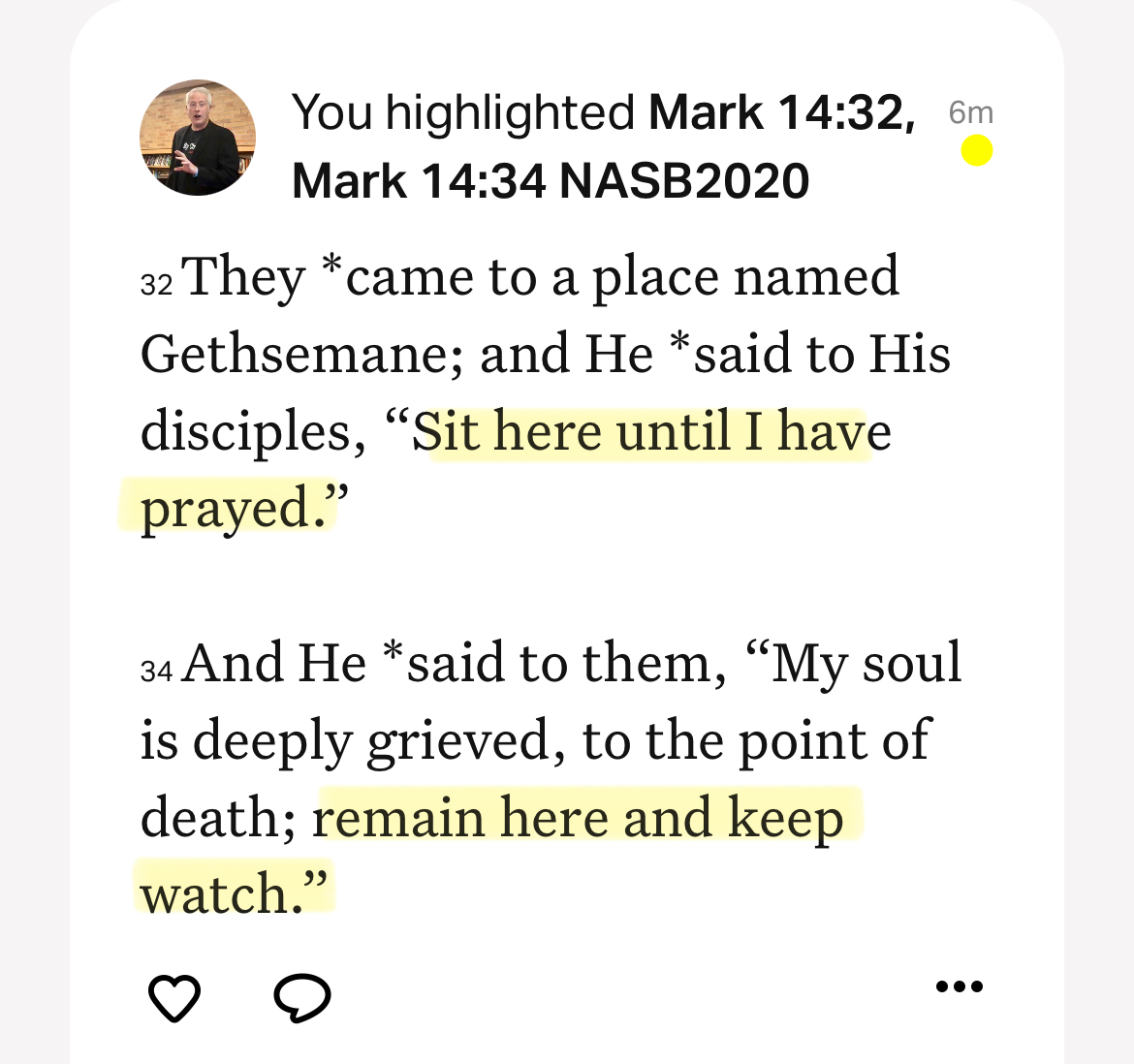
They came to a place named Gethsemane; and He said to His disciples, “Sit here until I have prayed.” … And He said to them, “My soul is deeply grieved, to the point of death; remain here and keep watch.” (Mark 14:32, 34)
Jesus was staring down the most intense, horrific experience anyone on earth had ever faced—more intense than what anyone has ever faced since then. At this moment, He just wanted His friends close by.
Sometimes the best thing we can do for a hurting friend is just be present. Just be there for them. We cannot fully know what battle is raging in our friend’s heart, so we probably won’t have the appropriate words to share. So just be present for them—be physically there in the room with them.
Job’s friends started out well, as they sat silently with their friend. When they tried to counsel Job, they made matters worse. Job called them “miserable counselors” (Job 16:2) and their words made God angry with them too.
Don’t feel like you have to have words to share with your friend. Sometimes just weeping with those who weep is enough to let your friend know that they are not alone.
Listen to the podcast of this post by clicking on the player below, and you can also subscribe on Apple, Spotify, or Audible.
We as a Church are underperforming. How do I know this? Look at the way the world treats Christians; specifically, look at what’s NOT happening.
“By this all will know that you are My disciples, if you have love for one another” (John 13:35). Jesus said this right after He served His disciples by washing their feet. Is this happening today: Do people know you are a Christian by the way you put your love into servant-hearted action, or do they just know what you are against?
“Be prepared to give an answer to everyone who asks you to give the reason for the hope that you have” (1 Peter 3:15). When was the last time someone saw your hope-filled life in such contrast to everyone else’s response that they said, “How can I have what you have?”
Peter said our adversary prowls like a lion. He is perfectly willing to bide his time, picking the strategy that works best. One of his favorite strategies is lies—sometimes half-truths or out-of-context truths.
…Woe to the earth and the sea, because the devil has gone down to you! He is filled with fury, because he knows that his time is short. … The dragon was enraged with the woman and went off to make war against the rest of her offspring—those who obey God’s commandments and hold to the testimony of Jesus (Revelation 12:12, 17).
Lies are his native tongue. He lied to Adam and Eve right in the beginning (Genesis 3:1, 4-5), and he still lies now (Revelation 12:10). Jesus contrasted this with the truth that He came to proclaim (John 8:42-45).
The devil has learned that with many people, outright attacks drive them TO God. We see this in the oldest book of the Bible (Job 1:6f, 20-22), and in modern times (churches were filled after the 9-11 terrorist attacks).
What the devil would rather do is lie to you to keep you comfortable. In The Screwtape Letters, Screwtape implores Wormwood to keep his patient indifferent and comfortable. Indeed, we all have a comfort zone and we love to stay in it.
King Saul went from 3000 men to 600 men, from a full armory to only two swords, from defeating the Ammonites to being hemmed in by the Philistines. King Saul was enjoying life as the king, hanging out with his friends, sitting under a pomegranate tree, far away from his enemies. Life was good for Saul, life was familiar and comfortable. Saul was living in his comfort zone. But the comfort zone is a lousy place to live.
In the comfort zone you only tell stories, but never live an adventure. In the comfort zone, you only hear about what God has done for others, but you never experience Him move in miraculous ways for yourself.
God has given us all gifts so that we can live as overcomers and bring Him glory, but we settle for living only in our comfort zone. Our comfort zones are always way smaller than our gift zones, and the devil is perfectly happy to see us stay there.
Moses was comfortable in the desert, but God sent him in His power (Exodus 3:11, 14).
David was comfortable in the pasture, but God equipped him to lead a whole nation (2 Samuel 7:18; Psalm 78:70-71).
Jeremiah was comfortable being an anonymous priest, but God gave him words to prophesy to a wayward nation (Jeremiah 1:4-8).
Saul was comfortable as a Pharisee, but God sent him to tell the world the Jesus is the Messiah (Acts 8:3; 1 Timothy 1:16).
What lies have kept you in your comfort zone?
Maybe a parent said, “You’ll never amount to anything.”
Maybe a teacher said, “You’re slow.”
Maybe a classmate said, “You’re weird.”
Maybe the devil said, “You cannot make a difference in the world.”
You need to silence those lies with God’s truth:
God created me on purpose and for a purpose—Psalm 139:13-17
He has given me all the gifts I need to soar—2 Peter 1:3-4
He wants to help me, if I will trust Him—Isaiah 41:10, 13-14
Charles Spurgeon said, “The extent of power God can infuse into a person is immeasurable; when divine strength is granted, human weakness ceases to be a hindrance.”
So, friends, it’s time to get uncomfortable with staying comfortable. It’s time to stretch and soar out of your comfort zone and into more of your gift zone!
Stop praying to yourself! God isn’t impressed with your “powerful” prayer! Jesus tells an interesting story about two men: one thought very highly of his spiritual status and the only could barely lift his eyes. Jesus said that the proud man’s prayer received no help from God, but only the humble man’s prayer was heard. This is a short clip from my series called Kingdom Praying. I have lots of new content every week, which you can check out on my YouTube channel.
“If the fetus gets in the way, ditch it. If the old person gets in the way, ditch it. If you get in the way…” —Francis Schaeffer
“The god of convenience, ruling capriciously in the hearts of men and women, and supported by worshipers of the god of wealth—greedy, self-interested profit-takers in the guise of abortionists and abortion-rights advocates—is the putative lord of life and death where children in the womb are concerned. …Christians must insist that all political candidates seeking their support, at whatever level of government, be firm in their commitment to resist the present abortion regime and expose the lie of the pro-choice agenda by every available means. …The Law of God is holy and righteous and good. Abortion is unholy, unrighteous, and evil. If we want a just and loving society, we will worship God and obey His Law, and we will work to dethrone the god of convenience and to expose the folly and self-interest of all its followers. And we will look to God to explain the nature, meaning, and value of all lives.” —T.M. Moore
Elihu is angry at Job “because he justified himself before God.” Better stated: “Job was more concerned about justifying himself—making himself look good—than he was about making God look good.” Elihu is angry at Job’s three friends because they acted like God and pronounced a guilty verdict against Job. Elihu is righteously provoked. After holding his tongue for 31 chapters, he cannot remain silent any longer!I conclude that Elihu is righteous in his response because God doesn’t have anything negative to say to or about Elihu (as He does with the three friends) at the end of the Book of Job.
Long before the term “fake news” made it into our lexicon, Charles E. Robinson wrote an article in 1934 “as a solemn warning to all Christians” about the rising tide of anti-Semitism. He was especially upset about a book that made an erroneous case blaming Jews for global economic and political turmoil. I am thrilled with the strong spiritual and intellectual legacy in the Assembly of God fellowship!
“There’s a lot of blood, sweat and guts between dreams and success.” —Paul Bear Bryant
Peter described the ministry of Jesus as “doing good and healing all who were under the power of the devil.” Historical records tell us the first Christians lived this exact same way! This clip is from our current series of sermons on prayer. I have lots of new content every week, which you can check out on my YouTube channel.
Belshazzar was unknown outside the Bible for quite awhile, prompting one biblical skeptic to say, “the whole story [in the Book of Daniel] is disfigured and falsified by the author, who was neither an eye-witness of the occurrences, nor accurately acquainted with the history of them.” Once again, archeology has confirmed the historicity of both Belshazzar and Daniel.
On YouVersion I shared this on Job 1:20-22. The Old English spelling of worship is “worthship.” We worship God because He has infinitely greater worth than any other person or thing. It’s not that Job wasn’t sad about his losses, but He saw Jehovah as the One of greatest worth in spite of his earthly losses.
“Leaders are responsible for building organizations where people continually expand their capabilities to understand complexity, clarify vision, and improve shared mental models—that is, they are responsible for learning.” —Peter M. Senge, in The Fifth Discipline
Never stopping praying for your loved ones. It could be that with their very last breath they will call on Jesus as their Savior!



 Comedian Brian Regan has a great bit about the “Me Monster.” Don’t be that person! John Maxwell wrote, “The problem is that interrupting translates to ‘What I want to say is more important than what you are saying.’” We probably can all do better at this.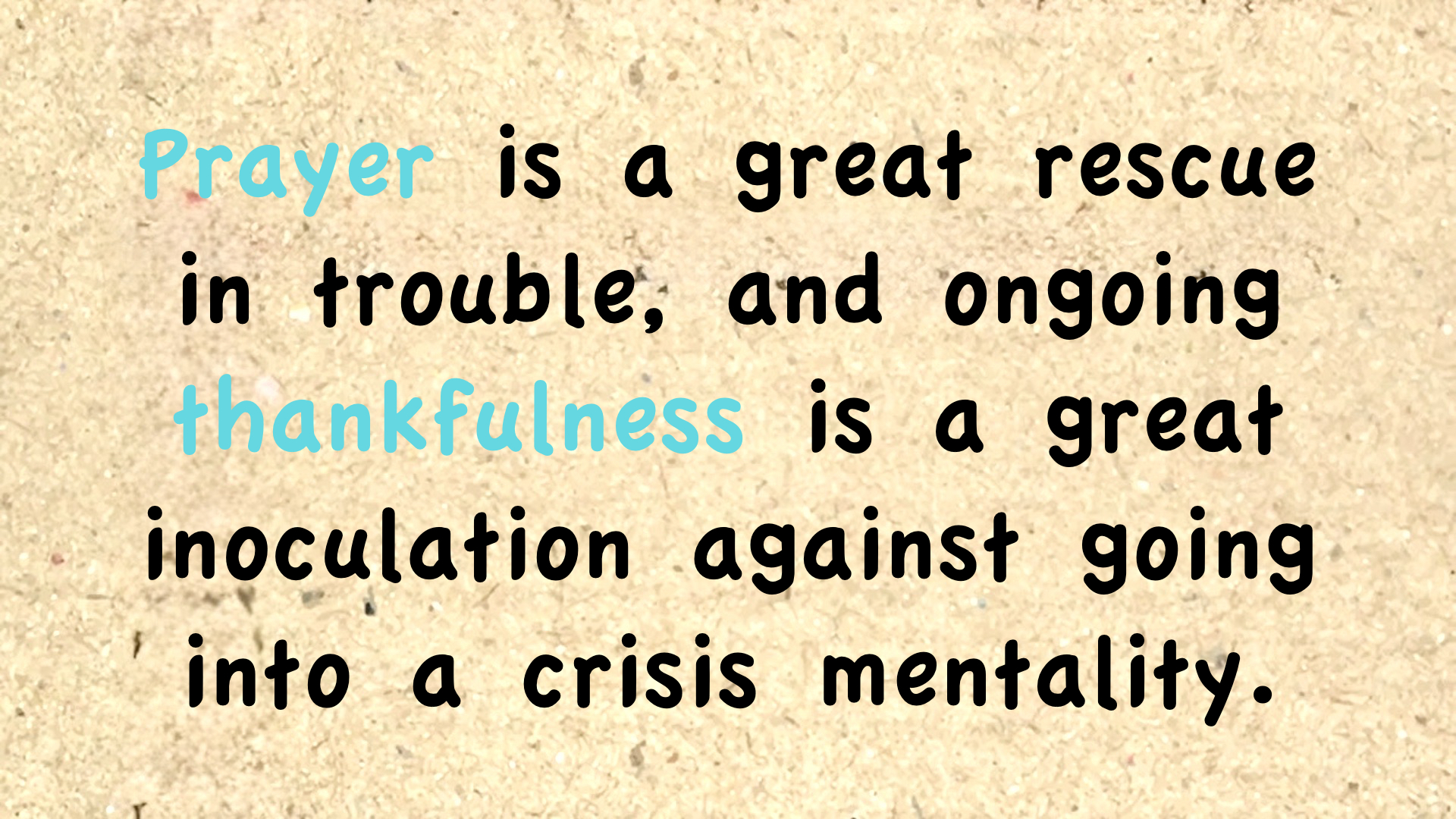









 Craig T. Owens