Saturday In The Proverbs—Fools Talk A Good Game, But… (Proverbs 14)

[Each chapter in the Book of Proverbs contains thoughts that fit into a theme; they are not just random thoughts gathered together. In this “Saturday In The Proverbs” series, I will share a theme that I see in each chapter. But the cool thing about God’s Word is that you may see an entirely different theme. That’s great! If you do, I would love for you to share it in the comments below.]

Where no oxen are, the trough is clean; but much increase come by the strength of an ox (Proverbs 14:4).

You can have something that looks pristine on the outside, but it is all show and no production. Eventually, it will all come crashing down. 

Or you can have the messiness of productivity which will result in lasting success. 

The wise make the productive mess, knowing that they are building something lasting. The fool only tries to make it look good on the outside, but they are undermining themselves (see vv. 1, 11). 

The fool talks a good game, but…

  • their perversity is despised by God
  • their pride injures themselves and others 
  • they lie to keep up appearances 
  • they never learn from their mistakes
  • they are deceitful 
  • they are on the path to death
  • they are self-confident and quick-tempered, which alienates them from others 
  • they will eventually serve the wise
  • they despise others’ needs 
  • they are poor
  • they are fearful of the future
  • they don’t leave a good legacy for their children
  • they rot with envy
  • the oppress poor people
  • then will end up in utter shame

…all for the sake of trying to make others think they have lives that are perfect! 

Keeping up appearances is hard, painful, unrewarding, and will ultimately end in disaster. 

Selah

The word Selah appears nearly 70 times in the Bible, almost exclusively in the Psalms. Although it is primarily a musical term, it applies beautifully to our new summer series. 

Selah can mean…

  • a pause from the noise to reflect;
  • a preparation for an exciting accent; or 
  • a reflective time of consideration

Throughout the Psalms, Selah appears at the end of a verse, at the end of the psalm, or sometimes even mid-sentence. But each one of them is perfectly placed by the Spirit-inspired authors to get us to take a breath and deeply contemplate what we just read or sang. 

Summertime is typically a time for us to pause from our regular routine. Perhaps it’s a vacation, time with friends and family, driving around with the windows down and the music blasting, or just a quiet walk through woods or along a beach. In any case, whether we realize it or not, we’re actually doing Selah in these break-from-the-routine activities. 

Join me beginning this Sunday for our summertime look at each of the Psalms that ask us to Selah. I think you will find that this Sunday summertime pause will be both refreshing and encouraging. You can join me either in person or on Facebook Live. 

If you missed any of the messages in this series, check them out here:

Thursdays With Oswald—Jeremiah 9

Oswald ChambersThis is a weekly series with things I’m reading and pondering from Oswald Chambers. You can read the original seed thought here, or type “Thursdays With Oswald” in the search box to read more entries.

Jeremiah 9

[These are notes from Oswald Chambers’ lecture on Jeremiah 9.] 

    Jeremiah states that wisdom and enlightenment are not to be found among the infatuated people, they have been swept away from right judgment by false prophets who taught that everything develops along a natural rational line. That was the infatuation in Jeremiah’s day, and in our own day the proclaimers of the truth of God are in the minority; men won’t listen to them.

     There are those who say there is no such thing as the supernatural incoming of Jesus Christ, either in history or in the human heart. Our Lord Jesus Christ is not Someone Who has sprung from human nature by evolution: He is Someone Who has come crushing into the human nature by the superb miracle of the Incarnation. The supernatural is the only explanation of our lives if we are right with God, and at any moment God may tumble our lives up as He likes. The question is, are we willing to let Him? We have to maintain our personal relationship to God in Christ Jesus, no matter what happens. The one thing that is of value to God in a human life is a personal relationship of holiness to God, and every part of physical, mental, moral life and of Christian work that is not so related will be desolated and burnt as rubbish.

     The characteristic of life today is that the gospel of, ‘Cheer up, look on the bright side,’ is being preached on all sides. Our Lord says, in effect, that every happiness and peace and well-being that is based on the ignoring of a relationship to God will end in dirges and woes, disasters and terrors.

From Notes On Jeremiah

This statement arrested my attention—At any moment God may tumble our lives up as He likes. The question is, are we willing to let Him?

That is the true question for all followers of Jesus Christ: Am I willing to let Him have His way with my life?

Saturday In The Proverbs—Nourishing (Proverbs 13)

[Each chapter in the Book of Proverbs contains thoughts that fit into a theme; they are not just random thoughts gathered together. In this “Saturday In The Proverbs” series, I will share a theme that I see in each chapter. But the cool thing about God’s Word is that you may see an entirely different theme. That’s great! If you do, I would love for you to share it in the comments below.]

A man shall eat well by the fruit of his mouth … The righteous eats to the satisfying of his soul… (Proverbs 13:2, 25).

God’s wisdom never leaves us flat. Never leaves us with a bad taste in our mouth. Never leaves us unsatisfied. Never leaves us without all that we need. 

God’s wisdom…

  • instructs (v. 1) 
  • satisfies the soul (vv. 2, 12, 25)
  • preserves life (vv. 3, 14)
  • brings real riches (vv. 4, 7, 11)
  • promotes (v. 5) 
  • guards (vv. 6, 8)
  • leaves a legacy (vv. 9, 22, 24)
  • increases peace (v. 10)
  • rewards (v. 13) 
  • brings favor (vv. 15, 18)
  • grows knowledge (v. 16)
  • preserves health (v. 17) 
  • gets things down (v. 19) 
  • gains even more wisdom (v. 20) 
  • repays good (v. 21)
  • wastes nothing (v. 23) 

Wow! How nourishing God’s Wisdom is! 

Thursdays With Oswald—Jeremiah 8

Oswald ChambersThis is a weekly series with things I’m reading and pondering from Oswald Chambers. You can read the original seed thought here, or type “Thursdays With Oswald” in the search box to read more entries.

Jeremiah 8

[These are notes from Oswald Chambers’ lecture on Jeremiah 8.] 

     Wherever I banish them, all the survivors of this evil nation will prefer death to life (Jeremiah 8:3). 

     Our Lord Jesus used these burning words, “The worms that eat them do not die, and the fire is not quenched,” [Mark 9:44, 46, 48] in reference to the condition of people who deprive themselves of right judgment by persistently going wrong (see also 2 Thessalonians 2:11). In the prophecies of Jeremiah we have the same great revelation, that eternal issues are involved in temporal living, but in a different connection. If we are going to remain true disciples of Jesus Christ, we will have to remain alien to the day we live in.

     Such terrible suggestions as these verses contain [verses 1-3] serve as a very wholesome awakening, and bring men to the understanding of the need of Redemption. …  

     The subject of the Second Coming is the one the average unholy Christian cannot stand, and the tendency is to listen, as the people did in Jeremiah’s day, to the false prophets (2 Peter 3:3-6). …  

     The modern scholar pretends to be expounding the Word of God, but in reality he is writing with a lying pen, he builds his wisdom out of his own rationalism, and takes out of the law of God only what agrees with it. …  

     Paul says the same to Timothy—“For the time will come when men will not put up with sound doctrine. Instead, to suit their own desires, they will gather around them a great number of teachers you say what their itching ears want to hear” (2 Timothy 4:3). 

     They dress the wound of My people as though it were not serious. “Peace, peace,” they say, when there is no peace (Jeremiah 8:11). That is the perpetual peril at all times, relieving present pain by a temporal fictitious cure, when what is needed for an effectual cure is a surgical operation. …  

     All Christians are not Christian workers, but those who are called to be workers need the courage of the Holy Ghost to face life from God’s standpoint. We have to keep our hearts and minds faced with the awful condition of human life apart from the Cross of Christ. We must get into our souls the iron of God which makes us strong enough to present Jesus Christ to men. …  

     The majority of us know nothing about shame and repentance, consequently we drift from the central point because we more easily get into sympathy with men than with God, and that is slander against God. To save the world cost Jesus Christ His life, and if we teach that the world can be saved in any other way we slander God.

From Notes On Jeremiah

Oh God, help us—all of us, but especially Your workers—to preach sound doctrine that would save lost people from an eternal Hell. 

What Is Church?

All across the world on Sunday morning, people met for church? But what exactly is church? Is it a place we go to? Is it something that only happens on Sundays? 

The Greek word for church is ekklesia. It meant an assembly of citizens. Luke used the term when he recorded a government official saying, “If there is anything further you want to bring up, it must be settled in a legal assembly” (Acts 19:39). But in the New Testament, it came to mean “a community based on a special religious idea and established in a special way” (Dr. Marvin Vincent). It can also mean either a local group of Christians or “the whole body of Christians scattered throughout the earth” (Dr. James Strong). 

Church never means a building. Nowhere does the phrase “go to church” appear in the New Testament. Instead, church carried the idea of a living, growing organism because church was wherever a follower of Jesus was. Sometimes the church met collectively in one location, and sometimes individual believers were out in the community. But wherever the Spirit of God went, church was happening. 

If church is not something we go to, it’s also not something that takes place only one day per week. Look at what Jesus did on the Sabbath day: 

But we also see Jesus doing all of these things EVERY day of the week. 

For Jesus, neither the day of the week nor the location determined the way He lived. Peter summed it up this way, “God anointed Jesus of Nazareth with the Holy Spirit and with power. Then Jesus went around doing good and healing all who were oppressed by the devil, for God was with Him” (Acts 10:38). 

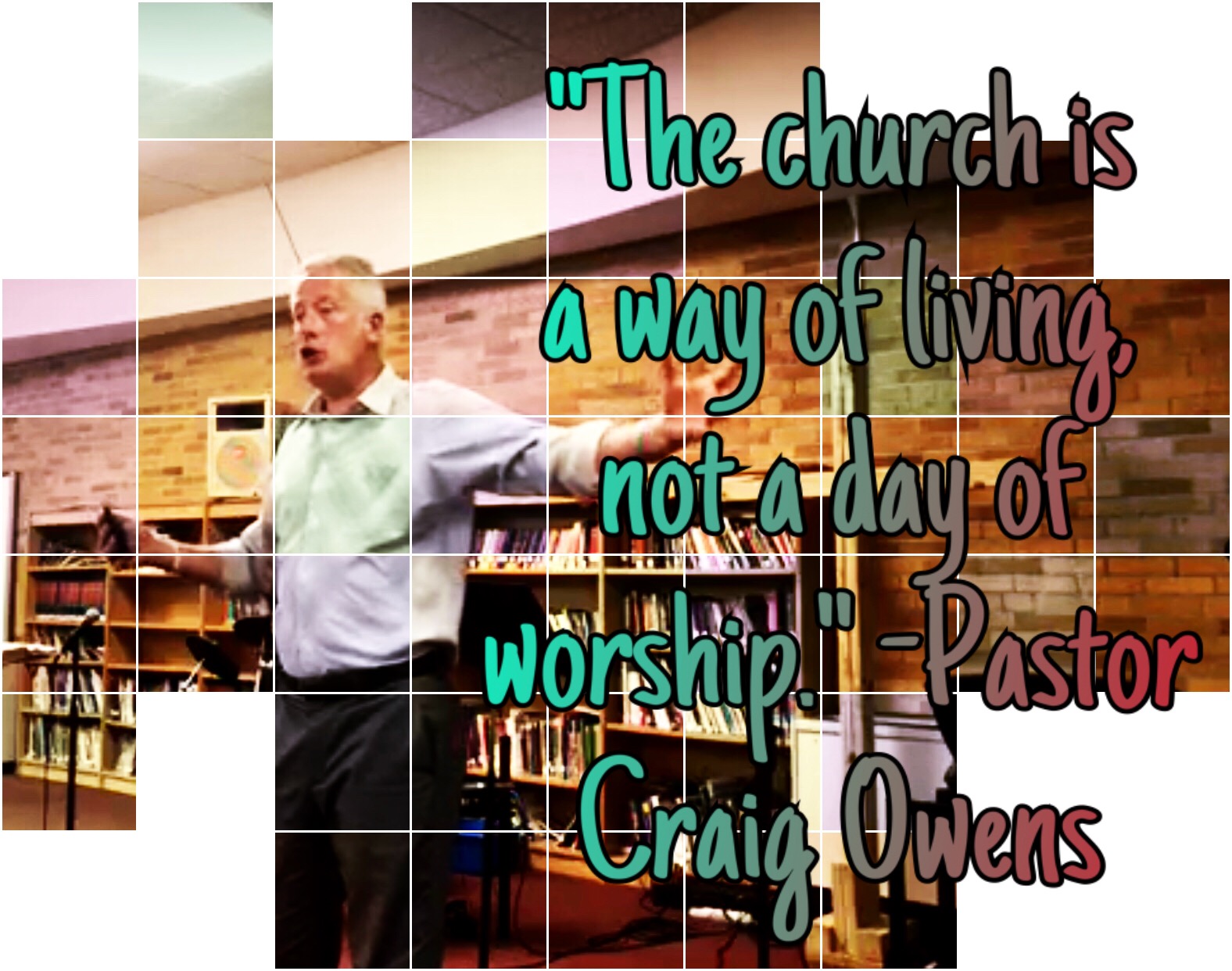
In fact, before they were called Christians the church was simply called “the Way” letting us know that the church was a way of life, not a day of the week. 

Based on how Jesus lived and how the Apostle taught, I think we can see the Church Way like this: 

In other words, EVERY day and in EVERY place the followers of Jesus were being enriched in their own lives so that they could reach out to the hurting so that they could come to know Jesus personally so that their lives could be enriched so that they too could reach out to others, and on, and on, and on it goes! 

Limiting “church” to a specific location or to a specific day of the week is way too small-minded. Church as Jesus intended it was a powerful force that would set people free EVERY day and in EVERY place from the power of the devil and introduce them to God’s eternal life! 

Saturday In The Proverbs—How Does That Taste? (Proverbs 12)

[Each chapter in the Book of Proverbs contains thoughts that fit into a theme; they are not just random thoughts gathered together. In this “Saturday In The Proverbs” series, I will share a theme that I see in each chapter. But the cool thing about God’s Word is that you may see an entirely different theme. That’s great! If you do, I would love for you to share it in the comments below.]

Whoever loves instruction loves knowledge, but he who hates correction is stupid (Proverbs 12:1).

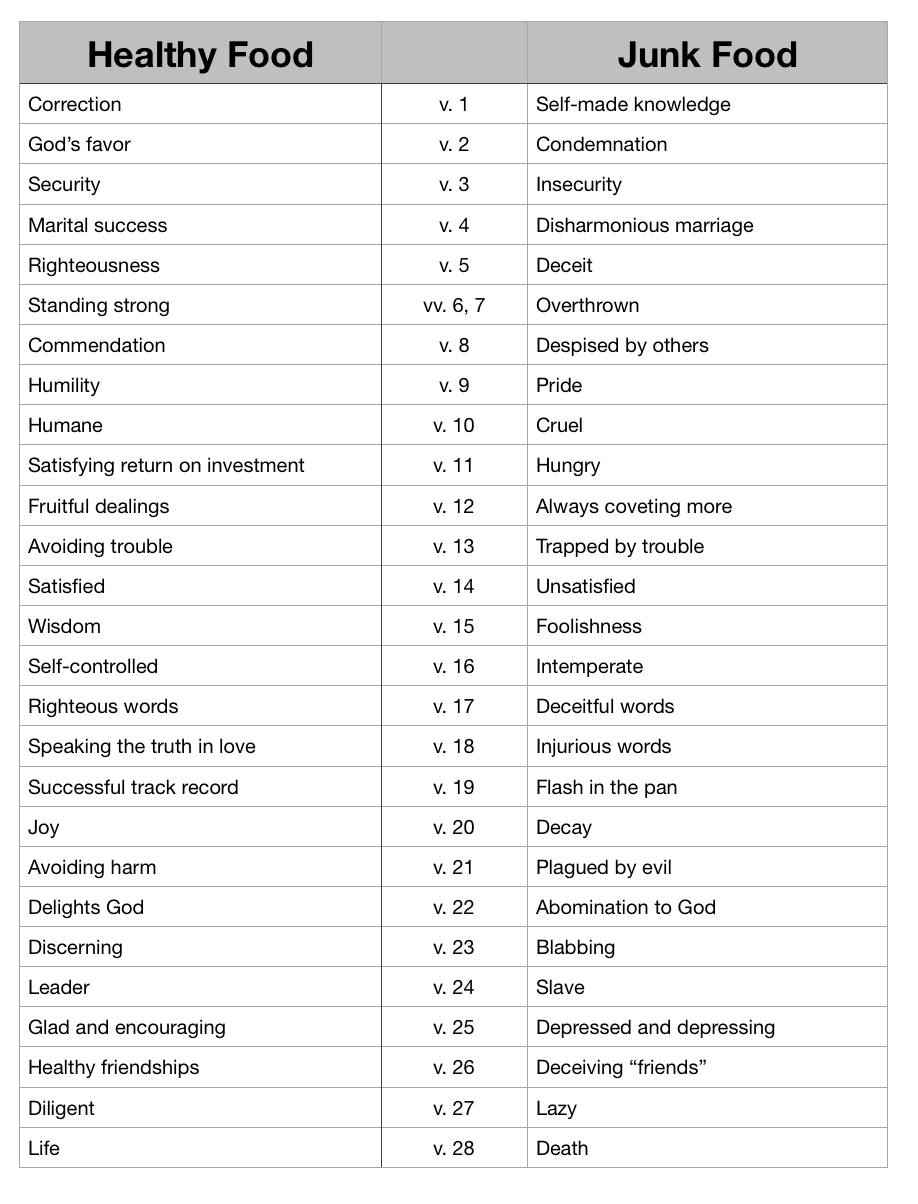
What comes from our lips is either a healthy feast or it is nauseating junk food. But what comes from our lips is based on what we put in—garbage in, garbage out.

The only way to fix this is by gaining godly knowledge and listening to godly correction.

Here is a side-by-side comparison of healthy food and junk food that Solomon lists for us in Proverbs 12:

(click on the image to see a larger view or click here to download a PDF → Proverbs 12 – how does that taste)

Thursdays With Oswald—Jeremiah 7

Oswald ChambersThis is a weekly series with things I’m reading and pondering from Oswald Chambers. You can read the original seed thought here, or type “Thursdays With Oswald” in the search box to read more entries.

Jeremiah 7

[These are notes from Oswald Chambers’ lecture on Jeremiah 7.]

     To seek a place instead of a Person is the first peril in the spiritual life, and to sentimentalize over places where God has met you is the beginning of spiritual twist. Beware of relying on a principle saving you from moral wrong, for it never can. A personal relationship to a personal Savior is the only power that can shield the soul from moral peril. The golden rule is, my personal Savior in every place, not that in certain places I meet my Savior. …  

     Self-deception always arises by ignoring the personal relationship to God….

     Self-examination is the only exercise for a soul who would remain true to the light of God. … The hardest thing in a saint’s life is to maintain a simple belief in Jesus until he realizes the one relationship is—my Lord and I; then His joy will be fulfilled in us.

From Notes On Jeremiah 

We have to be very careful about making a special landmark out of a place, an experience, or even a passage of Scripture where God met us in a profound way. Those special encounters are intended for one specific purpose: to draw us more deeply into a relationship with the Person of Jesus Christ. 

We are on the road to self-deception if we keep seeking experiences. The road to spiritual health is paved with Spirit-inspired self-examination where we ask, “How did that experience lead me closer to Jesus?” When all the other stuff is stripped away, that’s where we will feel Christ’s joy fulfilled in us.

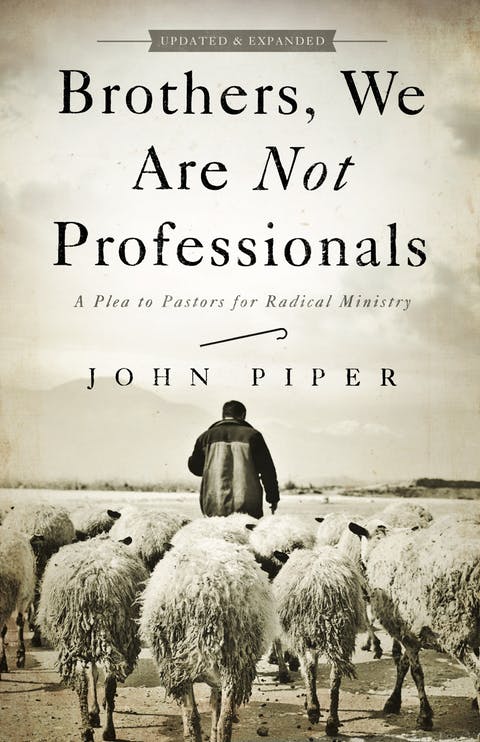
9 More Quotes From “Brothers, We Are Not Professionals”

Those in pastoral ministry are ministers; they are not professional, career-minded, corporate ladder-climbers. John Piper has written a book that I believe every pastor should read: Brothers, We Are Not Professionals. Here are a few more quotes from this excellent book. 

“Is not our most painful failure in the pastorate the inability to weep over the unbelievers in our neighborhoods and the carnal members of our churches? …  

“I must feel the truth of hell—that it exists and is terrible and horrible beyond imaginings forever and ever. ‘These will go away into eternal punishment’ (Matthew 25:46). Even if I try to make the ‘lake of fire’ (Revelation 20:15) or the ‘fiery furnace’ (Matthew 13:42) a symbol, I am confronted with the terrifying thought that symbols are not overstatements but understatements of reality. …

“I say to you, on the authority of Scripture, remember, remember, remember the horrid condition of being separated from Christ, without hope and without God, on the brink of hell. ‘Remember that you were at that time separated from Christ, alienated from the commonwealth of Israel and strangers to the covenants of promise, having no hope and without God in the world’ (Ephesians 2:12). … 

“When the heart no longer feels the truth of hell, the gospel passes from good news to simply news.” 

“Warning has value in stirring us up to take the glories of holiness and heaven seriously so that we come to see them for what they are and delight in them. But it is the delight in them that causes the true grief when we fall short.” 

“Pastors, you will know your people’s souls best by knowing your own. So try to be ruthlessly honest with yourself.” 

“If the heart is without passion, it will produce lifeless, jargon-laden spontaneity. And if the heart is aflame, no form will quench it.” 

“We ought to experience the deepest emotions about the deepest things. And we ought to speak often, and publicly, about what means most to us, in a way that shows its value.” 

“Eating, exercising, and sleeping are more spiritually relevant in the ministry than we may think. … The point is that we be intentional about how our eating affects the ability of our body to be a helpful partner in seeing the glory of God.” 

“When we say that what we do on Sunday morning is to ‘go hard after God,’ what we mean is that we are going hard after satisfaction in God, and going hard after God as our prize, and going hard after God as our treasure, our soul-food, our heart-delight, our spirit’s pleasure. Or to put Christ in His rightful place—it means that we are going hard after all that God is for us in Jesus Christ, crucified and risen.” 

“It will transform your pastoral leadership in worship if you teach your people that the basic attitude of worship on Sunday morning is not to come with your hands full to give to God but with your hands empty to receive from God.” 

“Brothers, we are leaders, and the burden of change lies most heavily on us.” 

You can read my full book review of Brothers, We Are Not Professionals by clicking here, and you can check out some other quotes from this book here. 

A Warrior For God’s Favor

I love this guy! 

Caleb is a dog. I’m not kidding: his name literally means dog. To be more specific his name actually means a rabid dog. What?! Yeah, but it totally fits his life. 

Caleb first shows up on the scene when the Israelites are getting ready to explore Canaan for the first time. They have just been delivered from Egypt and in about two months have arrived at the border of their promised land. Moses wants to send a representative from each tribe to scout out the land. 

So the first thing we learn about Caleb is that he is a leader of the largest, most powerful tribe in Israel (Numbers 13:1-3, 6). 

After scouting the land for 40 days, these men come back with a report for everyone. Halfway through their report, Caleb interrupts everyone—“We should go take the land right now, for we can certainly do it!” (13:30). Caleb was outspoken for God’s favor. He firmly believed that God was for them. 

Unfortunately, nearly all the other scouts (except Joshua) disagreed with Caleb. They warned that there were giants in the land that would eat them for lunch. In essence, the same people who had seen God deliver them from the Egyptians and part the Red Sea for them now thought that God wasn’t able to defeat giants. This vocal majority turned the entire nation against Moses and wanted to return to Egypt! 

So God promised that none of the adults would enter the promised land, with only two exceptions: Joshua and Caleb. God pointed out that Caleb “has a different spirit and follows Me wholeheartedly” (Numbers 14:24). This is where we first learn that Caleb is rabid. The term rabid means zealous, intense, fanatical, inspired. Caleb is a man who is focused—intensely, wholeheartedly focused—on God. In fact, this word wholehearted is used about Caleb three more times (see Joshua 14: 8, 9, 14). 

Along with the rest of the Israelite community, Caleb wandered in the wilderness for 40 years. He never thought God had forgotten him; he never lost his intense wholeheartedness; he stayed rabid the whole time. He had a trust in God that never diminished. His motto might have been: “God said it; I believe it.” 

After 40 years in the wilderness, and then five more years fighting to claim their promised land, Caleb was still raring to go. He told Joshua, “I am still just as strong as I was 45 years ago. I’m 85 years old and still ready to take on giants. Let me at ‘em!” And he did it! Caleb drove out three giants in order to claim his territory (Judges 1:20).

But Caleb wasn’t done yet. He then used God’s favor to be a blessing to others. The Apostle Paul tell something that Caleb lived out: God will generously provide all you need. Then you will always have everything you need AND plenty left over to share with others (2 Corinthians 9:8). Without a word of complaint, Caleb gladly accepted not only the responsibility of letting the Levities live in the town he had conquered, but he also took on the added duties of making that city of Hebron a “city of refuge.” In this city, Caleb would keep anyone safe from those seeking their lives until a proper trial could be held. 

Caleb was successful for nearly 90 years because he was convinced that God was for him.

Nothing could distract him from wholeheartedly clinging to God’s favor! 

Caleb was a warrior for God’s favor, and he was a successful warrior because of God’s favor. The same can be said of you IF you will decide to cling to God’s favor wholeheartedly.