Strengths-Based Marriage (reading plan review)

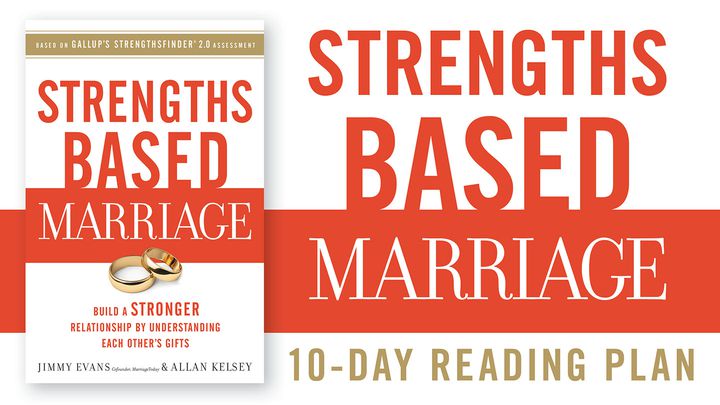
Normally on Tuesdays, I post book reviews here, but I’ve been reading a couple of YouVersion reading plans with my wife this summer that I felt I must share with you. Both of them are by Jimmy Evans—One: A Marriage Devotional and Strengths-Based Marriage. 

If you are unfamiliar with YouVersion Bible, there is both a web-based site and a mobile app that you really should check out. I spend a lot of quality time in the Scripture using the app on my iPhone each day. One of the cool features YouVersion has recently introduced is the ability to read devotional plans with friends. This offers:

  • accountability with your reading partners 
  • a set schedule of reading assignments
  • access to all the biblical texts that correspond with the day’s devotional reading
  • a place to share your thoughts just with your reading partners, and inaccessible to anyone else on YouVersion

Strengths-Based Marriage focuses on exactly what the title leads you to expect—the strengths in you and your spouse. Instead of trying to “fix” something in your spouse, Jimmy Evans turns your attention toward the God-implanted strengths in your spouse, and then gives you some practical counsel for calling out those strengths. 

For example, in one of the devotions he wrote, “Each of us is remarkably unique, and to minimize that irreplaceable uniqueness is to rob the world of a contribution that cannot come any other way.” And in another devotional he says, “You cannot separate your treasures from your passions. In other words, you will always be most passionate about the people, pursuits, and places where you are investing the best of your life. Your passions will always follow the investments of your time, energy, and strengths.”

One: A Marriage Devotional is a much more daily nuts-and-bolts approach to our marriages. In this devotional he shares relationships principles, and then gives us a “Talk It Out” and a “Walk It Out” assignment to put into practice. 

In one of these devotionals he writes, “God created marriage to operate as the most important human relationship in our lives, and it only succeeds on that level. … Priority must be proven daily in real terms and not just in words. Good intentions mean very little in marriage. The only thing that matters is what you do and continue to do consistently. For your marriage to work, you must establish it as the first priority and be willing to protect it against good or bad things that try to distract you.”

Whether your marriage is in need of urgent attention, it could use some minor improvements, or it’s already pretty great, both of these devotionals will give you practical tips, time with your spouse in God’s Word, great conversation-starting questions, and some highly practical tips you can use right now. 

Renewed Passion For Prayer

If I were to ask you if we should we pray for our friends in need, I think I’d probably get a universal “yes.” Even non-Christians might say we should “send good thoughts” or “best wishes” to our friends.

But if I were to ask, “How long should we pray for them?” we might get a lot of different answers. 

What about if we’re praying for a friend to get a job (and he gets it), or a friend to be healed (and she is), or a marriage to be restored (and it is)—do we stop praying then? 

Psalm 20 and 21 appear to be companion psalms: with Psalm 20 being David’s prayer of petition, and Psalm 21 being his prayer of praise. But there is also something quite interesting in each of these psalms about the placement of the word Selah. 

Remembering that Selah means some sort of pause, I find it very interesting where David tells us to pause in both of these psalms. In Psalm 20 we see the prayer request “may” either 6 or 7 times in the first five verse, but the Selah pause is right in the middle of them. Why would David start making his requests to God, tell us to pause in the middle, and then continue making his requests? 

I believe this Selah means to “pause and consider” that… 

  1. God invites us to participate with Him in fulfilling His plans. 
  2. God loves us so much that He wants to hear from us. 
  3. God is powerful enough to grant what we ask of Him. 

It’s as if in the middle of all of his petitions, David says, “Hold on a second. Do you realize what we are in the midst of doing? We are actually communing with the All-Knowing, All-Loving, All-Power Creator and Sustainer of the Universe!!”

In Psalm 21 David is offering up a prayer of praise for God’s answers to his prayers (note the similar language in Psalm 20:4 and 21:2), and once again he tells us to Selah pause right in the middle of those prayers of gratitude. 

I asked earlier, “When do we stop praying for a friend or for ourselves?” Is it when we get the job, or experience the healing, or have the breakthrough or restoration? What if the job, the healing, the restoration was just the beginning of what God wanted to do? The Selah in Psalm 21 is an accentuation: an explosion into so much more!! 

David prayed for victory in battle, but God gave him an everlasting victory; David prayed for long life, but God gave him eternal life (21:4); David prayed for blessings on his battle, but God gave him His eternal blessings (21:6).

Jesus said our Heavenly Father has gifts for us beyond our asking (Matthew 7:11), and the Apostle Paul said the same thing in Ephesians—

Now glory be to God, who by His mighty power at work within us is able to do far more than we would ever dare to ask or even dream of—infinitely beyond our highest prayers, desires, thoughts, or hopes. (Ephesians 3:20 TLB)

These two Selahs tell me: 

Don’t quit praying when times are tough. 
Don’t quit praying when you’ve prayed a long time. 
Don’t quit praying when it seems like God has answered. 
Keep on praying. Always. About everything!


Please join me this coming Sunday as we continue to look at the Selahs in the Psalms. You can join me in person or via Facebook Live. 

Saturday In The Proverbs—Self-Made People Get Robbed (Proverbs 18)

[Each chapter in the Book of Proverbs contains thoughts that fit into a theme; they are not just random thoughts gathered together. In this “Saturday In The Proverbs” series, I will share a theme that I see in each chapter. But the cool thing about God’s Word is that you may see an entirely different theme. That’s great! If you do, I would love for you to share it in the comments below.]

A man who isolates himself seeks his own desires; he rages against all wise judgment (Proverbs 18:1).

The self-absorbed, self-centered, self-made man only robs himself of…

  • …the wisdom others could give him (vv. 1, 15)
  • …understanding more deeply (vv. 2, 4)
  • …peaceful relationships (vv. 6, 7, 18, 19, 24)
  • …getting the full story (vv. 8, 13, 17)
  • …God’s help (v. 10)
  • …honor (v. 12)
  • …life (v. 21) 

Don’t get ripped off by thinking you already know it all! 

Thursdays With Oswald—Jeremiah 13

Oswald ChambersThis is a weekly series with things I’m reading and pondering from Oswald Chambers. You can read the original seed thought here, or type “Thursdays With Oswald” in the search box to read more entries.

Jeremiah 13

[These are notes from Oswald Chambers’ lecture on Jeremiah 13.] 

     When a man is afraid of God the only right thing for him to do is to run straight to God and not wait to dress himself. The further we get away from God the more we want to dress ourselves up in prayer, etc., but if we fly, just as we are, God will take us and remove the unclean thing. … 

     Spiritually when an individual builds his confidence on anything less than God inevitably there will be a perishing of the ground of confidence. … Beware of building your faith on your experience of God’s grace instead of on God Who makes the experience possible. … 

     Never succumb to believing in an inevitable fate, but fly to God, then you will never know the darkness or the judgments on sin (cf. John 3:19). Judgment comes because of conscious rejection or a conscious neglect. If we see and do not obey, there will be the wandering in the shadows, by God’s decree. There is always a way back to God, and that is to fly as you are, not as you want to be. …  

     Never trust innocence of outlook in yourself or in other people when the statements of God’s Word are directly opposite (see Mark 7:21 and Jeremiah 17:19). … It is difficult when convicted to turn to Jesus Christ; we turn to vowing; but unless we turn to Jesus in obedience and let His life enter in, it is hopeless, for we build again on the same old foundation.

From Notes On Jeremiah

When the Holy Spirit convicts us, our natural human tendency is to (a) justify, (b) make excuses, (c) vow that we will never do that again, (d) ask a friend to help hold us accountable to better behavior, or (e) try to cover up with a lot of religious activity. 

What God wants instead is for us to run to Him. Just as we are. No pretenses. No excuses. No delay. He alone has the healing and restoration we desperately need. 

Unexpected Praise

Well, this isn’t what I expected! David says his song in Psalm 9 is supposed to be sung to the tune of “Death Of The Son,” so I’m expecting a prayer that is loaded with minor notes. But instead, David gives us … this! 

The opening verses show us David exploding in praise to God. Check out his vocabulary—

  • I will praise You—this literally means David is pumping his hands in the air
  • I will tell of all Your wonders—David is not doing this just one time but is ticking off a long list of God’s praiseworthy deeds and attributes
  • I will be glad—his face lights up with joy 
  • I will rejoice—this word means a roar of praise (see 1 Chronicles 16:32)
  • I will sing praise—there is a new melody with every praise David lifts to God

Why this loud, exuberant, unexpected praise? Because David has noticed that whatever has “died” on earth is only a temporary loss, but God is forever! 

There is an unusual word pairing at the end of verse 16: Haggaion and Selah. This is the only time these two words appear like this in all of Scripture, and it’s also the only time Haggaion is used without being translated. 

Haggaion appears just four times in the Bible—(a) in Psalm 19:14 where it is translated meditation; (b) in Psalm 92:3 where it is translated solemn sound; (c) in Lamentations 3:62 where it is translated whisper and mutter; and (d) here in Psalm 9 where it is untranslated. 

By combining Haggaion and Selah, David is wanting us to solemnly meditate on an important contrast: God’s way vs. man’s way. In verses 3-16, David uses huge and eternal terms for God like righteous Judge, reigns forever, refuge, stronghold, merciful, and prayer-answerer. 

Side-by-side with these eternal terms for God, David lists the temporary terms for man like stumble, perish, ruined, forgotten, and trapped. In fact, David ends this Psalm by reminding us evil men who do evil things are “mere men.” Other translations fill in the details: 

  • make them realize their frail nature (AMP)
  • show them how silly they look (MSG)
  • merely human (NLT) 
  • puny men (TLB)

Then David ends with a final Selah—one more call for us to allow this message to resonate with us, especially during the times others may call dark, depressing times. The message that should resonate in our hearts and cause us to throw our hands up in joyful celebration of God is…

these earthly things are temporary and God is eternal. He has never forsaken those who seek Him, and He has never forgotten those who call on Him for help. 

When a dark time—a “death of a son”—tries to rock your world, don’t do what puny mortals expect, but throw your hands up in the air, and sing and roar a praise to the Almighty God Who cares for you! 

Join me this coming Sunday as we continue our looks at the Selahs in the Book of Psalms. You can join me in person or on Facebook Live.

Saturday In The Proverbs—Sowing & Reaping (Proverbs 17)

[Each chapter in the Book of Proverbs contains thoughts that fit into a theme; they are not just random thoughts gathered together. In this “Saturday In The Proverbs” series, I will share a theme that I see in each chapter. But the cool thing about God’s Word is that you may see an entirely different theme. That’s great! If you do, I would love for you to share it in the comments below.]

A wise servant will rule over a son who causes shame… (Proverbs 17:2).

There are inevitable outcomes for our attitudes and (in)actions. Or said another way: We always reap what we sow.

Not dealing with confrontation correctly → → Strife (v. 1)

Wise work ethic → → Leadership rewards (v. 2)

Allowing God to refine you → → A pure heart (v. 3)

Listening to lies and slander → → Punished by God (v. 4)

Mocking the less fortunate → → Punished by God (v. 5)

Living well → → Leaving a legacy for my children (v. 6)

Truthful, uplifting speech → → Being treated like a prince (v. 7)

Lies and loose lips → → Being treated like a fool (v. 7)

Giving gifts to others → → Favor with others (v. 8)

Forgiving and forgetting an offense → → Cementing a friendship (v. 9)

Telling others about an offense → → Losing a friendship (v. 9)

Rebuking a wise man → → Gaining wisdom (v. 10)

Rebuking a fool → → Getting rebuked myself (v. 10)

Rebellion → → Repaid with cruelty (v. 11)

Trade folly with a fool → → Get mauled (v. 12)

Repay good with evil → → Get stuck with evil (v. 13)

Keep picking a fight → → Open a world of hurt (v. 14)

Justify the wicked or condemn the just → → Displace God (vv. 15, 26)

Give wisdom to a fool → → Get burned (v. 16)

Love your friends → → Have help in difficult times (v. 17)

Make a bad deal → → Get stuck with it for a long time (v. 18)

Love sin and promoting yourself → → Watch it all crash down (v. 19)

Look for deceit → → Fall into evil (v. 20)

Don’t discipline your children → → No joy (vv. 21, 25)

Be happy → → Make others happy (v. 22)

Be sad → → Cause rotten feelings in others (v. 22)

Accept a bribe → → Pervert justice (v. 23) and displease God (v. 15)

Keep focused on the here-and-now → → Get wisdom for there-and-then (v. 24)

Use words sparingly → → Bring calm (v. 27)

Stay silent when you have nothing good to say → → Be thought of as wise (v. 28)

If you don’t like what you’re reaping in your life, check what you’re sowing. 

Thursdays With Oswald—Jeremiah 12

Oswald ChambersThis is a weekly series with things I’m reading and pondering from Oswald Chambers. You can read the original seed thought here, or type “Thursdays With Oswald” in the search box to read more entries.

Jeremiah 12

[These are notes from Oswald Chambers’ lecture on Jeremiah 12.]

     Few suffer more seriously in character than the men and women who for one reason or another are exempt from frank, honest criticism. …  

     Progressive realization does not mean that God reveals Himself by inches, but that we realize His revelation of Himself by inches as we obey. … 

     God would have been “a wall of fire round about and…the glory in the midst” [Zechariah 2:5] if they had been obedient. The difference between God as a consuming fire and natural fire is just this, that the further you get away from God the more fiercely you feel His burnings, but when you are close to Him, you will find it is a glorious protection. … 

     The truth about God is Jesus Christ—light, life and love. Whatever is dark to us will, by means of our obedience, become as clear as the truth which we have made ours by obedience. The bit we do know is the most glorious, unfathomable delight conceivable, and that is going to be true about everything to do with God and us. The process is continual obedience. 

From Notes On Jeremiah 

God wants to reveal Himself to us, even if He has to be a consuming fire in order to do so! 

God will burn up everything that keeps us from obeying Him—everything that takes our attention off of Him. He will burn up everything worthless so that we can know what is of incalculable worth; namely, Himself. 

If you want to have more of God revealed to you, scrupulously obey the parts that have already been revealed to you. 

Saturday In The Proverbs—God Is Sovereign (Proverbs 16)

[Each chapter in the Book of Proverbs contains thoughts that fit into a theme; they are not just random thoughts gathered together. In this “Saturday In The Proverbs” series, I will share a theme that I see in each chapter. But the cool thing about God’s Word is that you may see an entirely different theme. That’s great! If you do, I would love for you to share it in the comments below.]

…from the Lord (Proverbs 16:1).

God is Sovereign, which means He has supreme authority. 

The sooner—and more consistently—I acknowledge this, the more joy I can experience! According to Proverbs 16, acknowledging God as Lord and Master means: 

  • having the right answers (vv. 1, 24)
  • living with a clear conscience (v. 2)
  • thinking better thoughts (v. 3)
  • not getting swept away in judgment (vv. 4, 5)
  • experiencing mercy, truth, and atonement (v. 6)
  • peaceful living (v. 7)
  • contentment (vv. 8, 16)
  • divine direction (v. 9)
  • righteous living (vv. 10-12, 31)
  • favor among kings (vv. 13-15)
  • avoiding stumbling (v. 17)
  • avoiding pride (vv. 18-19)
  • happiness (v. 20)
  • having prudence (v. 21)
  • getting better understanding (vv. 22-23)
  • eternal life (v. 25)
  • satisfaction in my work (v. 26)
  • avoiding evil people (vv. 27-30)
  • self-control (v. 32)
  • seeing God’s providence at work (v. 33)

Not a bad list! 

Thursdays With Oswald—Jeremiah 11

Oswald ChambersThis is a weekly series with things I’m reading and pondering from Oswald Chambers. You can read the original seed thought here, or type “Thursdays With Oswald” in the search box to read more entries.

Jeremiah 11 

[These are notes from Oswald Chambers’ lecture on Jeremiah 11.]

     Misapprehensions of God arise from not understanding that His way for us is obedience until we discern, not waiting to obey until we know. The only way to know God more fully is to obey what we have discerned, then we shall know something more. …  

     If we will obey, we are backed by Omnipotence; but if once we begin to be cunning and suspicious and to doubt, we are backed by diabolical inspiration as compelling on the wrong side as obedience is on the right. … 

     Unless we keep in touch with God by obedience it is possible to pray for a wrong thing. In this case [Jeremiah 11:9-11] the people have rebelled and do not intend to obey, they only pray because they are suffering, not because they want God’s will to be done in them. … 

     “My Lord and I” is a very beautiful sentiment, but before we know it as a living experience we have to fight our way through all the contradicting things to the un-afraid, simple life that trusts in God. 

From Notes On Jeremiah

Most of us have an attitude that says, “As soon as I understand, I will fully believe.” But Oswald Chambers points out that the Scriptures teach that we are to be fully obedient to what has already been revealed to us in order to receive more revelation. 

A loving God would not reveal things to us that we are not yet ready to obey. So if you want God to show you deeper things, obey what He’s already shown you. 

Defy The Experts

Later war broke out with the Philistines at Gezer. That was the time Sibbecai the Hushathite killed Sippai of the clan of giants. The Philistines had to eat crow. 

In another war with the Philistines, Elhanan son of Jair killed Lahmi, the brother of Goliath the Gittite whose spear was like a ship’s boom. 

And then there was the war at Gath that featured a hulking giant who had twenty-four fingers and toes, six on each hand and foot—yet another from the clan of giants. When he mocked Israel, Jonathan son of Shimea, David’s brother, killed him. 

These came from the clan of giants and were killed by David and his men. (1 Chronicles 20:4-8) 

All the experts said that it was humanly impossible for a human to run a mile in less than four minutes. They looked at all the data and concluded it just couldn’t be done. 

But in 1954, Roger Bannister ran a mile in 3:59.4. 

Since that time, over 1400 runners have been inspired by Bannister’s success and have also broken the “unbreakable” barrier of a 4-minute mile. 

Before David faced the giant Goliath, the experts were probably all in agreement: giants just can’t be killed by normal-sized humans. 

But David killed Goliath. And then, inspired by his success in doing the “impossible,” David’s fellow warriors began chopping down giants too!

What’s holding you back? What have you or other so-called experts declared “impossible” or “unbreakable” or “undoable”? 

If God is calling you to take on the giant, DO IT! 

Defy the so-called experts. Do the “impossible.” Don’t let what others say is un-doable hold you back from victory!