5 Quotes From “Praying For Muslims”

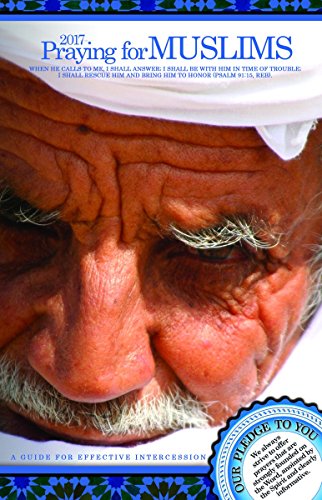
Sobhi Malek put together an extremely helpful guide for praying for Muslims. Each week has a prayer, but there are also several helpful insights which Sobhi shares. Here are a few of those insights.

“This warfare is not against people of any religion or affiliation. Christ, who died for all human beings, instructed us to love our neighbors. Rather, this war is against the evil powers which control people and hinder them from seeing the light of the Gospel of Christ (Ephesians 6:12). In other words, we are warring against satan who ‘has blinded the minds of unbelievers.’ His goal is to keep people from seeing ‘the light of the Gospel of the glory of Christ, who is the image of God’ (2 Corinthians 4:4). When we pray and ask others to pray, this does not mean that we feel superior. We do not think we are better than Muslims or any other people.  Rather, we believe we are fallen human beings like all others, but we have been saved by God’s grace.”

“When Muslims say, ‘In the name of God the merciful, the compassionate,’ all Muslims and many Christians do not know that this is taken from the Bible. This phrase demonstrates the early influence of Judaism and Christianity on Muhammad. Here are some occurrences of this combination in the Bible: compassionate and gracious (Exodus 34:6, NIV); compassionate and merciful (Psalm 86:15, GW; 103:8, NLT; James 5:11, GW); merciful and tender (Luke 1:78, TEV).”

“There are many teachings in Islam that we, believers in Christ, can use as bridges to help Muslims draw near to and enter the Kingdom of God. The Qur’an states that God created Adam and Eve, that He sent the flood but rescued Noah, that He spoke to Abraham, that He gave the Torah (Pentateuch) to Moses, that He sent Jesus who was born of a virgin. All these narratives, common to both Muslims and Christians, can be used as bridges to bring Muslims closer to the Gospel of our Lord Jesus Christ. This does not mean that all the details of these stories in Islam are in full agreement with the biblical accounts, but they can work as starting points. It is also rewarding to establish friendships with Muslims as you seek to share with them the Gospel of Christ. Friends trust each other, depend on each other and desire each other’s wellbeing. Building bridges of common narratives and friendship pays dividends.”

“The Qur’an, Islam’s holy book, is a collection of jumbled statements and stories in a random arrangement. Most of its stories are fractured and lack consistency. Subjects and themes are not connected. So fractured are narratives in the Qur’an that only one story has a clear beginning, middle, and end: the story of Joseph. All the other stories pick up in the middle, or else they are never carried to their conclusion. The Qur’an admits that satan sometimes intervened and gave Muhammad ‘inspiration.’ It also states that Muhammad forgot some parts of it. Several chapters start with meaningless three-letter words such as alr, alm, etc. Even great quranic interpreters cannot find a meaning for such words. In one place the Qur’an states that no changes occurred in its text, and in another it says changes to it indeed took place.”

“In the past few decades, millions of Muslims have migrated to the West. Some seek jobs, others pursue freedom and a better living, and still others hope to conquer the West by converting Westerners to Islam or by sheer reproduction and numerical growth! I personally take this migration to mean the Lord wants to help the Church win large numbers of Muslims to Christ by bringing them to her doorstep.”

Next week I will share a few of the prayers Sobhi leads us in each week. I would also recommend that you check out my review of Praying For Muslims.
No Room For God?

My friend Scott delivered a right-between-the-eyes message yesterday. Here are my takeaways.

Quite possibly the deadliest of the relationship killers is pride.

Think of all the ugly things surrounding Pride:

  • Always fault-finding
  • Always defensive
  • Constantly craving attention
  • Disregarding advice
  • Saying “I’m better than you!”
  • Saying “I don’t need your help!”
  • Quick to tell others “Here’s how you should do that”
  • Can’t handle any constructive criticism
  • But always critical of others

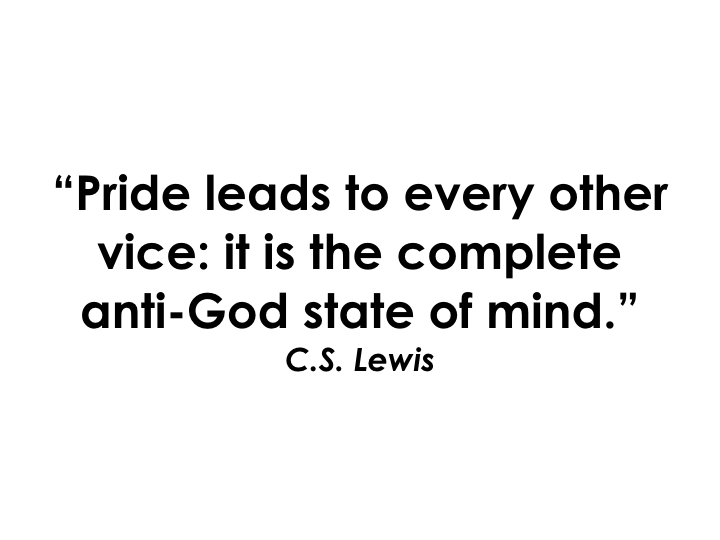
In fact, C.S. Lewis said, “Pride leads to every other vice: it is the complete anti-God state of mind.”

One psalmist got right to the root of the problem of pride when he wrote—

In his pride the wicked does not seek Him; in all his thoughts there is no room for God. (Psalm 10:4)

No room for God?!

The Bible is all about relationships. Adam was first created to be in a relationship with God, and then Eve was created so she and Adam could be in a relationship with each other. Jesus reiterated this when He was asked what the greatest commandment was, and He said, “Love God with all your heart, mind and soul.”

But if Pride rules in my heart, and there is no room for God, how can I love Him with all I’ve got? The simple answer is: I can’t.

Jesus quickly added that the next greatest commandment also revolved around relationships when He said, “And love your neighbor as yourself.”

If my proud heart is filled with prideful love, it cannot be filled with God’s love.

If my pride-filled heart has no room for God’s love, then it has no room to love anyone else.

Pride kills every relationship.

Jesus had absolutely no trace of pride when He set aside all His heavenly privileges and came to earth as a Human (Philippians 2:6-8). The Apostle Paul then tells us that our attitude should be the same as Christ’s attitude.

Humility kills pride!

Are you filled with pride? Ask yourself some of these questions:

  • Do I have a problem submitting to authority?
  • When I get into an argument, do I always have to have the last word?
  • Am I willing to accept blame?
  • Can I ask for forgiveness, or am I always right?
  • Do I sometimes cheat at a game just so I can win?
  • If I lose, is it someone else’s fault?
  • If I win, do I brag about how good I am?
  • Do I think I’m the only one who can solve all my own issues?
  • Do I think I can solve everyone else’s issues too?

If you found yourself saying “yes” to these questions it’s probably time to ask the Holy Spirit to do a heart-check on your level of pride. Make sure that in your heart there is increasingly more room for God.

Who Can Bridge The Gap Between God And Man?

Listen to the podcast of this post by clicking on the player below, and you can also subscribe on AppleSpotify, or Audible. 

Mankind was created good and upright in God’s image and given dominion over everything God had created (see Genesis 1:26-28; Psalm 8:3-8). But man was not given dominion over himself (Genesis 2:15-17).

As Oswald Chambers said, “The temptation came to him on this line—‘Disobey, and you will become as God.’ Man took dominion over himself and thereby lost his lordship over everything else. According to the Bible, the disposition of sin is my claim to my right to myself” (see Genesis 3:1-7).

“And sure enough, they then had knowledge of good and evil, but it was from the standpoint of becoming evil and remembering how good they once were” (Nancy Guthrie). Their disobedience created an unbridgeable gulf between God and man. 

There were other consequences of their sin too:

  • Consequence #1—They realized they were naked, making them ashamed of themselves and ashamed to be in God’s presence.
  • Consequence #2—They feared God and tried to hide from Him.
  • Consequence #3—They couldn’t accept responsibility for what they did because that acceptance would mean they would also be responsible for bridging the gulf, something they were utterly unable to do.
  • Consequence #4—They were completely separated from God. Now there was nothing that they could do except work, have children, raise a family, and try to make the best of things.

Even in the midst of this despair, God foreshadowed the hope that would be their salvation. First, God promised that their offspring would one day crush satan’s head. Then God sacrificed an innocent animal and used those skins to make more permanent clothes for Adam and Eve, foreshadowing what Jesus would do.

Adam must have glimpsed this ray of hope because he then named his wife Eve, which means life!

But who could bridge this chasm? Who could be a mediator between God and man? The only possible candidate would have to be Someone who was both fully God and fully Man—that is Jesus Christ!

Only Jesus can fully and eternally cover our nakedness, remove our fear and shame, and present us without sin before His Father (see Jude 24 and Romans 5:6-11).

If, as Oswald Chambers says, sin is my claim to my right to myself, then salvation is God’s right to myself because I have surrendered to the reconciling work of Jesus.

“Believers in Christ are seen by God exactly as Christ is seen by God,” wrote Ann Voskamp, because those who believe in Jesus are clothed in His righteousness!

If you haven’t surrendered yourself to God’s right to you, what’s holding you back from doing that today? If you have surrendered yourself to God, don’t ever let satan lie to you about your nakedness, shame, or unworthiness—you are “Christ’s friend, God’s child, Spirit’s home!” (Ann Voskamp).

►► Would you please prayerfully consider supporting this ministry? My Patreon supporters get behind-the-scenes access to exclusive materials. ◀︎◀︎

Cherish (book review)

Gary Thomas notes something rather peculiar: Many wedding vows contain the promise “to love and cherish” our spouse, and many pastors spend quite a bit of time promoting love, but often the concept of cherishing our spouse gets overlooked. Gary is out to correct that in his aptly-titled book Cherish.

Learning the value of cherishing our spouse pays enormous benefits. In fact, near the beginning of the book Gary says, “Cultivating a cherishing attitude toward your spouse will elevate your marriage relationally, emotionally, spiritually, and even physically.” That sounds to me like something we would all want in our marriages!

So Gary begins unpacking and defining the idea of marriage in practical terms that any married person (or soon to be married person) can grasp. He uses examples from the first marriage in history between Adam and Eve, shows some of the principles Solomon outlines in his Song of Songs, shines a light on the many passages in the New Testament that address marriage, and even shows the ultimate picture of Jesus cherishing His bride. Throughout all of these, Gary gives us modern-day examples from couples he has known and counseled, and even lessons learned from his own marriage.

Each chapter concludes with some bullet points summarizing the main themes, and some questions to help couples grow in their cherishing of one another.

If you are married, about to be married, or a pastor or counselor who works with married couples, Cherish is a book you need to read and be ready to share with others. Such an outstanding read!

I am a Zondervan book reviewer.

6 Quotes From “The Fi5th Gospel”

The Fi5th GospelI have been watching the One Minute Apologist videos from Bobby Conway for quite awhile, and find them very helpful. Recently I finished a reading plan in YouVersion based on Bobby’s book The Fi5th Gospel. Here are a few quotes that especially caught my attention.

“If I am the only Gospel people will ever experience are they experiencing the true Gospel?”

“At no other time in human history has God so plainly and blatantly revealed Himself than at Calvary. At no point has He so graphically uncovered His heart for mankind. It was there, on a hill outside Jerusalem, the Messiah bled for us, suffering hellish agony and sin-induced banishment, all the while enduring the brutal wrath of a holy and righteous God.”

“The exclamation point to this graphic love letter to us was the resurrection—Jesus’ conquering moment of triumph over sin, satan, and the grave. This is what Christians are all about right? It’s how we are saved. Take away the Cross and we’re no different from any other religious idea. It’s Jesus Christ, His death and resurrection. Strip away all the modern church fluff and this is what you find at the core of our faith. It’s essential. Nonnegotiable. Undeniable. It’s what makes us who we are. It’s what makes Christians ‘Christian.’ And it’s why Jesus is the answer to all of life’s deepest issues.”

“The sacrifice [God] requires isn’t death on a cross, but rather death to our pride and fear of what other might think. God just wants us to be proud of Jesus and what He has done for us. He wants us to be unashamed of His Son.”

“Though we were originally created in God’s image, God’s reflection in us was marred in the Garden of Eden when Adam and Eve sinned. And though His image wasn’t completely erased, it was defaced and tarnished. When you trusted in Christ, the Holy Spirit began a beautiful work of ‘image restoration’ in you; masterfully remaking you to more accurately reflect God’s virtue. He began sculpting, forming, and transforming your character to better display Christ to the world. You become His image-bearer, and His ongoing work in your life distinguishes you from the world. This is a lifelong process, by the way, and one God is committed to completing.”

“None of us will ever perfectly represent God’s character. As long as we’re on this earth, we’ll have imperfections. And it’s these imperfections that some unbelievers are quick (and happy) to point out and expose. But there is value in listening to what others say, of taking an honest look in the mirror, of stepping into an unbeliever’s shoes to see what they perceive about Jesus and His bride. Think of it as a spiritual awareness-building exercise.”

Life Or Death?

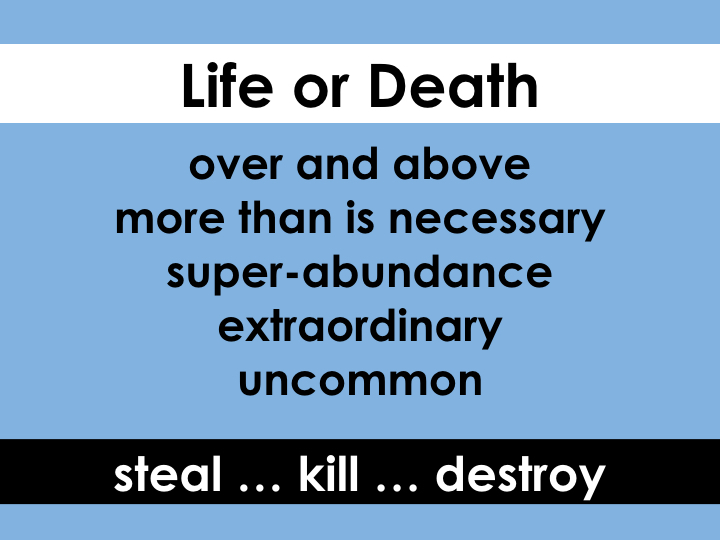
Life or deathSince Jesus predicted His death on a Cross, and His resurrection from the dead three days later, and since that really happened(!), I think that it would be wise to consider the other words Jesus said!

Here’s an important one—The thief cometh not, but for to steal, and to kill, and to destroy: I am come that they might have life, and that they might have it more abundantly (John 10:10).

It’s a pretty clear distinction: One way brings death and the other way brings life. But not just any kind of life.

The Greeks had three words for “life”—

  1. Bios from which we get our word biology. We can see when something is alive because of its biological growth.
  2. Psuche from which we get our word psychology. Plants might be biologically alive, but they don’t have the psychological life of a human.
  3. Zoe. This is the word Jesus used in John 10:10. It’s the word that means “life force” or better stated it’s God’s life.

God is a Triune God: Father, Son, and Spirit. When God created humans, we were created in His “trinity” image—Let Us make man in Our image (Genesis 1:26). Adam was created with bios, psuche, and zoe life. God told Adam and Eve that if they sinned, they would die (Genesis 2:17). When they did eat that forbidden fruit, they remained biologically and psychologically alive, but the zoe life force was cut off.

Jesus came to restore that! He came to bring us back to the state God originally intended for us, which meant He had to go to the Cross to become our sin, so that we could be forgiven and brought back to life.

Placing your faith in Jesus Christ’s work on the Cross means a complete about-face. The devil wants to steal from you, kill you, and destroy your soul for eternity. But Jesus came that you could have zoe in a way that was above-and-beyond, super-abundant, extraordinary and uncommon!

To get this life, Jesus asks us to do something that He did—If anyone would come after Me, he must deny himself and take up his cross and follow Me (Matthew 16:24).

Jesus isn’t calling for our hands and feet to be nailed to a wooden Cross. But He is calling for our selfish thoughts to be crucified (Matthew 16:23), and for us to give no more attention to our old sinful life.

I think this passage in Romans captures that thought so well—

Could it be any clearer? Our old way of life was nailed to the Cross with Christ, a decisive end to that sin-miserable life—no longer at sin’s every beck and call! What we believe is this: If we get included in Christ’s sin-conquering death, we also get included in His life-saving resurrection. We know that when Jesus was raised from the dead it was a signal of the end of death-as-the-end. Never again will death have the last word. When Jesus died, He took sin down with Him, but alive He brings God down to us. From now on, think of it this way: Sin speaks a dead language that means nothing to you; God speaks your mother tongue, and you hang on every word. You are dead to sin and alive to God. That’s what Jesus did. That means you must not give sin a vote in the way you conduct your lives. Don’t give it the time of day. Don’t even run little errands that are connected with that old way of life. Throw yourselves wholeheartedly and full-time—remember, you’ve been raised from the dead!—into God’s way of doing things. Sin can’t tell you how to live. After all, you’re not living under that old tyranny any longer. You’re living in the freedom of God. (Romans 6:6-14)

The choice is yours: the rip-off, destruction, and death the devil offers OR the abundant, overflowing, extraordinary, more-than-is-needed, zoe life that Jesus offers.

Life or death. Your choice.

The Power Of Confession

God restoresGod wants to meet with us. He loves hearing our voice and talking to us. We can come into His presence at anytime, with anything and everything that’s on our heart, and know for sure that He is waiting to hear from us.

But there is one thing that can short-circuit this intimate relationship. And if we don’t deal with this one thing quickly, it could lead to disastrous results.

This one thing is unconfessed sin.

Adam and Eve sinned, and started a downward slide that we continue in today. First, they tried to cover up their sin (Genesis 3:7). Think about this for a moment. They made clothes out of fig leaves. What happens to leaves when are detached from their vine? Yep, they die and shrivel up!

Next, they tried to hide from God (Genesis 3:8-10). Really? You can hide from God?! That’s sort of like a toddler covering her eyes and thinking since she can’t see daddy, he can’t see her either.

Then they made excuses for their sin (Genesis 3:11-13). Of course, they said, we would have never sinned on our own. She made me do it! The devil made me do it!

None of this worked. Instead it kept them in fear of God’s presence!! 

A beautiful prayer of confession of his sin is David’s prayer in Psalm 51. Notice this:

  • He was assured of God’s unfailing love and His great compassion (v. 1).
  • He confessed his sin without excuse. Five times in verses 1-3 he says my transgression, my sin, my iniquity.
  • He let God restore him (vv. 7-12)

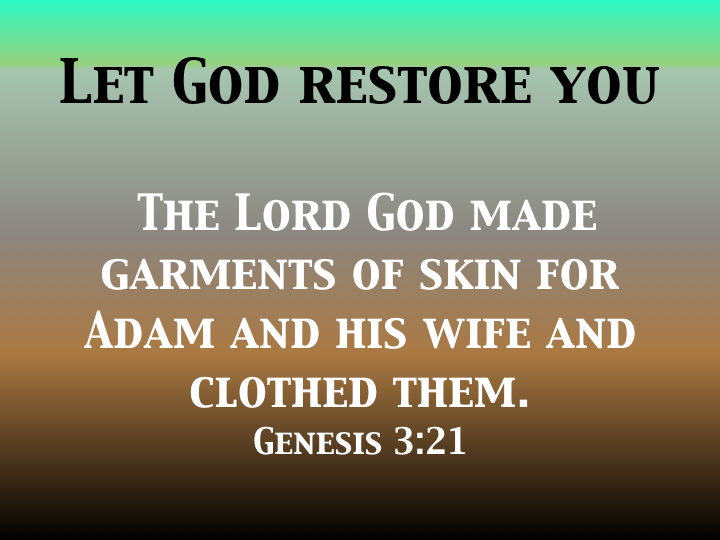
It works so much better when God does the restoring! Instead of the fig leaves which were dying, God Himself made clothes for Adam and Eve (Genesis 3:21). This was a foreshadowing of the of way God will clothe all men and women who confess their sin, and place their faith in Christ’s work on Calvary (Ephesians 5:26-27).

Don’t let unconfessed sin keep you from God’s presence! Quickly confess your sin, and let God clothe you in the righteousness of Jesus.

We’ll be continuing our look at Practical Prayer this Sunday, and I hope you can join me. If you cannot join us in person, check out our live broadcast on Periscope.

Our Portrait In Genesis (book review)

The Complete Works Of Oswald ChambersI love having Oswald Chambers walk alongside me as I study the Bible. He is like a wise, insightful friend pointing out, “Did you see that? Did you notice what God is doing here? What do you think that means for you?” In Our Portrait In Genesis, Chambers walks with us through the first book of the Bible.

Previously I reviewed Not Knowing Where by Oswald Chambers, which looks specifically at the life of Abraham in Genesis 12-25. In Our Portrait, Chambers turns his attention to the other notable people in Genesis.

As he looks at Adam, Eve, Cain, Able, Noah, and the other patriarchs, Chambers is constantly pointing out the lessons we can learn from their lives and apply to our lives. Because of his training in psychology, Chambers is so skilled at knowing what was going on in the minds of these biblical examples, and then helping us examine our own thinking along the same lines.

Our Portrait and Not Knowing Where are tremendously helpful commentaries to read as you work your way through the book of Genesis. As always, you can’t go wrong picking up an Oswald Chambers book!

12 Quotes From “In Light Of Genetics”

Dr. John SanfordDr. John Sanford’s ebook In Light Of Genetics is fascinating reading. It’s a bit technical in certain places, but I think Dr. Sanford does a good job making the genetic concepts accessible to almost anyone. Check out my book review by clicking here. Below are some quotes from this work.

“Forensic evidence is never conclusive, and so scientific claims about the distant past must always contain an element of belief. The direction of genetic change is down, not up. Humanity is devolving due to mutation.”

“We feel biological similarities between different kinds of life are better explained by a Common Designer than by common descent.”

“We are unique and alone now in the world. There is no other animal species that truly resembles our own. A physical and mental chasm separates us from all other living creatures. There is no other bipedal mammal. No other mammal controls and uses fire, writes books, travels in space, paints portraits, or prays. This not a question of degrees. It is all or nothing; there is no semi-bipedal animal, none that makes only small fires, writes only short sentences, builds only rudimentary spaceships, draws just a little bit, or prays just occasionally.” —Juan Arsuaga, writing in The Neanderthal’s Necklace

“Man is a singular creature. He has a set of gifts which make him unique among the animals: so that, unlike them, he is not a figure in the landscape—he is a shaper of the landscape.” —Jacob Bronowski

“From a genetic point of view, the genes that enable our unique capabilities, gifts, and talents (i.e., science, art, love, relation to God) could not arise by any series of random mutations filtered by natural selection—not in any amount of time. There is no credible mechanism that could lead to spontaneous origin of mind, consciousness, intelligence, soul, or spirit. Indeed, while these human traits are found within a biological context (i.e., within an animal-like body/brain), they clearly transcend mere biology. We are exquisitely programmed to be more than animals, and our bodies are well-designed vessels that house our immaterial being: mind, soul, and spirit.”

“Leading human geneticists agree that in mankind deleterious (bad) mutations are accumulating faster than they are being selected away, and so the human genome is degenerating. … The data are highly consistent. The coefficient of determination (matching the curve to the data) is very high: 0.96. Due to the consistency of the decay rate, we can also rule out the idea that there were hundreds (or thousands) of missing generations that were not recorded. We conclude that the genealogical record must either be complete or very nearly complete. This validation of the genealogical record very powerfully points to the historicity and reliability of the book of Genesis.”

“Mounting evidence shows that natural selection is not a creative force, but is a stabilizing force that helps preserve the various kinds of life (i.e., it culls out the most dysfunctional individuals). It is very clear that natural selection cannot create our genome, let alone our mind and soul. At best, natural selection can only slow down the rate of genetic degeneration. … Because of the great abundance of deleterious mutations and the extreme rarity of beneficial mutations, it is not possible for mankind to achieve a net gain of genetic information.”

“Our latest numerical simulations show that in the type of pre-human population that supposedly gave rise to modern man, billions of years would be required just to create and establish a new genetic text string as small as six or seven letters, such as ‘GTCGCT’ or ‘GAGTTCA.’ Yet such a string would be just a drop in the ocean of new information needed to transform an ape into a man.”

“In the biblical model, humanity begins with Adam and Eve, who descendants rapidly multiply, and then, went through a one-generation bottleneck at the time of the Flood, then the population once again rapidly increased, followed by rapid divergence at the Tower of Babel event, creating today’s people groups.”

“If Adam’s genome was intelligently designed, it would obviously have had a great number of designed genetic variants. Otherwise all people would essentially be clones of Adam and Eve, which would be bad design, for many obvious reasons. … Even though many mutations have accumulated in the genome during human history, it is reasonable to conclude that most observable human genetic variation was created by God. The biblical perspective has unique explanatory power in terms of giving a credible explanation for the amazing range of human traits and abilities. There is no single ‘superior genotype.’ We all have unique sets of gifts and talents, which very reasonably reflect good design, and for which we can give thanks to God.”

“We have statistically analyzed over 800 human mitochondrial sequences and have been able to reconstruct and publish a very close approximation of Eve’s mitochondrial sequence. We found that the average human being is only about 22 mutations removed from the Eve sequence, although some individuals are as much as 100 mutations removed from Eve. Can we account for this amount of mutation in a biblical timeframe? Easily. The most recent estimate of the mutation rate in human mitochondria is about 0.5 per generation. Thus, even for the most mutated sequences, it would only require 200 generations (less than 6,000 years) to accumulate 100 mutations.”

“Now, by God’s grace, we do not have to choose between faith in God’s Word vs. faith in science, we can embrace both. There is now very strong genetic evidence that strongly supports Scripture and refutes evolution.”

In Light Of Genetics (ebook review)

Dr. John SanfordWhen I went to college, I went as a biomedical chemistry major. I began my collegiate education at a Christian liberal arts university, and then transferred to a very secular state university. Ever since that time, I have always been deeply interested in the scientific fields, especially biology. So I was excited to read Dr. John Sanford’s paper In Light Of Genetics: Adam, Eve and the Creation/Fall.

In my Christian education experience, the scale was slightly weighted in favor of a biblical view of Creation. In my state university experience, the scale was overwhelming tipped toward an evolutionary paradigm. At both universities, I had rather intense conversations with my professors and classmates about hard science viewed through a biblical paradigm. Dr. Sanford’s paper was an encouraging study to read because of its balance between science and the Bible.

You can read Dr. Sanford’s full paper by clicking here, but here are a few highlights for me:

  • Genetic evidence is pointing more and more toward the biblical description of Creation.
  • The “junk DNA” claim that Darwinists need to support their theories of evolution are being proven invalid.
  • There is clearly a “Mitochondrial Eve” whose DNA sequence is evident in living human beings today.
  • There is also a “Y Chromosome Adam” whose DNA sequence is equally as evident.
  • Molecular clocks point to a young genome for biological life.
  • The Y chromosomal differences between man and chimp are far greater than evolutionist theories predicted.
  • The genetic differences/similarities seen today fit perfectly with the account of the biblical Flood.

For all my geeky science friends, I will post some quotes from this paper soon.

Whether you are a geek or not, this is fascinating reading! I encourage my friends who hold Darwinist views to read this, and then let’s talk. I also encourage my Creationist friends to read this too, and use these studies to strengthen your apologetics.

Read more about Dr. Sanford and his work here.