If you want your heart to be able to perform better, you are going to have to stress it a bit—that’s called exercise. The same thing is true for the heart of leadership—we have to exercise our leadership so that it can rise to the challenge later.
J. Warner Wallace wrote, “Everyone, whether they realize it or not, is engaged in worship. We all adore something, elevating it above the rest, sometimes so much that we overlook its flaws.” Check out this post about being careful about what we worship.
“Nothing teaches us about the preciousness of the Creator as much as when we learn the emptiness of everything else.” —Charles Spurgeon
“We should avoid end-time hysteria and ‘not grow weary in doing good’ (2 Thessalonians 3:13). There will be good work to do (vocationally and socially and personally) right up to the Lord’s coming. Our normal earthly duties will not end until the Lord appears. The rule then, until he comes, is, ‘Whatever you do, work heartily, as for the Lord and not for men’ (Colossians 3:23).” —John Piper
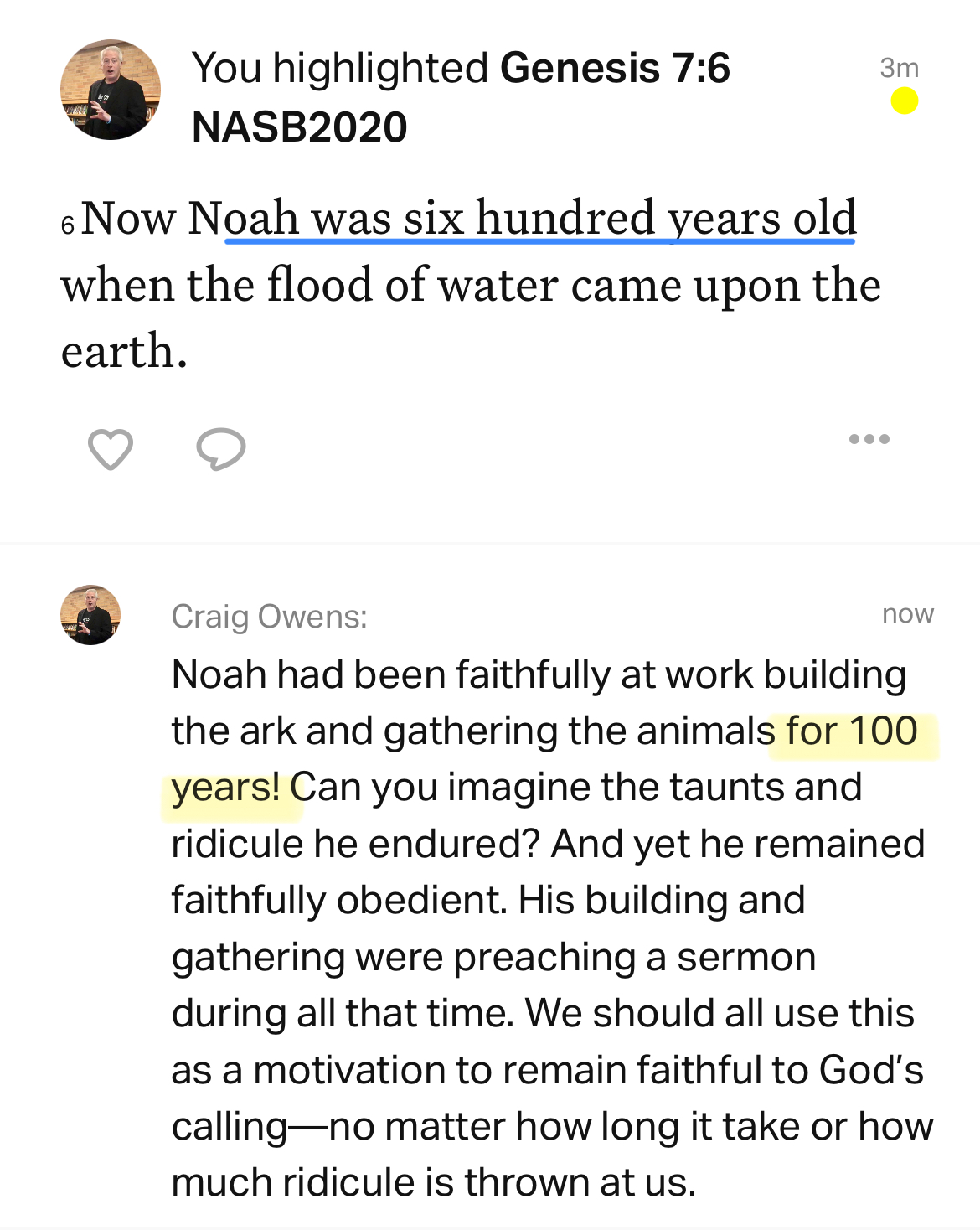
Greg Morse has a fascinating post connecting the fable of Chicken Little with the historical account of Noah and the imminent return of Jesus. “I hope an acorn falls afresh on our heads as we observe an Old Testament saint who was the Chicken Little of his day. A man who remained awake and faithful with his back against the end of the world: a man named Noah.”
The word gospel simply means the good news about the salvation that comes only through Jesus.
Paul loves this word!
Interestingly, although we refer to the first four books of the New Testament as “The Gospels,” the word itself barely appears:
Matthew—4 times
Mark—8 times
Luke—0 times
John—0 times
And even though these four opening books are the Gospels about Jesus, He Himself only uses the word nine times, with the other three times attributed to someone else mentioning what Jesus was doing.
Peter only uses this word twice (Acts 15:7; 1 Peter 4:17). And John uses it just once (Revelation 14:6).
Paul, however, uses this word 64 times!
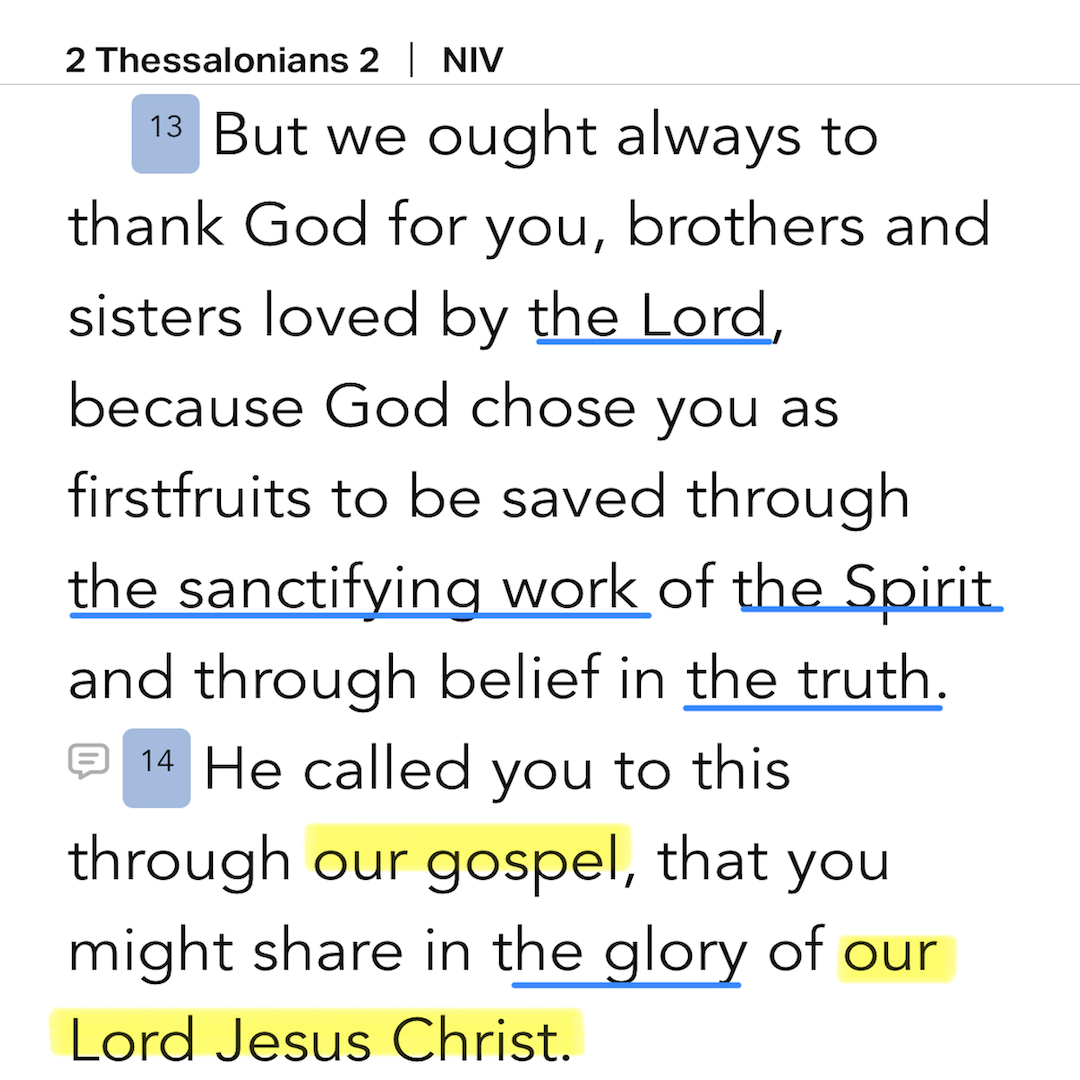
It becomes such a part of who he is and how he thinks, that he calls it “my gospel” twice (Romans 2:16, 16:25) and “our gospel” three times (2 Corinthians 4:3; Colossians 1:23; 2 Thessalonians 2:14).
For Paul and for us this Good News is—
God’s promises fulfilled
salvation power
the fullness of God’s blessing
the opening of mysteries
the guide for godly living
glorious light
the expression of God’s grace
the standard of all truth
a key part of the Christian’s spiritual armor
the empowerment for ministry
the anchor of unshakable hope
the means by which we experience Christ’s glory
the only door to life and immortality
For those of us who have been called to preach this Gospel, these thoughts should both humble and empower.
For those of us who have been saved by believing this Gospel, these thoughts should cause us to desire to know more, and more, and more about our Savior.
Listen to the podcast of this post by clicking on the player below, and you can also subscribe on Apple, Spotify, or Audible.

A quick recap: We are all gifted by God, but we typically restrict ourselves to a comfort zone which is much smaller than our God-given gift zone. In order to maximize our impact for the Kingdom of God, we are going to have to get uncomfortable with staying comfortable—we are going to have to trust God as we push out further into our gifts.
Last week I gave you a homework assignment to think about the things you love to do. Why do we need to know this? Because it is one of the indicators of our areas of giftedness.
In the whole carrot-versus-stick discussion, you will find that most people are motivated by reward way more than they are by the fear of punishment. Look at how these God-fearing men were motivated by the God’s rewards:
Who’s more likely to get the reward: the one who loves what they are doing or the one who hates what they are doing? We are more likely to stick with what we love doing, and you are going to love doing what you are gifted by God to do.
Why we do what we do is much more important that what we do (Isaiah 1:11, 13, 15; Matthew 7:22-23).
We have been gifted by God to do great things. When we do those great things, we are rewarded and it brings God glory. That realization should answer the question of why we do what we do (Ephesians 2:10).
The way we see the world, what motivates us, and how we act are all determined by our gifts. We are working on the same Great Commission, but how we live that out will be different because of our different gifts.
In the Old Testament, the saints wanted Zion to be strong and God-glorifying:
David fought battles and wrote worship songs
Solomon gave wise proverbs
Josiah brought about reforms
Ezra encouraged the Israelite governor and high priest
Daniel encouraged the Babylonian rulers
Nehemiah built the wall
In the New Testament era, the saints should all want the Body of Christ to be strong and God-glorifying. Toward that goal, we still need warriors, worshipers, wisemen, reformers, teachers, counselors, workers.
Toward that goal, we all have a part to play (Ephesians 4:12). Check out the example of Paul in…
…Thessalonica: Paul was in the synagogue on three Sabbaths (Acts 17:1-2; 2 Thessalonians 3:8)
…Corinth: Paul was synagogue on the Sabbath days, but after Silas and Timothy arrived, Paul was able to be preaching every day for 18 months (Acts 18:1-5, 11)
What’s the difference? Silas and Timothy used their gifts so that Paul could use his. Without the “enzyme” of Silas and Timothy’s gifting, the whole Body of Christ would have been impoverished.
One of the things that will help your spot your areas of giftedness is noticing what you are passionate about—What do you love to do?
Let me give you three things to consider:
When can I do this again? vs. When will this be over?
When I do this, I’m tired but fulfilled vs. When I do this, I’m tired.
I would do this without pay vs. I would rather find something else to do.
Our prayer should echo what Paul prayed:
For this reason, since the day we heard about you, we have not stopped praying for you. We continually ask God to fill you with the knowledge of His will through all the wisdom and understanding that the Spirit gives, so that you may live a life worthy of the Lord and please Him in every way: bearing fruit in every good work, growing in the knowledge of God. (Colossians 1:9-12)
If you’ve missed any of the messages in our series Living in Your Gift Zone, you can find them all here.
“Hard times create strong men. Strong men create good times. Good times create weak men. Weak men create hard times.” —G. Michael Hopf
“Luck is when an opportunity comes along and you’re prepared for it.” —Denzel Washington
“Ministers are set to be lights to the souls of men in this respect, as they are to be the means of imparting divine truth to them, and bringing into their view the most glorious and excellent objects, and of leading them to and assisting them in the contemplation of those things that angels desire to look into…by which they may know God and Jesus Christ, whom to know is life eternal.” —Jonathan Edwards
“Scripture the unus sermo Dei—the one sermon of God.” —Augustine
T.M. Moore is presenting another outstanding series of posts, this one about the dignity of work. In one post, he wrote, “A just society requires all members to contribute love for their neighbors, whether they are poor or wealthy. Those who will not work when they can do so should be left to the consequences of their sluggardliness (2 Thessalonians 3:10). It is incumbent on local community leaders to discover ways, analogous to the work of gleaning, of helping to meet the needs of local poor. These might include keeping part-time work available, identifying ‘community work’ opportunities and helping to fund them, offering job counseling and training, and so forth. Churches certainly could pioneer the way in this, creating opportunities for work on their campuses, on behalf of needy members, and for the community at large.”
“The Holy Spirit responds to our walking according to the Word, not merely talking about the Word.” —Dr. Tony Evans
Listen to the podcast of this post by clicking on the player below, and you can also subscribe on Apple, Spotify, or Audible.
Last week we learned that we have a job to do. If we want to see Jesus come back to take us Home, we need to share the Good News with everyone. Jesus said that we didn’t have to obey Him in this Great Commission by ourselves, but we can go in His authority and with the empowerment of the Holy Spirit (Matthew 24:14; 28:18-20; Acts 1:8).
In Acts 1:8 notice that Jesus said we are “be My witnesses.” This isn’t an action first, but they are actions that spring out of who we are. So we need to ask: How are we to be His witnesses? Answer: By being blessed by God!
God has desired that we know the blessing of His presence since the very beginning. He instructed the priests to bless the people with these words:
The Lord bless you and keep you; the Lord make His face shine on you and be gracious to you; the Lord turn His face toward you and give you peace. (Numbers 6:24-26)
The Hebrew word for “peace” in this passage is shalom. One of the most basic definitions for shalom is “nothing missing.” In other words, we are blessed people when we realize there is nothing keeping us back from God’s presence.
If you asked someone in the Old Testament where they thought God’s presence was, they would probably point you to the Tent of Meeting or the Tabernacle in Jerusalem. But that was merely a foreshadowing of what God truly desired for His relationship with us. Jesus promised His followers, “On that day you will realize that I am in My Father, and you are in Me, and I am in you” (John 14:20). So if Jesus is in the Father, and we are in Him, that means we are also in the Father. In this position, we can experience the nearness to the Father that Jesus knows (see Ephesians 1:3-8).
This nearness is our source of peace: Now may the Lord of peace Himself give you peace at all times and in every way. The Lord be with all of you (2 Thessalonians 3:16). In this verse, the Greek word for “peace” is eirene, which means a soul at utter peace with God because it is assured of its eternal Home in God’s presence.
Blessed people are abundance people. Blessed people have all their needs supplied so that they can be a conduit of blessing to others. Our increasing awareness of God’s blessing empowers us to be witnesses for Him.
Let me take you back to the Book of Psalms. In Psalm 67, the psalmist asks for God’s blessing on his life four times in just seven short verses. Why does he desire this blessing? It’s not for himself but for others. Look at just the first two verses of this psalm:
May God be gracious to us and bless us and make His face shine on usTHAT Your ways may be known on earth, Your salvation among all nations.
Recall that Jesus commissioned us to go to all nations and that the Holy Spirit empowers our witness to all peoples. This psalmist is asking for God’s blessing so that he can be a witness to everyone. Nine times he says that he desires that all nations or all peoples will know and worship the Most High God.
God’s blessing on His people is really SO THAT all peoples and nations can see His blessing and turn to Him. One of the roles of the Holy Spirit in a believer’s life is to remind us that we are indeed blessed in Jesus, and that we have a mission to fulfill in taking that blessing to others.
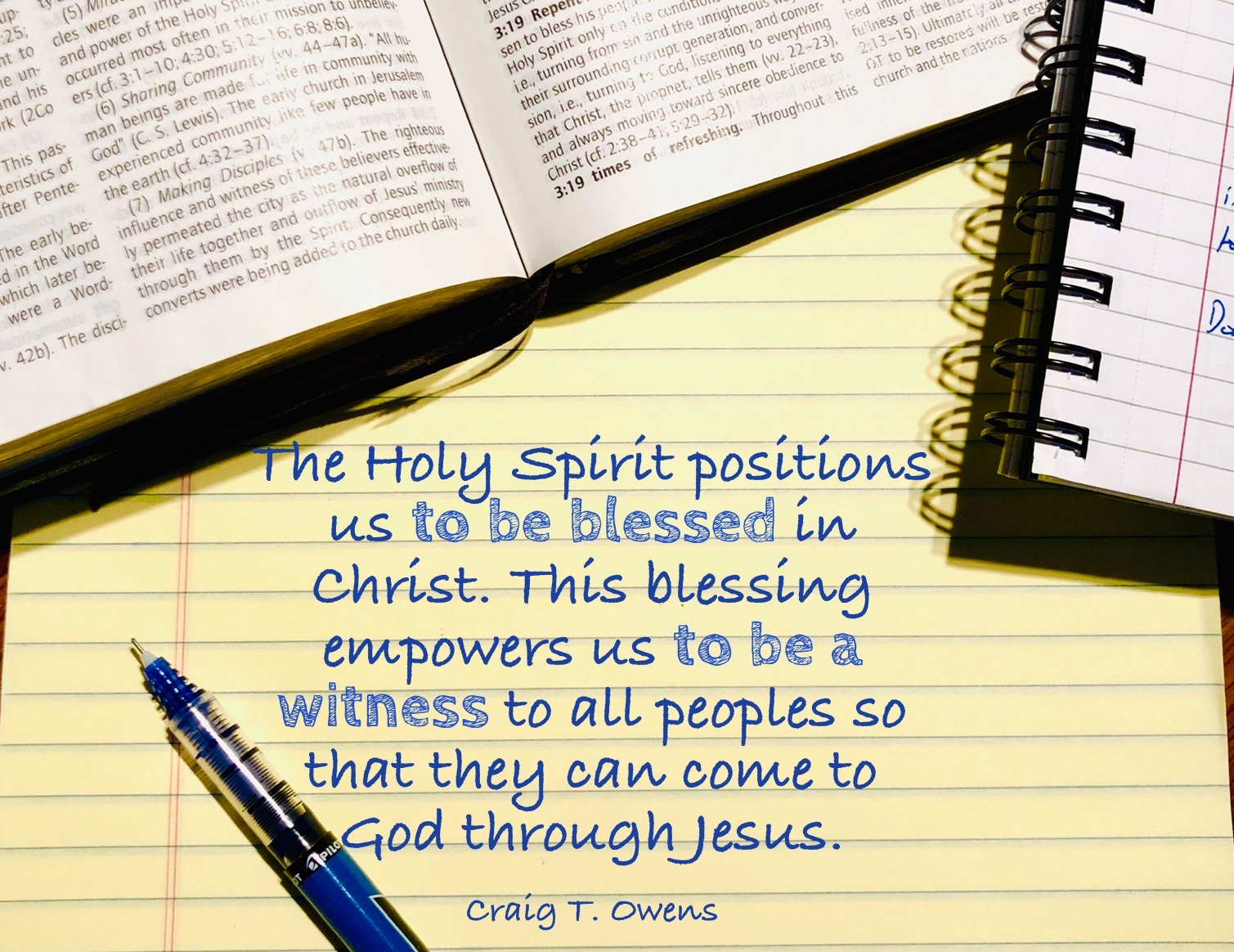
The Holy Spirit positions us to be blessed in Christ. This blessing empowers us to be a witness to all peoples so that they can come to God through Jesus.
It is good for us to pray for the Spirit’s blessing on our lives so that we can BE a blessing to all nations and peoples.
If you would like to check out all of the other messages in our series called We Are: Pentecostal, please click here.
Listen to the podcast of this post by clicking on the player below, and you can also subscribe on Apple, Spotify, or Audible.
…to the church of the Thessalonians (2 Thessalonians 1:1).
This short letter from the apostle Paul to the church in Thessalonica is a masterpiece on how to correctly correct fellow Christian brothers and sisters.
The entire letter follows this pattern: 3 Cs surrounded by prayer—
(1) Compliment and encouragement—“We are bound to thank God always for you…because your faith grows exceedingly” (1:3). Paul complimented their love for each other, their patience and endurance in persecution, and their future glorification. He encouraged them that Jesus IS coming, and He will deal with their persecutors and take the righteous into glory with Him (1:3-10).
(2) Prayer—And then he prays for them to be equipped to endure to the end and finish well (1:11-12).
(3) Clarify misunderstandings—“Let no one deceive you by any means” (2:3). Paul reminds them of what he taught them about the end times and the Second Coming of Christ, clarifying that watchful Christians will by no means miss out on the signs (2:1-12).
(4) Prayer—Paul again praises their acceptance of the gospel and launches into another prayer for them to finish well (2:13-3:5).
(5) Correct errors of understanding—“But we command you” (3:6). There were those who were departing from the faith, growing slack in their work ethic, being disorderly, and meddling as busybodies. Paul said, “We command and exhort through our Lord Jesus Christ” that you knock it off! He even told the church to “not keep company” with such people (3:6-15).
(6) Prayer—Finally, Paul closes with a prayer for God’s peace to be with his brothers and sisters (3:16-18).
This is such a masterful pattern for all of us in church ministry to follow!
If you are in a leadership role, I hope your ongoing prayer would be the same as mine: “Holy Spirit, in all my interactions with my fellow saints, remind me of this godly, practical plan for confrontation, and help me to live it out for God’s glory. In Jesus’ name, amen.”
P.S. You can also learn a lesson from the way the prophet Samuel handled correction in this post.
Examine and test and evaluate your own selves to see whether you are holding to your faith and showing the proper fruits of it. Test and prove yourselves… (2 Corinthians 13:5).
The root word for discern in the New Testament Greek is dokimazō. This word means to examine something—scrutinize it closely—to see if it is genuine. We’re instructed to take a close, scrutinizing look at…
…our beliefs about God (Romans 1:28)
…our understanding of God’s will for our lives (Romans 12:2)
…our relationship with God and others (1 Corinthians 11:28)
In his book Romans: God’s Glory, Donald Grey Barnhouse discussed the root word for discern (the Greek word dokimos). He said,
“In the ancient world there was no banking system as we know it today, and no paper money. All money was made from metal, heated until liquid, poured into moulds and allowed to cool. When the coins were cooled, it was necessary to smooth off the uneven edges. The coins were comparatively soft, and of course many people shaved them closely. In one century, more than eighty laws were passed in Athens to stop the practice of whittling down the coins then in circulation. But some money-changers were men of integrity, who would accept no counterfeit money; they were men of honour who put only genuine, full-weight money into circulation. Such men were called dokimos, and this word is used here for the Christian as he is to be seen by the world.” (emphasis mine)
This should be said of every Christian: “They are dokimos—men and women who are honorable and are the real deal. They don’t shave anything off; they don’t water anything down. They can be scrutinized closely and found to be the genuine article.”
The Bible makes it clear that before the world can call us dokimos, the Holy Spirit first has to stamp that word on us. It’s only after we have allowed Him to scrutinize (and correct) our beliefs, relationships, faith, and motives that we can be labeled dokimos. When we are the real deal in His presence, the world cannot help but see the genuine article when they examine us.
Let’s live this way! May both God and the watching world be able to call us dokimos!
In the same way, let your good deeds shine out for all to see, so that everyone will praise your heavenly Father. (Matthew 5:16)
Jesus wants Christians to be leaders, to be pacesetting examples. That means that Christian leaders must be comfortable with others carefully watching their lives.
A mark of a godly leader is one who is comfortable with public scrutiny.
“It is bad enough to be blind ourselves. It is a thousand times worse to be a blind guide.” —J.C. Ryle
“Live an exemplary life among the natives so that your actions will refute their prejudices. Then they’ll be won over to God’s side and be there to join in the celebration when he arrives.” —1 Peter 2:12 MSG
“Sermons must be practiced as well as preached…. If a man teach uprightly and walk crookedly, more will fall down in the night of his life than he built in the day of his doctrine.” —John Owen
“Be a walking, talking, living example of what you preach, in every silent moment of your life, known and unknown; bear the scrutiny of God, until you can prove that you are indeed an example of what He can do.” —Oswald Chambers
“Behave yourselves wisely—living prudently and with discretion—in your relations with those of the outside world (the non-Christians)…” —Colossians 4:5 AMP
“We hear that some people in your group refuse to work [or are behaving irresponsibly; are living/walking in idleness/disorder]. They do nothing but busy themselves [meddle; interfere] in other people’s lives. We command those [such] people and beg [urge; encourage; exhort] them in the Lord Jesus Christ to work quietly [or settle down] and earn [eat] their own food.” —2 Thessalonians 3:11-12 EXB)
“We should make less excuses for the weaknesses of a Christian than for any other man. A Christian has God’s honor at stake. When a man is regenerated and bears the Name of Christ the Spirit of God will see to it that he is scrutinized by the world, and the more we are able to meet that scrutiny the healthier will we be as Christians.” —Oswald Chambers
This is part 37 in my series on godly leadership. You can check out all of my posts in this series by clicking here.
This is a weekly series with things I’m reading and pondering from Oswald Chambers. You can read the original seed thought here, or type “Thursdays With Oswald” in the search box to read more entries.
Jeremiah 8
[These are notes from Oswald Chambers’ lecture on Jeremiah 8.]
Wherever I banish them, all the survivors of this evil nation will prefer death to life (Jeremiah 8:3).
Our Lord Jesus used these burning words, “The worms that eat them do not die, and the fire is not quenched,” [Mark 9:44, 46, 48] in reference to the condition of people who deprive themselves of right judgment by persistently going wrong (see also 2 Thessalonians 2:11). In the prophecies of Jeremiah we have the same great revelation, that eternal issues are involved in temporal living, but in a different connection. If we are going to remain true disciples of Jesus Christ, we will have to remain alien to the day we live in.
Such terrible suggestions as these verses contain [verses 1-3] serve as a very wholesome awakening, and bring men to the understanding of the need of Redemption. …
The subject of the Second Coming is the one the average unholy Christian cannot stand, and the tendency is to listen, as the people did in Jeremiah’s day, to the false prophets (2 Peter 3:3-6). …
The modern scholar pretends to be expounding the Word of God, but in reality he is writing with a lying pen, he builds his wisdom out of his own rationalism, and takes out of the law of God only what agrees with it. …
Paul says the same to Timothy—“For the time will come when men will not put up with sound doctrine. Instead, to suit their own desires, they will gather around them a great number of teachers you say what their itching ears want to hear” (2 Timothy 4:3).
They dress the wound of My people as though it were not serious. “Peace, peace,” they say, when there is no peace (Jeremiah 8:11). That is the perpetual peril at all times, relieving present pain by a temporal fictitious cure, when what is needed for an effectual cure is a surgical operation. …
All Christians are not Christian workers, but those who are called to be workers need the courage of the Holy Ghost to face life from God’s standpoint. We have to keep our hearts and minds faced with the awful condition of human life apart from the Cross of Christ. We must get into our souls the iron of God which makes us strong enough to present Jesus Christ to men. …
The majority of us know nothing about shame and repentance, consequently we drift from the central point because we more easily get into sympathy with men than with God, and that is slander against God. To save the world cost Jesus Christ His life, and if we teach that the world can be saved in any other way we slander God.
From Notes On Jeremiah
Oh God, help us—all of us, but especially Your workers—to preach sound doctrine that would save lost people from an eternal Hell.
I just finished an outstanding reading plan on YouVersion called Legacy Leadership by Dr. J. Lee Whittington. For anyone interested in the biblical concept of servant-leadership, I highly recommend you check out this reading plan.
Here are a few quotes I especially liked…
“Legacy Leadership is a process of intentional influence that takes place in the context of a relationship.”
“There is a recurring pattern of affirmation and exhortation in Paul’s leadership. He provided a dynamic balance between challenging his followers to grow and acknowledging their progress. He was affirming, but never content.”
“There is a growing trend to attack, criticize, and resent anyone who has talent or achievements that sets them apart from others. This tendency extends to those who resent the efforts of leaders who challenge the status quo. Opponents of change initiatives often attempt to marginalize leaders by attacking their character and questioning their motives. If the messenger is flawed, then the message and vision they offer cannot be trusted. As disappointing as it is, these challenges come with the territory of leadership.”
“If I am to lead with integrity, I must always confront my own lack of integrity. This demands a willingness to constantly reflect on my motives and the courage to confront my own hypocrisy. It also requires me to allow myself the discomfort of inviting the scrutiny of both the Lord and others who care enough to confront me about my motives, my attitudes, and my behavior.”
“The most effective leaders are able to exert influence without asserting their formal authority. … Paul deliberately chose to forego the legitimate, reward, and coercive power inherent in his position. Instead, he leaned into another base of power: referent power. Referent power is based on respect and admiration. When this is present, the followers identify with and want to emulate their leader. This power base does not come from the leader’s position or control of resources. Rather, it is based on the leader’s character and integrity. Referent power is based on who the leader is.”
“Legacy Leaders do not lead from a distance. They imitate Jesus who said, ‘I am among you as one who serves’ (Luke 22:27). They are comfortable sharing their lives with their followers.”
“The best relationships between a leader and their followers are those that are characterized by a great deal of mutual trust and shared information. The responsibility for creating this type of relationship rests squarely on the shoulders of the leader.”
“Authentic leaders have a seamless link between their values and their actions. But the congruence between values and attitudes is just the starting point for authentic leadership. From the perspective of scripture, a leader’s attitudes and actions must be anchored to God’s standards. When a leader’s enacted values are in congruence with their espoused values, and those espoused values are in turn anchored to God’s principles, the leader had moral authority.”
“It’s easy to critique the authenticity of others. But, if we are really serious about developing our own authenticity, we must focus on ourselves. I read this statement several years ago: ‘If we are to be people of integrity, we must constantly confront our lack of integrity.’”
“Legacy Leaders embrace the principles of servant-leadership and understand that the conscious choice to lead comes after the desire to serve. This inclination is not natural. It must be energized by continuous reliance on the empowering presence of God’s Spirit.”