Listen to the podcast of this post by clicking on the player below, and you can also subscribe on Apple, Spotify, or Audible.
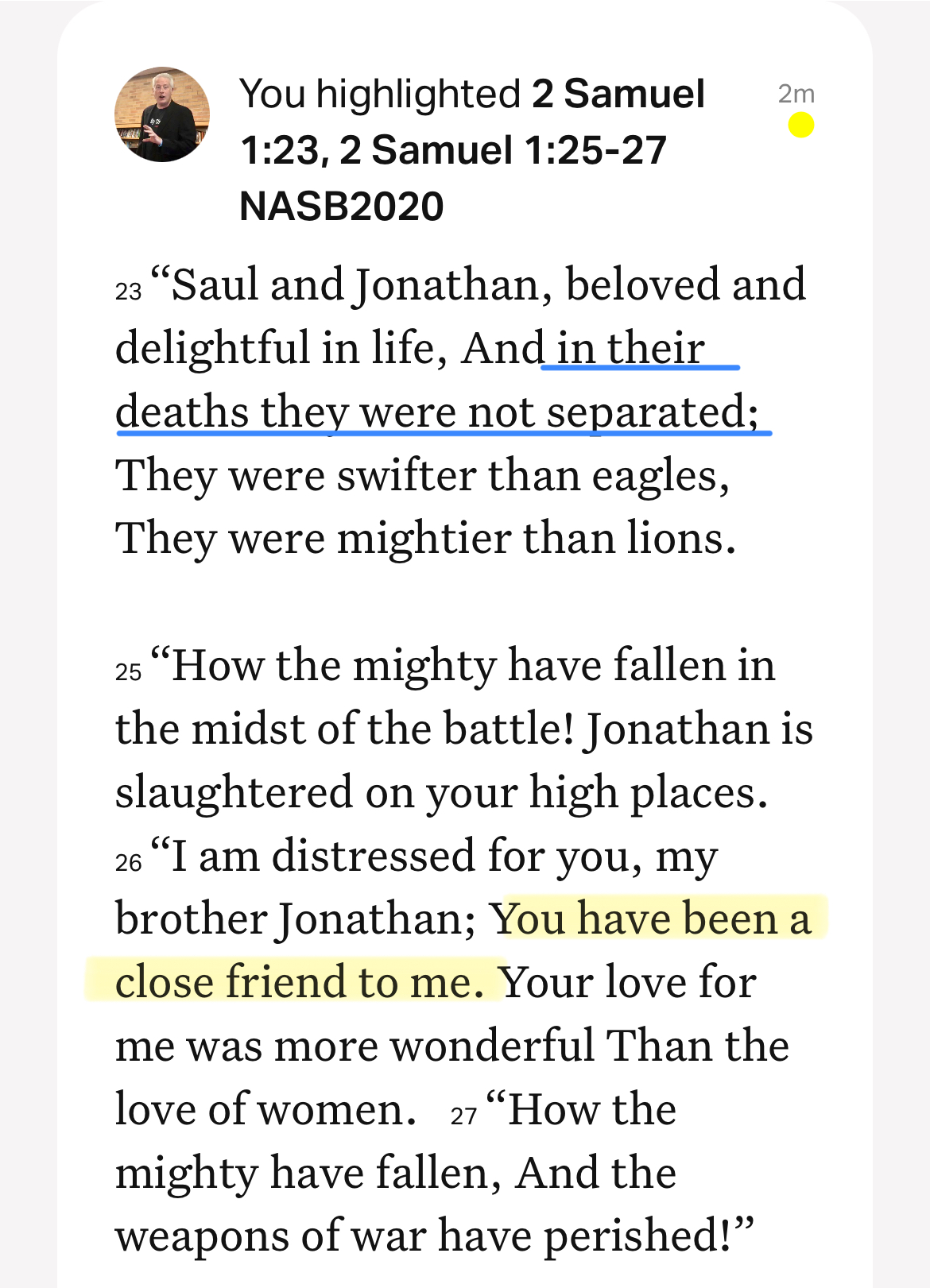
Saul and Jonathan, beloved and delightful in life, and in their deaths they were not separated; they were swifter than eagles, they were mightier than lions. Daughters of Israel, weep over Saul, who clothed you in scarlet, with jewelry, who put gold jewelry on your apparel. How the mighty have fallen in the midst of the battle! Jonathan is slaughtered on your high places. I am distressed for you, my brother Jonathan; you have been a close friend to me. Your love for me was more wonderful than the love of women. How the mighty have fallen, and the weapons of war have perished! (2 Samuel 1:23-27)
It’s not surprising that David honored his friend Jonathan in song after his death. But it is surprising that Jonathan remained faithfully at his father’s side, fulfilling his duties as a son and a prince of Israel, although he did not agree with his father’s treatment of David.
In Jonathan we see the obedience to the fifth commandment: Honor your father and mother (Exodus 20:12).
And it is also surprising that David says nothing bad about Saul in this song of lament, but only praises him for his valiant victories as Israel’s king.
In David we see a true picture of forgiveness—where a forgiven transgression is a forgotten transgression, no longer held by David against his tormentor. Later in his life, David would write about the mind-blowing truth that God obliterates the record of our forgiven sins, never bringing them up again (Psalm 103:10-12)!
Is it any wonder that David and Jonathan became and remained such close friends? From the moment Jonathan first heard David speaking about his trust in God, they became “one in spirit” and forged a covenant friendship that lasted even beyond Jonathan’s life (1 Samuel 18:1-4).
May we learn from these two God-fearing, faithful friends what it really means to honor others, whether we call them friends or others might call them “enemies.”
In my book When Sheep Bite I have a chapter called “When the sheep slander you.” In that chapter, I dive deeper into the lesson leaders can learn from how David treated Saul both during his life and after his death.
The psalmist Heman is the grandson of Samuel. “These are the ones who served with their sons: From the sons of the Kohathites wereHeman the singer, the son of Joel, the son of Samuel, the son of Elkanah, the son of Jeroham, the son of Eliel, the son of Toah” (1 Chronicles 6:33-34; 1 Samuel 1:1, 20).
Samuel came from the line of Levites (specifically the Kohathites), which is the same family to which Moses, Aaron, and Miriam belonged. While the tabernacle of the Lord was mobile in the wilderness, the Kohathites were responsible for carrying the furnishings of the tabernacle (Numbers 4:4-20).
When the permanent temple was constructed in Jerusalem, the responsibility of the Kohathites changed. They now oversaw the worship in the temple, and Heman is listed as the chief worship leader, with others to his right and left. “Heman’s brother Asaph stood at his right hand, Asaph the son of Berechiah, the son of Shimea. … On the left hand were their kinsmen the sons of Merari: Ethan the son of Kishi, the son of Abdi, the son of Malluch” (1 Chronicles 6:39, 44).
And then we see Heman’s family line continuing in the roles of worship leaders after him: ”All these were the sons of Heman the king’s seer to exalt him according to the words of God, for God gave fourteen sons and three daughters to Heman. All of these were under the direction of their father to sing in the house of the Lord, with cymbals, harps, and lyres, for the service of the house of God. Asaph, Jeduthun, and Heman were under the direction of the king. Their number who were trained in singing to the Lord, with their relatives, all who were skillful, was 288“ (1 Chronicles 25:5-7).
The Book of Psalms contains just one psalm that Heman composed (Psalm 88).
Listen to the podcast of this post by clicking on the player below, and you can also subscribe on Apple, Spotify, or Audible.
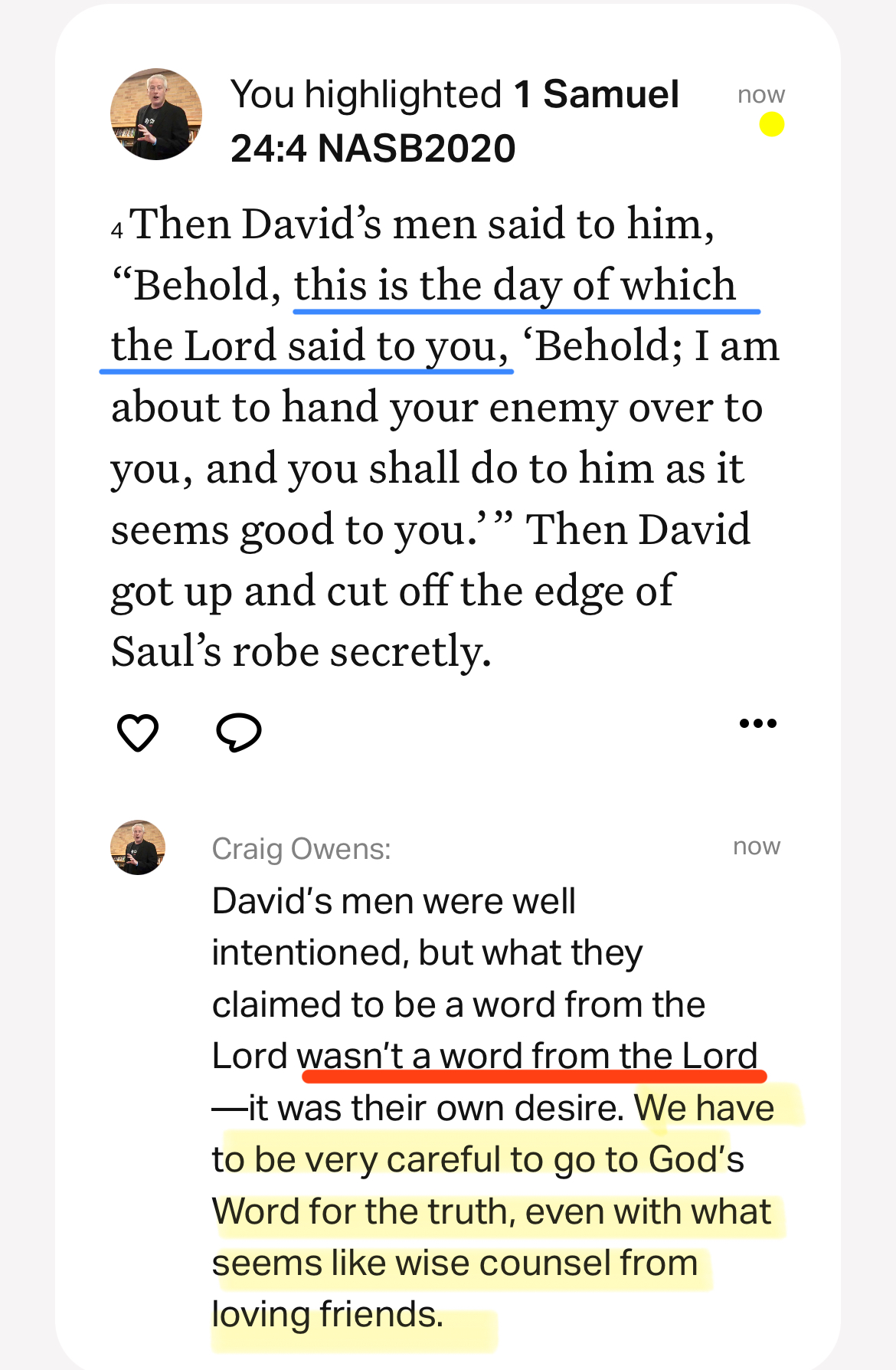
David was hiding from Saul in a cave when Saul walked into the same cave, totally oblivious to the danger that awaited him! David’s men tried to spur him to action by whispering, “Isn’t this what God said, that He would hand your enemy over to you?” (see 1 Samuel 24).
David momentarily listened to his men and then acted on their words. He crept forward to cut off a corner of Saul’s robe. But then the Holy Spirit pricked his conscience.
Why?
Because God never said those words!
From what David has learned, he now speaks this same lesson to Saul. He in essence asks Saul, “Are you listening to men or to God?” (vv. 9-11).
David learned that without God as his Guide, he could easily be persuaded to act in a way that seemed right to men but was wrong before God.
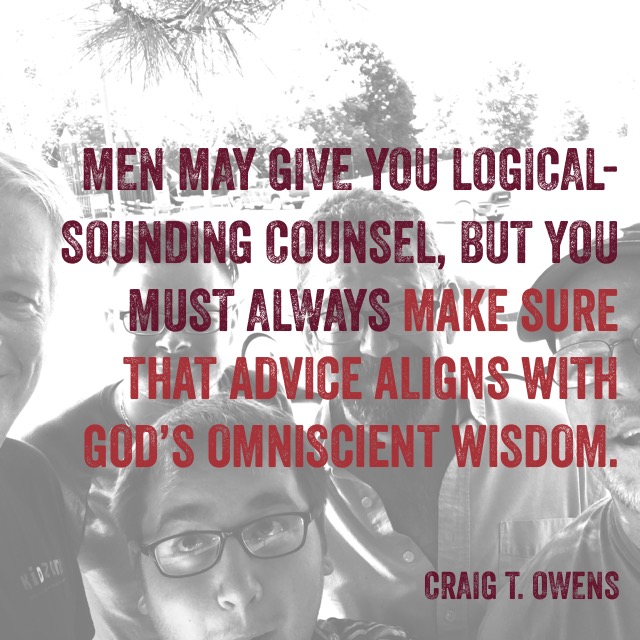
It’s still true for all of us today: Men may give you logical-sounding counsel, but you must always make sure that advice aligns with God’s omniscient wisdom. That means you need to be reading, studying, meditating on, and thinking about God’s Word.
✔️ Keep God always before you
✔️ Know His voice intimately
✔️ Compare every word of man with God’s infallible Word
🙏🏻 “Hear my prayer for help, O God, for I look to You alone as my Helper and the Sustainer of my soul. You will deal with my enemies as You know best, and You will deliver me from my troubles” (see David’s prayer in Psalm 54).
The devil wants us to remember what we’ve done or what we still need to do, but Jesus wants us to remember what He has already done. There is a huge difference! Check out this whole message here. I have lots of new content every week, which you can check out on my YouTube channel.
“The most likely man to go to hell is the man who has nothing to do on earth. Idle people tempt the devil to tempt them.” —Charles Spurgeon
“What were we made for? To know God. What aim should we have in life? To know God. What is the eternal life that Jesus gives? To know God. What is the best thing in life? To know God. What in humans gives God most pleasure? Knowledge of Himself.” —J.I. Packer
We can learn childlike faith by simply watching and listening to how young children interact with their loving parents. This video is a clip from one of the message in our series called Kingdom Praying.
Technological advancements abound all around us. How are Christians supposed to interact with technology: embrace it? ignore it? This is a thoughtful message to give us a biblical paradigm for our daily use of technology.
“We must quit bending the Word to suit our situation. It is we who must be bent to that Word, our necks that must bow under the yoke.” —Elizabeth Elliot
“The things you pray about are the things you trust God to handle. The things you neglect to pray about are the things you trust you can handle on your own.” —H.B. Charles
“Learning to pray doesn’t offer us a less busy life; it offers us a less busy heart.” —Paul Miller
Listen to the podcast of this post by clicking on the player below, and you can also subscribe on Apple, Spotify, or Audible.
I’m not a fan of rollercoasters, but I know a lot of people who really like them. Some even travel all over the world to experience unique rollercoasters. The anticipation as the cars climb slowly up the big hill, knowing that there’s no stopping this thing now! Then the rush of emotions, a deep breath and a laugh at the end (usually laughing at our friends’ responses while on the ride), and then we just walk away. The moment of anticipation leading up to the big drop was usually longer and more intense than the ride itself.
Not only do people travel all over to find rollercoasters, some people seem to have their emotions perpetually on rollercoasters.
One of the telltale signs of someone with an immature mental health is the way every situation gets blown out of proportion before anything even happens. Then as an event unfolds, their exaggerations continue: the molehills are mountains, every valley is the valley of the shadow of death, the night is a nightmare, the “crisis” is lasting forever, no one has ever gone through what they’re going through, and the list goes on.
To break out of this habit requires us developing emotional capacity. John Maxwell describes it like this: “Emotional capacity is the ability to handle adversity, failure, criticism, change, and pressure in a positive way.” Just as athletes have to develop lung capacity or muscle capacity, developing emotional capacity takes time, patience, and diligence.
Increased emotional capacity is not escaping from our problems or even learning coping skill. Escapism never allows us to confront the things that are keeping our emotional capacity immature. On the other hand, maturing emotional capacity is learning to pause to get perspective so that we can avoid turning every mountain into a molehill, and every challenge into a do-or-die battle.
Let me illustrate this by looking at two emotions which seem to be the most rollercoaster-ish.
(1) The first rollercoaster emotion is anger
Out-of-proportion anger can either burn everyone around us when we explode, or it can eat away inside us if we hold it in. Neither of these are healthy emotional responses. Jesus got angry at the religious crowd that was keeping people away from God’s kingdom, but He didn’t ride the rollercoaster that led to a sinful expression of His anger.
God asked Jonah a very helpful question: Have you any right to be angry? (Jonah 4:4). When we feel the Holy Spirit asking us this question, our defiant first response is almost always, “Yes! I didn’t do anything wrong! It was all him!” Solomon would counsel us to cross-examine that thought (Proverbs 18:17).
Sometimes God will bring someone else across our path to help us pause to get perspective—to flatten the rollercoaster. For instance, God used Abigail to help David (see the story in 1 Samuel 25). However the Holy Spirit cross-examines us, we need to learn to truly listen. James told us:
My dear brothers and sisters, take note of this: Everyone should be quick to listen, slow to speak and slow to become angry, because human anger does not produce the righteousness that God desires. (James 1:19-20)
(2) The second rollercoaster emotion is fear
Fear usually causes us to fight or flight. Those are the natural responses, but the supernatural response is to pause to evaluate. I love the reminder that F.E.A.R. means false evidence appearing real.
As with anger, our first pause to get perspective on this potential rollercoaster that can plunge us into a deep, dark valley should be to cross-examine the false evidence of fear.
When the group of ladies came to the tomb of Jesus on the Sunday following His crucifixion, they were already battered and bruised in their emotions. Finding an empty tomb brought even more fear in their hearts. But there is a keyword in this account that will help us:
In their fright the women bowed down with their faces to the ground, but the men [angels] said to them, “Why do you look for the living among the dead? He is not here; He has risen! Remember how He told you, while He was still with you in Galilee: ‘The Son of Man must be delivered over to the hands of sinners, be crucified and on the third day be raised again.’” Then they remembered His words. (Luke 24:5-8)
The Holy Spirit can help us remember the truth in God’s Word to counteract the fear-inducing false evidence (2 Timothy 1:7; John 14:26), but we must pause to listen to this evidence before this rollercoaster emotion picks up speed.
The bottom line: Don’t try to escape your strong emotions. Pause. Cross-examine the evidence with the help of God’s Word, the Holy Spirit, and a friend to get a healthy perspective. This can help you flatten the rollercoaster before your emotions run away with you.
Listen to the podcast of this post by clicking on the player below, and you can also subscribe on Apple, Spotify, or Audible.
I’ve talked before about the benefits of calling the Old and New Testaments the First and Second Testaments. This helps me not to subconsciously slip into the thought that “old” means outdated or that “new” means a replacement of what came before it. When I say First and Second I remember that there cannot be a Second without a First, that the First anticipates the Second and the Second fulfills the First.
The people of the First Testament experienced the Spirit of God in an often-repeated phrase: “the Spirit of the Lord came on” someone. It usually came on them for a specific task or season. For instance…
70 leaders to help Moses (Numbers 11:25)
the judges that delivered Israel from their enemies (Judges 3:10, 6:34, 11:29, 14:6, 15:14)
the anointing for Israel’s king (1 Samuel 16:13)
empowerment for prophets to prophesy (Ezekiel 11:5)
When the Holy Spirit came on these men, there was a noticeable supernatural anointing and empowerment, but more times than not these men also had visible and sometimes crippling stumbles.
What happens on the outside often stays on the outside. Sort of like the little boy whose mom brought him to church one Sunday. The little boy was constantly standing up on his chair and disturbing everyone around him. Finally, the exasperated mother whispered, “If you don’t sit down I’m going to take you to the restroom and spank you.” The little boy immediately sat down with his arms tightly crossed. He looked at his mom and said, “Outside I may be sitting down but inside I’m standing up!”
God looks at the heart. He told the Israelites that their inward defiance didn’t outweigh their outward religious practices. And Jesus said that people who prophesied, cast out demons, and performed miracles, but still had an unrepentant heart, would hear Him say, “I never knew you” (Isaiah 1:12-13; Matthew 7:21-23).
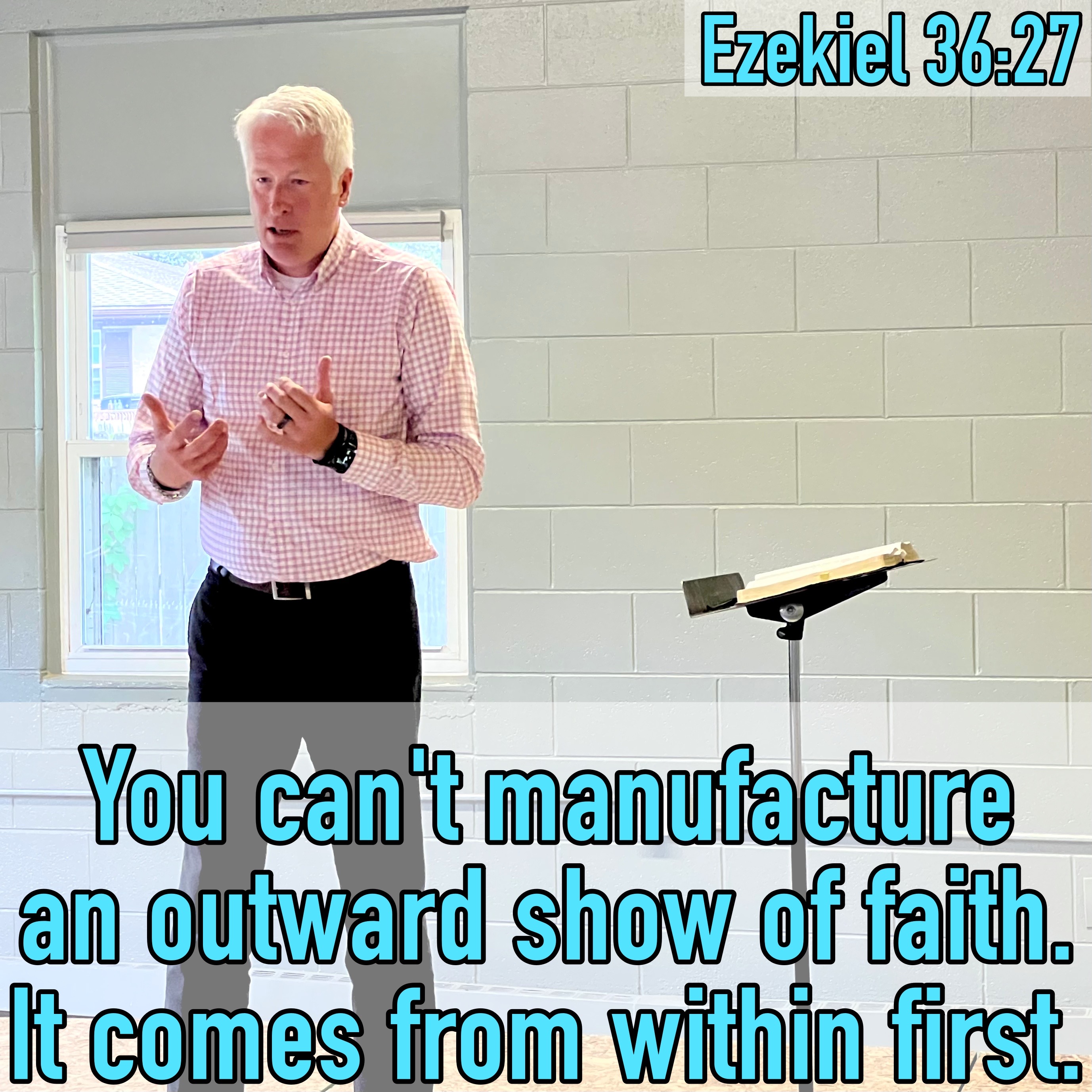
In the First Testament, we see a desire for the Holy Spirit to be more than on—a desire for Him to come in.David prayed, “Create in me a pure heart, O God, and renew a steadfast spirit within me” (Psalm 51:10). And God promised His people, “I will give them an undivided heart and put a new spirit in them … And I will put My Spirit in you and move you to follow my decrees and be careful to keep My laws” (Ezekiel 11:19, 36:27).
Paul identified this fruit of the Spirit as “love, joy, peace, forbearance, kindness, goodness, faithfulness, gentleness and self-control,” and he concluded with the phrase, “against such things there is no law” (Galatians 5:22-23). The law always sets limits, but when the Holy Spirit abides in us, the production of fruit is limitless!
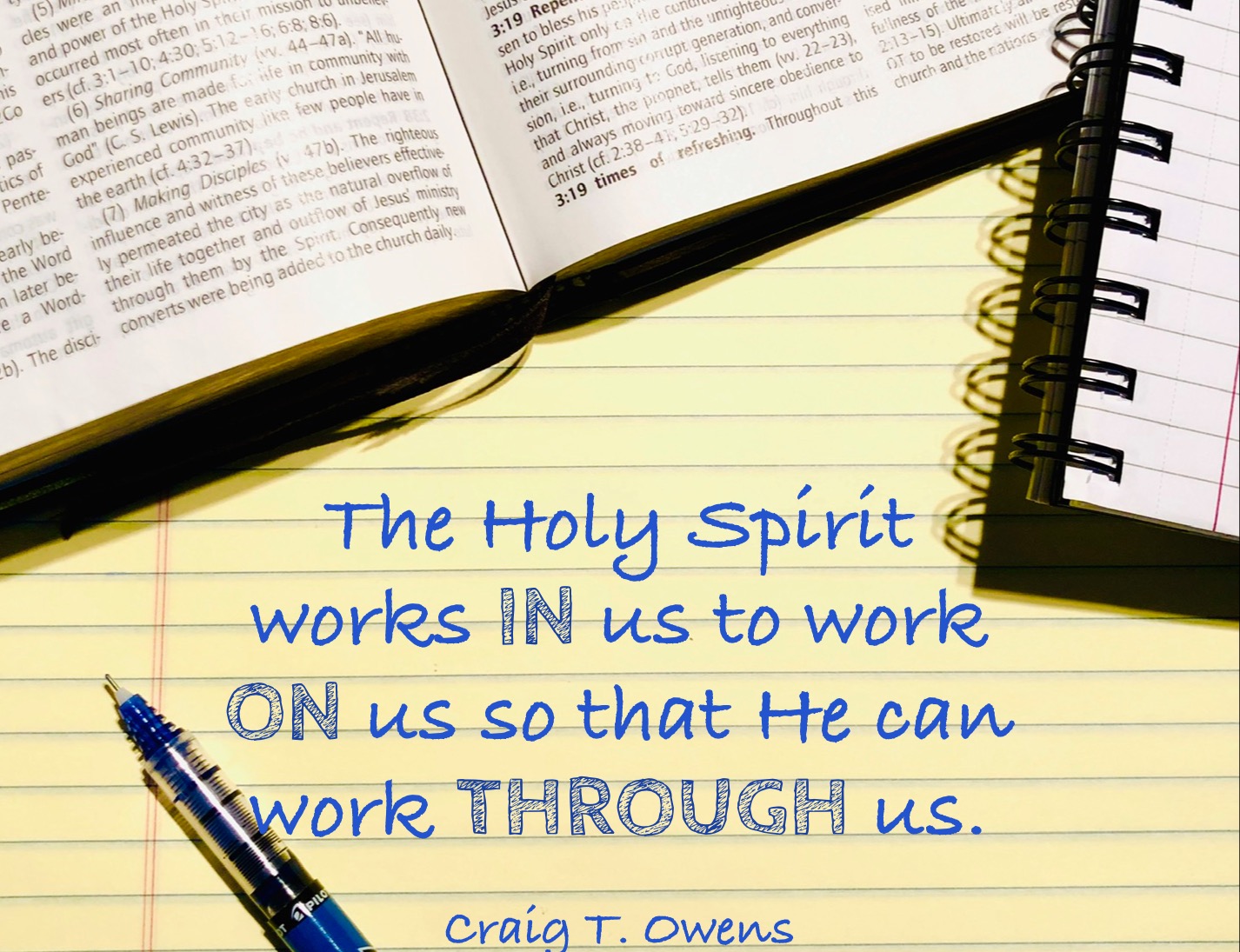
Being baptized in the Holy Spirit means that we allow Him to come in us and then to work on us. It’s only when the Holy Spirit has worked in us that can He flow through us to others. Jesus said that we would receive the Spirit’s empowerment to be witnesses—that’s an inward change that produces an outward fruit.
Leaders always go first. I want to develop myself so that I have something to give to other emerging leaders around me. If I’m not growing, I’m not going to be able to help others. Check out this full conversation Greg and I had our on leadership podcast The Craig And Greg Show. And be sure to check out all of my videos on my YouTube channel.
“The important thing is not to stop questioning. Curiosity has its own reason for existing. One cannot help but be in awe when he contemplates the mysteries of eternity, of life, of the marvelous structure of reality. It is enough if one tries merely to comprehend a little of this mystery every day. Never lose a holy curiosity.” —Albert Einstein
This is sort of gross, but kind of cool at the same time. “A new study in the journal Scientific Reports concludes that 12 severed hands discovered in 2011 at Tell el-Dab’a (the site of the ancient Hyksos capital of Avaris) constitute the first bioarchaeological evidence of the gruesome ‘trophy taking’ practice of amputating the right hands of defeated enemies.” Read more about this find here. This is a corroboration of the ‘trophy taking’ David performed for King Saul in the Bible.
The more scientists learn about Creation, the more in awe of our Creator I am! Recently, researchers have discovered even more happening inside our cells that keep everything operating optimally. And then there’s this: “Besides the origin of the eye, Darwin had a problem with the origin of flowering plants (angiosperms—plants that produce seeds within an enclosure, i.e., a fruiting plant), known as Darwin’s abominable mystery. The biblical model of origins maintains that the first forms of life created by God were land plants on Day 3 of the creation week. Land plants were fully-formed and functional—‘in the beginning.’”
Dan Reiland encourages leaders to look at their weaknesses differently. “The chinks in your armor allow you to develop empathy and compassion. They give you insight to human nature. They help you genuinely connect with people. Without these things it’s difficult to lead with God’s heart.”
I am a proud member of the Assembly of God fellowship, so I especially loved reading this report on Breakpoint:
“According to recent research by pastor Ryan Burge of eight major Protestant denominations, only the Assemblies of God has seen a steady increase in church membership since 1987. Each of the others, mostly denominations that are fully progressive theologically and culturally, are experiencing steady decline.
“Denominations like The Episcopal Church, Evangelical Lutheran Church in America, and the Presbyterian Church (USA) began long ago to move away from orthodoxy and capitulate to new ideas about sex, gender, and marriage. On the other hand, the Assemblies of God (AG) remained committed to orthodoxy on matters of Scriptural authority, the Deity of Christ, the Resurrection, and on sexual matters. It supports the protection of life at all stages, marriage between one man and one woman, and it insists that the body determines identity as male and female.
“Christians are constantly pressured, within the Church and without, to evolve on these issues or, we are told, we will die out. It seems however, that biblical orthodoxy draws people in. Maybe because it provides an anchor in confusing times.”



 Saul and Jonathan, beloved and delightful in life, and in their deaths they were not separated; they were swifter than eagles, they were mightier than lions. Daughters of Israel, weep over Saul, who clothed you in scarlet, with jewelry, who put gold jewelry on your apparel. How the mighty have fallen in the midst of the battle! Jonathan is slaughtered on your high places. I am distressed for you, my brother Jonathan; you have been a close friend to me. Your love for me was more wonderful than the love of women. How the mighty have fallen, and the weapons of war have perished! (2 Samuel 1:23-27)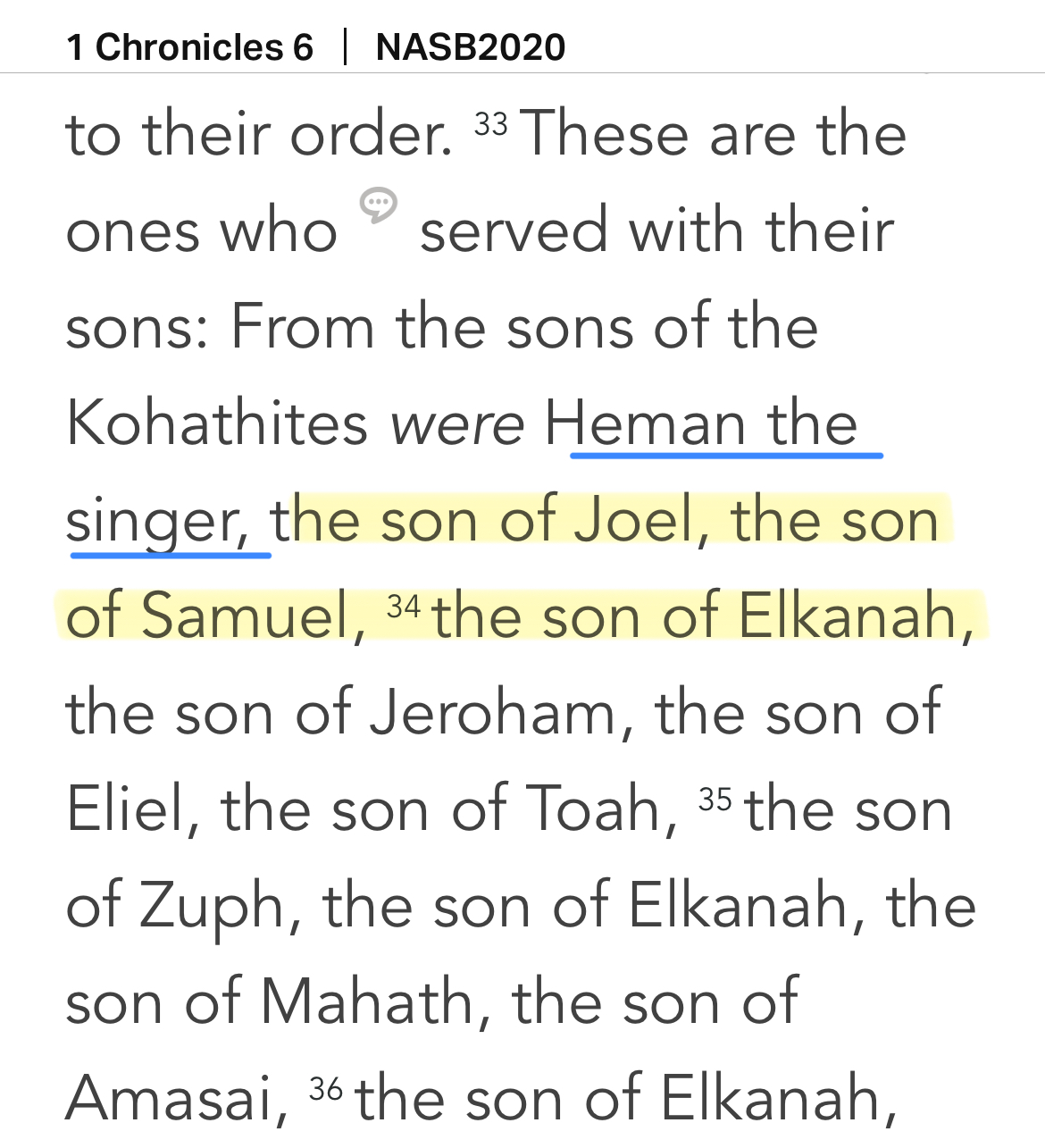






 Craig T. Owens