A Perspective On Problems

False ideas on problemsWe were blessed to have a special guest speaker yesterday morning: Jeff Hlavin. Wow, what a great word he shared with us! He continued in our series called Aliens and Strangers, on how Christians are to live in this world as citizens of Heaven. Below are a few notes I jotted down.

Dear friends, do not be surprised at the fiery ordeal that has come on you to test you, as though something strange were happening to you. (1 Peter 4:12)

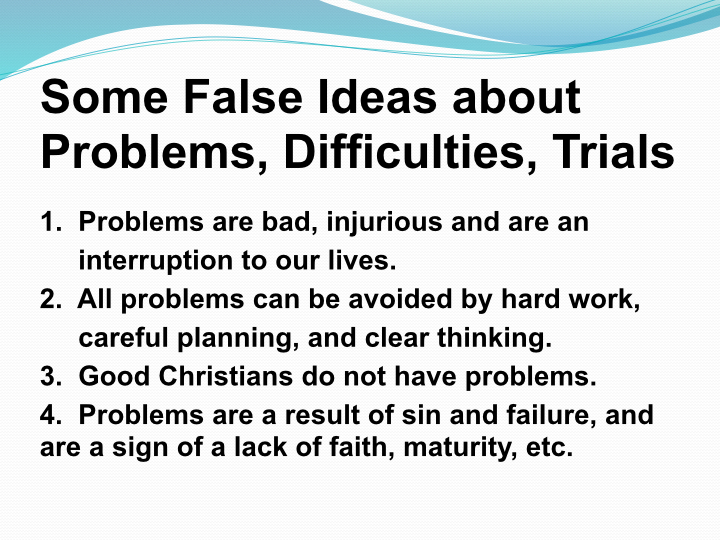
Using this verse as his introduction, Pastor Jeff shared four false ideas about problems:

  1. Problems are bad and are an interruption to our lives.
  2. All problems can be avoided by hard work, careful planning and clear thinking.
  3. Good Christians don’t have problems.
  4. My problems are a result of sin or are a sign of a lack of faith/maturity.

Instead I should see from a biblical perspective that…

“The Holy Spirit is the greatest Change Agent in a Christian’s life. I can only resolve this tension by obedience. … The devil tries to invoke turmoil in my life, but I can overcome this turmoil by submitting to God (James 4:7).” —Jeff Hlavin

“Trials develop spiritual/emotional/mental muscles that we need to have to soar into the place God has for us.” —Jeff Hlavin

If you would like to download a copy of the outline Pastor Jeff handed out to us, click here → Perspective on Problems Outline ←

We will be continuing in our Aliens and Strangers series this Sunday, and I’d love to have you join us. If you’ve missed any messages in this series, you may find the complete list by clicking here.
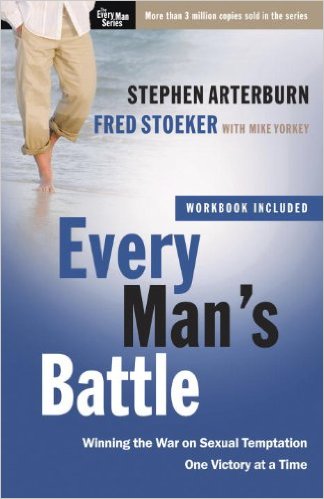
Every Man’s Battle (book review)

Every Man's BattleMen are wired differently from women (surprise!). While not all men struggle with pornography, the way men are wired makes it easier to allow lust to begin through what we see with our eyes. This is every man’s battle, and this is the reason Stephen Arterburn and Fred Stoeker have given men an essential book called Every Man’s Battle.

If you’re a guy and you say, “I never battle with lust. I can control myself,” I’d like to remind you of one piece of Scripture: If you think you are standing strong, be careful not to fall. In other words, a little humility and a little help is never a bad thing. In fact, it may just help you keep your guard up.

If you’re a guy and you say, “If the truth were known, I do battle lust quite often,” perhaps your battle with lust has even gotten the best of you, and you’ve begun sneaking a peak at things your shouldn’t be looking at. Maybe those quick peaks have even become longer looks … or even turned into a pornography problem.

In whatever category you find yourself, Every Man’s Battle is an invaluable book for men. The authors are very honest about their own struggles with lust and pornography, including the things they tried to help them kick their habit that ultimately failed. What’s presented to us in this book are successful strategies for defeating lust and eliminating pornography from our lives.

I found the strategies they shared to be practical. They weren’t just some “pray a lot and trust God” approaches, but truly things that any guy can put into practice. That’s not to say that they will be easy to do. After all, rewiring the way you’ve been used to doing things is a lot of hard work. But Stephen and Fred give you a biblical foundation, their own lives as examples, and simple next-steps that any guy can do!

There’s a workbook included, which I would recommend for guys to do with an accountability partner. I would also recommend the website We Dared (where you will meet author Stephen Arterburn) to get some daily help in your battle against lust.

GUYS: GET THIS BOOK! Your family, your church, and your community need you to be strong and victorious over lust and pornography.

Links & Quotes

link quote

“Paul says ‘whatever you do’—even down to such everyday things as taking a meal—do it in order to glorify God [1 Corinthians 10:31]. Apparently there are ways of using culture—our table manners, language, style of dress, way of working, how we drive our car and care for our homes, the use we make of TV and films, the emails we write, the phone calls in which we become involved, and all the rest of our culture—there are ways of using such everyday things that will allow us to signal to the world around us that we are aware of an obligation in such cultural activities that extends beyond our own puny selfish interests. We seek the glory of God in our use of culture.” —T.M. Moore

“To be fully free, we must have the desire, the ability, and the opportunity to do what will make us happy forever. No regrets. And only Jesus, the Son of God Who died and rose for us, can make that possible. If the Son shall set you free, you shall be free indeed [John 8:31-32].” —John Piper

Here is what is sad to me, many people buy into what George Lord Byron wrote, speaking of Socrates: “Well didst thou speak, Athena’s wisest son, ‘All we know is nothing can be known.’” We can know through our relationship with Jesus Christ.

“Heaven will solve our problems, but not, I think, by showing us subtle reconciliations between all our apparently contradictory notions. The notions will all be knocked from under our feet. We shall see that there never was any problem.” —C.S. Lewis

“Pleasure is not a quick fix, it can be a thief, it will undermine happiness. Eventually, pleasure loses its pleasure and becomes a prison.” —Andy Stanley

If you have ever been hurt by your church, first of all: my heart breaks with yours … that should never have happened. But if it did, this post may help you in overcoming your hurt.

We must be in prayer! Every five minutes, a Christian is martyred for their faith somewhere in the world.

[VIDEO] J. Warner Wallace, a cold case detective, talks about how he uses his investigative skills to explain the origin of life from non-life—


Thursdays With Oswald—The Memory Of Sin

This is a periodic series with things I’m reading and pondering from Oswald Chambers. You can read the original seed thought here, or type “Thursdays With Oswald” in the search box to read more entries.

The Memory Of Sin

     No aspect of Christian life and service is in more need of revision than our attitude to the memory of sin in the saint. When the Apostle Paul said “forgetting those things which are behind,” he was talking not about sin, but about his spiritual attainment. Paul never forgot what he had been; it comes out repeatedly in the Epistles—“For I am the least of the apostles, that am not meet to be called an apostle” (1 Corinthians 15:9); “unto me who am less than the least of all saints, is this grace given” (Ephesians 3:8); “…sinners, of whom I am chief” (1 Timothy 1:15). …

     If one wants a touchstone for the depth of true spiritual Christianity, one will surely find it in this matter of the memory of sin. There are those who exhibit a Pharisaic holiness, they thank God with an arrogant offensiveness that they are “not as other men are”; they have forgotten the horrible pit and miry clay from whence they were taken, and their feet set upon a rock through the might of the Atonement. … 

     May the conviction of God come with swift and stern rebuke upon any one who is remembering the past of another, and deliberately choosing to forget their restoration through God’s grace. When a servant of God meets these sins in others, let him be reverent with what he does not understand and leave God to deal with them. 

From Conformed To His Image (emphasis added)

These are good questions for Christians to ask themselves regularly: (1) Am I remembering the sins of others the way I would want others to remember my sins? (2) Am I remembering my forgiven sins the way that God remembers them (Psalm 103:10-12)?

Thursdays With Oswald—Sanctified Specimens

This is a weekly series with things I’m reading and pondering from Oswald Chambers. You can read the original seed thought here, or type “Thursdays With Oswald” in the search box to read more entries.

Sanctified Specimens

     May God save us from the selfish meanness of a sanctified life which says, “I am saved and sanctified, look what a wonderful specimen I am.” If we are saved and sanctified we have lost sight of ourselves absolutely, self is effaced, it is not there. 

     …We are saved and sanctified for God, not to be specimens in His showroom, but for God to do with us even as He did with Jesus, makes us broken bread and poured-out wine as He chooses. 

From Bringing Sons Unto Glory

The apostle Paul said it this way, “You were bought with a price [purchased with a preciousness and paid for, made His own]. So then, honor God and bring glory to Him in your body” (1 Corinthians 6:20, AMPC). And he wrote later, “God paid a high price for you, so don’t be enslaved by the world” (1 Corinthians 7:23, NLT).

If God has changed you, don’t try to remain a specimen on the shelf, don’t posture and pose. In fact, stop thinking about how good you look because that only glorifies you.

Instead, let God by glorified as you allow Him to use you as a living, breathing example of how He can totally change someone’s life.

Where Are You Looking?

JesusThis morning I shared this quote from Leonard Sweet and Frank Viola’s book Jesus: A Theography

“When Jesus said to satan, ‘Get behind Me,’ He was acknowledging that we all live with the devil. We cannot escape evil on this earth. But as long as we are in front and he is behind us, we are protected. The devil ought not be in our line of vision but in our shadow.”

It reminds me of the old song:

Turn your eyes upon Jesus

Look full in His wonderful face

And the things of earth will grow strangely dim

In the light of His glory and grace

Stop looking at that loser named satan! Stop listening to the one who’s been defeated and whose fate is already sealed! Keep your eyes fixed on Jesus! Keep your ears tuned into His voice!

“Where, O death, is your victory? Where, O death, is your sting?” (1 Corinthians 15:55)

Jesus says: I am the Living One; I was dead, and now look, I am alive for ever and ever! And I hold the keys of death and Hades. (Revelation 1:18)

And the devil, who deceived them, was thrown into the lake of burning sulfur, where the beast and the false prophet had been thrown. They will be tormented day and night for ever and ever. (Revelation 20:10)

Check out more in our series Who Is Jesus?

Drifting

Listen to the podcast of this post by clicking on the player below, and you can also subscribe on AppleSpotify, or Audible.

It’s a funny story that I love to tell, but my wife doesn’t enjoy it so much (please forgive me, dearest!).

We were visiting my father-in-law in northern California and he took us sailing on a huge sailing ship. Being novice sailors, Betsy and I were excited to learn and to experience all of the thrills of hoisting sails, coming about, and the like. After we had been in the Monterey Bay for awhile, heading out toward the Pacific Ocean, it was Betsy’s turn to pilot the ship. I was busy with all of my other sailing responsibilities, when I looked up and asked, “Weren’t we headed toward the ocean? Why are we heading back toward land?” Betsy had thought she was keeping the ship pointed straight, but in all of her concentration, we had slowly made a 180-degree turn.

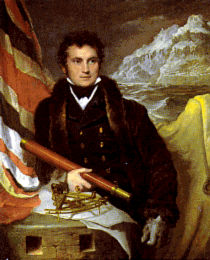
She is in good company! A similar thing happened to Sir William Edward Parry, the famous English naval officer and record-setting explorer of the Arctic. He made one of the first attempts to reach the North Pole and, in doing so, set a record for pushing farther north than anyone else, a record that was his for nearly fifty years.

On one of his trips to the Arctic, Parry and his men were trekking across the ice toward the North Pole. Admiral Parry stopped to calculated their position by using the stars. Hours later when the exhausted explorers stopped to rest, Parry again calculated their position and discovered something he could hardly believe. After hours of heading north, they were actually farther south than when he made his previous calculation! Fortunately, Parry quickly discovered the problem: they were on a gigantic ice floe that was moving south faster than they were sledding north. Much like Betsy’s experience on the sailing ship, the ice floe was so big and moving so slowly that the arctic team’s loss of position was barely perceptible until Parry recalculated.

This is why recalculations and realignments are so vital for Christians too.

So, if you think you are standing firm, be careful that you don’t fall! (1 Corinthians 10:12)

Let a man thoroughly examine himself…. (1 Corinthians 11:28)

Search me, O God, and know my heart; test me and know my anxious thoughts. Point out anything in me that offends You, and lead me along the path of everlasting life. (Psalm 139:23-24)

Don’t ever assume you’re still on the right course. Stop, listen to the Holy Spirit’s voice, recalculate your position by the perfect standard of God’s Word, and make the adjustments you need to. Otherwise, you may end up someplace you never intended to go!

►► Would you please prayerfully consider supporting this ministry? My Patreon supporters get behind-the-scenes access to exclusive materials. ◀︎◀︎

Thursdays With Oswald—Two Ways To Handle A Crisis

Listen to the podcast of this post by clicking on the player below, and you can also subscribe on AppleSpotify, or Audible. 

This is a weekly series with things I’m reading and pondering from Oswald Chambers. You can read the original seed thought here, or type “Thursdays With Oswald” in the search box to read more entries.

Two Ways To Handle A Crisis

     A man must decide whether he will be identified with the death of the Lord Jesus Christ, which will mean the turning out not only of the “old man,” but of the old responsible intelligence, the old bondage, the old legalism, the things which used to guide the life before, and the forming of a totally new mind. 

     It works out this way: in your practical life you come to a crisis where there are two distinct ways before you, one the way of ordinary, strong, moral, common sense and the other the way of waiting on God until the mind is formed which can understand His will. 

     Any amount of backing will be given you for the first line, the backing of worldly people and of semi-Christian people, but you will feel the warning, the drawing back of the Spirit of God, and if you wait on God, study His Word, and watch Him at work in your circumstances, you will be brought to a decision along God’s line, and your worldly “backers” and your semi-Christian “backers” will fall away from you with disgust and say, “It is absurd, you are getting fanatical.” 

From Biblical Psychology 

When you have to deal with a crisis, there are two options:

  1. Use your common sense and the good ideas of others
  2. Do it God’s way

God’s ways usually defy the world’s common sense.

“As the heavens are higher than the earth, so are My ways higher than your ways and My thoughts than your thoughts,” says God. (Isaiah 55:9)

For the foolishness of God is wiser than man’s wisdom, and…the wisdom of this world is foolishness in God’s sight. (1 Corinthians 1:25; 3:19)

If you want to try to do it the “common sense” way, go ahead. God will let you try it, and a lot of people will encourage you to keep at it. But I think you will quickly find that the “God sense” way is so much better! Although very quickly your former “backers” and “cheerleaders” will look at you as a fanatic.

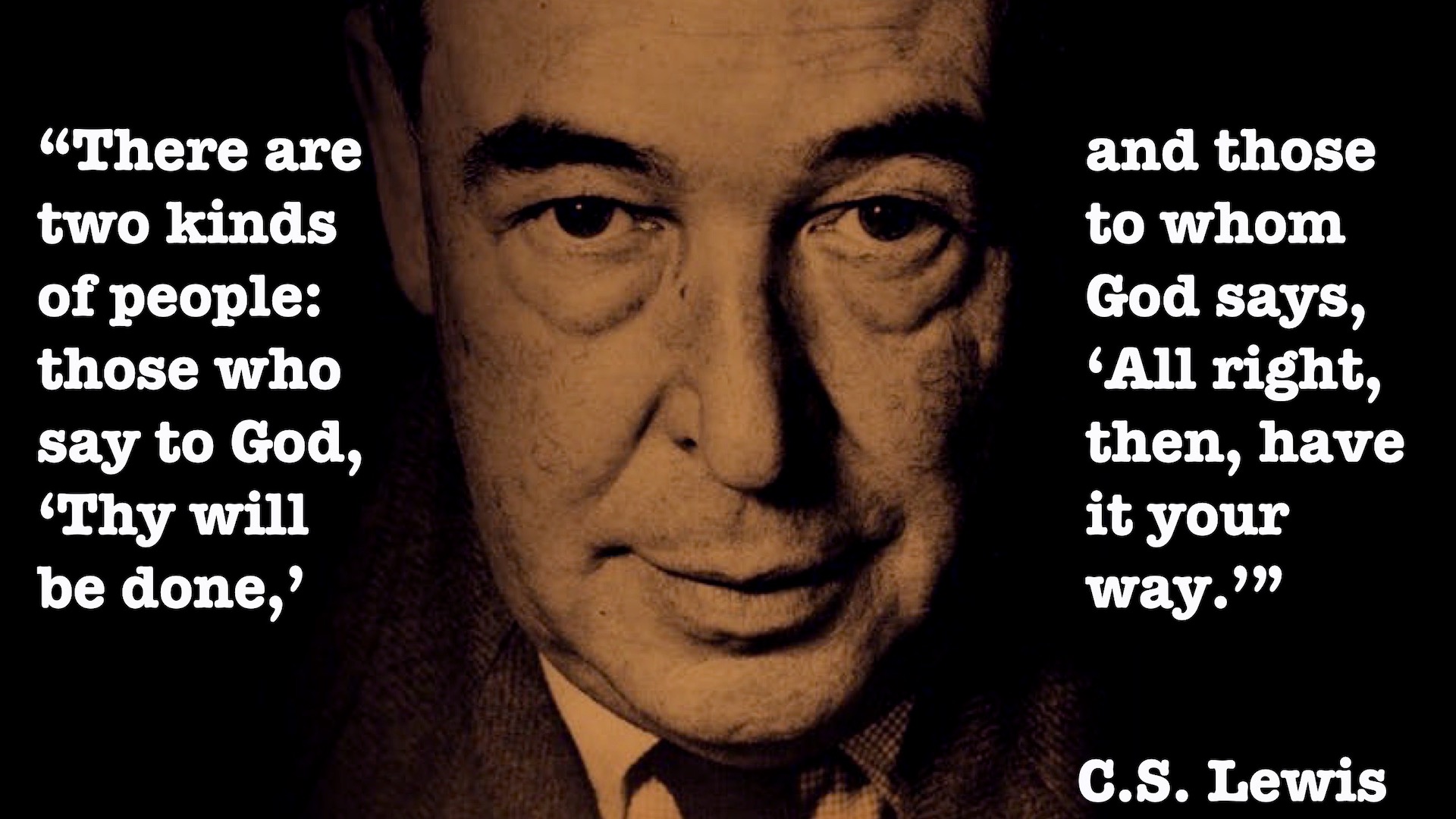
“There are two kinds of people: those who say to God ‘Thy will be done’ and those to whom God says, ‘All right then, have it your way.’” —C.S. Lewis

You must decide how you will respond in a crisis.

►► Would you please prayerfully consider supporting this ministry? My Patreon supporters get behind-the-scenes access to exclusive materials. ◀︎◀︎

Thursdays With Oswald—Don’t Let Others Stumble Because Of Me

This is a weekly series with things I’m reading and pondering from Oswald Chambers. You can read the original seed thought here, or type “Thursdays With Oswald” in the search box to read more entries.

Don’t Let Others Stumble Because Of Me

     There is a difference between “offense” and “stumbling.” And they were offended in Him. But Jesus said unto them, “A prophet is not without honor, save in his own country…” (Matthew 13:57). But Jesus knowing in Himself that His disciples murmured at this, said unto them, “Does this cause you to stumble?” (John 6:61; see also Matthew 5:29; 11:6; 13:41; 16:23; 17:27; 18:6-7). Offense means going contrary to someone’s private opinion, and it is sometimes our moral duty to give offense.

     …Stumbling is different from offense. For example, someone who does not know God as well as you do, loves you and continually does what you do because he loves you, and as you watch him you begin to discern that he is degenerating spiritually, and to your amazement you find he is doing what you are doing. No offense is being given, but he is stumbling, distinctly stumbling.

From Biblical Psychology

In 1 Corinthians 8 and 9 Paul talks about not causing someone else to stumble because of what we do. It’s a fine line sometimes between offense and stumbling, but it’s a distinct line that the Holy Spirit can help us discern.

Jesus often offended people because their mindset was so rigid, and He didn’t act in a way that fit their rigid religious stereotypes. But Jesus was very cautious about making sure He never caused someone to stumble. As Matthew points out, Jesus fulfilled the prophesy of Isaiah: He will not quarrel or cry out…. A bruised reed He will not break, and a smoldering wick He will not snuff out… (Matthew 12:19-20; Isaiah 42:1-4).

My prayer: Lord Jesus, please don’t let others stumble because of me! Let me have the discernment of the Holy Spirit to know when to offend, but to never cross the line to cause others to stumble. May I have Your same gentle spirit to not quarrel, and to treat the “bruised reeds” with utmost care.

Eye On It