This is a weekly series with things I’m reading and pondering from Oswald Chambers. You can read the original seed thought here, or type “Thursdays With Oswald” in the search box to read more entries.
The Love Behind The Warning
“Enter through the narrow gate. For wide is the gate and broad is the road that leads to destruction, and many enter through it. But small is the gate and narrow the road that leads to life, and only a few find it.” —Jesus (Matthew 7:13-14)
Always distinguish between warning and threatening. God never threatens; the devil never warns. A warning is a great arresting statement of God’s, inspired by His love and patience. …
It is the great patience of God that gives the warning, “The way of transgressors is hard.” Go behind that statement in your imagination and see the love of God. God is amazingly tender, but the way of transgressors cannot be made easy. God has made it difficult to go wrong, especially for His children. …
If Jesus came to be a teacher only, He had better have stayed away. What is the use of teaching a human being to be what no human being can be—to be continually self-effaced, to do more than his duty, to be completely disinterested, to be perfectly devoted to God? If all Jesus came to do was to teach men to be that, He is the greatest taunter that ever presented any ideal to the human race. But Jesus Christ came primarily and fundamentally to regenerate man. He came to put into any man the disposition that ruled His own life, and immediately that is given to a man, the teaching of Jesus begins to be possible.
From Studies In The Sermon On The Mount
The opposite of love is not hate; it’s apathy. If God didn’t love us, He wouldn’t care what road we attempted to take. But He does love us, so He tells us the one and only way to get to Him: Jesus Christ is THE way.
Chambers is exactly right when He says that Jesus was not just a great Teacher. If that’s all that Jesus came to do, we would be miserable people because we could never walk the narrow road that He taught. But Jesus came to enable and empower us to walk that road. He came to purchase our atonement (our “at-onement” with Him) so that we could live out all that He taught.
Jesus is a Teacher, but He is also the Enabler that makes it possible for us to obey His teaching. For that, we should be eternally grateful!
“Not only does he choose when he will tempt, satan also chooses the best methods for displaying his temptations. One strategy is to hang out false colors. He comes up to the Christian disguised as a friend, so that the gates are open to him before his true identity is discovered. Paul says we should not be shocked to find false teachers masquerading as apostles of Christ, ‘…satan himself is transformed into an angel of light’ (2 Corinthians 11:13-14). Of all his plots, this is perhaps the most dangerous to the saints; when he appears in the mantle of a prophet and silver-plates his corroded tongue with fair-sounding language. In this manner he corrupts some in their judgment by interpreting gospel truth in such a way that God appears to condone questionable behavior. These Christians get caught up in the world’s morality under the guise of Christian liberty. … How we need to study the Scriptures, our hearts, and satan’s wiles, that we may not bid this enemy welcome and all the while think it is Christ who is our guest!” —William Gurnall, in The Christian In Complete Armor (emphasis mine)
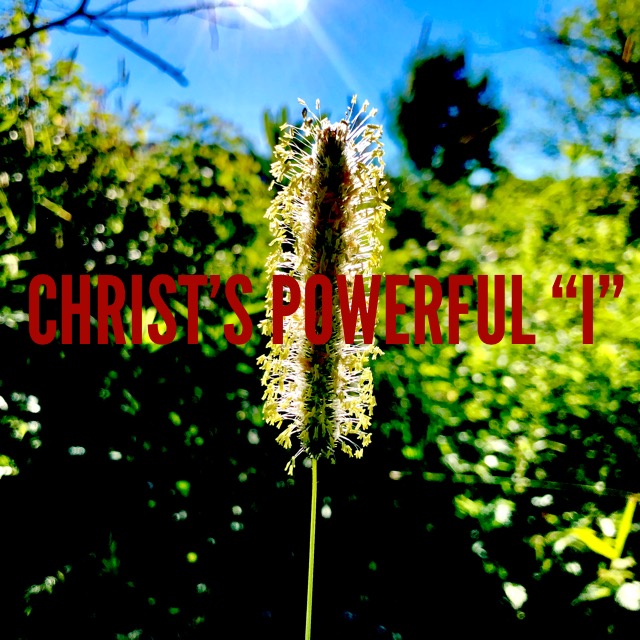
The disciples of Jesus, by their words and actions, have made it perfectly clear that they are “troubled” at the thought of being on their own. Jesus assures them with three powerful “I” truths:
I go to prepare a place for you—your future home is secure.
I will come again—we will be with Jesus forever.
I am the way, the truth, and the life—there is no need to second-guess, no confusion; just perfect, heart-cheering clarity!
The disciple’s job—and therefore our job as well—is simply this: “Believe Me” (v. 11).
When we believe what Jesus says—I go, I will, I am—then we unleash the power of God in our lives. The power to…
… do greater works (v. 12)
… pray more powerful prayers (vv. 13, 14)
… know the companionship of the Holy Spirit (vv. 16-18)
Whenever fear tries to creep in and paralyze us, may we quickly drive out that fear by believing and reaffirming what Jesus says: “I go … I will … I AM!”
On what we now refer to as Palm Sunday, Jesus arrived in Jerusalem with the crowd shouting, “Hosanna” because they thought Jesus was going to set things right. In this, they were disappointed. Jesus knew that His time for reigning in Jerusalem hadn’t come yet, and Christ’s passionate journey meant He would not cut any corners!
Before Jesus left Jerusalem that Sunday evening, Mark noted that “He looked around at everything.” He didn’t respond right away to what He saw. This is very important to note because we shouldn’t think that His response on Monday was something spontaneous. No, it was planned out in specific detail.
On Monday morning, Jesus prepared to make the 2-mile trip from Bethany to Jerusalem. The Gospels note quite frequently the amount of time Jesus spent in prayer, including beginning His day in conversation with His Father (see Mark 1:35). On this morning, He must have talked with His Father about everything He had seen in Jerusalem the day before.
En route to Jerusalem, Jesus encounters a fig tree that gives every appearance of life and vitality. It looks like it’s ready to serve people, but upon closer inspection, Jesus discovers that there is no fruit on it. He curses the tree for its deceptive outward appearance. This is definite foreshadowing for what’s about to happen!
Jesus enters the temple and begins to drive out merchants, and moneychangers, and dove sellers. He roars at them, “God says this is to be a place of prayer for all nations, but you have turned it into a den of robbers!” (see Matthew 21:12-17; Mark 11:15-19; and Luke 19:45-48).
The phrases house of prayer and den of robbers are direct quotations from Isaiah and Jeremiah, respectively (Isaiah 56:3-7; Jeremiah 7:1-11), but what do they mean?
The temple had specific courts available—
The Court of the Gentiles was open to all people, foreigners included.
The Women’s Court was open to all Jews and, their “uncontaminated” wives.
The Court of Israel was limited to male Jews who were clean and purified.
The fourth court was the Holy Place limited to priests robed in their priestly vestments.
This buying and selling was undoubtedly happening in the Court of the Gentiles. As the Passover was approaching, people from all over the world were here—some purchasing animals to use as sacrifices, and some exchanging their foreign money for Israelite money for the temple tax.
There was a lot of hustle and bustle, but very little worship. This is what angered Jesus. The activity in the temple was like the fig tree He cursed—it looked like it was fruitful, but that was merely outward deception.
Were the merchants exploiting people? Perhaps. But they were certainly occupying the only space where non-Jews could worship. They were certainly becoming a distraction to any true worship activities. They were clearly becoming the main attraction.
There are two important lessons in this outburst that Jesus gives to all His disciples:
As our Christlikeness increases, our intolerance of religious showmanship should increase.
As our Christlikeness increases, our intolerance of unrighteousness should increase—both a greater hate for sin and a greater love for sinners!
“Let the zeal of the house of the Lord ever eat you up. For example: do you see a brother running [toward sin]? Stop him, warn him, be grieved for him, if the zeal of God’s house has now eaten you up. Do you see others running and wanting to drink themselves drunk? Stop whom you can, hold whom you can, frighten whom you can; win in gentleness whom you can: do not in any way sit still and do nothing.” —Augustine
Christ’s passionate journey was out of love for us. Which means He hates anything that keeps us from His Father.
If you know God’s love, be zealous about those things that keep others from coming in to know God’s love for themselves. Not angry at people, but angry at practices and “religious shows” that hinder people from knowing God’s love like you know God’s love.
“God endows us with gifts so we can make Him known. Period. God endues the Olympian with speed, the salesman with savvy, the surgeon with skill. Why? For gold medals, closed sales, or healed bodies? Only partially.
“The big answer is to make a big to-do out of God. Brandish Him. Herald Him. ‘God has given gifts to each of you from His great variety of spiritual gifts. Manage them well. … Then God will be given glory’ (1 Peter 4:10-11 NLT).
“Live so that ‘He’ll get all the credit as the One mighty in everything—encores to the end of time. Oh, yes!’ (1 Peter 4:11 MSG). Exhibit God with your uniqueness. When you magnify your Maker with your strengths, when your contribution enriches God’s reputation, your days grow suddenly sweet.” —Max Lucado, in You!
This is a weekly series with things I’m reading and pondering from Oswald Chambers. You can read the original seed thought here, or type “Thursdays With Oswald” in the search box to read more entries.
Bridging The Unbridgeable Gap
When you read a book about life, life looks simple; but when you actually face the facts of life you find they do not come into the simple lines laid down in a book. An idea is like a searchlight, it lights up what it does and no more, while daylight reveals a hundred and one facts the searchlight had not taken into account. … To treat the Sermon on the Mount merely as an ideal is misleading. It is not an ideal, it is a statement of the working out of Jesus Christ’s disposition in actuality in the life of any man. …
No man is so labored as the man who has ideals which he cannot carry out. Jesus Christ says to such, “Come unto Me…and I will give you rest,” i.e., “I will ‘stay’ you, put something into you which will make the ideal and the actual one.” Without Jesus Christ there is an unbridgeable gap between the ideal and the actual; the only way out is a personal relationship to Him. The salvation of God not only saves a man from hell, but alters his actual life.
From Studies In The Sermon On The Mount
The words Jesus taught are more real than any other teaching anyplace. In another book, Chambers notes, “Jesus Christ’s view is that the Christian religion has been tried and abandoned, but never been tried and failed.” How true!
But we cannot try to live out Christ’s words in our own strength. Trying to live this way will result in frustration and abandonment. Instead, Jesus reminds us that we are to be yoked to Him. We are to be as connected to Him as a branch is to its vine. The branch doesn’t beg and plead for the life-giving sap to flow into it, but simply as it abides it cannot help but receive all of the nutrients the vine supplies.
So too with us as Christians. Don’t try to do Christian things—just abide in Jesus and you cannot help but have a new outlook, a new strength, and new fruit of the Spirit blossoming from your life!
Jesus made His passion, crucifixion, and resurrection unmistakable.
He told us the Scriptures that He would fulfill (13:18).
He told us the details of His crucifixion and resurrection (John 3:14).
And He received the “stamp of approval” from His Father (13:31-32).
When Jesus came into Jerusalem, was arrested by the religious leaders, condemned by Pilate, crucified by Roman soldiers, and resurrected three days after His death, no one should have been surprised because Jesus made it unmistakable!
Jesus also told us how to make our belief in all He did for us unmistakable too—“By this will all know that you are My disciples, if you have love for one another” (v. 35).
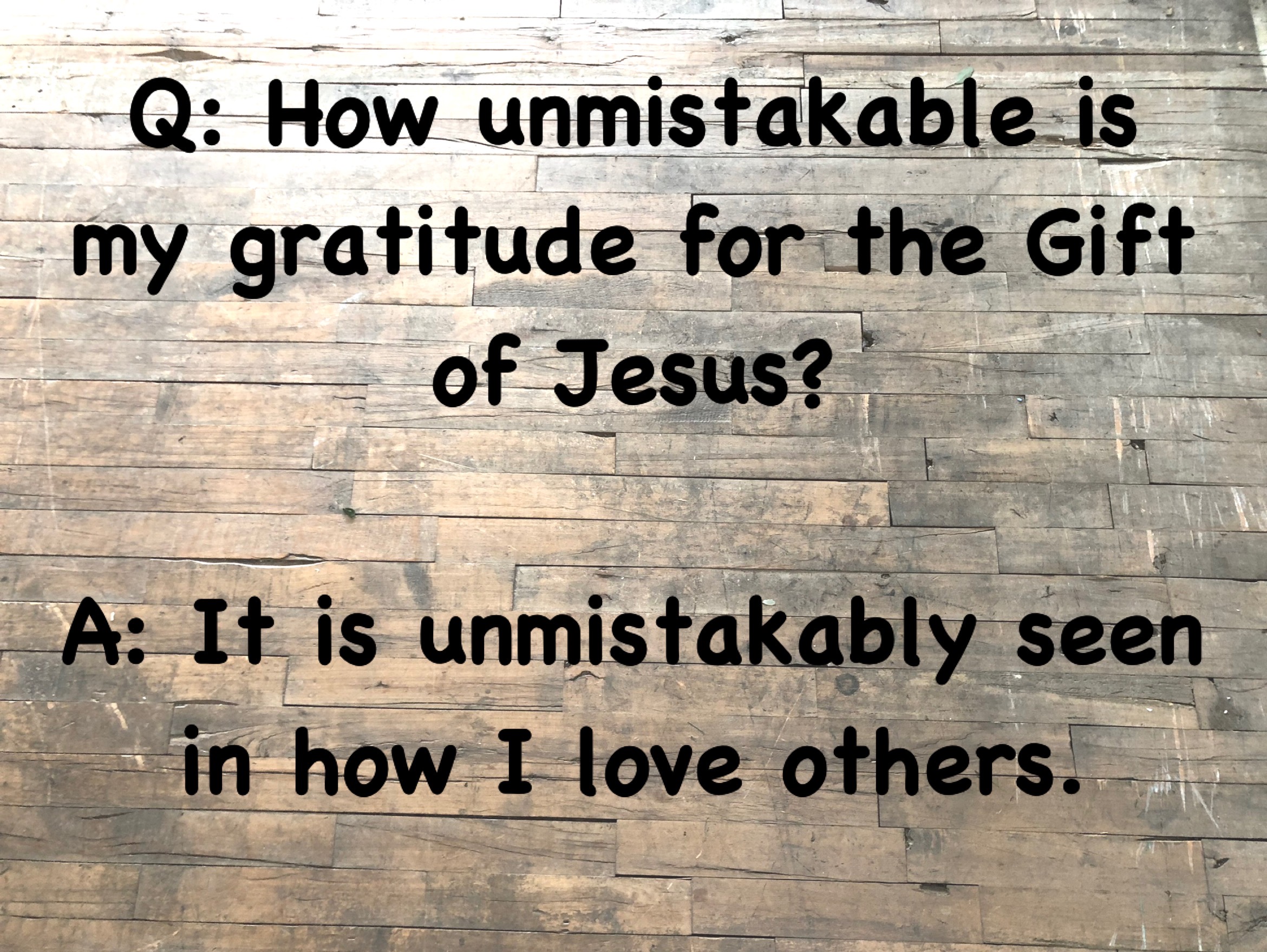
Q—How unmistakeable is my gratitude for the Gift of Jesus?
Erwin McManus’ book The Way Of The Warrior will unleash something in you to want to become the warrior for peace that God intended you to be! Check out my full book review by clicking here.
“There is no territory more critical or difficult for you to take than that of your inner world. … Every battle that you will ever face in the outside world must first be one in your inner world.”
“When your mind is shaped by hope, you do not see simply two paths; you see an endless number of paths filled with opportunity, possibility, and beauty. However, if your mind-set is shaped by cynicism or fear or doubt, then the only paths you see in front of you are the ones that are filled with pain and disappointment, with failure and hardship.”
“The warrior knows that honor is not found in the victory. Honor is found in the nobility of the battle. If the battle is not worthy of the warrior’s life, there is no honor in its victory. In the same way, the warrior knows there is no dishonor in defeat. Failure and defeat are not the same. To fear defeat is to surrender victory. There is only a good fight and a good death for the one whose life is given to the noble. The warrior never claims victory for themselves but only for others. In the same way, the warrior never gives blame for defeat but owns it for themselves. The warrior owns defeat, and therefore defeat never owns the warrior. The warrior who lives and dies with honor enters each eternity undefeated.”
“Here is the hard reality: even if it’s not your fault, it’s still your responsibility. Though the wounding wasn’t your fault, the healing is your responsibility. Though your past may not be your fault, your future is your responsibility. Though their choices were not your fault, your choices are your responsibility. Don’t let those who are at fault keep their hold on your life by relinquishing your power to change and to be free of them.”
“Energizing and exhausting are not diametrically opposed. The things that give you energy also cost you energy, but that cost has a return. The things that energize you the most might actually cost you the most energy. They might be the hardest things that you do. They might be the most difficult challenges in your life. But when they are energizing, you do not find yourself in a deficit of energy, because whatever it costs you, the return is greater.”
“The warrior finds their strength because they fight only battles that matter.”
“Worry consumes your energy without productivity. … Worry is a waste of energy. Emotions such as anxiety and stress are the result of unharnessed energy misdirected by our fears and doubts. … When you doubt, you hesitate. When the warrior hesitates, he faces certain defeat. … When you doubt, your energy wars against itself. It becomes unharnessed and unfocused and loses its power. There is a strength that comes when you have confidence that even if you fail, you’ve given yourself to the right battle. We spend too much of our lives trying to make sure we are right about the what, the where, the when, and the how, and too little time making sure we are right about the why.”
“We transmit to one another what occupies our souls. Your soul is the conduit of your energy. If your soul is empty, you will consume energy from the world around you. … When you are full of life, you become a conduit of life. You will become a source of what is good and beautiful and true. People will naturally draw inspiration from your life. They will see you as a source of hope.”
“This is the paradox that the warrior has come to know. They know they are not the source of their own strength. The fire that burns within the warrior is an eternal fire. The warrior knows their strength because they know their weakness. It was Jesus who said, ‘Apart from the Father I can do nothing.’ The warrior understands there is no weakness in this. The warrior has found their strengths and their weaknesses. Jesus spoke to Paul about this: ‘My power is made perfect in weakness.’ The way of the warrior is to know that God is our strength. The warrior boasts all the more gladly about their weaknesses so Christ’s power may rest on them. The warrior knows they were created by God who is Spirit. Though we appear as flesh and blood, every cell in our bodies is energy. All our energy comes from God. What we do with our energy is up to us.”
Check out some of the other quotes from The Way Of The Warrior that I shared here.



 I see His blood upon the rose







 Craig T. Owens