Listen to the podcast of this post by clicking on the player below, and you can also subscribe on Apple, Spotify, or Audible.
Let me give you the bottom line right at the top: God in the Dock by C.S. Lewis is a challenging book, but it is so worth your time to work your way through it!
Sometimes I feel that Lewis is from a different planet that allows his mind to move so beyond the things the rest of us are observing. It reminds me a little of Edwin Abbott’s book Flatland where 3-dimensional Sphere is talking with 2-dimensional Square. Sphere can see so much more than Square can, but he is trying to describe it in terms that Square can grasp.
This is why I say that God in the Dock is a challenging read. The phrase “in the dock” is how the English would describe someone who is on trial, listening to the evidence against them and presenting evidence in their own favor. Imagine that Person on trial was God! As Lewis himself notes, “The ancient man approached God (or even the gods) as the accused person approaches his judge. For the modern man the roles are reversed. He is the judge: God is in the dock.”
This book is made up of Lewis’ essays, responses to critical attacks on his other written works, conversations with atheists, and correspondence with people of all levels of society. His arguments are witty, biblical, philosophical, logical, sophisticated, and frequently other-worldly. This is why I said it is a challenge to keep up with his line of reason. But I promise you that those who persevere through this book will be the better for it.
Psychologists call it “projection” when I see so quickly in others what’s really in myself.
If I see sin in others, my first response would be to hit my knees and ask the Holy Spirit to search me to point out the same sin in myself.
It’s only after confessing my sin and receiving God’s complete forgiveness that I am equipped with the empathy and mercy to help someone else find the same freedom I have found.
Lord, may I be more sensitive to the sin in my life than I am aware of the sin in the world.
Listen to the podcast of this post by clicking on the player below, and you can also subscribe on Apple, Spotify, or Audible.
Our Royal Psalms take us from King David to King Jesus. David went from the anointed king on the run from King Saul, to being king over Judah (2 Samuel 2:4), to being king over “all the tribes” (2 Samuel 5:1-3; 8:15).
David’s kingdom stretched far and wide (1 Chronicles 22:14-16; 29:10-13). This absolute control King David now wields over every nation surrounding Israel puts fear into the hearts of Israel’s enemies. Fear of David brings freedom for the people of his kingdom.
As the Sons of Korah think about this fear that brings them freedom, they look beyond their earthly king to the King of Heaven and compose this Royal Psalm recorded in Psalm 47. This psalm has majestic terminology for God in almost every verse; including, Lord Most High, great King over all the earth (vv. 2, 7, 9), God reigns over the nations; and God is seated on His holy throne.
I’m especially intrigued by the word awesome in verse 2. The KJV says “the Lord Most High is terrible” because it does take two Hebrew words to give us the full definition of awesome. First, “Most High” is best thought of with the suffix -est: greatest, highest, noblest. In other words, there is nothing above Him. Then “terrible” is to be held in awe, to be honored, to be reverenced.
Just as the Israelites had no fear of enemies because David was on the throne, God says the same thing to us: Because the Most High is on the throne, His people have no fear of their enemies.
When we fear God we need not fear anything else.
When we fear God:
…we hate our own sin (Psalm 36:1-3)
…we love His mercy that forgives our sin (Psalm 103:2-3, 10-12)
…we hate sin in the world (2 Timothy 2:26)
…we love sinners (2 Timothy 2:24-26; Acts 10:38; Jude 20-23)
…we hate the darkness that traps people (2 Corinthians 4:4)
…we love shining the light of King Jesus (Philippians 2:15-16)
…we hate this life (John 12:25)
…we love eternal life (Romans 3:23-24, 8:18)
When the people of Israel reverenced David as their king, they would be able to know his blessings. When we fear our awesome God, we will also receive His blessings. Take a look at the amazing blessings Jesus Himself—the King of kings—lists for those who reverence His awesome Kingship (Revelation 2:7, 11, 17, 26-28; 3:5, 11-12, 21)!
God is awesome and asks us to reverence Him and then enjoy life in His freedom.
Leaders must resist trying to rush in “to save the day.” We need to let our teammates learn how to rescue themselves through a time of productive struggle. Check out the full conversation Greg and I had in our episode “The struggle is real (but necessary).”
I have had an ongoing series of posts and videos called “Is that in the Bible?” Many times we discover that a phrase we think is biblical isn’t found in the Scripture or it is being used out of context. John Stonestreet addresses this same concern. He writes, “Selective proof-texting points to how widespread and deep biblical illiteracy is. In addition to an ignorance of the actual content of the Bible, there is ignorance about what the Bible even is, and how Christians throughout the ages have used it. It’s bad when this ignorance shows up in politics. It’s sad when it shows up in our churches and Christian subcultures.”
“Strength does not come from winning. Your struggles develop your strengths.” —Arnold Schwarzenegger
Marcus Buckingham shared something fascinating: “I studied 3000 Disney housekeepers. Eight of them told me what they loved about their work. One vacuums herself out of every room to make perfect carpet lines. Another lies on every bed to test the ceiling fan because dust falling means guests think the room is dirty. A third arranges kids’ toys in elaborate scenes—Mickey with the TV remote, Minnie with french fries. All breaking Disney’s rules. All excellent for completely different reasons. Stop building competency models for leaders. The best leaders are super different from each other. Average is homogenous. Excellence is idiosyncratic.”
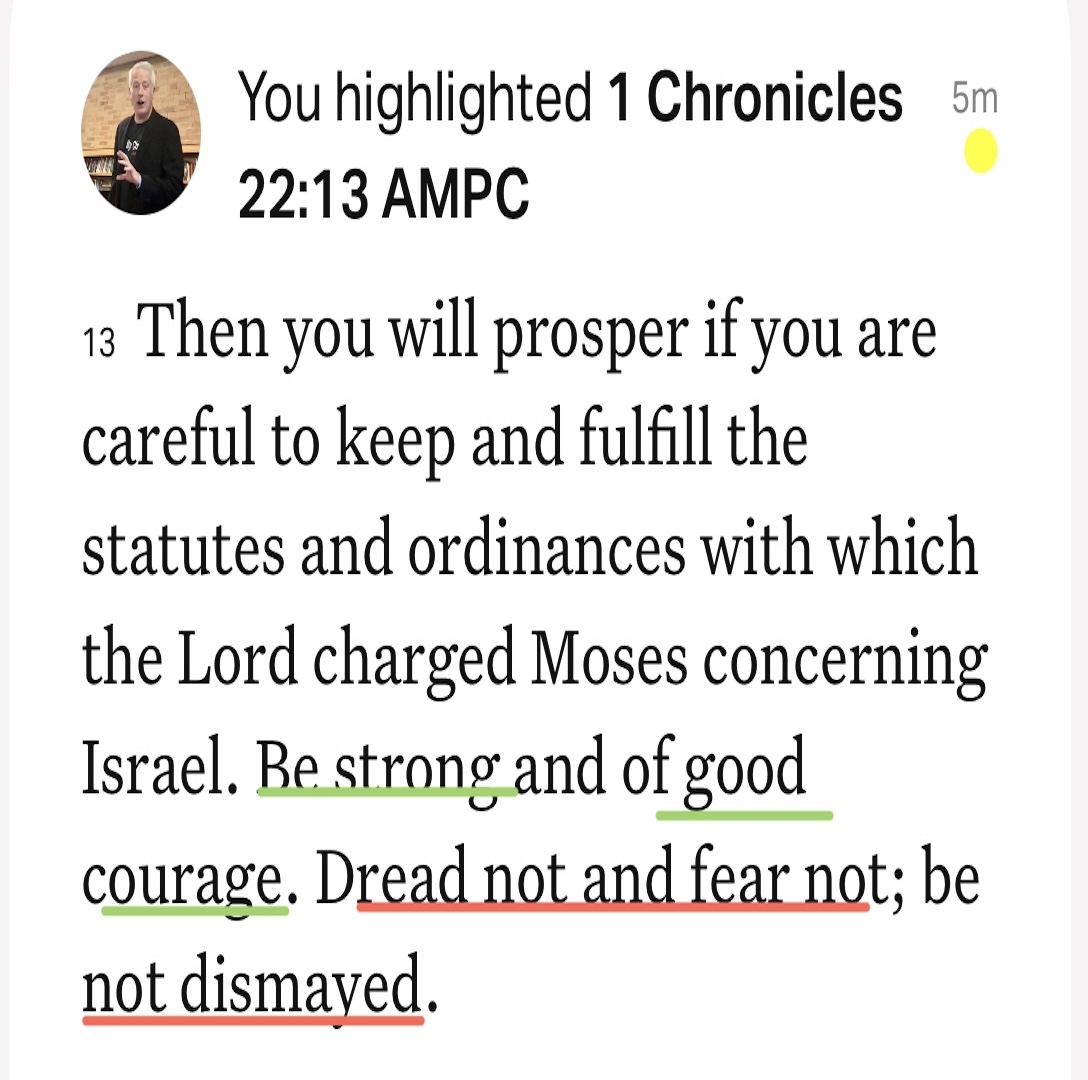
Then you will prosper IF you are careful to keep and fulfill the statutes and ordinances with which the Lord charged Moses concerning Israel. Be strong and of good courage. Dread not and fear not; be not dismayed. (1 Chronicles 22:13 AMPC)
True prospering can only come through carefully doing things God’s way. “I will obey God no matter what,” is easier said than lived. This is why David tells Solomon both the virtues to cultivate and the emotions to guard against:
Listen to the podcast of this post by clicking on the player below, and you can also subscribe on Apple, Spotify, or Audible.
What does it mean when we really believe the words, “The Lord is my Shepherd, I lack nothing” (Psalm 23:1)?
When the sheep is utterly dependent on the shepherd, it lacks nothing. A sheep without any lack glorifies the Good Shepherd.
God is glorified when I remain in utter dependence on Him, and I continue to have to lack because of His perfect provision. I am quiet, restored, on the right path, fearless, secure, provisioned, blessed, and forever hopeful.
To try to provide for my own needs dishonors the Good Shepherd, but to come to Him for absolutely everything glorifies Him as eternally satisfying and reliable.
The more my needs are satisfied by God alone, the more He is glorified.
Listen to the podcast of this post by clicking on the player below, and you can also subscribe on Apple, Spotify, or Audible.
Ahab, king of Israel, and Jehoshaphat, king of Judah, are strategizing a battle plan against Syria when they call for God’s prophet to share with them God’s counsel in this matter.
Then Micaiah said, “I did see all Israel scattered upon the mountains as sheep that have no shepherd, and the Lord said, ‘These have no master. Let each return to his house in peace.’ … Now, you see, the Lord put a lying spirit in the mouths of your prophets; and the Lord has spoken evil concerning you. … If you return at all in peace, the Lord has not spoken by me” (2 Chronicles 18:16, 22, 27).
You would think this would cause these kings to scrap their battle plans and keep their armies at home. But the next verse says they utterly rejected the prophet’s warning. “So Ahab king of Israel and Jehoshaphat king of Judah went up to Ramoth-gilead” (v. 28).
What in the world is Jehoshaphat doing?!
He asked for a prophet from God and then when he hears from God that this combined army will be defeated, Jehoshaphat still goes with Ahab?!
But let’s back up: Why was Jehoshaphat even here hanging out with Ahab? And before even hearing from Micaiah, why does he commit his army and cavalry to this joint-venture (v. 3)?
I think the clue is in v. 1: Jehoshaphat “was allied by marriage to Ahab.” Jehoshaphat’s son Jehoram is married to Ahab’s daughter Athaliah (2 Kings 8:18).
Jehoshaphat thought this was a strategic move. Like a chess master moving his pieces on the board, he calculated that this alliance would give him an advantage. But instead this move resulted in years of heartache and destruction.
First, Jehoshaphat feels trapped into allying with Ahab in this ill-fated battle against the Syrians. Ahab is killed in this battle, and Jehoshaphat barely escapes with his life, although his army is embarrassed in defeat.
As he is returning to Jerusalem, another prophet meets him and pronounces this heartbreaking message, “Should you help the ungodly and love those who hate the Lord? Because of this, wrath has gone out against you from the Lord” (2 Chronicles 19:2).
Later on, Jehoshaphat again partners with Ahab’s son, “After this, Jehoshaphat king of Judah joined with Ahaziah king of Israel, who did very wickedly” (20:35).
After Jehoshaphat died, his son Jehoram ascends the throne.
His reign as king is only eight years long, and is noted for him walking “in the ways of the kings of Israel” by doing evil in God’s sight (2 Kings 8:15). Jehoram was killed in battle.
Ahaziah his son then sits on the throne in Jerusalem for only a year, manipulated by his mother Athaliah. “He walked in the ways of the house of Ahab and did evil in the sight of the Lord, as did the house of Ahab, for his father was son-in-law of Ahab” (2 Kings 8:27). This alliance led to another disastrous joint military campaign with Israel. Ahaziah was killed by Jehu shortly after this.
Look what happens next: “When Athaliah the mother of King Ahaziah of Judah saw that her son was dead, she arose and destroyed all the royal descendants (2 Kings 11:1). This began a six-year reign of terror in which Athaliah assumed the throne.
Where did all of this mayhem begin? When Jehoshaphat calculated his own destiny.
We have such a limited view; whereas, God is timeless, all-knowing, all-powerful. It is the highest form or arrogance to think we can out-maneuver God’s plan, or that we can even begin to know what’s best for our lives.
The One who has all of our days written in His book is also the One who tells us that we can call to Him to learn things we don’t know and access the wisdom we don’t have (Psalm 139:16; Jeremiah 33:3; James 1:5).
Think of the misery that could have been avoided if Jehoshaphat would have heeded the counsel of his forefather Solomon: “Lean on, trust in, and be confident in the Lord with all your heart and mind and do not rely on your own insight or understanding. In all your ways know, recognize, and acknowledge Him, and He will direct and make straight and plain your paths” (Proverbs 3:5-6 AMPC).
What a miserable strategist I am when I make plans that I think are clever! Instead, I’m trying my best to follow Solomon’s counsel, and I pray you are too.
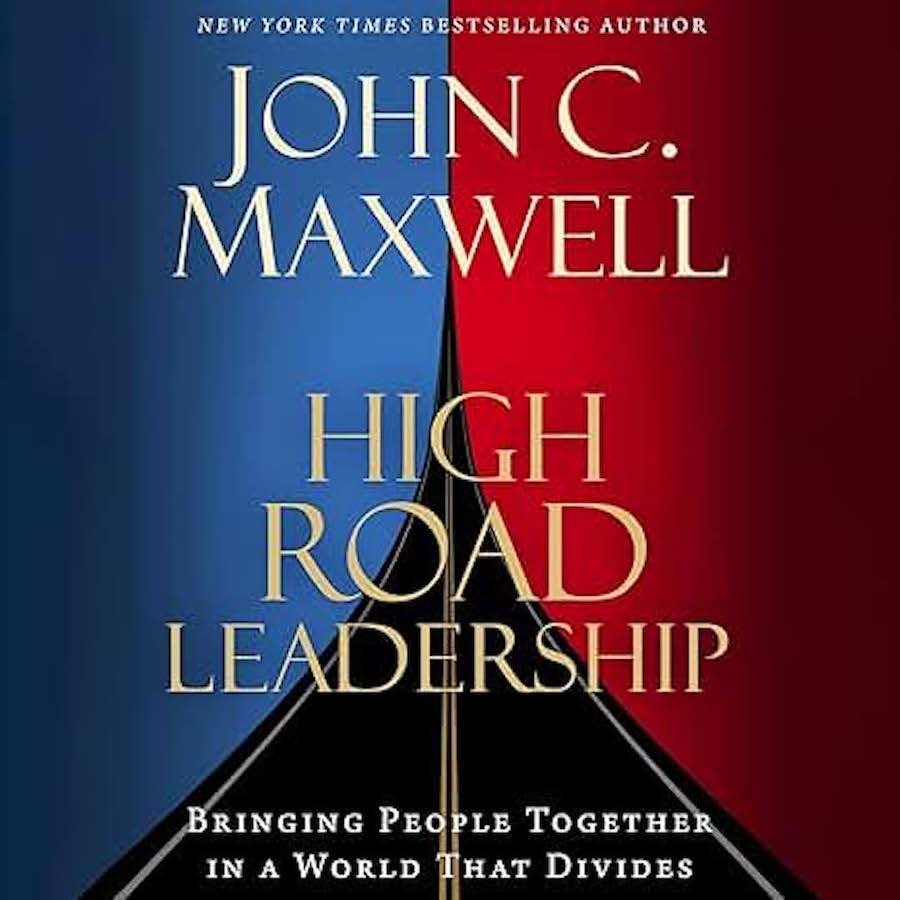
The subtitle of this John Maxwell book is “Bringing People Together in a World That Divides.” That is so needed today! Check out my review of High Road Leadership, and may these quotes inspire you to pick up a copy of this book to learn how you can be a part of healing a divided world.
“Leadership can be a blessing or a curse. It can help people rise to a better life, or it can cause people to fall into despair.”
“One of the reasons we don’t come together and work with one another is that we no longer see people on the other side as merely disagreeing. We see them as disagreeable human beings. We assume their motives are wrong. And the moment we think a person’s motives are wrong, we lose trust. … Good leaders need to rise above this attitude and help the people they lead do the same. How? We need to possess a strong collaboration bias. We need to bring people together to increase our understanding of each other and broaden our perspective.”
“We can’t divide people and expect to accomplish positive results. Conversation and collaboration will always come up with better answers than isolation and exclusion.”
“In my opinion, as a culture we lost our way when we went from simply disagreeing with others to devaluing them because we disagree. That’s when we crossed the line into low-road leadership. It’s one of the reasons so many people are so angry all the time. And when others take the low road with them, they become even angrier. It’s always easier to make a negative point than to make a positive difference.”
“High-road leaders who value people have a strong, healthy sense of self-worth, yet at the same time they are humble, meaning they don’t think too much of themselves or about themselves too much.”
“Accepting our humanness and possessing humble confidence does nothing to diminish our leadership ability. In a study of medical students, those who possessed doubts about their ability were just as effective in diagnosing illnesses as their more confident counterparts. Furthermore, the more humble students rated higher in bedside manner, empathy, respect, and professionalism.”
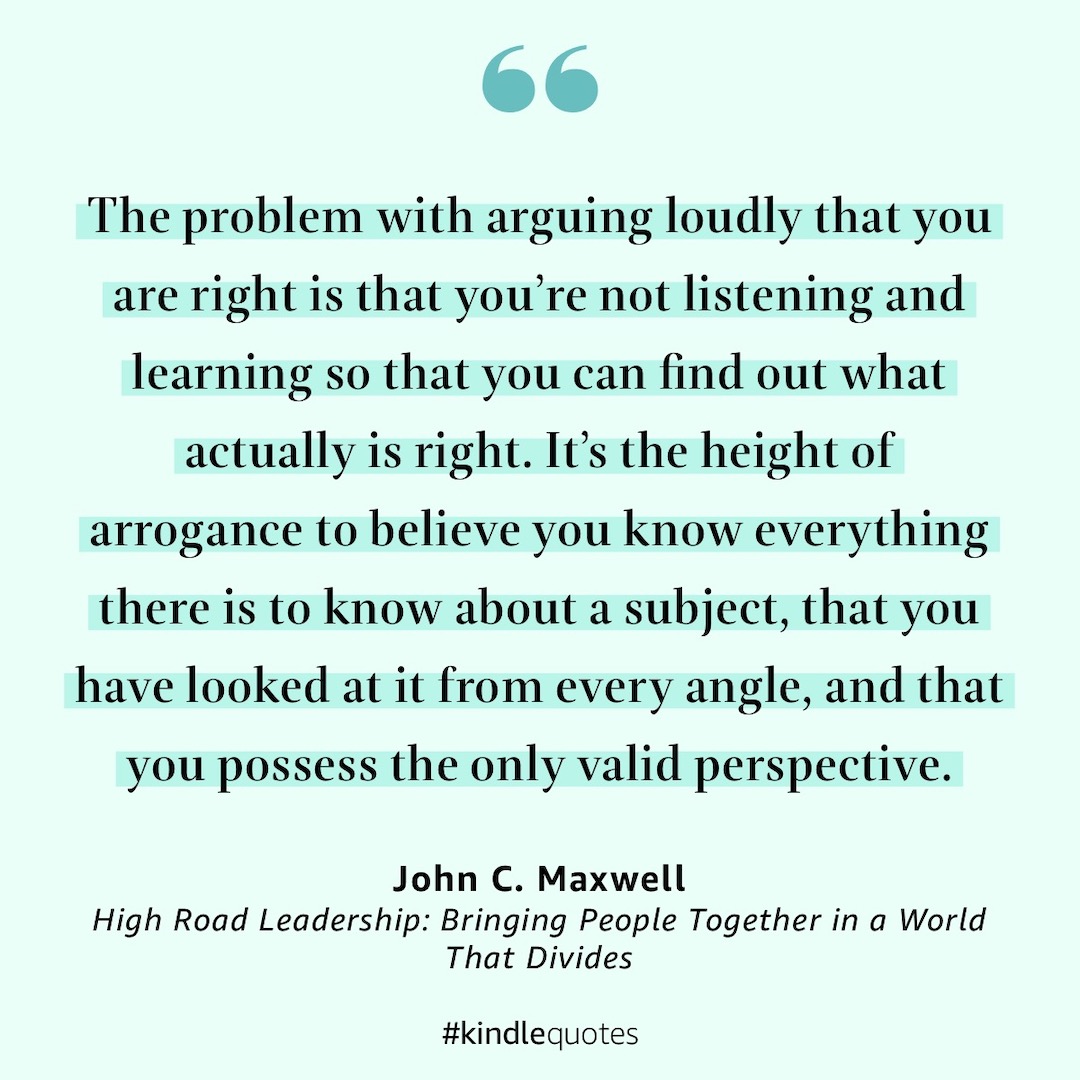
“The problem with arguing loudly that you are right is that you’re not listening and learning so that you can find out what actually is right. It’s the height of arrogance to believe you know everything there is to know about a subject, that you have looked at it from every angle, and that you possess the only valid perspective.”
My Patreon supporters have access to 25+ quotes from this book. They also get exclusive content and early access to public content. Join them today.
Listen to the podcast of this post by clicking on the player below, and you can also subscribe on Apple, Spotify, or Audible.
Calvary Assembly of God joined with Hillcrest Community Church of God for a service to send a message. We want to show that the Body of Christ is more than just multiple buildings where people meet on Sundays.
Pastor Caleb Claybaugh and I are going to be joining our congregations together again for two more outdoor gatherings over the next two months, and I would love to have you join us! Leave me a comment and I will get back to you with all of the details.
Leaders would do well to remember that they lead a group of unique individuals. Let the unique gifts of those unique people be used in unique ways, and watch both the individuals and the organization grow!
“As Tyler Cowen wrote in The Free Press, ‘Whether or not you work in the AI sector, if you put any kind of content on the internet, or perhaps in a book, you are likely helping to train, educate, and yes, morally instruct the next generation of what will be this planet’s smartest entities. You are making them more like you—for better or worse.’ Now, maybe someone thinks, ‘I’ve hardly got any followers, who cares what I post? It probably won’t matter.’ But the principle means we should care. The philosopher Immanuel Kant famously offered his ‘categorical imperative’ as a test for ethical decisions: ‘Act only according to that maxim whereby you can at the same time will that it should become a universal law.’ In other words, we should only do what we think would be good for everyone to do.” —Axis.org
How much good inside a day?
Depends how good you live ’em.
How much love inside a friend?
Depends how much you give ’em. —Shel Silverstein
A fantastic mini-biography of Otto J. Klink who went from being a Christian, to an atheist socialist, to failed presidential assassin, to a Pentecostal author and evangelist. Wow!
“My acceptance of the universe is not optimism, it is more like patriotism. It is a matter of primary loyalty. The world is not a lodging-house at Brighton, which we are to leave because it is miserable. It is the fortress of our family, with the flag flying on the turret, and the more miserable it is the less we should leave it. The point is not that this world is too sad to love or too glad not to love; the point is that when you do love a thing, its gladness is a reason for loving it, and its sadness a reason for loving it more.” —G.K. Chesterton
Marshall Segal said this about our daily Bible reading time, “I want to walk through a five-step prayer you could pray when you sit down with your Bible to meet with God. The five steps are built on an acronym for FEAST. Focus my mind; Enlighten my eyes; Address my sin; Satisfy my soul; Train my hands.”
“A man of character will make himself worthy of any position he is given.” —Mahatma Gandhi
“A retentive memory may be a good thing, but the ability to forget is the true token of greatness. Successful people forget. They know the past is irrevocable. They’re running a race. They can’t afford to look behind. Their eye is on the finish line. Magnanimous people forget. They’re too big to let little things disturb them. They forget easily. If anyone does them wrong, they consider the source and keep cool. It’s only the small people who cherish revenge. Be a good forgetter. Business dictates it, and success demands it.” —Elbert Hubbard
“Leadership is not about being in charge, but about taking care of the people in your charge.” —Simon Sinek
Flowing Data has a fascinating look at how people spend their time during the day. Their adjustable chart shows activities by age, sex, and time of day. It reminds me of a blog post I shared about time management, where I noted, “You cannot add more Tick, Tocking! time to your day, but you can keep more of your day from Drip, Dropping! away.”
“We might think, ‘Well, hey, if I’m devoting myself all the time to looking out for others’ needs, who’s going to be looking out for mine?’ The Lord, of course, because He knows what you need even before you ask Him, and He has ways of meeting your needs that are more wonderful than you in your cleverness or strength could ever conjure or provide (cf. Matthew 6:25-34).” —T.M. Moore
“We all know that exercise makes us feel better, but most of us have no idea why. We assume it’s because we’re burning off stress or reducing muscle tension or boosting endorphins, and we leave it at that. But the real reason we feel so good when we get our blood pumping is that it makes the brain function at its best, and in my view, this benefit of physical activity is far more important—and fascinating—than what it does for the body. Building muscles and conditioning the heart and lungs are essentially side effects. I often tell my patients that the point of exercise is to build and condition the brain.” —Dr. John Ratey
T.M. Moore has a hard but good word for Christians: “If this day, and this expectation and hope [when we heard King Jesus say, ‘Well done, good and faithful servant’], are not the driving force for every aspect of our lives and work, then it is doubtful we have really understood the Good News of the Kingdom or received the salvation freely offered to us by the King. I say this again: If we are not motivated and driven, day by day, by the prospect of hearing ‘Well done, good and faithful servant,’ then we need to examine ourselves, whether we truly know the Lord of glory. That’s pretty hard language, I know, but let’s face the reality: If we have not submitted to Jesus as Lord of every area of our life, all the work we’ve been given to do, then we are still living for ourselves, not Him.” —T.M. Moore



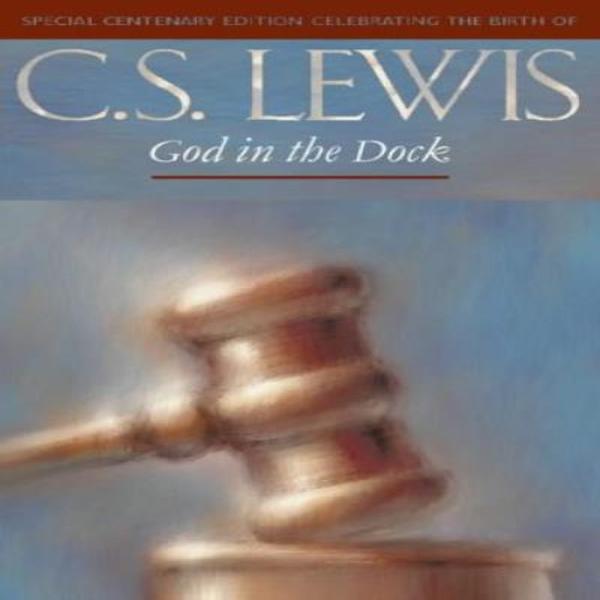 Let me give you the bottom line right at the top: God in the Dock by C.S. Lewis is a challenging book, but it is so worth your time to work your way through it!
  ►► Would you please prayerfully consider supporting this ministry? My Patreon supporters get behind-the-scenes access to exclusive materials. ◀︎◀︎

![Joshua 3.5 and Psalm 19.12 [commentary]](https://i0.wp.com/craigtowens.com/wp-content/uploads/2025/08/joshua-3.5-and-psalm-19.12-commentary.jpg?w=386&h=386&crop=1&ssl=1 "Joshua 3.5 and Psalm 19.12 [commentary]")










 Craig T. Owens