Listen to the podcast of this post by clicking on the player below, and you can also subscribe on Apple, Spotify, or Audible.
At a recent Q&A, I was asked how leaders in smaller markets or communities can avoid becoming discouraged if their measurable metrics aren’t continually rising.
I answered this by pointing to a simple three-word phrase that God laid on my heart a number of years ago.
This is an idea that I unpack throughout my book Shepherd Leadership: The Metrics That Really Matter. Please pick up a copy for yourself or as a gift for your friends who are in leadership positions. My book is available in print or ebook, and in audiobook through either Audible or Apple.
This is a weekly series with things I’m reading and pondering from Charles Spurgeon. You can read the original seed thought here, or type “Thursdays With Spurgeon” in the search box to read more entries.
Listen to the podcast of this post by clicking on the player below, and you can also subscribe on iTunes or Spotify.
Forgiven And Forgiving
Forgiving one another, even as God for Christ’s sake has forgiven you. (Ephesians 4:32)
Now observe how the apostle puts it. Does he say, ‘forgiving another’? No, that is not the text. If you look at it, it is ‘forgiving one another.’ One another! Ah, then that means that if you have to forgive today, it is very likely that you will, yourself, need to be forgiven tomorrow, for it is ‘forgiving one another.’ … Let us begin our Christian career with the full assurance that we will have a great deal to forgive in other people, but that there will be a great deal more to be forgiven in ourselves! …
Note again: When we forgive, it is a poor and humble business compared with God’s forgiving us, because we are only forgiving one another—that is, forgiving fellow servants. But when God forgives us, the Judge of all the earth is forgiving, not His fellows, but His rebel subjects, guilty of treason against His majesty! For God to forgive is something great—for us to forgive, though some think it great—should be regarded as a very small matter. … What we owe to God is infinite, but what our fellow creature owes to us is a very small sum. …
If anyone here who is a Christian finds a difficulty in forgiveness, I am going to give him three words that will help him wonderfully… Here they are again: ‘For Christ’s sake.’ …
I do not know how to put this next word I am going to say. It is a paradox. You must forgive or you cannot be saved. But at the same time, you must not do it from compulsion, you must do it freely. … Remember, it is of no use for you to put your money into that offering box as you go out unless you remember, first, to forgive your brother. God will not accept the gifts, prayers, or praises of an unrelenting heart. … The very prayer that teaches you to ask for mercy bids you say, ‘And forgive us our debts, as we forgive our debtors’ (Matthew 6:12). Unless you have forgiven others, you read your own death warrant when you repeat the Lord’s Prayer!
From Forgiveness Made Easy
We honor the forgiveness that God has extended to us by liberally forgiving others. And our forgiveness of others shows them just how loving and forgiving our God is too!
I add my prayer to Charles Spurgeon’s that you would grasp the truth that we can forgive one another for Christ’s sake because God has forgiven us for Christ’s sake. Let’s all grow in this Christian maturity!
Listen to the podcast of this post by clicking on the player below, and you can also subscribe on Apple, Spotify, or Audible.
Surely it was for my benefit that I suffered such agony… (Isaiah 38:17).
These are words written by King Hezekiah after God had healed his life-threatening illness. Hezekiah also noted how he would now conduct himself: “I will walk humbly all my years because of this anguish of my soul” (v. 15).
Hezekiah had been a godly king, leading Judah in removing idol worship from its borders. In his prayer from his sickbed, Hezekiah asked God to remember how he had faithfully lived in such a God-honoring way. God heard this prayer, He answered this prayer, and Hezekiah was totally healed.
Sadly, after the threat of death was removed, Hezekiah became proud of his accomplishments, and enjoyed showing off his treasures (Isaiah 39:2, 4). When some ambassadors came for a visit because they had heard he was ill, he showed them every precious thing he possessed, but didn’t mention one word of the God who had miraculously and graciously healed him.
There’s a valuable lesson in this for us to keep in mind today: Affliction can be a good thing IF it drives us to God’s presence.
And there’s a corollary to this lesson: Blessing can be a bad thing IF it drives us from God’s presence.
Hezekiah would have done well to remember the words of one of his predecessors. King Solomon prayed, “Give me neither poverty nor riches, but give me only my daily bread.Otherwise, I may have too much and disown You and say, ‘Who is the Lord?’ Or I may become poor and steal, and so dishonor the name of my God” (Proverbs 30:8-9).
Whether things are going well or not—whether we are suffering affection or enjoying blessing—we must be diligent to remain constantly dependent on God!
Sometimes celebrities and other people in the public spotlight will hire a publicist to help promote their cause, build their brand, or present them in the best possible light.
If you wanted to stretch the terms, you could say that some of the Old Testament prophets and the New Testament disciples could have been viewed as the “publicists” for Jesus. At least, that’s what critics might point to.
But despite the best efforts and high salaries of publicists—both ancient and modern—they cannot control the “word on the street.” What people are actually saying about the one in the spotlight is usually the best evidence of who that person truly is.
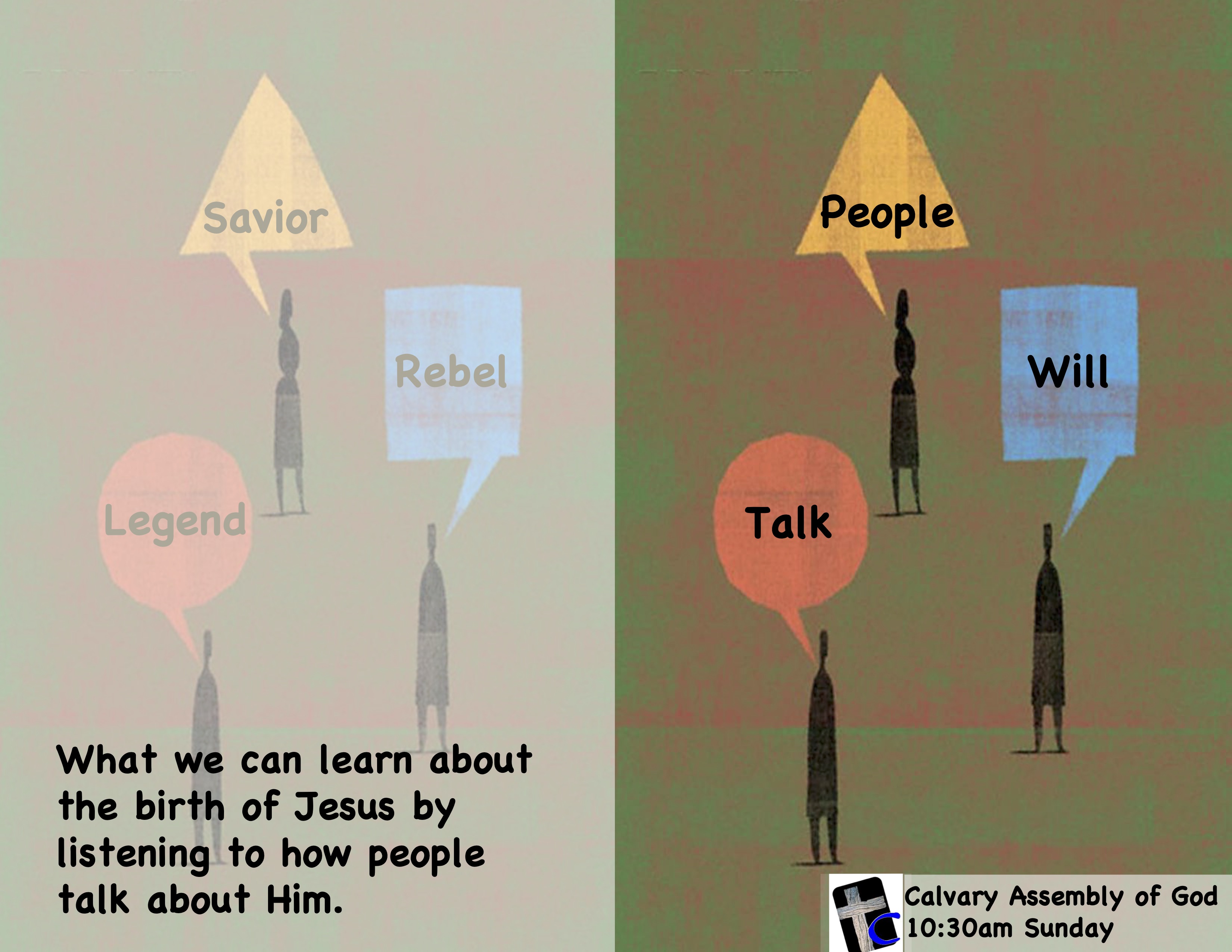
As we celebrate this Advent season, we are going to look at what the people on the street were saying about Jesus at the time of His birth. Before He ever performed a miracle or presented a parable—before any of His “publicists” could try to make Him look good—people were already talking. And what they said about Him is truly enlightening.
I hope you can join me each Sunday in December as we walk through this series of messages called People Will Talk. If you’ve missed any of the messages in this series, check them out here:
[1:27] what leaders do that will undermine their leadership
[2:48] why it’s more fun to be around grateful people
[4:12] Craig shared about the impact grateful teammates have had on him
[4:52] why is it so easy to complain?
[6:28] leaders need to speak positive things into this around them
[7:42] leaders need to shut down complaining teammates quickly
[8:39] Greg challenges leaders to confront their own negative attitude
[10:00] leaders need to create a place of safety to help others to develop to their full potential
[12:08] Greg reminds leaders that busyness can restrict gratitude
[13:29] criticism is both a mindset and a “heartset”
[13:59] how many of our criticism come from our assumptions about others?
[15:06] poor leaders have a misunderstanding of what gratitude does
[15:55] some ways leaders can express gratitude to their teammates
[17:57] another look at the problem of assumptions
[19:08] a grateful person attracts others to them
[21:00] Craig gives leaders a challenge to help bolster their attitude of gratitude
Check out this episode and subscribe on YouTube so you can watch all of the upcoming episodes. You can also listen to our podcast on Spotify and Apple.
Listen to the podcast of this post by clicking on the player below, and you can also subscribe on Apple, Spotify, or Audible.
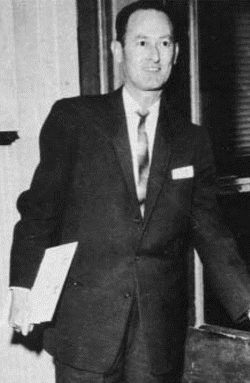
Sometimes you might hear it said of someone’s leadership mettle or leadership philosophies that they are “battle-tested.” In the case of Hal Moore On Leadership, this is literally true!
Perhaps you’ve seen the movie “We Were Soldiers Once…And Young,” which recounts the first full-scale military battle in Vietnam between Moore’s 450-man force and the 2000 soldiers of the North Vietnamese Army. Despite being completely surrounded and severely out-gunned, Moore’s First Cavalry decisively defeated the NVA.
General Moore’s leadership principles won the day for his men in that battle. But even then, his principles had already been battle-tested under fire in the Korean War, and put to the test in the various assignments that Hal Moore faced in his highly-decorated military career. Moore was continually tasked by superior officers to re-tool underperforming units, or step in where tensions were high, or help reorganize when the Army was experiencing some growing pains.
Moore not only excelled at every assignment, but he kept meticulous notes that are now available to any leader in this excellent book.
Hal Moore On Leadership is partially a biography, but mostly his story is told as the backdrop for the leadership principles that were proven to be correct time and time again.
Students of both leadership and military history will find this book enjoyable and practical.
Listen to the podcast of this post by clicking on the player below, and you can also subscribe on Apple, Spotify, or Audible.
Let’s get on the same page with a few facts:
Nearly 1-of-5 adults in the United States age 18 and older battle some form of anxiety disorder.
Being anxious is not a sin but we can grieve God’s heart if we don’t train ourselves to turn to Him as our First Source. Notice that David said, “When[not “if”] I am afraid, I put my trust in You” (Psalm 56:3).
A third definition of anxiety is found here: “Cast your cares on the Lord and He will sustain you; He will never let the righteous be shaken” (Psalm 55:22). This word for cares or anxieties is the only time this Hebrew word is used in the Bible. The idea is a heavy burden, which the Amplified Bible captures like this: “Cast your burden on the Lord—releasing the weight of it—and He will sustain you….”
We can be burdened because we pick up and carry things on our own. But the word for cares or burdens in Psalm 55:22 can mean not only things we pick up, but things given to us by God or allowed by God. You might ask, “Why would God give me a burden?”
Sometimes it’s allowed—God allowed satan to afflict Job within limits, and He allowed Joseph’s brothers to ambush him (Job 1:8-12; 2:3-7; Genesis 50:20).
Sometimes it’s given—God gave Jesus a bitter cup to drink, and He gave Paul a “thorn in the flesh” (Matthew 26:39-42; 2 Corinthians 12:7).
In every instance, the limits are perfectly measured to accomplish what God wants to do. The way we respond glorifies Him and keeps us dependent on Him (Job 1:20; 2:10; Genesis 50:20; 2 Corinthians 12:8-10; Hebrews 10:10).
Still in the middle of this, the burdens can seem overwhelming and anxiety-inducing. That’s why God tells us what to do with these burdens: Cast them off!
In Psalm 55:22, David gives us the word “cast” in the imperative mood, which means it’s a command. Literally, the word means to throw away or shed the burden.
How often do we do this? David said he prayed “evening, morning, and noon” for God’s help (Psalm 55:16-17).
What does God do when we cast off these burdens? He sustains and supports us—“He will sustain you; He will never let the righteous be shaken.”
The apostle Peter quotes the opening words of this verse when he writes, “Cast all your anxiety on Him,” and then he tells us why we can do this: “Because He cares for you” (1 Peter 5:7). Just like David said he prayed for his burdens to be released “evening, morning, and noon,” the verb tense Peter uses implies the same thing. We don’t just release our burdens once, but we continue to do it again and again and again!
The word Peter uses for “cast” is only used twice in all the New Testament. The word means not just to drop our burdens at our feet—where we may trip over them or be tempted to pick them up again—but to throw our burdens on someone else. The only other place this word is used is when on the day Jesus rode into Jerusalem the disciples “threw their cloaks on the colt and put Jesus on it” (Luke 19:35).
Peter tells us that this casting off of our burdens requires us to humble ourselves before God. Pride makes us think we can handle it on our own, and that same pride robs God of the glory He would receive when He provides relief from our heavy load. We cast these burdens onto Jesus so that we can be alert to the enemy’s sneaky tactics, and help others who are also being attacked. And just as David said God supported and sustained him, Peter said the same thing (1 Peter 5:6-10). I especially like the wording from the King James Version—
But the God of all grace, Who hath called us unto His eternal glory by Christ Jesus, after that ye have suffered a while, make you perfect, stablish, strengthen, settle you. (1 Peter 5:10 KJV)
Jesus can X-out the instability that comes with carrying heavy burdens and make us stablished, strengthened, and settled in Him.
Don’t try to carry these anxiety-inducing burdens on your own, but cast them on Jesus every evening, morning, and noon. Let Him carry those burdens so you can live in a way that glorifies Him every single day.
Listen to the podcast of this post by clicking on the player below, and you can also subscribe on Apple, Spotify, or Audible.
If anxiety kills joy, what kills anxiety? Anxiety—the joy-killer—is itself killed when joy is expressed.
Being grateful forwhat you have kills the anxiety of what you don’t have.
Being thankful forwhat you have kills the fear of what you may be missing.
Being grateful forwhat you have kills the anxiety of the bad stuff that may never even happen.
If joy kills anxiety, how can we develop more of it? Most people would say, “If you’re happy, give thanks” or “If you’re happy, honk.” But really it’s the other way around: “If you want to be happy, honk!”
Don’t fret or worry. Instead of worrying, pray. Let petitions and praises shape your worries into prayers, letting God know your concerns. Before you know it, a sense of God’s wholeness, everything coming together for good, will come and settle you down. It’s wonderful what happens when Christ displaces worry at the center of your life. (Philippians 4:6-7)
Honking your thanks is not only good for you, but it’s good for everyone around you who hears your “honk! honk!” of gratitude. David experienced this in Psalm 34:1-3. Even when he was at a low point, when he started praising God other anxious people began to experience joy as well.



 Before you speak, listen.







 Craig T. Owens