Listen to the audio-only version of this podcast by clicking on the player below, or scroll down to watch the video.
Too often we fall into the trap of seeing meetings as perfunctory, tedious, and downright boring to attend. In this episode, Greg and I are here to tell you, we like meetings! If managed correctly, meetings can be an impactful leadership tool that helps grow and bond your team. So set aside any of your preconceived notions, and let us tell you why they think you should embrace opportunities for meetings.
[0:57] We’re robbing ourselves when we just try to “get through” a meeting.
[2:33] Leaders help everyone learn during the meetings.
[4:00] Don’t spring brand new information on your team at the meeting, but help them prepare to contribute ahead of time.
[5:40] There is a value in getting our teams together.
[7:50] Sometimes the best leadership move is to cancel a meeting.
[9:28] How can leaders make meetings more efficient?
[10:42] A leader’s attendance signals the value of the meeting.
[11:23] Greg has a sarcastic quote that makes a great point about meetings.
[12:57] Not every meeting needs to involve every team member.
[14:36] Leaders need to set expectations before the meeting starts.
[16:37] How insecure leaders sabotage meetings.
[19:01] Be conscious of the workloads of those who are invited to your meetings.
[21:47] How do leaders keep people on-topic during meetings?
Check out this episode and subscribe on YouTube so you can watch all of the upcoming episodes. You can also listen to our podcast on Spotify and Apple.
Listen to the podcast of this post by clicking on the player below, and you can also subscribe on Apple, Spotify, or Audible.
When Mary visits Elizabeth, she discovers that Elizabeth is pregnant, just as the angel Gabriel told her. This confirms for Mary that everything Gabriel told her about her own pregnancy would be fulfilled too.
Mary’s rejoicing was prompted by her deeper realization of who her Savior is. The more she knows her Lord, the more she can praise Him; the more she praises Him, the more He is glorified; the more He is glorified, the more she knows Him.
So could we say it this way? As my spirit rejoices in God my Savior my soul glorifies Him. Yes, indeed we can! There seems to be an interconnectedness: As I focus on God to rejoice in Him, that rejoicing cannot help but glorify Him.
So we could also say it this way: God is glorified in my rejoicing of Him.
Or: As I express my delight in my Savior, His glory is seen more clearly.
However we put it, when I rejoice in who God is, He is glorified. As He is glorified, my joy in rejoicing in Him is increased. As my joy in Him increases, I cannot help but rejoice in Him even more.
This, I believe, is a picture of Heaven. Just as the angels encircle the throne and call out to one another, “Holy! Holy! Holy!” as they perpetually rejoice in a new realization of God’s glory, so will we. There are an infinite number of beauties in our Savior which will prompt us to rejoice in Him and glorify Him, so we need an infinite amount of time to fully appreciate His majestic beauty.
Let’s not wait until we arrive in Heaven to begin this loving worship. Let’s follow the example of Mary and sing out our praise at every possible moment. As we do, a desperate world cannot help but be drawn to gaze upon the beauty which is celebrated in our rejoicing.
Listen to the podcast of this post by clicking on the player below, and you can also subscribe on Apple, Spotify, or Audible.
I’ve talked before about the benefits of calling the Old and New Testaments the First and Second Testaments. This helps me not to subconsciously slip into the thought that “old” means outdated or that “new” means a replacement of what came before it. When I say First and Second I remember that there cannot be a Second without a First, that the First anticipates the Second and the Second fulfills the First.
The people of the First Testament experienced the Spirit of God in an often-repeated phrase: “the Spirit of the Lord came on” someone. It usually came on them for a specific task or season. For instance…
70 leaders to help Moses (Numbers 11:25)
the judges that delivered Israel from their enemies (Judges 3:10, 6:34, 11:29, 14:6, 15:14)
the anointing for Israel’s king (1 Samuel 16:13)
empowerment for prophets to prophesy (Ezekiel 11:5)
When the Holy Spirit came on these men, there was a noticeable supernatural anointing and empowerment, but more times than not these men also had visible and sometimes crippling stumbles.
What happens on the outside often stays on the outside. Sort of like the little boy whose mom brought him to church one Sunday. The little boy was constantly standing up on his chair and disturbing everyone around him. Finally, the exasperated mother whispered, “If you don’t sit down I’m going to take you to the restroom and spank you.” The little boy immediately sat down with his arms tightly crossed. He looked at his mom and said, “Outside I may be sitting down but inside I’m standing up!”
God looks at the heart. He told the Israelites that their inward defiance didn’t outweigh their outward religious practices. And Jesus said that people who prophesied, cast out demons, and performed miracles, but still had an unrepentant heart, would hear Him say, “I never knew you” (Isaiah 1:12-13; Matthew 7:21-23).
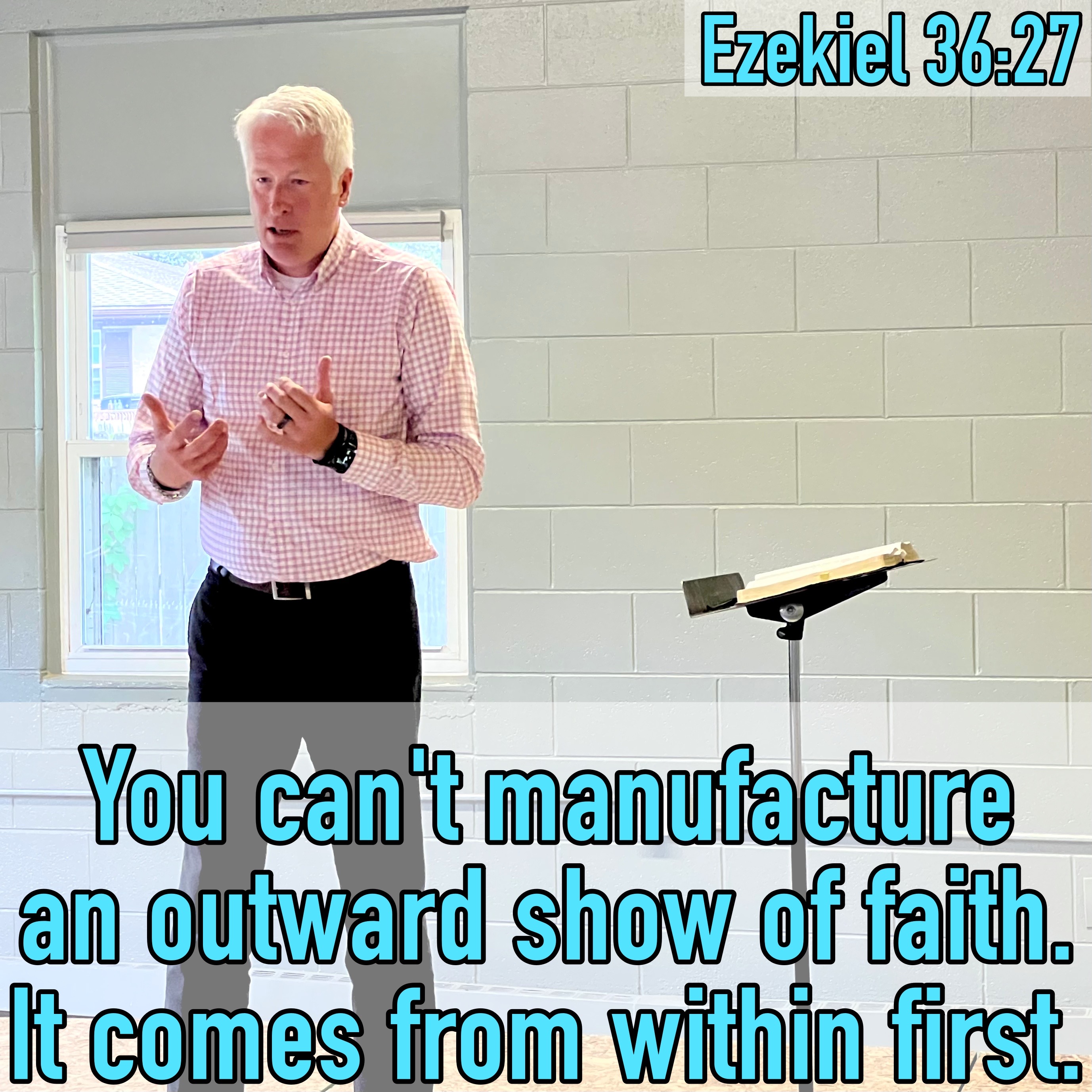
In the First Testament, we see a desire for the Holy Spirit to be more than on—a desire for Him to come in.David prayed, “Create in me a pure heart, O God, and renew a steadfast spirit within me” (Psalm 51:10). And God promised His people, “I will give them an undivided heart and put a new spirit in them … And I will put My Spirit in you and move you to follow my decrees and be careful to keep My laws” (Ezekiel 11:19, 36:27).
Paul identified this fruit of the Spirit as “love, joy, peace, forbearance, kindness, goodness, faithfulness, gentleness and self-control,” and he concluded with the phrase, “against such things there is no law” (Galatians 5:22-23). The law always sets limits, but when the Holy Spirit abides in us, the production of fruit is limitless!
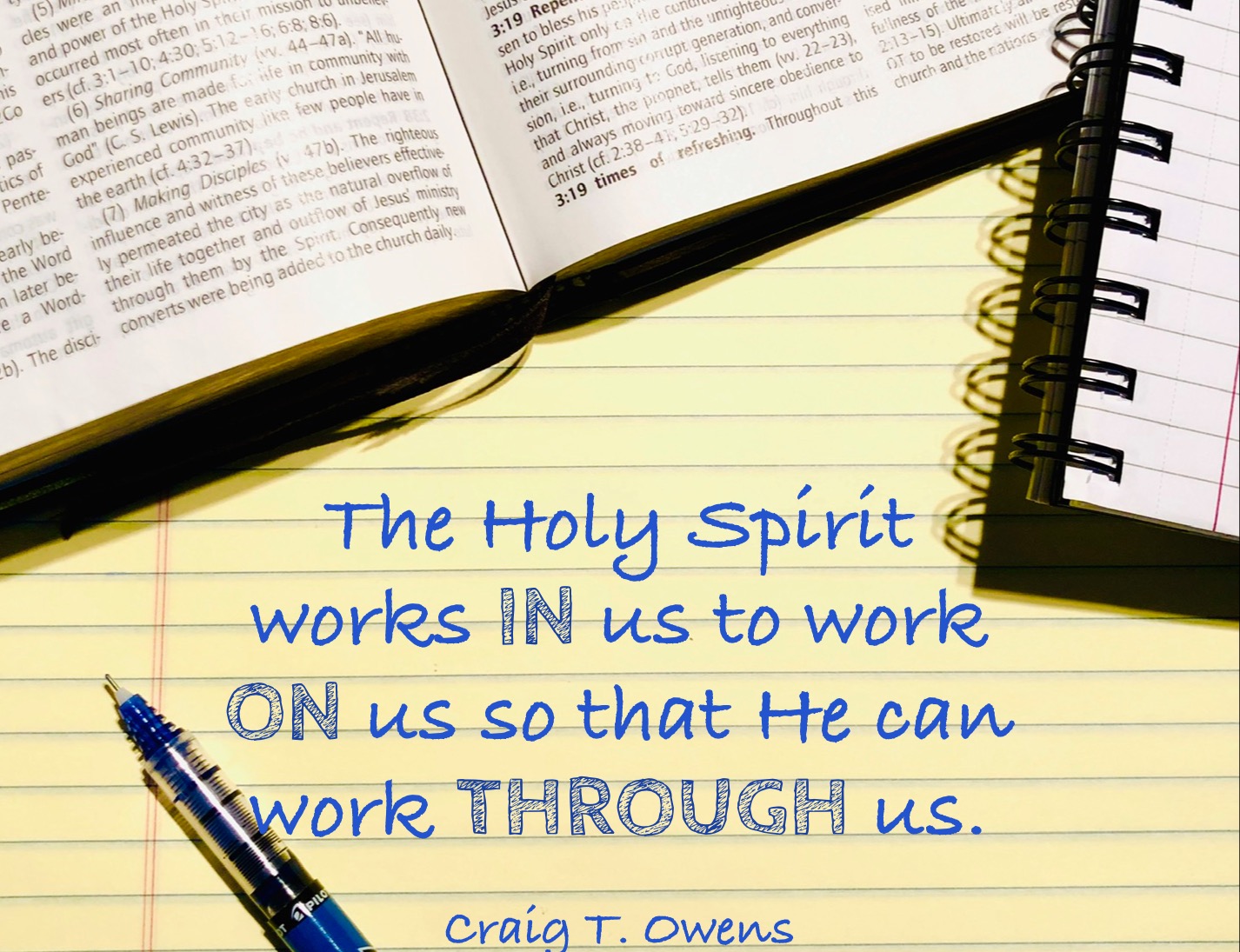
Being baptized in the Holy Spirit means that we allow Him to come in us and then to work on us. It’s only when the Holy Spirit has worked in us that can He flow through us to others. Jesus said that we would receive the Spirit’s empowerment to be witnesses—that’s an inward change that produces an outward fruit.
Listen to the podcast of this post by clicking on the player below, and you can also subscribe on Apple, Spotify, or Audible.
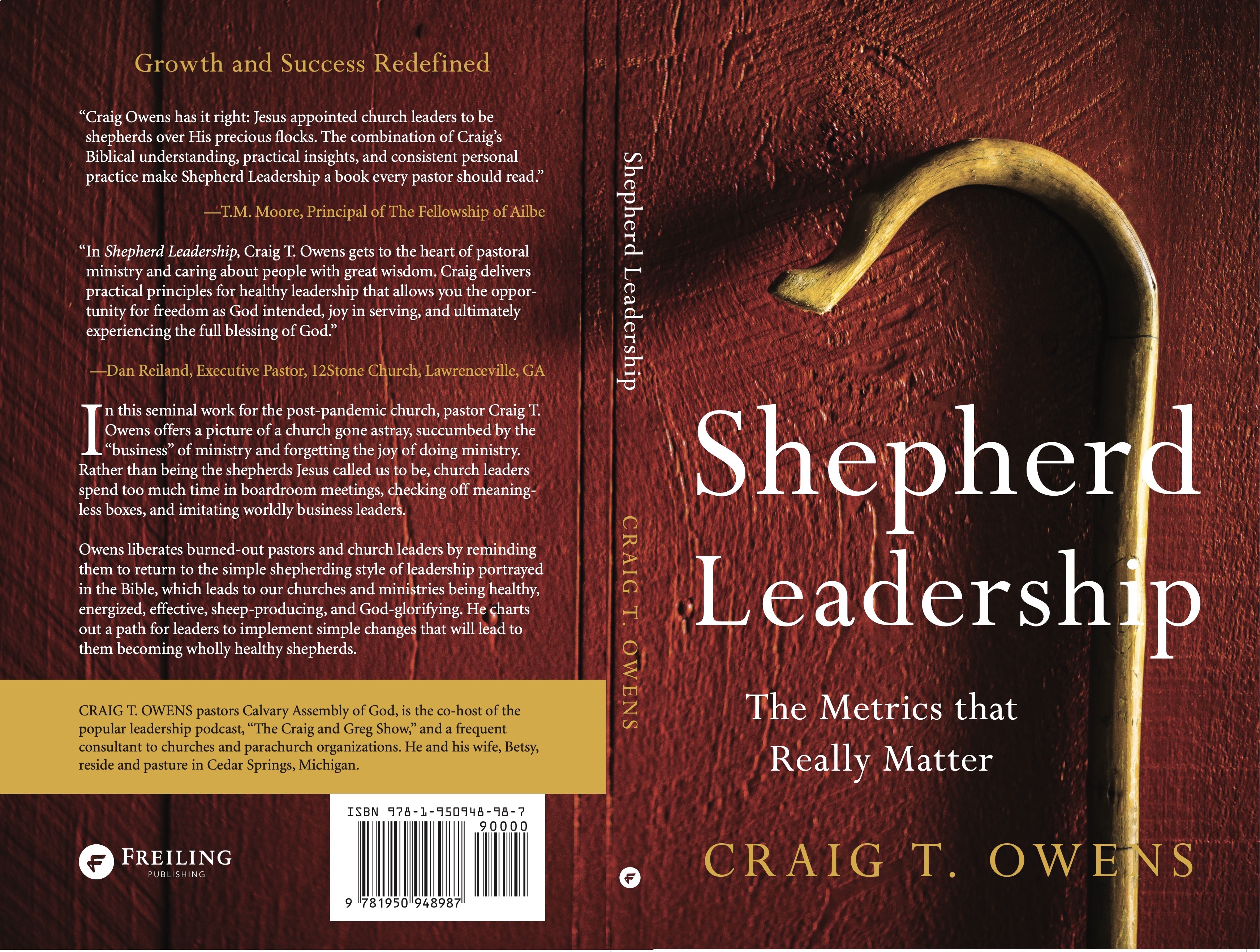
As I was being interviewed on theLeading From Alignment podcast, Jim Wiegand and John Opalewski were asking me about back-to-back chapters in my book Shepherd Leadership where I discuss how a leader’s confidence and humility should be in a healthy tension with each other.
There is an alter-ego superhero I created to help me learn this lesson—his name is Plungerman!
Listen to the podcast of this post by clicking on the player below, and you can also subscribe on Apple, Spotify, or Audible.
T.M. Moore is an esteemed theologian and a good friend. I was excited to discover someone who shared my passion for viewing pastoring as “pasturing”—seeing ourselves as under-shepherds following The Chief Shepherd Jesus.
Listen to the podcast of this post by clicking on the player below, and you can also subscribe on Apple, Spotify, or Audible.
Jesus was the healthiest Person to ever walk planet Earth. When Luke, a physician, tells us about the growth of Jesus, he says first that “Jesus grew in wisdom.” (Luke 2:52). That is our indication that a healthy mind is at the foundation for every other aspect of health.
But mental health doesn’t stay in your mind—it affects every other part of your life. Likewise, all of the other parts of your life can enhance or drain your mental health. We are created as interconnected beings. For instance, it’s hard to think correctly when you’re physically tired, spiritually drained, or involved in an unhealthy relationship. It’s also true that it’s hard to make good decisions about your physical health, stay focused on God, or handle your relationships successfully if you aren’t thinking correctly.
Dear friend, I pray that you may enjoy good health and that all may go well with you, even as your soul is getting along well. (3 John 2)
Now may the God of peace make you holy in every way, and may your whole spirit and soul and body be kept blameless until our Lord Jesus Christ comes again. (1 Thessalonians 5:23 NLT)
When my laptop is disconnected from the monitors I use at our church building, the message on the screen tells me to “check your inputs.” That’s not just for inanimate technology, but for us too: To maintain good overall health, we need to check our physical, spiritual, mental, and emotional inputs.
Let’s start with the physical inputs. When we are active during the day our bodies release a stress hormone called cortisol. Stress is not a bad thing—it’s a normal thing. A body that isn’t stressed will atrophy and become susceptible to disease. Balanced, healthy stress is called eustress, and unbalanced, unhealthy stress is called distress.
Cortisol is naturally flushed from the body in two ways: exercise and sleep. Exercise is important to keep our bodies moving effectively, and sleep helps us recover and helps our brains catalogue our memories (see 1 Timothy 4:8; Psalm 3:5). To fuel our exercise and our sleep requires the energy which we get from a healthy diet.
So if you’re not thinking healthy thoughts, check your physical inputs: Am I getting the proper amount of sleep? Am I exercising regularly? Am I eating properly? Do I see a doctor for a checkup?
How about spiritual inputs? Somewhat surprisingly, our spirits are kept healthy very much along the same lines as our physical bodies—proper food, appropriate exercise, and a time of rest. Our spiritual food is God’s Word, our exercise is working out what we’ve studied in the Bible, and our rest is called sabbathing (Jeremiah 15:16; Matthew 7:24-27; James 2:17). Jesus demonstrated all of these in His life and we, too, should follow His example.
If you’re not thinking healthy thoughts, check your spiritual inputs: Am I reading the Bible regularly? Am I putting what I learn into practice? Am I sabbathing properly?
Then there our emotional inputs, or the relationships that build us and relationships that drain us. You are always going to encounter people in need, and ministering to those needs is draining (Luke 8:45-46). We also need to be alert to those antagonistic people who purposely drain us (2 Timothy 4:14-15). We can make decisions to place people in our lives who build us up and be cautious of those who drain us (Proverbs 27:3, 5-6, 9, 17).
Once again, if you’re not thinking healthy thoughts, check your emotional inputs: Do I have healthy people investing in my life? Am I sharpening the iron of others?
Finally, let’s not forget the mental inputs. Computer programmers are well aware of the acronym GIGO: garbage in, garbage out. If you don’t like the results that are coming out, check what is going in. The apostle Paul gives us an outstanding checklist in Philippians 4:8.
If your mental health isn’t as healthy as you would like it to be, perhaps you need to talk to your doctor about your physical health, or a mature spiritual friend about your spiritual health, or a Christian counselor about your emotional health. As you consult with these wise people, continue to pray for God’s help. As your Creator, He knows you better than anyone else could and He can give you the wisdom you need as you check your inputs.
This is part 5 in our series on a Christian’s mental health. If you’ve missed any of the other messages I’ve shared, you can find them all by clicking here.
Never forget that we live among giants. Greg and I would like to encourage you to honor those who gave their lives so we could enjoy the freedom that we have today 🇺🇸 And be sure to check out all of my videos on my YouTube channel.
I am always fascinated by the latest discoveries that scientists are making. Especially when the complexities show the intimate involvement of a loving, all-wise Creator! The Institute for Creation Research reported a new discovery: “Who isn’t curious, at some level at least, about how human brains process all the complicated inputs and outputs that our daily lives require? Neurobiologists take that curiosity to the top floor. Their recent discovery of a new function for certain neurons has suddenly added a new dimension to these tiny processors along with a new take on how they came to be in the first place.”
“All life is an experiment. The more experiments you make, the better.” —Ralph Waldo Emerson
Listen to the audio-only version of this podcast by clicking on the player below, or scroll down to watch the video.
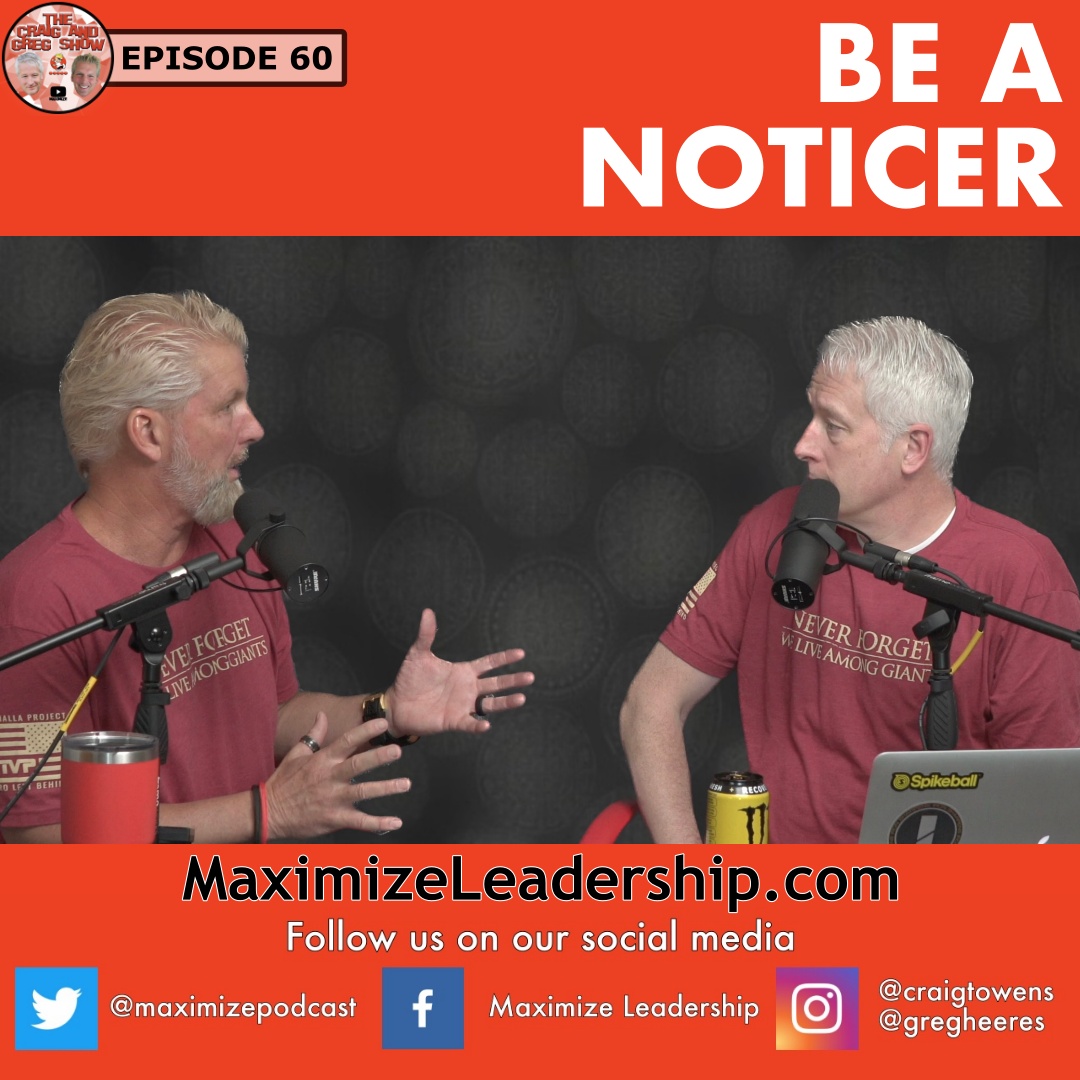
When was the last time you noticed your team? Not just on a surface level like saying hello in the hallway, but really truly paying attention to what’s going on with your team. Noticing is easy to do, but it does require you to spend time doing it. It’s impossible to see what your team is doing locked inside your office, so get out there and notice!
[0:17] Kids on the playground demonstrate an important leadership attribute.
[1:43] Leaders sometimes get too engaged in their work—how do we keep this from happening?
[3:48] People are dying to be noticed!
[6:17] What happens when we do or don’t notice the uniqueness of our teammates?
[9:54] Leaders need to know the difference between windows and mirrors.
[13:25] How our teams reciprocate for their leaders who notice them.
[14:45] There are some huge and lasting benefits when leaders create a culture of curiosity.
[17:11] Greg challenges leaders to learn a leadership lesson from Jesus.
[19:20] We need to build noticing into our weekly schedules.
[21:07] One group that all of should notice and celebrate: Our veterans and the family members of fallen vets.
Check out this episode and subscribe on YouTube so you can watch all of the upcoming episodes. You can also listen to our podcast on Spotify and Apple.
Listen to the podcast of this post by clicking on the player below, and you can also subscribe on Apple, Spotify, or Audible.
Let’s say you are thinking about buying a particular book. Are you more likely to buy that book because the author says it’s good, because a book reviewer says it’s good, or because a close friend says it’s good? I think all of us give more weight to the suggestions from our friends, especially because they have nothing to gain from making that suggestion.
In the same way, when someone close to us says, “I know from personal experience that following Jesus is the best decision that I have ever made. Making Jesus my Lord and Savior has completely changed everything for me,” it’s easier for us to make that same decision for ourselves.
The deeper the level of our intimacy with someone usually means we have more influence with them.
Jesus told us all about the Holy Spirit when He was discussing His ascension. He wasn’t going to leave us as orphans, but told us of the intimate connection the Spirit would make for us. For instance, Jesus said, “And I will ask the Father, and He will give you another Counselor to be with you for ever—the Spirit of Truth” (John 14:16-17).
Notice that Jesus considers the Holy Spirit an irreplaceable and coequal part of the Godhead—I will ask the Father, and He will give you another Counselor (see also Matthew 3:16-17; Luke 10:21; Matthew 28:19).
The word Jesus uses for Counselor is parakletos. This means One who comes alongside to help us. I like all the words the Amplified Bible uses: “Comforter—Counselor, Helper, Intercessor, Advocate, Strengthener, and Standby.” Indeed, Luke records numerous instances where the Holy Spirit is alongside Christians to strengthen and encourage them (for instance: Acts 4:8, 6:10, 9:31).
Notice as well that Jesus tells us that as a part of the Trinity the Holy Spirit is eternal: “to be with you for ever.” Because the Holy Spirit is fully God, He knows the end from before the beginning. His perspective is infinite, so He can guide us in ways that only One who can see everything could guide us. For example, He leads us to places we might not have chosen on our own (Luke 4:1; Acts 8:29), or stops us from going somewhere at the wrong time (Acts 16:7), or talking with people we might have overlooked (Acts 10:19, 11:12).
Jesus also calls the Him the Spirit of Truth. He reveals things that we could not have perceived with our natural minds (see Acts 5:1-9).
And Jesus calls the Holy Spirit a great Teacher, “The Counselor, the Holy Spirit, whom the Father will send in My name, will teach you all things and will remind you of everything I have said to you” (John 14:26). So we see the Holy Spirit helping us apply Scripture to our prayers (Acts 4:25-26) and to incredibly complex and delicate situations (Acts 11:15-18, 15:1-21).
The Holy Spirit is not a force to fear but a Person to know ever more intimately.
When our lives are transformed and expanding because of an intimate, ongoing, vibrate relationship with the Holy Spirit, we are witness (Acts 1:8). You cannot exhaust all that the Spirit has for you, so keep abiding and growing in that intimate relationship. Let it be said of you as it was said of Peter and John: “We can tell you have been with Jesus!” (Acts 4:13).



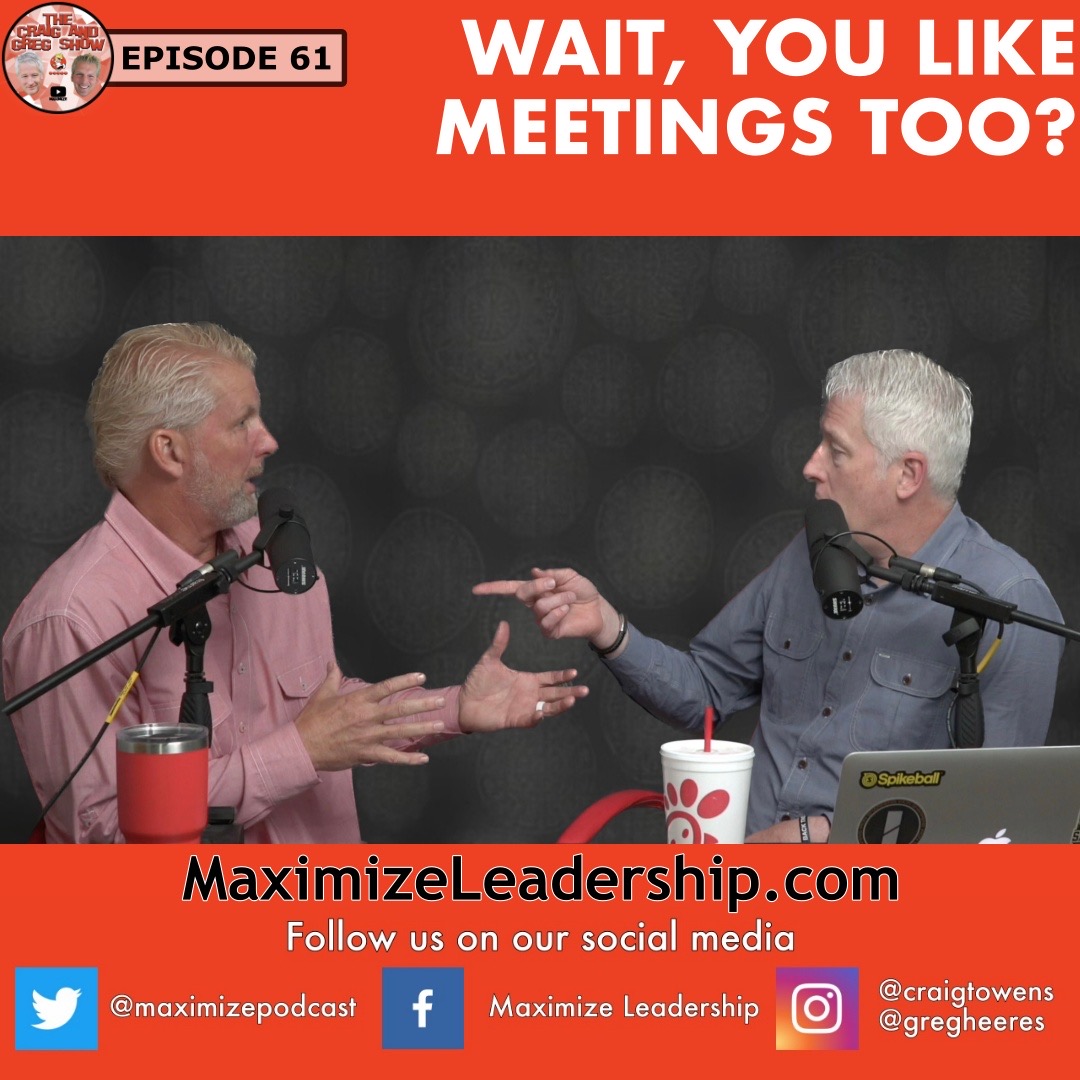 Too often we fall into the trap of seeing meetings as perfunctory, tedious, and downright boring to attend. In this episode, Greg and I are here to tell you, we like meetings! If managed correctly, meetings can be an impactful leadership tool that helps grow and bond your team. So set aside any of your preconceived notions, and let us tell you why they think you should embrace opportunities for meetings.








 Craig T. Owens