Links & Quotes

Leaders need to give others confidence to try something new. We need to help people get moving so that we can coach what they are doing. For more great leadership insights, check out The Craig and Greg Show.

I have lots of new content every week, which you can check out on my YouTube channel.

A couple of thought-worthy quotes for pastors. First from David Mathis: “Pastors, observe that in and of itself, mocking is no clear reflection of the faithfulness or fruitfulness of preaching Christ. Wise preachers do not take mocking as an indicator of failure, nor as an indicator of success. Twice in Athens some mock Paul, which may seem like a failure compared to his homiletic triumphs elsewhere. However, others say, ‘We will hear you again.’ And then, in the end: ‘some men joined him and believed’ [Acts 17:32-34]. … How foolish it would be to distract ourselves with the mockers. Or to call special attention to the mocking as some great badge of our own faithfulness. Rather, we have the example of Paul at Mars Hill, who, so far as we can tell, wholly overlooks, with a holy disregard, these mockers and concerns himself instead with those asking honest questions.”

…and then one from John Piper: “Preaching is a happy business. Because even if the text is a hard word that devastates the hearers, the preacher connects the hard word with the gracious word and the hopeful word, and he catches them as they fall. So, in the end, all preaching is a happy business.

“A people that values its privileges above its principles soon loses both.” —Dwight D. Eisenhower

“For condemnation to work, we must say to God what the devil has said to us and believe it. If I want to stand before God with excuses that make what He said to me void, I’ll have to quote the devil to God. Does that sound like a good thing to do? God’s will for me is not to condemn me, but to liberate me from everything that holds me back from being what He created me to be through an ongoing relationship. To accomplish that, I need to do the opposite of what I used to do when I walked in condemnation. Instead of quoting to God what the devil is saying, I quote to the devil what God has said.” —Jim Wiegand, in Recruiting To Releasing 

Thinking about “how Martin Luther, a professor at Wittenberg University, helped to spark the 16th century Protestant Reformation,” J. Calvin Holsinger conceived the idea of preparing missionaries to US colleges and universities—a ministry called Chi Alpha.

Another great story from the “Here We Stand” series of biographies of notable people during the Reformation. “An attendant asked [King Henry VIII] whom he wished to have at his bedside. The king asked for Thomas [Cranmer]. By the time Cranmer arrived, King Henry was unable to speak. Foxe tells the story. ‘Then the archbishop, exhorting him to put his trust in Christ, and to call upon His mercy, desired him though he could not speak, yet to give some token with his eyes or with his hand, that he trusted in the Lord. Then the king, holding him with his hand, did wring his hand in his as hard as he could (Foxe’s Book of Martyrs, 748).’ The scene sweetly punctuates the most important friendship in the English Reformation. Whatever King Henry believed when he squeezed Cranmer’s hand that day, God used the bond between them to break England free from Roman Catholicism and to recover the one true gospel.”

The ICR reports, “Genesis claims that people in the pre-Flood world routinely attained 900-year lifespans. The best-known example is Methuselah, who had the longest recorded lifespan of 969 years (Genesis 5:27). Skeptics dismiss these great ages as fanciful legends, but recent fossil data are providing unexpected, albeit indirect, corroboration of the Bible’s testimony.” Check out this full report.

“In my experience, each failure contains the seeds of your next success—if you are willing to learn from it.” —Paul Allen, cofounder of Microsoft
Pre-Political Christians

Listen to the podcast of this post by clicking on the player below, and you can also subscribe on AppleSpotify, or Audible. 

John Stonestreet used an interesting term (pre-political) that got me thinking about how many government programs would be unnecessary if the Church was doing what Jesus called the Church to do. 

Here’s the full quote from John Stonestreet: “Christian political engagement should hit its fever pitch not during elections. The only way to relieve the political pressures of our day is to build up the pre-political aspects of our life together, especially the family and the Church. When we care well for our children, our neighbors, and our communities, the state doesn’t have to.” 

The Scriptures I reference in this video—Isaiah 3:4-5; Mark 12:28-31; Matthew 25:34-40. 

The post I mention in the video that was prompted by the Isaiah 3 passage is It’s Not “Them,” It’s Us.

If you would like to watch the full sermon from which I took this clip, you can find that here. 

►► Would you please prayerfully consider supporting this ministry? My Patreon supporters get behind-the-scenes access to exclusive materials. ◀︎◀︎

Beware Of Boasting

Listen to the podcast of this post by clicking on the player below, and you can also subscribe on AppleSpotify, or Audible. 

Jesus had just healed the sick people that were brought to Him, and then we read:

So the crowd was astonished as they saw those who were unable to speak talking, those with impaired limbs restored, those who were limping walking around, and those who were blind seeing; and they glorified the God of Israel. (Matthew 15:31)

Before Jesus ascended back into Heaven, He told His followers that they would do the same things He had done, including preaching the Gospel and healing the sick. The focal point is still to be the same as it was while Jesus was on earth: “They glorified God.” 

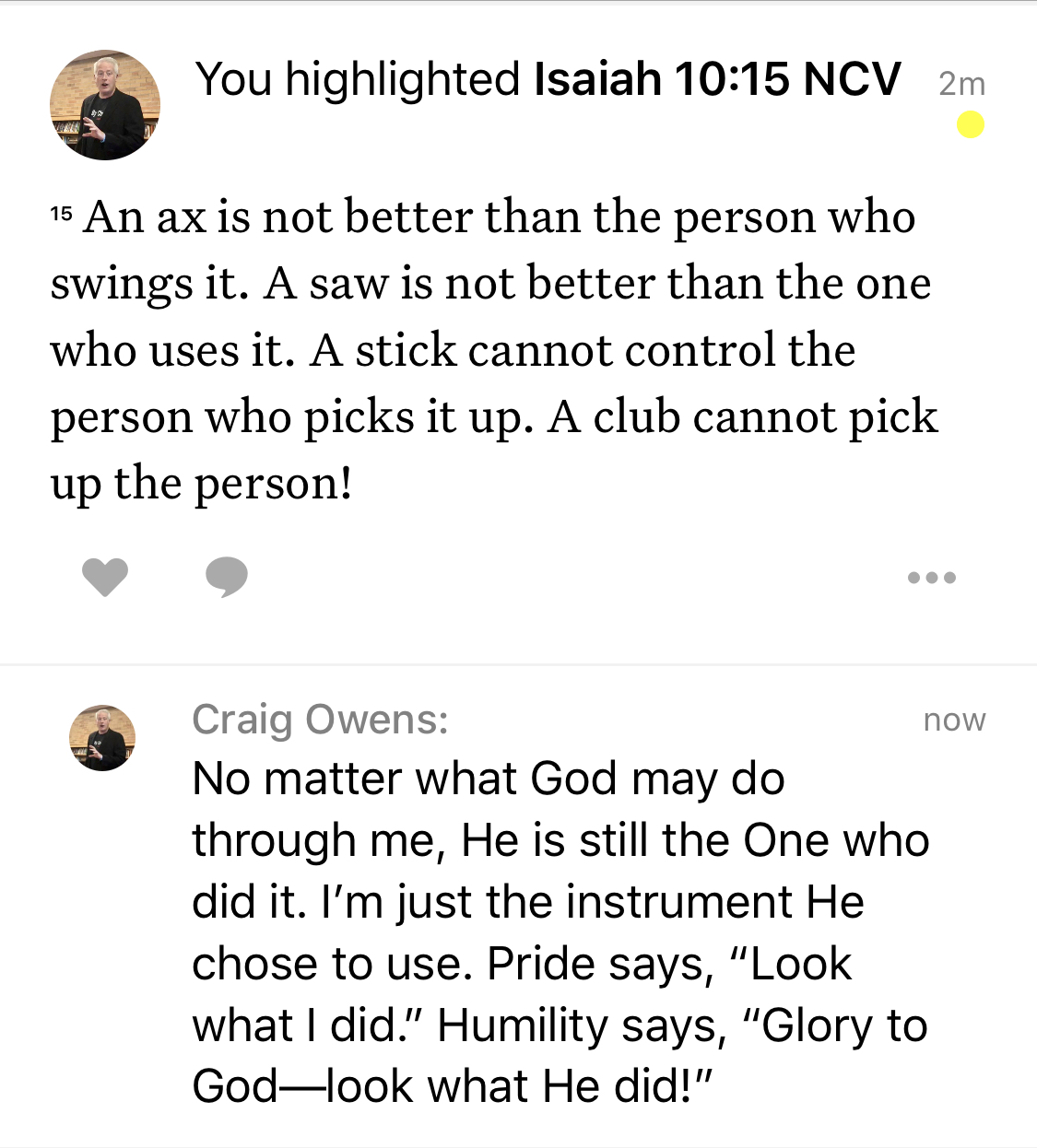
We would laugh if an ax boasted about the tree he had cut down. We all know that the power came from the lumberjack. 

It was the lumberjack who chose the ax, sharpened the ax, and skillfully used the ax to chop down the large tree. The felled tree is a testament to the lumberjack’s strength. 

In the same way, God may use one of us as His instrument to display His power. If the blind receive their sight, the lame can walk, and the lost find Jesus as their Savior, we would laugh if the one who prayed or preached boasted about his ability that brought about these miracles. 

These changed lives are a testament to the power and wisdom that flows from God. The one who prays or preaches is merely the instrument that was used by Him. God may pick up that person again and again, or He may lean him against the wall after one use. God determines the best instrument to use for His glory. 

In fact, God Himself says, “Does the ax raise itself above the person who swings it, or the saw boast against the one who uses it?” (Isaiah 10:15). And, “Let not the wise boast of their wisdom or the strong boast of their strength or the rich boast of their riches, but let the one who boasts boast about this: that they have the understanding to know Me” (Jeremiah 9:23-24). 

Be careful if you find yourself thinking, “Look what I have done,” and let your heart quickly change that to, “Look what my merciful God has been please to do through Me!” 

It’s not about our glory, is all about God’s glory! 

Sola Deo gloria! 

(Check out what A.W. Tozer said about a Christian neither boasting nor belittling.)

►► Would you please prayerfully consider supporting this ministry? My Patreon supporters get behind-the-scenes access to exclusive materials. ◀︎◀︎

Great Hardships Can Be Great Opportunities

Listen to the podcast of this post by clicking on the player below, and you can also subscribe on AppleSpotify, or Audible.

The Christians could have used the “great persecution” that broke out against them (Acts 8:1) as a great excuse to hide or to remain quiet. After all, Saul and his hoard were specifically targeting those who were known to be Christians, so keeping quiet or out of sight might have saved their lives. 

Instead, these fearless Christians used this great persecution as a messenger from God to keep them on-mission in fulfilling the Great Commission (Matthew 28:18-20; Acts 1:8), taking the Gospel to even the despised Samaritans (Acts 8:4)! 

Would they have taken this message to these folks without this “nudge” of persecution? Maybe, but then again, maybe they would have stayed in Jerusalem and delayed too long in sharing with those who lived in the capital city. It’s a really good bet that without this persecution they wouldn’t have come up with the idea of going to Samaria on their own!

I think we can learn some good lessons from this incident. When unexpected difficulties crash into our lives, let’s re-frame our thinking. Instead of using this hardship as an excuse to do less, let’s ask:

  • Do I need to re-evaluate what I have (or haven’t) been doing? Do I need to repent of anything? 
  • Am I on-mission as a Christian witness? Am I consistently using my God-given gifts in God-glorifying ways to point others to Jesus? 
  • How can I live out and proclaim the Word of God even in this unexpected place? 

Let’s be like those Christians who didn’t grumble, who didn’t hide, who didn’t make excuses. But they said, “This is just another opportunity for us to invite people to meet Jesus as their Lord and Savior,” and then they joyfully moved forward. 

►► Would you please prayerfully consider supporting this ministry? My Patreon supporters get behind-the-scenes access to exclusive materials. ◀︎◀︎

What Can Your Pain Tell You?

Listen to the podcast of this post by clicking on the player below, and you can also subscribe on AppleSpotify, or Audible. 

Have you ever been trying to finish a DIY project and you’re getting frustrated because there’s one part you cannot seem to complete? Then you phone a friend. They come over, look at the situation, pull the perfect tool out of their toolbox, and quickly fix the problem. You are amazed and they think, “It’s no big deal. I just happened to have the right tool for the job and the skill to know how to use it.”  

We are all gifted, but in different ways. 

God has uniquely prepared you for the situations you will face in your life. David declared, “All the days ordained for me were written in Your book before one of them came to be” (Psalm 139:16). That tells me that your loving Creator knew the challenges and opportunities you would have, and He has already placed the perfect tool in your toolbox that you will need to excel in that moment. 

We have already talked about how your passion helps you discover your areas of giftedness. Finding out what thrills you and what fills you is one key step on this journey. There’s another aspect of this discovery process that at first seems almost the opposite, but I think they are actually two sides of the same coin. 

If passion is what thrills me, then pain is what kills me. I think a good word for this is zeal. In the biblical context, zeal would be anger at the things that keep people from experiencing all that God has for them—things that keep them from knowing the fullness of God’s glory. 

As Moses grew older, it killed him that the Jewish people were now enslaved by the Egyptians and kept from worshiping God in their own place (Exodus 2:11-12). 

(Check out all of the Scriptures in this post by clicking here.)

We see Moses’ zeal misapplied at first (I mean, he did commit a murder!). This about the differences between a river powerfully flowing within its banks, and a flood when the river overflows its banks. When we use our God-implanted zeal in ways that He hasn’t sanctioned, we make a mess like that flood. But when we use our zeal to glorify God, it is as powerful as a mighty river within its banks. 

We see perfect zeal in Jesus. We see Him cleansing the temple so all worshipers could come close to God (John 2:13-17). We see his anger over the religious rules that kept people trapped in their disease( Mark 3:1-5; Luke 13:10-16). 

If passion asks, “What is God passionate about that thrills my heart too?” then pain asks, “What breaks God’s heart that also breaks my heart?” or “What’s broken that I would love to fix?” 

Zeal moves us to action! 

When we move forward in our zeal, others may say we are meddling or we are sticking our nose in places where it shouldn’t be. But we simply cannot help ourselves. 

In Moses’ initial zeal—without God’s commission—he committed murder and then fled to the wilderness. 

Stephen says, “Moses was well educated in all the wisdom of the Egyptians and was powerful in speech and action” (Acts 7:22). The word Stephen uses for “educated” means Moses was fully trained to interact success with is culture. And he also says Moses was “powerful” in speech and action. 

So why does Moses say of himself that he is not “eloquent” and “slow of tongue” (Exodus 4:10)? Literally, Moses is saying, “I might make the same mistake that I made previously.” 

Moses looked back on his initial stumble and was fearful he may misfire again. He was comfortable staying in his restricted comfort zone, but this attitude made God angry (Exodus 4:10-12). 

Saul in his zeal for the rules and traditions of Judaism, persecuted the Christians. After he became a Christian, we see the same zeal—calling out Barnabas and Peter, and asking the Galatians who has bewitched them to stay entangled with meaningless traditions. 

We usually discover our giftedness by looking backward. The devil would love for us to see our previous missteps as disqualifications for future service. But God says that He can use all of these things for His glory (Romans 8:28). We have to surrender our fears to Him if we want to soar out of our comfort zone and into our comfort zone. 

Let me give you three things to consider:

  1. What do you find yourself praying about more than anything else? 
  2. What do you move toward that others ignore or move away from?  
  3. What topic do you talk about all the time?  

Here’s your homework: Think about the three things to consider regarding pain, and then consider where your passion circle and your pain circle may overlap. 

If you’ve missed any of the messages in our series Living In Your Gift Zone, you can find them all here. 

►► Would you please prayerfully consider supporting this ministry? My Patreon supporters get behind-the-scenes access to exclusive materials. ◀︎◀︎

Links & Quotes

Is it okay to pray a prayer written by someone else? Sure! But let’s use those prayers merely as guides to help us form our own personalized prayers to our loving Heavenly Father. I shared a whole series on prayer that you may want to check out.

I have lots of new content every week, which you can check out on my YouTube channel.

T.M. Moore wrote, “The Holy Spirit comes to dwell in believers with an agenda. His agenda is not ours, and unless we can put our agendas aside, we will never line up with His to realize more of the presence, promise, and power of the Kingdom of God. The Spirit has not come to make us ecstatically happy. He has not come to fulfill our every wish. He comes to bring forth in us distinctly Kingdom values and virtues: love, joy, peace, patience, kindness, goodness, faithfulness, gentleness, and self-control. He comes to distribute among us spiritual gifts, God-given abilities to serve one another in caring and sharing ways. He comes to empower us as witnesses for Jesus, both in how we live and what we say. And He comes to build our churches up into Christlikeness by our unified and focused work.”

I am really enjoying these mini-biographies of key leaders in the Reformation presented by Desiring God. One that I found especially fascinating is about Menno Simons—“If you are familiar with the contemporary Mennonites, you may be surprised to learn that the group’s founder started as a Catholic priest who had never read the Bible.” Yet, near the end of his life, Menno wrote, “Although I resisted in former times Thy precious Word and Thy holy will with all my powers…nevertheless, Thy fatherly grace did not forsake me, a miserable sinner, but in love, received me…and taught me by the Holy Spirit until of my own choice I declared war upon the world, the flesh, and the devil…and willingly submitted to the heavy cross of my Lord Jesus Christ that I might inherit the promised kingdom.”

“What strikes me is that there’s a very fine line between success and failure. Just one ingredient can make the difference.” —Andrew Lloyd Webber 

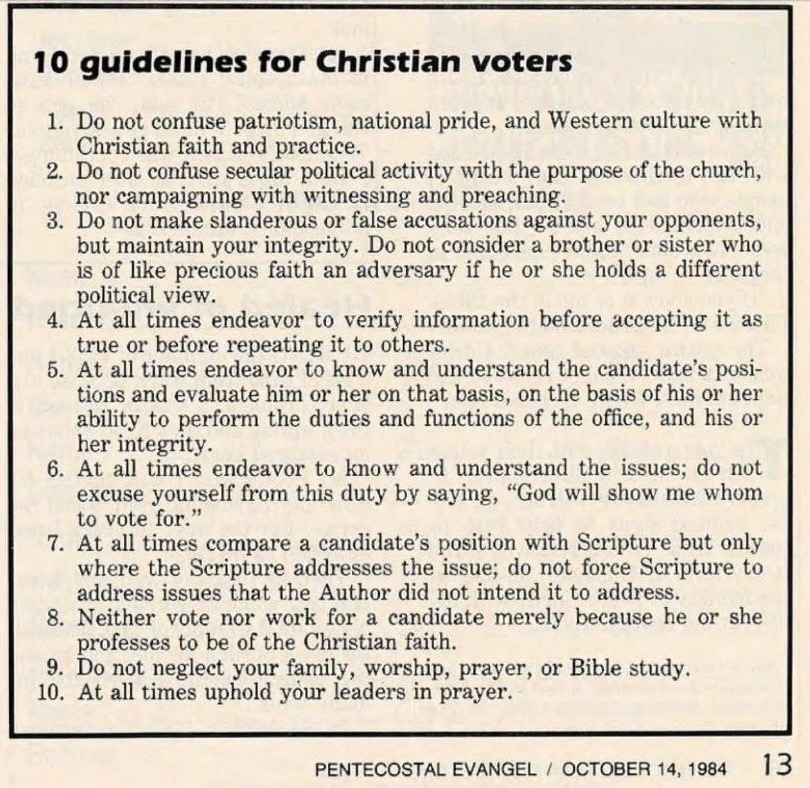
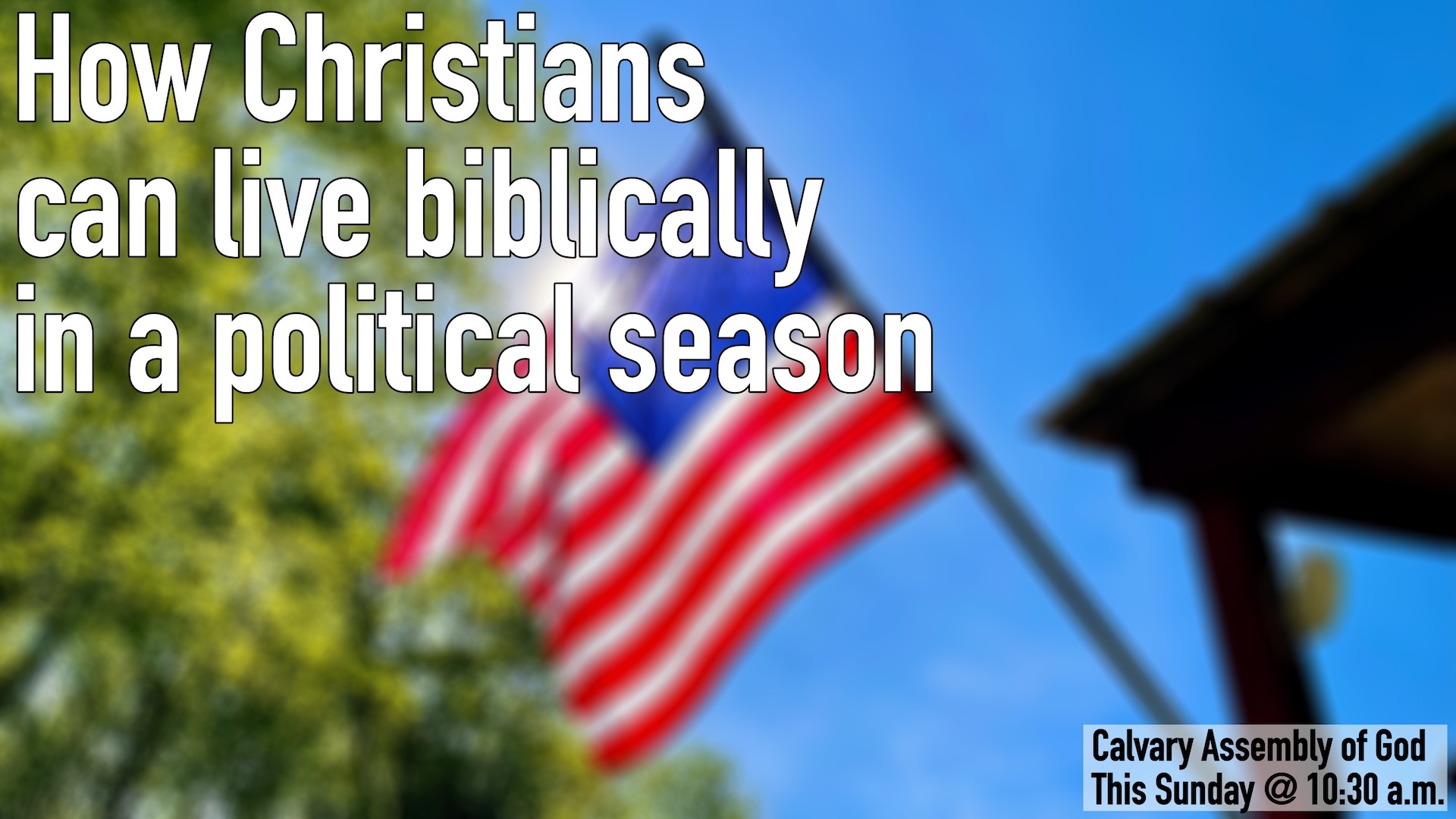
This past Sunday I spoke to my congregation about how Christians should behave biblically during an election season. Someone forwarded to me a related graphic from the Pentecostal Evangel magazine (a publication of the Assemblies of God) from 1984. I love these reminders for Christians!

Researchers unveiled the largest brain map ever completed. It was of a fruit fly, whose brain “includes nearly 140,000 neurons and captures more than 54.5 million synapses”! It took four years to complete this map. “All told, the researchers identified 8,453 types of neuron—much more than anyone had expected. Of these, 4,581 were newly discovered.” This level of complexity and order in a fruit fly is astounding to me. Can you imagine what it would take to map the much larger and more complex human brain?! Truly, David was right when he said that we are wonderfully made by our Creator!

“Freely, willingly and joyfully do good to everyone, serve everyone, suffer all kinds of things, love and praise the God who has shown such grace. Thus, it is just as impossible to separate faith and works as it is to separate heat and light from fire!” —Martin Luther

“Faith the mother of all good works justifieth us, before we can bring forth any good work: as the husband marryeth his wife before he can have any lawful children by her.” —William Tyndale

The Craig And Greg Show: Good, Better, Best

Listen to the audio-only version of this podcast by clicking on the player below, or scroll down to watch the video.

It’s good to be good, but good is never great. As leaders we have to consciously work to avoid the trap of good. Join Greg and me as we discuss how to make your good better, and your better best.

  • [0:15] I share a poem my grandma taught me. 
  • [1:09] What happens to our leadership if we become satisfied?
  • [2:10] Striving for perfection is also a terrible trap for leaders.
  • [4:12] What happens if leaders settle for merely “satisfied”?
  • [5:40] How to send the message to your team that we’re going to keep raising the standard.
  • [8:17] Some people are looking for excuses to remain complacent.
  • [9:59] At some point, leaders will have to take a risk to raise the standard.
  • [10:49] Why do people want to cut corners? How do we avoid this trap?
  • [13:19] How do we get motivated to go farther?
  • [15:45] A couple of great examples of leaders who pulled people to excel.
  • [17:36] We have to keep working or it’s going to be more work!
  • [19:10] A quote from Charles Sorenson that is insightful.

Check out this episode and subscribe on YouTube so you can watch all of the upcoming episodes. You can also listen to our podcast on Spotify and Apple.

Make Your Bible Studies Stickier

Listen to the podcast of this post by clicking on the player below, and you can also subscribe on AppleSpotify, or Audible. 

I want to give you some thoughts to take your Bible studies even deeper. Here are three strategies to make your Bible study time stickier—sticking in your heart and your mind.  

Check out this episode of The Podcast. 

The Scriptures I reference in this episode are Matthew 13:10-13 and Luke 8:18.

Here are some study Bibles I have used and reviewed: 

And if you are interested in the posts and videos where I talk about how to handle difficult-to-understand passages of Scripture, check out Handling Tough Texts and The Lens for Difficult Biblical Passages. 

►► Would you please prayerfully consider supporting this ministry? My Patreon supporters get behind-the-scenes access to exclusive materials. ◀︎◀︎

Ungodly Leadership Is Unsure Leadership

Listen to the podcast of this post by clicking on the player below, and you can also subscribe on AppleSpotify, or Audible. 

After examining Jesus himself and then getting a report back from King Herod, Pontius Pilate announces to the crowd of religious leader, “I find no basis for a charge against Him. But…” (John 18:38-39). 

The “But” signals the language of an unsure leader.  

Pilate knew the truth. He knew the Roman law. He had soldiers around him to protect him from physical harm. No recrimination or rebuke would have come from Rome for letting Jesus go free. Yet Pilate wavered. 

He was unsure of his leadership position. “Did I earn this position or did I manipulate my way into it? What will others think of me if I make this decision? Is there a way that I can keep everybody happy?” 

Pilate gave himself an out: “…but it is your custom for me to release to you one prisoner at the time of the Passover. Would you like me to release Jesus?” 

Pilate was hoping to satisfy the fickle mob that was pressing in on him and pestering him to give in to their demands, even if it meant he would be perverting justice. Unsure leaders are always trying to find a way to navigate the current situation, just to get on to the next chapter of their leadership. 

History records that about three years later, Pilate took his own life in the face of being removed from his office. 

A godly leader who is sure of his calling can make tough calls while still preserving justice and maintaining truth. 

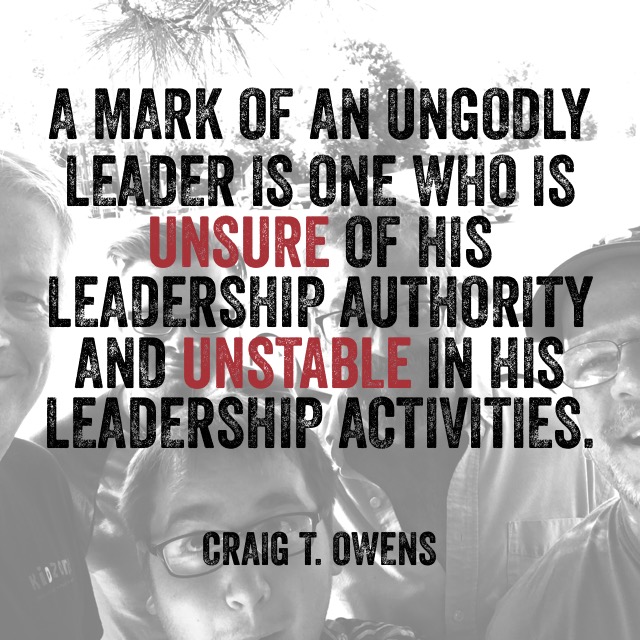
A mark of an ungodly leader is one who is both unsure of his leadership authority and unstable in his leadership activities. 

I talk more about a godly leader’s sure calling in my book Shepherd Leadership. And in this blog post, I give a three-word statement that can help godly leaders navigate through the toughest of decisions. 

This is part 79 in my series on godly leadership. You can check out all of my posts in this series by clicking here.

►► Would you please prayerfully consider supporting this ministry? My Patreon supporters get behind-the-scenes access to exclusive materials. ◀︎◀︎

How Christians Can Live Biblically In An Election Season

Listen to the podcast of this post by clicking on the player below, and you can also subscribe on AppleSpotify, or Audible. 

Much like Jude who had a message he wanted to deliver to the saints, but was compelled by the Holy Spirit to address something concerning him (Jude 3-4), I, too, was excited to deliver the next message in our series on discovering your gifts and then living in your gift zone. But I am deeply concerned about the words and actions of Christian saints during these past election cycles. 

(Check out all of the Scriptures I reference in this post by clicking here.)

I recently heard John Stonestreet say, “Currently, politics is carrying far more cultural weight than it is able to bear.” I agree: Christians are putting far too much emphasis on political candidates than the Bible would suggest. 

I frequently quote something from Charles Colson that always makes people smile. He said, “Salvation will never arrive in Air Force One.” The flip side is true as well: Neither will the Apocalypse arrive on Air Force One. 

We have to remember that the Most High is sovereign over all the nations of the earth, and He gives them to whom He choose (Daniel 4:25, 32). When we think that our candidate or our party is the only way our nation can be saved, aren’t we elevating the political process above God’s plan? 

I hope this doesn’t come as a shock to anyone, but there are no perfect candidates, perfect political parties, nor perfect party platforms. We can study our Bibles, pray, study the candidates’ lifestyle and policies, but ultimately we will have to cast a ballot for an imperfect candidate. 

God doesn’t have an “R” or “D” next to His name. He has not endorsed a political candidate. You may be sitting next to someone right now that is going to vote for the opposite political party that you will be voting for. And the way we interact with those people—whether they are fellow Christians or not—is deeply concerning to me. 

Moses saw a couple of fellow Israelites fighting each other, and he asked them, “Why are you hitting your fellow Hebrew” (Exodus 2:13). The Hebrew word rea means a friend who is also a fellow citizen. These Hebrews were citizens of Zion, but they were living in Egypt, and they definitely weren’t treating each other in a way that would be a testimony to the Egyptians. 

When Stephen retold this portion of the story in his sermon, he phrased it this way, “Men, you are brothers” (Acts 7:25-26). Stephen used the Greek word adelphos which literally means “from the same womb.” But the Christians used this word to mean brothers and sister in Christ—people with whom we will spend eternity. 

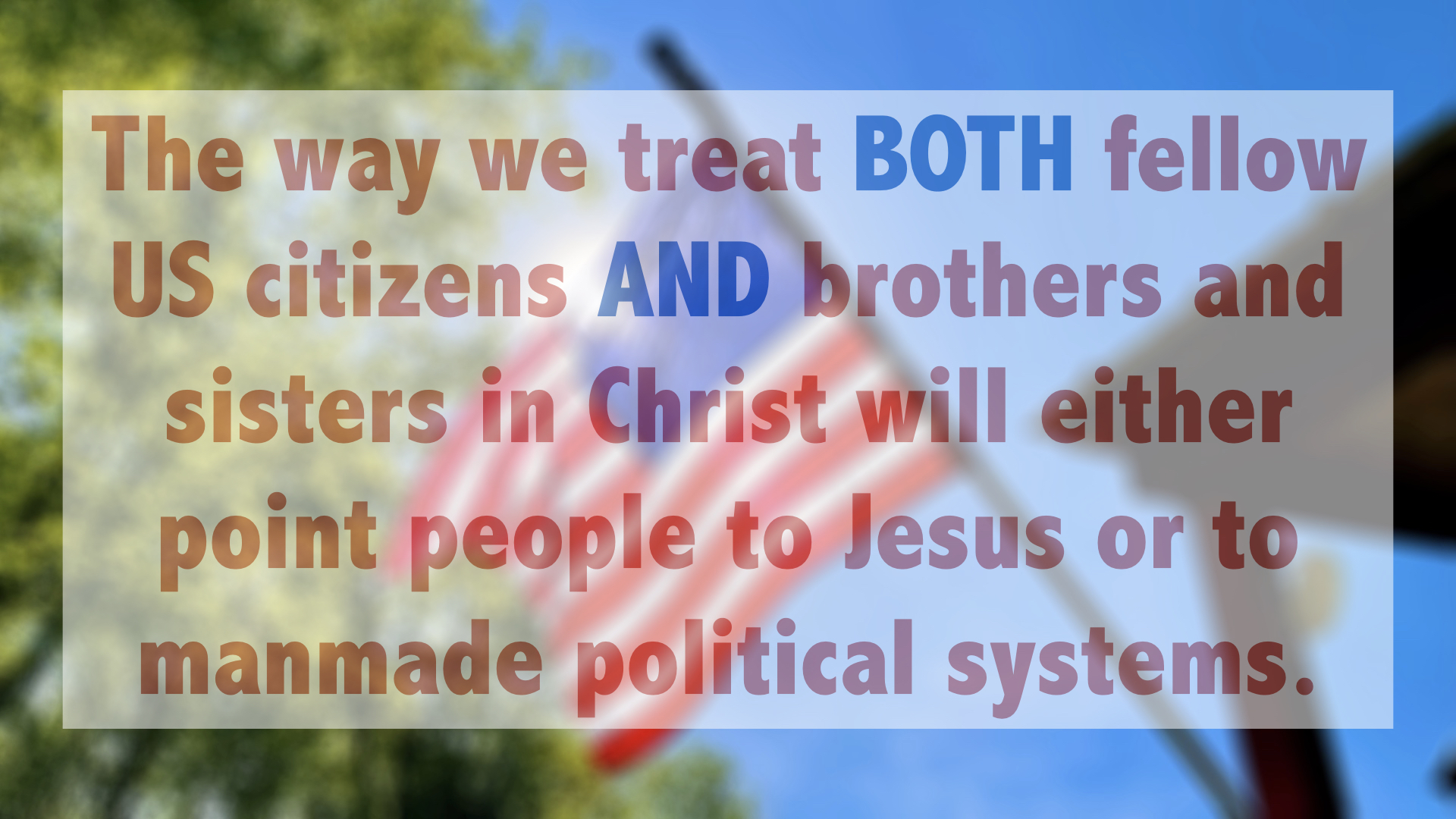
Let us always remember that others who are participating in the American political process are BOTH fellow US citizens AND brothers and sisters in Christ. 

In J.R.R. Tolkien’s Return of the King, when Gandalf sees fellow citizens and friends at each other’s throats, he exclaims, “Work of the enemy! Such deeds he loves: friend at war with friend, loyalty divided, and confusion of hearts.” Indeed, the enemy of our souls would love to see the chaos of a nation at war with itself; especially to see Christians at odds with each other. 

Paul said, “Therefore, as we have opportunity, let us do good to all people, especially to those who belong to the family of believers” (Galatians 6:10). On the flip side, Jesus said that when we think or speak poorly of a fellow human, we are in danger of judgment (Matthew 5:22). 

Listen to Paul’s appeal to his friends at Philippi—

Therefore if you have any encouragement from being united with Christ, if any comfort from His love, if any common sharing in the Spirit, if any tenderness and compassion, then make my joy complete by being like-minded, having the same love, being one in spirit and of one mind.

And then he specifically addressed a couple of sisters in Christ who were ad odds with each other

I plead with Euodia and I plead with Syntyche to be of the same mind in the Lord. Yes, and I ask you, my true companion, help these women since they have contended at my side in the cause of the gospel, along with Clement and the rest of my co-workers, whose names are in the book of life. (Philippians 2:1-2, 4:2-3) 

The politicians we have are always downstream from culture, which means we have allowed those sorts of politicians to be in place. 

John Stonestreet used a phrase I hadn’t heard before, but I think it’s appropriate: “Christian political engagement should hit its fever pitch not during elections. The only way to relieve the political pressures of our day is to build up the pre-political aspects of our life together, especially the family and the Church. When we care well for our children, our neighbors, and our communities, the state doesn’t have to.”  How true this is! 

I wrote something this summer based on Isaiah 3:4-5. In essence, I wrote that God gives nations the “leaders” they deserve. They are leaders in that they occupy an office, but they don’t lead people nor care for the citizens—they don’t have wisdom to lead nor do they care about anyone but themselves. This is the inevitable result for a nation that turns its back on God! So if we think our political and civic leaders are self-focused, unskilled, and childish, we should look in the mirror. It’s not “them,” it’s us. We have to change—turning wholeheartedly to God—and only then God can change our leadership. 

We need to be praying for our governmental leaders, not vilifying them. We need to be speaking well of our fellow US citizens. We need to be especially treating our fellow brothers and sisters in Christ well. 

Our hope is not in the results of an election. Our hope is in Jesus. The way we treat BOTH fellow US citizens AND brothers and sisters in Christ will either point people to Jesus or to manmade political systems. 

I pray we can do better at pointing people to Jesus! I pray I can do better! 

►► Would you please prayerfully consider supporting this ministry? My Patreon supporters get behind-the-scenes access to exclusive materials. ◀︎◀︎