The Holy Spirit knows the best place to use us, the best time to use us, and the best way to use us. We must trust Him! I have lots of new content every week, which you can check out on my YouTube channel.
“In our rush to be thanked or appreciated, or even in our shortsighted compassion, we can undermine the good God is patiently working. In that sense our good is actually evil, for it resists the wisdom, love, and transformative lessons of God.” —Dick Brogden, in Proverbs: Amplified and Applied
I love this quote in J.R.R. Tolkien’s Fellowship of the Ring when Merry Brandybuck tells Frodo about the stick-to-it-iveness of his friends: “You can trust us to stick to you through thick and thin to the bitter end. And you can trust us to keep any secret of yours closer than you keep it yourself. But you cannot trust us to let you face trouble alone. … We are your friends, Frodo.”
I love this devotional from John Piper about God-given foes and God-given faith. “The logic of fearlessness in the face of adversity is this double truth: Both your adversity and your faith in the face of adversity are gifts of God.”
Listen to the podcast of this post by clicking on the player below, and you can also subscribe on Apple, Spotify, or Audible.
When Jesus was discussing end times events with His disciples, He described days that looked pretty bleak. Do any of these descriptions sound familiar today?
In times like these, Jesus said many people will be deceived. This is why Jesus twice tells His followers to “be on your guard” (vv. 9, 23).
What exactly does “on guard” look like?
Maybe you’ve heard a similar phrase before a fencing match, reminding the combatants to raise their swords. That’s a good picture for Christians. Paul tells us that we can use the “sword of the Spirit, which is the Word of God” to defend ourselves during spiritual warfare (Ephesians 6:17).
While Jesus is instructing His disciples, He tells them the sword-like power of His words. He said, “My words will never pass away” (Mark 13:31). In other words, His sword is invincible!
Another modern-day phrase that fills out the definition of being on guard is when someone says, “Heads up!” This means to watch out for things that may be headed your way. Jesus reminded us, “I have told you everything ahead of time” (v. 23) so we can be aware of what’s coming.
We are aware of the approaching dark days of the end times, but we are not afraid of them. Three times, Jesus tells us to “keep watch” (vv. 34, 35, 37). This Greek word means to be aroused from sleep so that we can give active and strict attention to the task before us.
“Be on guard! Be alert!” Jesus said (v. 33), so that you don’t become apathetic. The devil prowls around, seeking to use the times of turmoil to confuse, deceive, and then mislead people.
But we are not unaware of his schemes.
Christian, we must stay on guard. We must be ready but unafraid of the opposition. We must keep in mind the never-failing Word of God, and we must use that sword to cut down the deceiving ideas. The Holy Spirit will give you the right words to wield at the right moment—
“…Don’t worry in advance about what to say. Just say what God tells you at that time, for it is not you who will be speaking, but the Holy Spirit.” (Mark 13:11)
Listen to the podcast of this post by clicking on the player below, and you can also subscribe on Apple, Spotify, or Audible.
In my book Shepherd Leadership I talk about some strong, godly men who gave into temptation at a moment of weakness—David who behaved so poorly toward Bathsheba and Uriah, Elijah who got depressed and suicidal, and Peter who denied knowing Jesus.
One common factor for all of these guys is that their moment of giving in came when they were alone. They were isolated from others who may have been able to help them overcome the temptations that tripped them up.
Have you ever heard of the law of the weakest link?
If I have a chain with links that can handle 400, 300, 250, 175, and 500 pounds, how much weight can the chain hold? You don’t really need a calculator for this one because the answer is the capacity of the weakest link: 175 pounds. This is why it’s to my advantage to not only strengthen myself, but to help others grow their strength as well.
In Galatians 6:2-5, the apostle Paul talks about the strength we need for ourselves and our fellow Christian brothers and sisters. First, he says that each of us should test our own actions. I can only know my breaking point if I’m tested, and the Holy Spirit knows how to do this perfectly. After this testing, Paul says then I can take pride in myself without saying, “Well, at least I’m better than him!”
Quite simply, Paul tells each of us that we must be able to carry our own loads. Why? Because only a strong Christian can help someone else with their load. We each have to get stronger individually so that we have strength for others!
This is just like what we’ve been learning in our look at the Songs of Ascent: the goal is for all of the pilgrims to get to Zion together!
In this series, we are going to learn about six spiritual disciplines. Much like a physical workout, the Holy Spirit will start with us where we are. Not everyone will be at the same level nor will everyone progress at the same rate. But all of us will need these four things.
(1) Discipline. This is saying no to the easy thing or the thing that brings only fleeting happiness so that I can say yes to the things that bring eternal joy.
(2) Stick-to-it-iveness. I have to be committed to this process for a lifetime.
(3) Grace for yourself. There are going to be moments of struggles, plateaus, and even stumbles. Those are all a part of the journey, so we must extend grace to ourselves to learn, repent, and move forward.
(4) Patience for others. As I just mentioned, we are all on our own journey and we all progress at different rates. Let’s be patient with each other.
All of these spiritual disciplines are to strengthen us individually so that we have something to share with other saints (2 Corinthians 1:3-6).
These spiritual disciplines shouldn’t become legalistic. Don’t make the way you do it the way everyone has to do it. After all, a 175-pound link will be different than a 250-pound link.
What I am calling spiritual disciplines, C.S. Lewis called religious practices. In a letter to a friend, he wrote about the safety and beauty that result from these pursuits—
“I think about the practices what a wise old priest said to me about a ‘rule of life’ in general—‘It is not a stair but a bannister’…i.e. it is, not the thing you ascend by but it is a protective against falling off and a help-up. I think thus we ascend. The stair is God’s grace. One’s climb from step to step is obedience. Many different kinds of bannisters exist, all legitimate. It is possible to get up without any bannisters, if need be: but no one would willingly build a staircase without them because it would be less safe, more laborious, and a little lacking in beauty.” (C.S. Lewis)
Don’t give in to F.E.A.R. When the devil’s lies make us afraid, remember that F.E.A.R. stands for false evidence appearing real. The Holy Spirit can help you find the true evidence in God’s Word that will confront and dismantle the false evidence.Check out this full message here. I have lots of new content every week, which you can check out on my YouTube channel.
“Meanwhile it is also necessary for the ruler [pastor] to keep wary watch, lest the lust of pleasing men assail him; lest, when he studiously penetrates the things that are within, and providently supplies the things that are without, he seek to be beloved of those that are under him more than truth…” (Gregory the Great). Check out how T.M. Moore unpacks this quote.
The Culture Translator” newsletter from Axis has this sobering reminder of the dangers of pornography.
What it is: An eye-opening essay in The Free Press describes the impact of pornography on a teen’s developing brain.
What it tells us: The author of this piece, Isabel Hogben, is a homeschooled high schooler living in Redford City, California. In one of several devastating lines, Hogben details how she stumbled upon PornHub when she was only ten years old, even as her very present mother was “making sure I was eating nine differently colored fruits and vegetables on the daily.” Hogben goes on to explain that today’s pornography depicts a synthetically augmented and physically brutal type of sex that makes Playboy magazine look “like an American Girl Doll catalog.” She notes that teens who have never had a physical sexual encounter can’t know the difference between what fake sex and real sex is supposed to be like, skewing their expectations, and that her peers think selling nudes online is normal. As she examines the way porn causes scientifically-measurable changes in the brain, Hogden concludes that porn is not “content” as much as it is a dangerously addictive substance not unlike street drugs.
“Do nothing that you would not like God to see. Say nothing you would not like God to hear. Go no place where you would not like God to find you. Never spend your time in such a way that you would not like God to say, ‘What are you doing?’” —J.C. Ryle
“Learning to say no is not just about courage, but also learning how to prioritize your life and become more productive.” —John Maxwell
Listen to the audio-only version of this podcast by clicking on the player below, or scroll down to watch the video.
If you said, “No,” are you sure? Sometimes micromanagement can come out of good intentions, or as we focus on a project, we as leaders can slide into it without even realizing it. In this episode, Greg and I discuss why micromanagement is bad for your leadership, how to identify if you’ve fallen into this trap, and, most importantly how to free yourself to soar into a place of macro-leadership.
[0:17] Greg and I break into song.
[0:38] Micromanagers stunt the growth of others in the organization.
[1:45] There is a difference between intense focus and micromanagement. How do we find those differences?
[3:44] A definitive quote about the destructive nature of micromanaging.
[6:05] Micromanagers create an unhealthy environment.
[6:47] The Craig And Greg Show audience is exceptionally intelligent!
[8:36] How do we know if we are unconsciously crossing the line into micromanagement?
[9:50] Micromanagement needs to give way to macro-leadership.
[11:16] Two more telltale phrases that micromanagers use.
[12:30] Greg helped a struggling leader break free from his micromanagement trap.
[14:07] The value of an “outsider’s” perspective can be huge!
[15:03] Greg shares some natural consequences for the entire organization of micromanagement.
[17:31] Characteristics of macro-leaders
[19:34] Greg shares two very sad stories of micromanagers who created problems in their company.
[21:50] Some final quotes to bring it home.
Check out this episode and subscribe on YouTube so you can watch all of the upcoming episodes. You can also listen to our podcast on Spotify and Apple.
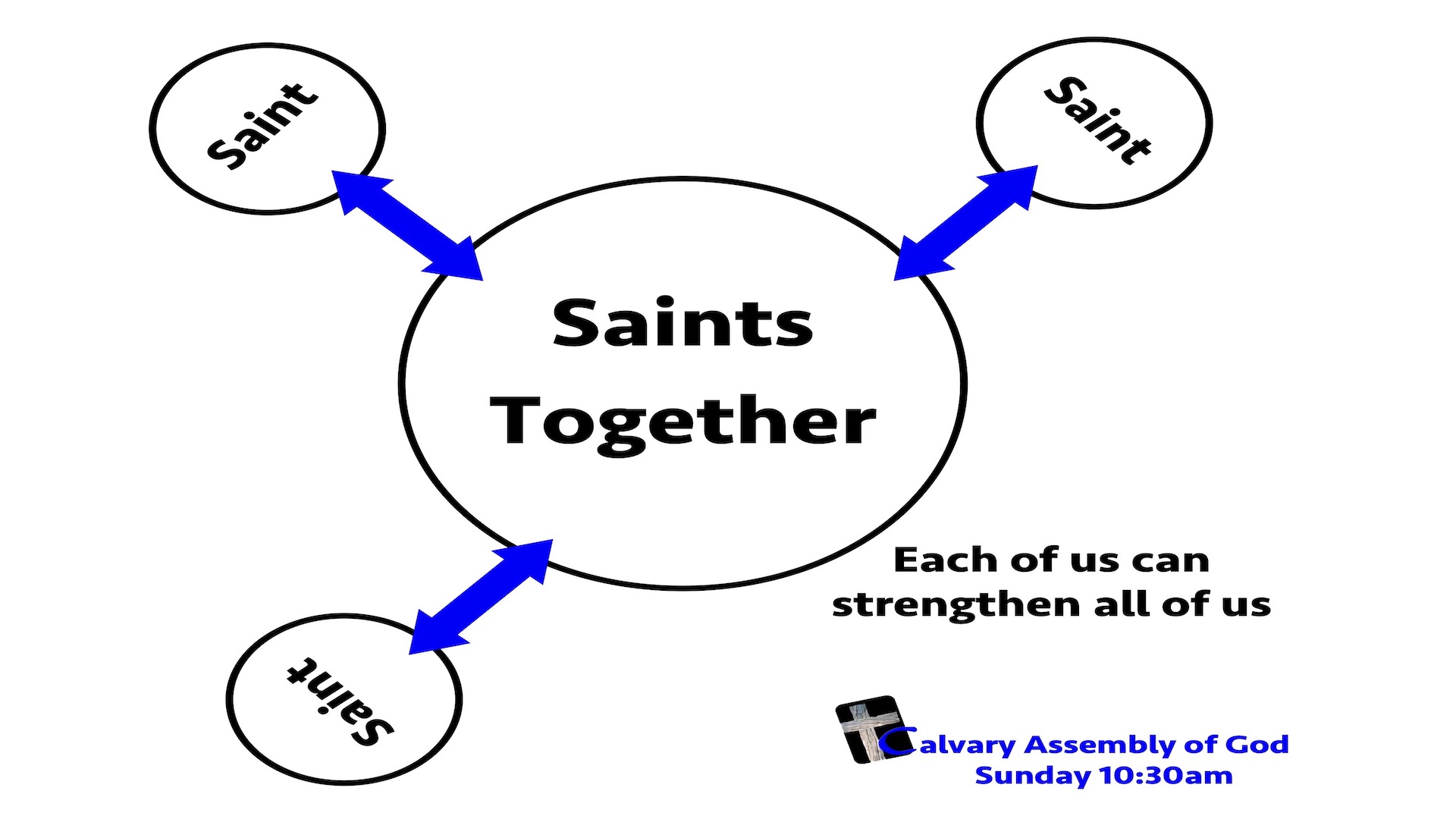
Throughout the New Testament the word “saints” is always in the plural form. This is a clear indication that none of us can develop into the full-fledged Christians we were meant to be on our own.
We all need each other. More specifically, we all need the most mature version of each other.
A key component of an individual saint’s development is the time spent alone being forged by the discipline of the Holy Spirit. Maturing saints then come together with each other to continue to strengthen and sharpen everyone in the church. Strong individual saints make a strong church, and a strong church makes strong individual saints!
Join me for our new series called Saints Together. We will be studying the six spiritual disciplines that each individual saint must put into practice so that they can use their newly developed strengths to help other saints in their own development.
Listen to the podcast of this post by clicking on the player below, and you can also subscribe on Apple, Spotify, or Audible.
I was sitting with a couple of ladies in our school district who were trying to figure out the logistics for a food distribution program. I was offering them a couple of suggestions when one of them asked me, “Have you ever had any experience with something like this?”
I told her that I had, and then she responded, “But this is going to be pretty big. Probably about 40 families.”
I smiled and told her that the food distribution program I helped coordinate fed nearly 5000 people.
She said, “Well, I guess we don’t have to worry anymore!” And from then on, whenever any logistical concerns came up, these ladies confidently handed off the situation to me. Once they knew that I had some relevant experience, they didn’t have any more moments of questioning.
Unlike Jesus, I didn’t create all of the food from a few loaves and fish. I simply organized the distribution of the food others had donated. I am glad these ladies had confidence in me, but at the same time, I had to guard my heart against the pride that can so easily puff up my ego.
Can you imagine if you were one of the disciples of Jesus, and had seen all of the miraculous things He had done and heard all of the profound things that He had said, and then still had the audacity to ask, “Who is the greatest”?!
And yet that is exactly what they did (Mark 9:33-35).
How in the world could they argue about something like this when Jesus was right there with them? Maybe this thought finally sunk in a little because later on they pivoted a bit in their argument to ask who was the greatest after Jesus (Matthew 20:20-28).
Jesus minced no words and left nothing vague in His answer: “Anyone wants to be first must be the very last, and the servant of all” (Mark 9:34).
This is exactly what Jesus embodied. He literally lived and died to prove that the highest greatness is measured by the lowest of servanthood.
…Christ Jesus: Who, being in very nature God, did not consider equality with God something to be used to His own advantage; rather, He made Himself nothing by taking the very nature of a servant, being made in human likeness.And being found in appearance as a man, He humbled Himself by becoming obedient to death—even death on a Cross! (Philippians 2:5-8)
The very last. Jesus made Himself nothing.
Not above some and beneath some, but the servant of all.
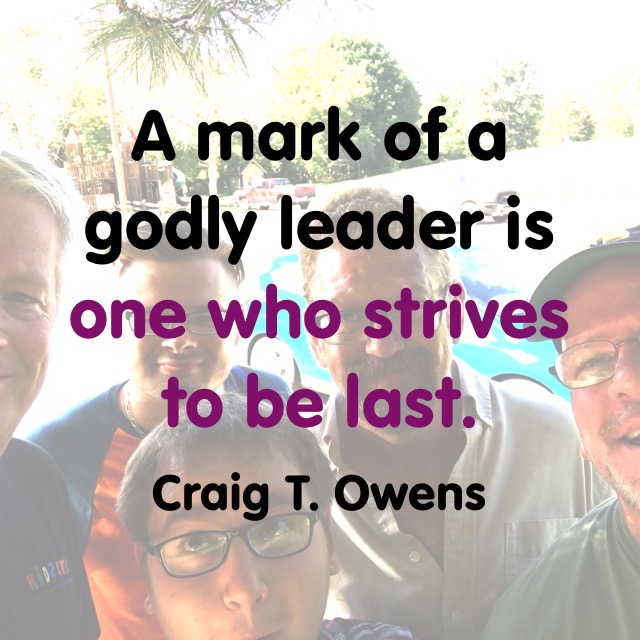
A mark of a godly leader is one who strives to be last.
Not: “I am second.” But: “I am last.”
This is not just a declaration, but it is a declaration followed by a lifetime of submitting and serving. Not trying to lead others, but trying to out-serve all.
This is part 74 in my series on godly leadership. You can check out all of my posts in this series by clicking here.








 Craig T. Owens