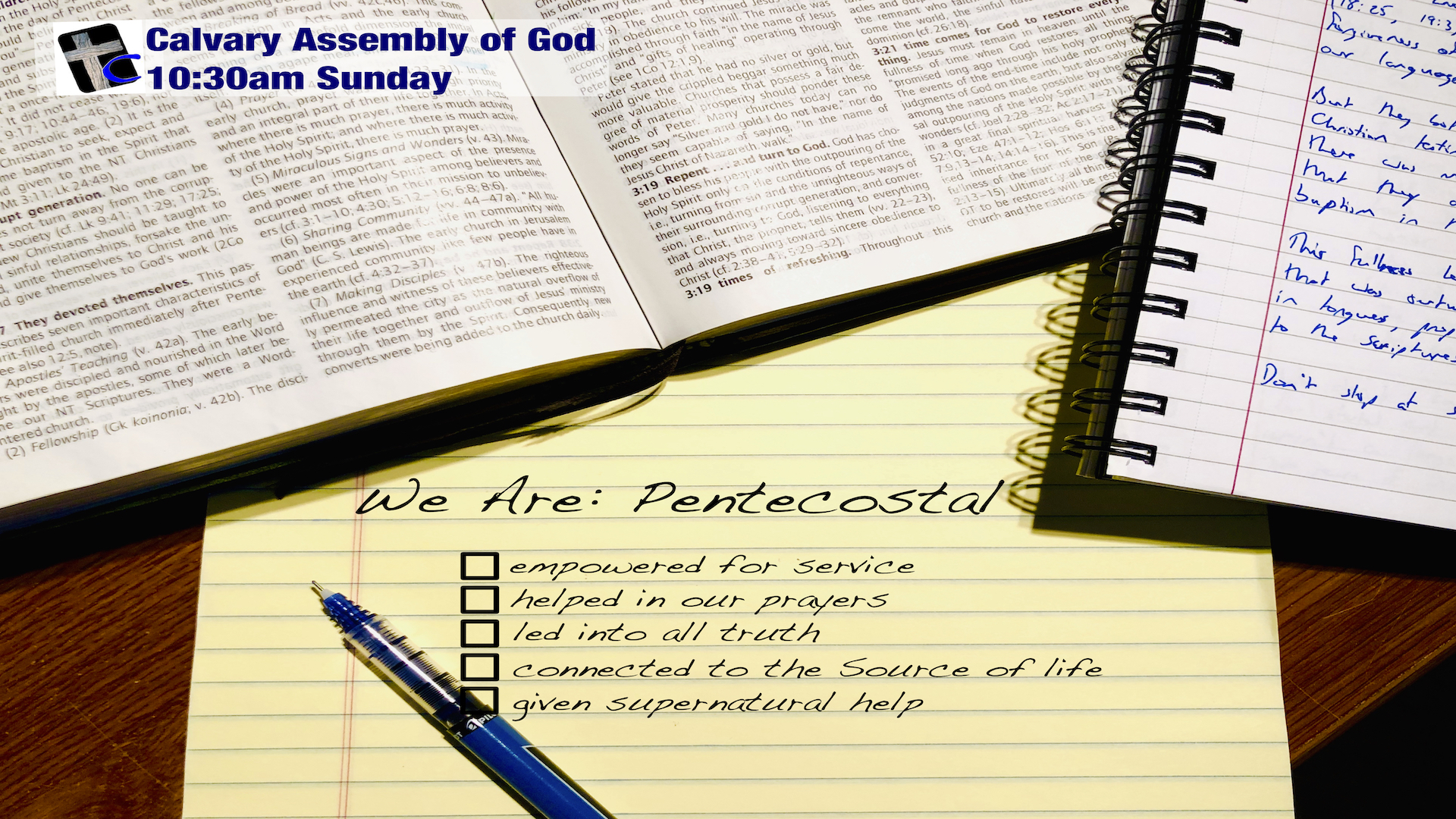
Pentecost for over 1500 years was a celebration in Jerusalem that brought in Jews from all over the world. But on the Day of Pentecost which came just ten days after Jesus ascended back into heaven, the meaning of Pentecost was forever changed!
Followers of Jesus—now empowered by an infilling of the Holy Spirit—began to take the good news of Jesus all over the world. These Spirit-filled Christians preached the Gospel and won converts to Christ even among hostile crowds, performed miracles and wonders, stood up to pagan priests and persecuting governmental leaders, and established a whole new way of living as Christ-followers.
We, too, can be Pentecostal followers of Jesus Christ today. We can experience an anointing and an empowering in our lives that turns ordinary Christianity into extraordinary Christianity!
Please join me this Sunday at Calvary Assembly of God as we rejoin this series. You can check out what I taught in this series in 2019 by clicking here, the messages from 2020 are here, and the messages from 2021 are here.
Listen to the podcast of this post by clicking on the player below, and you can also subscribe on Apple, Spotify, or Audible.
“Ezekiel will be a sign to you…” —God (Ezekiel 24:24).
How many times have I told God, “I am Your servant. Use me as You know best”?
But do I really want that?
Ezekiel is told by God in the ninth year of their captivity in Babylon, on the tenth day of the tenth month, that the siege of Jerusalem had begun that very day. Ezekiel is then instructed to share this news with his fellow exiles. God tells Ezekiel that after he shares this news, he will be unable to speak until a messenger arrives in Babylon to confirm the report.
That same day, God also tells Ezekiel that his wife will die, but that he is not to mourn over this loss. God had grieved for years over Judah’s slide away from Him, but He could no longer grieve because it was now time for Judah’s punishment. Perhaps just like Judah’s slow downward slide, Ezekiel’s wife had been in declining health too, but now Ezekiel was called to obey God in this second illustrated sermon.
About seven months later, Jerusalem’s walls were broken through, King Zedekiah was captured, and about three weeks later Nebuzaradan torched the city. On that day, Ezekiel lost his power to speak, just as God said he would, and Ezekiel remained mute for nearly two years (2 Kings 25:1-10; Ezekiel 24:1-2, 15-27; 33:21-22).
This is what it means to be used by God. He used Ezekiel as His illustrated sermons to vividly show the exiles the consequences of their sinful choices.
But we don’t read a single word of complaint or bargaining from Ezekiel—just complete obedience.
A mark of a godly leader is one who signs a blank check for God to fill in the amount.
The leader that serves God in this obedient way is one who is highly esteemed by both God and men. God said, “As for you, son of man, your people are talking together about you by the walls and at the doors of the houses, saying to each other, ‘Come and hear the message that has come from the Lord.’ … When all this comes true—and it surely will—then they will know that a prophet has been among them” (Ezekiel 33:30, 33).
I want to believe that I am willing to serve God this way but am I truly willing? Perhaps my prayer should be, “Father I want to be able to be used by You. I want to say that I am ready for You to use me as You see best. But You alone truly know my heart. Holy Spirit, if I am not as committed as Ezekiel was, please do Your work in me so that I can truly say, ‘I am ready to be used.’”
This is part 63 in my series on godly leadership. You can check out all of my posts in this series by clicking here.
[6:30] Efficiency and effectiveness don’t have to compete with each other
[7:11] Quality is never an accident
[7:50] Greg shares a helpful list of three items, but to stay on track you can only pick 2-of-the-3
[8:45] What distracts us from pursuing quality?
[10:00] Both quality and quantity have their places, but the leader needs to determine which one takes the priority
[10:47] Greg shares a comical conclusion he made after overhearing a break room conversation
[12:27] Why do leaders find security in “more”?
[13:55] There is one key place where quantity should probably come first
[14:48] Numbers are easy to use to measure quantity, but quality is much harder to measure
[16:38] An important lesson for leaders
[18:14] A leader’s words need to be more qualitative than quantitative
[19:15] Our coaching huddle clients get both quantity and quality
Check out this episode and subscribe on YouTube so you can watch all of the upcoming episodes. You can also listen to our podcast on Spotify and Apple.
Listen to the podcast of this post by clicking on the player below, and you can also subscribe on Apple, Spotify, or Audible.
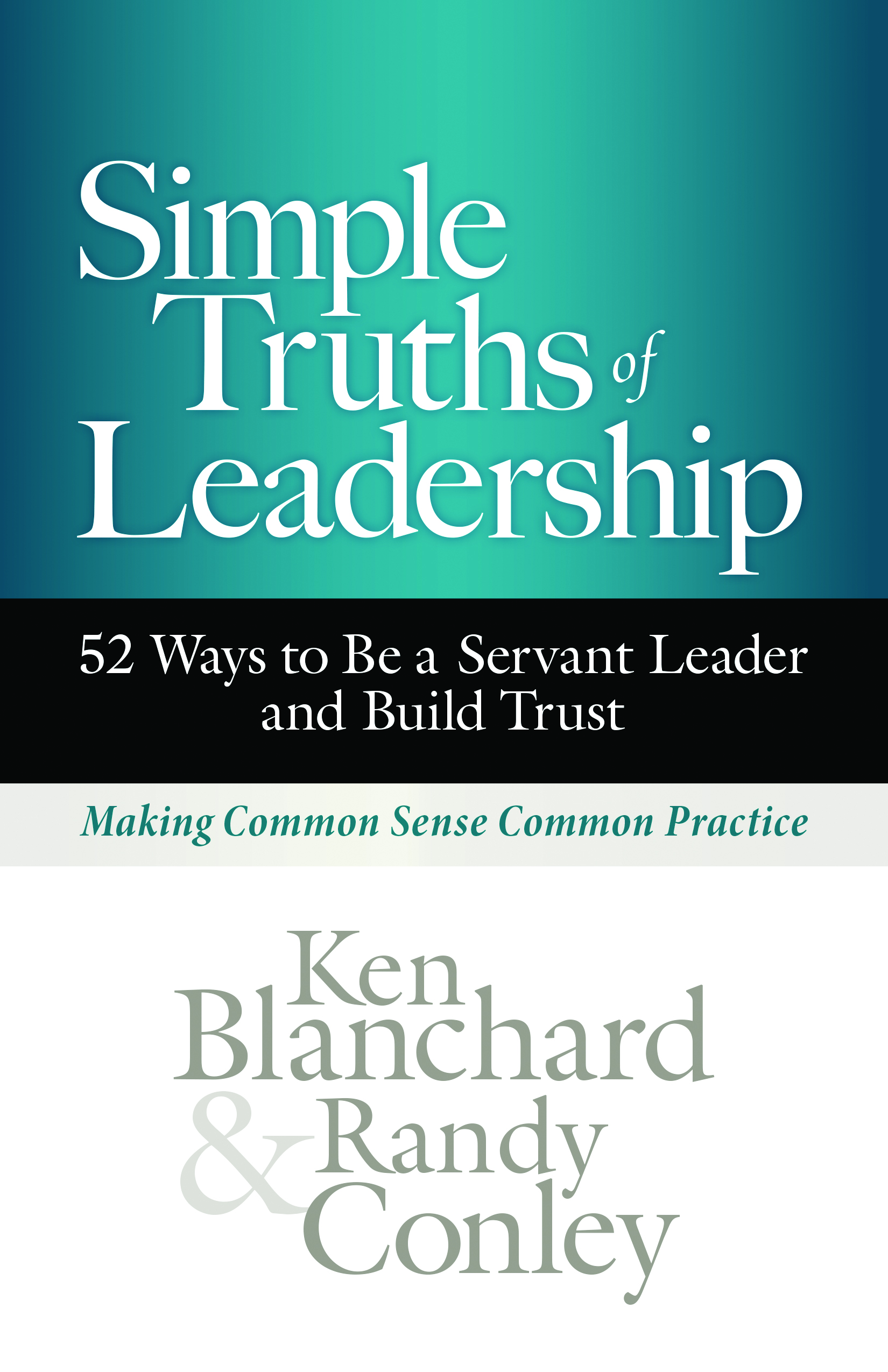
Kenneth Blanchard cranks out the leadership books! What I love about his writing style is how he makes his leadership principles so accessible in just a few words. Most of his books contain an overarching concept that’s easy to grasp and immediately applicable. But Simple Truths Of Leadership, which he co-wrote with Randy Conely, is a slight departure from this predictable style.
Simple Truths—as its title implies—still presents easy-to-grasp principles, but this book has a different feel to it. I think the best way I can describe this book is as an index to Blanchard’s earlier leadership books.
The overall emphasis of this book is servant leadership, with all of these simple truths being presented to us in 52 snippets. Each snippet gives the reader more than enough information to get to work, but then there is a reference given to a book previously written or co-written by Kenneth Blanchard to allow for a deeper study of that principle. This is why the overall feel of this book is as an index to the other books.
Whether you’ve read Kenneth Blanchard’s leadership books before, or if this is your first time picking up something he’s written, Simple Truths is a great book to add to your leadership library.
Listen to the podcast of this post by clicking on the player below, and you can also subscribe on Apple, Spotify, or Audible.
I am so grateful for the blessings of a godly mother and a godly wife! I can relate to Abraham Lincoln who said, “All I am, or can be, I owe to my angel mother. … I remember my mother’s prayers and they have always followed me. They have clung to me all my life.”
Mothers—both the natural, physical, and adoptive mothers—can save the rest of us from a world of hurt. We see this in a story in the Bible of a mother that saved innumerable people from the consequences of folly. This is an amazing story in 1 Samuel 25, so please take some time to read it for yourself.
King Saul and David have finally separated from each other, with Saul returning home to Gibeah and David returning to his stronghold at En Gedi. Eventually, David moved west from En Gedi to the Desert of Moan, where the town of Carmel was nearby.
A prominent citizen of Carmel was a man named Nabal. He is described as “very wealthy,” owning 1000 goats and 3000 sheep. But he apparently gained his wealth through less-than-honorable means because he is described as “surly and mean in his dealings.” We find out later in the story that he’s also hard-hearted and hard-headed, not listening to any counsel others may offer him.
That fits him because his name means “fool.” I find it hard to believe that his parents named him this from birth. If they did, it reminds me of the opening words of C.S. Lewis’ book The Voyage Of The Dawn Treader: “There was a boy named Clarence Eustace Scrubb, and he almost deserved it.” Instead, I think Nabal’s dealings were so mean, surely, and foolish that the name stuck. Perhaps he even wore that name as a badge of honor.
It came sheep-shearing time—which is really payday for shepherds—so David sends some of his servants to Nabal to ask for whatever he might find to give as a gift to “your servants and your son David.” David’s men had been a constant source of protection for Nabal’s herdsmen, so a gift of gratitude does seem appropriate.
Nabal doesn’t just say, “No,” but he insults David. As his foolish nature controlled him, he not only insulted David, but he insulted God too by implying that David wasn’t anointed by God, but was merely ruthlessly climbing a ladder of success. Probably Nabal thought this way because that’s how he himself gained his fortune.
Nabal’s response lit David’s fuse! In fact, David’s response to his men was just four words long: “Put on your swords!”
Fortunately, one of Nabal’s servants informed his wife Abigail of this.
In the same verse where Nabal is described as mean and surely, Abigail is described as “intelligent and beautiful.” Whereas Nabal’s name means fool, Abigail’s name means “my father’s joy.” She must have been born at just the right time for her father and she continues to be a just-in-time woman!
This servant brought Abigail word of Nabal’s foolish response, telling her that David’s men were indeed “a wall around us” while they were in the desert. And then he says, “Think carefully about what you should do because disaster is hanging over us!”
Abigail acts quickly, wisely, and humbly.
The first thing she does is send hundreds of pounds of food to David and his men. She sends the gift that Nabal probably should have sent. Then Abigail herself follows the gifts on her own donkey. When she encounters David and his armed men coming down the mountain pass, she humbly falls at his feet asking David to reconsider.
Abigail doesn’t tell David he shouldn’t be angry, but she points him to something bigger and more long-lasting than his immediate thought of revenge. She reminds him that he is God’s anointed leader, and she asks, “When you become king, do you want this bloodshed on your conscience?”
Abigail’s words have an immediate effect on David, who calls off the attack, praises Abigail, and praises God for sending Abigail to him. Abigail rescued Nabal’s family and workers from imminent destruction, and she saves David from the consequences of his rash response.
The next morning, when she relates this story to Nabal, he has either a stroke or a heart attack, and then dies ten days later. Justice is served, but it’s served by God and not by David.
Later on, David takes the now-widowed Abigail as his wife.
Abigail’s name scarcely appears anywhere else in the Bible, but there is one notable appearance:
Sons were born to David in Hebron: His firstborn was Amnon the son of Ahinoam of Jezreel; his second, Kileab the son of Abigail the widow of Nabal of Carmel; the third, Absalom the son of Maakah daughter of Talmai king of Geshur; the fourth, Adonijah the son of Haggith; the fifth, Shephatiah the son of Abital; and the sixth, Ithream the son of David’s wife Eglah. (2 Samuel 3:2-5)
Amnon, first in line for the throne, raped his half-sister Tamar and was then killed by Absalom, who was Tamar’s brother. Absalom, third in line for the throne, not only avenged his sister’s disgrace but led a coup against David, where he was killed in battle.
That leaves Kileab as the obvious heir to King David’s throne, yet this is the only place he is mentioned in the Bible. I think Abigail’s wise influence saved Kileab from the drama of aspiring to be king, a painful future, and perhaps a premature death.
From this amazing story, I would like to offer three takeaways for Moms:
Use your inner beauty to persuade foolhardy men—1 Peter 3:2-3
Use your Holy Spirit-given wisdom to dissuade foolishness—Matthew 10:19
Use your prayer life to bring a legacy of peace—Psalm 116:16
Godly mothers, please be encouraged today at how much influence you exert over others in your life. Your inner beauty, God-given wisdom, humility, and prayers are making more of an impact than you may ever know. I believe in heaven the full story will be shared, and you will be praised for being a wise and faithful servant.
May God continue to bless, empower, and use our Moms to save us from the consequences of our foolishness!
Jeff asked me how the challenges of the last couple of years affected the thoughts that went into writing my book Shepherd Leadership. I explained to him how my conversation with a local pastor actually created the subtitle of the book: The Metrics That Really Matter.
In another recent conversation on The Craig And Greg Show, I talked about a comical conversation I had with a church board about their definition of the word “grow.”
In Shepherd Leadership, I wrote,
Growth and success may need to be redefined in your church or ministry. If you’ve been thinking that success is a steadily upward climb in attendance or donations, or a bigger facility, or more people on staff, then it would appear that the ministries of Philip, Paul, and even Jesus were highly unsuccessful. We’ve already seen that Philip went from a large revival in Samaria to one person in the desert. Paul came to the end of his life telling Timothy how many of his companions had abandoned him. And Jesus started His public ministry with twelve emerging leaders, only to see one betray Him, nine run away when He was arrested, and one deny that he even knew Him. When we come up with our plans to “grow” our ministry, or we say “success” is all about what we can count, aren’t we really just self-promoting?
Godly shepherd leaders need to make sure that they are concentrating not on more sheep, but on greater health. Remember: the shepherd doesn’t give birth to sheep, but the shepherd creates a healthy environment for the sheep to reproduce.
I’ll be sharing more clips from this 200churches interview soon, so please stay tuned. Shepherd Leadership: The Metrics That Really Matter is available in print or ebook, and in audiobook through either Audible or Apple.
To fill the granaries of God! —Margaret J. Prescott
My friend and podcast partner Greg Heeres talked about growing and learning through change. You can check out the rest of this episode of The Craig And Greg Show here.
Sometimes the prophetic language in the Bible can be a bit confusing. Like the phrase: “A time, times, and half a time.” Here is how Dr. Henry Halley unpacks this—
“It denotes the duration of the other horn of the fourth beast (Daniel 7:25). It denotes the period from Daniel to the time of the end (Daniel 12:6–7). It is used in Revelation 12:14 as identical to 42 months and to 1260 days (Revelation 11:2–3; 12:6, 14; 13:5), the period of time the Holy City was trampled, the two witnesses prophesied, the woman was in the wilderness, and the revived beast was on the throne.
“The word ‘time,’ in the phrase ‘a time, times, and half a time’ is generally taken to mean year; the phrase thus means three and a half years, which is 42 months, or 1260 days.
“By some, this is taken to refer to a literal three and a half years. Others, on the year-day interpretation (Numbers 14:34; Ezra 4:6), take it to be a period of 1260 years. Still others look upon the figures, not as defining time limits or periods, but as being symbolic: 7 Is the symbol of completeness, while three and a half, which is half of 7, represents incompleteness—that is, the reign of evil will be only temporary.” —Halley’s Study Bible(check out all of the biblical references in this quote by clicking here)
“Ambivalence toward the Law of God is troubling. Theologians discard the Law, and pastors either reject or neglect it. Jesus said that keeping and teaching the Law of God was a mark of Kingdom greatness (Matthew 5:17-19). Apparently that’s not a goal many of us aspire to. He also said that when the Law of God is neglected, love grows cold (Matthew 12:24). The ubiquitous lack of love in our world today is undoubtedly related to our failure to teach and live according to the Law of God. …
“Pastors have three main resources for the work and business of ministry: The Word of God, prayer, and their personal example (Acts 6:4; 1 Peter 5:1-3). If any of these fails, their ministry will as well. Especially must pastors be seen to be men zealous for the Law of God, to obey all the counsel of the Lord in His Word and to resist the devil and overcome every temptation. Jesus did. Paul did. John said this is the way love flourishes (1 John 5:1-3). Throughout this generation, failures of obedience on the part of highly visible pastors have contributed to the Church’s becoming an object of scorn by many unbelievers, while believers have been largely silent about their failings. We must be diligent in obeying Christ if we would teach others to do so and thus fulfill our calling to the Kingdom and glory of God.” —T.M. Moore
Not all viruses need to be eliminated. A study has discovered 5500 new RNA viruses on the ocean, finding “an entire phylum, the Taraviricota . . . found all over the oceans, which suggests they’re ecologically important.” The Creator knew what He was doing!
Our foolishness can get us into a lot of trouble, so thank God for mothers!
We are going to celebrate Moms by sharing three valuable lessons from a mother we meet in the Bible, as we learn how she saved her family from the consequences of their foolishness.
How wonderful to be able to say with Abraham Lincoln, “All I am, or can be, I owe to my angel mother. … I remember my mother’s prayers and they have always followed me. They have clung to me all my life.”



 Pentecost for over 1500 years was a celebration in Jerusalem that brought in Jews from all over the world. But on the Day of Pentecost which came just ten days after Jesus ascended back into heaven, the meaning of Pentecost was forever changed!






 Craig T. Owens