Thursdays With Oswald—The Leap Of Faith

Oswald ChambersThis is a weekly series with things I’m reading and pondering from Oswald Chambers. You can read the original seed thought here, or type “Thursdays With Oswald” in the search box to read more entries.

The Leap Of Faith

     Suppose Jesus tells you to do something that is an enormous challenge to your common sense, what are you going to do—hang back? If once your nerves are in the habit of doing anything physically, you will do it every time, until you break the habit deliberately; and the same is true spiritually. Over and over again you will get up to what Jesus wants and turn back every time when it comes to the point, like a man balking a hurdle, until you break the habit and abandon resolutely. Jesus Christ demands of the man who trusts in Him the same reckless sporting spirit that the natural man in exhibits in his life. If a man is going to do anything worthwhile, there are times when he has to risk everything on a leap, and in the spiritual world Jesus Christ demands that we risk everything we hold by our common sense and the leap into what He says. Immediately we do, we find that what He says fits on as solidly as our common sense.

     Following Jesus Christ is a risk absolutely; we must yield right over to Him, and that is where our infidelity comes in, we will not trust what we cannot see, we will not believe what we cannot trace, then it is all up with our discipleship. The great word of Jesus to His disciples is Abandon. When God has brought us into the relationship of disciples, we have to venture on His Word; trust entirely to Him and watch that when He brings us to the venture, we take it. …  

     It is not only wrong to worry, it is real infidelity because it means we do not believe God can look after the little practical details of our lives, it is never anything else that worries us. Notice what Jesus said would choke the Word He puts in—the devil? No, the cares of this world. That is how infidelity begins. It is ‘the little foxes that spoil the vines,’ the little worries always. The great cure for infidelity is obedience to the Spirit of God. Refuse to be swamped by the cares of this world, cut out nonessentials and continually revise your relationship to God and see that you are concentrated absolutely on Him. … 

     At the bar of common sense Jesus Christ’s statements are those of a fool; but bring them to the bar of faith and the Word of God, and you begin to find with awestruck spirit that they are the words of God. 

From Studies In The Sermon On The Mount

Wow, I don’t think I can add anything else to that! Except to repeat Chamber’s words: “If a man is going to do anything worthwhile, there are times when he has to risk everything on a leap.” 

Do you trust God enough to take a faith leap beyond your common sense? 

9 More Quotes From “Jesus Always”

Sarah Young does a masterful job of weaving Scriptures together and presenting them to us as though Jesus Himself were speaking to us in first person. You can check out my full book review of Jesus Always by clicking here. 

“The problem arises when you gaze too long into the future, trying to visualize and take control of those not-yet events. A future-focus can easily deteriorate into a problem-focus. Weeds of worry and fear spring up quickly in this sort of ‘soil.’ When you realize this has happened, turn away from your worries and back to the One Who is lovingly present with you. Rejoice that I will still be with you when you arrive at each coming stage of your journey.”

“When My followers are joyful, unbelievers are more likely to be drawn to Me. Joy shines in stark contrast to your ever-darkening world, and some people will ask you about it. Always be prepared to give an answer to everyone who asks you the reason for your hope.”

“Treasure Me above all else. … To treasure something is to hold or keep it, esteeming it as precious. I am training you to hold securely onto Me, your Savior-God and constant Companion. … When you prize Me above all else, other things lose their grip on you.”

“Thank Me for all the challenges in your life. They are gifts from Me—opportunities to grow stronger and more dependent on Me. Most people think that the stronger they get, the less dependent they will be. But in My kingdom, strength and dependence go hand in hand.”

“For Christians, aloneness is an illusion—a dangerous one that can lead to depression or self-pity. The devil and his underlings work hard to cloud your awareness of My presence. It’s crucial for you to recognize and resist their attacks. Fight back with My powerful Word, which is living and active. Read it; ponder it; memorize it; speak it.”

“My followers often fail to see the many blessings I shower on them. They’re so busy looking for other things that they miss what is before them—or is on the way. They forget I am sovereign God and the timing of events is My prerogative.”

“Do not be frightened by world events or news reports. These reports are biased—presented as if I do not exist. News clips show tiny bits of world events from which the most important factor has been carefully removed: My presence in the world.”

“It’s important for you to grow not only more trusting but more thankful. A grateful attitude is essential for living near Me. Ingratitude is offensive to Me, and drags you down both spiritually and emotionally.”

“Stillness is a rare commodity in this world. Many people judge themselves and their day by how much they have accomplished. Resting in My presence is usually not one of those accomplishments. Yet how much blessing can be found in this holy rest!”

You can check out other questions I’ve shared from Jesus Always by clicking here and here.

Thursdays With Oswald—Grow Like A Lily

Oswald ChambersThis is a weekly series with things I’m reading and pondering from Oswald Chambers. You can read the original seed thought here, or type “Thursdays With Oswald” in the search box to read more entries.

Grow Like A Lily

     Jesus declares it to be unreasonable for the disciple to be careful of all that the natural man says we must be careful over [Matthew 6:26-32]. … Jesus does not use the illustration of the birds and the flowers by accident, He uses it purposely in order to show the utter unreasonableness from His standpoint of being so anxious about the means of living. …

     Imagine a lily hauling itself out of its pot and saying, “I don’t think I look exactly right here.” The lily’s duty is to obey the law of its life where it is placed by the gardener. “Watch your life with God,” says Jesus, “see that that is right and you will grow as the lily.” We are all inclined to say, “I should be all right if only I were somewhere else.” There is only one way to develop spiritually, and that is by concentrating on God. …  

     How are you to grow in the knowledge of God? By remaining where you are, and by remembering that your Father knows where are you are and the circumstances you are in. Keep concentrated on Him and you will grow spiritually as the lily. 

From Studies In The Sermon On The Mount

Don’t think for one moment that God doesn’t see where you are. Don’t think He doesn’t care about you. He knows precisely where you are, and He knows precisely what He is doing. 

If you want to grow, don’t worry about your circumstances or your setting. Keep concentrated on God and let Him grow you as only He can. 

Reversing The Distress Cycle

God wants you to live in a place where your heart has unshakable security and tranquility. The Hebrew word is shalom, and the Bible gives us a “Shalom Cycle” that keeps us centered and grounded in God’s peace. 

But the Shalom Cycle begins to break down when…

  • …gratitude is replaced by grumbling 
  • …trust in God’s future grace is replaced by unbelief
  • …taking our worries to God is replaced by self-reliance

Anxiety causes our mind to race through all sorts of “what if” scenarios. My friend Josh Schram points out, “There are no benefits at all to having anxieties!” 

The disciples of Jesus were in an anxiety-producing situation—they were in a boat going through stormy seas. Jesus was in the boat with them, but He was sound asleep. Instead of going to Jesus with their worries, the disciples tried to get themselves out of the situation. As they did, the “what ifs” began to mount. 

What if the boat sinks … What if we get smashed on the rocks … What if not everyone can swim … What if (gasp!) Jesus doesn’t make it out alive … What if … What if… WHAT IF?!?

Until finally they screamed at Jesus, “Don’t You even care?!” 

Sadly, their last thought was to go to Jesus, instead of making Him their first thought. 

But Jesus cared more than they knew. Years later, Peter—who was in this storm-tossed boat—wrote, “Casting all your cares—all your anxieties, all your worries, and all your concerns, once and for all—on Him, for He cares about you with deepest affection, and watches over you very carefully (1 Peter 5:7). 

Not—only your big concerns. 

Not—most of your concerns. 

But—ALL of your concerns; every single thing that robs you of even a moment’s peace. 

“Jesus, do You even care?” And Jesus responds with a loving, resounding, “YES! I care about every single thing that causes you anxiety, and worry, and care. Give them all to Me!” 

Paul wrote, “Don’t worry about anything; instead, pray about everything. Tell God what you need, and thank Him for all he has done” (Philippians 4:6). 

If we allow the Shalom Cycle to break down, the inevitable result in the exact opposite: The Distress Cycle


The arrows are going the wrong way, and we’re being pulled farther and farther down. We need an about-face, a 180-degree-turn, a new direction. The Bible has a word for this: repentance. Instead of the wrong direction, turn around and go the right direction: 

  • Instead of anxiety—prayer
  • Instead of worry—worship
  • Instead of tests—testimonies 

“Jesus is more concerned about changing our hearts than about changing our circumstances. He uses our circumstances to change our hearts, IF we will trust Him.” —Josh Schram

Overcoming Unbelief Before It’s Too Late

Unbelief can shut down the “Shalom Cycle” that God intends for our lives. Even worse, unbelief can put us on a slippery slope that could be disastrous for our future! So it is vital that we understand what unbelief is, how we can recognize it in our own lives, and the steps we can take to recover from unbelief. 

First of all, let me remind you of what the Shalom Cycle looks like—

Quite simply, when we are grateful for what God has already done for us it fuels our trust in God’s future grace to meet our needs. 

But when we forget to be grateful and gratitude turns to grumbling, unbelief displaces trust.

A good way to remember how unbelief works is thinking of it as an un-complete faith. An un-complete faith is lacking power to trust God because of one of two reasons:

  • Either we don’t know there is a promise available to us,
  • Or we know of a promise but don’t think it applies to our circumstance. 

J.C. Ryle pointed out that, “Unbelief has a power to rob man of highest blessings.” 

Hebrews 3 shows us that left unchecked and uncorrected, unbelief can turn into disbelief. You can remember this word by defining it as a complete disintegration of faith. Notice in Hebrews 3 how quickly the word unbelieving becomes turns away from God, and how closely associated are the words unbelief and disobeyed (Hebrews 3:12, 19-20). 

We need to correct and reverse unbelief as quickly as possible. We do this through capturing our thoughts—or thinking about what we’re thinking about—and identifying three warning signs: 

  1. Worrying all the time—God wants you to enter His rest, not wallow in worry (Hebrews 3:11) 
  2. Making contingency plans—the Israelites forgot to be grateful and they grumbled instead. The next step (since they didn’t trust that God’s future grace would take them into the Promised Land) was to disobey by concocting a Plan B: “Let’s go back to Egypt.” 
  3. An inward focus on self-preservation—we no longer encourage others but think only of ourselves (Hebrews 3:13). 

If you detect any of these warning signs, quickly repent (Revelation 3:2-3) and then run to Jesus for help. One of the most honest prayers you can pray—and one of the prayers Jesus answers the quickest—is “Lord, I believe; help me overcome my unbelief!” (Mark 9:22-24). 

“Lord, I believe; help me overcome my unbelief!” 

Take control of grumbling by gratitude
Take control of unbelief by repentance and running to Jesus for help
Then help others take control of their unbelief by encouraging one another daily

Join me next Sunday for the final message in our 4-part series on God’s Shalom. 

What Is Shalom?

Shalom is the Hebrew word for peace. Some of the best definitions of shalom include ideas of completeness, soundness, and wholeness. One Jewish rabbi commented that when you say “Shalom” to someone, you’re really saying, “may you be full of well-being.” Or another way of thinking of shalom is—nothing missing, nothing broken. 

Some have tried to describe shalom as the absence of conflict, but that’s not quite accurate. On the verge of going into the Promised Land to fight their enemies, God commanded Aaron to speak a blessing of peace of the people (Numbers 6:24-26). And just before Jesus said, “Blessed are those who are persecuted because of righteousness,” He said, “Blessed are the peacemakers” (Matthew 5:9-10). 

Shalom is not controlled by outward circumstances. Shalom is a deep-seated, rock-solid, unshakable assurance that I am in God’s hand. 

Isaiah describes how we live in shalom like this—

You will guard him and keep him in perfect and constant peace whose mind—both its inclination and its character—is stayed on You, because he commits himself to You, leans on You, and hopes confidently in You. (Isaiah 26:3)

How do we do keep our mind stayed on God? The Apostle Paul says, “We take captive every thought to make it obedient to Christ” (2 Corinthians 10:5). Psychologists call this process metacognition: when we think about what we’re thinking about. It’s being aware of our anxious thoughts that are robbing us of shalom and then talking back to them. 

What often robs us of peace is listening to ourselves instead of talking to ourselves! 

Someone once asked evangelist Smith Wigglesworth, “Smith, how do you feel?” He replied, “I never ask Smith how I feel. I tell him how he feels!” Exactly right! 

Why do we make our thoughts obedient to Jesus? Because one of the titles given to Jesus before He was born was Prince of Peace (Isaiah 9:6), and Jesus assures us that His peace is unlike anything we can ever find in earthly things (John 14:27, 16:33). 

God’s peace is always there, but our divided minds keep us from experiencing His peace. So Isaiah tells us to keep our mind steadfast on God’s goodness, and Paul says the same thing—Don’t fret or worry. Instead of worrying, pray. Let petitions and praises shape your worries into prayers, letting God know your concerns. Before you know it, a sense of God’s wholeness, everything coming together for good, will come and settle you down. It’s wonderful what happens when Christ displaces worry at the center of your life. (Philippians 4:6-7)

I want to encourage you to practice what the Bible calls capturing your thoughts—or what psychologists call metacognition. Ask yourself, “Why am I thinking that?” Capture those thoughts and make them obedient to Christ. Don’t let your worrisome thoughts rob you of God’s shalom.

Join me this Sunday as we take a closer look at the “shalom cycle,” including the things that can derail it. 

Alien Anxiety

“A recent survey of primary care physicians in the United States revealed that at least one-third of office visits were prompted by some form of anxiety.” —Lanny Hunter & Victor Hunter 

The Greek word for anxiety means to be pulled in different directions. In the context of “Aliens and Strangers,” it means being pulled between Earth’s way and Heaven’s way. Other biblical definitions for anxiety that the Amplified Bible brings out include—

  • being perpetually uneasy…about your life (Matthew 6:25) 
  • a troubled mind unsettled, excited, worried, and in suspense (Luke 12:29) 
  • drawn in diverging directions, his interests are divided and he is distracted from his devotion to God (1 Corinthians 7:34) 

Unchecked anxiety can negatively impact our physical, emotional, mental, and even spiritual health, so it’s imperative—if we are going to live differently than Earthlings—that Christians handle their anxiety in an alien way. 

Peter gives us an alien response to our feelings of worry and anxiety—

Cast all your anxiety on [Jesus] because He cares for you. (1 Peter 5:7)

Notice that Peter doesn’t say, “Don’t be anxious,” but he does say, “Here’s what to do with your anxiety.” Being anxious is not a sin, but hanging on to your anxiety may cause you to behave in a sinful way. 

So what do we do with our anxiety? In a word cast it off—throw it somewhere else! The verse tense here means it’s something we must keep on doing, so Peter is really saying keep on casting your anxiety on Jesus. 

Why can we keep on casting our anxieties on Jesus? Because He cares for you. Jesus has taken charge of your care; He’s made it His goal that you aren’t missing out on the abundant life He paid for! This verb is in what’s called the indicative mood. That means it is something that has happened in the past, and it is happening now, and it will continue to happen forever and ever! 

Even if you cast an anxiety on Jesus 30 seconds earlier, you can do it again right now because that’s how much He cares for you! 

At the risk of oversimplifying it, here is the prescription for anxiety in four steps: 

  1. Recognize that you are anxious—admit it to yourself and to God. 
  2. Remind yourself that Jesus cares for you. 
  3. Reject your anxieties by counteracting your worry with God’s truth—I like to read something like Psalm 23.
  4. Repeat steps 1-3. 

“Your natural tendency when you’re feeling anxious is to focus on yourself and your problems. The more you do this, the more you forget about Me and all the help I can supply. This worldly focus only increases your anxiety! Let the discomfort you feel at such times alert you to your neglect of Me. Whisper My Name, and invite Me into your difficulties. … A problem-preoccupation makes you anxious. So I urge you to cast all your anxiety on Me—trusting that I care for you. You may have to do this thousands of times daily, but don’t give up! Each time you cast your worries and concerns on Me, you are redirecting your attention from problems to My loving presence.” —Sarah Young, in Jesus Always 

Join me next week as we continue our series called Aliens and Strangers. If you’ve missed any messages in this series, you may find the complete list by clicking here.

Thursdays With Oswald—Jeremiah 10

Oswald ChambersThis is a weekly series with things I’m reading and pondering from Oswald Chambers. You can read the original seed thought here, or type “Thursdays With Oswald” in the search box to read more entries.

Jeremiah 10

[These are notes from Oswald Chambers’ lecture on Jeremiah 10.] 

     The ungodly disposition in a man makes him worship beings or things or ideas in order to render them powerless, and the same idea is apt to creep into the worship of God amongst Christians if not watched—“God will never let this or that come to me; I am a favorite of His.” Jesus Christ’s life is an illustration as to how God will deal with us, He will not shield us from the world, the flesh or the devil, they are allowed to do their worst because God has staked His all on what He has done in us (see John 16:33; 1 John 4:4). Trials and tribulations are trumpet calls to the witnesses to God. …  

     One moment’s realization that Almighty God is your Father through Jesus Christ, and I defy anything to terrify you again for long. If we realize, what these prophets realized, that nothing can happen without God’s permission, we are kept in peace. Worrying is wicked in a Christian. “Let not your heart be troubled.” How dare we be troubled if Almighty God Who made the world and everything in it, is our Father? … 

     We have got to be holy someday, why not be holy now? … No matter how moral we may be, every domain of our life that is not regulated by the direct application of the wisdom of God is brutish in God’s sight. … 

     The greatest obstruction to the working of God comes from those who give themselves to interpreting the words of God rather than doing them. … Obedience is superbly easy because we have Almightiness on our side. Acknowledge God’s voice, take the step in the right direction and obey, and you will be backed by omnipotence in every detail. 

From Notes On Jeremiah

We go wrong when…

  • …we try to make God in our image, telling others what God will or won’t do 
  • …see trials and temptations only as bad things 
  • …allow our fears to paralyze us to God’s strength
  • …think we are unworthy to call God our Father 
  • …worry obsessively 
  • …block the Holy Spirit from continuing to make us holy
  • …keep God out of certain areas of our life 
  • …hear God’s Word but don’t obey it

I love this question—“We have got to be holy someday, why not be holy now?” Well, why not?! 

The Power To Turn Worry Into Worship

Anxiety makes people feel overwhelmed. We over-burden ourselves with worries like…

  • Can I do it?
  • Am I good enough?
  • Do people really like me?
  • What if I fail?

Jesus said, “Which of you by being anxious can add a single hour to his span of life? If then you are not able to do as small a thing as that, why are you anxious about the rest?” Jesus went on to say that this type of worry and anxiety was exactly the opposite of what His followers should be doing: “People who don’t know God and the way He works fuss over these things.”

Instead, Jesus said, we are to turn our focus on Him: “Your Father already knows your needs. Seek the Kingdom of God above all else, and He will give you everything you need.” (see Luke 12:22-31)

Instead of worrying … pray!

My friend Josh Schram said,

“When we worry, we communicate to God that we don’t really trust Him to take care of us.”

OUCH!

You might be saying, “If I’m supposed to pray every time I worry about something, I’d be praying all the time!” You know what? That’s actually a good thing because it’s exactly what the Bible instructs us to do—

Always be joyful. Never stop praying. (1 Thessalonians 5:16-17)

Give all your worries and cares to God, for He cares about you. (1 Peter 5:7)

Don’t worry about anything; instead, pray about everything. Tell God what you need, and thank Him for all He has done. (Philippians 4:6)

“We have the power to turn our…

  • anxiety into prayer
  • worry into worship
  • struggles and trials into testimonies.” (Josh Schram)

Are you using that power God has given you? Don’t let worry cause you to feel overwhelmed. Keep turning your worries over to God again and again and again and again….

The Power In Rejoicing

Rejoice in the Lord always. I will say it again: Rejoice! … Do not be anxious about anything, but in everything, by prayer and petition, with thanksgiving, present your requests to God (Philippians 4:4, 6).

Paul isn’t playing around here—when he says to rejoice, it’s not a suggestion or a good idea. He says REJOICE with the force of a commandment!

Even the Greek word for rejoice isn’t a mild “yea!” It carries with is the idea of big joy! It’s the kind of rejoicing that is…

  • exceedingly great!
  • overflowing!
  • bubbling up!
  • never ending!
  • continuously gushing!

Why would Paul make this kind of rejoicing a command? Because God is serious about pointing us to the only path that will guard our hearts and minds. When we are rejoicing, praying, and thanksgiving, then the peace of God, which transcends all understanding, will guard your hearts and minds in Christ Jesus (Philippians 4:7).

Do you realize how much of our worrying is pointless? My friend Scott pointed out the following research:

  • 40% of the things we worry about will never even happen
  • 30% of the things we worry about happened in the past and cannot be changed
  • 12% of our worries are regarding health issues we don’t even have
  • 10% of our worries are about our friends and loved ones which are based on rumors

That means … only 8% of the things we worry about have any basis in reality!

Think about that—9 out of 10 things that consume our minds with worry aren’t even worth our time!

That’s why Paul commands rejoicing as a means to freedom and peace.

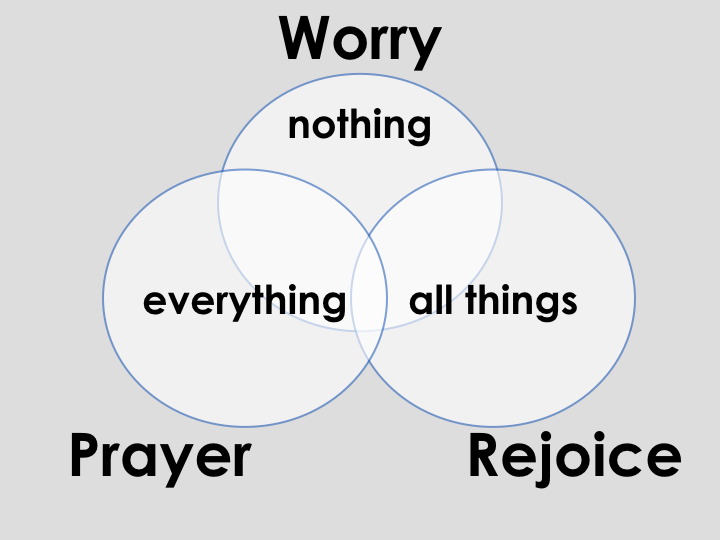
  • What should we worry about? Nothing! 
  • What should we pray about? Everything!
  • What should rejoice about? All things!  

This is the one and only path to transcendent peace! 

This is part two in our series The Antidote For Anxiety. Be sure to check out the video below, and also check out the first part of this series—Honk! Honk! Honk!