8 Quotes From “More Than A Carpenter”

more-than-a-carpenterMore Than A Carpenter by Josh & Sean McDowell is a wonderful resource to prepare you to share the uniqueness of Jesus Christ. Check out my book review by clicking here, and then enjoy these quotes that I especially found interesting.

“Why don’t the names of Buddha, Mohammed, or Confucius offend people the way the name of Jesus does? I think the reason is that these other religious leaders didn’t claim to be God.” —Josh McDowell

“It was reserved for Christianity to present to the world an ideal which through all the changes of eighteen centuries has inspired the hearts of men with an impassioned love; has shown itself capable of acting on an all ages, nations, temperaments, and conditions; has been not only the highest pattern of virtue, but the strongest incentive to its practice. … The simple record of these three short years of active fife has done more to regenerate and soften mankind than all the disquisitions of philosophers and all the expectations of moralists.” —William Lecky, one of Great Britain’s most noted historians and a fierce opponent of organized Christianity

“This testimony [that Jesus was God], if not true, must be downright blasphemy or madness. … Self-deception in a matter so momentous, and with an intellect in all respects so clear and so sound, is equally out of the question. How could He be an enthusiast or a mad man who never lost the even balance of His mind, who sailed serenely over all the troubles and persecutions, as the sun above the clouds, who always returned the wisest answer to tempting questions, who calmly and deliberately predicted His death on the Cross, His resurrection on the third day, the outpouring of the Holy Spirit, the founding of His church, the distraction of Jerusalem—predictions which have been literally fulfilled? A character so original, so complete, so uniformly consistent, so perfect, so human and set so high above all human greatness, can be neither a fraud nor a fiction. The poet, as has been well said, would in this case be greater than the hero. It would take more than a Jesus to invent a Jesus.” —Philip Schaff

“There exists no document from the ancient world witnessed by so excellent a set of textual and historical testimonies, and offering so superb an array of historical data on which an intelligent decision may be made. An honest [person] cannot dismiss a source of this kind. Skepticism regarding the historical credentials of Christianity is based on an irrational bias.” —Clark H. Pinnock

“The Gospels tell us Jesus’ family, including James, were embarrassed by what He was claiming to be. They didn’t believe in Him; they confronted Him. In ancient Judaism it was highly embarrassing for a rabbi’s family not to accept him. Therefore, the Gospel writers would have no motive for fabricating this skepticism if it weren’t true. Later the historian Josephus tells us that James, the brother of Jesus, who was the leader of the Jerusalem church, was stoned to death because of his belief in his brother. Why did James’ life change? Paul tells us: the resurrected Jesus appeared to him. There’s no other explanation.” —J. P. Moreland

“The resurrection takes the question ‘Is Christianity valid?’ out of the realm of philosophy and makes it a question of history.”

“I believe in the resurrection, partly because a series of facts are unaccountable without it.” —Michael Ramsey, former Archbishop of Canterbury

“The Old Testament contains sixty major messianic prophecies and approximately 270 ramifications that were fulfilled in one Person, Jesus Christ. … We find the chances of just forty-eight of these prophecies being fulfilled in one person to be only 1 in 10157. … All of the prophecies about the Messiah were made at least four hundred years before He was to appear. … This description of the manner of [Christ’s] death was written eight hundred years before the Romans used crucifixion as a method of execution.” —Josh McDowell

I am always sharing quotes from More Than A Carpenter and other interesting authors regularly on both Twitter and Tumblr. Please make sure you are following me there as well to see these quotes as soon as they are posted.

Thursdays With Oswald—A New Perspective Of Calvary

Oswald ChambersThis is a weekly series with things I’m reading and pondering from Oswald Chambers. You can read the original seed thought here, or type “Thursdays With Oswald” in the search box to read more entries.

A New Perspective Of Calvary

     If Jesus Christ were only a martyr, His Cross would be of no significance; but if the Cross of Jesus Christ is the expression of the secret heart of God, the lever by which God lifts back the human race to what it was designed to be, then there is a new attitude to things. … 

     There are any number of amateur skeptics, and the men who are seeing the difference between “believing their beliefs,” and “believing God,” men, who, through the turmoil and the stress, are seeing that rationalism is not the basis of thing. According to the Bible, the basis of things is tragedy, and the way out is the way made by God in Redemption. The New Testament does not say that the human race is evolving, but that the human race is a magnificent ruin of what it was designed to be. …

     Paul says the fundamental revelation of the New Testament is that God redeemed the whole human race when they were spitting in His face, as it were. … 

     The majority of people who have never been touched by affliction see Jesus Christ’s death as a thing beside the mark. When a man gets to his wits’ end and things go hard with him, his thick hide is pierced and he is stabbed wide awake, then for the first time he begins to see something else—“At last I see; I thought that He was stricken, smitten of God and afflicted; but now I see He was wounded for my transgressions.” … 

     Jesus Christ did not come to give us pretty ideas of God, or sympathy with ourselves; He came from a holy God to enable men, by the sheer power of His Redemption, to become holy.

From The Shadow Of An Agony

Oswald Chambers wrote these words in the midst of The Great War (what we now refer to as World War I), when everyone’s belief in rationalism was shaken to the core. Tragedy has a tendency to do that to us.

Chambers says that trouble in this world should point us to the unshakable, inescapable truth that this world is “a magnificent ruin of what it was designed to be,” and the only security and hope we have is a new life with God though the Redemption Jesus paid for at Calvary.

May any pain, suffering, or confusion you feel in this world help you see the Cross of Christ in a whole new light.

The Qur’an And The Bible

Answering JihadIn his outstanding book Answering Jihad, Nabeel Qureshi gives us an understanding of the beliefs which support the Islamic faith. One thing that is key for Muslims is their reliance on multiple sources for definitive answers to their faith. Nabeel explains it this way…

“The Qur’an that was the first Arabic book ever put into writing, and the Arabic script of the seventh century remained too deficient to capture the richness and complexities of its text. … Muslim biographers begin to write about Muhammad’s life around 770 A.D.” 

“By the middle of the ninth century, there were more than 500,000 traditions of Muhammad’s life in written and oral circulation, and Muslim scholars decided to undertake the effort of sifting through them and distilling the most authentic accounts.” 

“Since there are thousands of verses in the Qur’an and hundreds of thousands of hadith, it is expected that only trained Muslim jurists can engage in determining what sharia teachers. The jurist must give primacy to the Qur’an, then consider the actions (sunnah) and sayings (hadith) of Muhammad, followed by reviewing the consensus of Islamic scholars, or ijma, before using his own reasoning (qiyas). By following these four steps, a Muslim jurist can make a decision, or fatwa, about what sharia teaches on a given matter. The ultimate goal is to apply the teachings of sharia to Muslim life, and that is called fiqh.” 

“As is probably clear by now, at no point was the average Muslim expected to read the Qur’an to decide upon correct Islamic practices by himself or herself. Not only is Islam not a faith that upholds the sufficiency of scripture alone, the complexity of its foundations virtually necessitates a reliance on jurists and scholars for proper practice.” 

I prefer to pattern my life after the Bible, a book which I am free to read on my own. It’s authenticity has been well-established, and it doesn’t require me to find an “expert” in the texts and traditions to explain to me how to live my life.

I would highly recommend you read two books by Nabeel Qureshi: Seeking Allah, Finding Jesus and Answering Jihad. If you are curious about the claims of the Bible, you can check out God-Breathed and Questions Christians Hope No One Will Ask. And if you want to dig any deeper, search this website for the quotes I have posted from all four of these books.

Archeological Study Bible (book review—part 2)

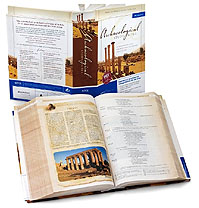
Archeological Study BibleI wrote a review on the Archeological Study Bible when I was roughly halfway through the Bible, but as I have now finished, I thought another review was in order.

Zondervan did an amazing job on this project! I love reading the Bible, and I love studying history, and this study Bible helped me to do both of those things without getting lost on too many “rabbit trails.” Some study Bibles I have read require a lot of page flipping to follow a thought or do a little research. But the ABS kept the historical articles, maps, and graphics close at hand to the biblical text I was reading, so page flipping was kept to a minimum.

At over 2300 pages, there is so much history that came alive as I read through the Bible. I also read through the Bible in chronological order, so I really felt like the ABS was helping me move seamlessly along the timeline of history.

Purchasing this Bible gives you access to an online gallery of many of the photos and other study materials. I also purchased the Kindle version of this Bible, to make searching for content much easier.

If you are looking for a fresh way to study the history surrounding the Scripture, I highly recommend the Archeological Study Bible to you.

10 Quotes On The Difference Between Christianity And Islam

Nabeel Qureshi wrote a couple of outstanding books to help those in the West better understand Islam (Seeking Allah, Finding Jesus and Answering Jihad).

Answering JihadIn Answering Jihad, Nabeel invests several chapters in looking at the differences between Christianity as displayed in the Bible and Islam as displayed in the Quran. Here are some of the more noteworthy quotes I pulled from this book. The references in parenthesis in these quotes are references to a chapter and verse in the Quran.

“Christians believe Jesus is God, but the Quran is so opposed to this belief that it condemns Jesus worshipers to hell (5:72).”

“According to Jesus, God is our Father, yet the Quran very specifically denies that God is a father (112:1-4).”

“Islam roundly condemns worship of the Trinity (5:73), establishing in contrast its own core principle of Tawhid, the absolute oneness of God. Tawhid emphatically denies the Trinity, so much so that it is safe to say the doctrine of God in Islam is antithetical to the doctrine of God and Christianity. … The Trinity teaches that God is not a person, but three Persons: Father, Son, and Spirit. To assert that the God of Islam is the same person as the God of Christianity becomes almost nonsensical at this point, as the Christian God is tripersonal, two persons of Islam specifically denies in the Quran.”

“The Trinity is an elaboration of Jewish theology, not a rejection. By contrast, Tawhid is a categorical rejection of the Trinity, Jesus’ deity, and the Fatherhood of God, doctrines that are grounded in the pages of the New Testament and firmly established centuries before the advent of Islam. The earliest Christians were all Jews, incorporating their encounter with Jesus into their Jewish theology. Nothing of the sort is true of Muhammad, who was neither a Jew nor a Christian. Islam did not elaborate on the Trinity but rejected and replaced it.”

“Christians worship the triune God: a Father Who loves unconditionally, a Son Who incarnates and Who is willing to die for us so that we may be forgiven, and an immanent Holy Spirit Who lives in us. This is not who the Muslim God is, and it is not what the Muslim God does. Truly, Tawhid is antithetical to the Trinity, fundamentally incompatible and only similar superficially and semantically. Muslims and Christians do not worship the same God.”

“The warfare the Quran commands is not due to any evil action, but rather due to the beliefs of non-Muslims, such as the Christian belief that Jesus is the Son of God (9:29, 30).”

“Warfare in the Old Testament is not about subjugating inferior peoples. Yahweh does not promise the Jews that they are the best of people and that their enemies are less than they are. He makes this quite clear in Deuteronomy 9:4-6. … The Quran, by contrast, envisions Muslims as the best people: ‘You are the best of all people, evolved for mankind’ (3:110). It teaches that Jews and Christians who do not convert to Islam are the worst of all creation: ‘Those who do not believe [in Islam] from among the Jews and Christians and the idolaters will go to hell. They are the worst of creatures’ (98:6; see 98:1-5 for context). This is why the Quran in 9:33 commands Muslims to fight Jews and Christians, so that Allah may cause Islam ‘to prevail over all religions.’”

“Muhammad’s life moved from peaceful to violent in a crescendo, reflecting the trajectory of the Quran, and he died just after conquering the Arabian Peninsula. His words in the canonical collections were, ‘I have been ordered by Allah to fight against the people until they testify that none has the right to be worshiped but Allah and that Muhammad is Allah’s messenger. … [O]nly then will they save their lives and property from me’ (Sahih Bukhara 1.2.25). Muslims are commanded to follow Muhammad’s example, and his example was jihad.

“By contrast, the stories in the Old Testament do not enjoin Jews or Christians to fight today. Though commands to fight are recorded in the text, no Jew or Christian is commanded to memorialize these battles as ongoing conduct. They were a part of the history of Israel, certainly, not a mandate or continuing command going forward.”

“Violence has a very different place in Islam and Christianity’s theological frameworks. The final marching order of Islam is jihad. The final marching orders of Christians are grace and love.”

But I especially love this thought from Nabeel: “One can both love Muslims and insist that the God they worship is not the same as the Christian God.” Amen!

Other quotes from Answering Jihad are here and here.

Additional quotes from Seeking Allah, Finding Jesus are here.

10 More Quotes From “Answering Jihad”

Answering JihadNabeel Qureshi has given us a very timely book in Answering Jihad. He cuts through the confusion and misinformation to give us an informed, clear look at the teachings of Islam in regard to jihad.

I already shared one set of quotes from this book (which you can read here). Here is the next set of quotes I found eye-opening.

“At the risk of over-generalizing, this common understanding of Islam boils down to this: True obedience to Allah will result in Muslim dominance.”

“I have heard many people, frustrated by the increasing frequency and scale of Islamist terrorism, suggest that Islam needs a reformation. What they may not realize is that radical Islam is the Islamic reformation. This might sound shocking, but consider: Just as the Protestant Reformation was an attempt to raze centuries of Catholic tradition and return to the canonical texts, so radical Islam is an attempt to raze centuries of traditions of various schools of Islamic thought and return to the canonical texts of the Quran and Muhammad’s life.”

“Violent expressions of Islam adhere more consistently and more literally to the foundational texts of the Islamic faith, the Quran and the hadith. Peaceful versions of Islam must reinvent traditions from Muhammad’s life in order to be internally consistent, or they must ignore them outright.”

“Instead of fearing Muslim immigrants, we should embrace them and be the element of change we wish to see. … I suggest friendship rather than fear has a better way forward.”

“Christians believe Jesus is God, but the Quran is so opposed to this belief that it condemns Jesus worshipers to hell (5:72).”

“According to Jesus, God is our Father, yet the Quran very specifically denies that God is a father (112:1-4).”

“Islam roundly condemns worship of the Trinity (5:73), establishing in contrast its own core principle of Tawhid, the absolute oneness of God. Tawhid emphatically denies the Trinity, so much so that it is safe to say the doctrine of God in Islam is antithetical to the doctrine of God and Christianity. … The Trinity teaches that God is not a person, but three Persons: Father, Son, and Spirit. To assert that the God of Islam is the same person as the God of Christianity becomes almost nonsensical at this point, as the Christian God is tripersonal, two persons of Islam specifically denies in the Quran.”

“One can both love Muslims and insist that the God they worship is not the same as the Christian God.”

“In the Christian worldview, the exemplar for followers of God is no mere man but God Himself. Since God cares for those who are His enemies, even blessing them with rain, Christians ought to love their enemies and pray for those who persecute them, so that they can follow God’s example. This contrasts with the teaching of the Quran, where Allah tells Muslims, ‘O you who believe! Do not take my enemies or your enemies as allies, offering them your friendship when they do not believe’ (60:1). Of course, that is not to condemn the Quran, as it is counterintuitive to love one’s enemy. The Christian command may make little earthly sense, but it is the explicit teaching of Jesus.” 

“Even though Muslims are often raised with the teaching that ‘Islam is the religion of peace,’ when they study the texts for themselves, they are faced with the reality that Muhammad in the Quran calls for jihad. They will stand at the crossroads for only so long before they choose what path they will take—apostasy, apathy, or radicalization. As Muslims make that choice, it would benefit the whole world if they did not make it alone, or worse, with radical recruiters. We need to show compassion for Muslims and befriend them.”

Be sure to check out my review of Answering Jihad, and then pick up a copy for yourself.

9 Quotes On Socialism From “Churchill’s Trial”

Churchill's TrialWinston Churchill waged a lifelong battle against Socialism creeping into a democratic government. He felt it would ultimately undermine the freedoms of individual citizens. In Churchill’s Trial by Larry Arnn, significant space was given to this topic. Here are a few of the most noteworthy quotes on the evils of socialism.

“Human relations are not a contest in which the advantage of some requires the disadvantage of others. That means in turn that government need not have the authority to allocate resources, at least not comprehensively. A government with such power would be in one sense at war with any citizens who have more than others, effectively with all citizens but the few poorest.” —Larry Arnn

“I declare to you, from the bottom of my heart, that no Socialist system can be established without a political police. Many of those who are advocating Socialism or voting Socialist today will be horrified at this idea. That is because they are short-sighted, that is because they do not see where their theories are leading them. No Socialist Government conducting the entire life and industry of the country could afford to allow free, sharp, or violently-worded expressions of public discontent. They would have to fall back on some form of Gestapo, no doubt very humanely directed in the first instance.” —Winston Churchill

“The inherent vice of capitalism is the unequal sharing of blessings. The inherent virtue of socialism is the equal sharing of miseries.” —Winston Churchill

“Churchill’s differences with socialism proceed from this fundamental difference about nature. He thought that the equality for which socialism aimed was unnatural. He thought that it could not be achieved except by suppressing nature, including human nature, which would require the suppression of humans. He thought that because of this fundamental difference, socialism would result in impoverishment in economics, corruption in personal character, and despotism in politics. He thought that by nationalizing these areas of private life in which most human beings do their most urgent and fulfilling tasks, socialism would truncate the lives of ordinary people. For that reason he regarded socialism as dehumanizing.” —Larry Arnn

“A state that attempts to equalize things that are not inherently equal will be at war with human excellence. Some people are in fact wiser, braver, more generous, more skillful, more beautiful, stronger, and more active than others. This does not make them different in their rights, if those rights are defined as the right to employ their ability and gain or lose by their efforts. Both the equality of rights and the differences of human makeup are natural phenomena, and they must be accorded their sway. The attempt to equalize unequal things would, Churchill argued, produce resistance, which in turn would call forth from socialism more vigorous laws. This cycle will continue until all the rights of the people were gone.” —Larry Arnn

“Socialism knows that it can only operate through an agency of bureaucracy under the direction of an autocratic sect.” —Winston Churchill

“If you make 10,000 regulations you destroy all respect for the law.” —Winston Churchill 

“Property [means] every thing to which a man may attach a value and have a right; and which leaves to everyone else the like advantage.” —James Madison (emphasis in original)

“If evil systems corrupt good men, it is no less true that base men will dishonor any system, and while no bond of duty more exacting than that of material recompense regulates the relations of man and man, while no motion more lofty and that of self-interest animates the exertions of every class, and no hope beyond the limits of this fleeting world lights the struggle of humanity, the most admirable systems will merely succeed in transferring, under different forms and pretexts, the burden of toil, misery, and injustice from one set of human shoulders to another.” —Winston Churchill 

You can read my review of Churchill’s Trial by clicking here.

My first set of quotes from this book can be found by clicking here.

12 Quotes From “Churchill’s Trial”

Churchill's TrialIn Churchill’s Trial, Larry Arnn has given us a fascinating look at Winston Churchill’s battle to keep freedom alive, both in the moment of crisis and after the crisis has passed. You can read my full book review by clicking here. Below are a few of the quotes I highlighted as I read.

“Mankind has never been in this position before. Without having improved appreciably in virtue or enjoying wiser guidance, it has got into its hands for the first time the tools by which it can unfailingly accomplish its own extermination. That is the point in human destinies to which all the glories and toils of men have at last lead them. They would do well to pause and ponder upon their new responsibilities. Death stands at attention, obedient, expectant, ready to serve, ready to shear away the peoples en masse; ready, if called upon, to pulverize, without hope of repair, what is left of civilization. He awaits only the word of command. He awaits it from a frail, bewildered being, long his victim, now—for one occasion only—his master.” —Winston Churchill 

“Science is necessary, and also science is a master. As the human ability to make grows, the human ability to control the engines by which we make diminishes. The logical problem is relentless: we may stay as we are and lead shorter lives of pain and trouble, or we may use our capacity to make our lives easier and safer. If we do that we will gain power, and we can use that power against ourselves.” —Larry Arnn

“No material progress, even though it takes shapes we cannot now conceive, or however it may expand the faculties of man, can bring comfort to his soul.” —Winston Churchill 

“We must never cease to proclaim in fearless tones the great principles of freedom and the rights of man which are the joint inheritance of the English-speaking world and which through Magna Carta, the Bill of Rights, the Habeas Corpus, trial by jury, and the English common law find their most famous expression in the American Declaration of Independence. …

“All this means that the people of any country have the right, and should have the power by constitutional action, by free unfettered elections, with secret ballot, to choose or change the character or form of government under which they dwell; that freedom of speech and thought should reign; that courts of justice, independent of the executive, unbiased by any party, should administer laws which have received the broad ascent of large majorities or are consecrated by time and custom. Here are the title deeds of freedom what should lie in every cottage home. Here is the message of the British and American peoples to mankind. Let us preach what we practice—let us practice what we preach.” —Winston Churchill

“There is enough for all. The earth is a generous mother; she will provide in plentiful abundance food for all her children if they will but cultivate her soil in justice and in peace.” —Bourke Cockran

“Human relations are not a contest in which the advantage of some requires the disadvantage of others. That means in turn that government need not have the authority to allocate resources, at least not comprehensively. A government with such power would be in one sense at war with any citizens who have more than others, effectively with all citizens but the few poorest.” —Larry Arnn

“In republics, the greater danger is that the majority may not sufficiently respect the rights of the minority.” —James Madison

“He who molds public sentiment goes deeper than he who enacts statutes or pronounces decisions.” —Abraham Lincoln

“Democracy properly understood means the association of all through the leadership of the best.” —Winston Churchill

“Our hearts will ache…if we have not a vision above material things.” —Winston Churchill

“If men were angels, no government would be necessary. If angels were to govern men, neither external nor internal controls on government would be necessary.” —James Madison

“We now watch the workings of a written Constitution enforced by a Supreme Court according to the letter of the law, under which anyone may bring a test case challenging not merely the interpretation of the law, but the law itself, and if the Court decides for the appellant, be he only an owner of a few chickens, the whole action of the Legislature and the Executive becomes to that extent null and void.” —Winston Churchill 

More quotes coming soon…

Churchill’s Trial (book review)

Churchill's TrialI have read so much written by and about Winston Churchill, that it’s hard to imagine learning something new about this remarkable man. And yet, I was amazed at how much more I learned in reading Churchill’s Trial by Larry Arnn.

It’s easy to take for granted the freedoms people have in countries like England and the United States because of the foresight of the framers of our Constitutions. But there are trials which put these freedoms in a precarious place, and if it were not for strong and insightful men—like Winston Churchill—those freedoms could have disappeared.

Churchill played key roles in his country, and in world politics, through two world wars, a global depression, the coming of age of new military super-powers, the dawn of the era of atomic warfare, and the rise of Communism. In all of these intense events, the temptation was there to make radical changes to meet the challenge of the moment. Churchill had the wisdom and foresight to leverage the strength of his country’s Constitution, without undermining it nor setting a precedent which would erode future freedoms.

In what Churchill did for England, he also helped strength the resolve of key leaders in the United States, who faced similar challenges in a shifting geopolitical climate. Churchill not only saved the world from the spread of fascism and communism, but he did so in a way that would guarantee freedom for millions of people in generations to follow. The question before us now is: Will we learn from Churchill’s example, or will we fail the trial we now face?

For history buffs, political junkies, and fans of Winston Churchill, Churchill’s Trial is an excellent read.

I am a Thomas Nelson book reviewer.

Book Reviews From 2015