“Love of the Word appears preeminently in our Lord and Savior Jesus Christ. He read it publicly. He quoted it continually. He expounded it frequently. He advised the Jews to search it. He used it as His weapon to resist the devil. He repeatedly said, ‘The Scripture must be fulfilled.’ Almost the last thing He did was to ‘open their minds so they could understand the Scriptures’ (Luke 24:45). I am afraid that man cannot be a true servant of Christ, who has not something of his Master’s mind and feeling towards the Bible.” —J.C. Ryle, Bible Reading
“The character of our praying will determine the character of our preaching. Light praying will make light preaching. …The preacher must be preeminently a man of prayer. His heart must graduate in the school of prayer. In the school of prayer only can the heart learn to preach.” —E.M. Bounds, Power Through Prayer
“Some pastors and preachers are lazy and no good. They do not pray; they do not read; they do not search the Scripture. … The call is: watch, study, attend to reading. In truth you cannot read too much in Scripture; and what you read you cannot read too carefully, and what you read carefully you cannot understand too well, and what you understand well you cannot teach too well, and what you teach well you cannot live too well. … The devil … the world … and our flesh are raging and raving against us. Therefore, dear sirs and brothers, pastors and preachers, pray, read, study, be diligent.” —Martin Luther
Listen to the podcast of this post by clicking on the player below, and you can also subscribe on Apple, Spotify, or Audible.
God needed to use Philip to steer a God-seeking government official to Jesus Christ. After this brief one-on-one encounter, God removed Philip from the scene and almost entirely from the pages of history.
Philip had just been leading a huge revival in Samaria, but he didn’t count success by the nickels-and-noses metrics of the world. He obeyed God even to the point of “taking a step backwards” in the world’s eyes, but in God’s eyes it was the most successful of moves.
Don’t try to grow your ministry. First, because it’s not yours, it’s His; and second, because your measure of success is probably more slanted toward quantitative measurements than qualitative. Jesus wasn’t concerned about bigger numbers: “What do you think?” He asked, “If a man has a hundred sheep, and one of them goes astray, does he not leave the ninety-nine and go to the mountains to seek the one that is straying?” (Matthew 18:12). …
What’s the value of one government official’s life? God says that his value is incalculable. Apparently, God knew that Philip was the perfect shepherd to lead this Ethiopian to the pasture where he would accept Jesus as his Savior. Philip was obedient, a sheep was saved, and God was pleased. …
The Chief Shepherd made this commitment to His sheep: “And I will give you shepherds according to My heart, who will feed you with knowledge and understanding” (Jeremiah 3:15). My prayer is that we would much rather feed a few sheep where God has directed us and given us His heart than for us to try to manufacture success that is measured by how many nickels and noses we can count.
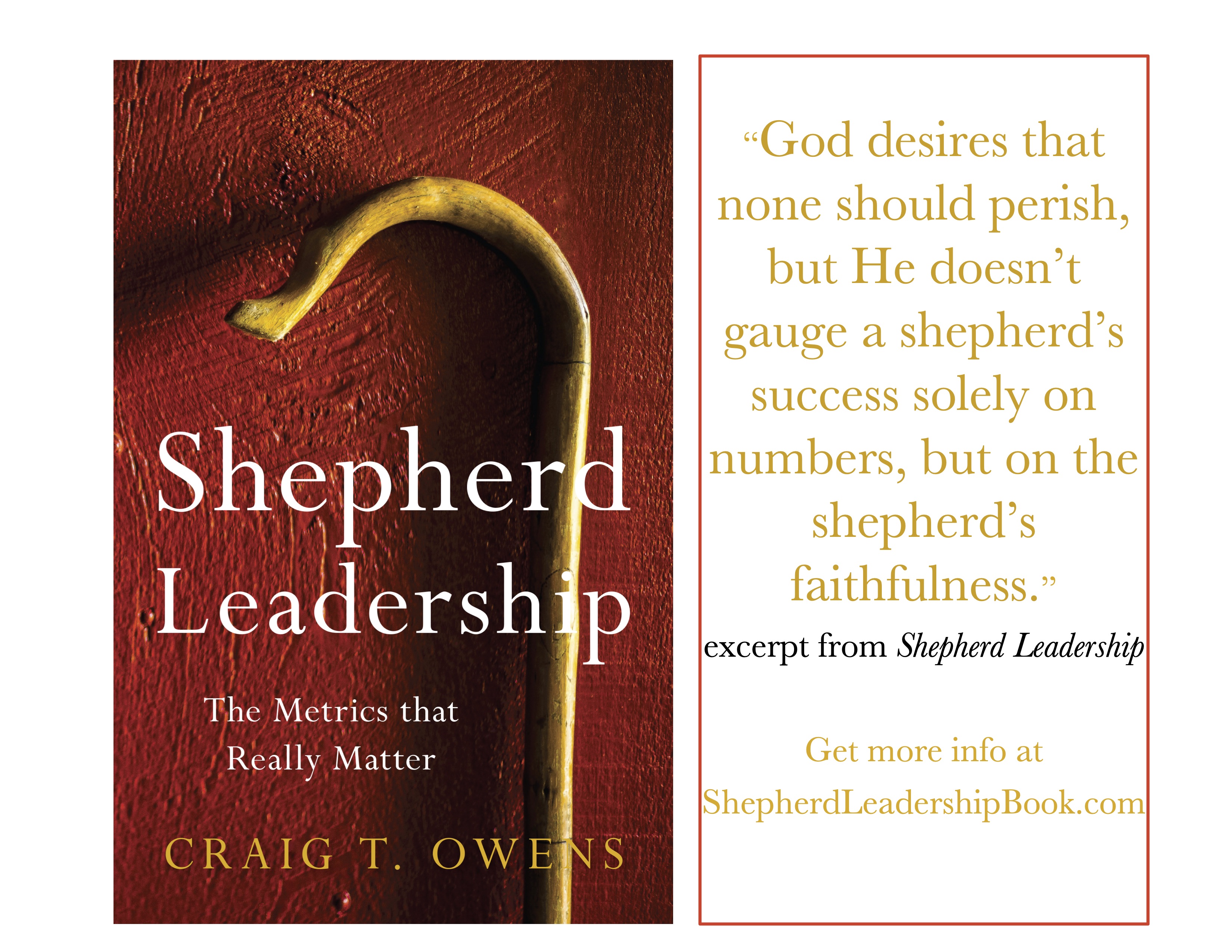
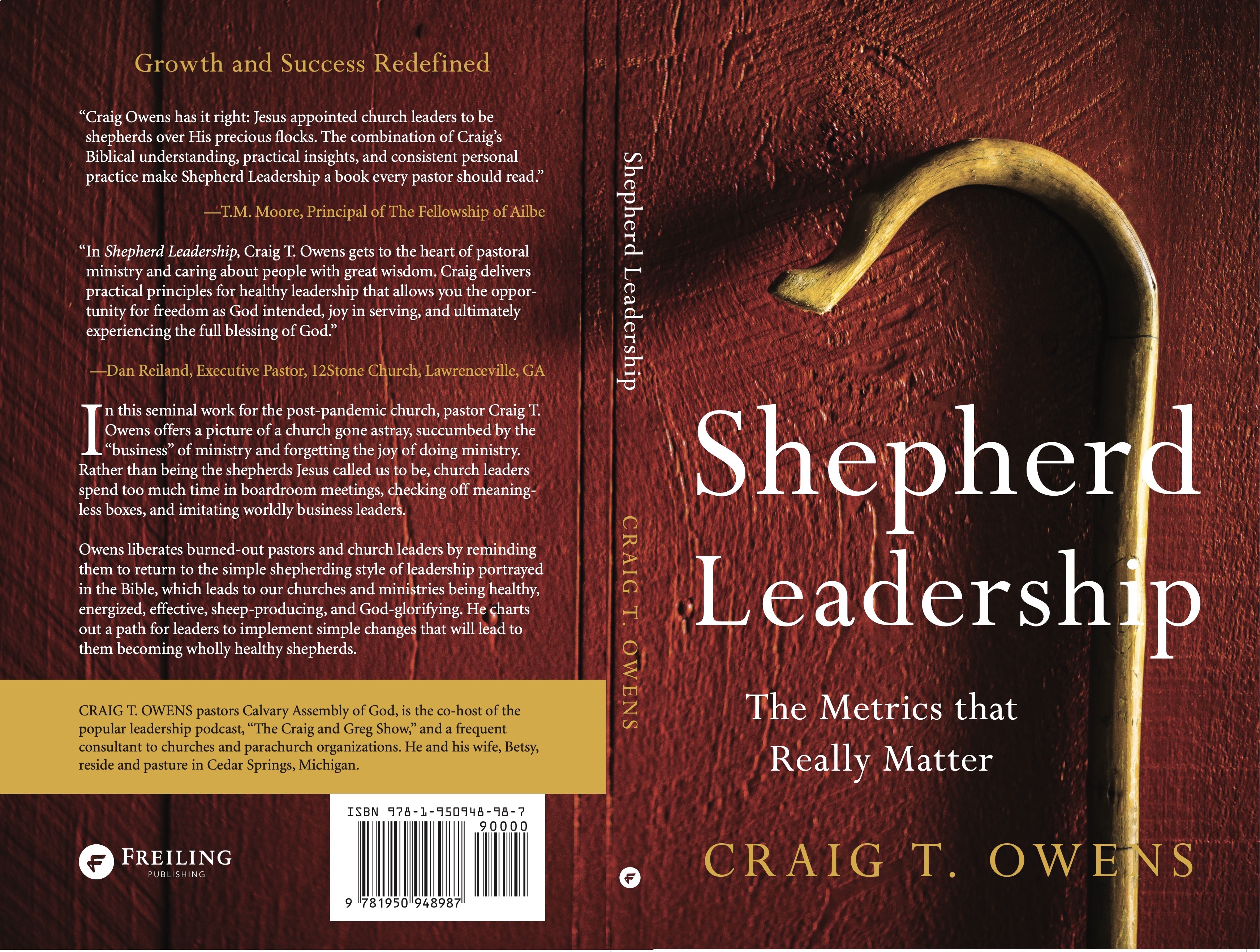
I’ll be sharing more clips from this book signing event soon, so please stay tuned. Shepherd Leadership: The Metrics That Really Matter is available in print or ebook, and in audiobook through either Audible or Apple.
On a recent episode of our leadership podcast, Greg Heeres and I were discussing how easy it is for people to slip into a complaining attitude. One of the things I point out is that if we ask for compliments instead of complaints, we can begin to change the culture of our organization.
I wrote Shepherd Leadership: The Metrics That Really Matter to encourage pastors who are tired and struggling with feelings of failure. One of the most powerful sources of encouragement is more leaders surrounding a tired pastor.
I have a chapter dedicated to this called “Going Farther.” Here’s a short excerpt—
You will not only extend your leadership by having other servant-hearted shepherds around you, but you will also have a guard against the aloneness that led to such ugly warts on the biography of otherwise powerful leaders such as David, Elijah, and Peter.
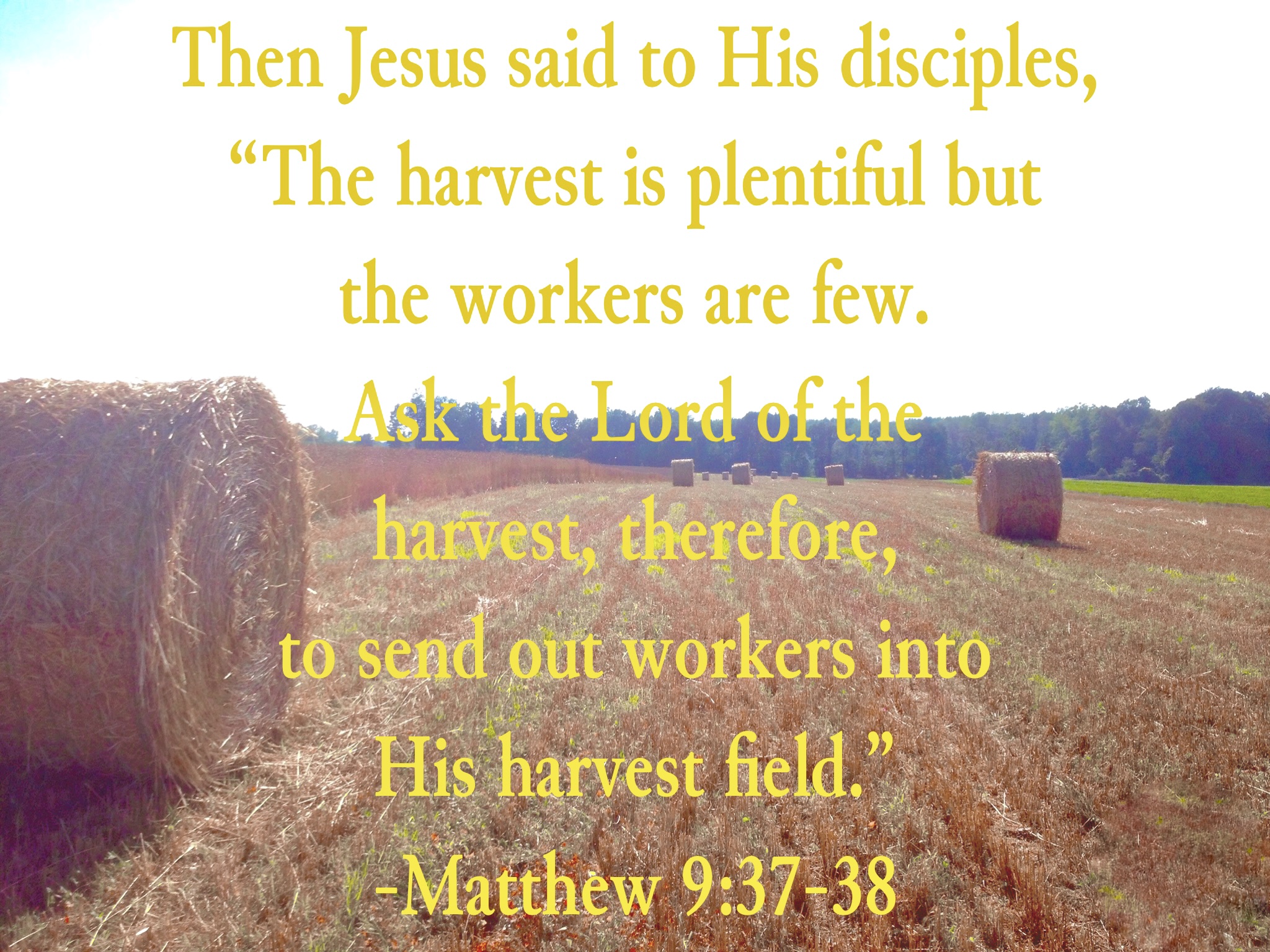
Jesus told us to pray to the Lord of the Harvest to send out more workers into the field (Luke 10:2). In a similar attitude, I believe we can pray to the Chief Shepherd to send out more under-shepherds into the pastures; specifically, we can pray for those under-shepherds to be sent into the pasture where we labor. The early church showed us the example of prayer being the priority when new shepherds were needed (Acts 1:21-26, 6:3-6, 13:1-3; 2 Timothy 1:3-6). We would do well to make it a priority to pray for God to send us godly leaders that can serve alongside us.
If you are a pastor, please pick up a copy of this book, as I truly believe it will encourage you. If you love your pastor, please give him or her a copy as a gift. I promise you that this book will bring such a fresh perspective to their ministry.
And whether you are a pastor or a lay leader in your church, please continue to pray for God to send more laborers into your harvest field.
Listen to the podcast of this post by clicking on the player below, and you can also subscribe on Apple, Spotify, or Audible.
Last week here in wintry Michigan we had a couple of snow days (for those of you in non-snow states, that means the roads were too dangerous even for us Michiganders, so the schools were closed). Students and teachers too “work” very hard for snow days. By that I mean they try a bunch of tactics that are supposed to increase the likelihood of school being called off—like flushing ice cubes down the toilet, wearing their PJs inside-out, or even sleeping with a spoon under their pillow.
But I’ve also noticed it’s not just praying for snow days where people employ some tactics they think will help things go their way. Like saying, “Pretty please with sugar on top” when trying to get special favor, or athletes not saying anything at all to a teammate who’s on the brink of something historic, or business people saying, “Wish me luck” before going into the big meeting. And even Christians who end their prayer with, “In Jesus’ name, Amen” to help make their prayer answerable.
In case you haven’t noticed, just saying that phrase is not some magical, abracadabra formula for success (for some very notable examples of this check out Matthew 7:21-23 and Acts 19:13-16).
But still, Jesus does specifically say, “And I will do whatever you ask in My name, so that the Father may be glorified in the Son. You may ask Me for anything in My name, and I will do it” (John 14:13-14).
This is where context is king. In John 13-16, Jesus is giving His final instructions to His disciples before His arrest and crucifixion. They are clearly anxious about His departure because chapter 14 opens with the words, “Do not let your hearts be troubled.”
In this passage of John 14, Jesus is giving the disciples the basis for their confident hope in Him. He tells them that He is THE way to the Father (they don’t have to look for another path), and He is THE revelation of the Father (He will make the Father’s will crystal clear to them).
Jesus tells them that He has been doing His Father’s work, which is verified by the evidence of the miracles—or we could say the answers to His prayers (v. 10-11). Jesus wants His followers to pray this same way, live this same way, and see even greater things done in His name (v. 12).
So we can infer from this that praying in the name of Jesus essentially means two things:
We pray in harmony with the character of Jesus. That means that we pray prayers that Jesus Himself would pray. If you cannot imagine Jesus asking for what you’re asking for, then it’s not in alignment with His character.
We pray in faith in the supreme authority of Jesus to do what we ask. Jesus is Supreme over everything else. To pray in His name means we look for answers from no other source.
I think the key to understanding this is found in the small preposition Jesus uses 12 times in this passage: IN.
Jesus is IN the Father, the Father is IN Jesus, and the Holy Spirit is IN us. This means that we are also IN the Father with Jesus!
Which means we don’t have to try to be like Jesus or to merely imitate Him, but we let the Holy Spirit sanctify us into the character of Jesus.
When I talk to my Dad I don’t have to remind myself that I am his son—I just am his son. I don’t have to carefully calculate how I’m going to make requests of him. I know his heart, and I know my inseparable relationship with him, so I just talk to him.
Have you ever noticed in the Gospels that when Jesus does a miracle, He doesn’t pray the way that we typically pray? When the man with leprosy came to Jesus, He merely said, “Be clean.” I think we might have bowed our heads, closed our eyes, placed our hands on him and said something like, “Dear heavenly Father, if it’s Your will bring Your healing touch to our dear brother. In Jesus’ name we pray, Amen.” But Jesus knew the Father’s heart was to heal this suffering man, so Jesus simply spoke the words. His statement was a prayer that resonated with the heart of His Father, and that prayer was immediately answered.
The Holy Spirit is sanctifying you to pray this same way:
He wants to mold your heart to be passionate for the things of the Father—John 5:17
He wants to transform your mind to think the Father’s thoughts—John 16:13-14
He wants to soften your will to be yielded to the will of the Father—Matthew 26:36-44
He wants to settle your emotions to be at peace in the Father—John 14:1
He wants to even change your vocabulary to the very words Jesus would use—John 12:49
When your heart, mind, will, and emotions are being sanctified, the supremacy of Jesus will naturally be at the forefront of everything you feel, think, do, and say. Then you will be naturally praying in the name and character of Jesus for God’s glory to be seen.
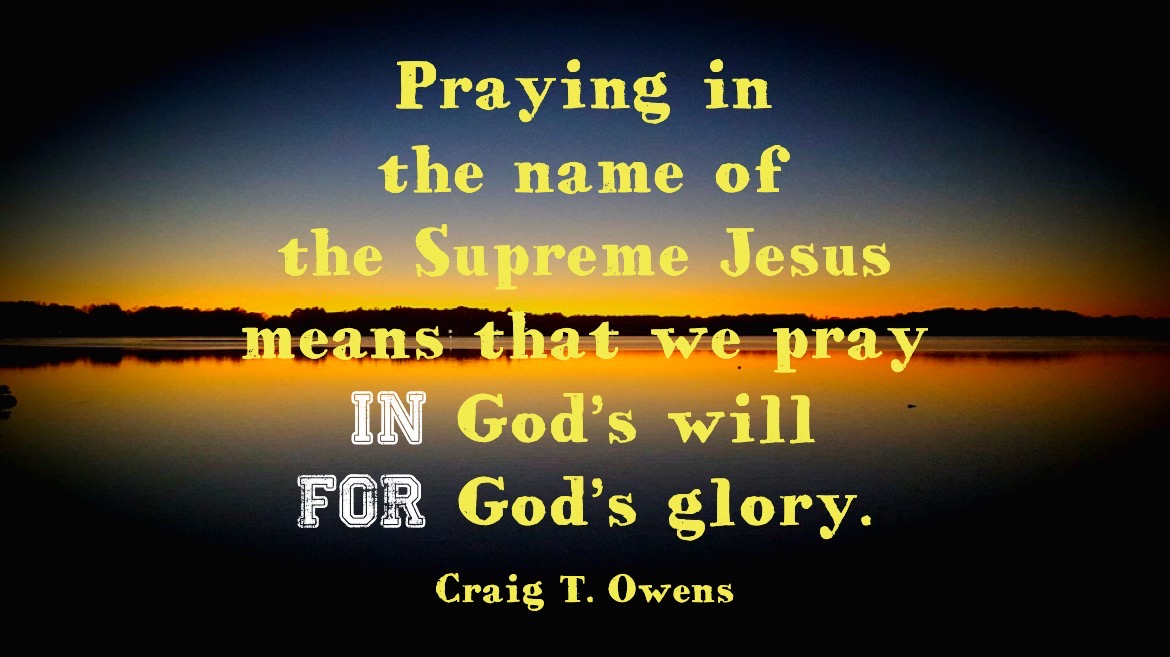
Praying in the name of the Supreme Jesus means that we pray IN God’s will FOR God’s glory.
To see all of the messages in our series called Awesome: Learning to pray in the awesome name of Jesus, please click here.
“If a claim to spiritual revelation leads us to depend less on the once-for-allness of the historical Word that comes to us by Jesus Christ through the apostles (Hebrews 2:3), then that claim is dubious.” —John Piper
“God, change me today because I have spent time being exposed to Your thoughts in Scripture. As risky as it is, I want Your Word to cut away everything in me that doesn’t look like Jesus.” —Kenneth Blanchard (see Hebrews 4:12)
A scrip on my back, and a staff in my hand, I march on in haste through an enemy’s land; The road may be rough, but it cannot be long; And I’ll smooth it with hope, and I’ll cheer it with song. —Henry Francis Lyte
Listen to the podcast of this post by clicking on the player below, and you can also subscribe on Apple, Spotify, or Audible.
I had a great time on the Ailbe Podcast with Rusty Rabon.
Usually leaders want their lives and their organizations to be tension-free. But I’m advocating that healthy shepherd leaders actually embrace the tension.
God has wired us all uniquely, but I’ve found that many leaders are slightly unbalanced in their wiring. That is, most of us are naturally more confident or naturally more humble. God made you that way on purpose, but confident leaders are allowing the Holy Spirit to temper their confidence with humility, and humble leaders are allowing the Holy Spirit to bolster their humility with confidence.
The seed thought for this concept that figures prominently in my book Shepherd Leadership was one that I’ve been wrestling with for over a decade. If you’re interested, you can check out this post.
I’ll be sharing more clips from this interview soon, so please stay tuned. Shepherd Leadership: The Metrics That Really Matter is now available in print or ebook, and in audiobook through either Audible or Apple.
This is a weekly series with things I’m reading and pondering from Charles Spurgeon. You can read the original seed thought here, or type “Thursdays With Spurgeon” in the search box to read more entries.
Listen to the podcast of this post by clicking on the player below, and you can also subscribe on Apple, Spotify, or Audible.
Beautiful Homegoing
You shall come to the grave at full age, as a sheaf of grain ripens in its season. (Job 5:26)
The Christian’s death is always timely. ‘You shall come to the grave at full age.’
‘Ah,’ says one, ‘that is not true. Good people do not live longer than others. The most pious man may die in the prime of his youth.’ But look at my text. It does not say you will come to your grave in old age, but in a ‘full age.’ … All fruits do not get ripe and mellow at the same season. So it is with Christians. They are at a ‘full age’ when God chooses to take them home. …
There are two mercies to a Christian. The first is that he will never die too soon. And the second is that he will never die too late. …
‘But,’ say some, ‘how useful might they have been had they lived.’ Ah, but how damaging they might have been! And were it not better to die than to do something afterward that would disgrace them and bring disgrace to the Christian character? Were it not better for them to sleep while their work was going on than to break it down afterward? …
Again, the Christian never dies too late. … God is too good a Husbandman to leave His wheat in the field too long and let it shale out. …
Now the last thing is that a Christian will die with honor. … I think there are two funerals for every Christian: one is the funeral of the body, and the other of the soul. Funeral, did I say, of the soul? No, I meant not so. I meant not so. It is a marriage of the soul. For as soon as it leaves the body, the angel reapers stand ready to carry it away. They may not bring a fiery chariot as they had for Elijah. But they have their broad spreading wings. I rejoice to believe that angels will come as convoys to the soul across the ethereal plains. … I think the most honorable and glorious thing we will ever behold, next to Christ’s entrance into heaven and His glory there, is the entrance of one of God’s people into heaven.
From The Death Of The Christian
As I mentioned last week, this sermon was so providential in its timing for me because my precious mother went Home to be with Jesus just days before I opened to this sermon from Charles Spurgeon.
We are comforted by the promises Rev. Spurgeon shares because they are based on the truth in God’s Word. “Good people pass away; the godly often die before their time. But no one seems to care or wonder why. No one seems to understand that God is protecting them from the evil to come. For those who follow godly paths will rest in peace when they die” (Isaiah 57:1-2).
At my Mom’s graveside committal service I shared this—
One of my favorite authorsC.S. Lewis made a comment, “You don’t have a soul. You are a soul. You have a body.”
This part that we called Claudia Owens was just the body that carried around who she really was. What a beautiful soul that we got to experience for 78 years. What shined through was so sweet and graceful and wonderful. What a glimpse we got! But a joy to know that it was only a glimpse. That the part of my Mom that was so beautiful that we got to see, was only a fraction of her full beauty! The part that was really her, that is at Home with her Savior Jesus now is shining in all its brilliance. …
We will all miss her and we will grieve our loss. But as the apostle Paul reminded us, we don’t grieve as those who have no hope. We know that to be absent from the body is to be present with the Lord. We know that this body is sown perishable ravaged by the disease of cancer, but that my Mom is now in a place with no more tears or disease. We know that the same Savior that prepared a place for Claudia has prepared a place for us.
And we concluded with this prayer that can be offered up for every Christian who has died at their “full age”:
Heavenly Father,
We commit this body to the ground with the full assurance that her soul is in your everlasting presence. Holy Spirit, help us in our grief to be reminded of the hope of eternal life that we all share. Thank You, Jesus, for purchasing this hope on which we stand.
As I mentioned last week, if you don’t have this blessed assurance of the marriage of your soul when you take your last breath here on earth, please don’t hesitate to contact me.
Listen to the podcast of this post by clicking on the player below, and you can also subscribe on Apple, Spotify, or Audible.
Isaiah 49 has an interesting phrase that appears twice: “But I said…” (vv. 4, 14).
Notice that first word: But. That conjunction means that “I” am saying something in contradiction to what someone else has said. Sadly, in this case the Someone Else that is speaking in this chapter is God Himself!
The phrase “this is what the LORD says” is used three times in this same chapter (vv. 8, 22, 25). Look at what God is saying to you and me:
I made you
I called you
you are My servant
I reward you
you have My favor
you have My comfort
I never forget you
I will never disappoint you
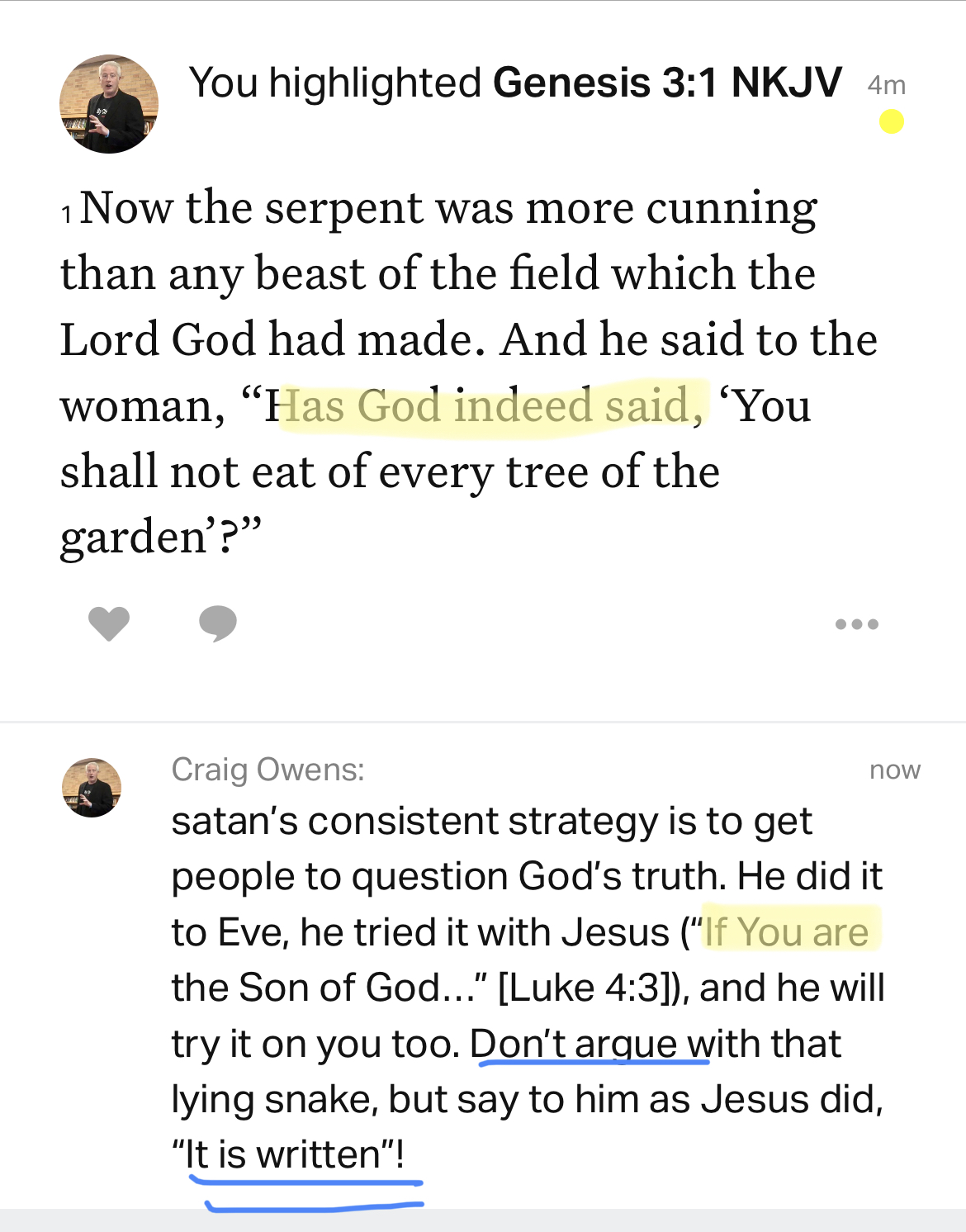
A consistent strategy of the devil is try to get us second-guessing or doubting God’s promises. He did this to Eve—“Did God really say that?”—and he tried it with Jesus—“Are You really the Son of God?”—and he’s still trying it today.
Jesus said the devil’s native tongue is lying. He lies and he slanders you. He wants you to simply listen to those lies without questioning them.
Someone once asked Smith Wigglesworth, “Smith, how do you feel?” He replied, “I never ask Smith how I feel. I tell him how he feels!”
That’s good counsel for us today!
Don’t listen to yourself, especially when you’re tired or lonely or anxious or scared, but talk to yourself. Remind yourself what God says to you and what He says about you. Remind those negative thoughts that God never lies, that He is all-loving, that He is all-powerful, and that He has a unique plan and purpose your life.
Whenever you feel like saying, “But I said,” change those thoughts around to, “But this is what God says!”
I’ve shared a couple of other posts that expand on this idea which you may want to read here and here.
This is a weekly series with things I’m reading and pondering from Charles Spurgeon. You can read the original seed thought here, or type “Thursdays With Spurgeon” in the search box to read more entries.
Listen to the podcast of this post by clicking on the player below, and you can also subscribe on Apple, Spotify, or Audible.
The Death Of The Christian
You shall come to the grave at full age, as a sheaf of grain ripens in its season. (Job 5:26)
Let me tell you a parable. Behold, two men sat together in the same house when Death came to each of them. He said to one, ‘You will die.’
That man looked at him. Tears suffused his eyes, and tremblingly he said, ‘O Death, I cannot! I will not die.’ He sought out a physician and said to him, ‘I am sick, for death has looked upon me. His eyes have paled my cheeks, and I fear I must depart. Physician, there is my wealth. Give me health and let me live.’ The physician took his wealth but gave him not his health with all his skill. The man changed his physician, tried another, and thought that perhaps he might spin out the thread of life a little longer.
But alas! Death came and said, ‘I have given you time to try your varied excuses. Come with me. You will die.’ And he bound him hand and foot and made him go to that dark land of Hades. As the man went, he clutched at every side post by the way, but Death, with iron hands, still pulled him on. … He did not come to his grave, but death fetched him to it; the grave came to him.
But death said to the other man, ‘I am come for you.’
He smilingly replied, ‘Ah, Death! I know you; I have seen you many a time. I have held communion with you. You are my Master’s servant. You have come to fetch me home. Go and tell my Master I am ready, whenever He pleases. Death, I am ready to go with you.’ And together they went along the road and held sweet company.
Death said to him, ‘I have worn these skeleton bones to frighten wicked men. But I am not frightful. I will let you see myself. The hand that wrote upon Belshazzar’s wall was terrible because no man saw anything but the hand. But,’ said Death, ‘I will show you my whole body. Men have only seen my bony hand and have been terrified.’
And as they went along, Death ungirded himself to let the Christian see his body, and he smiled, for it was the body of an angel. He had wings of cherubs and a body glorious as Gabriel. The Christian said to him, ‘You are not what I thought you were. I will cheerfully go with you.’ At last Death touched the believer with his hand. … So did Death put his finger on the man’s pulse and stopped it for a moment, and the Christian found himself by Death’s kind finger changed into a spirit. Yes, found himself brother to the angels. His body had been etherealized, his soul purified, and he himself was in heaven.
From The Death Of The Christian
I love God’s timing. In my ongoing series looking at the sermons of Charles Spurgeon, I simply turned the page to the next sermon for this week, and this parable was especially timed for me because my Mom just passed away on December 26.
What a godly woman she was!
What a thrill it is to know that Death did not take her to her grave, but that she came to her grave at full age, fully ripened in God’s timing. Our family is at peace because we know that my Mom is now at Home with her Savior Jesus—the home she has been longing for!
Our family loves the promise in 1 Thessalonians: And now, dear brothers and sisters, we want you to know what will happen to the believers who have diedso you will not grieve like people who have no hope (1 Thessalonians 4:13). We grieve because we will miss her, but we have such an unshakable hope of her eternal home! Paul goes on to tell us that we should “encourage each other with these words” (v. 18).
So let me encourage you, my friend, with this question: Will Death have to take you to the grave, or will you come willingly with him? If you have your sins forgiven because you have placed your faith in the sin-forgiving work Jesus Christ did upon His Cross, then Death will have no fear for you. If you are uncertain or fearful, don’t lose another moment! Pray to God: admit you are a sinner who is helplessly trapped in your sin, believe that Jesus paid the full penalty for your sin, and then ask God to forgive your sins because of your faith in Jesus. The moment you do that, you will be completely forgiven and the fear of Death will be removed.












 Craig T. Owens