“I believe this is keeping more people from having power with God than any other thing—they are not willing to cultivate the spirit of forgiveness. If we allow the root of bitterness to spring up in our hearts against some one, our prayer will not be answered.” …
“It may be that you are saying: ‘I do not know that I have anything against anyone.’ Has anyone anything against you? Is there someone who thinks you have done them wrong? Perhaps you have not; but it may be they think you have. I will tell you what I would do before I go to sleep tonight; I would go and see them, and have the question settled. You will find that you will be greatly blessed in the very act.” …
“It is human to err, but it is Christ-like to forgive and be forgiven.” …
“As Matthew Henry says: ‘We do not forgive our offending brother aright nor acceptably, if we do not forgive him from the heart, for it is that God looks at. No malice must be harbored there, nor ill will to any; no projects of revenge must be hatched there, nor desires of it, as there are in many who outwardly appear peaceful and reconciled. We must from the heart desire and seek the welfare of those who have offended us.’”
Check out more quotes from Prevailing Prayer by clicking here.
Check out my review of Prevailing Prayer by clicking here.
Christians often talk about God in terms of the “Trinity.” That is, the One True God revealed in three Persons: Father, Son, and Holy Spirit.
This is sometimes a difficult concept to grasp, especially since the word Trinity doesn’t specifically appear in the Bible. But make no mistake, just because the word isn’t there doesn’t mean it’s not true. Consider…
God’s Three-in-One nature is first exhibited when man is created (Genesis 1:26).
When the prophesy is given about Jesus being born in human flesh, He is given all the titles of the three Persons of the Godhead (Isaiah 9:6).
At Christ’s baptism we see Jesus in human form, we see the Holy Spirit descending as a dove, and we hear the Father’s voice announcing His approval of His Son (Matthew 3:16-17).
Jesus Himself said He would ask the Father to send the Holy Spirit to the Christians (John 14:16).
And just as Jesus ascended into Heaven, He told His followers to baptize people into all three Persons of the Godhead (Matthew 28:19).
But I think the best expression of the Trinity is revealed in three simple words. John talks about how all three Persons of the Trinity are involved in the life of a Christian. And then he sums it all up in three words—
“GOD IS LOVE”
Each Person of the Godhead is encouraging and illuminating and pointing to the other Persons in the Trinity. Love is perpetually being received and given. We humans are created in God’s image … we are created to receive and to give God’s love. That’s why John tells us that we know and rely on the love God has for us (that’s the receiving part), and that whoever lives in love lives in God, and God in him (that’s the giving part).
When Adam and Eve sinned, they were dis-membered from God. As a result, every human in their natural state longs for connection with God and others, but feels separated, isolated, unloved, and even unlovable.
Love re-members!
Jesus came to be broken and crushed and to feel the pain of separation from God. It was out of this brokenness that He could do the work of re-membering us to the fullness of the Trinity.
When Jesus shared His last supper with His disciples, He took bread (which is made from broken wheat kernels) and wine (which is made from crushed grapes). He told us as often as we eat the bread and drink the wine we are to remember how He was broken and crushed for us.
Remembering Christ’s work on the Cross re-members us to the fullness of the Trinity.
Sin and satan want to keep us feeling separated, unloved, and unloveable. But when we were the least worthy of His love, God—Who IS love—was broken and crushed to re-member us to Him.
If you feel lonely, separated, isolated, unloved or unloveable, I urge you to remember what Jesus did for you. He loved you enough to be broken and crushed for your re-membering to all of God’s love.
Check out this video where I explain this amazing thought in more detail…
Jesus had a way of praying that sounds unusual to our ears because He didn’t pray “normal” prayers. His prayers were bold statements! But Jesus also taught us to pray just like He did.
Most prayers that Christians pray sound like they come from the same formula. We may start with something like, “Heavenly Father” or “Dear God.” Then we probably spend some time praising God for His greatness before we make our requests of Him. Often our requests include something like “If this is Your will, I ask You to please heal/help/answer/etc.” And then almost always the prayer concludes, “In Jesus’ name, Amen!”
When Jesus prayed, His prayers sounded more like commands than requests. He would say things like, “Be clean” or “Rise up and walk” or “Blind eyes, be opened.” He usually didn’t ask His Father if it was His will to heal/help/answer/etc. And He never concluded a prayer by saying, “In My name, Amen!”
In Luke 6 there is a story about a man with a withered hand. Jesus healed him by speaking to the man, not to God. He said, “Stretch out your hand,” and when the man did so, his hand was completely restored. Jesus spoke with the authority of the Creator.
I believe this was possible because Jesus had an unbroken conversation with His Father and the Holy Spirit. Certainly He had set times of prayer (see Mark 1:35, Mark 6:45-46, and Luke 6:12-13 as examples), but Jesus also told us that He only did what His Father told Him to do (John 5:19), and He only said what His Father told Him to say (John 12:49).
I know sometimes people want to say, “Yeah, but this is Jesus we’re talking about! C’mon, He’s the Son of God, so of course He could do these things.” But remember that the miracle of Christ’s Incarnation is that He chose NOT to do these things out of His Deity while He was on Earth, but restricted Himself only to His humanity. That’s why the Bible says that everything we face, Jesus also faced in the flesh (Hebrews 2:14-18).
But perhaps another example from someone who had no Deity in his nature might help. Consider Joshua—this man spent more time in God’s presence, listening to His voice, than even Moses (Exodus 33:11). So when the time came, Joshua could pray an incredibly bold prayer: He actually spoke to the sun and the moon and told them to stand still in the sky, AND THEY OBEYED HIM!
Just like Jesus spoke to the man with the withered hand in the authority of the Creator, Joshua spoke to the sun and the moon in the same authoritative voice. How could these men do that? Because they were familiar with God’s voice, and when He told them to speak out boldly, they simply obeyed.
Jesus said we could pray the same way—Very truly I tell you, whoever believes in Me will do the works I have been doing, and they will do even greater things than these, because I am going to the Father. And I will do whatever you ask in My name, so that the Father may be glorified in the Son. You may ask Me for anything in My name, and I will do it (John 14:12-14, emphasis added).
How can we learn to pray this boldly? We need to spend more and more time in dialogue with God. We need to become increasingly aware of the His abiding presence with us. Then we, too, can pray in the Creator’s authority.
Praying this way glorifies God!
Get together with a friend this week and work through these application questions:
Am I spending time in planned prayer and Bible reading?
How can I make myself more aware of God’s perpetual presence?
Last week I asked you to imagine how your relationship grew with your best friend. You probably found that this special friendship was formed during hours andhours of talking.
I’m going to guess that at first your conversation was a little on the superficial side. You talked about “tame” topics like sports teams, or your job, or the city you lived in. But at some point you took a huge risk—you became vulnerable by sharing something really personal. Perhaps you shared a time that you got hurt, or something that makes you anxious, or maybe a big dream you carry around in your heart. But if that friend is still your friend, that means they treated what you shared reverently. They didn’t laugh at you, belittle your hurts or dreams, nor did they share with others what you said.
The relationships became deeper and more special because you now knew each other on a more intimate level.
Prayer is a conversation with a Friend. Of course, that Friend is God, so some people wonder, “What do I talk to God about?” The simple answer is anything and everything!
Time and time again God calls us to come closer to Him (see Isaiah 55:1-3), to discuss with Him things we don’t understand (Jeremiah 33:3), or to be assured that He is intimately tuned in to what’s happening in our life (Psalm 139:17; 1 Peter 3:12).
How do we get there? A good place to start is with our Bible. Dwight Moody said:
“The two first and essential means of grace are the Word of God and Prayer. … If we read the Word and do not pray, we may become puffed up with knowledge, without the love that buildeth up. If we pray without reading the Word, we shall be ignorant of the mind and will of God, and become mystical and fanatical, and liable to be blown about by every wind of doctrine.”
Scripture was written to point us to Jesus. So we don’t read the Bible just to read it; we read it to get to know God.
We don’t want to know the Word of God; we want to know the God of the Word.
A great place to start is in the book of the Psalms. Many of these were written as prayers, so it’s a good way to start our conversation with God. You can also search in the New Testament for all the places that biblical writers said, “I pray…” or “This is my prayer….”
I share a personal example of this in this video, especially if you want to fast forward to the 36:00 minute mark.
Don’t just read through the Bible this week—pray through the Bible. Use it as a means to have a conversation with the very Best Friend you could ever know!
I encourage you this week, as you think about this topic, to get together with an earthly friend and discuss these questions:
How can I use my Bible as a “conversation starter” with God?
How can I get into the regular practice of talking to God as a Friend?
I would like for you to get a really clear picture in your mind of your best friend. This is someone you have opened your heart to, and they have opened their heart to you as well. This is the friend that encourages you when you’re down, but never when you’re on a self-destructive path. This is the companion that cries with you when something is broken, but who also challenges you to accept responsibility if you are the one who broke it.
Do you have that friend clearly in mind?
Now I’d like you to imagine if your interaction with your friend went something like this. Every day around 7 o’clock in the morning, you call your friend and say…
“Good morning! I’m so grateful you took my call. Listen, I’ve got a few things that I’d love for you to help me with today. I’ve been fighting a cold and I’d really like you to help me feel better. My Aunt Sally is in the hospital, and it would be great if you could stop in to see her. Also, that guy at work has really been on my nerves lately and so I need some insight on how to deal with that. It would so great if you could help me with all of this. If you do, I’ll be singing your praises to everyone I meet. Have a great day. Thanks!”
And then you hang up and never talk to your friend again until the next morning when the exact same scenario is repeated. How do you think your relationship would progress? Do you see your relationship getting deeper over time, or becoming more distant? I’m guessing that, like me, you don’t see a future in this relationship.
Sadly, this is how many people treat prayer! We come to God once a day with our list of concerns, ask Him for His help, then say “goodbye” and never think about Him again until the next day. Or until we find ourselves in desperate need.
But we forget: God never leaves us!
We also forget something even more vital—God wants us to talk with Him, and He wants to talk with us, as a friend to a friend.
Abraham was called a friend of God—Abraham believed God, and it was credited to him as righteousness, and he was called God’s friend (James 2:23).
Moses, too, was also God’s friend—The Lord would speak to Moses face to face, as one speaks to a friend (Exodus 33:11).
This isn’t something that was just for them, but it’s relationship that’s available for ALL of us—For since our friendship with God was restored by the death of His Son while we were still His enemies, we will certainly be saved through the life of His Son. So now we can rejoice in our wonderful new relationship with God because our Lord Jesus Christ has made us friends of God (Romans 5:10-11).
From the moment we accepted Jesus as our Lord and Savior, His Holy Spirit took up residence in our heart. Before Jesus ascended to Heaven, He promised us, “I will talk to the Father, and He’ll provide you another Friend so that you will always have someone with you. This Friend is the Spirit of Truth” (John 14:16).
Amazing! Astounding! Mind-blowing! But totally true—Prayer is conversation with a Friend!
How would your day go differently if you kept up a conversation with your Best Friend all day long? How much more wisdom do you think you would receive? How many mistakes could you avoid if He was telling you which way to go and what to say?
You don’t have to live with the “what ifs.” He IS your constant Companion, your most loyal Friend, your wisest Counselor. All you have to do is keep the lines of conversation open!
Application questions:
How can I know God wants to be my Friend?
Have I been introduced to God?
How can I make the time to deepen my friendship with God?
Have you ever been stumped by someone’s argument against Christianity or the Bible? Has anyone ever made fun of you because the Bible sounds like a fairy tale? Over 100 years ago Oswald Chambers described how our post-Christian world was beginning to treat Christianity and the Bible on which it’s based—
“We have made ambition and competition the very essence of civilized life. No wonder there is no room for Jesus Christ, and no room for the Bible. We are all so scientifically orthodox nowadays, so materialistic and certain that rationalism is the basis of things, that we make the Bible out to be the most revolutionary, unorthodox and heretical of books.”
It’s that “rationalism” that we need to address. We need to ask scoffers and seekers alike, “What makes you so sure of your beliefs? How did you come to that conclusion?”
Every human being exercises some sort of faith—that the chair will hold them when they sit down, that their spouse will honor their marriage vows, and that their worldview is correct. We need to explore what kind of faith they (and we) have:
Unreasonable faith—believing in something in spite of the evidence.
Blind faith—believing in something without any evidence.
Reasonable faith—believing in something because of the evidence.
I want to show evidence that makes it reasonable to believe in the Bible.
Empirical evidence—
The bibliographical test: determining whether the text of the historical record has been transmitted accurately.
Josh McDowell states, “No other work in all literature has been so carefully and accurately copied as the Old Testament.” He can make this claim because the profession of “scribe” was one of the most professional and exacting of all professions. The rigorous standards employed to prove the accuracy of a copy of a biblical manuscript was higher than for any other literature.
Most of our modern-day Bibles are based on a 1000-year-old manuscript. But after the Dead Sea scrolls were discovered, we found biblical manuscripts going back to 250 B.C. that confirmed the accuracy of the manuscripts we already had. This led Dr. Peter Flint to conclude: “The biblical Dead Sea Scrolls are up to 1,250 years older than the traditional Hebrew Bible, the Masoretic text. We have been using a one-thousand-year-old manuscript to make our Bibles. We’ve now got scrolls going back to 250 BC. … Our conclusion is simply this—the scrolls confirm the accuracy of the biblical text by 99 percent.”
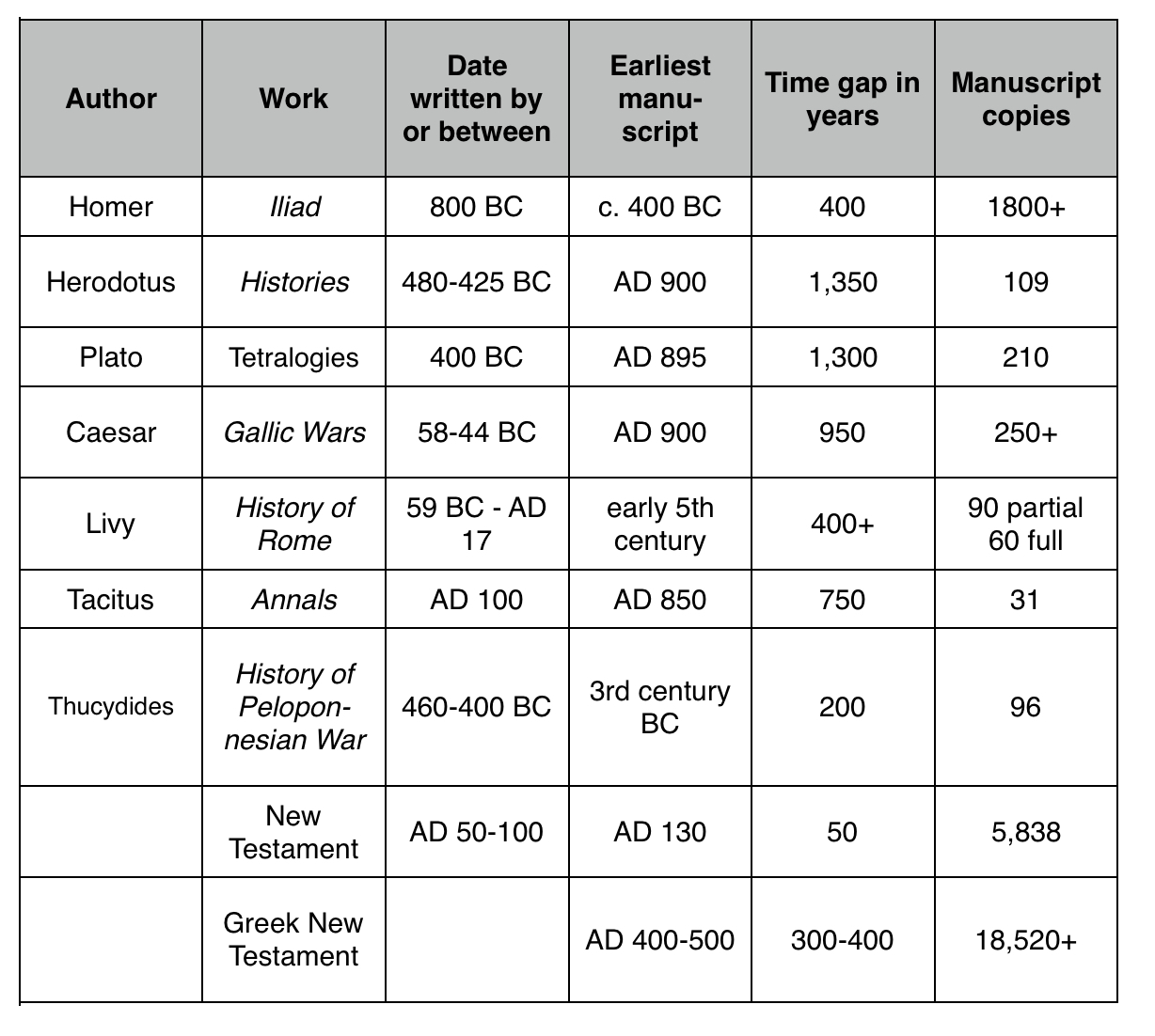
Then regarding the New Testament, Josh McDowell says, “I believe there is more evidence for the reliability of the New Testament than for any other ten pieces of classical literature put together.” Check out this chart reproduced from McDowell’s book God-Breathed to see by comparison to other literature, how close in dating the earliest biblical manuscripts are, and how many of those manuscripts have been discovered!
2. The external evidence test: determining whether the historical record has been verified or affirmed by data outside of itself.
Over one-fourth of the Bible is prophetic, and two-thirds of its prophesies have already been fulfilled. For example, 700 years before His birth, the city in which Jesus was to be born was identified by a man named Micah.
Time and time again archeologists discover articles that verify the claims in the Bible. This led archeologist Nelson Glueck to conclude, “It may be stated categorically that no archeological discovery has ever controverted a single biblical reference. Scores of archeological findings have been made which confirm in clear outline or in exact detail historical statements in the Bible.”
3. The internal evidence test: determining how of the historical record stands up to the test of internal validity.
The Bible was written by 45 different authors, over a span of 1500 years, on 3 different continents, and in 3 different languages. Yet there are no contradictions!
Anecdotal evidence—
Changed lives. My life is one that has been amazingly impacted by the God of the Bible, as was a man named Saul, who had a total about-face after encountering Jesus. As a result, Christianity was spread far and fast through his writings and world travels.
2. Changed societies. Wherever the Christian faith of the Bible has been put into practice, societies improve. Leonard Sweet notes—
“Before Christianity, there were cults that practiced all sorts of human sacrifice as well as self-mutilation and self-castration. Before Christianity, the weak were despised, the poor maligned, the handicapped abandoned. Before Christianity, infanticide was rampant, slavery run-of-the-mill, and gladiatorial combat a form of entertainment. In Jesus’ day, Corinth was famous for its temple prostitutes, continuing a long-standing tradition symbolized by the Corinthian athlete Xenophon.… Aristotle…not only condoned institutionalized slavery but provided an elaborate argument in favor of it. As if that weren’t enough, Aristotle called man ‘begotten’ and woman ‘misbegotten,’ and because a woman’s reasoning was ‘without authority’ accepted no female students.
“Only Jesus and His followers known as the church insisted on the concept of human dignity and the value of every human soul. Only the church built hospitals and took care of the abandoned and disabled. Only the church celebrated charity and selflessness as the highest virtue and elevated the status of women.”
Is all of this “proof positive” that the Bible is God’s Word? No, it’s not. But I think the evidence is compelling enough that it is certainly reasonable to reach this conclusion.
Here are some great application questions from this lesson:
Other than because it says so in the Bible, how do I know that it is God’s Word?
“If you should get up some morning and hear men on your house tearing off the tiles and taking down the roof with hammers and axes, you might think a gang of vicious enemies had come to destroy your home. But as soon as you understand that these workmen have been sent by your father to mend your house, you gladly endure the noise and trouble. Indeed, you thank your father for his care and expense. The very hope of the advantage that will come from the repairs makes you willing to dwell awhile in the inconvenient rubble of the old house.
“The promise [in Romans 8:28] assures the believer that the Heavenly Father intends no harm, only good, as He rebuilds the ruined frame of your soul into a glorious temple. And afflictions have a hand in the work. This insight frees you to pray, ‘Lord, cut and shape me however You will, that at last I may be framed according to the pattern which Your love has drawn for me!’” —William Gurnall (emphasis added)



 From D.L. Moody’s book Prevailing Prayer—








 Craig T. Owens