A Proactive Pause

Listen to the podcast of this post by clicking on the player below, and you can also subscribe on AppleSpotify, or Audible. 

Let’s keep in mind why we are learning and working on these spiritual disciplines. The key phrase is “so that”—I get stronger so that we can get stronger.

Today we are looking at spiritual discipline #2—Solitude. We will need discipline to abide with Jesus in our time of solitude—removing all distractions—so that we can respond better to our circumstances, and help other saints respond better too. 

Part of the dictionary definition of solitude is “a place absent of human activity.” Note that important word human activity. Solitude is a time for stepping back from all our human striving to get a heavenly perspective. Solitude is a proactive pause in difficult times so that we can respond with a God-honoring reaction. 

Let me give you five ideal situations to discipline ourselves to find solitude. 

(1) After ministry exertion. I’m sure there have been times when an interaction with another person or a group of people has exhausted you. It’s at these times we should find a place of solitude to be refreshed, just as Jesus did (Luke 5:16). 

(2) In stormy times. When everything around us seems to be unstable, proactively pausing in a time of solitude is saying with the psalmist, “God is our refuge and strength, an ever-present help in trouble,” and then hearing God say to our anxious hearts, “Be still, and know that I am God” (Psalm 46:1, 10). These are the same words Jesus said to both the stormy seas and the disquieted hearts of His disciples (see Mark 4:35-39). 

(3) When we’re between a rock and a hard place. This is when we feel like neither option before us is a pleasant one. Like when the Israelites were caught between the onrushing Egyptian army and the uncrossable Red Sea. Listen to how similar the words of Moses sound, “The Lord will fight for you; you need only to be still” (see Exodus 14:1-14). 

(4) When we have a big decision ahead. We may gather all of the information and do our our research and still feel inadequate to make a good decision. Jesus had hundreds of disciples, but He needed to choose just twelve to serve as His apostles. Before making this decision, Jesus spent the night in solitude with His Father (Luke 6:12-13). 

(5) When we get angry. There are other strong emotions that sometimes seem to overwhelm us, but I’ve noticed that anger causes more people to fly off the handle than most of the other emotions. When Jesus saw the shameful way the temple was being used, He got so angry that His disciples recalled the Psalm that said zeal was burning Him up (Psalm 69:9; John 2:17). Instead of reacting in the heat of the moment, Jesus spent all night in solitude with His Father (Mark 11:11, 19).  

Our solitude time could include Bible reading, but it’s probably more of a time for quieting ourselves—taking a break from human activity—so we can hear the Holy Spirit reminding us of what we’ve already studied (John 14:26).  

Then keep in mind that solitude is not retreating and staying away from others, but solitude is so that I can effectively respond to pressing situations. Christian solitude is not me-time, it’s us-time (where the “us” is me + Jesus) so that I’m ready for we-time (where the “we” is me + others). 

This is such an important discipline for Christians so that we don’t respond inappropriately in an intense situation, but we respond in a Christ-like way that brings glory to God. Pay attention to your strong emotions, listen to the Holy Spirit, and proactively find a place of solitude. 

If you have missed any of the other messages in this series called Saints Together, you can find them all by clicking here.

►► Would you please prayerfully consider supporting this ministry? My Patreon supporters get behind-the-scenes access to exclusive materials, like a 10-minute video I just shared on study tips for the poetic books of the Bible. ◀︎◀︎
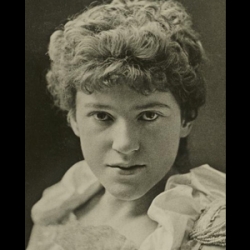
Poetry Saturday—Solitude

Listen to the podcast of this post by clicking on the player below, and you can also subscribe on AppleSpotify, or Audible.

Laugh, and the world laughs with you;
     Weep, and you weep alone;
For the sad old earth must borrow its mirth,
     But has trouble enough of its own.
Sing, and the hills will answer;
     Sigh, it is lost on the air;
The echoes bound to a joyful sound,
     But shrink from voicing care.

Rejoice, and men will seek you;
     Grieve, and they turn and go;
They want full measure of all your pleasure,
     But they do not need your woe.
Be glad, and your friends are many;
     Be sad, and you lose them all,
There are none to decline your nectared wine,
     But alone you must drink life’s gall.

Feast, and your halls are crowded;
     Fast, and the world goes by.
Succeed and give, and it helps you live,
     But no man can help you die.
There is room in the halls of pleasure
     For a large and lordly train,
But one by one we must all file on
     Through the narrow aisles of pain. —Ella Wheeler Wilcox

►► Would you please prayerfully consider supporting this ministry? My Patreon supporters get behind-the-scenes access to exclusive materials. ◀︎◀︎

8 Quotes From “Words To Winners Of Souls”

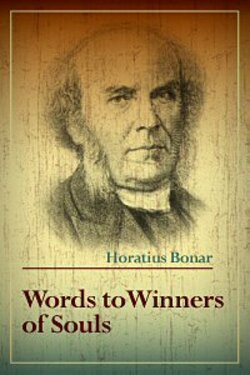
I don’t say this very often, but Words To Winners Of Souls by Horatius Bonar is a must-read for those in pastoral ministry. You can check out my full book review by clicking here. 

“The question, therefore, which each of us has to answer to his own conscience is, ‘Has it been the end of my ministry, has it been the desire of my heart to save the lost and guide the saved? Is this my aim in every sermon I preach, in every visit I pay? Is it under the influence of this feeling that I continually live and walk and speak? Is it for this I pray and toil and fast and weep? Is it for this I spend and am spent, counting it, next to the salvation of my own soul, my chiefest joy to be the instrument of saving others? Is it for this that I exist?’” 

“It is not opinions that man needs: it is truth. It is not theology: it is God. It is not religion: it is Christ. It is not literature and science; but the knowledge of the free love of God in the gift of His only-begotten Son.” 

“Our power in drawing men to Christ springs chiefly from the fullness of our personal joy in Him, and the nearness of our personal communion with Him.” 

“Why so many meetings with our fellow men, yet so few meetings with God?” 

“Our life has not been a lying-in-wait for the voice of God. ‘Speak, Lord; for Thy servant heareth,’ has not been the attitude of our souls, the guiding principle of our lives. Nearness to God, fellowship with God, waiting upon God, resting in God, have been too little the characteristic either of our private or our ministerial walk. Hence our example has been so powerless, our labors so unsuccessful, our sermons so meager, our whole ministry so fruitless and feeble.” 

“It is easier to speak or write about revival than to set about it. There is so much rubbish to be swept out, so many self-raised hindrances to be dealt with, so many old habits to be overcome, so much sloth and easy-mindedness to be contended with, so much of ministerial routine to be broken through, and so much crucifixion, both of self and of the world, to be undergone. As Christ said of the unclean spirit which the disciples could not cast out, so we may say of these: ‘This kind goeth not out but by prayer and fasting.’” 

“These must be days of strenuous, ceaseless, persevering, and, if God bless us, successful toil. We shall labor till we are worn out and laid to rest.” 

“It is unbelief that makes ministers handle eternal realities with such irreverence. It is unbelief that makes them ascend with so light a step ‘that awful place the pulpit,’ to deal with immortal beings about heaven and hell.” 

Seeking God

…David sought the face of the Lord… (2 Samuel 21:1). 

בָּקַשׁ פָּנִים יְהֹוָה

The Hebrew phrase is baqash paniym YHWH: 

  • baqash is to ask for, beg, desire “specifically in worship or prayer.” It’s a “searching as done by touching.” 
  • paniym literally means the face, but it carries the idea of being in someone’s presence.
  • YHWH (Yahweh) is Jehovah God. 

David repeatedly asked, sought, and begged through both prayer and worship that he might be in God’s presence. “Almighty God, I want to be with You. I want to know your heart intimately. I want to see Your face. I’m not seeking help from any other source, but I am resolutely seeking You alone.” 

Perhaps Jesus had this in mind when He told us, “Keep on asking, keep on seeking, keep on knocking. You will get an answer, you will find what you’re seeking, the door to God’s presence will be opened to you. Your Father—YHWH, God Almighty—longs to reveal Himself to you.” 

Q: How long did David seek the face of the Lord? 

A: Until God spoke, until God delivered, until God opened the door. 

Q: How long am I willing to keep on seeking the face of the Lord? 

A: I hope I can say until God speaks, until God delivers, until God opens the door.

Handling Personal Attacks

So the people grumbled against Moses … The people gathered in opposition to Moses and Aaron (Exodus 15:24; Numbers 20:2). 

People with limited vision have limited faith too. As a result, they frequently grumble when things don’t go their way. Ironically, their grumbling is almost always directed at the leader who does have far-reaching vision and God-honoring faith! 

For most of his tenure as leader, Moses handled the grumbling of the people well. Sometimes, though, the complaints seemed more personal:

  • …in opposition to Moses and Aaron
  • …they quarreled with Moses
  • …“Why did you…?” 

These complaints may seem like a personal attack, but in the end, we find out that these attacks weren’t really against Moses at all—“the Israelites quarreled with the Lord” (Numbers 20:13). 

God tried to help Moses and Aaron see that this was not a personal attack on them. He instructed them to “speak to that rock” so that water would be provided for the grumbling people. But sadly, Moses and Aaron missed this point. They said to the Israelites, “must we bring you water out of this rock?” And then in total frustration with the quarrelsome Israelites, Moses “struck the rock” instead of speaking to it.

Moses made himself the focal point, not God. God responded: “you did not trust in Me enough to honor Me as holy in the sight of the Israelites” (v. 12).

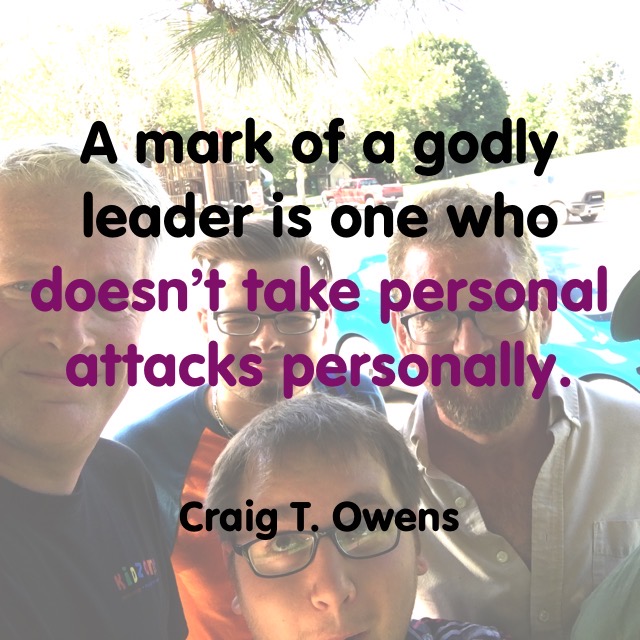
A mark of a godly leader is one who doesn’t take personal attacks personally.

Previously, Moses responded to the grumblers better—

  • He “cried out to the Lord” and received directions
  • He obeyed God’s directions to the letter
  • He reminded the people that their grumbling was really “against the Lord” (Exodus 16:6-8)
  • He humbled himself before the people and pleaded with them not to rebel against God
  • He humbled himself before God and interceded for the people

If God has called you to lead, people will bring their quarrels and complaints to you. It will feel like a personal attack, but it’s not. When attacked or when people grumble, you need to humble yourself before the Holy Spirit and ask, “Did I do something wrong?” and then listen attentively for His answer.

If the answer is yes: repent, ask forgiveness, make things right.

If the answer is no: don’t take it personally, stay humble before God and the people, and obey the specific directions God will give you. Don’t get frustrated and cut short your tenure as a leader.

This is part 44 in my series on godly leadership. You can check out all of my posts in this series by clicking here.

The Value In Retreating

So He Himself often withdrew into the wilderness and prayed (Luke 5:16).

So”—in light of what just happened. What happened? Jesus was preaching everywhere, He healed a leper, and great multitudes came to hear Him speak and to be healed. So Jesus had to withdraw frequently to pray and be replenished.

All of us have only a finite amount of energy. When we are sensing that energy level is low, we also need a retreat. Otherwise, our low energy levels can sabotage us and diminish what God wants to do through us. 

Then check out the results after Christ’s time of replenishing:

  • God’s power was “present to heal” (v. 17)
  • People were saved (v. 20)
  • Jesus had holy perception (v. 22)
  • Miracles confirmed the word that Jesus preached (v. 24)
  • God was glorified (v. 26)
  • People followed Jesus (vv. 27, 28)
  • Jesus had enough grace and patience to handle criticism (v. 30)
  • Jesus had enough wisdom and patience to handle tricky theological questions (vv. 33-39)

J.C. Ryle noted, “The most successful workmen in the Lord’s vineyard are those who are, like their Master, often and much upon their knees.”

Healthy leaders are keenly aware of their own energy levels. 

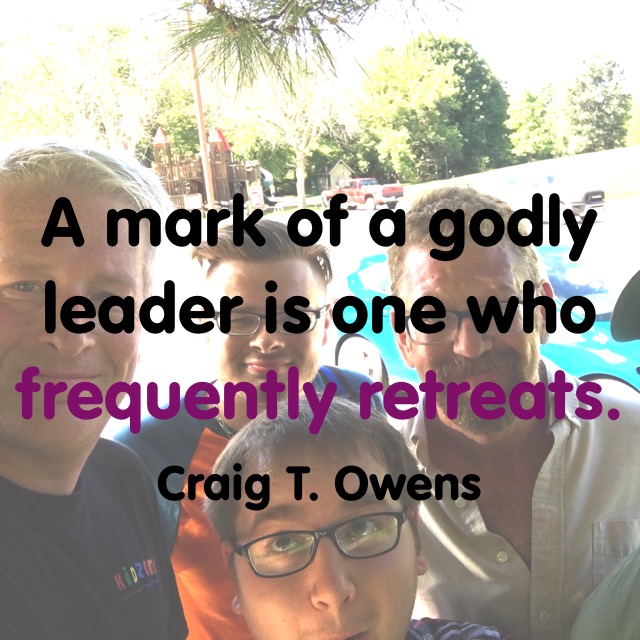
So… A mark of a godly leader is one who frequently retreats. 

This is part 32 in my series on godly leadership. You can check out all of my posts in this series by clicking here.

Thursdays With Oswald—Isaiah 8-11

Oswald ChambersThis is a weekly series with things I’m reading and pondering from Oswald Chambers. You can read the original seed thought here, or type “Thursdays With Oswald” in the search box to read more entries.

Isaiah 8-11

[These are notes from Oswald Chambers’ lecture on Isaiah 8-11.]

     God did not give a progressive revelation of Himself through the Old Testament: the people progressively grasped the revelation, which is very different. …

     The remarkable thing is that when Jesus Christ comes, every one of the things the prophets have been saying fit in with one Personality, the Being whom we know as the Lord Jesus Christ. Isaiah never saw Jesus Christ, he could not have imagined Him, then what inspired him? The very Mind of God (see 2 Peter 1:20). … 

     Fear is apt to make us atheistic and in our outlook we enthrone the devil, not God. God is behind it all, not a thing happens but He knows all about it. …

     If we try to draw our breath from any other source we instantly get diseased. By prayer and communion with God we live out in God’s moral open air, consequently we can live in the cities and amongst the places of men and maintain the life which is in accordance with the Messiah’s life…. The enemy of our souls goes for all he is worth against our praying, against our solitudes with God, he tries to prevent us drawing our breath in the fear of the Lord. The great need is to bring every thought and imagination into captivity to the obedience of Christ until every bit of our nature is reconstructed. 

From Notes On Isaiah

In these four chapters of Isaiah, the kings of Judah are facing enemies closing in from all sides and fear is mounting. Isaiah keeps speaking a word from the Lord that amounts to God saying this: Stop focusing on your troubles and focus on Me instead!

It’s a good reminder for us still today. God is in control. Let me say that again: God is in control! Let His perfect love and His perfect power drive out fear from your heart. Keep your eyes on Him, not on the problems coming against you. Let your thoughts be captivated by Jesus, and you will be reconstructed from the inside out with the nature of Christ.

Thursdays With Oswald—The Power Is In The Solitude

Oswald ChambersThis is a weekly series with things I’m reading and pondering from Oswald Chambers. You can read the original seed thought here, or type “Thursdays With Oswald” in the search box to read more entries.

The Power Is In The Solitude

     If we want to know the universal sovereignty of Christ, we must get into solitude with Him. It is not sufficient for someone else to tell us about Him; we must perceive with our own eyes Who He is, we must know Him for ourselves. … 

     We must get to the place of real solitude with Christ. He is our mountain-height and our sea-calm; He is the recreating power; He is the universal Sovereign. He tells us to consider the lilies; we say—“No, we must consider life.” We mistake the mechanism of life for life itself, and that idea has become incorporated into Christian work. In the active work we do for God we do not really believe that Jesus Christ is sovereign Lord; if we did, we should fuss less and build more faith in Him. We cannot do the Savior’s work by fuss, but only by knowing Him as the supreme sovereign Lord. … 

     Our Lord’s word “go” simply means “live,” and Acts 1:8 describes the “going.” Jesus did not say to the disciples—“Go into Jerusalem, go into Judea, go into Samaria, go into the uttermost part of the earth”; but—“You shall be My witnesses” in all these places: He undertakes to establish the goings. So many people are obsessed with this idea—“What are you going to do?” I hope none of us are going to do anything: I hope we are going to be what He wants us to be. … 

     The key to the missionary is the absolute Sovereignty of the Lord Jesus Christ. We must get into real solitude with Him, feed our soul on His Word, and He will engineer our circumstances.

From So Send I You 

Jesus gave a command to all His followers—including all of us today—All authority in heaven and on earth has been given to Me. Therefore go (Matthew 28:18-19). Jesus is saying to us, “Preach and teach out of a living experience of Myself.” In this respect, we are all missionaries.

Oswald Chambers reminds us missionaries that the only way we will be effective in our goings is by spending adequate time in solitude and worship with Our Lord. If we don’t, then we are trying to do ministry on our own, trying to engineer our own circumstances. But the missionary who is spending time with Jesus finds that He directs all our goings and engineers all our circumstances.

The power to testify about Jesus comes from our time of solitude with Jesus.

8 Quotes From “Live Dead Journey”

Live Dead Journey are notes from missionaries on the front lines. You can check out my book review by clicking here. One of the things that stood out to me was the focus of these “tour guides” on their time abiding with Jesus. Here are some quotes that share their heart on this.

“Abiding time is extravagant daily time with Jesus.” –Dick Brogden

“Jesus spent close to 90 percent of His life in a village of twelve families, and even His three years of ministry were characterized by time alone with the Father. Moses spent forty years in Midian and had multiple trips to the mountain with God. Paul spent thirteen years in preparation, some of it in the Arabian Desert, and prayed constantly. Adam, Joseph, David, Elijah, Daniel, Mary, John, and others all gave God extravagant time. When we examine the lives of any heroes of the faith, we can see that they lingered daily with Jesus.” –Dick Brogden

“Jesus has become my safe place. When stability is not present in life here, I can lean on Him. When friends are not constant, Jesus is. He knows what I need and provides everything. Jesus is enough for me.” –Joy Hawthorne

“I’ve learned that not spending time with Jesus today is one step in not spending time with Him tomorrow.” –Miriam Davis

“One thing I have discovered is that I can’t survive throughout the day on just one block of time with Jesus. So at some other point in my day, I spend time basking in His presence. … Abiding is a lifestyle.” –Eva Bridges

“To help draw out the lessons from a passage, I now look for the following. Is there:

  • A command for me to obey?
  • A promise for me to claim?
  • A sin for me to avoid or repent of?
  • An example for me to follow (good) or avoid (bad)?
  • A truth to believe?
  • A prayer to pray?” –Jeff Griffin

“I’ve realized that what I desire I become–Jesus is my desire, and I want to be like Him.” –Cathy Stone

“How extravagant are you toward Jesus with your time? Do you lavish time on Jesus? Do you give Jesus the most energetic and focused times of your day? Or do you tend to give Jesus the crumbs of your schedule?” –Dick Brogden

12 More Quotes From “Ordering Your Private World”

Gordon MacDonald did a phenomenal job synthesizing biblical principles as he teaches us how to pay attention to our private, inner world. One of the things I enjoyed was the number of other authors and teachers he quotes throughout Ordering Your Private World. Here are a few of those quotes he shared…

“The battle is lost or won in the secret places of the will before God, never first in the external world. … Nothing has any power over the man who has fought out the battle before God and won there. … I must get the things settled between myself and God in the secret places of my soul where no stranger intermeddles, and then I can go forth with the certainty that the battle is won.” —Oswald Chambers

“I took pleasure where it pleased me, and passed on. I forgot that every little action of the common day makes or unmakes character, and that therefore what one has done in the secret chamber, one has some day to cry aloud from the house-top. I ceased to be lord over myself. I was no longer the captain of my soul, and did not know it. I allowed pleasure to dominate me. I ended in horrible disgrace.” —Oscar Wilde 

“Think of no other greatness but that of the soul, no other riches but those of the heart.” —John Quincy Adams, in a letter to his daughter

“A public man, though he is necessarily available at many times, must learn to hide. If he is always available, he is not worth enough when he is available.” —Elton Trueblood

“Remember a long life of steady, consistent, holy labor will produce twice as much fruit as one shortened and destroyed by spasmodic and extravagant exertions; be careful and sparing of your strength when and where exertion is unnecessary.” —Catherine Booth, in a letter to her husband William Booth, founder of the Salvation Army

“There can be intemperance in work just as in drink. What feels like zeal may be only fidgets or even the flattering of one’s self-importance.” —C.S. Lewis

“The man of action has the present, but the thinker controls the future.” —Oliver Wendell Holmes

“No other pleasure suits every occasion, every age or every place. But the study of letters is the food of youth, the delight of old age, a delight at home and no burden abroad; it stays with us at night, and goes with us on our travels, near and far.” —Cicero

“We need to find God, and He cannot be found in noise and restlessness. God is the friend of silence. See how nature—trees, flowers, grass—grow in silence; see the stars, the moon and sun, how they move in silence…. The more we receive in silent prayer, the more we can give in our active life. We need silence to be able to touch souls. The essential thing is not what we say, but what God says to us and through us. All our words will be useless unless they come from within—words which do not give the light of Christ increase the darkness.” —Mother Teresa

“St. Augustine says, ‘God gives where He finds empty hands.’ A man whose hands are full of parcels can’t receive a gift. Perhaps these parcels are not always sins or earthly cares, but sometimes our own fussy attempts to worship Him in our way. Incidentally, what most often interrupts my own prayers is not great distractions but tiny ones—things one will have to do or avoid in the course of the next hour.” —C.S. Lewis

“Let inward prayer be your last act before you fall asleep and the first act when you awake.” —Thomas Kelly

“I know that there are certain mental and emotional and moral and spiritual attitudes that are anti-health: anger, resentments, fear, worry, desire to dominate, self-preoccupation, guilts, sexual impurity, jealousy, a lack of creative activity, inferiorities, a lack of love. These are the twelve apostles of ill health. So in prayer I’ve learned to surrender these things to Jesus Christ as they appear.” —E. Stanley Jones

You can check out my review of Gordon MacDonald’s Order Your Private World by clicking here. And you can read some quotes from Gordon by clicking here.