C.S. Lewis On Temptation

C.S. LewisAre you battling temptation? Do you feel like you keep giving in to it? This is part of a letter C.S. Lewis wrote to one who confessed to his ongoing battle—and seeming ongoing defeat—with temptation to sin.

“Perhaps, however, the most important thing is to keep on: not to be discouraged however often one yields to the temptation, but always to pick yourself up again and ask forgiveness. In reviewing your sins don’t either exaggerate them or minimize them. Call them by their ordinary names and try to see them as you would see the same faults in somebody else—no special blackening or whitewashing. Remember the condition on which we are promised forgiveness: we shall always be forgiven provided that we forgive all who sin against us. If we do that we have nothing to fear: if we don’t, all else will be in vain. Of course there are other helps which are more commonsense. We must learn by experience to avoid either trains of thought or social situations which for us (not necessarily for everyone) lead to temptations. Like motoring—don’t wait till the last moment before you put on the brakes but put them on, gently and quietly, while the danger is still a good way off. ” —C.S. Lewis

9 Requisites For Contented Living

Contented Living

“There are nine requisites for contented living:

  1. Health enough to make work a pleasure [Ecclesiastes 5:19*];
  2. Wealth enough to support your needs [Proverbs 30:8-9];
  3. Strength to battle with the difficulties and overcome them [1 Corinthians 15:57];
  4. Grace enough to confess your sins and forsake them [James 5:16];
  5. Patience enough to toil until some good is accomplished [Romans 5:3-5];
  6. Charity enough to see some good in your neighbor [Luke 10:25-37];
  7. Love enough to move you to be useful and helpful to others [Ephesians 4:2-3];
  8. Faith enough to make real the things of God [Psalm 91];
  9. Hope enough to remove all anxious fears concerning the future [Psalm 33:18].” —Goethe

* The quote is from Wolfgang Goethe, but I added the Scripture references.

13 Quotes From “The Solomon Seduction”

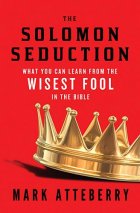
Solomon SeductionThe Solomon Seduction is a biography on King Solomon, a Bible study, a book for men to overcome temptation, a leadership book, and a great discussion starter for a men’s group. In other words, there are lots of reasons for guys to read this book! You can read my full book review by clicking here, and below are some of the quotes I highlighted from this book.

“Moderation can be a great thing. But the idea that anything is okay as long as it’s done in moderation has given rise to some of the wackiest notions known to man. … One of the big problems with using moderation as a justification for whatever you want to do is that it’s almost impossible to take just a bite when you’re really hungry.” 

“Are you just a guy who goes to church, or are you serious about growing spiritually and acquiring discernment? satan’s chances of seducing you will rise or fall on your answers to these questions.”

“Solomon is the perfect example of the fact that you can have your cranium crammed full of discernment and still end up embarrassing yourself. Keep in mind, he not only knew the book of Proverbs, he wrote the vast majority of it! And then ended up doing many of the very things he himself said were foolish!” 

“All of satan’s various attempts at seducing believers must include an attempt to undermine Scripture.”

“What we have here is a case not of ignorance or confusion or misinterpretation, but of satan subtly and artfully manipulating Solomon’s thinking to the point where he felt the commands of God seemed out of touch with his real-world experience.”

“satan doesn’t try to get you to forsake your good priorities. He just encourages you to mix in a few lesser priorities that will compete with those good priorities.”

“Mark it down. When the word I starts replacing the word we in your speech, something ugly is happening in your heart. Your ego is swelling.” 

“Big-ego people almost never back up and take another look at their actions. Why should they? They’re convinced that everything they do is right. It never occurs to them that they might be on the wrong track. They’re so infatuated with themselves that they can see nothing but that beautiful image in the mirror.”

‘What’s the big deal?’ If ever a question spoke to the attitude of our generation towards sin, that one does. We shrug off sin as though it’s just a little harmless fun. You know, boys will be boys. Everybody sows some wild oats, right? Or, if we don’t play the what’s-the-big-deal card, we claim that the sin we are indulging in is actually necessary.” 

“Instead of repenting, instead of exterminating, illuminating, or correcting their bad behavior, [sin managers] try to manage it. They believe that if they can keep the behavior from getting out of hand, keep people from being hurt or offended, keep the status quo from being upset, keep the ugliness under wraps and out of sight, they can hang on to their sin and everything will be fine. … This is typical of sin managers. Instead of seeing sin as the problem, they see the awkwardness the sin creates as the problem and believe, therefore, that if they can find an answer for the awkwardness, they will have solved the problem.”

“In the category of cold, hard truths, this is a doozy: God doesn’t share the throne of your heart with anybody or anything. You either give it to Him wholly and completely, or He vacates it. You can tell yourself that God comes first and that the sin you’re harboring is just a little something you need to work on, but if you choose a lifestyle of sin management over repentance, you’ve pledged your allegiance to your sin, not to God.”

“Repentance is not what saves us; grace is. But repentance is a response to grace that makes what we are after having received grace different from what we were before. … Repentance concerns itself with how things are while sin management only worries about how things look. Think of a messy closet. Repentance cleans out the closet. Sin management straightens up the closet. Repentance throws away the junk. Sin management rearranges the junk. Repentance gives you a better closet. Sin management only gives you a better-looking closet.”

“When we see Solomon at the height of his idolatrous lifestyle, marrying and buying and indulging like an out-of-control sailor on a weekend pass, what does he say over and over again? ‘I said to myself…’ (Ecclesiastes 1:16, 2:1, 2:15, 3:17, 7:23). Solomon was talking to himself about a lot of things he should have been discussing with God. Who can argue that the reason why he was seduced and eventually reduced to an object of scorn and pity was because he excluded God from so many areas of his life?” 


Poetry Saturday—God Answers

John PiperIs there a word to help us feel
the weight of Adam’s fall?
All.

How heavy will this burden weigh,
(Spare not!) on those who fell?
Hell.

O Lord, so great this forfeiture!
Was there sufficient reason?
Treason.

Then whence could any traitor hope
before Your burning face?
Grace.

But surely that will cost beyond
our wage. How is it priced?
Christ.

Entirely paid? By Him? O God,
and is that gift for me?
Free.

I would receive this gift, O Lord!
How soon would You allow?
Now. —John Piper

The Path Of Least Resistance

Path of least resistanceIt’s a concept that is observed in almost every discipline of science: in biology, physics, astronomy and other areas things naturally flow in the path of least resistance. What is true in the physical sciences is also true in the social sciences, especially in the relationship between a father and his children.

There’s a story tucked away in the records of the kings of Israel (see 1 Kings 15:33-16:3) in which Baasha comes to the throne, and immediately kills all of the descendants of Jeroboam, a previous king. Baasha is not only removing potential rivals to his kingship, but he is also bringing punishment on a family which had caused Israel to sin. But then Baasha walks in the exact same sinful path as Jeroboam!

A prophet was sent to confront Baasha. His name was Jehu son of Hanani. Hanani was the prophet God sent to Asa, king of Judah. In other words, Jehu is following in the same path of his father Hanani.

Two sons, both with free wills to choose their own path, and yet both of them chose the path their fathers set for them.

Children can choose their own path, but the path of least resistance is the path the father walks.

Notice I said “walks” (present tense). I’ve seen in both the Bible and in the lives of people around me, that a Dad who starts out well but finishes poorly, sets a path for his children that is away from God. But those Dads who start out poorly, but turn to God later in life, set a path for their children to pursue God.

Dad, the best time for you to set the path for your children is nowtoday! 

The good news is that you don’t have to do this on your own. Jesus said that even us Dads who are sinful have figured out how to give our children the best that we can. If we sinful Dads have figured that out, Jesus said, “How much more will your Father in Heaven give the Holy Spirit to those who ask Him!” (see Luke 11:11-13).

Your Heavenly Father wants to give You His Holy Spirit to help you set the right path for your kids. And He wants to give His Holy Spirit to your children to help them choose—and stay in—that right path.

Why does God want you and your kids in the right path? So He can pour out the best gifts on you! For the Lord God is our sun and our shield. He gives us grace and glory. The Lord will withhold no good thing from those who do what is right (Psalm 84:11).

Ask the Holy Spirit to help you set a righteous path for your kids today!

A Leader’s Nudge And Covering

Nudge & coverLeadership carries a heavy responsibility. I often paraphrase what the Apostle James wrote, “Not many of you should presume to be leaders because you know leaders will be judged more strictly” (see James 3:1).

Consider what was said to Jeroboam, the king of Israel: “And God will give Israel up because of the sins Jeroboam has committed and has caused Israel to commit” (1 Kings 14:16, emphasis added).

A leader’s action has consequences not only for himself, but for all the people under his care. Sure, some Israelites were going to sin regardless of how Jeroboam lived, but his sinful lifestyle gave a nudge to those who took their cues from him. In other words, Jeroboam’s sin made it that much easier for others to sin.

I’m sure there were some Israelites who didn’t follow Jeroboam into sin, yet they were now exposed to God’s “jealous anger” (1 Kings 14:22) because Jeroboam’s sin removed the covering of God’s blessing on those northern tribes.

These principles still hold true today for me as a dad, a husband, a pastor, a citizen of Cedar Springs. And they hold true for you in your role as a spouse, a parent, an employer or employee, a Christian. Your sin may be the nudge to others that causes them to sin; your sin will remove God’s covering and expose people to His judgment.

Leaders best serve by staying wholly committed to God. 

It’s only as I am wholly—and holy—His that I can nudge people toward righteousness and preserve the covering of God’s blessing.

May our lives never arouse God’s righteous anger, but may we be a blessing by wholly serving Him all the days of our lives.

Noble Revenge

Noble revengePerhaps one of the most counter culture things a Christian will ever do is to forgive. More specifically, to forgive God’s way in which the offending party is forgiven and the offense is no longer counter against him.

But this isn’t what today’s culture teaches us. Instead they say things like—

  • “I’ll forgive them only if they’re really, really, REALLY sorry for what they did….
  • …and I’ll forgive them only if they ask for forgiveness…
  • …and then only I’ll only forgive them a certain number of times…
  • …and most importantly, I may forgive, but I’ll never forget.

Why do we feel this way?

  • We buy into the old line: “Hurt me once, shame on you; hurt me twice, shame on me,” and we don’t want to feel shame.
  • We like to be in control. If we hold on to slights and injuries, then we have a trump card we can play later—“You owe me” or “This is why I don’t trust you.”
  • We mistakenly think that forgiveness makes us appear weak, like our offender won and we lost. And we certainly don’t want them to think they can take advantage of us again.
  • Because if they take advantage of us again it’s right back to, “Hurt me once…” so I’m going to make a preemptive strike and not forgive them.

Yes, forgiveness could make us appear vulnerable. Yes, we could be hurt again by the same offender. And, yes, we could be viewed as weak. But—The foolish thing that has its source in God is wiser than men, and the weak thing that springs from God is stronger than men (1 Corinthians 1:25, AMP). Total forgiveness is foolish looking in the natural, but it has God’s blessing on it.

With this in mind, the Apostle Paul wrote—

But Jesus said to me, “My grace is sufficient for you, for My power is made perfect in weakness.” Therefore I will boast all the more gladly about my weaknesses, so that Christ’s power may rest on me. That is why, for Christ’s sake, I delight in weaknesses, in insults, in hardships, in persecutions, in difficulties. For when I am weak, then I am strong. (2 Corinthians 12:9-10)

When we are totally reliant on Christ, that’s when His power rests on us. When we say, “I’m going to do this my way,” we block ourselves off from Christ’s grace and power and strength.

We need to remember HOW MUCH God has forgiven in us—He forgave ALL my sins and He no longer counts any of my treachery and rebellion against me. With this in mind, how dare I hold on to the comparatively small injuries others have inflicted on me (see Matthew 18:21-35).

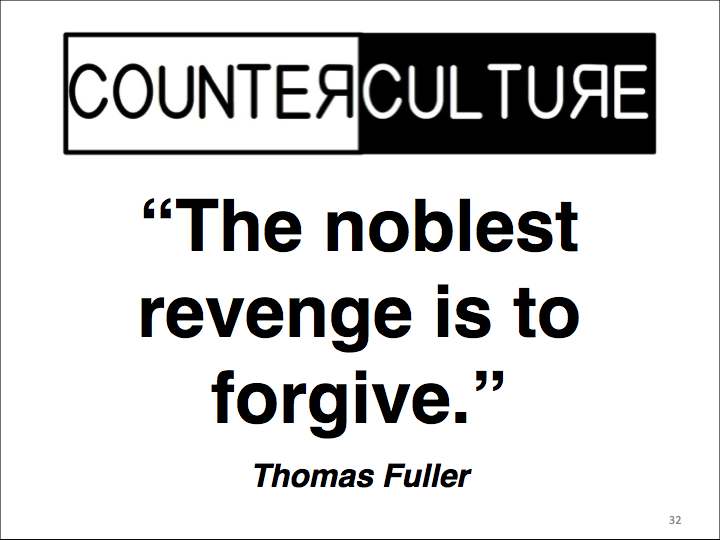
“The noblest revenge is to forgive.” —Thomas Fuller


Forgiveness gives me a nobility.
Forgiveness sets me free from the hurt.
Forgiveness makes me a child of God.
Forgiveness gives me God-sent strength.
Forgiveness is counter culture.
Because forgiveness glorifies God, and not my wound.

What are you waiting for? Get free today by giving and receiving forgiveness.

Thursdays With Oswald—All Of Me

ChambersThis is a weekly series with things I’m reading and pondering from Oswald Chambers. You can read the original seed thought here, or type “Thursdays With Oswald” in the search box to read more entries.

All Of Me

     Never run away with the idea that you are a person who has a spirit, has a soul and has a body; you are a person that is spirit, soul and body. Man is one; body, soul and spirit are terms of definition. My body is the manifest “me.” Some of us are so dominated by the body that our spirit lives only in the physical domain, instead of the physical being slowly taken into the spiritual by a series of moral choices. Our spirit goes no further than we bring our body. 

From Conformed To His Image

God created us as a three-part, integrated being. Quite simply, all parts are interdependent on each other.

If my body is diseased, it’s hard for me to develop my soul and spirit. If my emotions are out-of-balance, it adversely affects by body and spirit. If my spirit is still weighed down by sin, it cannot but affect my body and soul.

I love the brief description Dr. Luke gives us about how Jesus grew up: Jesus grew in wisdom and in stature and in favor with God and all the people (Luke 2:52). Let me state this verse differently. Jesus grew healthily…

  • …in wisdom (His mind)
  • …in stature (His physical body)
  • …in favor with God (His soul)
  • …in favor with all the people (His emotions and relationships)

Jesus showed us well-round, healthy growth. If you are diseased in your body, talk to a doctor about remedies; if you are diseased in your soul, talk to a counselor or psychologist about your emotional health; if you are diseased in your spirit, talk to God about forgiveness.

Don’t let one part of you hold you back from being all the you God created you to be!

Links & Quotes

link quote

Here are the links to some interesting reading I found today.

Great news! U.S. Supreme Court Affirms Prayer At Government Meetings.

A sober word for pastors: “I fear that sometimes our own eloquence and our own concepts may get in the way, for the unlimited ability to talk endlessly about religion is a questionable blessing.” —A.W. Tozer

“The more of Heaven there is in our lives, the less of earth we shall covet.” —Charles Spurgeon 

Ladies, looking for a pro-life OB/GYN? Check out this directory.

Good: Why We Need To Start Taking The Sabbath Seriously.

Dr. Tony Evans on homosexuality, the church, and Christianity.

“When God causes us to have no mercy on our sins, then He has great mercy on us. When we are angry with evil, God is no more angry with us. When we multiply our efforts against iniquity, the Lord multiplies our blessings.” —Charles Spurgeon

Did someone say Islam was “a religion of peace”? Guess they forgot to tell these guys…

Links & Quotes

link quote

Some great reading I found today.

Temptation is not fatal! “[We ought] to point out of what service temptations are in the training of the faithful, and what relief there is in the example of the patience of God, who has resolved to permit them even to the end.” —Augustine

“Our extremity is God’s opportunity.” —George Whitefield

Apparently the definition of “tolerance” today just means telling everyone what they want to hear. If you speak a truth that someone doesn’t like, then you are intolerant, as in the case of this guy in the U.K.

David Wilkerson says: Do Not Give satan An Inch Of Ground.

NBA Commissioner Adam Silver banned racist Donald Sterling for life. Check out A Statement Stronger Than Silver.

I love what Make-A-Wish does for kids! Here’s a great story from Detroit.

Google is on the wrong side of this one: they have decided that women searching for “abortion” shouldn’t see listings for pro-life crisis pregnancy centers!