Looking back at the history of God’s people in the Bible, there is a distinct up-and-down cycle. The Israelites would be worshiping God and enjoying His blessings, and then we see them turning their back on God and needing Him to rescue them from oppressors. After God rescues them the people praise Him, only to slip right back into the same downward slide again.
I believe their slipping away from God can be directly linked to their forgetfulness.
If any of us allows our gratitude for all of God’s blessings to fade, we will experience the same slipping away.
However, there is good news! If there is a peril in our forgetfulness, there is also a power in our thankfulness!
If you missed any of the messages in this series, please check them out here:
If someone asked you what a church is supposed to look like, do you describe steeples and crosses, stained glass windows and big wooden pulpits?
Guess what? The first Church in Jerusalem had none of those things!
Luke the historian describes the church this way: “They studied and prayed together, they ate with each other, they fed the hungry, and they took care of the poor. God performed miracles through them, everyone thought well of them, and people were getting saved every single day” (see Acts 2:42-47). Other historians of the day noted that Christians started the first orphanages, the first feeding programs, the first homes/schools for the blind, and the first medical dispensaries. They described how the Christians changed the cultural understanding of marriage and family, and how they gave dignity to women, children, the elderly, and the sick.
They did this by putting their faith into action, just as Jesus described (see Matthew 25:31-40). James reminds us that this required a deeply personal faith and a roll-up-your-sleeves attitude. In fact, James went so far as to say that faith in Jesus wasn’t enough.
Faith without works is dead. Works without faith is useless. We must believe it and live it. We need both faith and works.
Everyone can do this…
if a young kid is hungry, get involved with feeding them
if an elderly lady in your neighborhood needs a friend, stop by for coffee
if a neighbor is sick and can’t cover their usual tasks, mow their lawn
if a high school student can’t go to homecoming because she can’t afford the dress, take her shopping and buy the dress for her
if someone has an extended hospital stay, collect their mail and water their plants
if no one is visiting them in the hospital, go sit with them for a while
Jesus said, “When you do this for others, you are really doing it for Me.”
Luke didn’t say, “Every day the Christians were preaching.” He says, “Every day the Christians were serving. And then every day God was adding to their number people who were being saved.”
Your faith in action speaks a sermon louder and more convincingly than any sermon ever could.
How will you show your neighbors the love of Jesus this week?
When my father-in-law was still on his faith journey he asked me, “How can you reconcile the differences in God’s temperaments in the Bible? In the Old Testament He is full of judgment and in the New Testament He is all mercy.”
Quite simply, both are God’s character. They are two sides of the same coin. In fact, we more dearly appreciate God’s mercy and grace when we’ve clearly seen how we are subject to His justice and wrath.
Amos talked about both of these attributes, too, but he does so in a masterful way in which mercy and justice swirl around each other. It’s almost as if Amos can’t talk about justice without mentioning mercy or vice versa.
How do we know God’s judgment is coming? Because God said so! Amos quotes God saying judgment is coming “because of three sins, even for four” (see these verses in Amos’ first and second chapters). Even as Amos uses that phrase he is pointing to God’s mercy. He’s stating, “God could have punished you the very first time you sinned, but He is giving you another chance, and another chance, and another chance….”
But make no mistake: a day of judgment is coming. God concludes, “Now then I will crush you” (2:13).
God tries to get people’s attention by sending famines and plagues and disasters, but after each one of these God sadly notes “yet you have not returned to Me”—five times He says this in Amos 4!
But even as God calls them out on their lack of repentance He reminds them twice of the solution—“Seek Me and live” (5:4-6).
Finally, Amos concludes his book by letting us know God’s judgment IS coming, but so is God’s mercy (9:1-4, 11-15)!
Dear Christians, our responsibility is to let people know that there is a Heaven to gain and a Hell to shun. We must boldly and lovingly tell people of…
… God’s justice AND His mercy
… God’s wrath AND His grace
… Heaven for the repentant AND Hell for the unrepentant
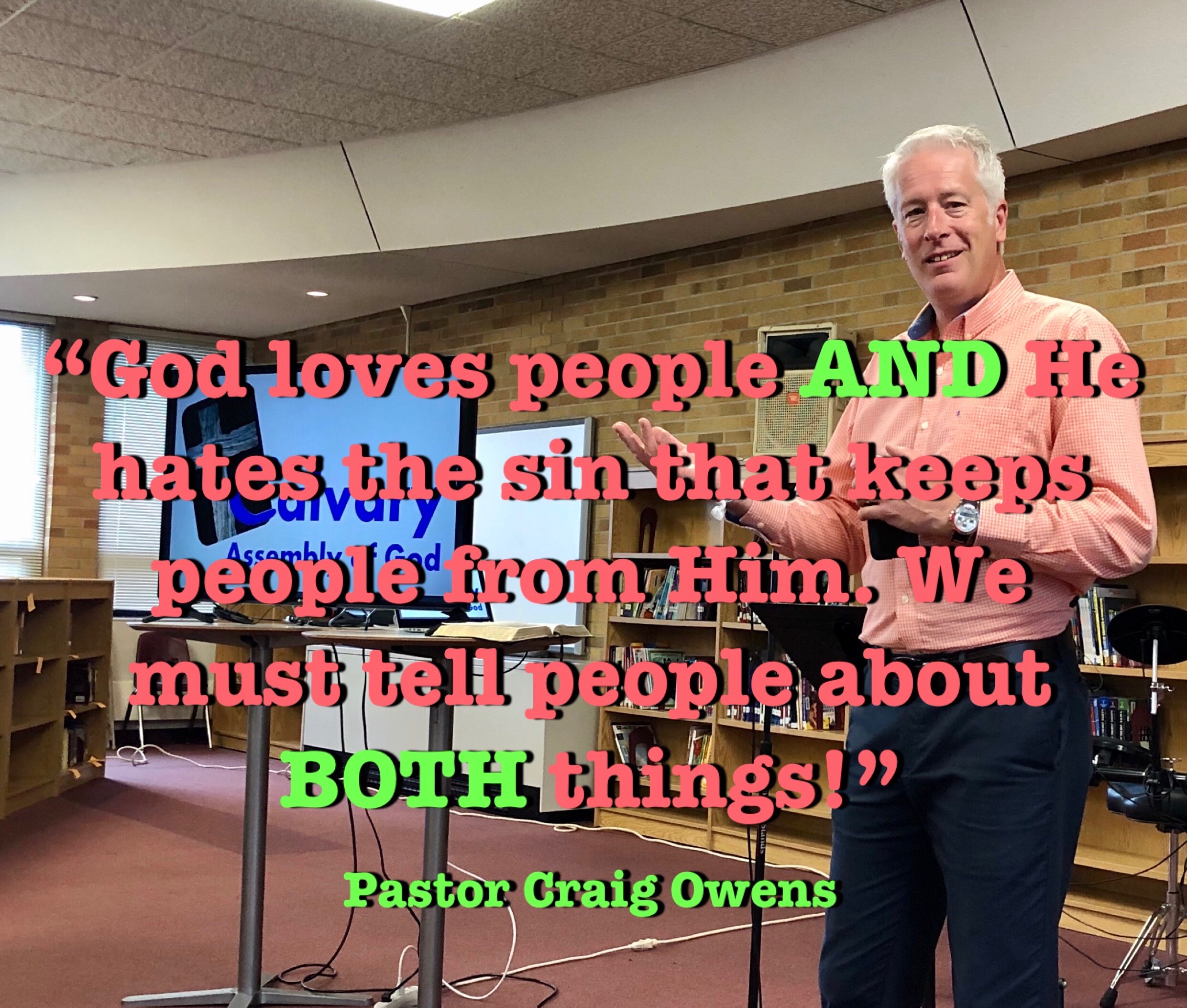
God loves people AND He hates the sin that keeps people from Him. It’s a message people need to hear, although they may not like to hear it. Like Amos, can God use you to warn this world of His judgment AND to woo this world by His love? Our world needs to hear BOTH-AND. They need to hear the whole story.
Have you ever had someone walk into your life—even if it was just for a moment—and say something you needed to hear? You might not have liked what they had to say, but it was definitely something you needed to hear.
My hunch is that those timely messengers were not necessarily “experts” in the area in which they talked to you. They may have been a doctor talking about a medical need, or it may have been a friend talking about some health issues. Most of the time our valuable messengers are just everyday people.
God loves using “everyday people”!
You don’t have to be a trained pastor to minister to people.
You don’t have to be a trained theologian to tell people what you believe about God.
You don’t have to be a trained counselor to encourage someone.
You just have to be who God created you to be. And you have to be available. Like Amos.
Amos was simply taking care of his farm and his herds when God called him to deliver a timely message to His people.
Amos introduces himself as just one of the shepherdsof Tekoa (1:1) and tells another priest that he was simply minding his own business when God said, “Go, prophesy to My people” (7:10-15).
Amos’ name means burden-bearer—he had a burden for his kinsmen. He saw their sin and knew what defiance of God would mean for them. This burden made him available to hear God’s voice say, “Go.”
“But I’m not a trained prophet,” Amos could have said. “You are telling me to ‘prophesy’ but all I really know is farming and shepherding.”
God said, “Say what you know.”
What did Amos know?
Amos knew God’s voice—In this short book, 43 times(!) Amos uses phrases like says the Lord, declares the Lord, or hear the word of the Lord.
Amos knew his business—This book is filled with language about sheep and shepherds, farmers and farm equipment, gardens and vineyards.
Amos knew God had told him “Go and speak” so Amos had boldness.
You can put your name in all three of those places that say Amos. You can know God’s voice through the Bible, you know your “business” (whether it’s parenting, or coaching, or your own profession), and you can hear God saying, “Go, tell people about Me.”
God wants to use you for His glory. He just needs your availability. Will you be open to being that person?
All we know about the prophet Joel is that he is the son of Pethuel, and his name means Jehovah is God. He appears to be addressing the southern part of Israel (Judah/Jerusalem).
What is interesting to note about Joel’s writing is a recurring theme that goes something like this:
Foreshadowing (or prophetic foretelling) → Calling for a godly response → God’s blessing on a right response or God’s punishment on a wrong response → An outcome which foreshadows or foretells another more dire event → repeat…
For instance, in Joel’s prophesy the massive invasion of locusts was intended to get the Israelites to pay attention to their sins. Joel calls for fasting and repentance and warns (foreshadows/foretells) that an invading army at a later date would do even greater damage (1:2-14).
Likewise, the invading army—which would do more damage than the invading locusts—should also call the Israelites to repentance and imploring God for His help.
Jesus, just like Joel, taught that whether it was an evil man, an accident, or even a natural disaster, painful things should cause us to consider the state of our eternal soul (see Luke 13:1-5). And Jesus and Joel both foretell of the Day of the Lord when there will be no more opportunities for repentance.
To prepare God-fearing people for this dreadful day of the Lord, Joel foretells if the outpouring of the Holy Spirit. This is the same empowering Spirit that Jesus said would equip His followers to take the message of salvation to all four points of the compass (Acts 1:4-8). And just as Joel foretold 800 years earlier, on the first Pentecost Sunday after Christ’s ascension back into heaven, the Christians were baptized in the Holy Spirit, prompting Peter to quote an extension passage from Joel (compare Joel 2:28-32 with Acts 2:14-21).
Joel’s final chapter talks about Judgment Day, and about the multitudes, multitudes in the valley of decision. Peter confronted his audience as well about the decision they should make to turn to Jesus as their Savior and Lord.
The Day of the Lord could come at any moment and millions around the world are still in the valley of decision. I find these words quite sobering—
“Someone asked, ‘Will the heathen who have never heard the Gospel be saved?’ It is more a question with me whether we—who have the Gospel and fail to give it to those who have not—can be saved.” —Charles Spurgeon
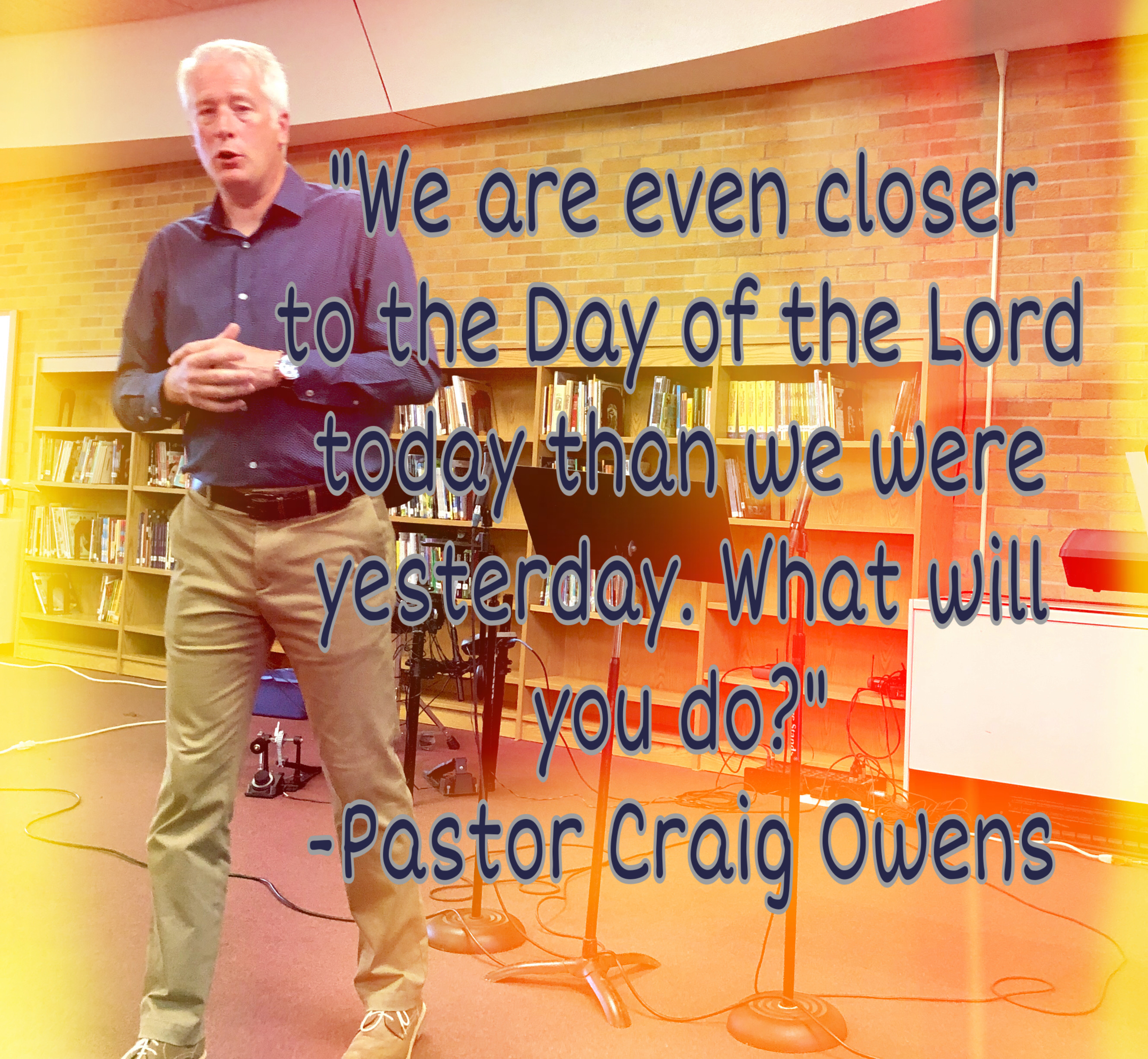
We are even closer to the Day of the Lord today than we were yesterday. What will you do?
I already shared the bizarre but beautiful sermon illustration that Hosea lived out for the Israelites and for us. His wife had been unfaithful to him and had gotten herself so far in debt that she was a virtual slave. Hosea, in a clear picture of God’s amazing, unrelenting love, bought back his wife, paid off her debts, and completely restored her to himself.
Sadly, the people of Israel—even after seeing this grace-filled living lesson—continue to push farther and farther away from God. This prompted God to announce the indictment against them…
Hear the word of the Lord, you Israelites, because the Lord has a charge to bring against you who live in the land: “There is no faithfulness, no love, no acknowledgment of God in the land. There is only cursing,lying and murder, stealing and adultery; they break all bounds, and bloodshed follows bloodshed” (Hosea 4:1-2).
It wasn’t the first time that someone preferred the things of the world to the things of God (like Adam and Eve), and it wasn’t the last time (like you and me). We mortals tend to be seduced by what we can see and hold right now, instead of trusting God for something far better.
Jesus told a story about a son who enjoyed the full privilege and favor of his father, yet this son thought he could do better on his own. He asked his father for his share of the inheritance and left for a distant land, determined to live a life where he called all the shots. But with his money gone, he found himself in debt, starving, and working as a hired hand in a pigsty.
It was then that Jesus said that young man came to his senses. He had nothing to bring to his father—no gift of restitution, no token of respect, nothing except his words. All he could say was, “Father, forgive me.”
But that’s all that was needed.Hosea counseled the Israelites to do the same thing:
Return, Israel, to the Lord your God. Your sins have been your downfall! Take words with you and return to the Lord. Say to Him: “Forgive all our sins and receive us graciously, that we may offer the fruit of our lips” (Hosea 14:1-2).
The wayward son had a rehearsed speech asking his father to simply hire him as a servant, as if he wasn’t worthy to be considered a son any longer. But the father—in words that reflect our Heavenly Father’s love—cut the son’s speech short. He let the son only say, “Forgive me,” but before the son could make the request to be a servant the father totally restored him.
After Hosea calls the wayward people to return with their “forgive us,” he quotes God’s reply: “I will heal their waywardness and love them freely, for My anger has turned away from them” (14:4).
How could this be? How could God’s full judgment not fall on His wayward people? How could it not fall on you and me?! Because it fell on Jesus (2 Corinthians 5:21)! So when we come back to God with our words of forgiveness, He restores us and clothes us in the robe of Jesus (Galatians 3:27).
Absolutely amazing!
God longingly speaks to His wayward people, “It’s time to come home. I’m waiting for you with open arms. I am ready to restore you completely. Just come home.”
Hosea is the only prophet from Israel (he calls the Israelite king “our king” in 7:5), and along with Amos he is the only prophet to address the northern kingdom exclusively. Hosea addresses the northern tribes of Israel with brutal honesty—he calls them an adulteress wife! Hosea isn’t alone in saying this, as Isaiah, Jeremiah, and Ezekiel all same the same thing too.
But Hosea alone is called on to live out his message in a most unusual way: God instructs him to marry “an adulterous woman”! The question is: was she already a promiscuous woman before they married? Or did she become unfaithful after they were married?
I believe that she became unfaithful after marriage. When Gomer gives birth to their first son, Hosea writes that “she bore him a son”—indicating he is the father. But with Gomer’s second and third pregnancies, Hosea simply writes, “she gave birth,” leading me to think that Hosea wasn’t the father of those children.
Jezreel—This boy’s name means “God sows.” It is a neutral word meaning either sowing good seed and reaping a healthy harvest, or sowing godlessness and reaping punishment.
Lo-Ruhamah—Her name means “not pitied.” God indicates that He will bring a judgment on Israel that is deserved justice. He has been patiently calling them to repentance but they kept running farther away from Him.
Lo-Ammi—This boy’s name is saddest of all. It means “not My people.”
How sad! Can you imagine Hosea’s heartache?! Can you imagine God’s heartache?! God tells Hosea the penalty for their adulterous life (Hosea 2:2-13), which the apostle Paul would later sum up in these straightforward words: the wages of sin is death (Romans 6:23).
“YET” and “THEREFORE”…
In the middle of God expressing His heartache over His wayward wife He says two amazing words “Yet” and “Therefore” (1:10; 2:14).
“Yet I will bless you and reverse your misfortune”
“Therefore I will allure you and speak tenderly to you”
This is UNBELIEVABLE!! Who would respond like this to such vile unfaithfulness?!
God would.
God did! But God shows and clearly proves His own love for us by the fact that while we were still sinners, Christ—the Messiah, the Anointed One—died for us (Romans 5:8).
Hosea—whose name means salvation—is called on to do exactly what Jesus did for us. Hosea buys back his wife from her master. Hosea pays the price for Gomer’s sin, just as Jesus paid the price for our sin.
What amazing love God has for us!
You have never lived an unloved day in your life. Not a single one! God loves you more than the best husband could ever love his wife. He paid for your forgiveness and your freedom. Will you receive that forgiveness and restoration today?
The minor prophets in the Bible are pretty cool! But we have to be careful with man-made titles. For example, the “old” in Old Testament doesn’t mean outdated; nor does the “new” in New Testament mean something updated to modern times.
In the same way, the minor prophets are only called “minor” because of the volume of their writing, not the quality of their message. In fact, their messages are actually quite major!
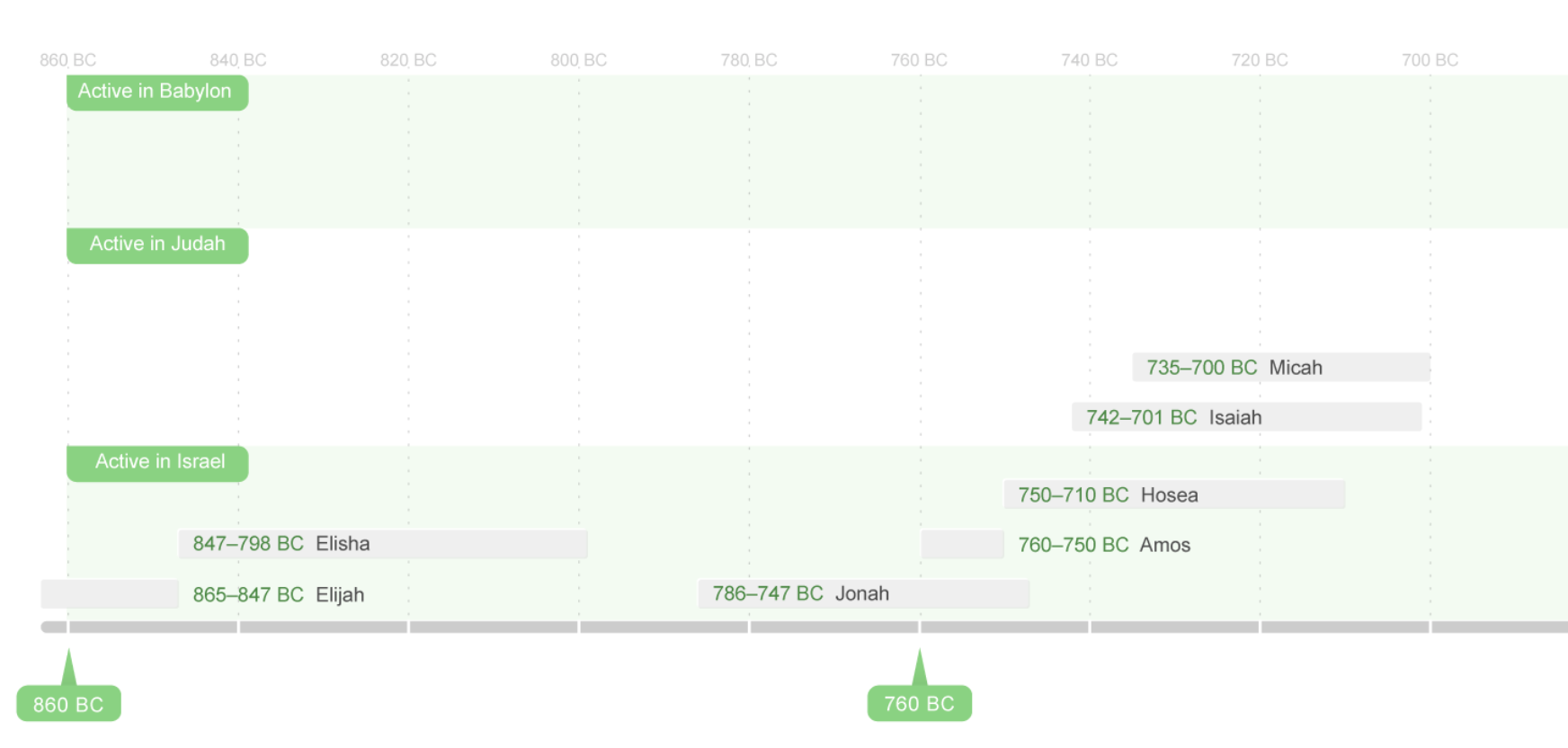
The minor prophets cover a span of about 300 years, from 760 BC (Amos) to 450 BC (Malachi). You can check out this side-by-side chart to see where these prophets fit in the history of Judah and Israel.
Here are some interesting tidbits about the minor prophets:
In the Hebrew Bible, these books are referred to simply as “The Twelve.”
All of these prophets identify themselves in the first verse of their writing except Jonah, but he is identified in 2 Kings 14:23-25.
The prophets consistently give us some historical context in their writings to help us place when, where, and to whom their ministry took place.
The Twelve also show up quite liberally in the New Testament. Every one of them has either direct quotations or has their writings implicitly referred to throughout the New Testament. Here’s just a small sampling…
Micah 5:2 tells us where Jesus would be born (Matthew 2:6)
Hosea 11:1 says Jesus would spend time in Egypt (Matthew 2:15)
Malachi 4:5 says an “Elijah” would precede Jesus (Matthew 17:10-11)
Zechariah 9:9 foretells Christ’s triumphal entry into Jerusalem (Mark 11:1-10)
Jonah 1:17 was used by Jesus to predict His own resurrection (Matthew 12:39-42)
Joel 2:28-32 was quoted by Peter on the Day of Pentecost (Acts 2:16-21)
Amos 9:11-12 foretold all peoples coming to Jesus (Acts 15:16-17)
Hosea 13:14 was quoted by Paul to show how death was defeated (1 Corinthians 15:53-57)
Habakkuk 2:4 was also quoted by Paul to tell how righteous people live (Galatians 3:11)
Haggai 2:6 foretells the end times (Hebrews 12:26-29)
I look forward to diving deep into the major lessons in the minor prophets over the next several weeks, but in preparation for that let me give you 3 overarching lessons for all Bible studies:
Christianity is rooted in history.The Bible is a historical record of real people, saying and doing real things in real places in the world. It’s not a collection of fables, myths, or legends.
We need to study the whole counsel of God’s Word. All of Scripture is interdependent on all the other parts of Scripture, and every part reinforces and amplifies every other part. Don’t limit your Bible reading to just one or two parts.
Looking back in wonder and gratitude builds faith for today and hope for tomorrow. When we see what God has done in the past, and we realize that He is still the same God today, it builds our faith for today. And when our faith today is strengthened, it gives us a bright hope for tomorrow.
Sometimes the naming of things gives us an inaccurate picture of the thing being named. For instance, many people think the “old” in Old Testament means outdated or perhaps updated by the “new” in the New Testament. When in fact, both Testaments are needed to give us the full picture of God’s love and glory.
A similar thing happens with the headings “major prophets” and “minor prophets.” It makes it sound like the major prophets have something major to say to us, while we could take or leave the minor messages of the minor prophets.
In reality, they were given these headings simply because of the volume of writing—the five major prophets consist of 182 chapters, whereas the 12 minor prophets only have 67 chapters. The volume of their writing may be minor, but their content carries major messages of meteoric power!
If you missed any of the messages in this series, you can find them here:
Listen to the podcast of this post by clicking on the player below, and you can also subscribe on Apple, Spotify, or Audible.
Twice the 80th psalm declares—Restore us, O Lord God Almighty; make Your face shineupon us, that we may be saved (Psalm 80:19).
But if we are already a Christian that has been saved from the penalty of our sin and saved to an eternal reward, then that also means that God’s face IS already shining on us, He HAS already restored us, and He HAS already given us His favor.
I like how the Amplified Bible renders this verse: Restore us, O Lord God of hosts; cause Your face to shine in pleasure, approval, and favor on us, and we shall be saved!
What we have received is too wonderful for us to keep to ourselves, so we must let His pleasure, approval, and favor now shine out of us!
“If the result of our experience of God does not compel and propel us into global mission, it is doubtful whether we have really encountered the God of the Bible.” —Dick Brogden
Jesus stated His mission simply and then sent us out on the exact same mission (Luke 4:18-19; John 20:21). We do this best by living closely among people so they can also see us shine with God’s favor.
Paul called us to shine as well: Live clean, innocent lives as children of God, shining like bright lights in a world full of crooked and perverse people (Philippians 2:15). I believe this is a perfect definition of the word influence.The origin of the word meant the supposed flowing of ethereal fluid from the stars thought to affect the actions of men.Christians that let their good deeds shine in the darkness can influence the entire culture around them!
“Radical Christianity is not going on a missions trip or a big conference. Radical Christianity is staying steady for decades.” —Mike Bickle
Being a person that shines with favorable influence requires staying involved for the long haul so that you can build trustworthiness. It’s being in visible places not to get glory, but to let people see God’s glory. When they see His glory shine on you and out of you, they will want what you have too!
Solomon said, By the blessing of the influence of the upright and God’s favor—because of them the city is exalted (Proverbs 11:11). So, my fellow Christian, let me ask you:
Has God shined on you?
Are you letting Him shine out of you?
Are you living a noteworthy, trustworthy, visible life in your dark community?
“It’s your choice: You can be a part of your city’s elevation or its deterioration.”



 Looking back at the history of God’s people in the Bible, there is a distinct up-and-down cycle. The Israelites would be worshiping God and enjoying His blessings, and then we see them turning their back on God and needing Him to rescue them from oppressors. After God rescues them the people praise Him, only to slip right back into the same downward slide again.





 Craig T. Owens