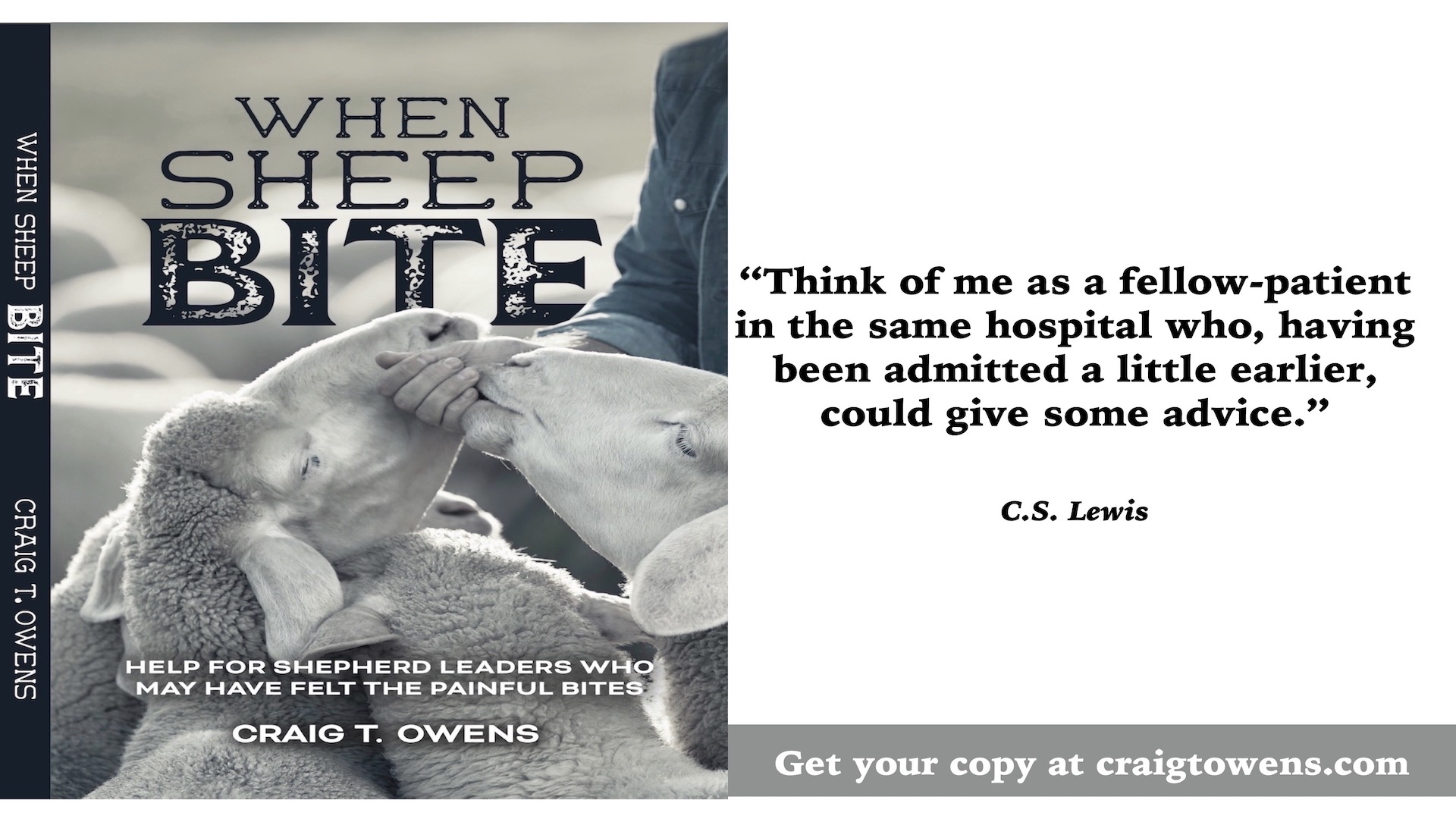
My book When Sheep Bite is all about recovering after difficulties—whether they were created by your mistakes or someone else’s mistakes. In the Introduction to my book I wrote:
I want to give you what I wanted when this happened to me: empathy, insight, a helpful perspective, and a manual of help that God has provided in the Bible. I don’t want to try to one-up your story of pain, because I’m confident that no one could truly know how deeply you’ve been hurt. But I do want to give you some assurance that I know what I’m talking about. …
Your pain and your circumstances are unique. Your pain is real, and it is incomparable to anyone else’s pain. But the biblical principles that God revealed to me—those things that helped me heal and the thoughts I want to share with you—are applicable for any shepherd. These tried-and-true principles can help you not just survive this pain but thrive in spite of this pain. I would say to you something that C.S. Lewis wrote, “Think of me as a fellow-patient in the same hospital who, having been admitted a little earlier, could give some advice.”
Listen to the podcast of this post by clicking on the player below, and you can also subscribe on Apple, Spotify, or Audible.
Last week I mentioned that I was a bit surprised that scientists had done so much research on the benefits of gratitude because science tends to have an over-reliance on the tangible world. But it’s hard to ignore that there are so many intangibles (like gratitude) which make a tangible difference in people’s lives.
We get ourselves into trouble if we focus exclusively on the tangible or intangible. We also get ourselves into trouble if we don’t use all of the resources God has given us.
The Bible tells us that we have been created in the image of God, and that one of the things that separates us from the other creatures in the world is our soul (Genesis 2:7). Our soul is compromised of our mind, our will, and our emotions.
We cannot allow any one of these to lay dormant or even considered less valuable than the others, nor we can allow any one of these to bully the others.
If my emotions dominate (especially emotions like fear or anger) I can give into fight-or-flight—Psalm 106:7
If my mind dominates, I can become dark and confused—Romans 1:21 NLT
If my willpower dominates, I tend to be very selfish—Isaiah 14:13-14
When my emotions flare up, when my mind is dark, or when I feel selfish, I need to remember to engage the other two parts of my God-breathed soul. This is where gratitude comes into play.
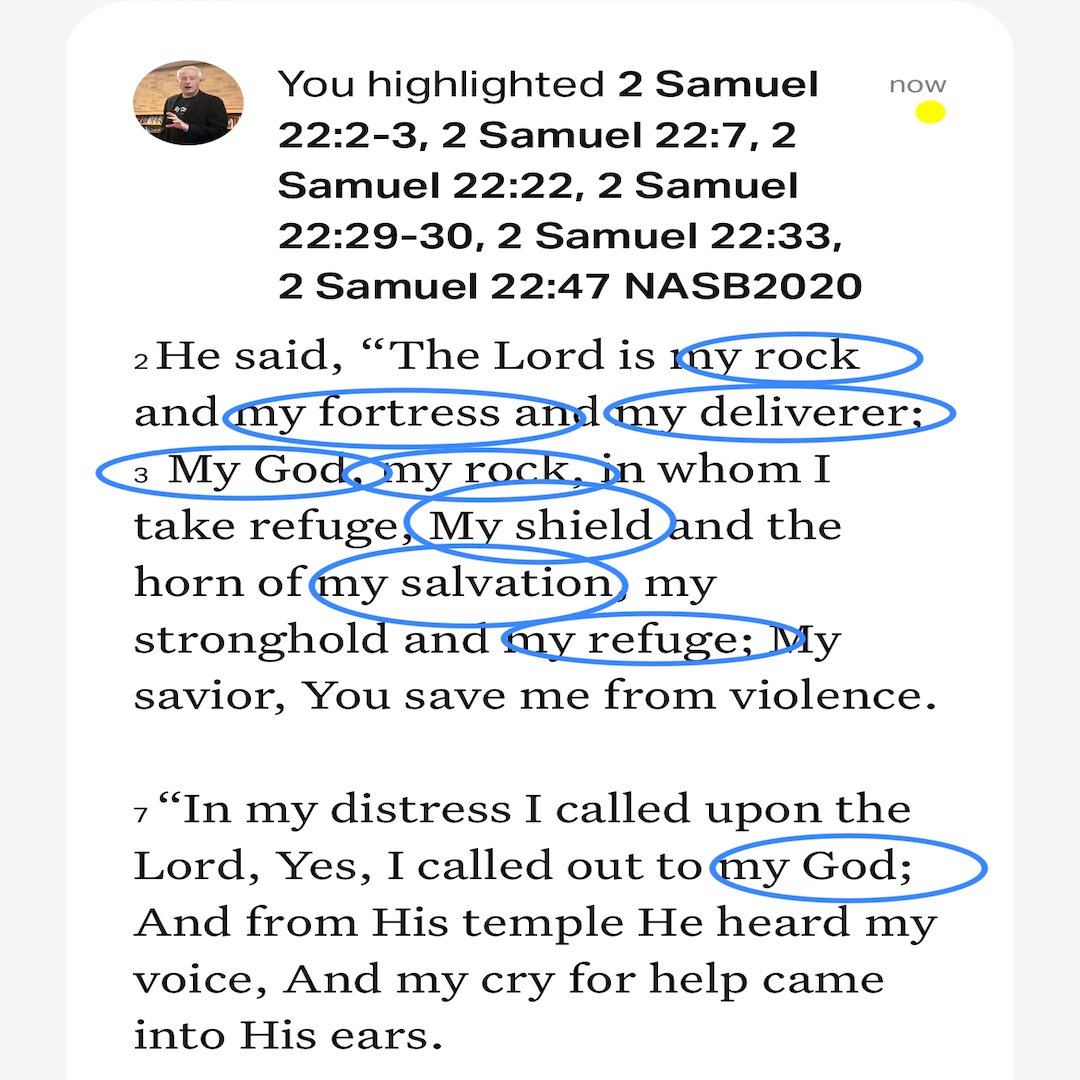
I love reading the Psalms when I’m battling the negative emotions that seem to rush in during trying times. The psalmists were so honest about what they were feeling. Check out a couple of examples in Psalm 7:17 and 9:1-2 where we see David engaging his mind and his will to make the choice to be grateful to God despite his circumstances.
In the New Testament, we see a similar response from Paul and Silas when they are falsely imprisoned in Philippi (see Acts 16:22-26). Despite their cruel circumstances, they chose to life thankful worship to God. Luke write that the other inmates were listening, and so was the jailer and his family, who ended up accepting Jesus as their Savior.
I’ve got three important words for you when dark times threaten to hijack your gratefulness:
TALK TO YOURSELF
We see another psalmist doing this in Psalm 42:1-6. He asks his soul why it is so downcast, and then he says, “I chose to remember God in all His goodness and I chose to praise Him!” These words are repeated again in Psalm 42:11 and 43:5, which tells me that giving thanks to God is not a one-and-done thing, but something that needs to be continually repeated.
You can get some conversation starters for your self-talk in two simple ways:
Write down your gratitude
Talk about your gratitude
Keep a gratitude journal: Write something down at the end of each and every day. Write it down. Re-read it regularly. Tell others about it. And then be ready for others to ask you about Jesus—just like the Philippian jailer—when they notice how thankful you are!
Use your mind to talk back to your fears and worries, and then engage your willpower. Don’t let your gratitude get hijacked by the circumstances around you, but allow your thankfulness to help you reframe your circumstances into God’s plan.
Check out the other messages in our Be Thankful series by clicking here.
Axis reported this in their weekly Cultural Translator newsletter. “Gallup polling data has found a huge spike in the percentage of Americans who say they get less sleep than they need. Survey results also indicate an increase in Americans’ daily stress. Why it’s news you can use: This data indicates that when you interact with anyone—in a store, on the road, at work, or in church—there’s a decent chance that particular human is feeling both exhausted and stressed out. The odds of this stress/exhaustion matrix are even higher if you are conversing with a young woman aged 18 to 29. In 2001, 42% of young women in that bracket said they get enough sleep, but that number has dropped to 27%. Younger women are also the most likely to say they experience daily stress. Stress and sleep have a symbiotic relationship, and parents should understand how both factors play a role in teens’ mental health.” I have written quite a few posts about getting enough sleep, and about taking some time for self-care.
“The world and its culture will not improve unless we play an active role in trying to improve it. Beginning with ourselves, we must make sure the culture we choose honors God and spreads His grace to the people around us. From there we must become informed about the state of culture, especially that which is most potent in conveying ideas and establishing practices—law, education, entertainment, social media, and pop culture in all its forms. That’s not to say we have to participate in all these; but at the least, we need to understand the times and how they shape and are shaped by various forms of culture so that we can know what we ought to do in pursuing a culture of love (1 Chronicles 12:32).” —T.M. Moore
“A man gives little if he gives much with a frown; he gives much if he gives little with a smile.” —Talmud, Ketubot
This is a very helpful interactive map of Paul’s missionary journeys. While you are on the viz.bible website, be sure to check out all of the other amazing infographics they have. I use these quite often to help me grasp the message of Scripture visually.
Listen to the podcast of this post by clicking on the player below, and you can also subscribe on Apple, Spotify, or Audible.
When fear seems to be griping a leader’s heart, how can that leader respond in a way that benefits both themself and their team? One important strategy is paying attention to how we talk to ourselves during our battles with fear.
On the Craig And Greg Show, Greg and I discussed this important leadership skill.
Check out the full Craig And Greg Show episode here.
“When we are foolish and young, we need more rules. As we mature, we can be trusted with extended boundaries. The wiser we are, the more we appreciate those boundaries and the less they offend us. Offense at law, accountability, hedges, and boundaries is an indicator of immaturity. The wiser we are, the more unafraid and appreciative we are of those who hold us to account.” —Dick Brogden, in Proverbs: Amplified and Applied
“When public policy begins to encroach on the Christian’s freedom and duty to proclaim the Good News, or to bring the benefits of the Gospel to the community, believers must continue our mission nonetheless and be ready to bear whatever punishments those in authority may choose to inflict. Christians do not seek suffering, but we must not shun it, particularly when by our suffering we can work for public policies more in line with the centrality of the Gospel for the wellbeing of all people.” —T.M. Moore
The Golden Rule—treat others as you would want to be treated—applies to the way you treat yourself too. Stop beating yourself up when you make a mistake. You probably don’t beat up others when they stumble, so extend the same grace to yourself. Practice healthy, affirming self-talk. Check out this full conversation from episode 68 of The Craig And Greg Show.
“A thought, a sword, and a spade should never be allowed to rust.” —Irish Proverb
Dr. C. John “Jack” Collins uses some thoughts from C.S. Lewis to help us learn a little better how to read Genesis 1-11. He writes, “We should approach any biblical passage with the conviction that God inspired the Bible to be the right tool for its job. If we can get a good idea of what kind of tool our passage is, we can discern what job God intended it to perform. And that means we need to be willing to adjust what we’re looking for and be willing to find other ways of addressing some questions.”
“Failure to pray is simple unbelief. We must repent of our unbelief and take up the work of prayer with greater devotion and dedication. We shall not be able to realize progress in Christ’s Kingdom, or in returning our nation to a greater experience of justice and goodness, apart from prayer. Prayer is the starting point for public policy. Prayer must be the sustaining power of public policy. And prayer in the form of worship will be the outcome of public policies, forged in prayer, which lead to a peaceful, godly, dignified, true, and Gospel-friendly society.” —T.M. Moore
Listen to the audio-only version of this podcast by clicking on the player below, or scroll down to watch the video.
Fear is something every leader struggles with, but great leaders learn to reframe that fear into an opportunity to grow. Join Greg and me as we discuss overcoming fear, reframing fear, and helping your team to do the same.
[0:23] Good leaders learn how to frame their fear in a different way.
[1:09] Greg and I talk about our biggest fears.
[2:21] I share about having to overcome fears about making a decision.
[3:38] Most of fear is rooted in past experiences, but reframing as a learning experience can help you grow.
[6:17] Attempting to use fear as a motivation tool will backfire and restrict your team’s potential.
[7:23] Reducing the fears of your team begins with leading from a place of transparent humility.
[11:55] Pride is a big stumbling block for leaders, don’t be afraid to include others in the decision making process.
[13:50] The top fears that paralyze leaders.
[19:55] Good leaders game-plan for future conflict, so when it comes their team is ready.
[20:34] Give your team opportunities to battle their fears and grow from them.
[22:51] Greg shares a quote from Henry Ford.
[24:11] I share a Little League story.
[25:03] Greg and I would love to come alongside and help coach you!
Check out this episode and subscribe on YouTube so you can watch all of the upcoming episodes. You can also listen to our podcast on Spotify and Apple.
Because of the miraculous things that God had done through Elisha, word began to spread about God’s power that was on display through this godly prophet. In fact, word even spread to other countries, including the land of Aram where was a highly decorated military commander named Naaman lived. This revered leader was afflicted by leprosy. The king of Aram sent Naaman to Elisha to be cured of this disease (see 2 Kings 5).
When Naaman came to Elisha, he was given instructions to bathe himself seven times in the Jordan River. Initially, Naaman balked at this, but eventually, he humbled himself in obedience and was miraculously healed of his leprosy!
Naaman had come to Israel and Elisha with the intention of buying a miracle (just take a look at the treasures that he brought with him). Elisha would not accept money or gifts from Naaman. Not that there’s anything wrong with a prophet receiving gifts, but not when the intention of the giver is to give a bribe.
This is where Gehazi makes a fatal mistake. Gehazi has a conversation with himself (notice the phrase “he said to himself”) that he should have had with Elisha. He determined that he and Elisha were owed something for their ministry work. Gehazi then compounded this unhealthy conversation by telling one lie after another lie to justify the conclusion he had reached.
Elisha knew that God keeps track, that God keeps perfect records, that God will reward far better than any man ever could. He said, “Is this the time to take money or to accept clothes?” No! We need to let God determine the timing and the gift.
As a result, the leprosy that had left Naaman now attacked Gehazi. In reality, it was a leprosy of his heart that merely appeared on his skin. Gehazi was then dismissed from his ministry position with Elisha.
Sadly, I’ve witnessed many ministry leaders who have derailed their leadership with an “I deserve this” attitude. Thinking “I’m owed this” took their eyes off God and put them on the rewards they thought they should have received. How sad this is!
Our constant prayer should be, “Holy Spirit, guard my heart against the leprosy of entitlement. Help me keep the ‘I’m owed this’ attitude far, far away from my heart’s door.”
“Courage is the mastery of fear, not the absence of fear.” —Mark Twain
“A good man leaves an inheritance to his children’s children…” (Proverbs 13:22). In his excellent book Proverbs: Amplified and Applied, my cousin Dick Brogden uses our grandfather as an example of the principle in this verse: “Good has multi-generational implications. My grandfather was an incredibly generous man, and his children, grandchildren, and great-grandchildren have reaped the benefit. I am convinced that one of the reasons my family is so generously provided for is because our ancestor repeatedly gave significant financial gifts to his church, the Billy Graham Association, and missionaries around the world. Contrary to Shakespeare’s pessimism in the mouth of Mark Antony, the good that men do does indeed live after them, it is not interred with their bones.”
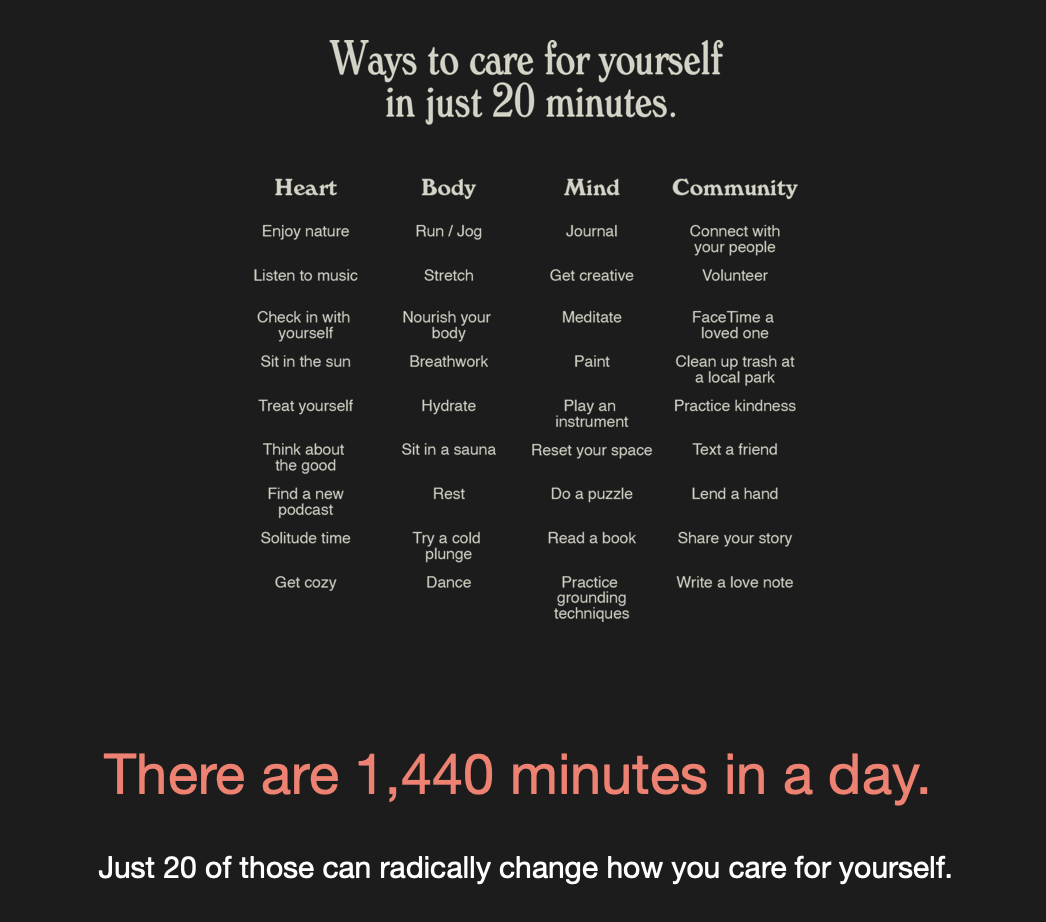
Self-care is vital. Without taking care of yourself first, how will you have any strength to take care of others? To Write Love On Her Arms has a helpful list of self-care items you can do in just 20 minutes per day.
“Knowledge follows understanding. We invert it and think that if we know facts, we are wise. In reality, it is only the wise who can rightly interpret the facts. … There is a posture of humility before God that opens the lowly to the understanding of God. This spirit of understanding becomes the filter with which we sift facts. Facts sifted by understanding lead us to accurate knowledge. Scoffers reject the reality that they need God’s help and God’s Spirit to understand facts. They foolishly think that true knowledge can be gained outside divinely enabled understanding. They have earned their PhD in ultimate idiocy.” —Dick Brogden, in ‘Proverbs: Amplified and Applied’ commenting on Proverbs 14:6



 I want to give you what I wanted when this happened to me: empathy, insight, a helpful perspective, and a manual of help that God has provided in the Bible. I don’t want to try to one-up your story of pain, because I’m confident that no one could truly know how deeply you’ve been hurt. But I do want to give you some assurance that I know what I’m talking about. …







 Craig T. Owens